 |
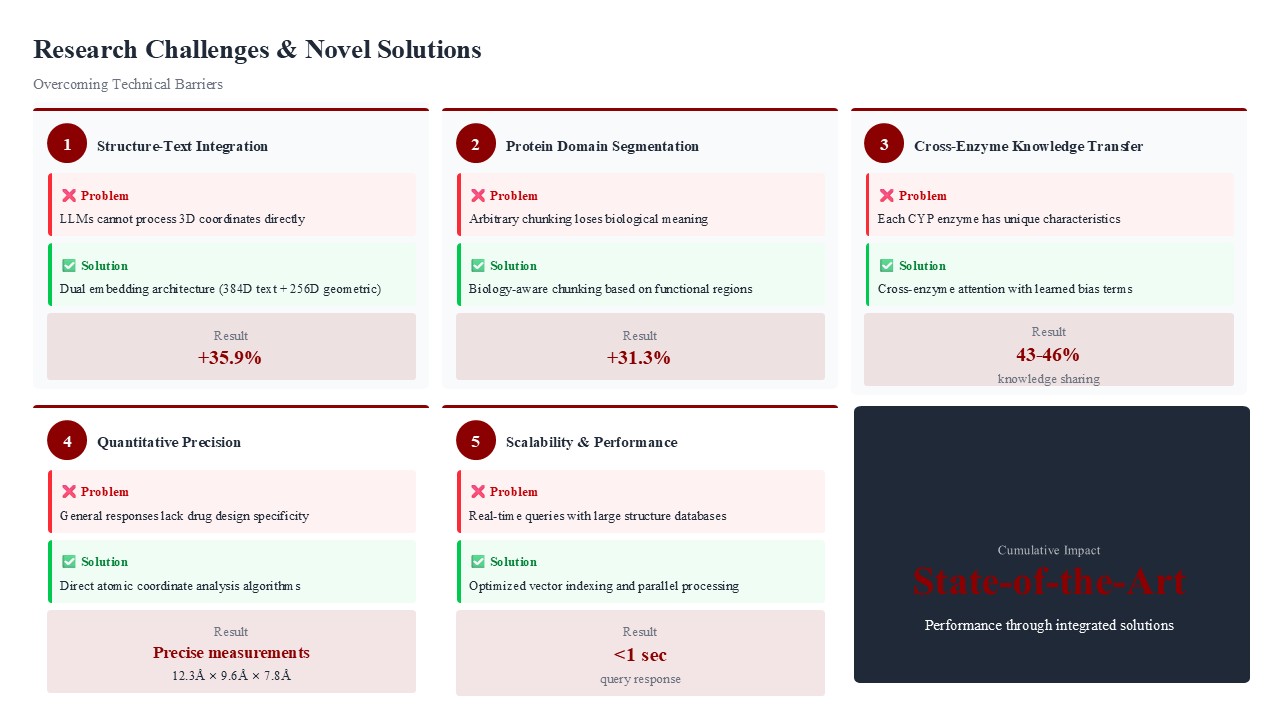
Throughout this project, we overcame five major technical barriers. First, structure-text integration - since LLMs cannot process 3D coordinates directly, we developed a dual embedding architecture combining 384D text with 256D geometric representations, achieving a 35.9% improvement. Second, protein domain segmentation - arbitrary chunking loses biological meaning, so our biology-aware chunking based on functional regions contributed 31.3% improvement. Third, cross-enzyme knowledge transfer - each CYP enzyme has unique characteristics, which we addressed through cross-enzyme attention with learned bias terms, enabling 43-46% knowledge sharing. Fourth, quantitative precision - general responses lack drug design specificity, so we implemented direct atomic coordinate analysis algorithms that provide precise measurements like 12.3, 9.6, and 7.8 angstroms. Fifth, scalability and performance - real-time queries with large structure databases required optimized vector indexing and parallel processing, achieving sub-one-second query response times. These integrated solutions deliver state-of-the-art performance. |
 IEEE/ICACT20260263 Slide.22
[Big Slide]