 |
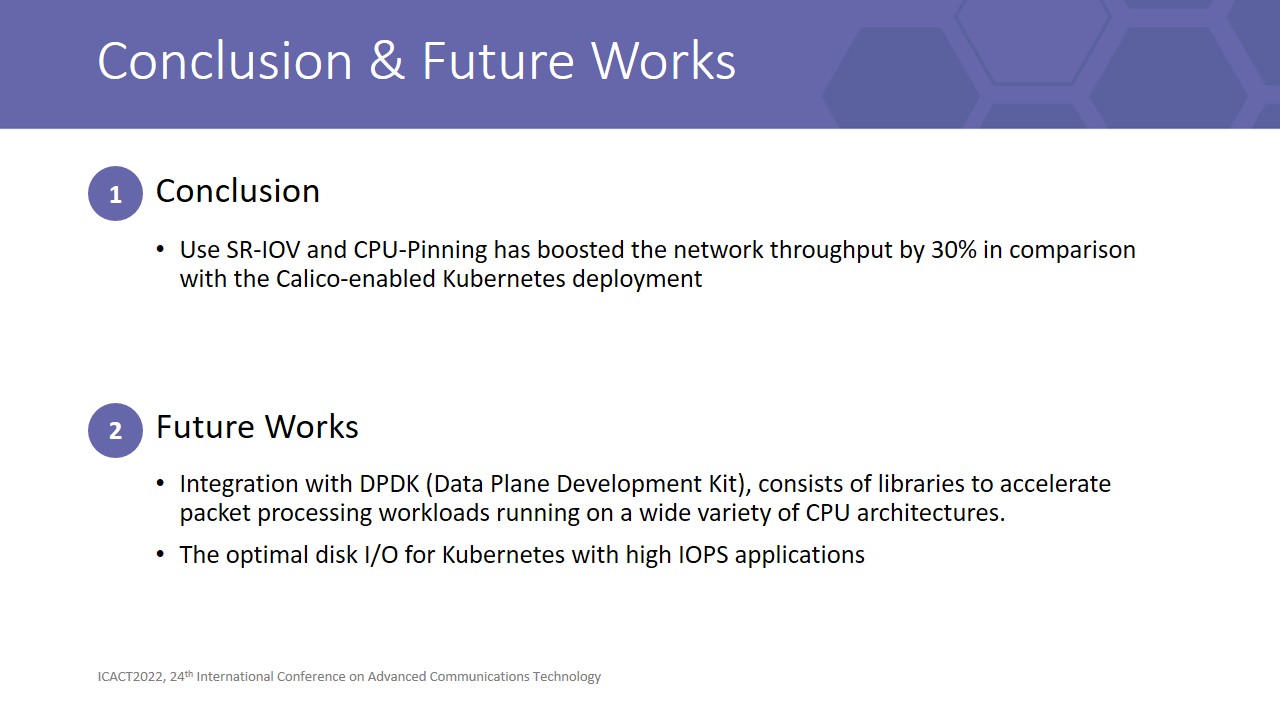
Our test result has demonstrated that the model using SR-IOV and CPU-pinning outperformed the bare-metal model with CPU-pinning by 30%, in terms of network throughput and package processing. On the other hand, the Cloud-native model using Calico performed worse than the bare-metal model with CPU-pinning, while the bare-metal model without CPU-pinning performed the worst. The subpar performance of the model using Calico can be explained by the need for more hardware resources as well as more time to encapsulate packets and route them to network cards. Meanwhile, SR-IOV helped containers directly connect to NIC; packets therefore bypassed the kernel stack in order to deliver high performance.
The optimistic results informed our decision to employ SR-IOV and CPU-pinning in the production deployment of vOCS4.0.
Besides SR-IOV, DPDK is gaining traction as a means to improve computing efficiency and packet throughput. DPDK consists of libraries to accelerate packet processing by offloading TCP packet processing from the operating system¡¯s kernel to processes running in the user space. This capability has prompted us to tinker with DPDK, beside SR-IOV, in the pursuit of a better vOCS. We will also look into the optimal disk I/O for Kubernetes with high IOPS applications.
|
 IEEE/ICACT20220041 Slide.23
[Big Slide]