 |
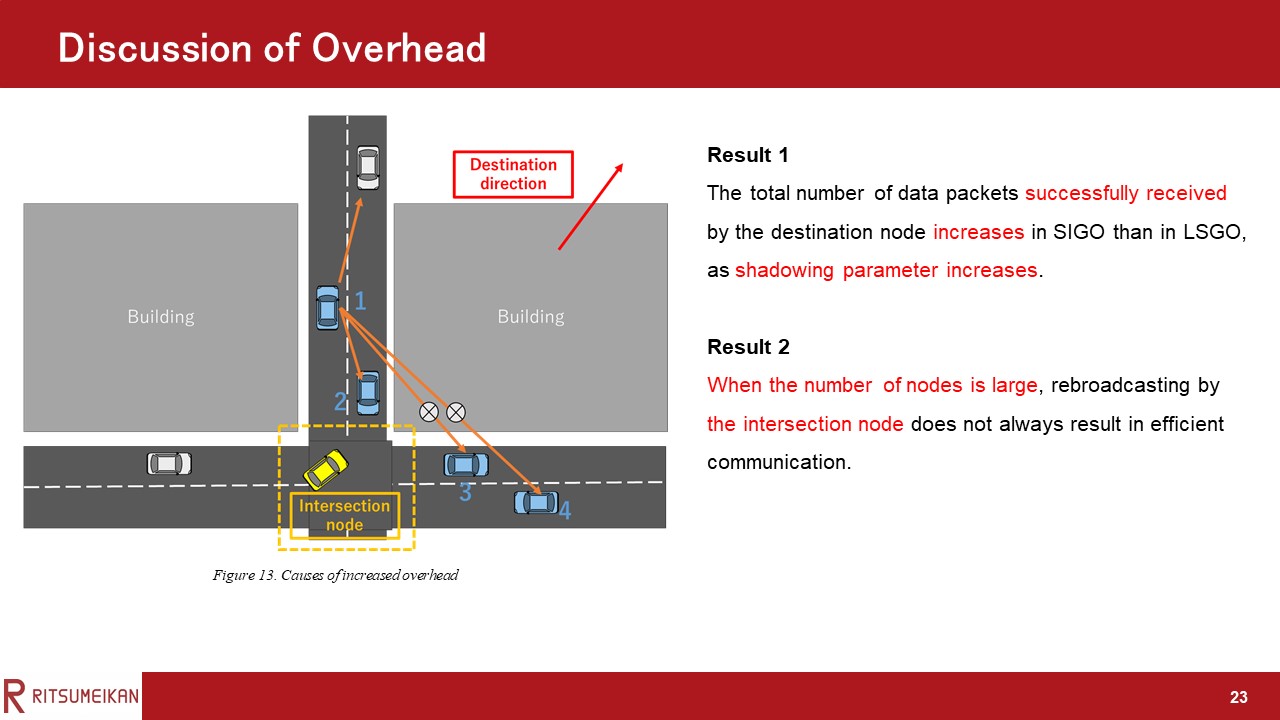
Next, we describe the cause of the result.
Result 1 is because that The total number of data packets successfully received by the destination node increases in SIGO than in LSGO, as shadowing parameter increases.
Result 2 is because that when the number of nodes is large, rebroadcasting by the intersection node does not always result in efficient communication.
An example is shown in this figure.
In that case, nodes on two different roads forming the intersection are likely to be selected as relay candidate nodes when the number of nodes is large. In this situation, the possibility that a low-priority candidate node cannot receive packets from a high-priority relay candidate node due to the shadowing effect of a building increases. As a result, redundant rebroadcasting increases because the rebroadcasting by a low-priority relay candidate node is not canceled. The packets rebroadcasted by the street intersection node are received by nodes 1-4. Nodes 1, 2, 3, and 4 have a higher priority in that order. Ideally, only node 1 should rebroadcast the data packet. However, even if node 1 rebroadcasts the packet, nodes 3 and 4 cannot receive it due to the shadowing effect and rebroadcast. In that case, nodes on two different roads forming the intersection are likely to be selected as relay candidate nodes when the number of nodes large.
|
 IEEE/ICACT20220087 Slide.23
[Big Slide]