 |
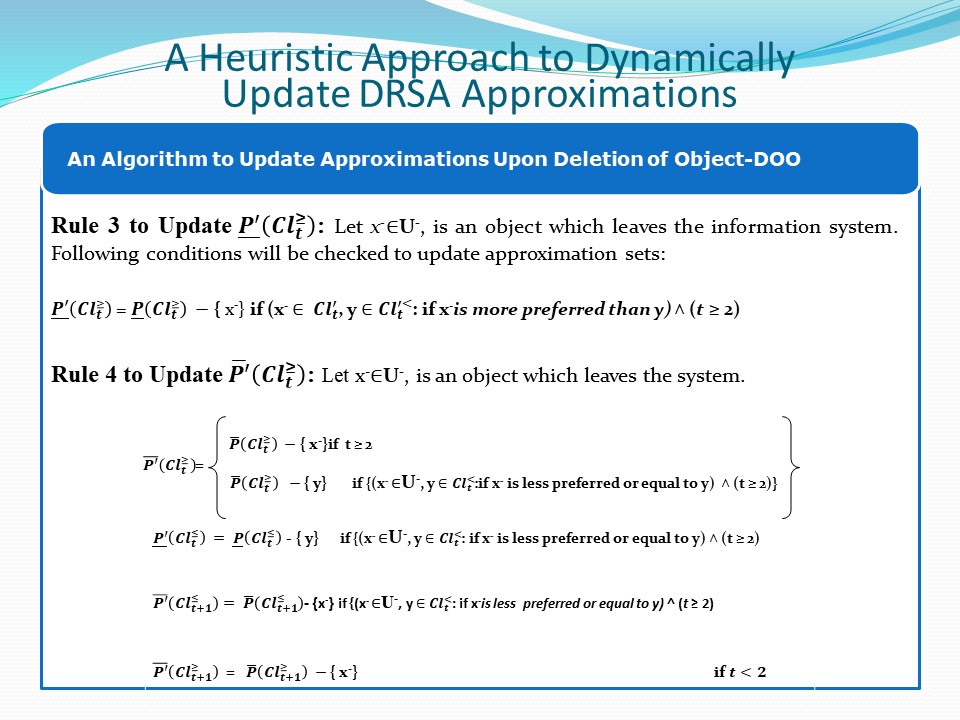
In rule 3, we proposed to compare new object ¡®x¡¯ with objects of less preferred classes than class t and if ¡®x¡¯ is more preferred than delete ¡®x¡¯ from lower approximation for upward union of classes of class ¡®t¡¯ (if t ¡Ã 2). To compute upper approximation for upward union of classes of class ¡®t¡¯, it has been proposed in rule 4, if t ¡Ã 2, delete ¡®x¡¯ from upper approximation for upward union of classes. Then compare object ¡®x¡¯ with object ¡®y¡¯ of less preferred class than ¡®t¡¯ and if ¡®x¡¯ is less preferred than ¡®y¡¯, delete ¡®y¡¯ from upper approximation for upward union of classes of class ¡®t¡¯, simultaneously delete ¡®y¡¯ from lower approximation for downward union of classes of class ¡®t¡¯ and from upper approximation for downward union of classes of more preferred class than ¡®t¡¯ (if t ¡Ã 2). Delete ¡®x¡¯ from upper approximation for upward union of classes of more preferred class than ¡®t¡¯,if 𝒕<𝟐.
|
 IEEE/ICACT20220156 Slide.23
[Big Slide]