 |
Here is our simulation setup.
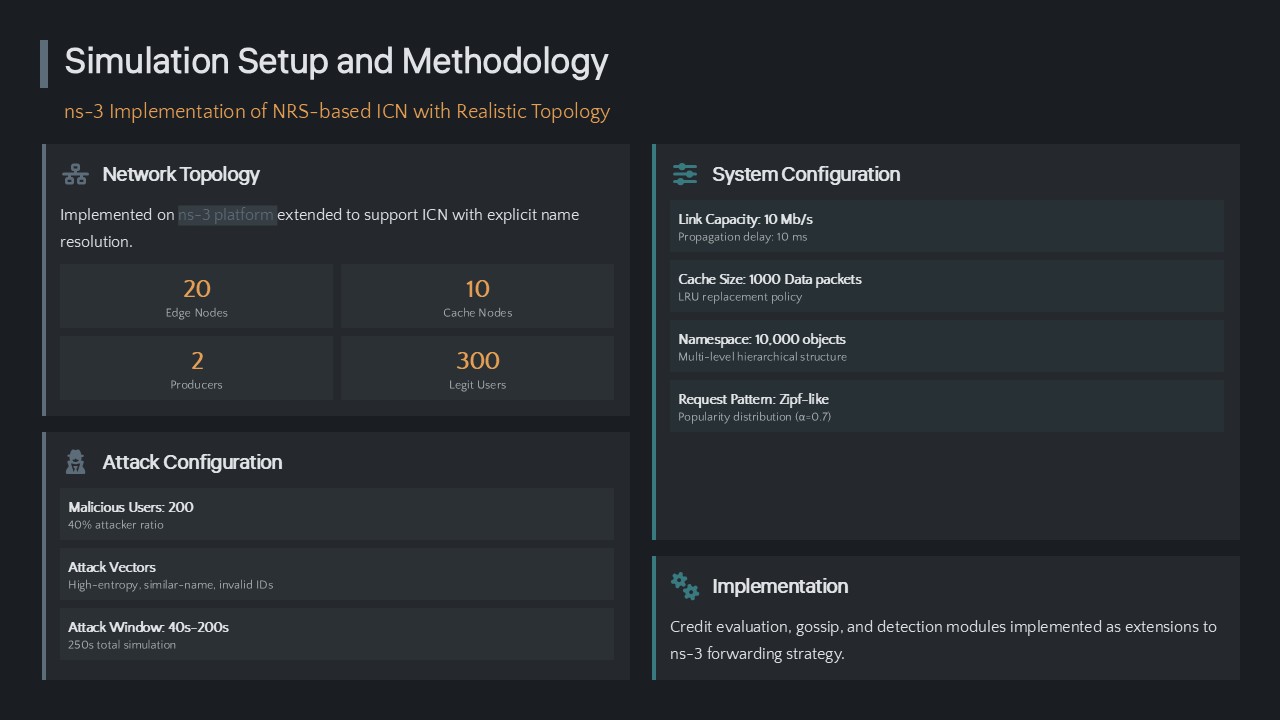
We use an ns-3 topology with 20 edge nodes, 10 cache nodes, and 2 content producers. Edge nodes are grouped into multiple resolution domains, each served by a local NRS cluster.
We have 300 legitimate users and 200 malicious users. Benign users follow a Zipf-like popularity distribution with parameter 0.7, while attackers follow the cache pollution and forwarding exhaustion models, including high-entropy names, similar-name pollution, invalid identifiers, and dynamic short-lived names.
Each simulation runs for 250 seconds. Attacks start at 40 seconds and stop at 200 seconds, so we observe both attack and recovery phases.
System parameters include 10 Mb/s link capacity, 10 ms propagation delay, cache size of 1000 Data packets with LRU replacement, and a content namespace of 10,000 objects. |
 IEEE/ICACT20260343 Slide.23
[Big Slide]
[YouTube]