 |
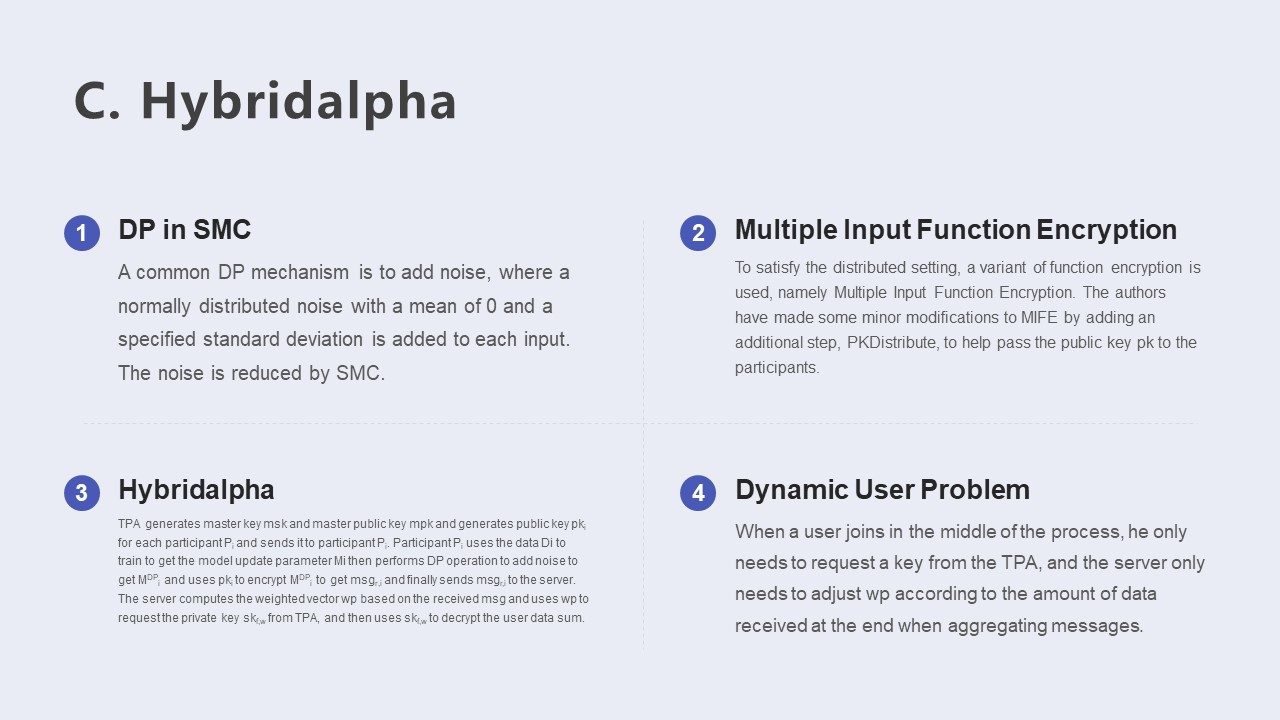
Hybridalpha protocol leverages two important points. The first one is DP in SMC. A common DP mechanism is to add noise, where a normally distributed noise with a mean of 0 and a specified standard deviation is added to each input. The noise is reduced by SMC. The second one is Multiple Input Function Encryption. To satisfy the distributed setting, a variant of function encryption is used, namely Multiple Input Function Encryption. The authors have made some minor modifications to MIFE by adding an additional step, PKDistribute, to help pass the public key pk to the participants. So Hybridalpha general process is TPA generates master key msk and master public key mpk and generates public key pki for each participant Pi and sends it to participant Pi. Participant Pi uses the data Di to train to get the model update parameter Mi then performs DP operation to add noise to get MDPi and uses pki to encrypt MDPi to get msgr,i and finally sends msgr,i to the server. The server computes the weighted vector wp based on the received msg and uses wp to request the private key skf,w from TPA, and then uses skf,w to decrypt the user data sum. Hybridalpha also has a very good nature. It solves the problem of dynamic users. When a user joins in the middle of the process, he only needs to request a key from the TPA, and the server only needs to adjust wp according to the amount of data received at the end when aggregating messages. |
 IEEE/ICACT20220347 Slide.26
[Big Slide]
[YouTube]