 |
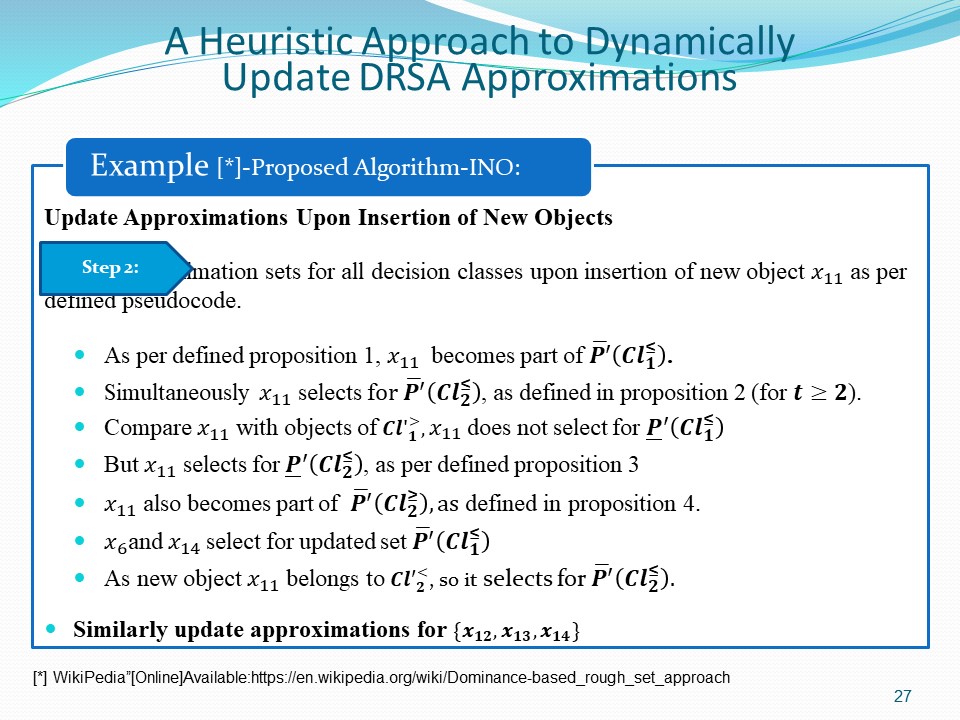
In the second step, algorithm updates approximations using defined pseudocode in the previous slides.As per defined rule 1, decision class of 𝑥_11 is lowest class in preference, so it becomes part of upper approximation for downward union of classes for class ¡®1¡¯.Simultaneously our proposed algorithm updates upper approximation for downward union of classes of class ¡®2¡¯,an object 𝑥_11 also selects for it without any computation. Now we compare an object 𝑥_11, with objects of more preferred class than class ¡®1¡¯.Here 𝑥_11 is more preferred than object 𝑥_6and new object 𝑥_14 , therefore, 𝑥_11 does not select for lower approximation for downward union of classes of class ¡®1¡¯ but as defined in pseudocode, 𝑥_11 selects for lower approximation for downward union of classes of class ¡®2¡¯. In the same step,𝑥_11 also becomes part of upper approximation for upward union of classes of class ¡®2¡¯. As mentioned earlier, objects of more preferred class than ¡®1¡¯,〖 𝑥〗_6and 𝑥_14 are less preferred than object 𝑥_11, so these objects become part of upper approximation for downward union of classes of class ¡®1¡¯, if already does not exist. So only 𝑥_14 selects for updated set.In proposed rule for upper approximation for downward union of classes of class ¡®t¡¯, all objects of less preferred class than ¡®t¡¯ become part of it. As new object 𝑥_11 belongs to class ¡®t=1¡¯, a less preferred class than class ¡®t=2¡¯, therefore, we select it for upper approximation for downward union of classes of class ¡®2¡¯, without performing any calculation. Similarly update approximations for remaining three objects.
|
 IEEE/ICACT20220156 Slide.27
[Big Slide]