 |
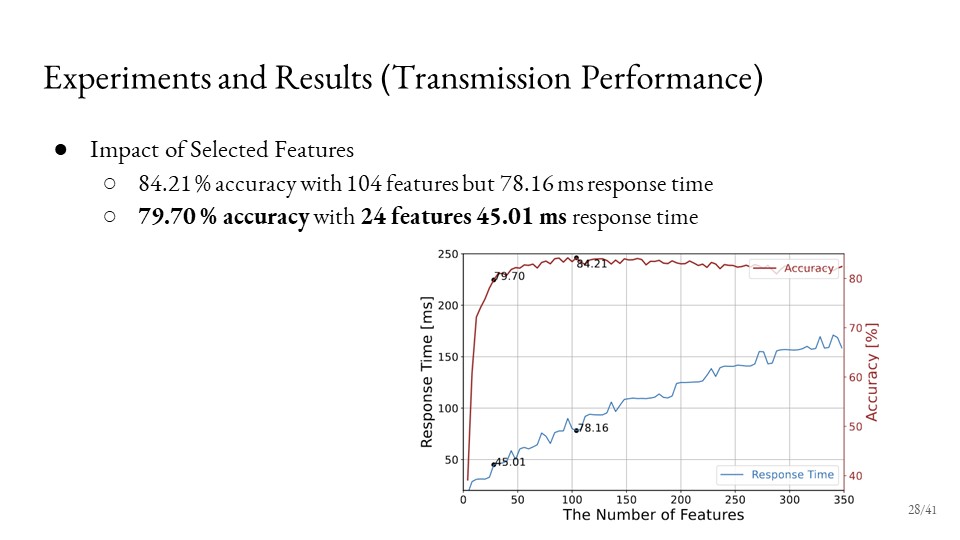
The plot illustrates the relationship between response time and accuracy as the number of features processed in the worker which is the primary device for computational tasks. As the number of features increases, response time exhibits an upward trend because of the computing load of features. Accuracy, depicted on the secondary y-axis, peaks at 84.21% with 104 features. The stability that occurs around 82% suggests that the increase in the number of features does not significantly impact accuracy. However, a slight decline is observed after 200 features indicating potential overfitting or redundancy in the feature set.
In this study, the main goal was not only to obtain a high-performance model but also to design a real-time emotion recognition system by taking into account all evaluation criteria. Therefore, instead of the model with 84% accuracy achieved with 104 features and an emotion response time of 78.16 ms, a model with 24 features achieving 80% accuracy and a response time of 45.01 ms, half the duration of the best model, was chosen to get optimum results for real-time emotion recognition system. Although there is a 5% loss in accuracy, the system operates approximately with half the response time. The evaluation criteria results are based on tests conducted on the system with 24 features.
|
 IEEE/ICACT20250190 Slide.28
[Big Slide]