 |
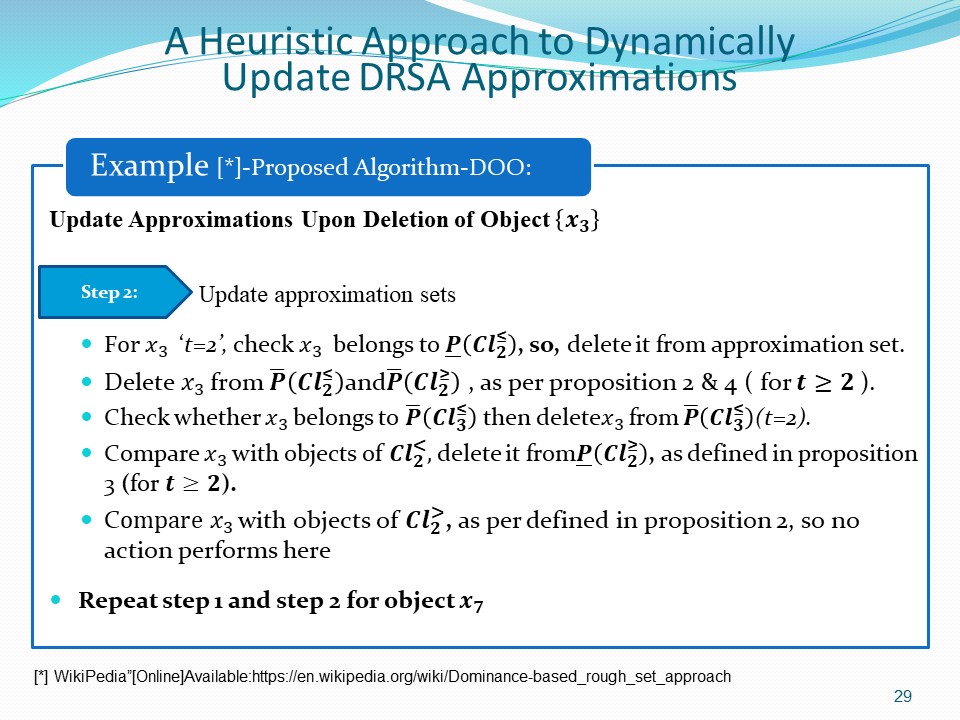
Then we update approximations using pre-defined four rules upon deletion of object ¡Ç𝒙𝟑¡¯ from the system. As decision class of 𝑥3 is ¡®t=2¡¯ ,we check 𝑥3 belongs to lower approximation for downward union of classes of class ¡®2¡¯ and delete it from approximation set. We delete 𝑥3 from upper approximation for downward union of classes of class ¡®2¡¯ and upper approximation from upward union of classes of class ¡®2¡¯, as per rule 2 & 4 ( for 𝒕¡Ã𝟐 ), without any computation. Simultaneously, we check whether 𝑥3 belongs to upper approximation for downward union of classes of class ¡®3¡¯then delete 𝑥3 from this approximation set. Compare 𝑥3with objects of less preferred class than class ¡®2¡¯,𝑥3 appears more preferred than all objects, delete it from lower approximation for upward union of classes of class ¡®2¡¯.When we Compare 𝑥3 with objects of more preferred class than class ¡®2¡¯,𝑥3 appears less preferred than all objects, so no action performs here. Similarly repeat step 1 and step 2 to update approximation sets for object 𝒙𝟕.
|
 IEEE/ICACT20220156 Slide.29
[Big Slide]