 |
Let me restate the main takeaways.
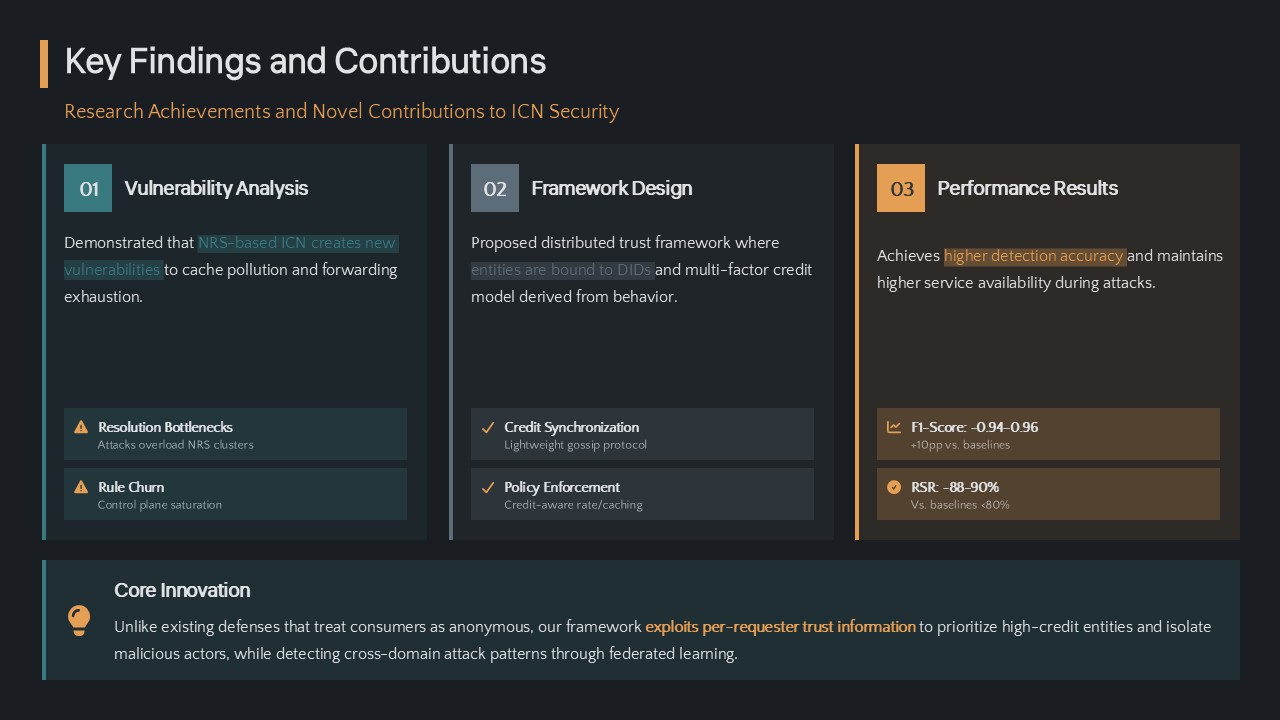
First, we show that NRS-based ICN introduces new vulnerabilities to cache pollution and forwarding exhaustion, because attacks stress the resolution and control loop rather than only per-hop router state.
Second, we propose DT-NRS: a distributed trust framework where entities are bound to DIDs, credit is computed from resolution and cache behavior, and trust is synchronized across domains via lightweight gossip.
Third, our simulation results demonstrate strong performance: detection F1 improves by about 10 percentage points compared to representative defenses, while maintaining RSR around 88–90% and CHR around 70% during attacks.
And the core innovation is that we exploit per-requester trust information—rather than treating consumers as anonymous—while using federated learning to capture cross-domain coordinated behavior. |
 IEEE/ICACT20260343 Slide.29
[Big Slide]
[YouTube]