 |
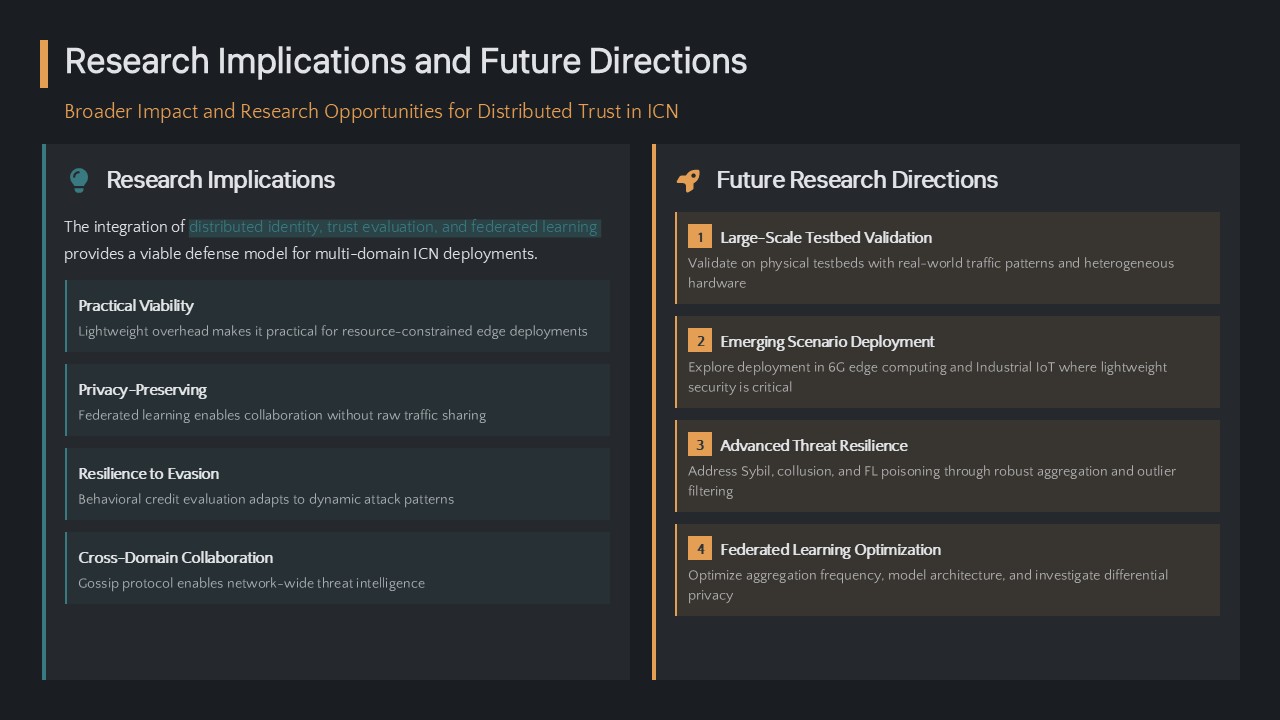
In terms of implications, this work suggests that combining distributed identity, behavioral trust evaluation, and federated learning provides a viable, privacy-preserving defense model for multi-domain ICN deployments.
It is practical because overhead is low, and it is resilient because trust adapts to behavior rather than relying on static thresholds.
For future work, we plan to validate the framework on a large-scale physical testbed with more realistic traffic and heterogeneous hardware. We also want to explore deployment in emerging scenarios such as 6G edge computing and Industrial IoT, where lightweight decentralized security is critical.
Finally, we will study more advanced threats in depth, including Sybil identities, collusion, and federated learning poisoning, potentially using robust aggregation and outlier filtering strategies. |
 IEEE/ICACT20260343 Slide.30
[Big Slide]
[YouTube]