 |
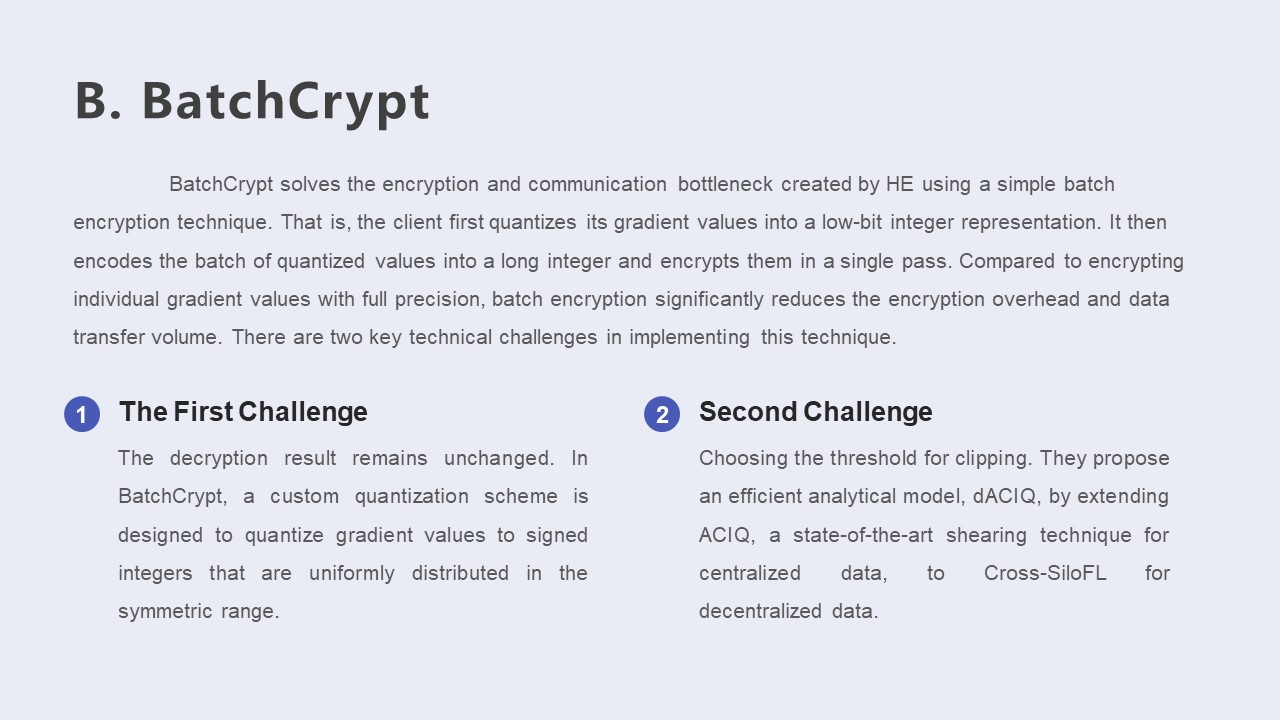
BatchCrypt solves the encryption and communication bottleneck created by HE using a simple batch encryption technique. That is, the client first quantizes its gradient values into a low-bit integer representation. It then encodes the batch of quantized values into a long integer and encrypts them in a single pass. Compared to encrypting individual gradient values with full precision, batch encryption significantly reduces the encryption overhead and data transfer volume. There are two key technical challenges in implementing this technique. The First Challenge is The decryption result remains unchanged. In BatchCrypt, a custom quantization scheme is designed to quantize gradient values to signed integers that are uniformly distributed in the symmetric range. In addition, to support simple additive forms of gradient aggregation and to add gradients that do not cause overflow to corrupt the encoding, they developed a new batch encoding scheme that uses two signed bits to represent the complementary representation of two of the quantized values. In addition, padding and advance scaling are used to avoid overflow. All these techniques allow performing gradient aggregation on the ciphertext of an encoded batch without first decrypting i. The Second Challenge is Choosing the threshold for clipping. They propose an efficient analytical model, dACIQ, by extending ACIQ, a state-of-the-art shearing technique for centralized data, to Cross-SiloFL for decentralized data. dACIQ allows the selection of the optimal shearing threshold with minimum cumulative error. |
 IEEE/ICACT20220347 Slide.31
[Big Slide]
[YouTube]