 |
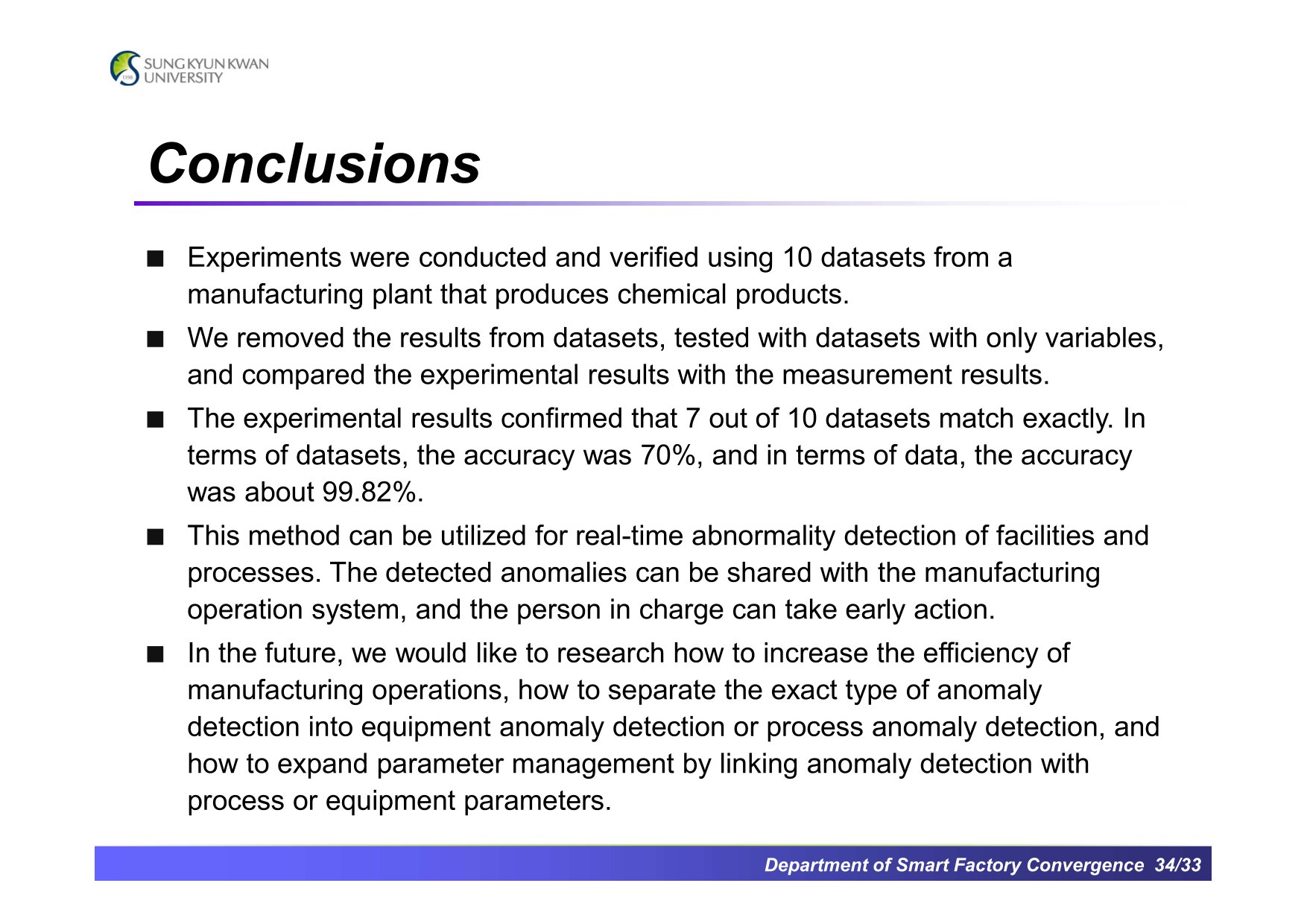
Supervised learning has higher prediction accuracy and good performance, but since there are some limitations to utilize the data immediately, it requires extra work on the data and is expensive. To compensate for this, unsupervised learning can be considered. However, unsupervised learning has lower accuracy and poorer performance compared to supervised learning. To analyze real-time data based on unsupervised learning, we proposed and validated "Multivariate PCA-based Composite Criteria Evaluation Method", which utilizes a simple PCA algorithm and two statistical techniques. In particular, in the case of anomaly detection, the frequency of anomalies is often too high for practical use. To improve this, two statistical technique thresholds were used together to reduce the frequency of anomalies. This method can be used to monitor and detect abnormal situations in facilities or processes. In the future, we plan to continue research on utilizing the identified anomalies information. In other words, the information sharing direction should be changed to bi-directional ways instead of single directional data flow between the manufacturing operation system and the data analysis system. We believe that it can be used in lot tracking to select the next process or facility, job dispatching, recipe parameter optimization, etc. |
 IEEE/ICACT20240049 Slide.34
[Big Slide]