 ICACT20210238 Slide.15
[Big slide for presentation] |
Chrome Text-to-Speach Click!! |
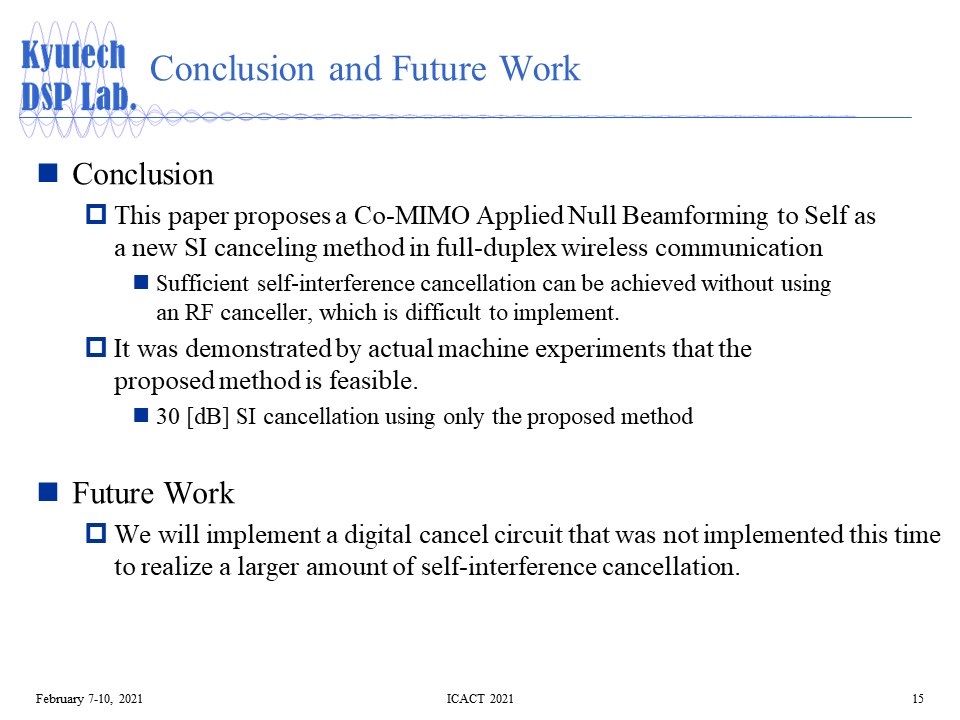 |
Finally, let us conclude this presentation.
We proposed a method of applying cooperative MIMO to Spatial Cancellation as one of the self-interference cancellation methods in full-duplex wireless communication.
The advantage of this method is that the amount of self-interference cancellation required for communication can be realized without using RF cancellation, which is difficult to implement, and the reduction rate of the degree of freedom is small compared to normal Spatial Cancellation.
It was demonstrated by actual machine experiments that the proposed method is feasible.
Finally, as a future work, we will implement a digital cancel circuit that was not implemented this time to realize a larger amount of self-interference cancellation.
This is the end of our presentation.
Thank you for your kind attention.
|
|
ICACT20210238 Slide.14
[Big slide for presentation]
|
Chrome Text-to-Speach Click!! |
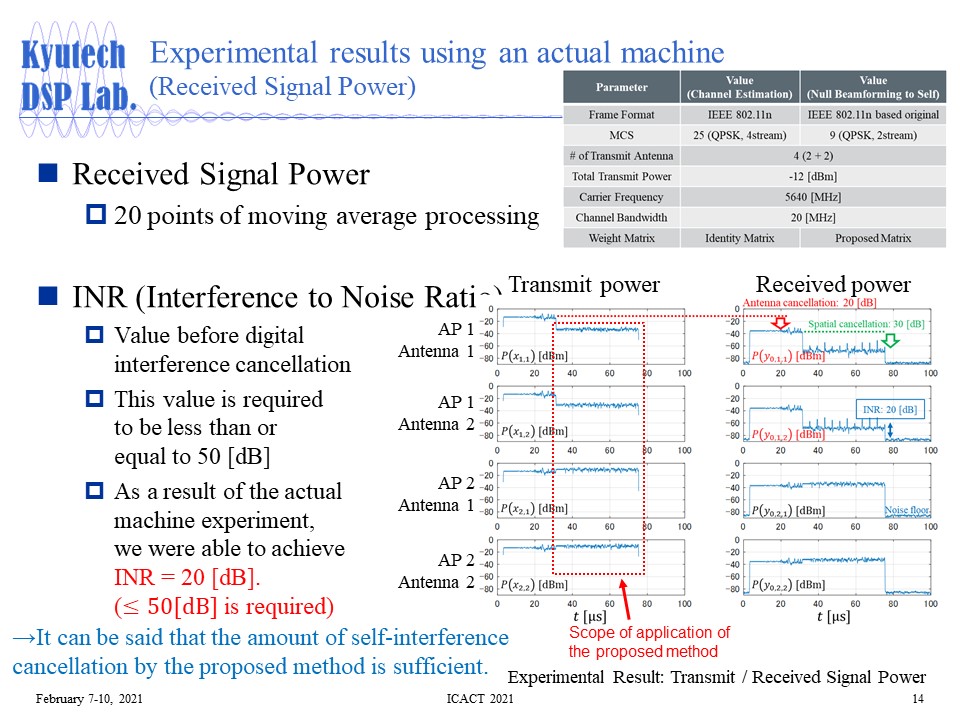 |
Next, this slide shows the calculated moving average of 20 points for the power of the transmitted and received signal waveforms.
Looking at the figure on the lower right, we can see that 20 [dB] can be achieved by antenna cancellation and 30 [dB] can be achieved by digital cancellation.
Next, let's look at the interference signal to noise ratio (INR) to examine whether the magnitude of this self-interference cancellation is sufficient.
For the INR here, the interference signal to noise ratio before passing through the ADC is the INR, and it is desirable that this value be 50 [dB] or less.
In this demonstration experiment, it can be seen that INR = 20 [dB] as shown in the lower right figure.
Therefore, it can be said that it was possible to show by actual machine experiments that enough self-interference can be removed by the proposed method.
Ultimately, this 20 [dB] INR can be further reduced using digital canceling.
|
|
ICACT20210238 Slide.13
[Big slide for presentation]
|
Chrome Text-to-Speach Click!! |
 |
From here, the experimental results are shown.
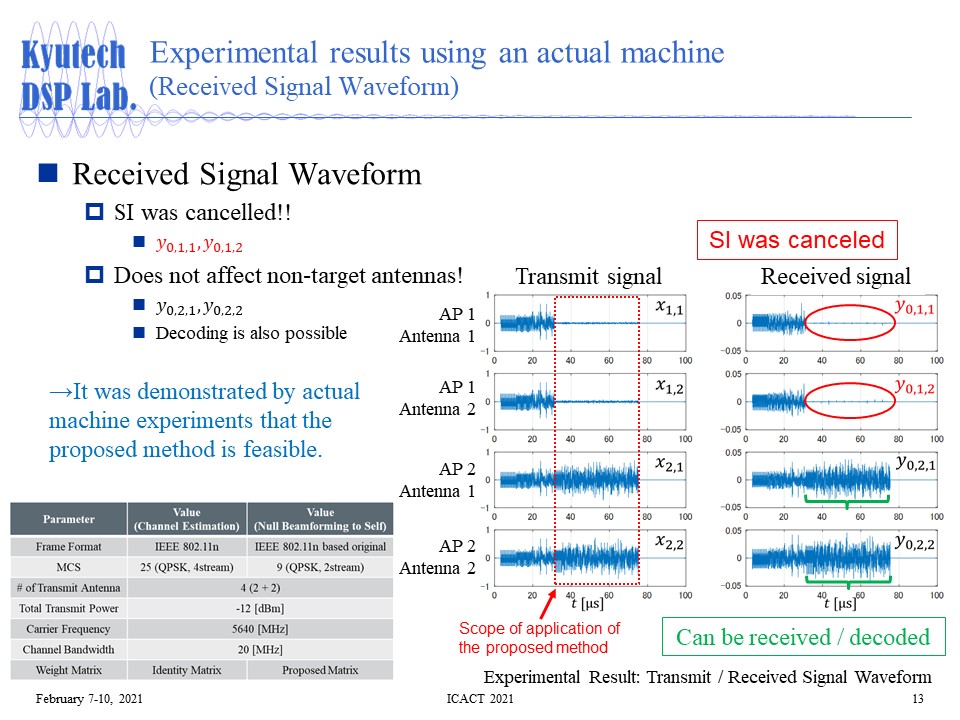
This slide shows the signal waveforms of the transmitted and received signals in the results of the actual machine experiment.
The parameters of the transmitted signal are as shown in the table at the bottom left.
Looking at the signal waveform, we can see that the self-interference cancellation is applied only to the two antennas to which the proposed method is applied, and it does not affect the other antennas. In other words, we were able to show that self-interference cancellation was realized by the proposed method.
|
|
ICACT20210238 Slide.12
[Big slide for presentation]
|
Chrome Text-to-Speach Click!! |
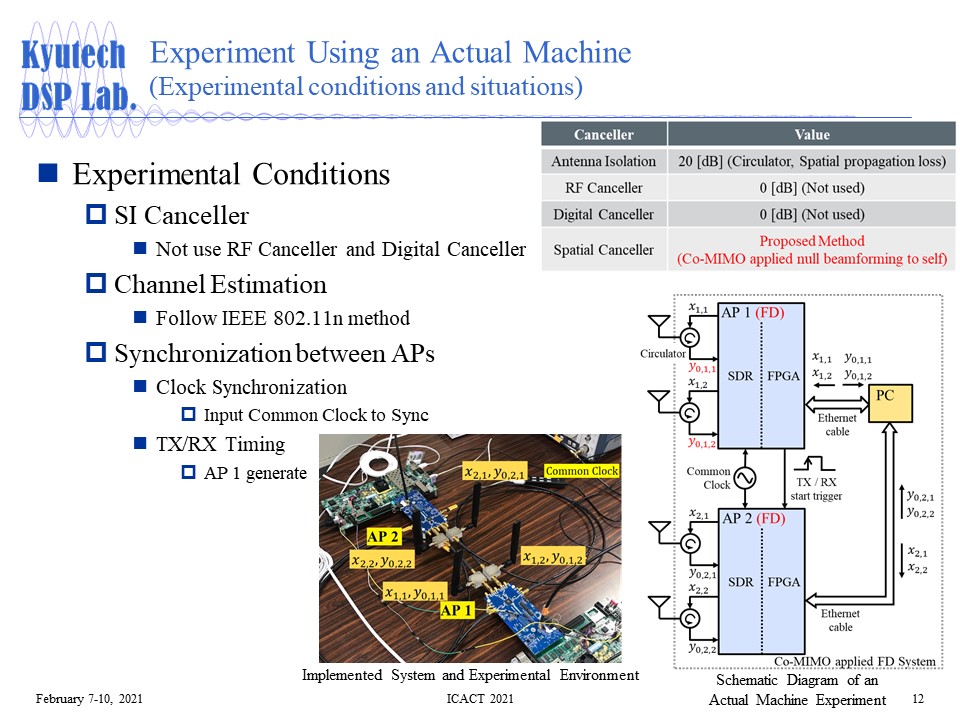 |
Next, the experimental environment is shown.
Only antenna cancellation and the proposed method are used as the self-interference canceling method.
In addition, the method defined by IEEE 802.11n is used as the channel estimation method required for the proposed method.
And, in order for the two APs to cooperate, it is necessary to synchronize the clock and share the transmission / reception timing, but this time, in order to simplify the experiment, the clock is clocked by inputting a common clock to the two APs.
Furthermore, as a transmission / reception timing sharing method, wired timing sharing is performed via GPIO.
|
|
ICACT20210238 Slide.11
[Big slide for presentation]
|
Chrome Text-to-Speach Click!! |
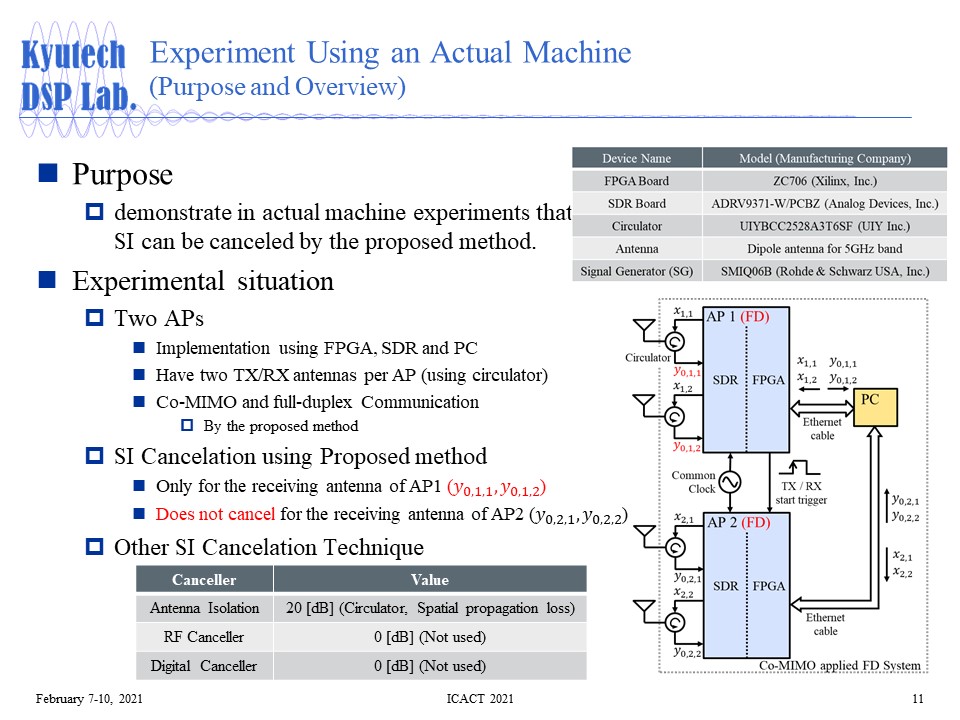 |
From here, we will demonstrate that the proposed method is actually feasible through actual machine experiments.
As a situation of an actual machine experiment, we consider that two APs apply the proposed method to perform Co-MIMO communication and full-duplex wireless communication at the same time.
Each AP has two transmitting antennas and two receiving antennas. Then, the self-interference cancellation by the proposed method is applied to 2 out of the total 4 receiving antennas.
Here is a brief description of the implementation.
The AP equipped with the proposed method is implemented using FPGA and SDR, and uses a circulator to reduce the number of antennas.
The PC performs operations for estimating the spatial channel necessary for realizing the proposed method, and generates signals to which the proposed method is applied.
The AP, which consists of FPGA and SDR, actually sends and receives the signal generated by the PC and sends the received signal to the PC.
Also, as shown in the table at the bottom of the slide, no RF canceller or digital canceller is used in this experiment.
The reason for this is that it is easy to evaluate the amount of self-interference cancellation of the proposed method alone, and to demonstrate that full-duplex wireless communication can be realized without an RF canceller.
|
|
ICACT20210238 Slide.10
[Big slide for presentation]
|
Chrome Text-to-Speach Click!! |
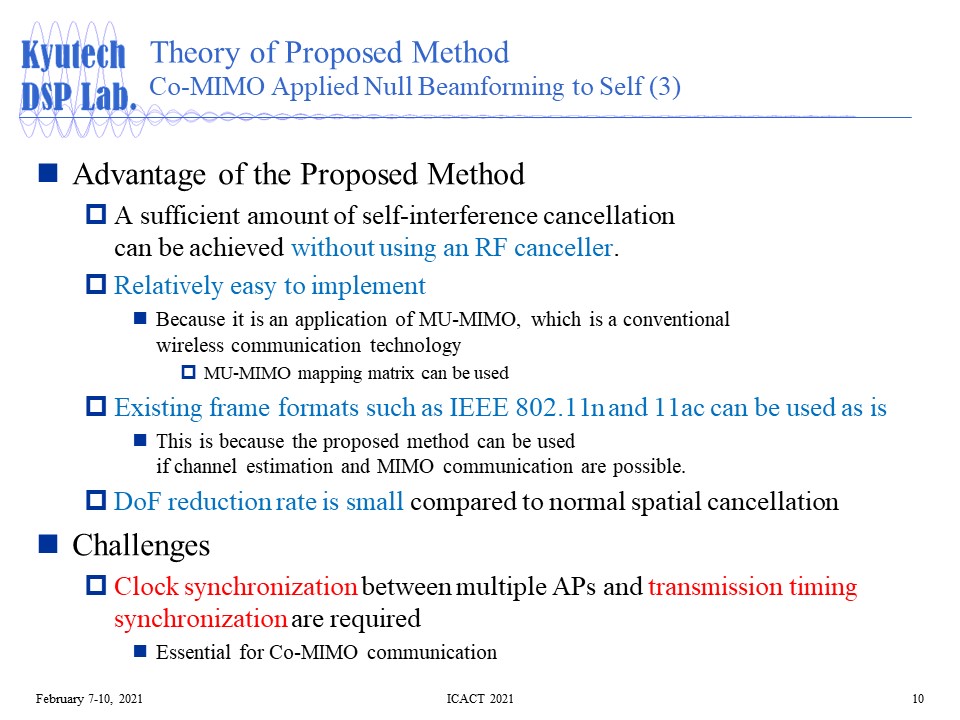 |
Next, the advantages and issues of the proposed method will be explained.
The major advantages of the proposed method are that sufficient self-interference cancellation can be achieved without using an RF canceller, which is difficult to implement, and that the proposed method can be applied without significantly changing the existing wireless communication standard. Compared to the self-interference canceling method using normal spatial canceling, the reduction rate of the degree of freedom is small.
On the other hand, as an issue, since Co-MIMO is applied to the proposed method, it is essential to synchronize the clocks between APs and the transmission timing.
|
|
ICACT20210238 Slide.09
[Big slide for presentation]
|
Chrome Text-to-Speach Click!! |
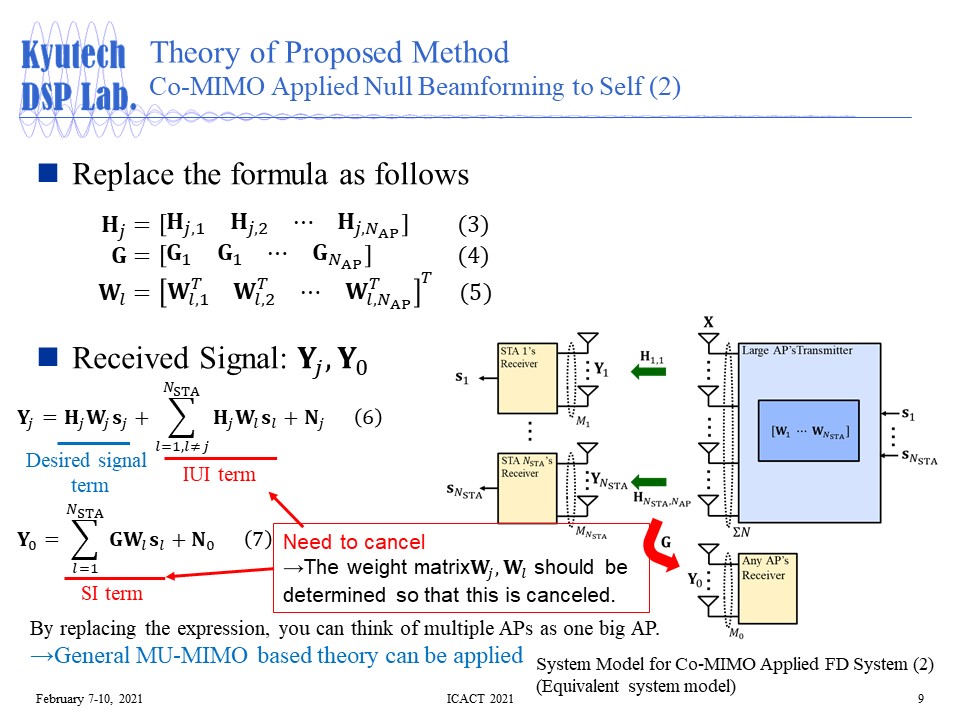 |
Next, replace the formulas shown in Equations 3 to 5 with the previous formulas.
Equations 1 and 2 can then be rewritten as shown in Equations 6 and 7.
By transforming the expression in this way, you can display multiple access points as if they were one large access point.
In other words, you can replace cooperative MIMO with a regular MU-MIMO-like expression.
Therefore, the inter-user interference and self-interference present in Equations 6 and 7 can be eliminated by applying the usual MU-MIMO interference elimination methods such as block diagonalization.
|
|
ICACT20210238 Slide.08
[Big slide for presentation]
|
Chrome Text-to-Speach Click!! |
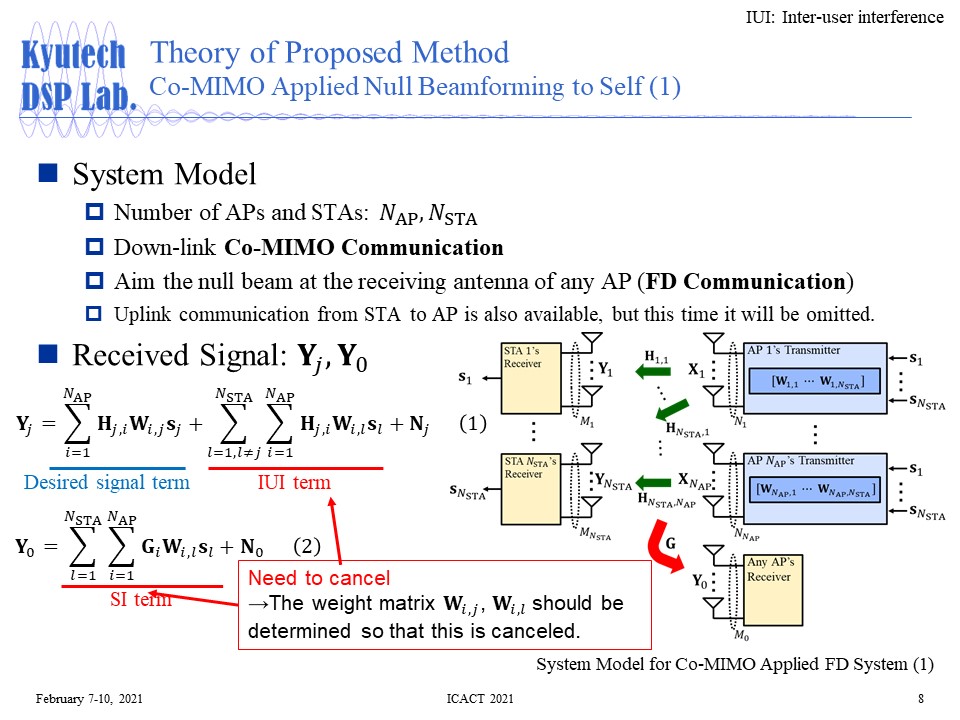 |
From here, I will explain the proposed method, Cooperative MIMO applied null beamforming to self.
For illustration purposes, consider a situation where you have N_AP access points (APs) and N_STA stations (STAs), as shown in this figure.
These APs and STAs attempt to perform full-duplex wireless communication while performing cooperative MIMO.
In other words, the purpose of this is to cancel the self-interference by applying the proposed method to the receiving antenna of the AP that receives Y_0 in this figure.
Furthermore, in actual wireless communication, uplink communication is also performed at the same time, but this is omitted in this explanation.
At this time, the received signal Y_j of each STA and the received signal Y_0 of the AP whose self-interference should be canceled are expressed as in equations 1 and 2.
Looking at the formula, we can see that in addition to the desired signal indicated by the blue line, the self-interference signal indicated by the red line and the inter-user interference signal are generated.
In particular, G_i included in the self-interference section is the spatial channel matrix from AP to AP, that is, the self-channel matrix.
In other words, in order to communicate correctly, it is essential to cancel this self-interference and inter-user interference signal, and in order to cancel this, it is necessary to properly determine the weight matrix Wij of the AP.
|
|
ICACT20210238 Slide.07
[Big slide for presentation]
|
Chrome Text-to-Speach Click!! |
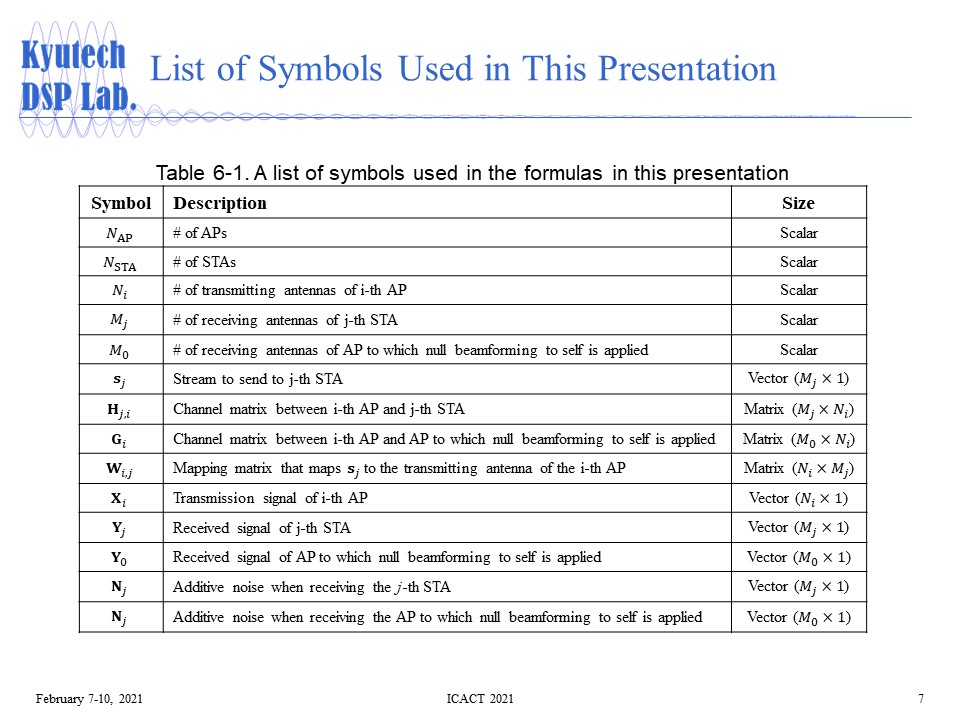 |
This table is a list of symbols used in the formulas in this presentation.
|
|
ICACT20210238 Slide.06
[Big slide for presentation]
|
Chrome Text-to-Speach Click!! |
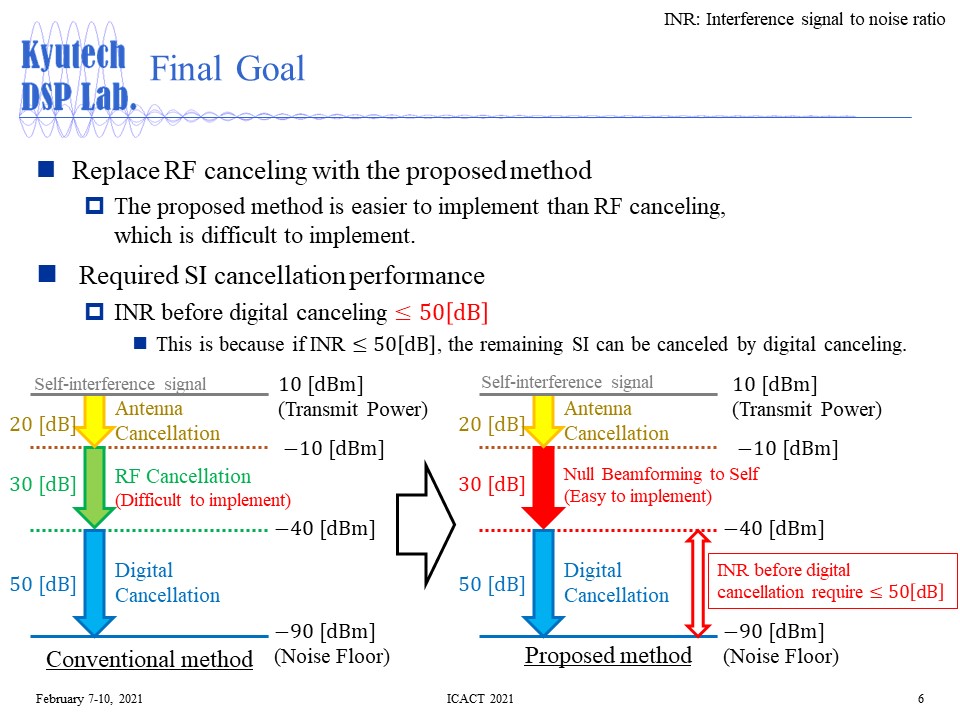 |
At the end of the introduction, I will explain the final goal of this research.
The purpose of this research is to propose a method that enables sufficient SI cancellation without using RF canceling, which is difficult to implement, and to demonstrate it with an actual machine.
In the demonstration using an actual machine, it is necessary to examine the SI cancellation performance of the proposed method, and the interference signal to noise ratio (INR) before applying digital canceling is used as an index.
If the INR is 50 [dB] or less, the self-interference signal remaining after applying the proposed method can be sufficiently canceled by using digital canceling.
Therefore, the ultimate goal of this research is to propose a method that can achieve INR 50 [dB] or less and prove it by actual machine experiments.
|
|
ICACT20210238 Slide.05
[Big slide for presentation]
|
Chrome Text-to-Speach Click!! |
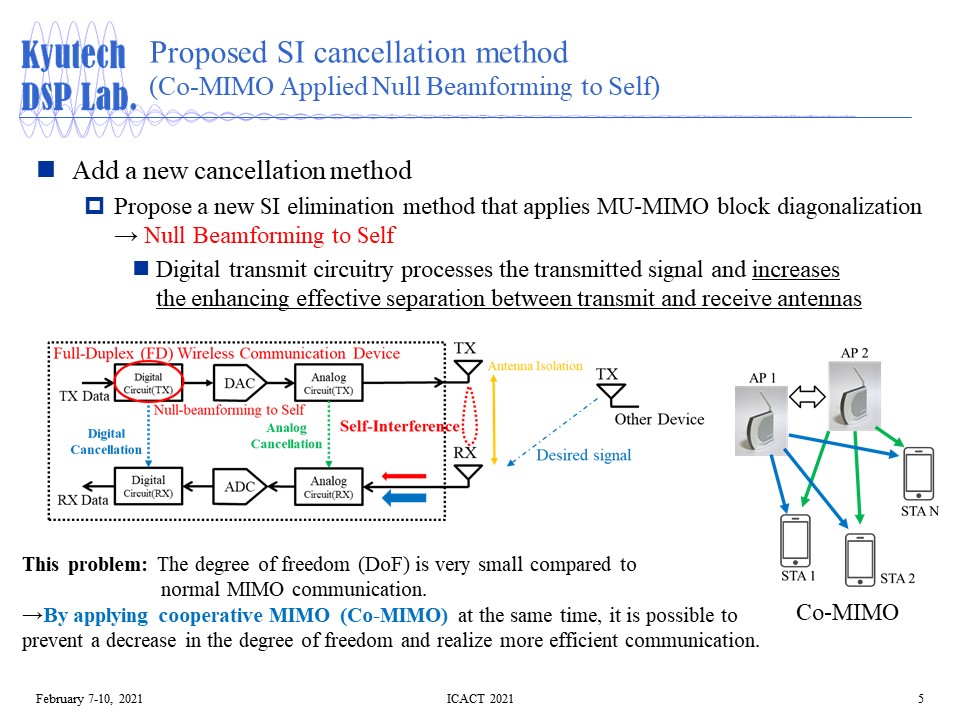 |
Therefore, in this proposal, in addition to the self-interference canceling method mentioned earlier, Null Beamforming to Self is proposed as a self-interference canceling method that extended the block diagonalization of MU-MIMO.
In this method, as shown by the red circle in the figure, effective isolation between the transmitting antenna and the receiving antenna is achieved by adding a circuit with extended block diagonalization to a part of the transmitting circuit of the wireless communication system.
In other words, self-interference can be canceled.
However, with this method alone, a part of the degree of freedom of transmission is used for self-interference cancellation, so there is a problem that the degree of freedom that can be used for actual transmission is greatly reduced.
As a method to solve this, the proposed method suppresses the decrease in the degree of freedom and realizes more efficient wireless communication by further applying cooperative MIMO, which communicates with multiple access points in a coordinated manner.
|
|
ICACT20210238 Slide.04
[Big slide for presentation]
|
Chrome Text-to-Speach Click!! |
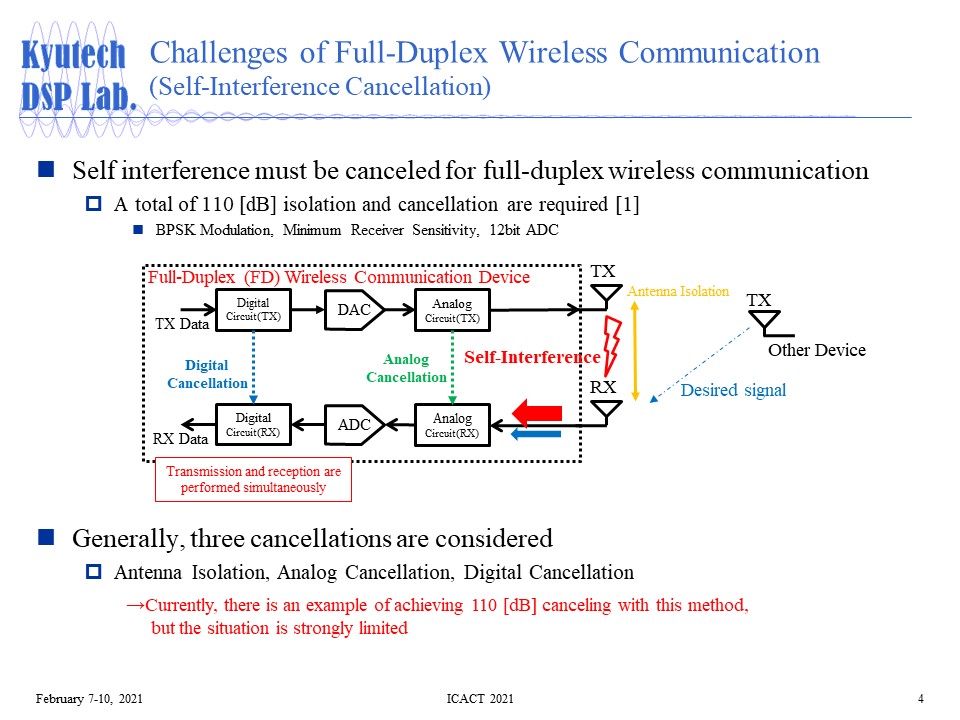 |
Cancellation of self-interference is an important issue that should be realized in realizing full-duplex wireless communication. Since a full-duplex wireless communication terminal transmits and receives radio waves at the same time, a signal that receives its own transmitted signal as it is is called self-interference. This is a factor that hinders the decoding of desired signals coming from other stations. Self-interference is a particularly serious issue in full-duplex wireless communication. In order to solve this, various discussions have been held on the method of canceling this self-interference. As a typical example, as shown in the figure, antenna cancellation that increases the isolation between antennas, RF cancellation that cancels at the analog signal stage, and cancellation after passing through the ADC to a digital signal. A method for performing digital cancellation has been proposed. In this case, it is necessary to cancel the self-interference of 110 [dB] in total of the three cancellations, but this is difficult because it is difficult to realize RF cancellation.
|
|
ICACT20210238 Slide.03
[Big slide for presentation]
|
Chrome Text-to-Speach Click!! |
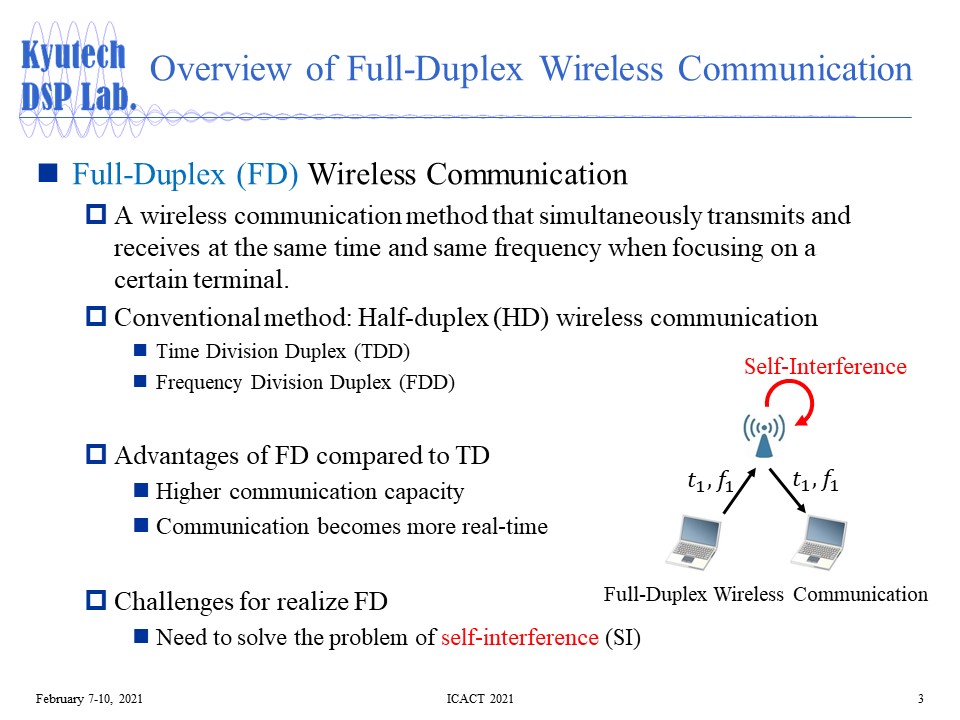 |
Full-duplex wireless communication is a wireless communication method in which transmission and reception are performed at the same frequency at the same time.
In the conventional method (half-duplex wireless communication), communication is performed by dividing the time,
such as time division multiplexing or frequency multiplexing, or communication is performed using multiple frequencies.
The advantage of full-duplex wireless communication is that transmission and reception can be performed at the same frequency at the same time,
which enables faster and more efficient communication than the conventional method (half-duplex wireless communication).
On the other hand, there is self-interference as a problem peculiar to full-duplex wireless communication, which is the subject of this research.
|
|
ICACT20210238 Slide.02
[Big slide for presentation]
|
Chrome Text-to-Speach Click!! |
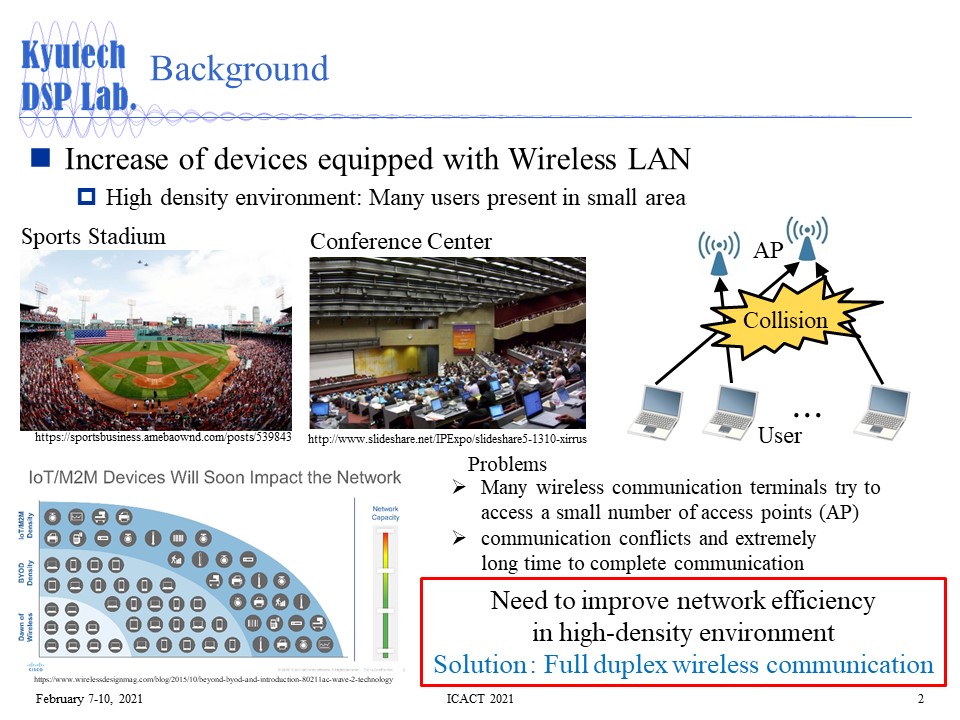 |
In recent years, one of the issues of wireless communication is the instability of wireless communication in a dense environment. As shown in this figure, in recent years, it has become common for many people, such as sports stadiums and conference centers, to meet together for wireless communication.
In such a situation, many wireless communication terminals try to access a small number of access points,
which causes problems such as communication conflicts and extremely long time to complete communication.
In other words, it is necessary to improve the efficiency of communication in a dense environment.
In recent years, full-duplex wireless communication has been attracting attention as one of the methods to solve this problem.
|
|
ICACT20210238 Slide.01
[Big slide for presentation]
|
Chrome Text-to-Speach Click!! |
 |
Hello, everyone.
My name is Masahiro Kawano.
I’m a student at Kyushu Institute of Technology in Japan.
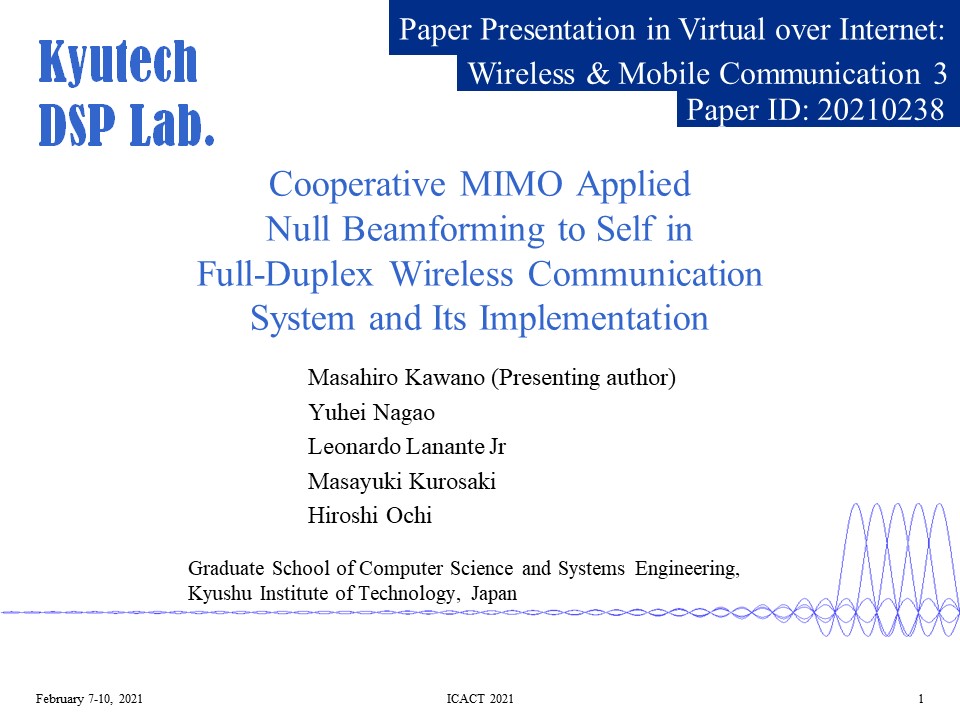
Today, I’d like to talk about “Cooperative MIMO Applied Null Beamforming to Self in Full-Duplex Wireless Communication System and Its Implementation.”
|
















