 ICACT20240387 Slide.21
[Big slide for presentation]
[YouTube] |
Chrome Text-to-Speach Click!! |
 |
This is my report of our paper. Thanks a lot for listening.
|
|
ICACT20240387 Slide.20
[Big slide for presentation]
[YouTube] |
Chrome Text-to-Speach Click!! |
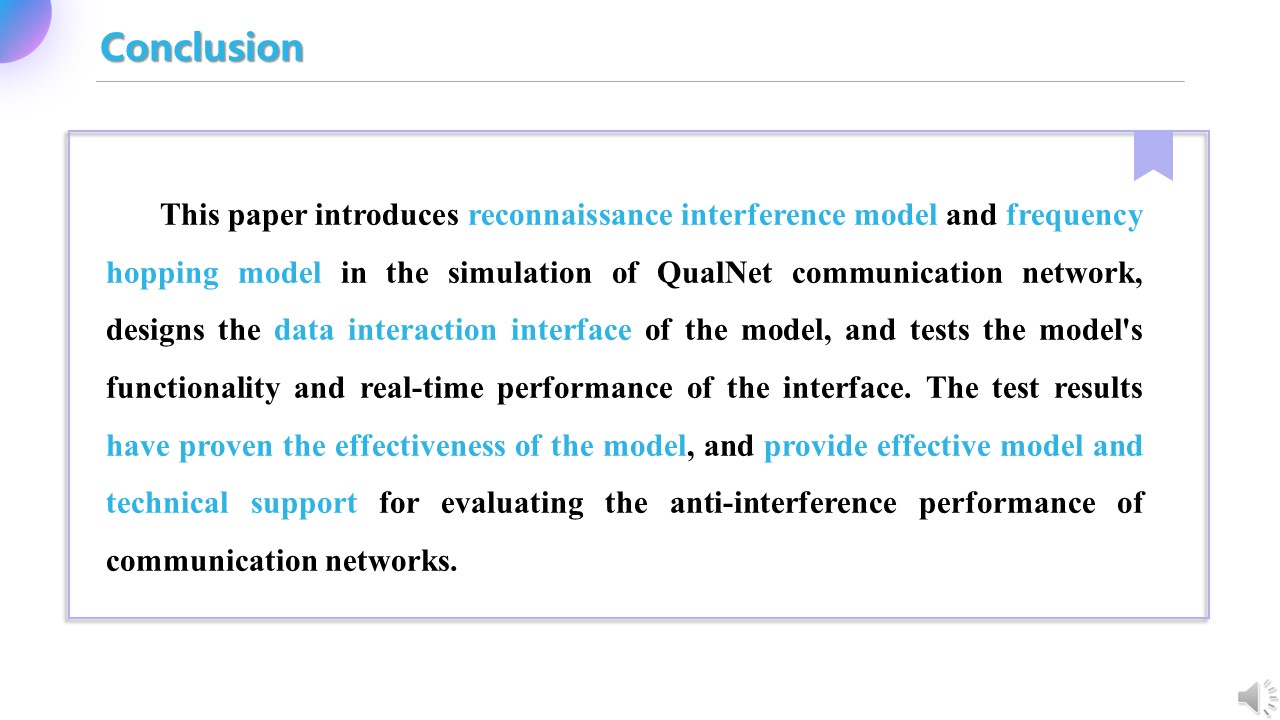 |
Our paper introduces reconnaissance interference model and frequency hopping model in the simulation of QualNet communication network, designs the data interaction interface of the model, and tests the model's functionality and real-time performance of the interface. The test results have proven the effectiveness of the model, and provide effective model and technical support for evaluating the anti-interference performance of communication networks.
|
|
ICACT20240387 Slide.19
[Big slide for presentation]
[YouTube] |
Chrome Text-to-Speach Click!! |
 |
Finally, here comes the conclusion.
|
|
ICACT20240387 Slide.18
[Big slide for presentation]
[YouTube] |
Chrome Text-to-Speach Click!! |
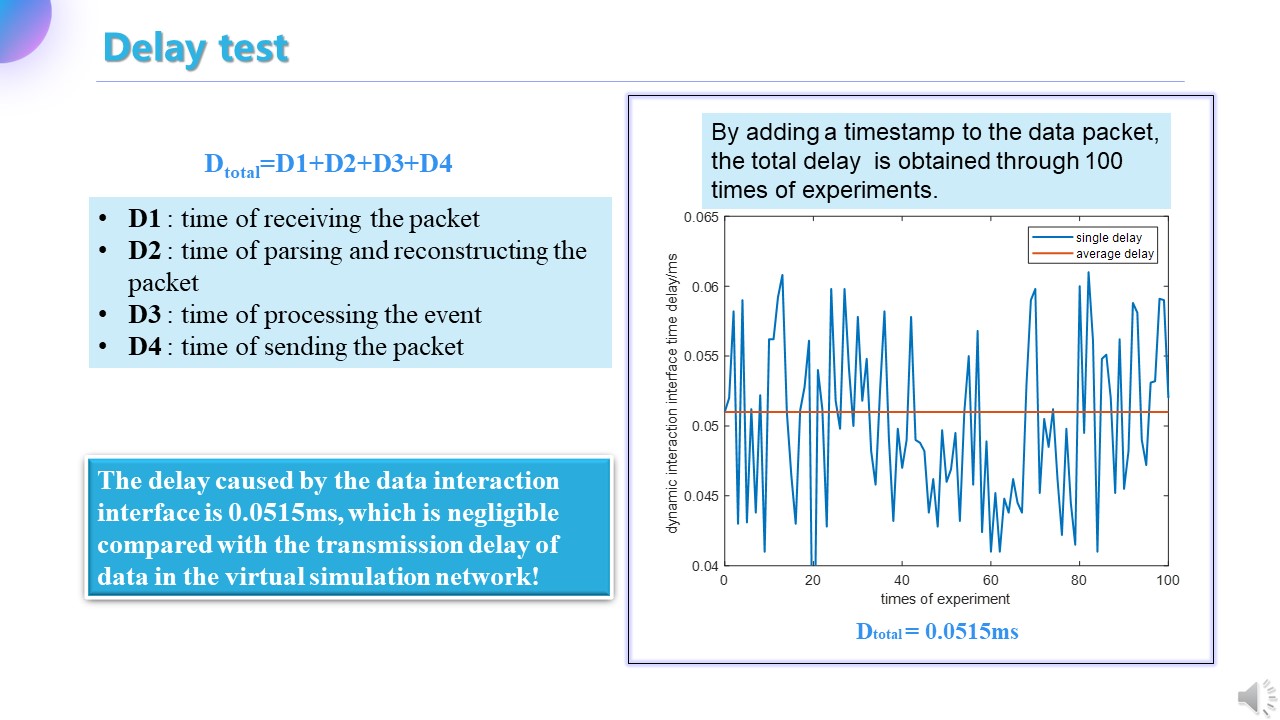 |
At last we conducted the delay test. The delay is mainly composed of four parts: D1 : time of receiving the packet; D2 : time of parsing and reconstructing the packet; D3 : time of processing the event ; D4 : time of sending the packet. By adding a timestamp to the data packet, the total delay is obtained through 100 times of experiments. As can be seen from the figure, the average delay is negligible compared with the transmission delay of data in the virtual simulation network!
|
|
ICACT20240387 Slide.17
[Big slide for presentation]
[YouTube] |
Chrome Text-to-Speach Click!! |
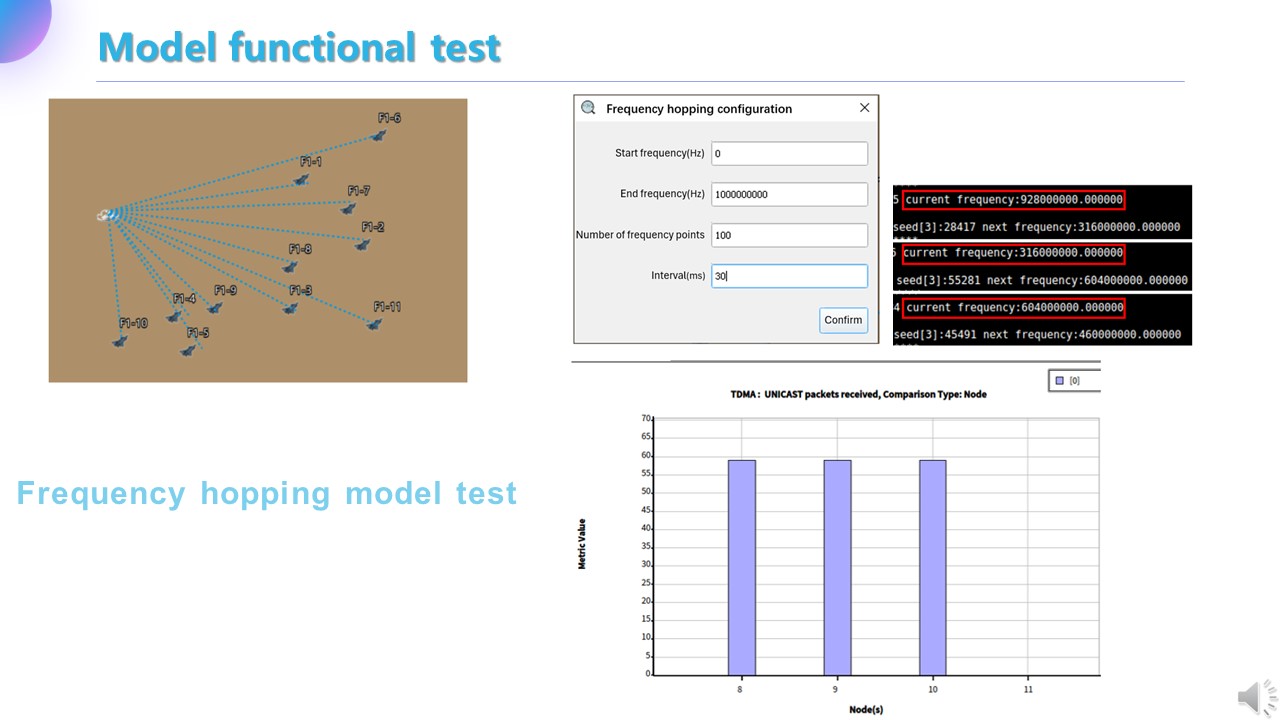 |
We Kept the jammer configuration unchanged, restarted the simulation and set the frequency hopping parameters in the configuration file. While the frequency hopping is enabling, the result is shown in this picture. According to the printed information, it can be seen that the network communication frequency changes over time. The number of received data packets of nodes 8, 9, and 10 is printed again. It shows a significant improvement in packet reception.
|
|
ICACT20240387 Slide.16
[Big slide for presentation]
[YouTube] |
Chrome Text-to-Speach Click!! |
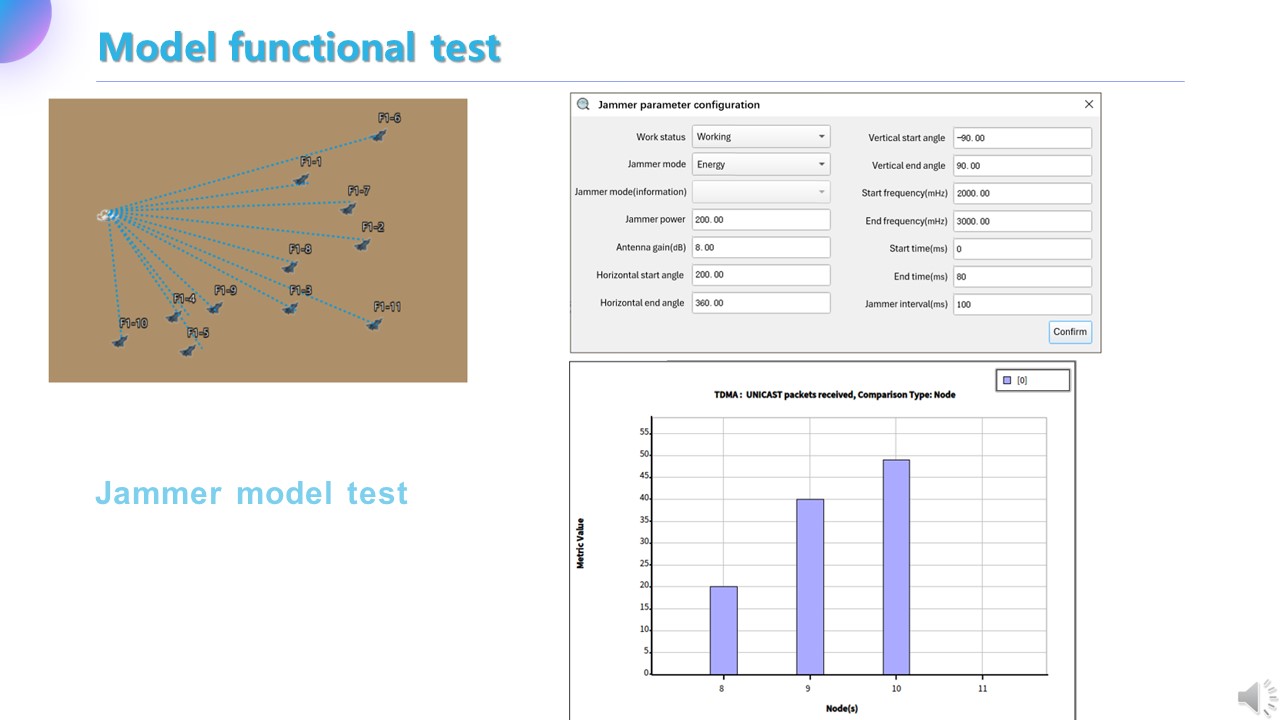 |
The parameters of the jammer node is configured according to the reconnaissance intelligence. The picture shows the number of received data packets of nodes 8, 9, and 10 under interference.
|
|
ICACT20240387 Slide.15
[Big slide for presentation]
[YouTube] |
Chrome Text-to-Speach Click!! |
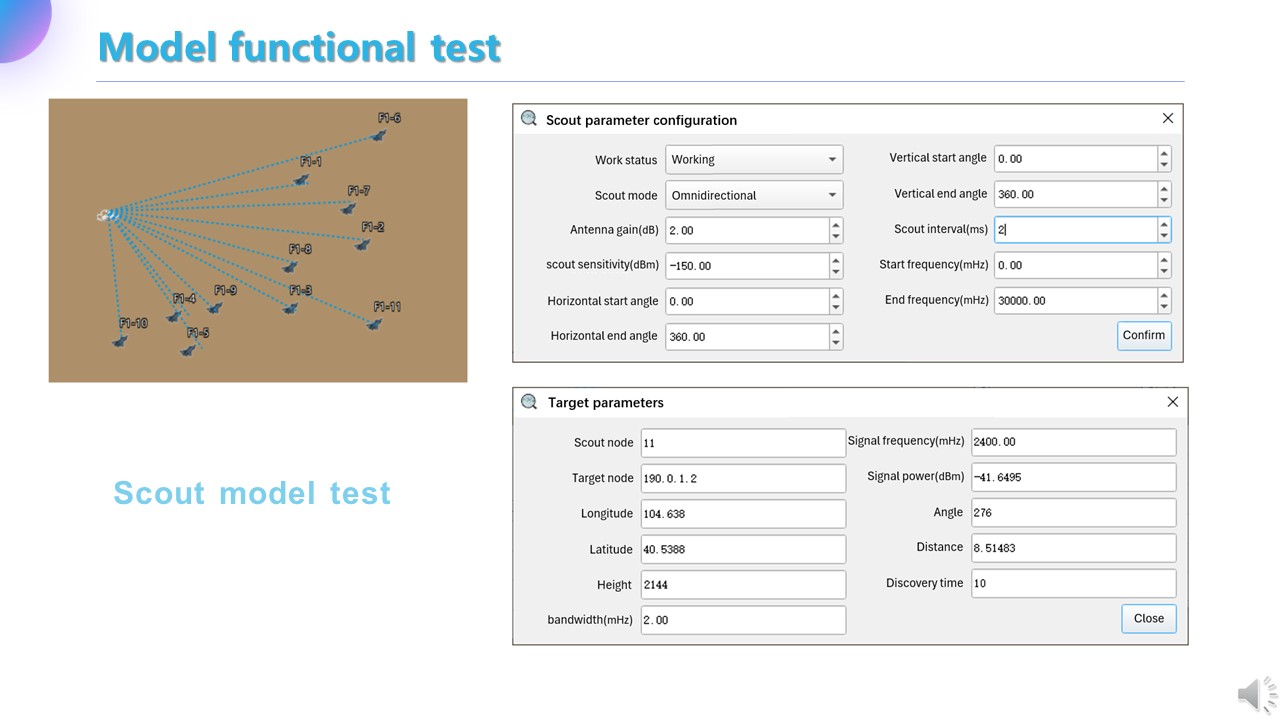 |
First we tested the function of our model. After the simulation starts, the scout node is turned on and the parameters are configured as shown in this picture. And then we obtained target information which is also shown in this picture.
|
|
ICACT20240387 Slide.14
[Big slide for presentation]
[YouTube] |
Chrome Text-to-Speach Click!! |
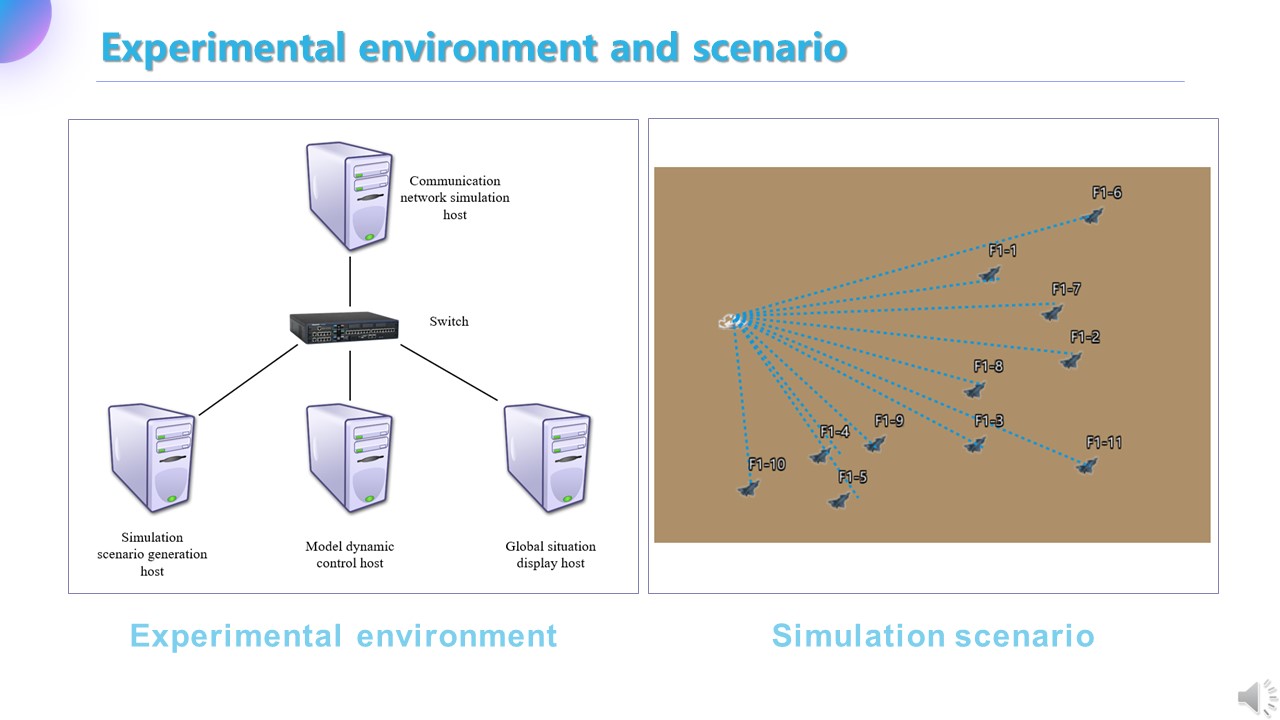 |
Here are the experimental environment and scenario. The experimental environment is in the left side. Let’s look at the simulation scenario in the right side. The scenario contains 11 nodes. Nodes 1-10 are communication nodes for 10 fighters, while node 11 is a scout and jammer integrated node.
|
|
ICACT20240387 Slide.13
[Big slide for presentation]
[YouTube] |
Chrome Text-to-Speach Click!! |
 |
After that, we conducted some experiments to test our model and interface.
|
|
ICACT20240387 Slide.12
[Big slide for presentation]
[YouTube] |
Chrome Text-to-Speach Click!! |
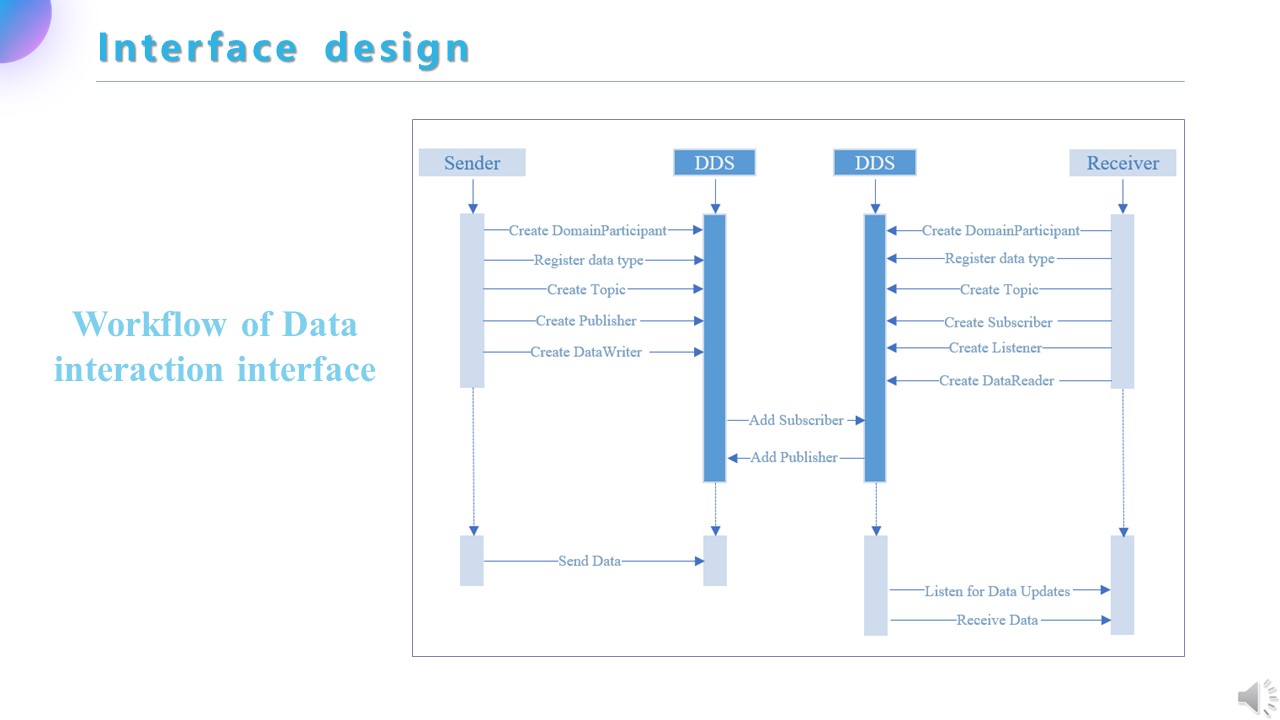 |
The workflow of the data interaction interface is shown here.
While initializing the interface, we need to create a data space Domain and Domain Participants on both receiving and sending ends. According to the DDS specification, we should encapsulate the data that needs to be interacted into a unified data structure and create corresponding Topics. The sender creates a Publisher and corresponding DataWriters for different Topics. The receiver creates Subscribers and corresponding DataReaders, and creates Listeners to listen to data in the Domain.
After the simulation starts, each module encapsulates the data to be sent into a specific structure, and then calls the corresponding data sending function, and uses DataWriter to send the data to the Domain.
The Listener will keep listening to the global data space. While new data is arriving, it will judge the type of data, and call the corresponding DataReader of Subscriber to receive the data. At last, it will call the corresponding data processing function to parse and process the data.
|
|
ICACT20240387 Slide.11
[Big slide for presentation]
[YouTube] |
Chrome Text-to-Speach Click!! |
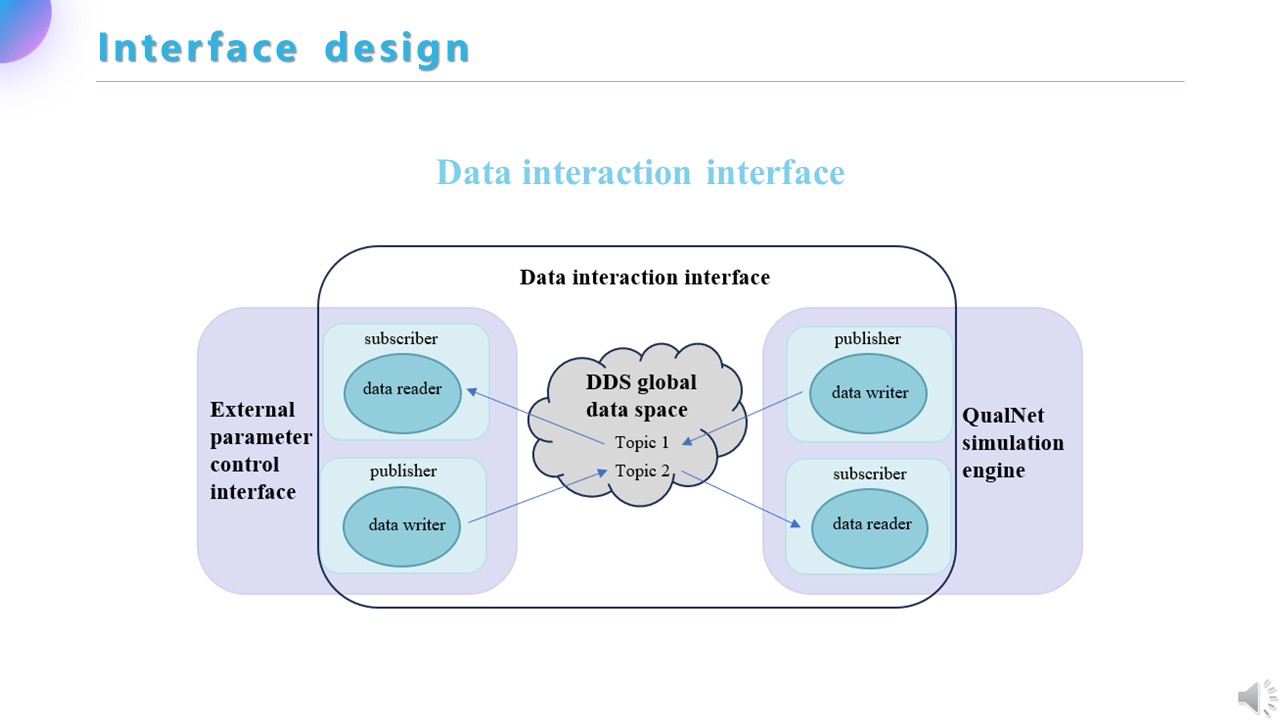 |
The data interaction interface consists of three parts:
QualNet simulation engine data interface: This interface follows the specifications for the secondary development of external interfaces in QualNet. It listens to the requests and responses from external simulation control modules, and publishes the real-time simulation situation information.
External simulation control module data interface: This interface is called by external simulation control modules to issue simulation control instructions and listen for response information from the QualNet simulation engine.
DDS global data space: The publish-subscribe model establishes a virtual shared global data space for all distributed simulation modules. The Publisher of each module sends the data to the global data space, and the Subscriber obtains the corresponding data from the global data space according to their own needs.
|
|
ICACT20240387 Slide.10
[Big slide for presentation]
[YouTube] |
Chrome Text-to-Speach Click!! |
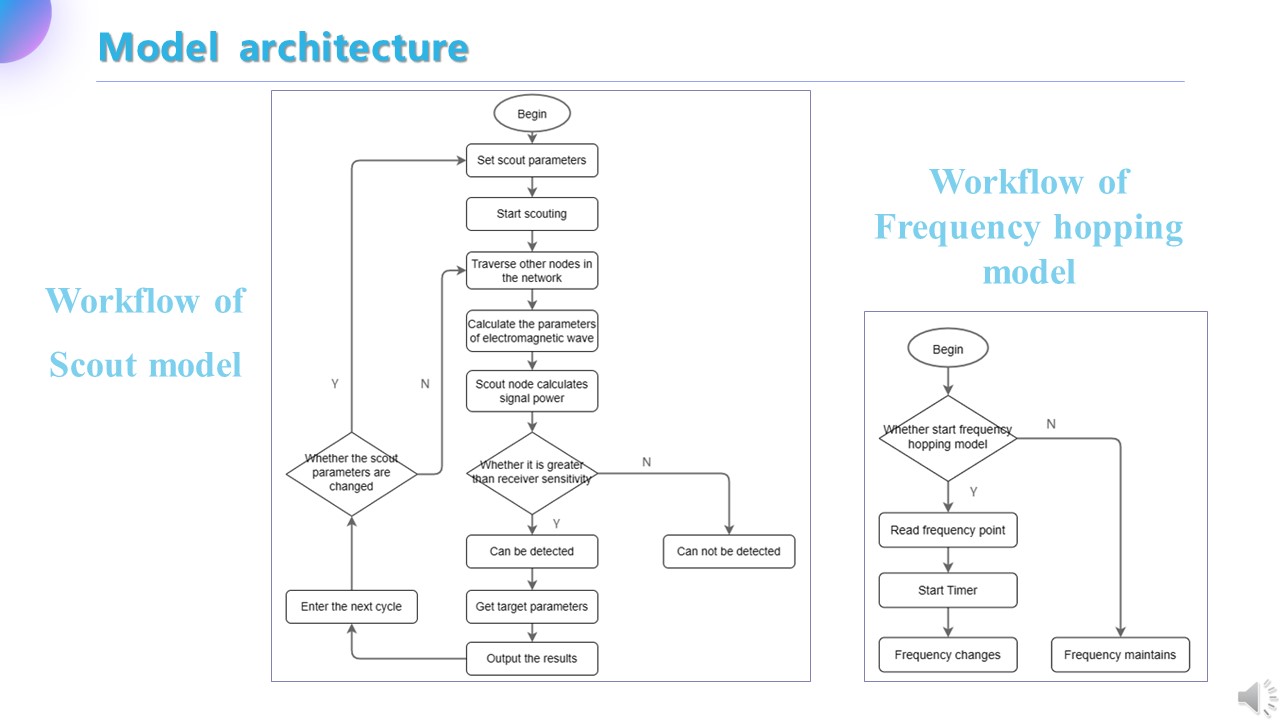 |
This is the workflow of scout model and frequency hopping model.
For the scout model, we need to set a node in the network as a scout node according to the simulation requirements, and configure parameters such as the working mode, interval, and working frequency before the simulation starts. After the simulation starts, the scout node will traverse the other nodes in the network and judges the communication status of the target node. If the target node is within the reconnaissance range and is in the signal transmitting state, the scout node will calculate the transmission parameters of the signal on the path from the target node to itself. When the signal reaches the scout node, the signal power need to be compared with the receiver threshold. If the signal power is greater than the receiver threshold, it is considered to be detectable. At this time, the parameters of the target node such as location, distance and communication frequency are extracted and encapsulated, and sent to the front end through the data interaction interface. After that, the scout node will enter the next cycle. While the scout node is working, the working parameters of it can be dynamically adjusted through the data interaction interface.
For the frequency hopping model, we need to set parameters such as start frequency, end frequency, time interval, and random seed in the configuration file of frequency hopping model. When the simulation begins, if frequency hopping is not enabled, the communication frequency will be fixed. If frequency hopping is enabled, the start frequency, end frequency, and time interval in the configuration file will be read, and the frequency hopping pattern will be generated based on the seed. Afterwards, the timer is started to change the network communication frequency. The frequency hopping patterns of different subnets can be different.
|
|
ICACT20240387 Slide.09
[Big slide for presentation]
[YouTube] |
Chrome Text-to-Speach Click!! |
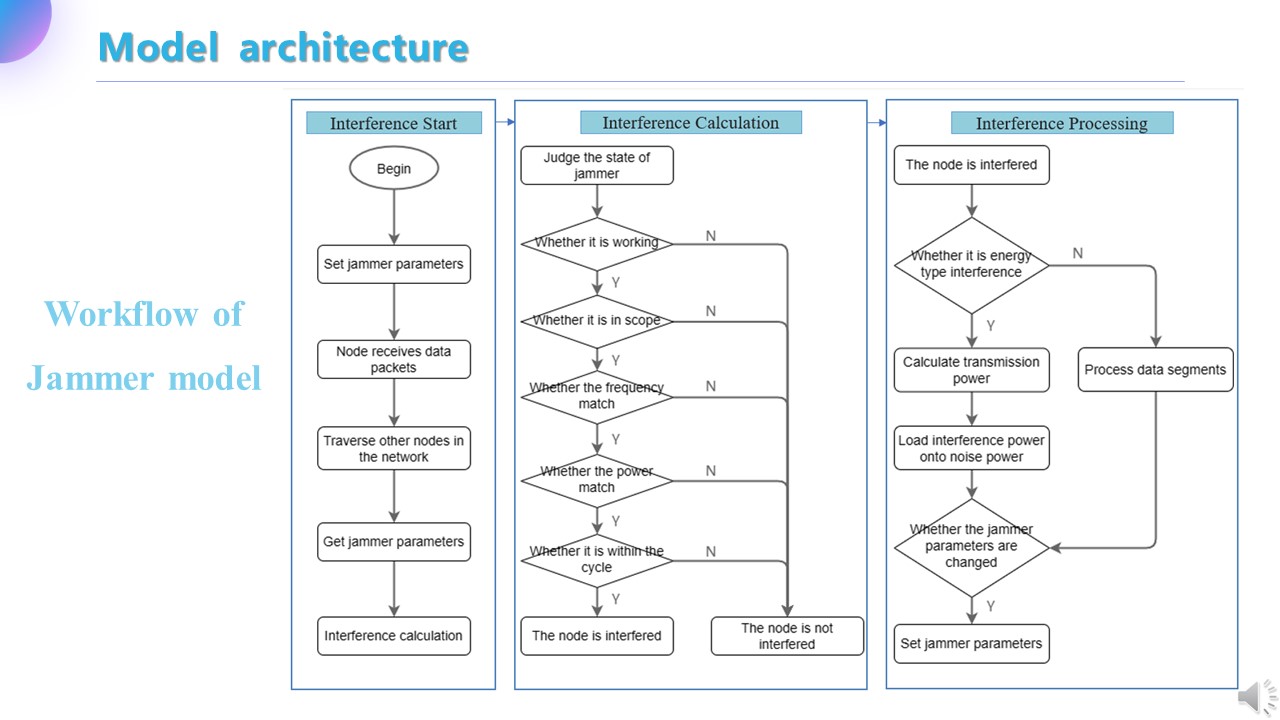 |
This is the workflow of jammer model.
First we need to configure parameters such as the working mode, direction, power, and frequency band of the jammer node. When a node in the network receives a data packet, it will traverse other nodes in the network, and find the jammer node to obtain the parameters. Afterwards, the node will enter the interference calculation module and determine whether itself is affected by the interference according to the direction, frequency, power, and time. If it is in a state of interference, different treatments will be carried out according to different interference methods. If it is energy type interference, the interference power will be loaded onto the noise power. If it is information type interference, the content of data packet will be randomly tampered.
|
|
ICACT20240387 Slide.08
[Big slide for presentation]
[YouTube] |
Chrome Text-to-Speach Click!! |
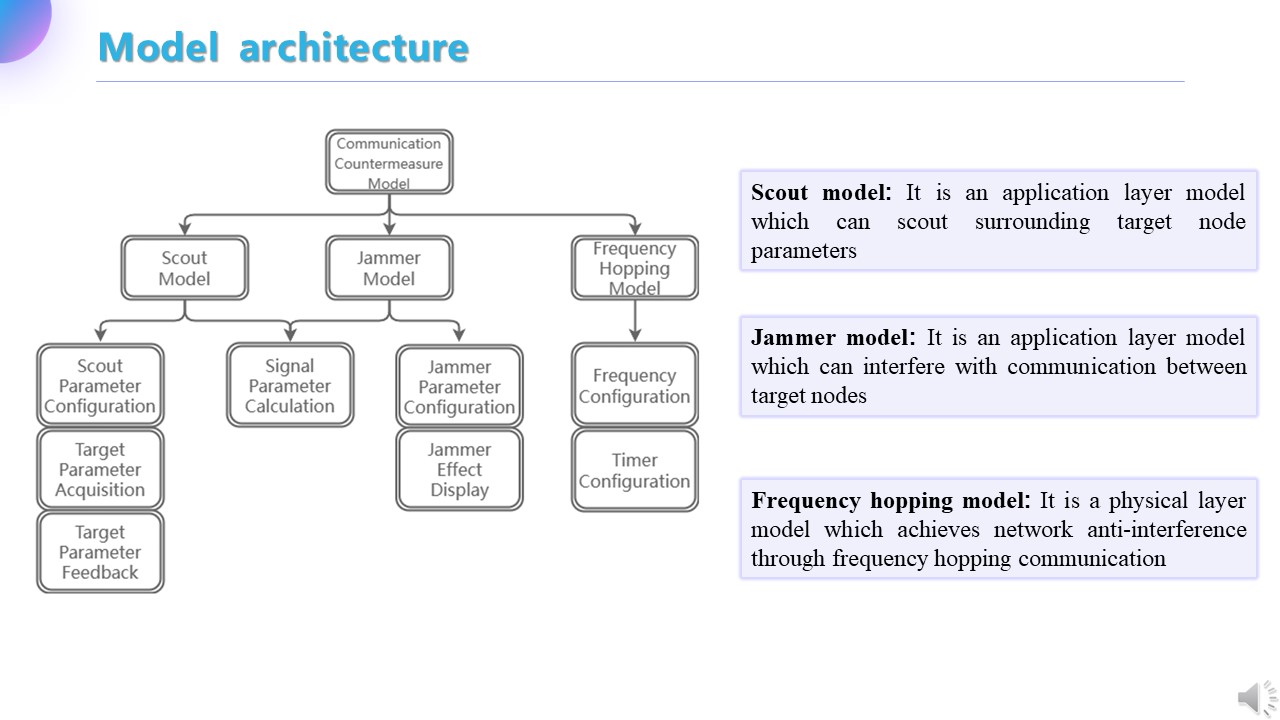 |
The overall architecture of the communication countermeasure model considered in this article is shown here. The scout model is an application layer model, which can scout surrounding target node parameters. The jammer model is also an application layer model, which can interfere with communication between target nodes. The frequency hopping model is a physical layer model which achieves network anti-interference through frequency hopping communication.
|
|
ICACT20240387 Slide.07
[Big slide for presentation]
[YouTube] |
Chrome Text-to-Speach Click!! |
 |
And here is the part two, we developed the model and designed the interface.
|
|
ICACT20240387 Slide.06
[Big slide for presentation]
[YouTube] |
Chrome Text-to-Speach Click!! |
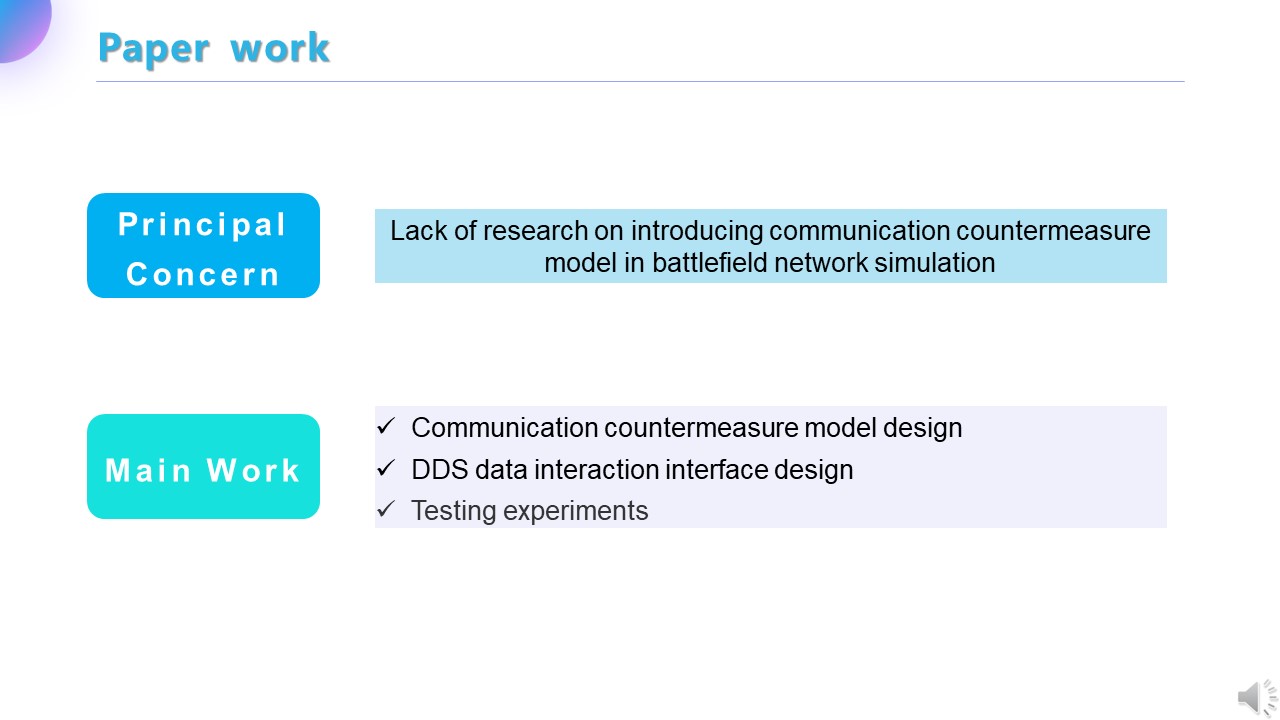 |
Now, Our direction is very clear. The principal concern of this paper is the lack of research on introducing communication countermeasure model in battlefield network simulation. Therefore, the work of this paper is summarized as shown. First, We developed a communication countermeasure model based on QualNet. Then, we designed the DDS data interaction interface. Finally, we conducted some testing experiments.
|
|
ICACT20240387 Slide.05
[Big slide for presentation]
[YouTube] |
Chrome Text-to-Speach Click!! |
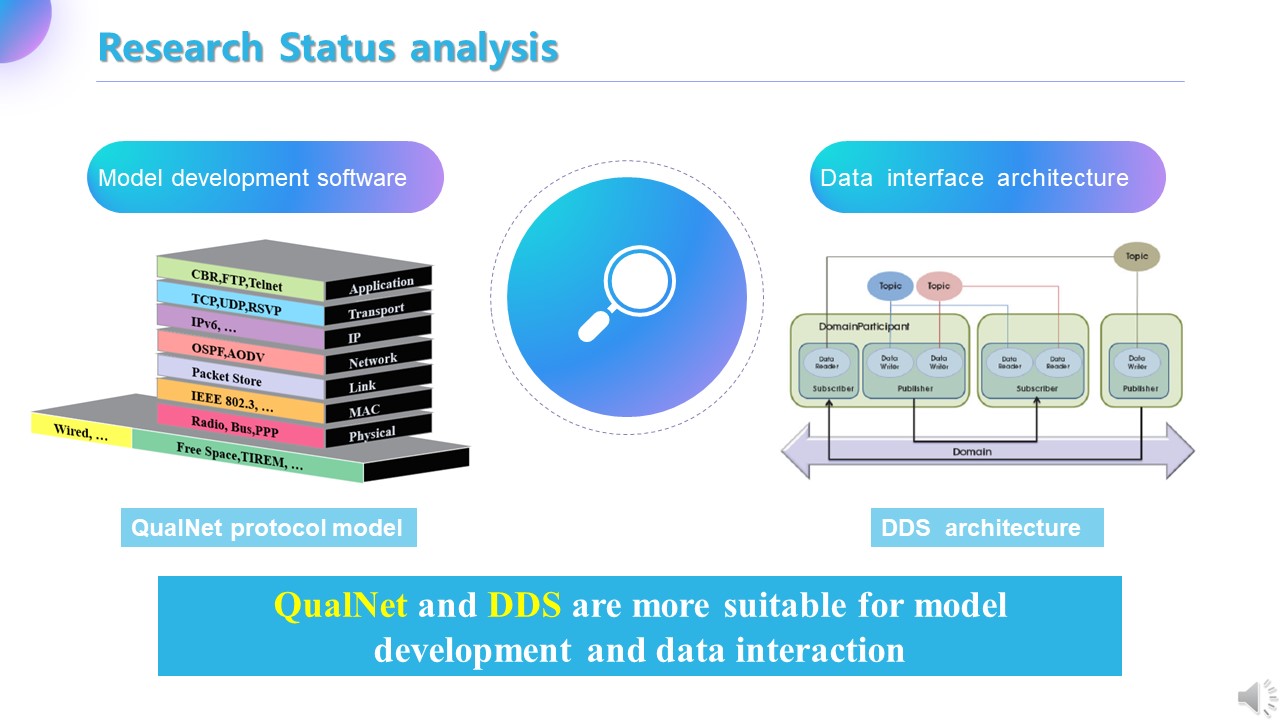 |
Before we start working, we divided the work into two parts.
In terms of model development, QualNet simulation has advantages of large scale, fast speed, and adopts a modular design, making it convenient for users to add or delete protocol models. It supports real-time communication with the real network, and the simulation accuracy is close to the real network. Therefore QualNet is the best choice for model development.
In terms of interface design, the data transmission of simulation system has the requirements of high real-time and high throughput, which means that DDS architecture is the best choice for the simulation system.
|
|
ICACT20240387 Slide.04
[Big slide for presentation]
[YouTube] |
Chrome Text-to-Speach Click!! |
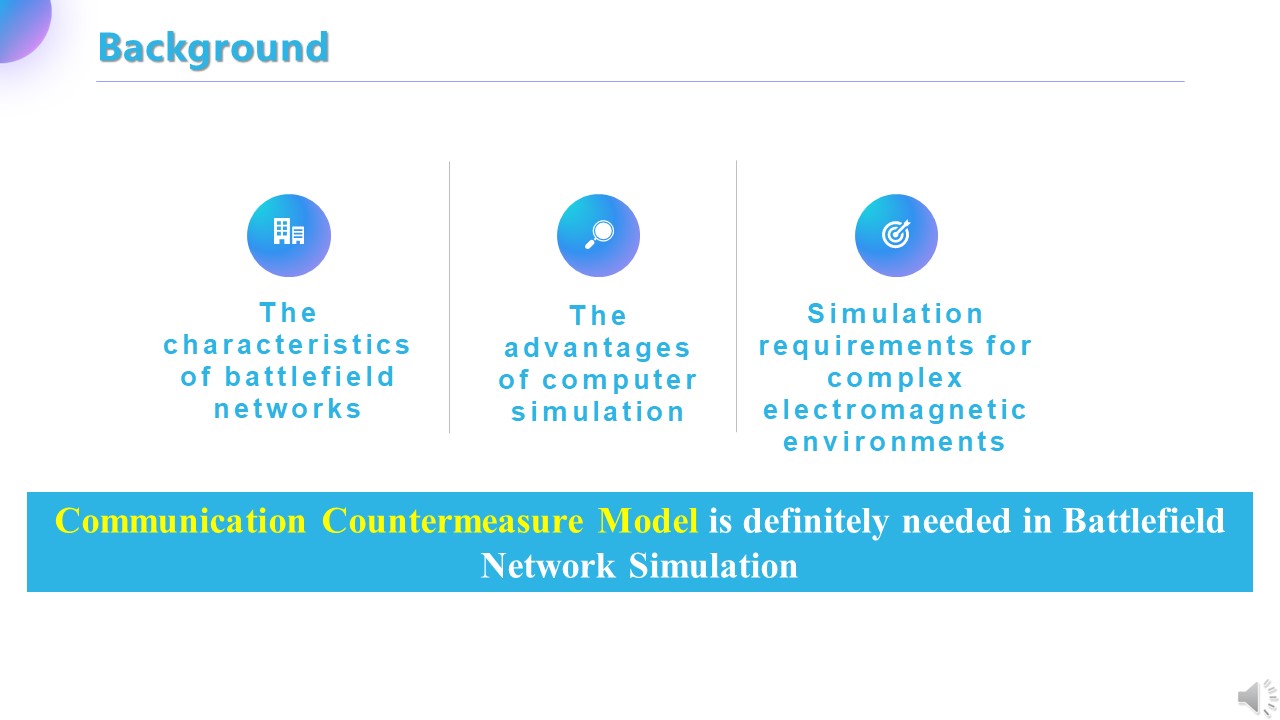 |
The battlefield network has the characteristics of larger scale, more types of nodes, and wider distribution of nodes. The performance analysis of battlefield communication network has been more and more complex and difficult with its increasing scale, heterogeneity and geographical distribution of nodes. Computer simulation technology is considered as a potential technology to efficiently and accurately solve this problem. Besides, battlefield networks usually face complex electromagnetic environments. The simulation of battlefield networks must also consider a comprehensive evaluation of the anti-interference performance of the entire network in a complex electromagnetic environment. Therefore, it is necessary to introduce the reconnaissance interference model and anti-interference model into network simulation to simulate and evaluate the anti-interference performance of the network.
|
|
ICACT20240387 Slide.03
[Big slide for presentation]
[YouTube] |
Chrome Text-to-Speach Click!! |
 |
First, let’s start with the introduction.
|
|
ICACT20240387 Slide.02
[Big slide for presentation]
[YouTube] |
Chrome Text-to-Speach Click!! |
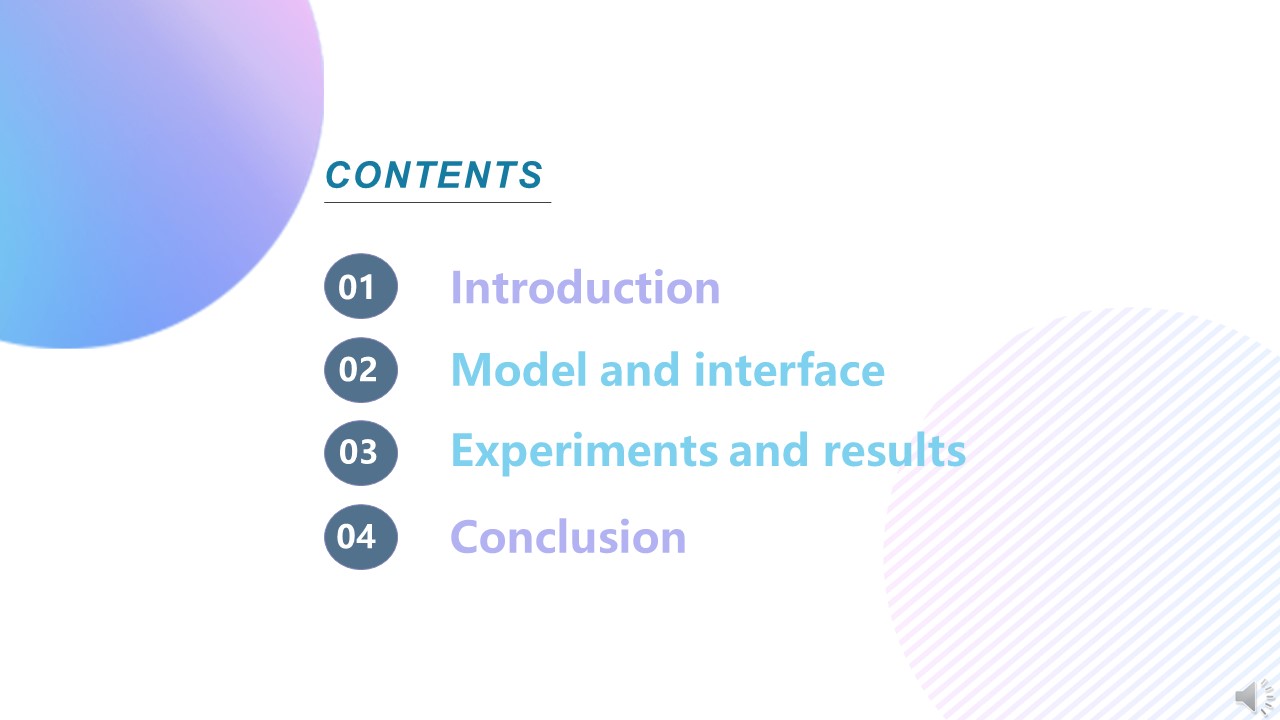 |
My presentation is organized in 4 parts——introduction, model and interface, experiments and results and conclusion.
|
|
ICACT20240387 Slide.01
[Big slide for presentation]
[YouTube] |
Chrome Text-to-Speach Click!! |
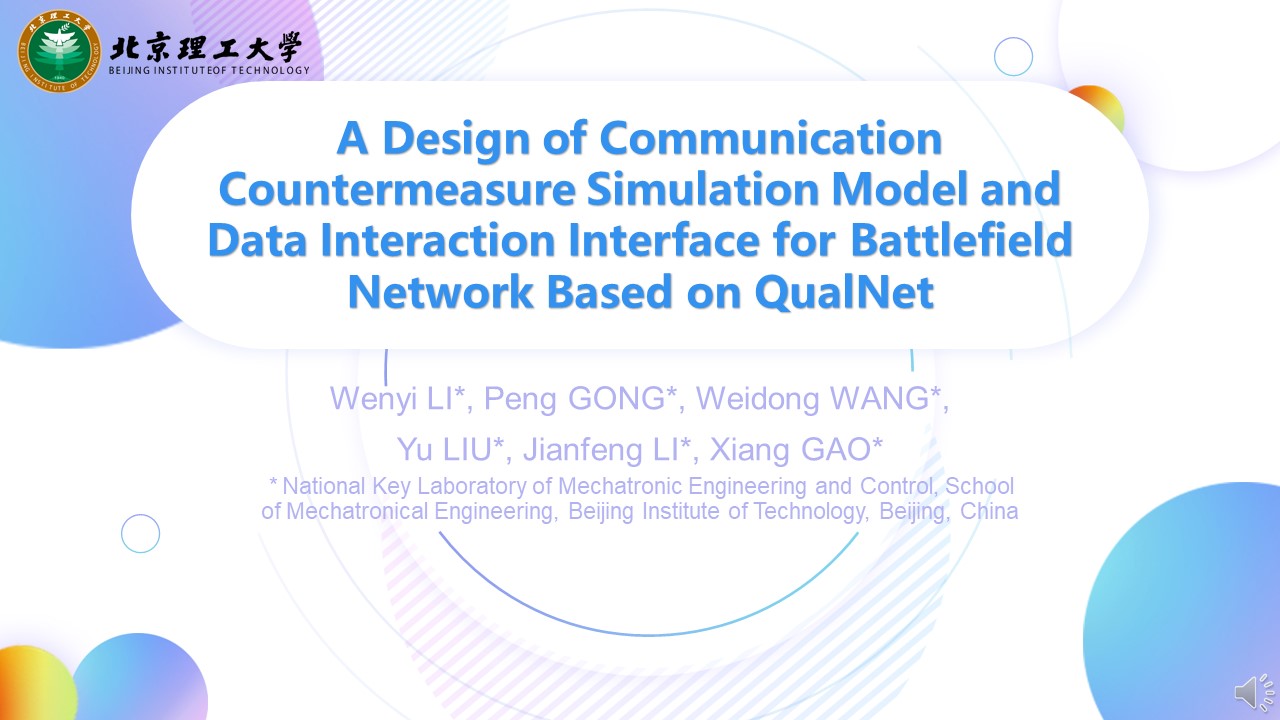 |
Hello, everyone! My name is Li Wenyi, from Beijing Institute of Technology. It’s my honor to be here to share you with my paper. The title of my article is Design of Communication Countermeasure Simulation Model and Data Interaction Interface for Battlefield Network Based on QualNet.
|
















