 ICACT20230164 Slide.23
[Big slide for presentation] |
Chrome Text-to-Speach Click!! |
 |
That's all. Thanks for listening.
|
|
ICACT20230164 Slide.22
[Big slide for presentation]
|
Chrome Text-to-Speach Click!! |
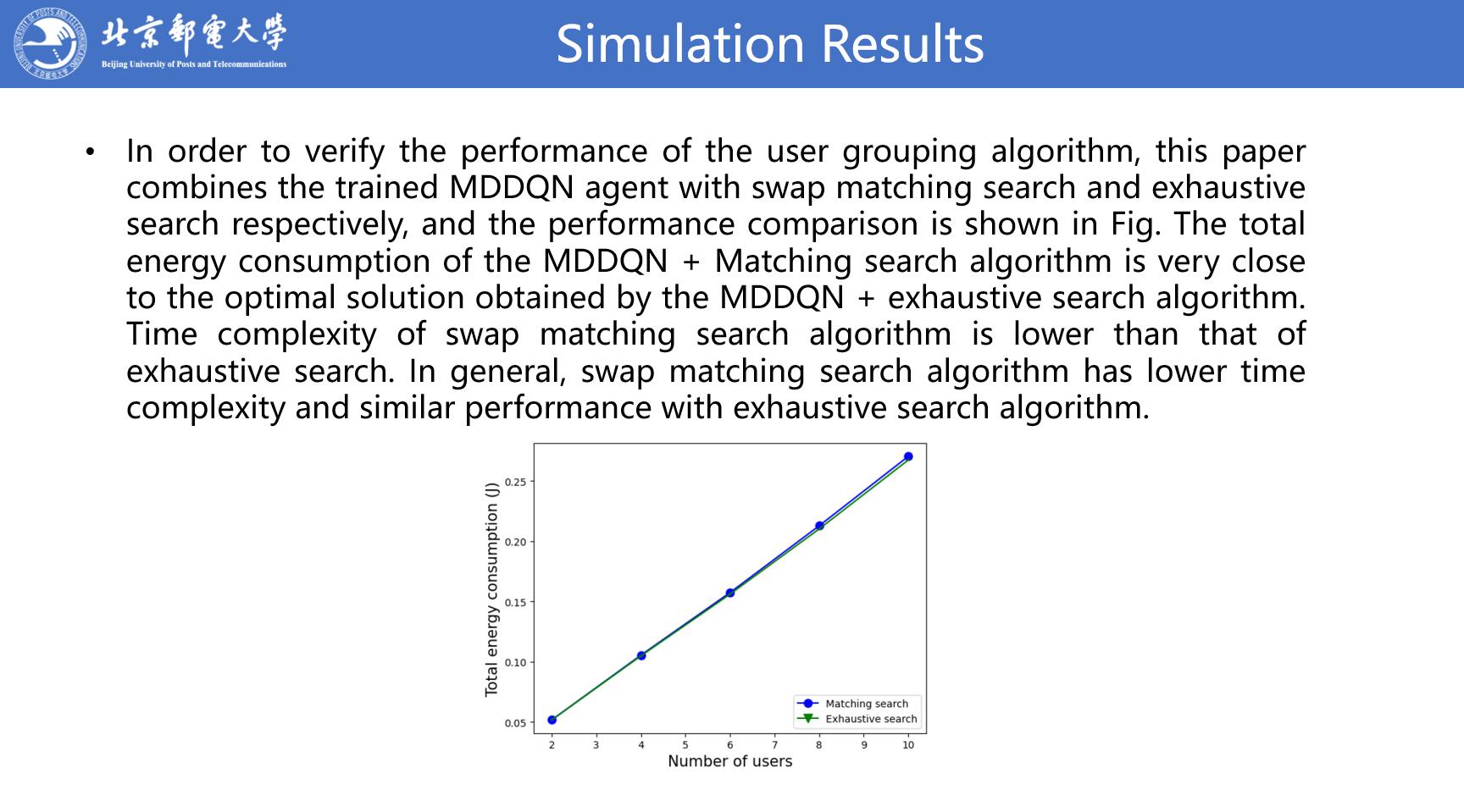 |
In order to verify the performance of the user grouping algorithm, this paper combines the trained MDDQN agent with swap matching search and exhaustive search respectively, and the performance comparison is shown in Fig. The total energy consumption of the MDDQN + Matching search algorithm is very close to the optimal solution obtained by the MDDQN + exhaustive search algorithm. Time complexity of swap matching search algorithm is lower than that of exhaustive search. In general, swap matching search algorithm has lower time complexity and similar performance with exhaustive search algorithm.
|
|
ICACT20230164 Slide.21
[Big slide for presentation]
|
Chrome Text-to-Speach Click!! |
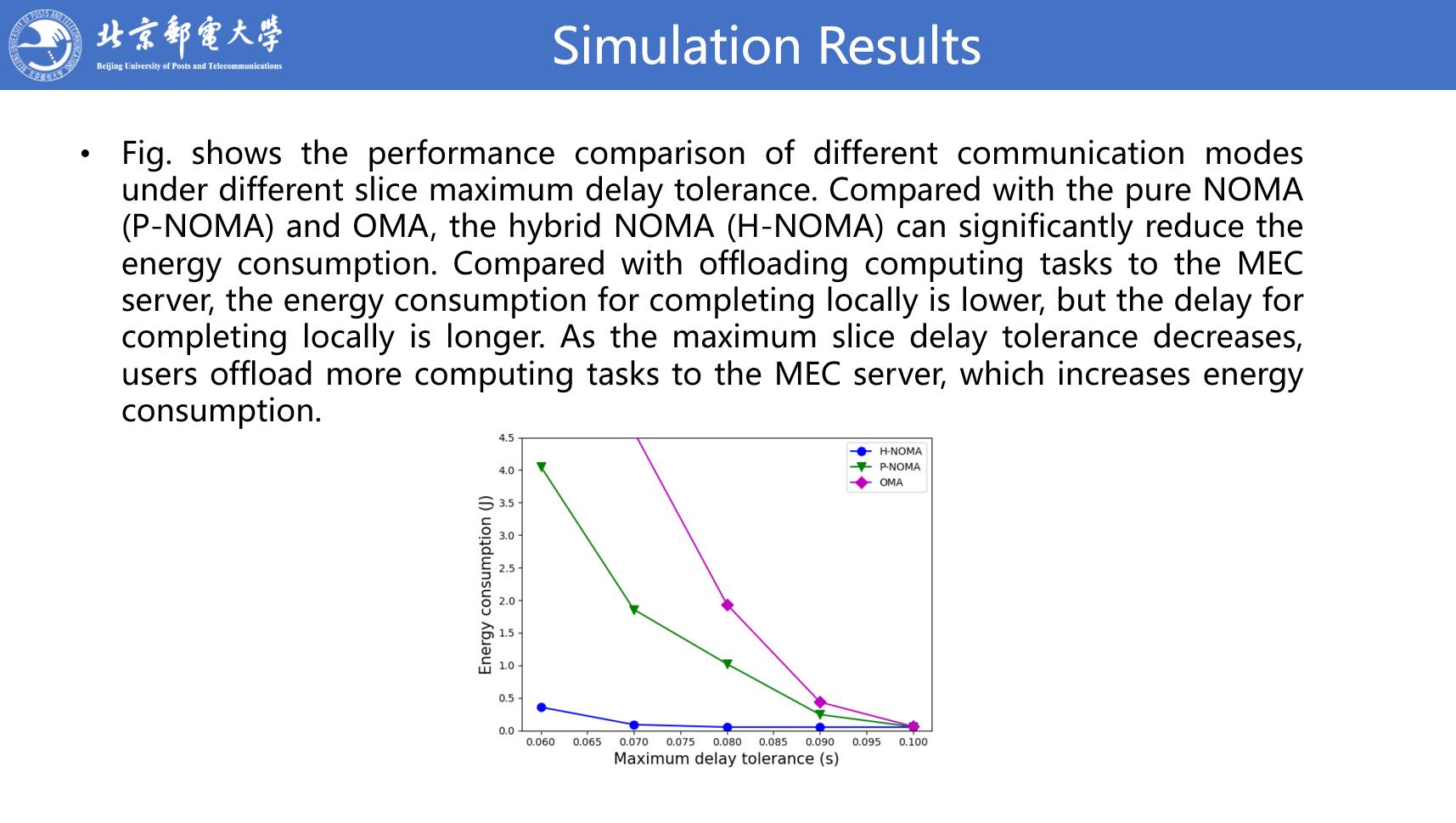 |
Fig. shows the performance comparison of different communication modes under different slice maximum delay tolerance. Compared with the pure NOMA (P-NOMA) and OMA, the hybrid NOMA (H-NOMA) can significantly reduce the energy consumption. Compared with offloading computing tasks to the MEC server, the energy consumption for completing locally is lower, but the delay for completing locally is longer. As the maximum slice delay tolerance decreases, users offload more computing tasks to the MEC server, which increases energy consumption.
|
|
ICACT20230164 Slide.20
[Big slide for presentation]
|
Chrome Text-to-Speach Click!! |
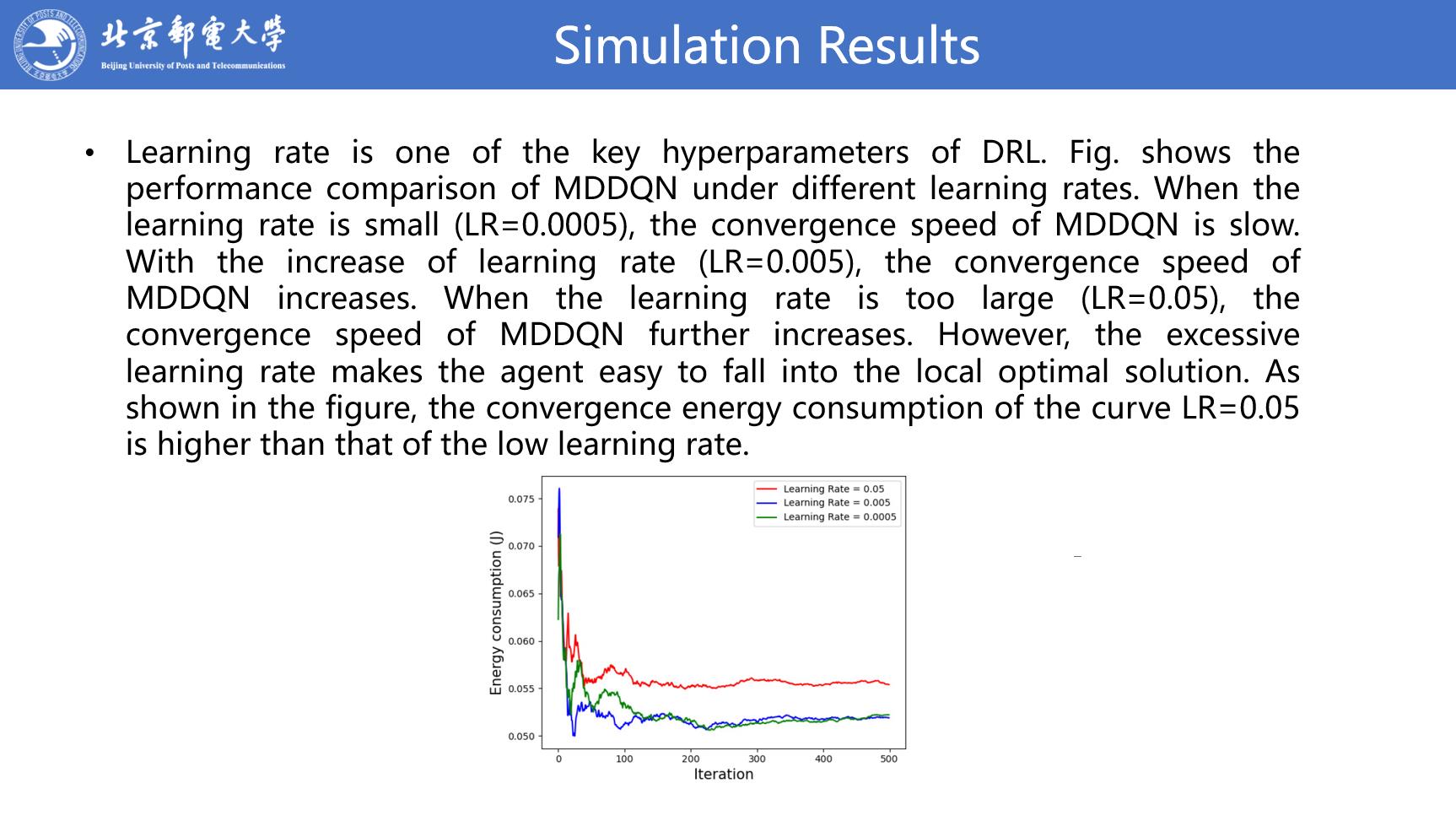 |
Learning rate is one of the key hyperparameters of DRL. Fig. shows the performance comparison of MDDQN under different learning rates. When the learning rate is small (LR=0.0005), the convergence speed of MDDQN is slow. With the increase of learning rate (LR=0.005), the convergence speed of MDDQN increases. When the learning rate is too large (LR=0.05), the convergence speed of MDDQN further increases. However, the excessive learning rate makes the agent easy to fall into the local optimal solution. As shown in the figure, the convergence energy consumption of the curve LR=0.05 is higher than that of the low learning rate.
|
|
ICACT20230164 Slide.19
[Big slide for presentation]
|
Chrome Text-to-Speach Click!! |
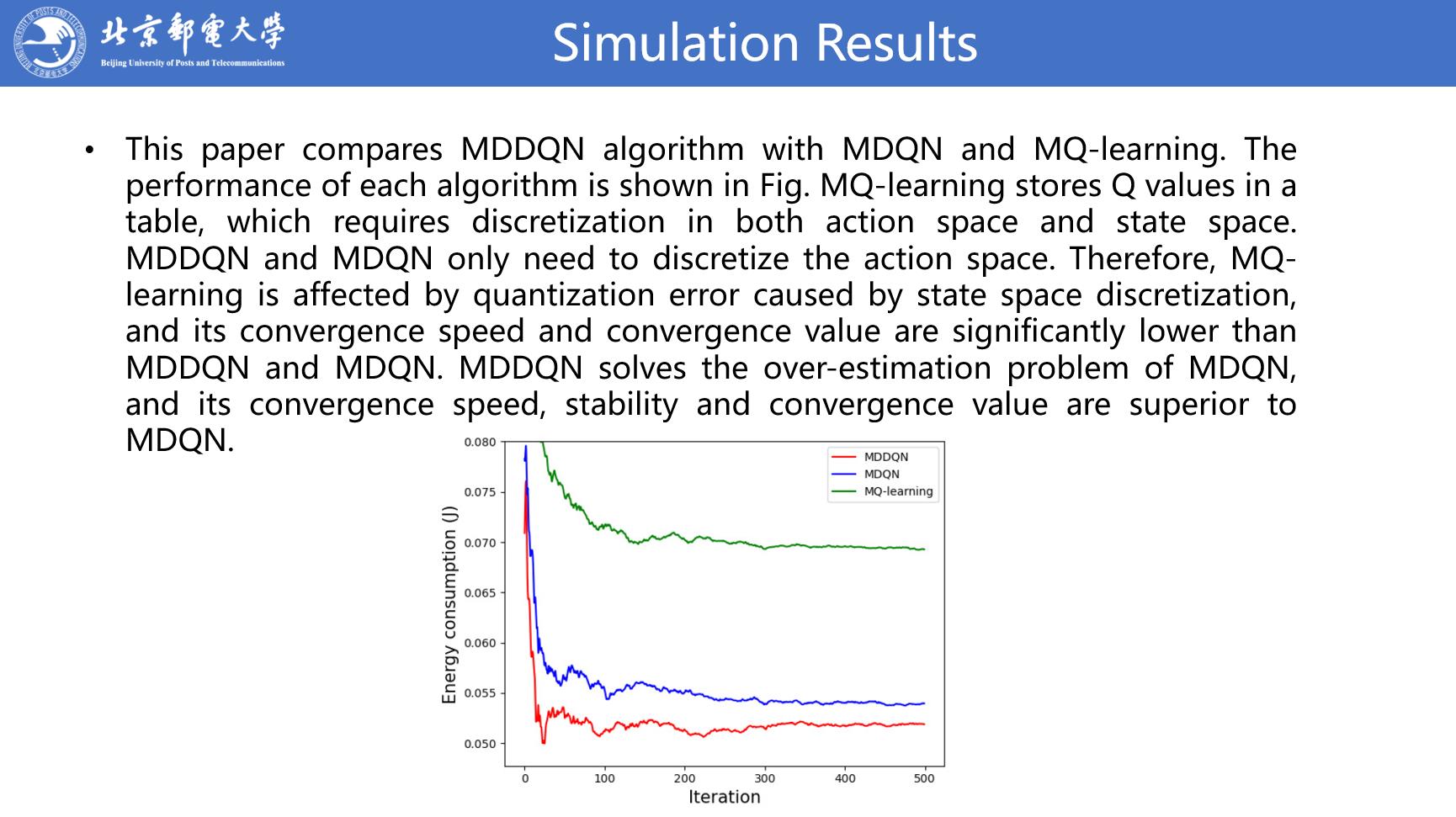 |
This paper compares MDDQN algorithm with MDQN and MQ-learning. The performance of each algorithm is shown in Fig. MQ-learning stores Q values in a table, which requires discretization in both action space and state space. MDDQN and MDQN only need to discretize the action space. Therefore, MQ-learning is affected by quantization error caused by state space discretization, and its convergence speed and convergence value are significantly lower than MDDQN and MDQN. MDDQN solves the over-estimation problem of MDQN, and its convergence speed, stability and convergence value are superior to MDQN.
|
|
ICACT20230164 Slide.18
[Big slide for presentation]
|
Chrome Text-to-Speach Click!! |
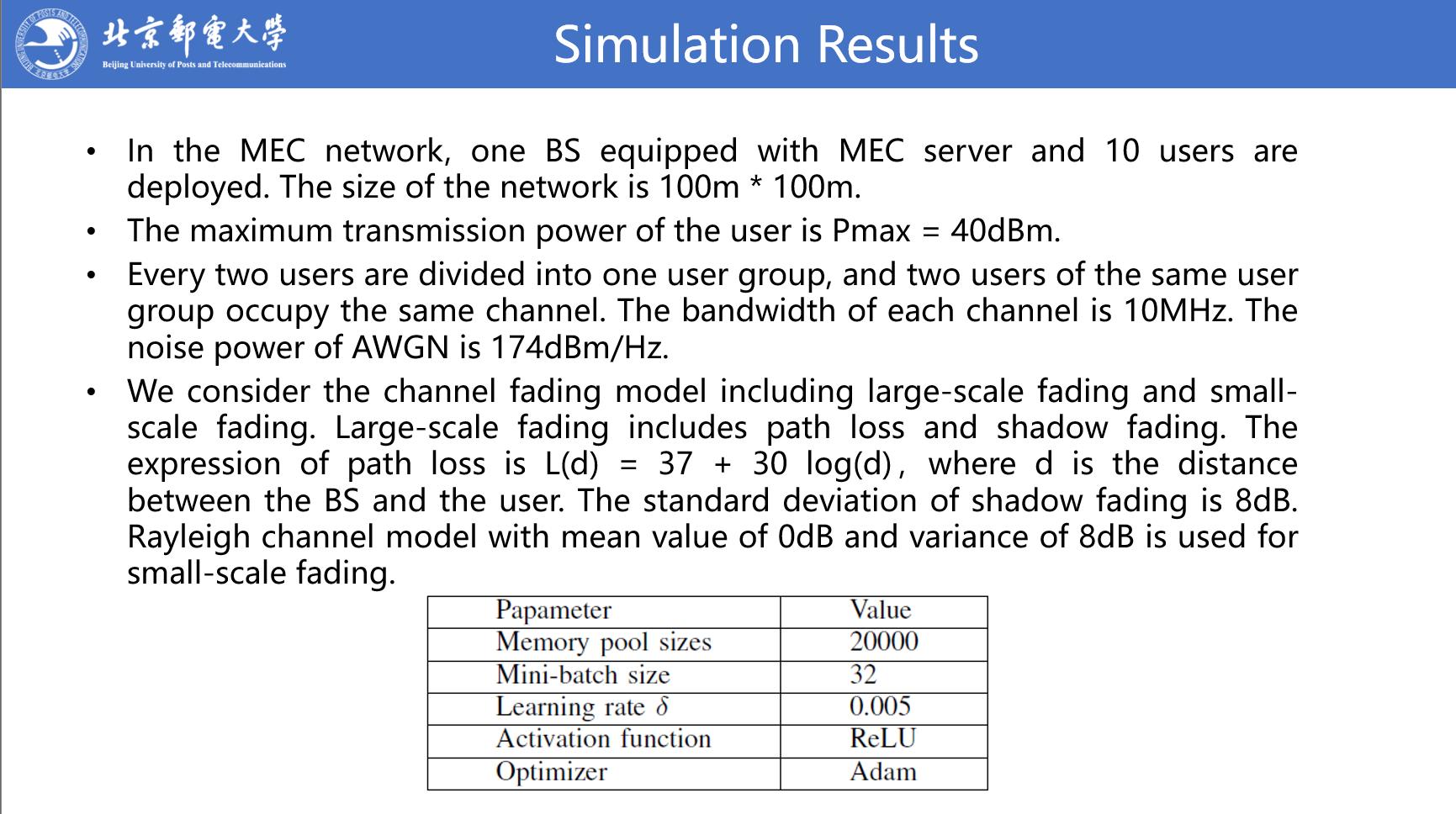 |
In the MEC network, one BS equipped with MEC server and 10 users are deployed. The size of the network is 100m * 100m.
The maximum transmission power of the user is Pmax = 40dBm.
Every two users are divided into one user group, and two users of the same user group occupy the same channel. The bandwidth of each channel is 10MHz. The noise power of AWGN is 174dBm/Hz.
We consider the channel fading model including large-scale fading and small-scale fading. Large-scale fading includes path loss and shadow fading. The expression of path loss is L(d) = 37 + 30 log(d),where d is the distance between the BS and the user. The standard deviation of shadow fading is 8dB. Rayleigh channel model with mean value of 0dB and variance of 8dB is used for small-scale fading.
|
|
ICACT20230164 Slide.17
[Big slide for presentation]
|
Chrome Text-to-Speach Click!! |
 |
At last, I will introduce the Simulation Results section.
|
|
ICACT20230164 Slide.16
[Big slide for presentation]
|
Chrome Text-to-Speach Click!! |
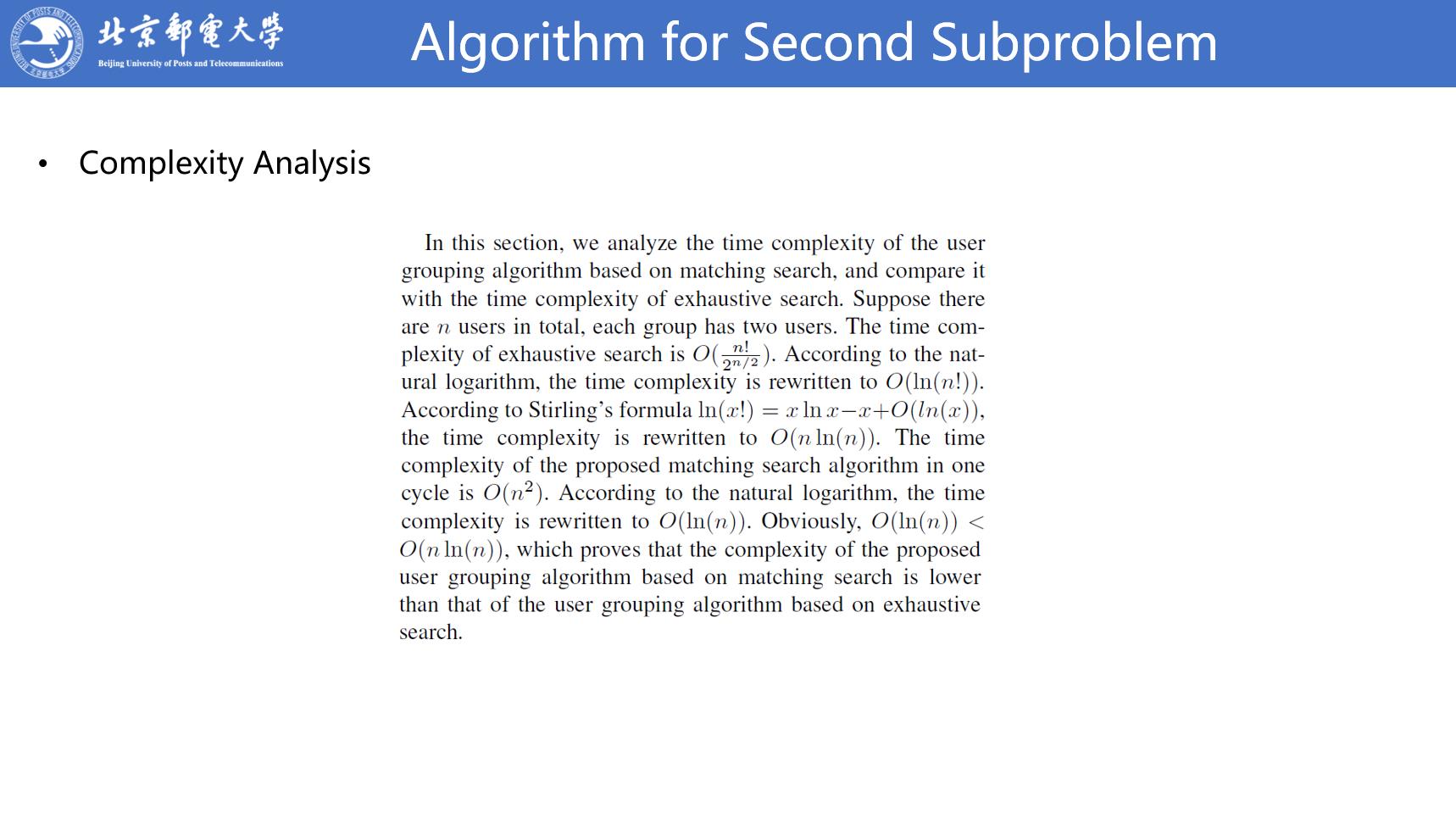 |
The complexity of the proposed user grouping algorithm based on matching search is lower than that of the user grouping algorithm based on exhaustive search.
|
|
ICACT20230164 Slide.15
[Big slide for presentation]
|
Chrome Text-to-Speach Click!! |
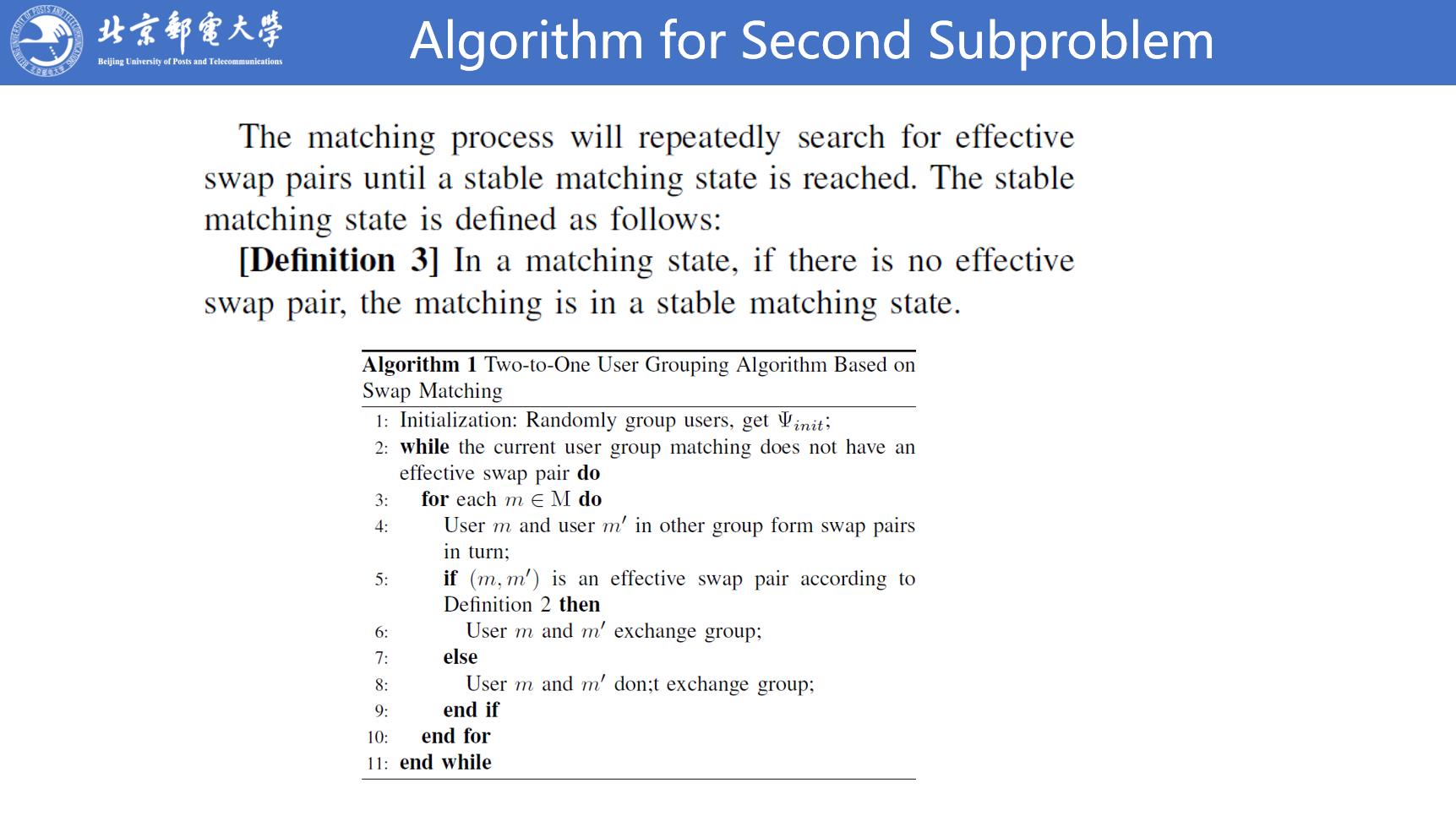 |
The matching process will repeatedly search for effective swap pairs until a stable matching state is reached.
|
|
ICACT20230164 Slide.14
[Big slide for presentation]
|
Chrome Text-to-Speach Click!! |
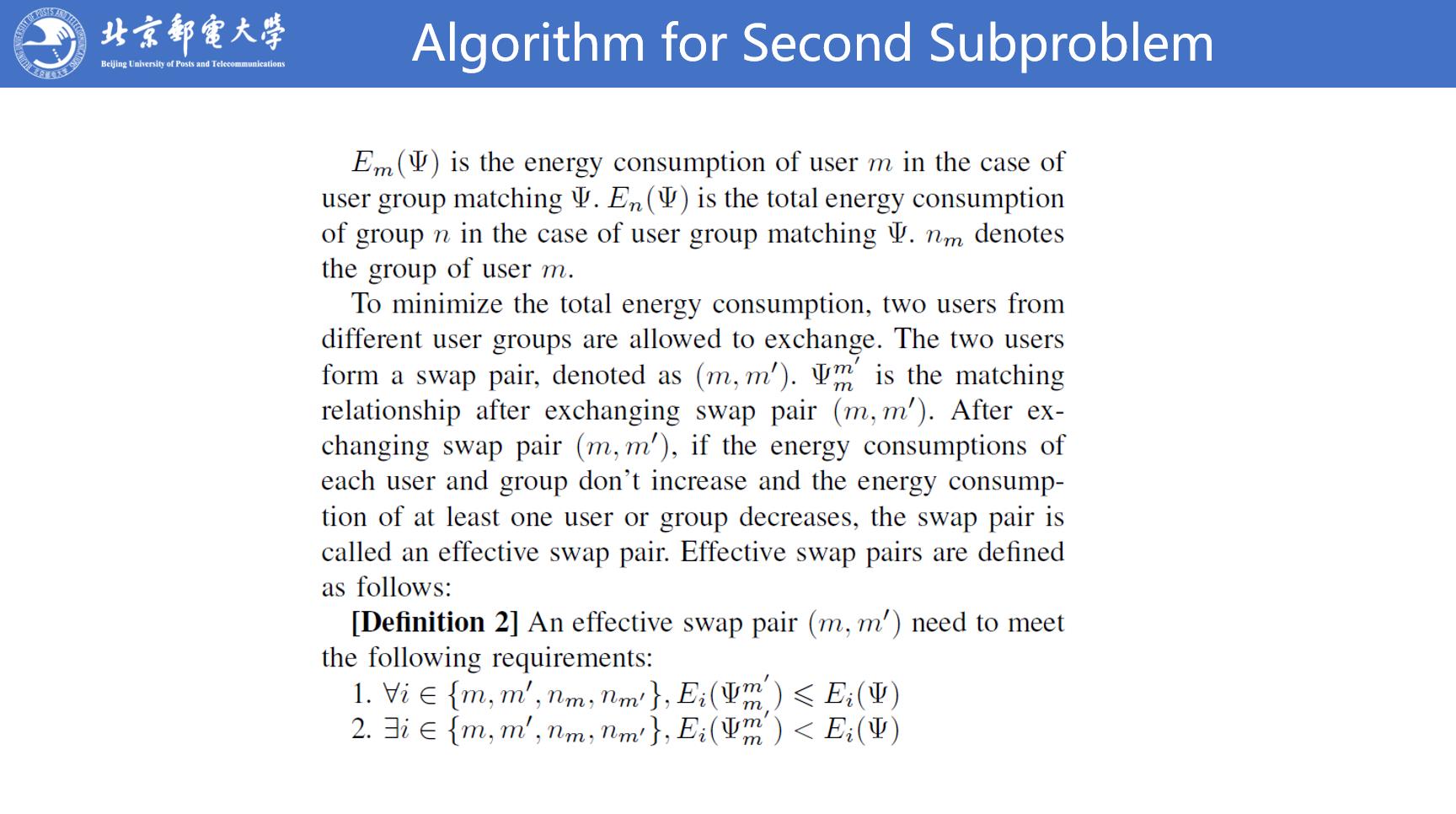 |
To minimize the total energy consumption, two users from different user groups are allowed to exchange. The two users from a swap pair, denoted as (m,m'). Fi is the matching relationship after exchanging swap pair (m,m'). After exchanging swap pair (m,m'), if the energy consumptions of each user and group don’t increase and the energy consumption of at least one user or group decreases, the swap pair is called an effective swap pair.
|
|
ICACT20230164 Slide.13
[Big slide for presentation]
|
Chrome Text-to-Speach Click!! |
 |
We extend the intra-group resource allocation scheme to multi-user scenarios by proposing a user grouping algorithm.
We propose a low complexity user grouping algorithm based on swap matching theory, to minimize the total energy consumption of MEC network system.
In Definition 1,
Condition 1 indicates that each user has a corresponding group.
Condition 2 indicates that each group corresponds to several users.
Condition 3 indicates that each user corresponds to only one group.
Condition 4 indicates that there are two users in each group.
|
|
ICACT20230164 Slide.12
[Big slide for presentation]
|
Chrome Text-to-Speach Click!! |
 |
The basic elements of task controller and power controller are set as follows:
Agent: The task controller is configured at the users to manage the user’s subtask offloading. The power controller is configured at BS to manage the transmission power of users.
State: The state of the task controller is expressed as , where is the adjacency matrix of the subtask dependency DAG. The state of the power controller is expressed as Spc = , where is the total number of bits transmitted by the user a.
Action: The action of the task controller is expressed as . The action of the power controller is expressed as .
Reward: The reward functions of task controller and power controller need to consider whether the users meet the network slice maximum delay tolerance. If the network slice maximum delay tolerance is not met, the reward value will be 0. The step function meets our expectations for the reward function. However, the step function is discontinuous at the point x=0, which makes it difficult to update the gradient of DNN. We use Sigmoid function instead of step function.
|
|
ICACT20230164 Slide.11
[Big slide for presentation]
|
Chrome Text-to-Speach Click!! |
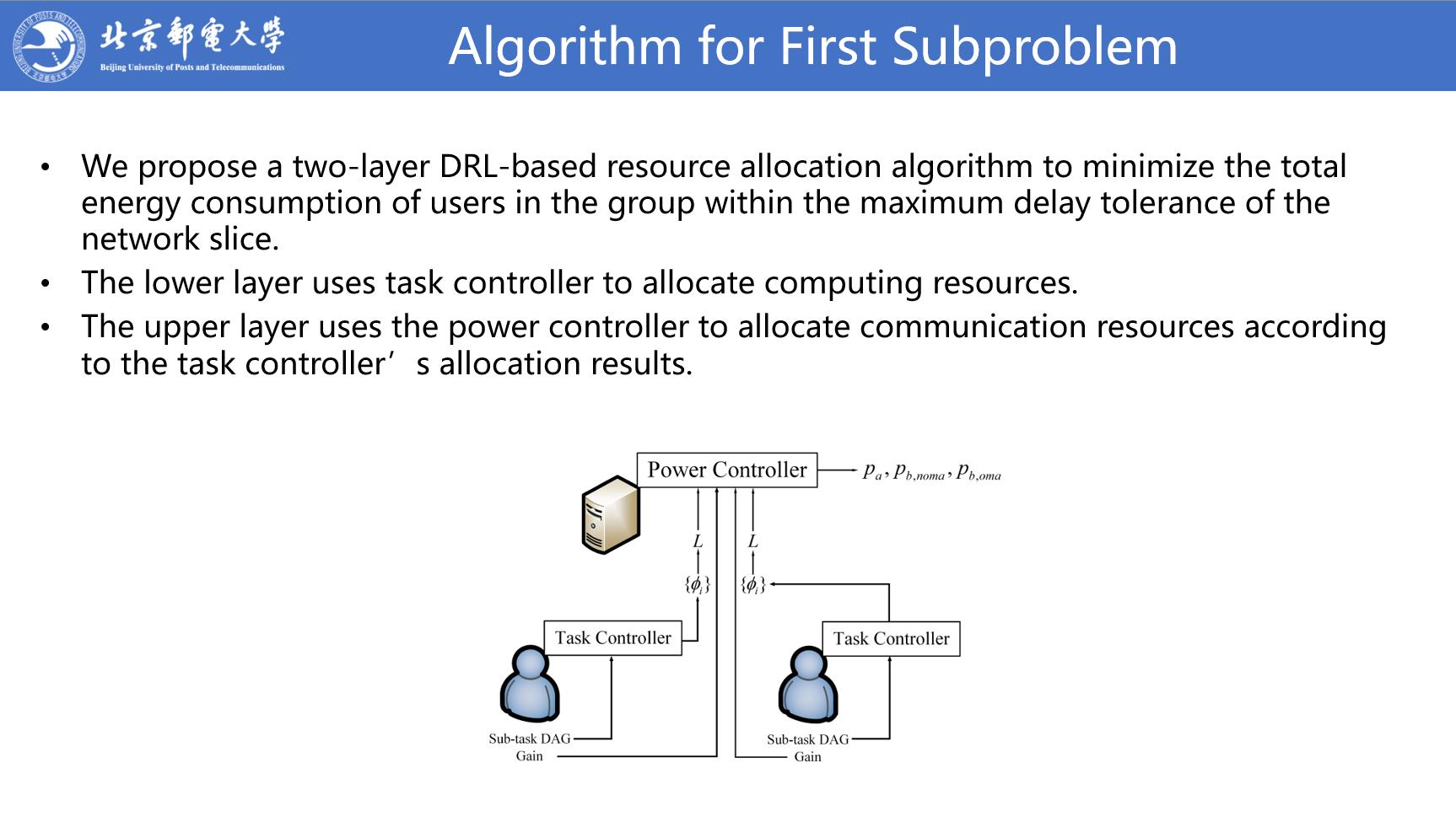 |
We propose a two-layer DRL-based resource allocation algorithm to minimize the total energy consumption of users in the group within the maximum delay tolerance of the network slice.
The lower layer uses task controller to allocate computing resources.
The upper layer uses the power controller to allocate communication resources according to the task controller’s allocation results.
|
|
ICACT20230164 Slide.10
[Big slide for presentation]
|
Chrome Text-to-Speach Click!! |
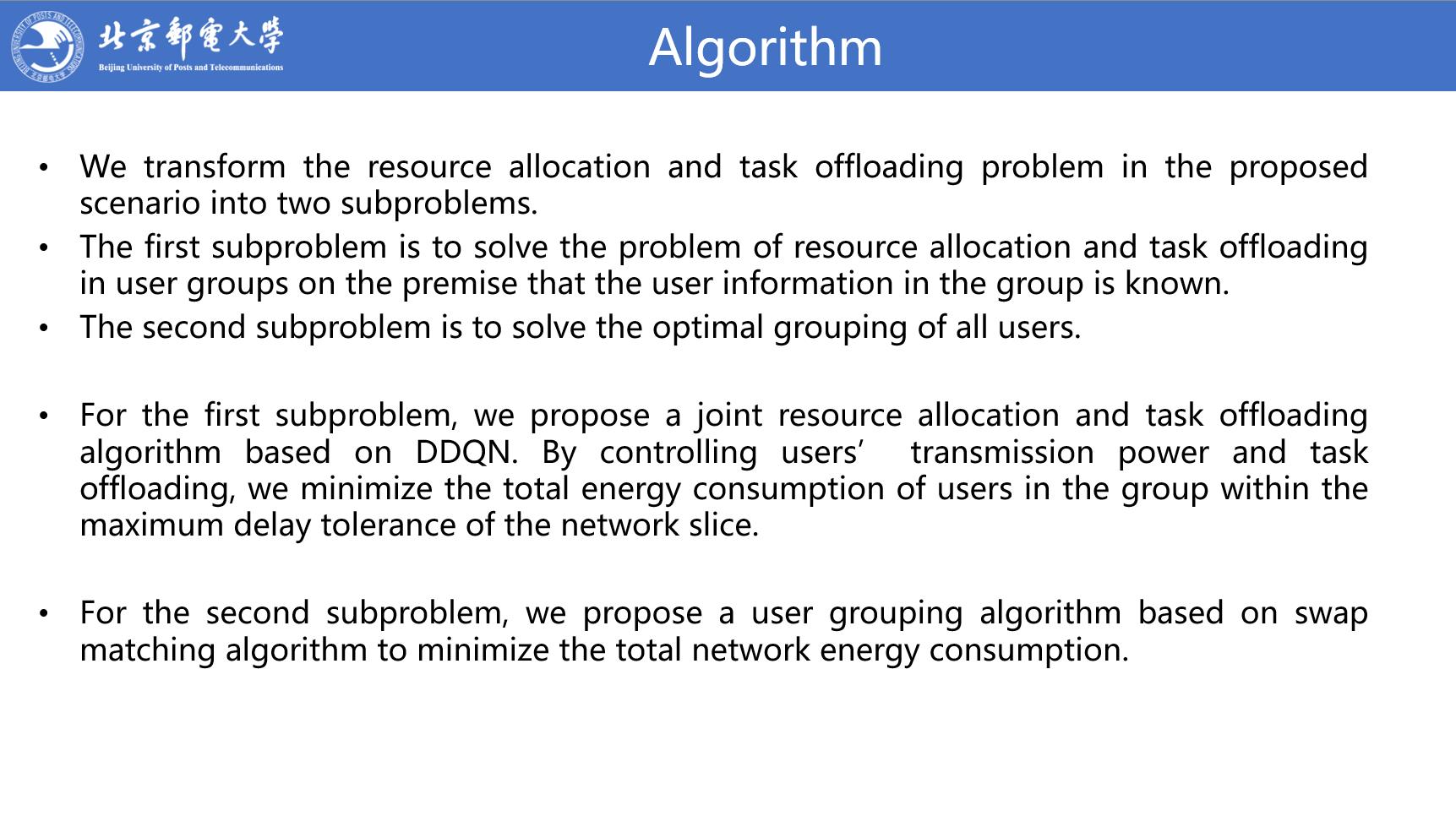 |
We transform the resource allocation and task offloading problem in the proposed scenario into two subproblems.
The first subproblem is to solve the problem of resource allocation and task offloading in user groups on the premise that the user information in the group is known.
The second subproblem is to solve the optimal grouping of all users.
For the first subproblem, we propose a joint resource allocation and task offloading algorithm based on DDQN. By controlling users’ transmission power and task offloading, we minimize the total energy consumption of users in the group within the maximum delay tolerance of the network slice.
For the second subproblem, we propose a user grouping algorithm based on swap matching algorithm to minimize the total network energy consumption.
|
|
ICACT20230164 Slide.09
[Big slide for presentation]
|
Chrome Text-to-Speach Click!! |
 |
Then, I will introduce the Algorithm section.
|
|
ICACT20230164 Slide.08
[Big slide for presentation]
|
Chrome Text-to-Speach Click!! |
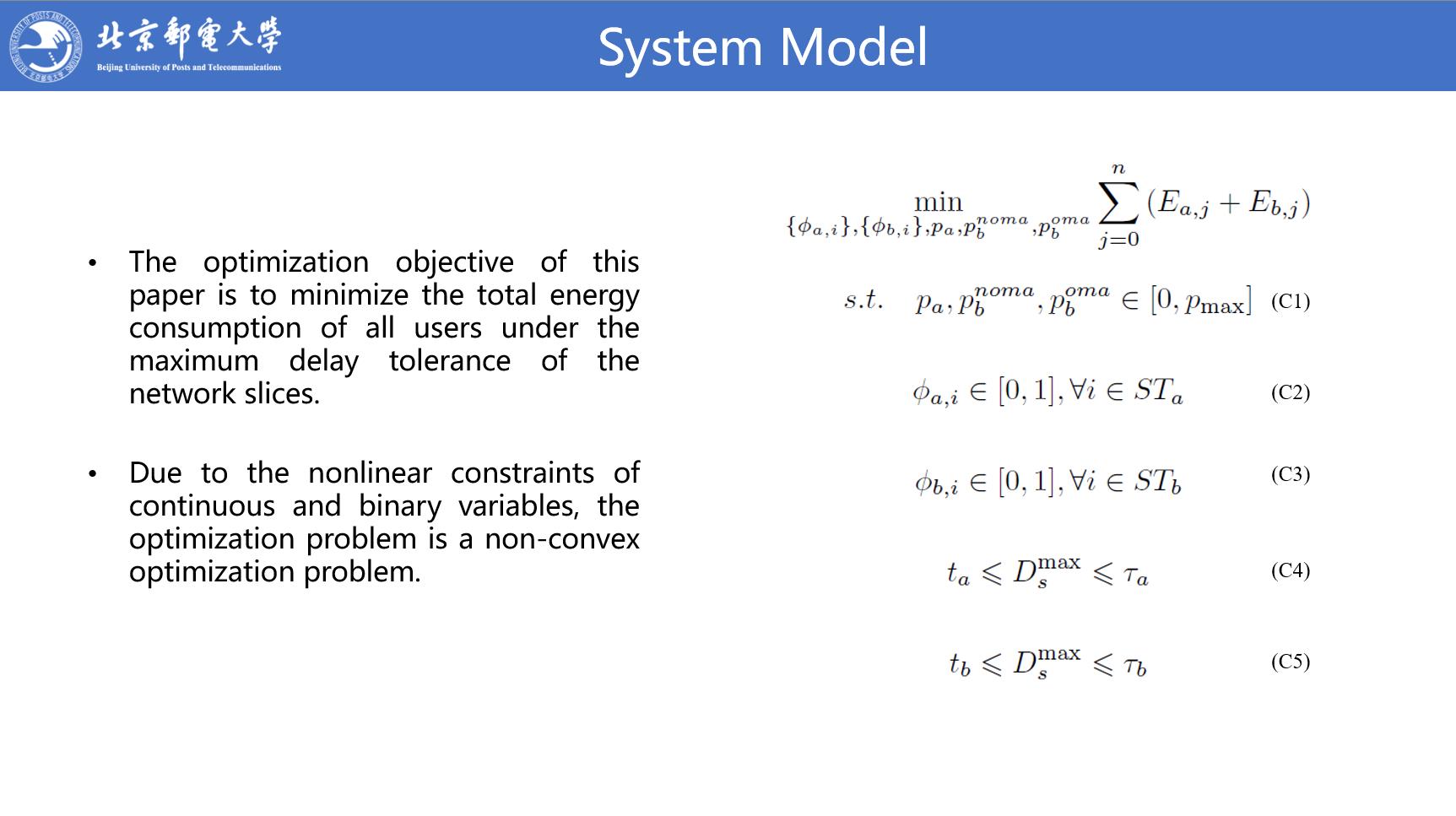 |
The optimization objective of this paper is to minimize the total energy consumption of all users under the maximum delay tolerance of the network slices.
Due to the nonlinear constraints of continuous and binary variables, the optimization problem is a non-convex optimization problem.
|
|
ICACT20230164 Slide.07
[Big slide for presentation]
|
Chrome Text-to-Speach Click!! |
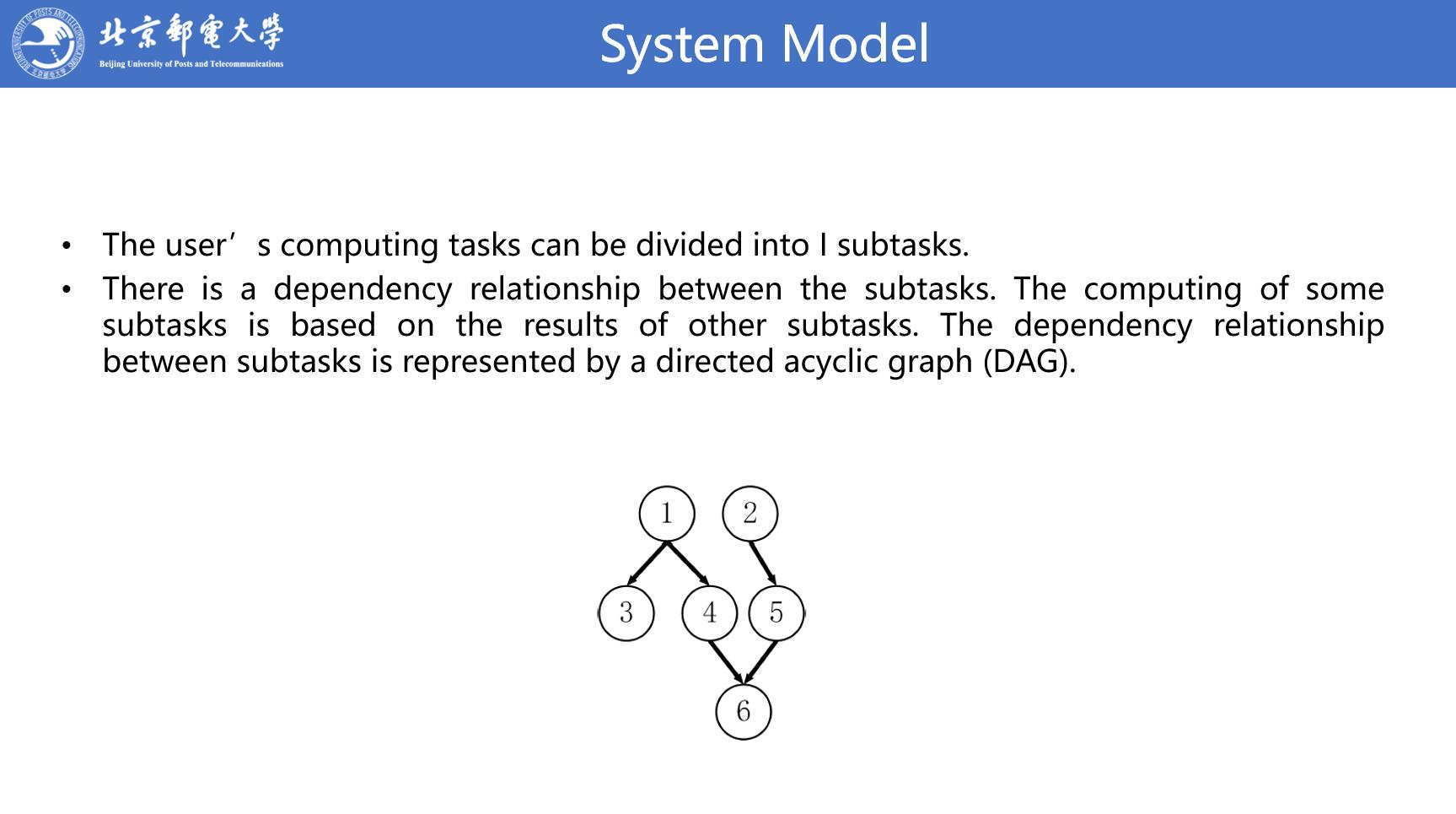 |
The user’s computing tasks can be divided into I subtasks.
There is a dependency relationship between the subtasks. The computing of some subtasks is based on the results of other subtasks. The dependency relationship between subtasks is represented by a directed acyclic graph (DAG).
|
|
ICACT20230164 Slide.06
[Big slide for presentation]
|
Chrome Text-to-Speach Click!! |
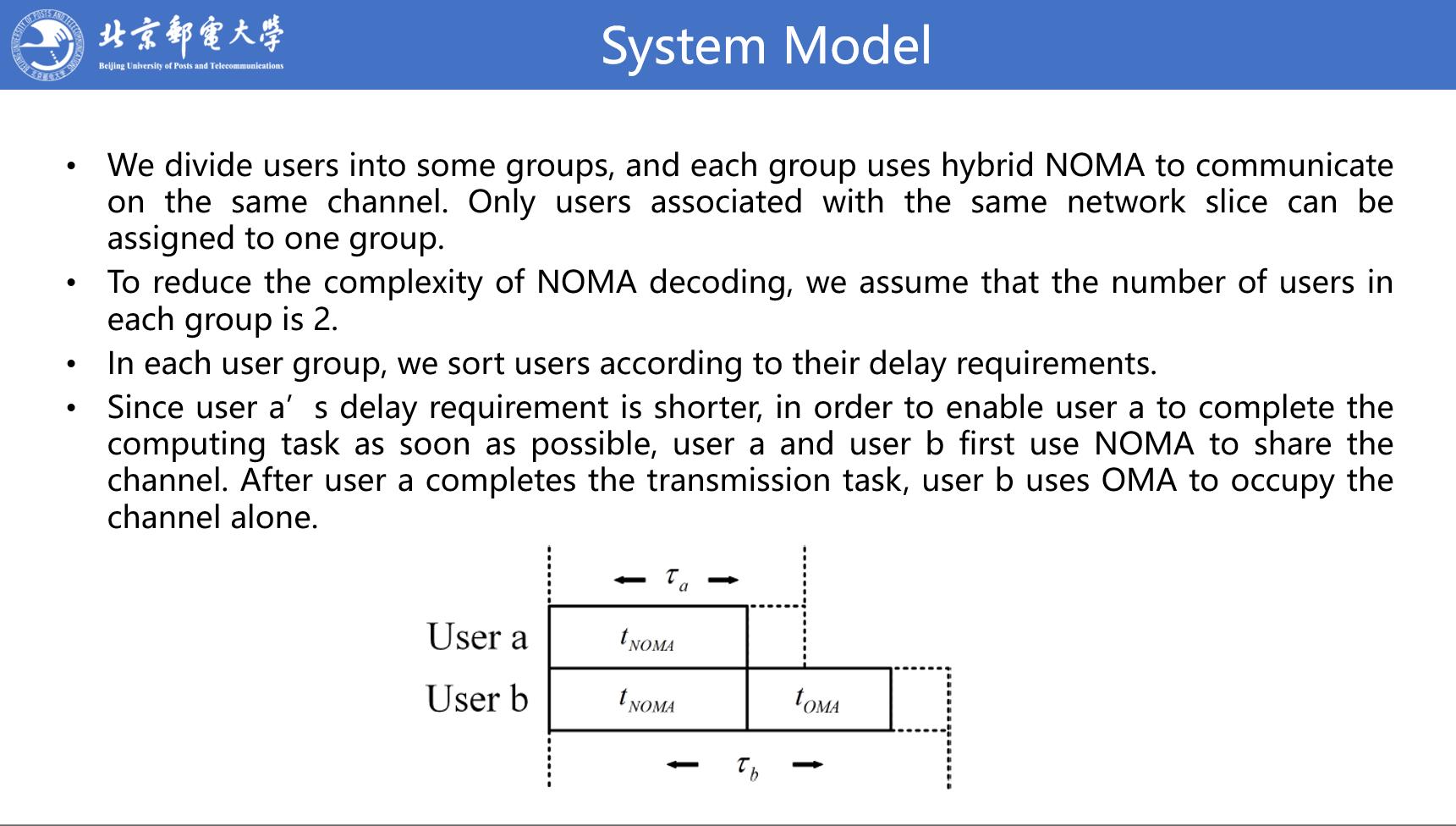 |
We divide users into some groups, and each group uses hybrid NOMA to communicate on the same channel. Only users associated with the same network slice can be assigned to one group.
To reduce the complexity of NOMA decoding, we assume that the number of users in each group is 2.
In each user group, we sort users according to their delay requirements.
Since user a’s delay requirement is shorter, in order to enable user a to complete the computing task as soon as possible, user a and user b first use NOMA to share the channel. After user a completes the transmission task, user b uses OMA to occupy the channel alone.
|
|
ICACT20230164 Slide.05
[Big slide for presentation]
|
Chrome Text-to-Speach Click!! |
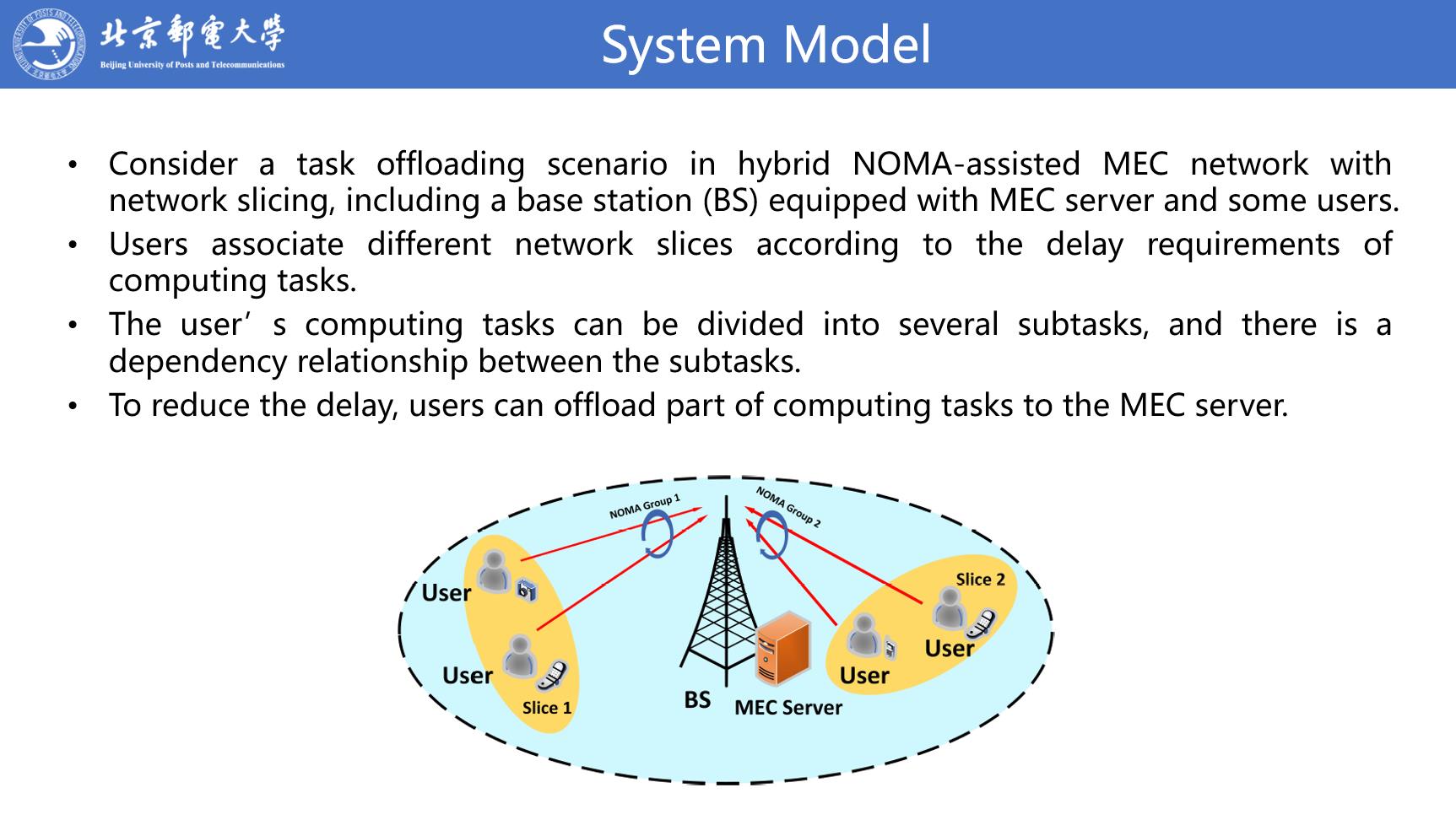 |
In this paper, we consider a task offloading scenario in hybrid NOMA-assisted MEC network with network slicing, including a base station (BS) equipped with MEC server and some users.
Users associate different network slices according to the delay requirements of computing tasks.
The user’s computing tasks can be divided into several subtasks, and there is a dependency relationship between the subtasks.
To reduce the delay, users can offload part of computing tasks to the MEC server.
|
|
ICACT20230164 Slide.04
[Big slide for presentation]
|
Chrome Text-to-Speach Click!! |
 |
Then, I will introduce the System Model section.
|
|
ICACT20230164 Slide.03
[Big slide for presentation]
|
Chrome Text-to-Speach Click!! |
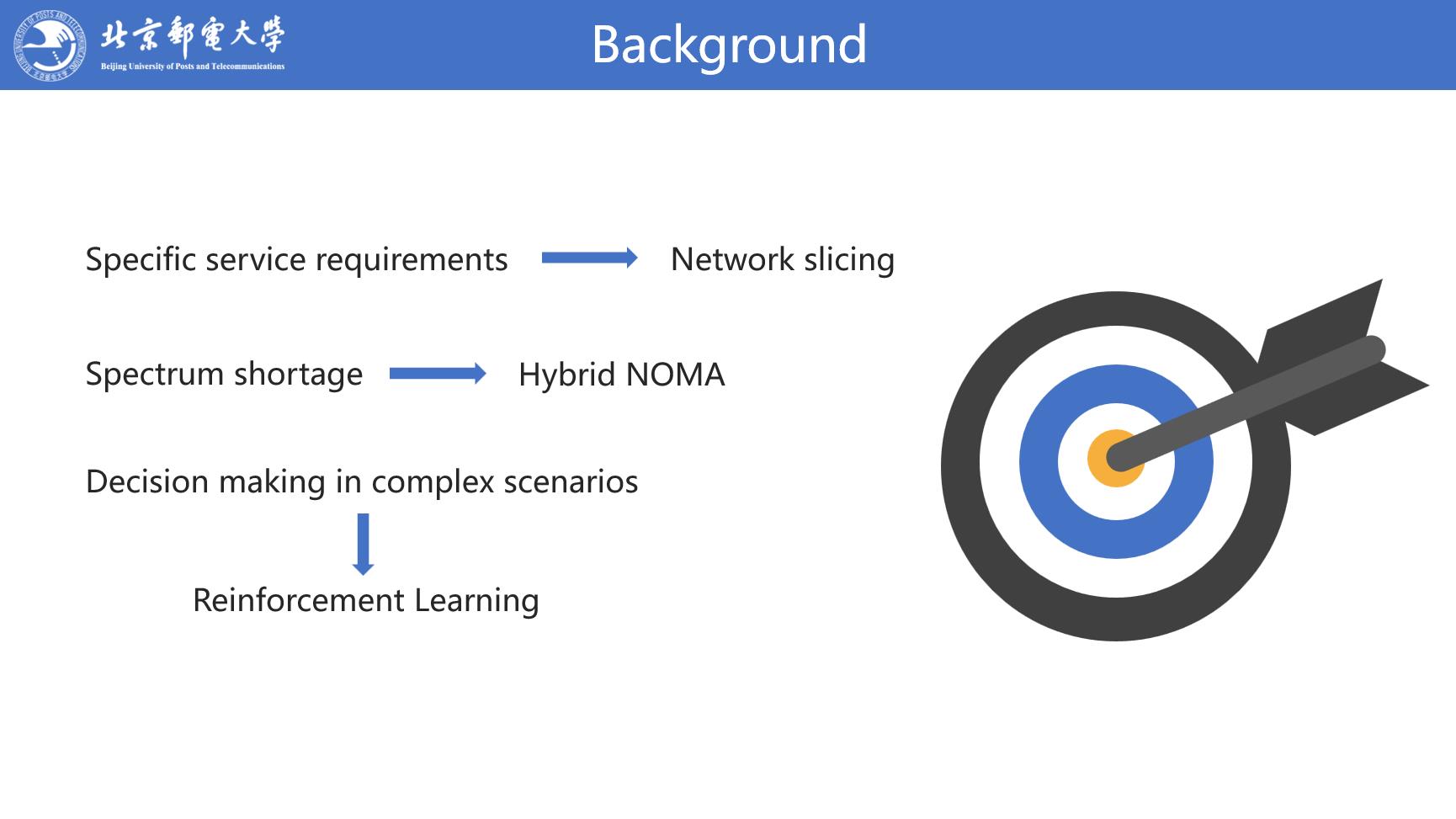 |
Nowadays, wireless communication network faces many kinds of application scenarios with different communication service requirements. Network slicing technology can provide specific services to different users. With the increasing of the demand for transmission rate, spectrum resources become scarce. Hybrid NOMA technology allows multiple users to use a channel at the same time to improve spectrum utilization. Nonconvex optimization problem in complex dynamic networks is difficult to solve by traditional methods. Reinforcement learning has a good performance in decision making.
|
|
ICACT20230164 Slide.02
[Big slide for presentation]
|
Chrome Text-to-Speach Click!! |
 |
First, I will introduce the Background section
|
|
ICACT20230164 Slide.01
[Big slide for presentation]
|
Chrome Text-to-Speach Click!! |
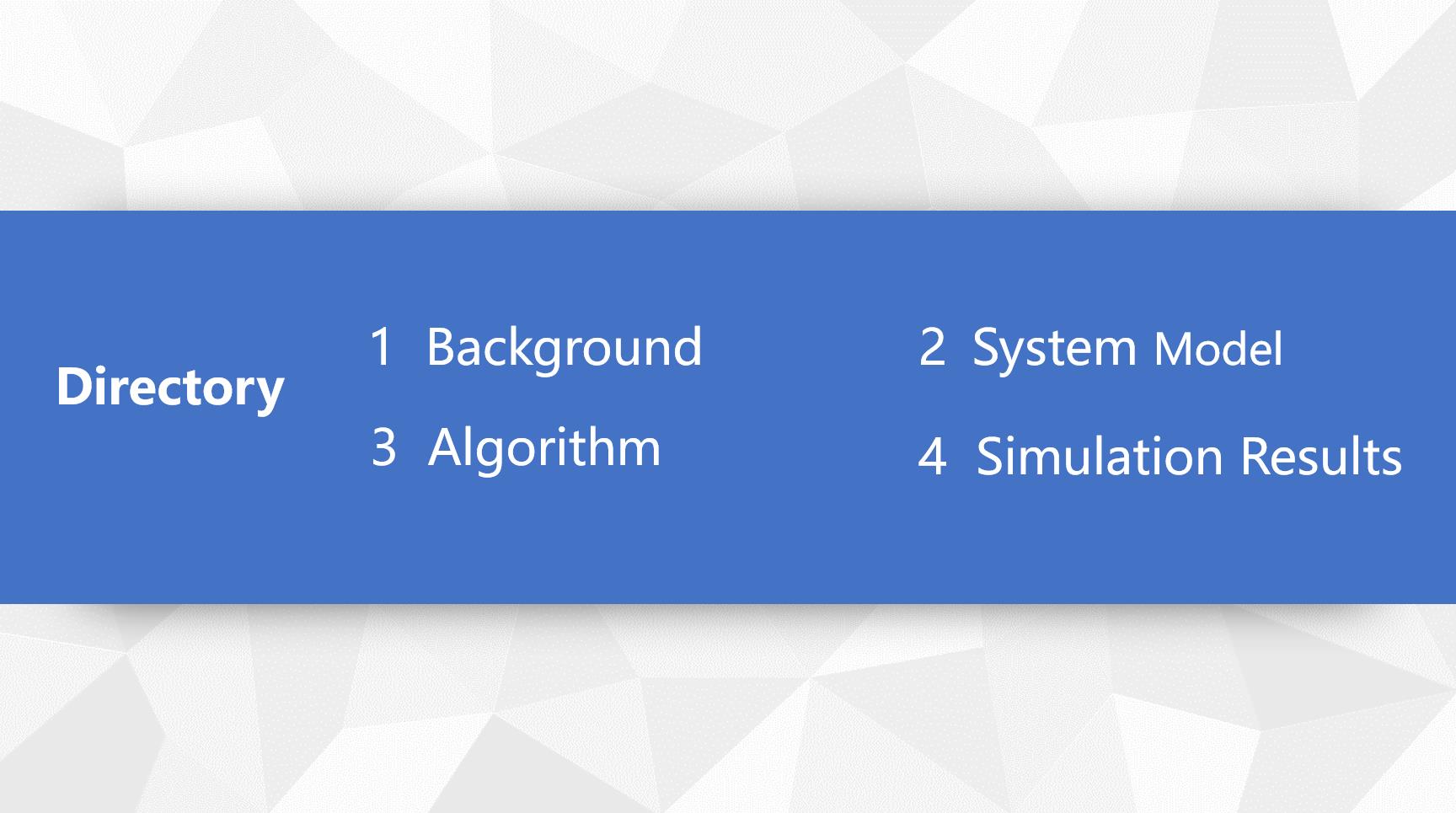 |
My presentation mainly includes four sections. Background section will cover the background knowledge about our work. System model section will introduce the MEC network system model and propose optimization problems. Algorithm section will describe the algorithm used. Simulation Results section will show the simulation results and discuss them.
|
|
ICACT20230164 Slide.00
[Big slide for presentation]
|
Chrome Text-to-Speach Click!! |
 |
Hello everyone. I am Siyu Yuan from Beijing University of Posts and Telecommunications, China. I would like to thank the ICACT organizers for giving us the opportunity to present our work. My presentation is about "Joint Resource Allocation and Task Offloading for Hybrid NOMA-assisted MEC Network with Network Slicing".
|
















