 ICACT20250041 Slide.19
[Big slide for presentation] |
Chrome Text-to-Speach Click!! |
 |
Thank you for your attention.
|
|
ICACT20250041 Slide.18
[Big slide for presentation]
|
Chrome Text-to-Speach Click!! |
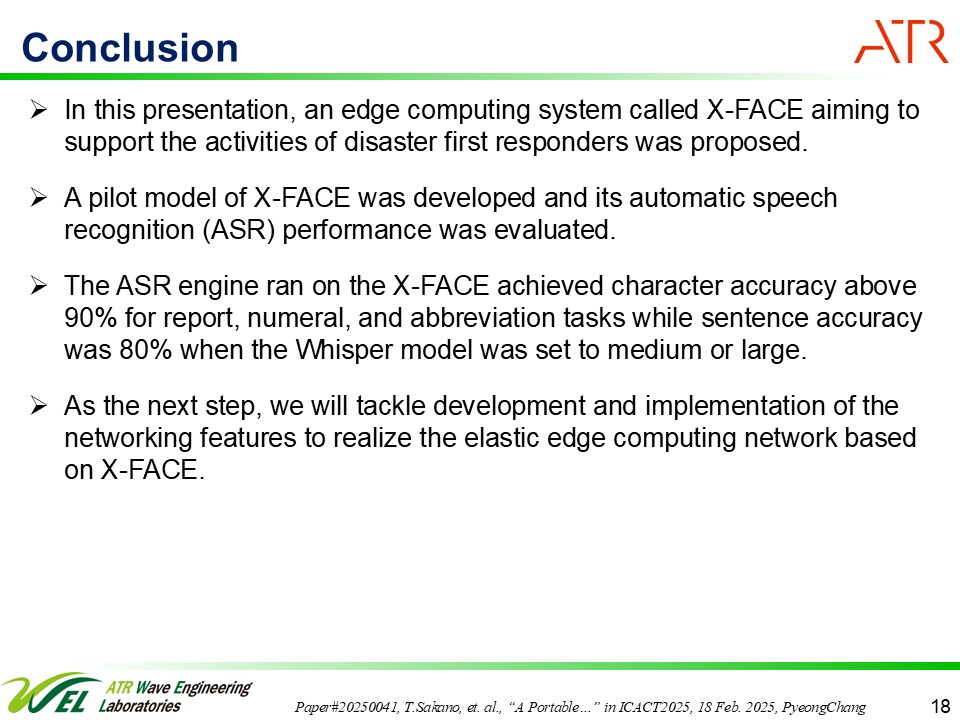 |
In this presentation, an edge computing system called X-FACE aiming to support the activities of disaster first responders was proposed.
A pilot model of X-FACE was developed and its automatic speech recognition (ASR) performance was evaluated.
The ASR engine ran on the X-FACE achieved character accuracy above 90% for report, numeral, and abbreviation tasks while sentence accuracy was 80% when the Whisper model was set to medium or large.
As the next step, we will tackle development and implementation of the networking features to realize the elastic edge computing network based on X-FACE.
|
|
ICACT20250041 Slide.17
[Big slide for presentation]
|
Chrome Text-to-Speach Click!! |
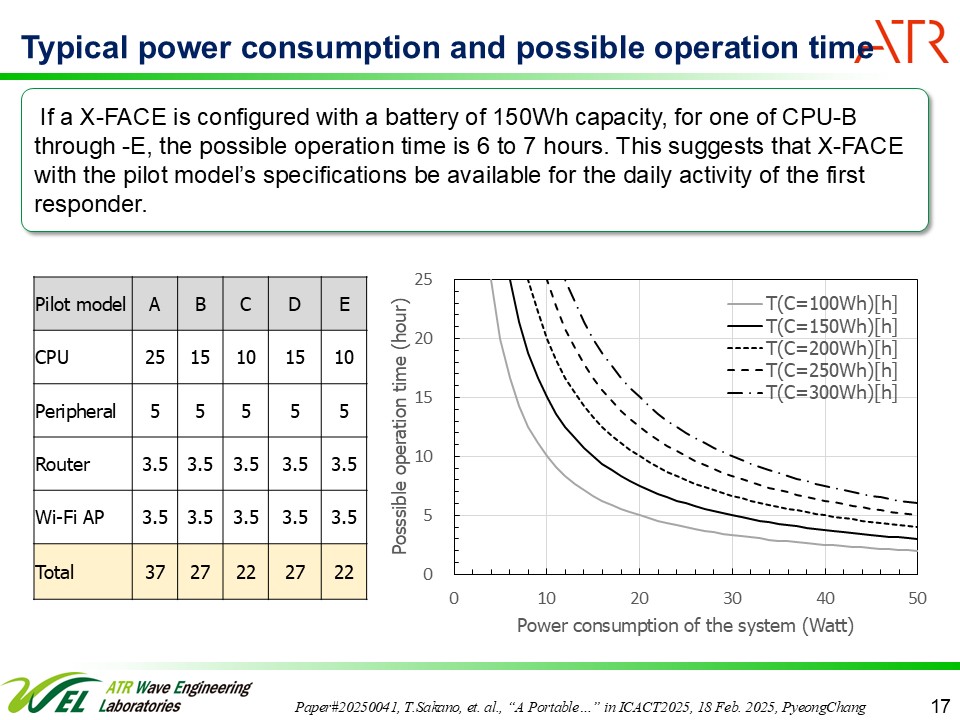 |
We analyzed typical power consumption of the pilot model and estimated possible operation time.
The table shows the measured power consumption of the pilot model depending on the installed CPUs from A through E.
The graph shows the estimated relationship between power consumption of the system and possible operation time.
If you see the plotted line of battery capacity of 150Wh, you can say, for one of CPU-B through -E, the possible operation time is 6 to 7 hours.
This suggests that X-FACE with the pilot model’s specifications be available for the daily activity of the first responder.
|
|
ICACT20250041 Slide.16
[Big slide for presentation]
|
Chrome Text-to-Speach Click!! |
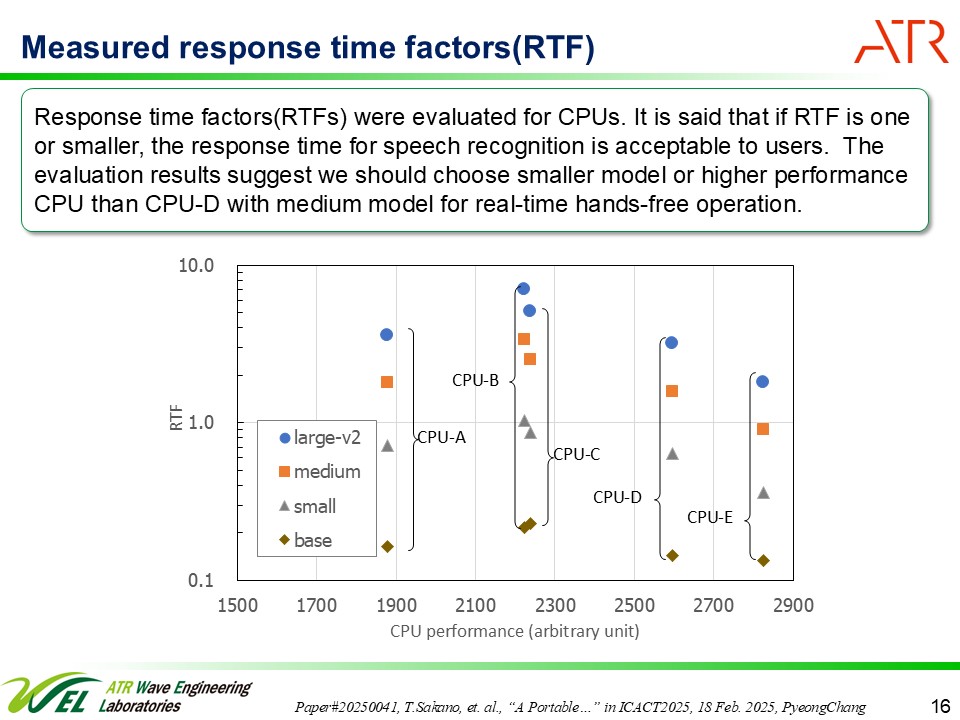 |
This slide shows the measured response time factors or RTF.
The graph shows the relationship between CPU performance and RTF.
RTF is a value to express the response time performance of the ASR engine. It is said that if RTF is one or smaller, the response time is acceptable to users.
The evaluation results suggest we should choose smaller model or higher performance CPU than CPU-D with medium model for real-time hands-free operation.
|
|
ICACT20250041 Slide.15
[Big slide for presentation]
|
Chrome Text-to-Speach Click!! |
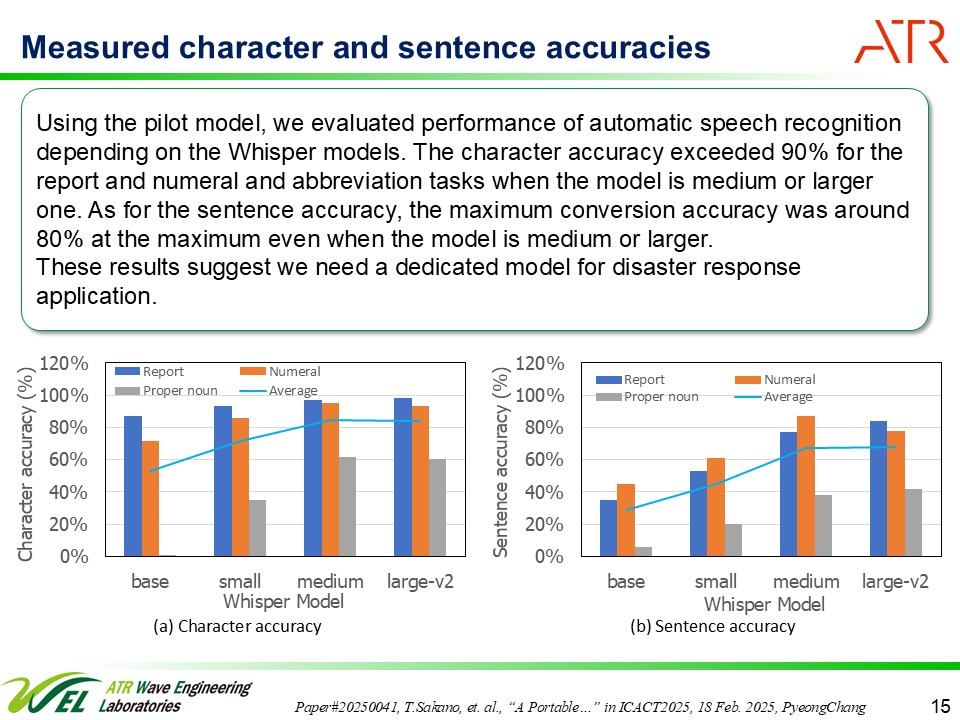 |
This slide show the measured character and sentence accuracies.
The graphs of left-hand side and right-hand side are measured character and sentence accuracies respectively.
The conversion accuracy of task sets, report, numeral and proper noun are plotted for whisper models, base, small medium and large-v2.
As you can see, the character accuracy exceeded 90% for report and numeral tasks when the model is medium or larger one.
As for the sentence accuracy, the maximum conversion accuracy was around 80% at the maximum even when the model is medium or larger.
These results suggest we need a dedicated model for disaster response application.
|
|
ICACT20250041 Slide.14
[Big slide for presentation]
|
Chrome Text-to-Speach Click!! |
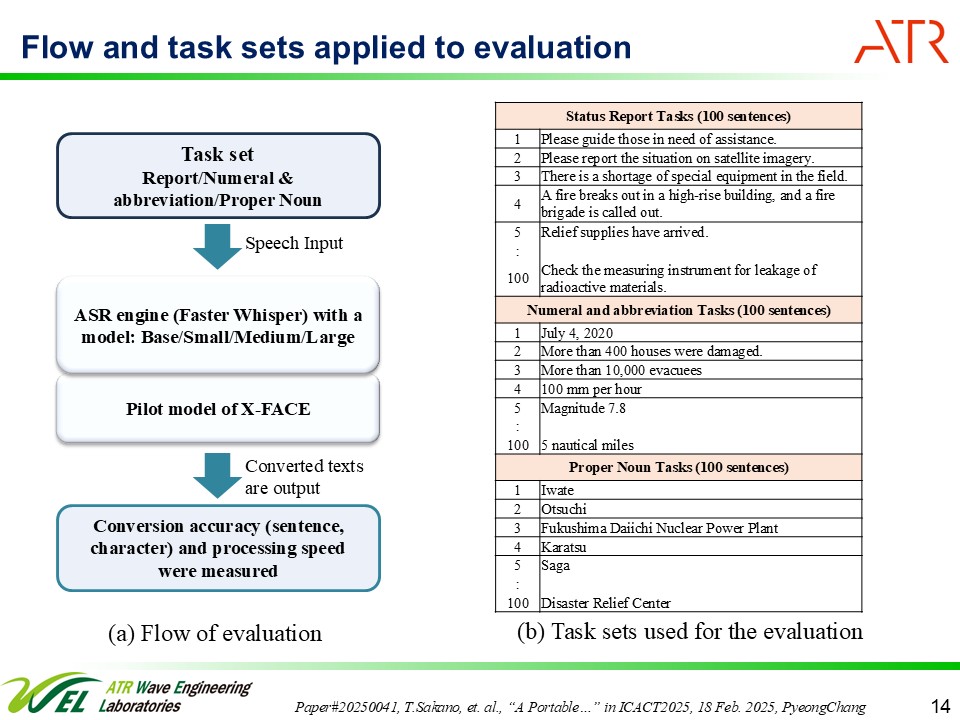 |
Using the developed pilot model, we conduced performance evaluation of automatic speech recognition which is the key to hands free operation.
Flow of the evaluation is shown in the left-hand of the slide.
We installed an open-source ASR engine, Faster Whisper with a model Base, Small, Medium or Large to the X-FACE pilot model.
We prepared task sets specific to disaster response applications for the evaluation of speech recognition as shown in the right-hand side of the slide.
These are status report, numeral and abbreviation, and proper noun tasks, each of which has 100 sentences.
The task sets were input to the X-FACE and converted texts were output.
We evaluated the conversion accuracy and processing speed of the conversion.
|
|
ICACT20250041 Slide.13
[Big slide for presentation]
|
Chrome Text-to-Speach Click!! |
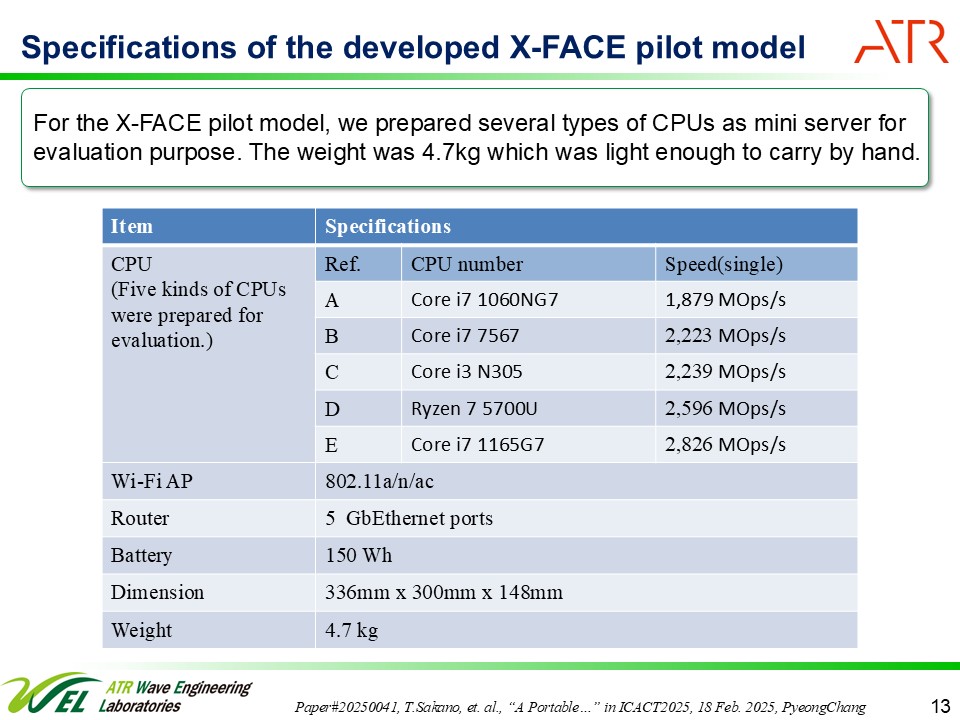 |
This slide shows the specifications of the developed X-FACE pilot model.
For the pilot model, we prepared several types of CPUs for evaluation purpose.
The weight was 4.7kg which was light enough to carry by hand.
|
|
ICACT20250041 Slide.12
[Big slide for presentation]
|
Chrome Text-to-Speach Click!! |
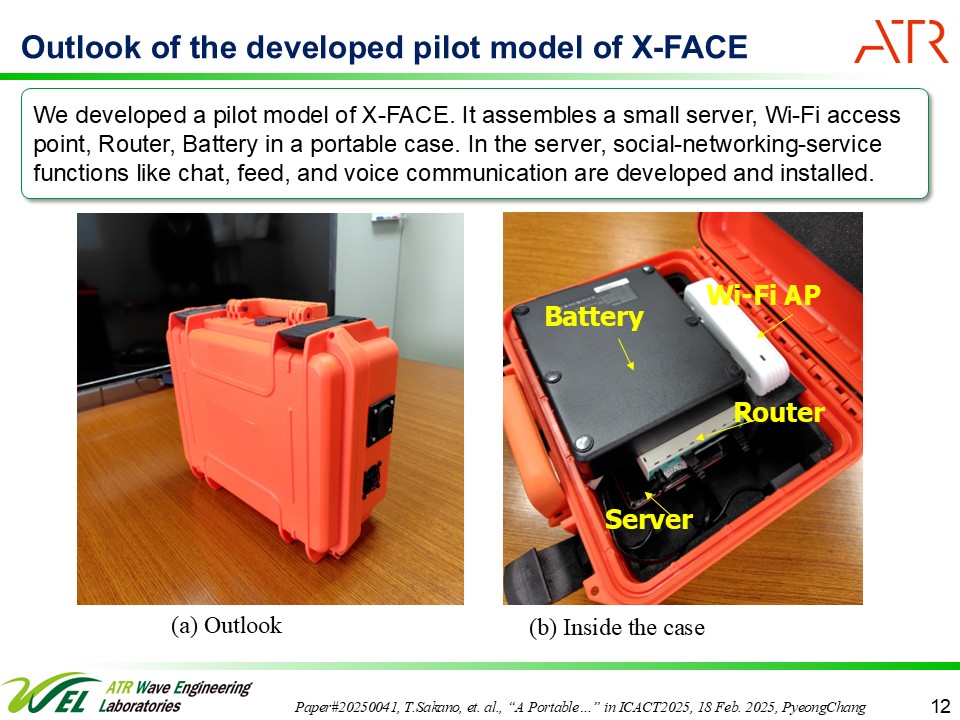 |
We developed a pilot model of X-FACE system.
The system assembles a small server, Wi-Fi access point, Router, Battery in a portable case.
In the server, social-networking-service functions like chat, feed, and voice communication are developed and installed.
|
|
ICACT20250041 Slide.11
[Big slide for presentation]
|
Chrome Text-to-Speach Click!! |
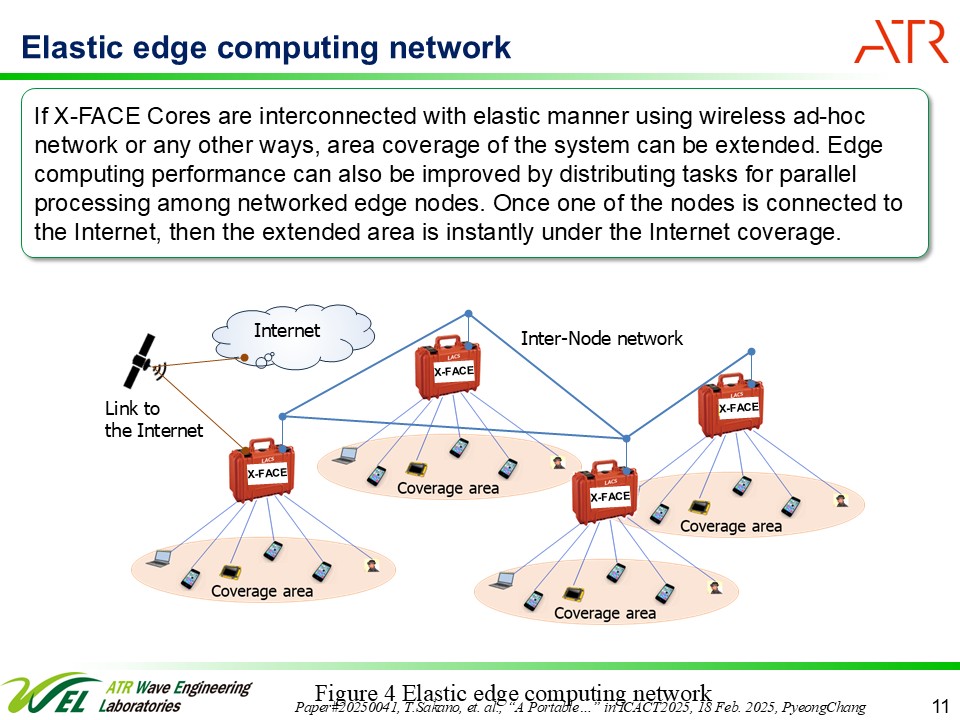 |
If X-FACE Cores are interconnected with elastic manner using wireless ad-hoc network or any other ways, area coverage of the system can be extended.
Edge computing performance can also be improved by distributing tasks for parallel processing among networked edge nodes.
Once one of the nodes is connected to the Internet, then the extended area is instantly under the Internet coverage.
|
|
ICACT20250041 Slide.10
[Big slide for presentation]
|
Chrome Text-to-Speach Click!! |
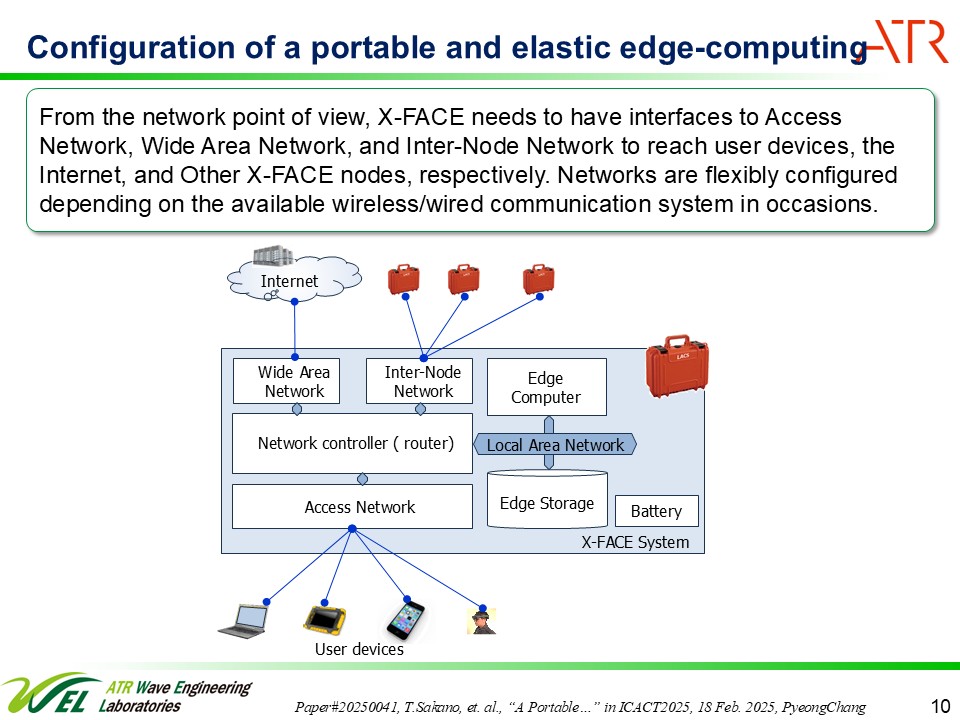 |
X-FACE core is considered as a portable and elastic edge computing node.
To make this, X-FACE will need to have interfaces to Access Network, Wide-Area Network, and Inter-Node network.
Here, Access network is like Wi-Fi network and connects the system to user devices.
Wide area network is connectivity to the Internet. It can be realized by, for example, connecting the system to Starlink service.
Inter-node network is to extend the area coverage in the local area.
|
|
ICACT20250041 Slide.09
[Big slide for presentation]
|
Chrome Text-to-Speach Click!! |
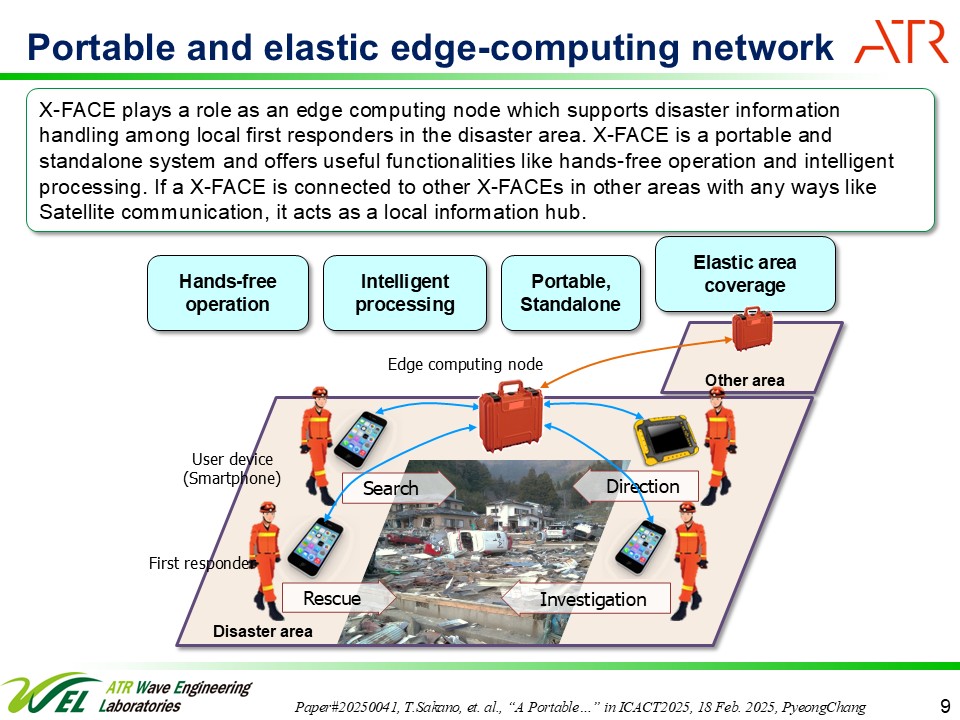 |
X-FACE plays a role as an edge computing node which supports disaster information handling among local first responders in the disaster area.
First responders can input and get the necessary information through their user devices with timely manner during their on-site activities.
The functions of X-FACE are available locally even under the communication service disruption.
If X-FACE core has connectivity to other X-FACE cores with proper wired or wireless communication systems, service coverage area is flexibly extendable.
|
|
ICACT20250041 Slide.08
[Big slide for presentation]
|
Chrome Text-to-Speach Click!! |
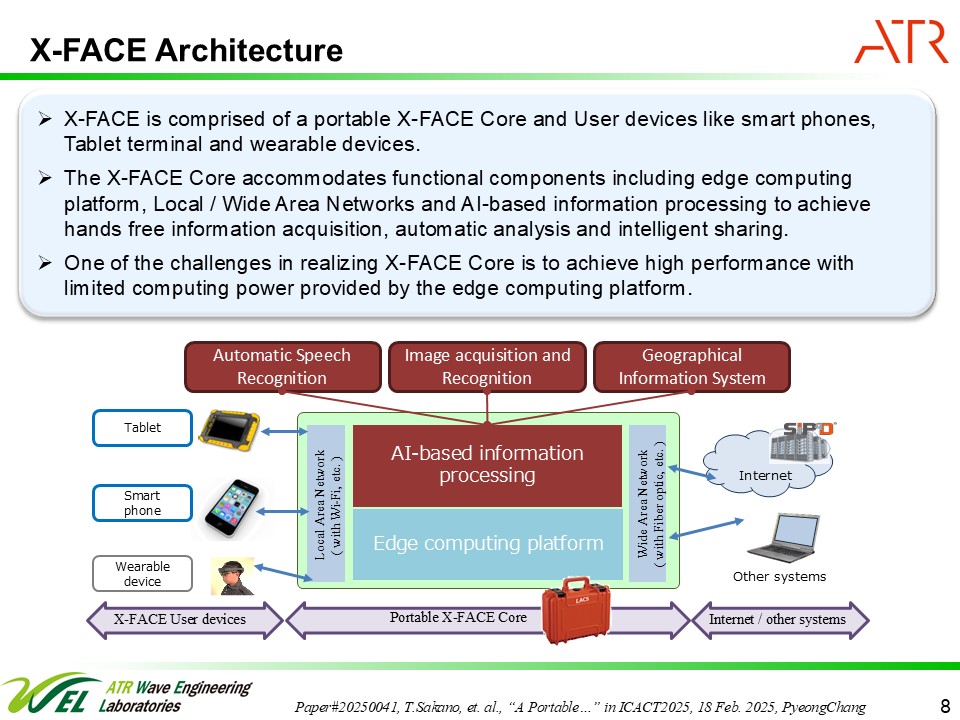 |
This slide shows the architecture of X-FACE.
The system is comprised of a portable X-FACE Core and User devices like smart phones.
The X-FACE Core accommodates functional components including computing platform, Local/Wide Area Networks and AI-based information processing to achieve hands free information acquisition, automatic analysis and intelligent sharing.
One of the challenges in realizing X-FACE Core is to achieve high performance with limited computing power provided by the edge computing platform.
|
|
ICACT20250041 Slide.07
[Big slide for presentation]
|
Chrome Text-to-Speach Click!! |
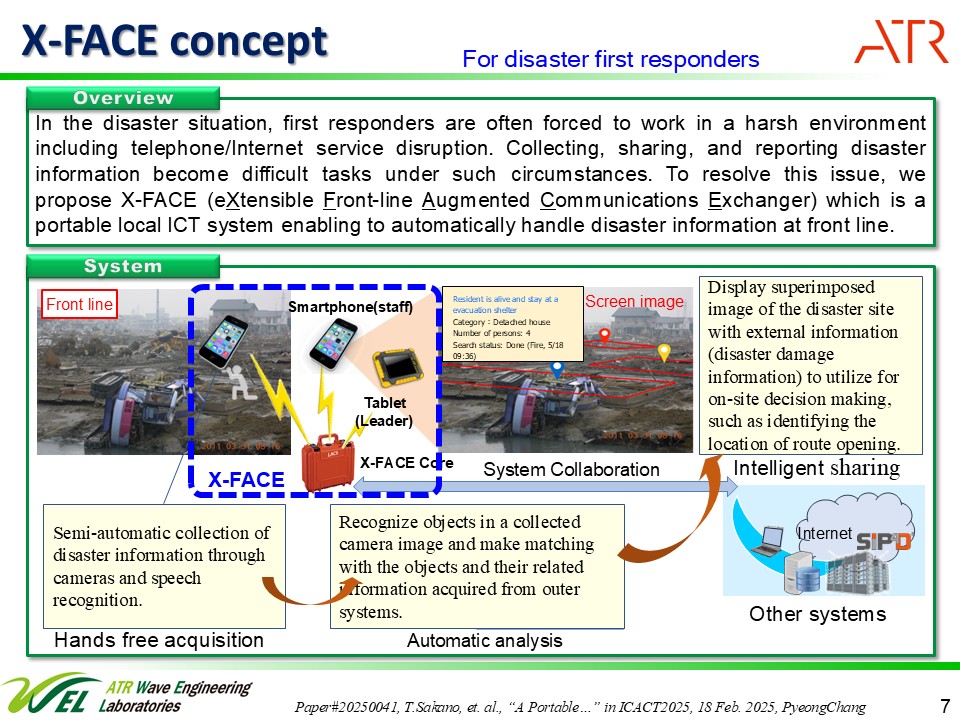 |
Based on the recognition of the challenges in the information handling, we propose a concept named X-FACE or eXtensible Front-line Augmented Communications Exchanger, which is a portable local ICT system enabling to automatically handle disaster information at front line.
X-FACE is an edge computing node to deliver functions for information handling to users in the disaster site.
The system has a function for hands free acquisition of disaster information based on automatic speech recognition.
This makes the system easy to use for first responders.
It has other intelligent functions to support the information handling and decision making of first responders, like automatic information analysis and intelligent information sharing with other systems.
|
|
ICACT20250041 Slide.06
[Big slide for presentation]
|
Chrome Text-to-Speach Click!! |
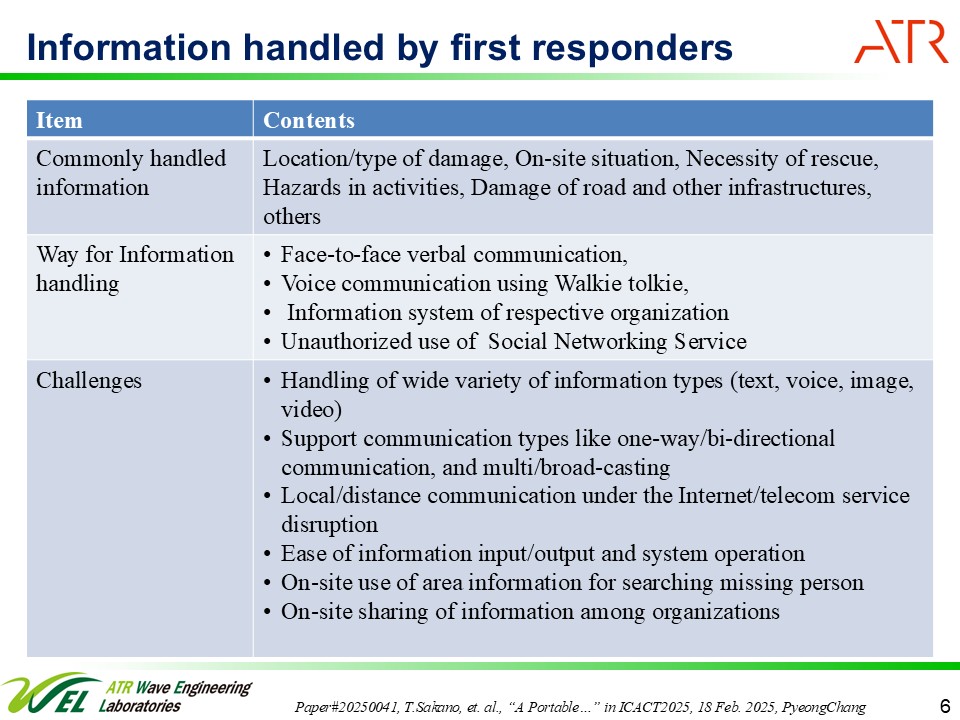 |
The information handled by first responders and the way to do it is as follows.
Commonly handled information is location and type of damage, onsite situation, necessity of rescue, hazards in activities, and damage of road and other infrastructures.
Current ways of handling the information are face-to-face verbal communication, Walkie-tolkie base voice communication and unauthorized use of social networking service.
There exist challenges in the current information handling methods.
It is difficult to easily handle multi-modality of information like text, voice, image and video.
Under the internet and other network service disruption, there is nothing to do to share the information in the disaster site.
|
|
ICACT20250041 Slide.05
[Big slide for presentation]
|
Chrome Text-to-Speach Click!! |
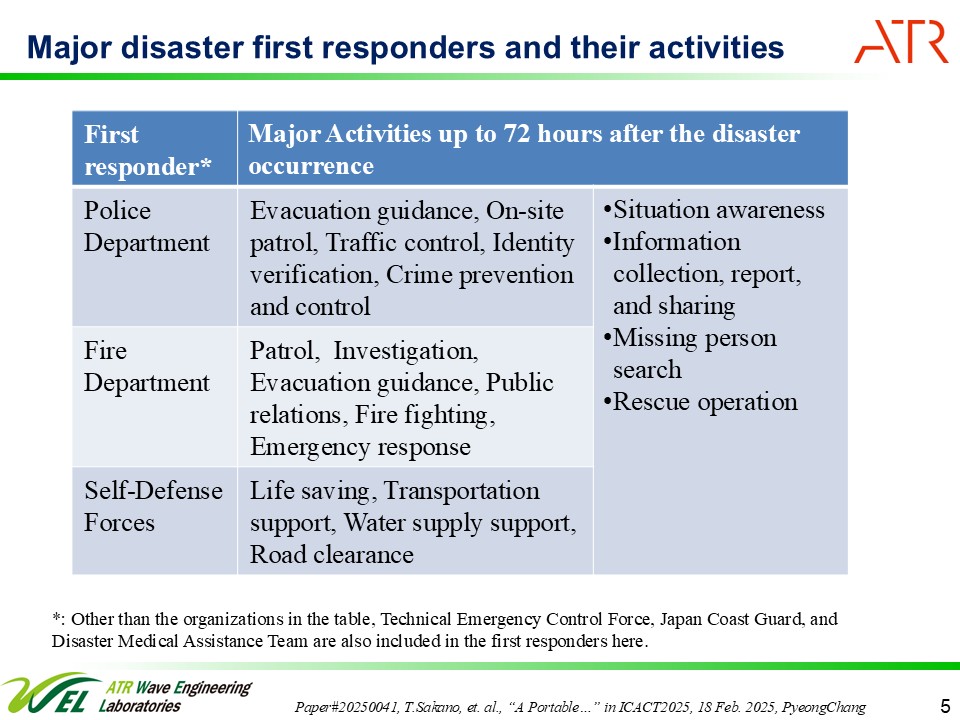 |
This slide shows the major disaster first responders and their activities.
Police department, fire department and self-defense force are major first responders.
They rush to the disaster areas just after the disaster occurrence and do their jobs like situation awareness, disaster information collection, report and sharing, searching for missing people and rescue operation.
They need to have tool to handle disaster information in the disaster site.
|
|
ICACT20250041 Slide.04
[Big slide for presentation]
|
Chrome Text-to-Speach Click!! |
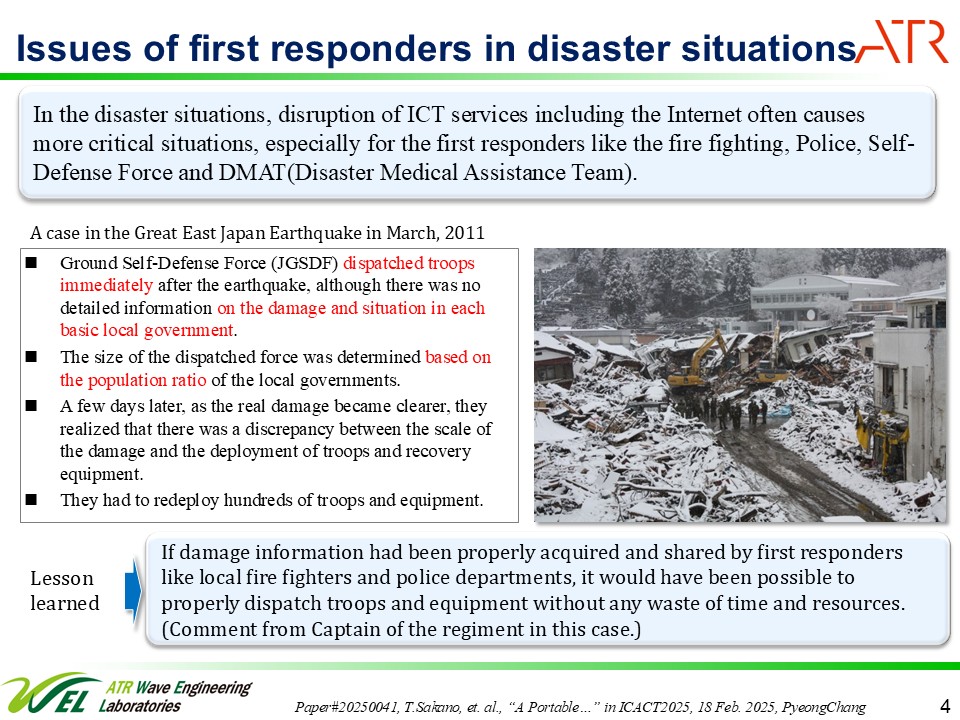 |
In the disaster situations, disruption of ICT services including the Internet often causes more critical situations, especially for the first responders like the fire fighting, Police, Self-defense force and DMAT.
This slide shows an example of the inefficiency caused by the lack of disaster information.
In the Great East Japan Earthquake in March, 2011, JGSDF first dispatched troops to local governments in the affected area based on their population scale since they couldn’t get latest damage information.
But reality was smaller towns were more severely damaged.
A few days later, they had to redeploy hundreds of troops and equipment to severely damaged areas.
In this case, disaster information was the key of decision making and they couldn’t get the information with timely manner.
|
|
ICACT20250041 Slide.03
[Big slide for presentation]
|
Chrome Text-to-Speach Click!! |
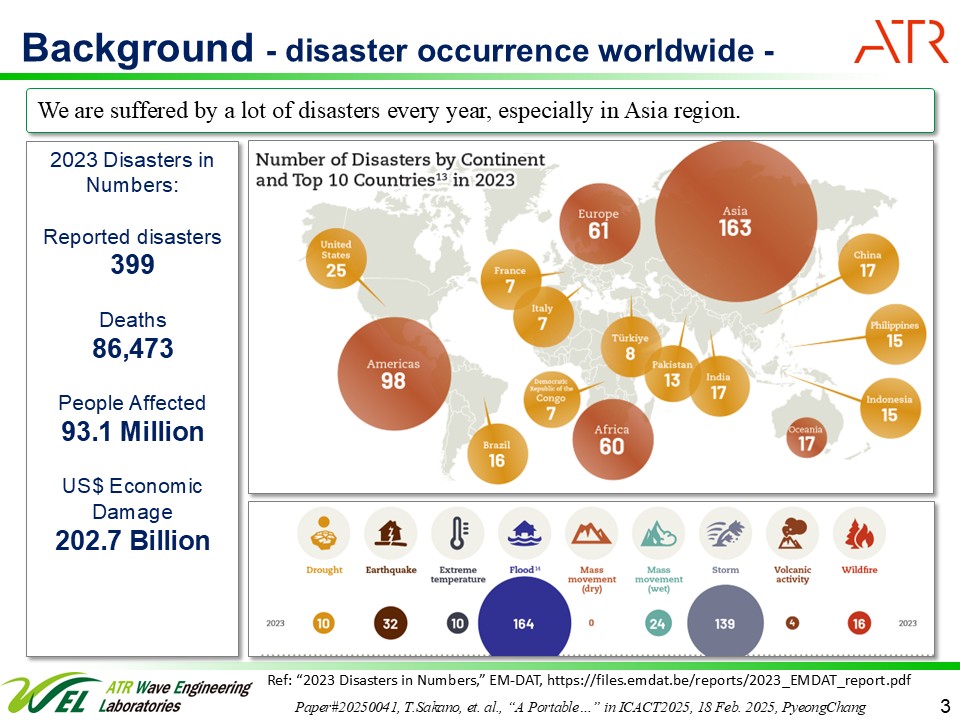 |
This slide shows disaster occurrence worldwide in 2023.
As you can see, Asia is the number one area of disaster occurrence with 163 out of 399 worldwide.
Here, types of disasters are Flooding, Storm, Earthquake, Landslides and others.
|
|
ICACT20250041 Slide.02
[Big slide for presentation]
|
Chrome Text-to-Speach Click!! |
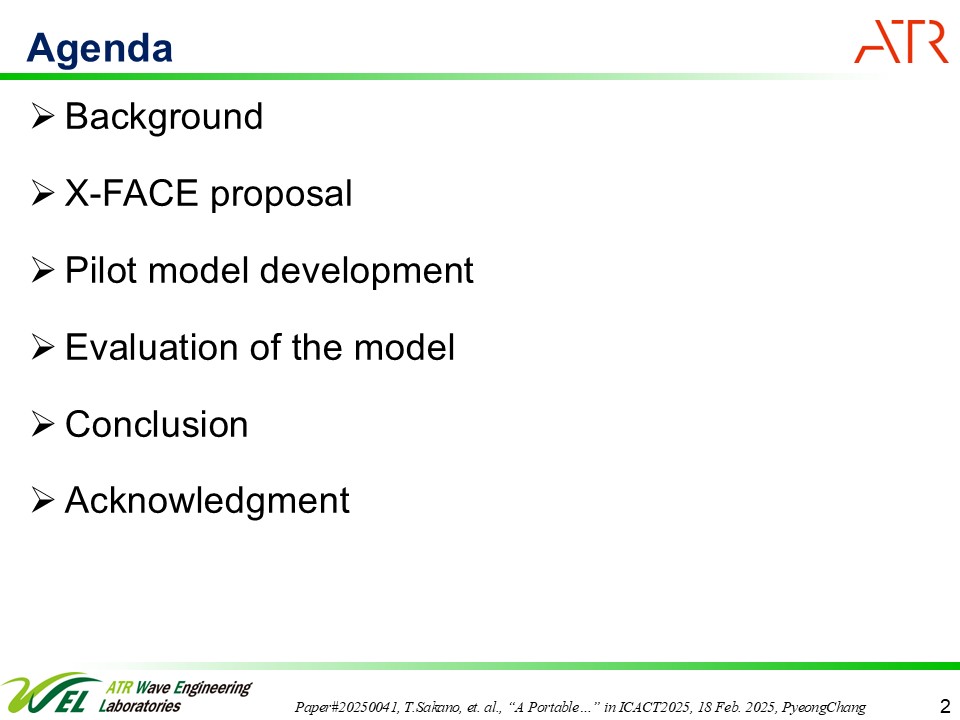 |
Agenda of my presentation is as follows:
I will start with some background and issues in disaster response activities.
Then I will propose a portable ICT system named X-FACE to resolve the issues.
Pilot model of X-FACE is then developed.
I will show you evaluation results using the pilot model.
Finaly I will conclude my presentation with some acknowledgment.
|
|
ICACT20250041 Slide.01
[Big slide for presentation]
|
Chrome Text-to-Speach Click!! |
 |
My name is Toshikazu Sakano and I am from Advanced Telecommunications Research Institute International based in Kyoto, Japan.
I would like to present my paper with the title, “A Portable and Elastic Edge Computing Network for Disaster First Responders.”
|
















