 ICACT20210251 Slide.19
[Big slide for presentation] |
Chrome Text-to-Speach Click!! |
 |
Thank for your listening.
|
|
ICACT20210251 Slide.18
[Big slide for presentation]
|
Chrome Text-to-Speach Click!! |
 |
load balancing in MANET is a very important issue. In order to improve performance in the MANET network, it is important to distribute traffic correctly among mobile nodes using load balancing to maximize node lifetime, packet-to-packet ratio and minimize traffic congestion. This paper discusses a part of different load balancing methods in this field and points out the limitations of them, which provides a direction for further development of future research work.
|
|
ICACT20210251 Slide.17
[Big slide for presentation]
|
Chrome Text-to-Speach Click!! |
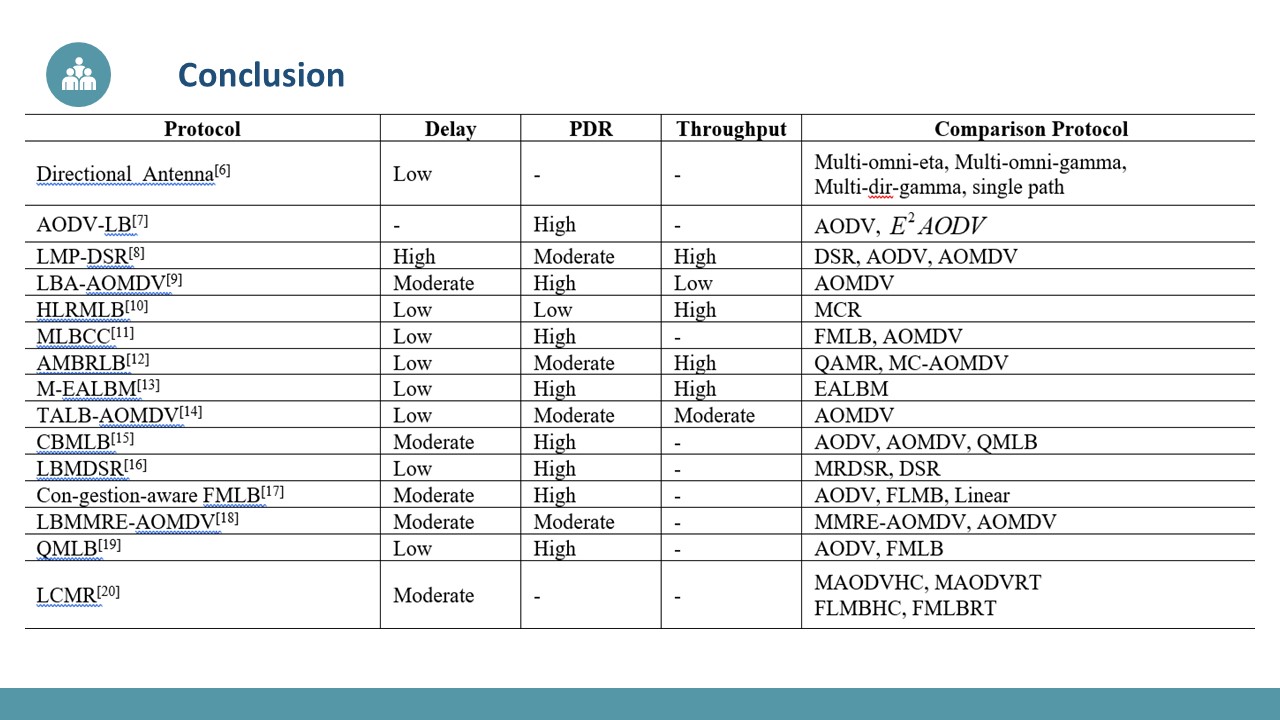 |
The following Table 1 shows the comparison of existing load balancing techniques in the different parameters like packet delivery ratio(PDR), delay and throughput.
|
|
ICACT20210251 Slide.16
[Big slide for presentation]
|
Chrome Text-to-Speach Click!! |
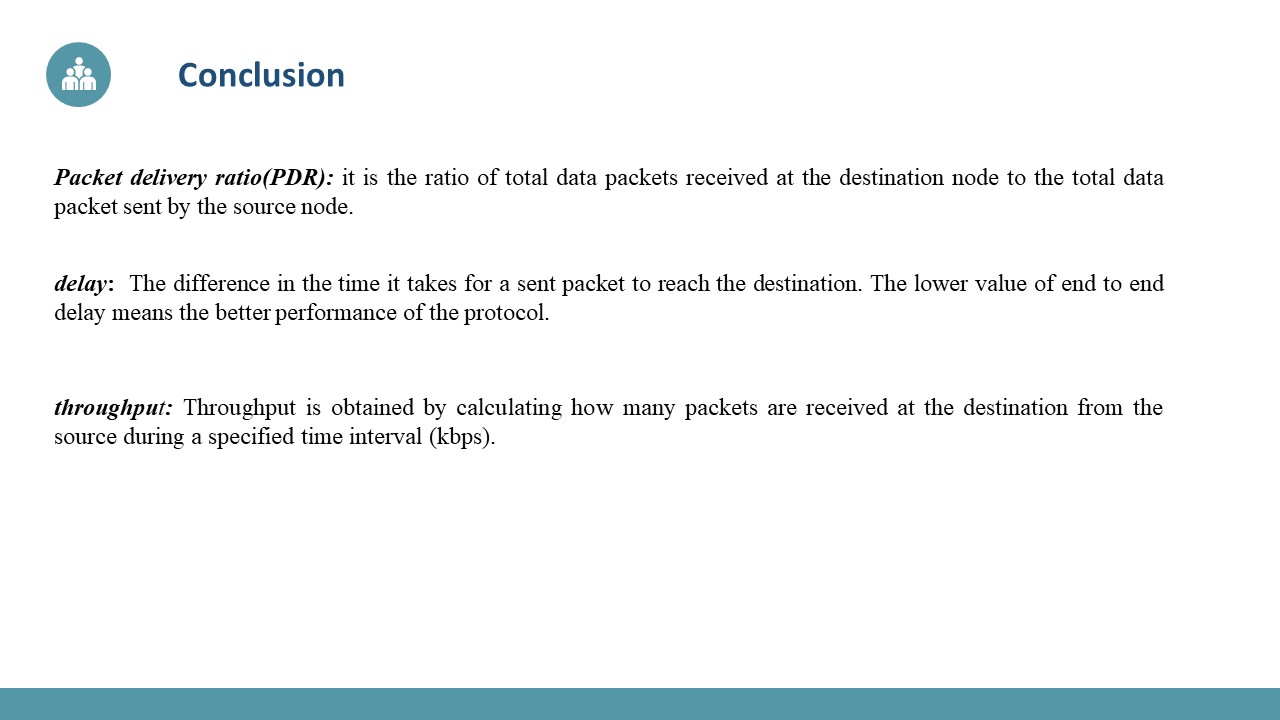 |
1) Packet delivery ratio(PDR): it is the ratio of total data packets received at the destination node to the total data packet sent by the source node.
2) delay: The difference in the time it takes for a sent packet to reach the destination. The lower value of end to end delay means the better performance of the protocol.
3) throughput: Throughput is obtained by calculating how many packets are received at the destination from the source during a specified time interval (kbps).
|
|
ICACT20210251 Slide.15
[Big slide for presentation]
|
Chrome Text-to-Speach Click!! |
 |
The fifth part is the conclusion.
|
|
ICACT20210251 Slide.14
[Big slide for presentation]
|
Chrome Text-to-Speach Click!! |
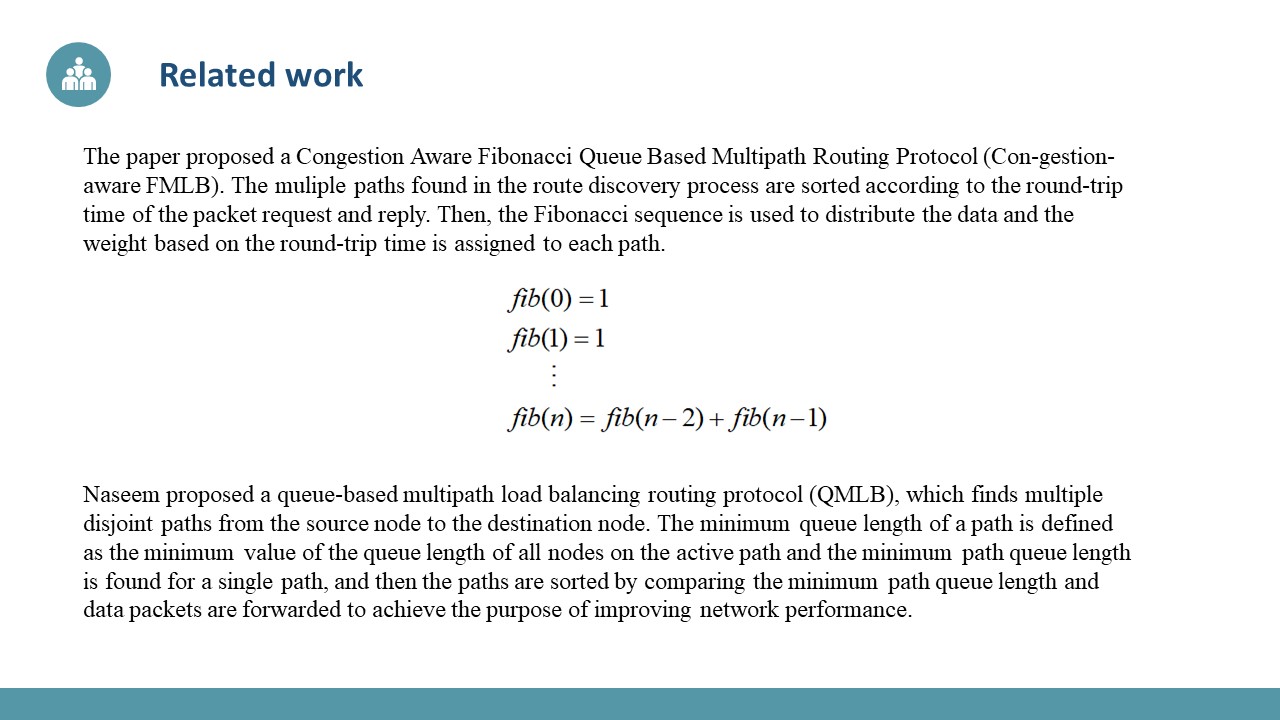 |
The next article proposed a Congestion Aware Fibonacci Queue Based Multipath Routing Protocol (Con-gestion-aware FMLB). The muliple paths found in the route discovery process are sorted according to the round-trip time of the packet request and reply. Then, the Fibonacci sequence is used to distribute the data and the weight based on the round-trip time is assigned to each path. The weight is set according to the Fibonacci sequence number. The Fibonacci calculation method is as follows:
Naseem finds multiple disjoint paths from the source node to the destination node. The minimum queue length of a path is defined as the minimum value of the queue length of all nodes on the active path and the minimum path queue length is found for a single path, and then the paths are sorted by comparing the minimum path queue length and data packets are forwarded to achieve the purpose of improving network performance.
|
|
ICACT20210251 Slide.13
[Big slide for presentation]
|
Chrome Text-to-Speach Click!! |
 |
MLBCC uses the arrival rate and the egress rate within a specific time period to detect congestion. The link cost and path cost are used to select the gateway node. When the default path is congested, the gateway node selects other paths for traffic distribution. The data packets are segmented and evenly distributed on other paths and sent in a circular manner.
The next article[13] focuses on the research of load balancing solutions based on battery life to improve network per-formance. When the remaining energy of node 1 is reduced to 40% from the default value, 50% of the incoming traffic is transferred to node 2. When the remaining traffic of node 1 is less than 20%, all incoming traffic is forwarded to node 2, and Node 1 becomes passive. multiple paths can be used for data transmission to further improve network performance.
Since AOMDV saves multiple paths for data transfer, using only one path can lead to high overhead and waste resources on a single path. The proposed method adds the queue length field to the RREQ packet, takes the queue length and the number of hops as the metric for path selection. However, this paper can further improve network performance using appropriate traffic allocation.
|
|
ICACT20210251 Slide.12
[Big slide for presentation]
|
Chrome Text-to-Speach Click!! |
 |
Siuli Roy proposed the use of directional antenna multi-path routing to achieve load balancing in mobile ad hoc networks, which can improve end-to-end delay. In this article, the correlation factor ƞ is used to measure the impact of routing coupling. Experimental results show that using directional antennas instead of omnidirectional antennas on mobile nodes and using proper load balancing can significantly reduce end-to-end latency as well as improve the performance of multi-path routing.
Malviya modified the DSR Protocol (DSR) to Load Balanced Multi-Path DDSR Protocol (LMR-DSR). Two data structures are introduced in the new protocol: route cache and load table. The route cache looks for a route to the destination node but only maintains five routes at most, and the load table maintains the amount of data on a given route. In this paper, the single-path routing protocol is modified to a multi-path routing protocol, but the appropriate load distribution strategy is not used, resulting in poor performance.
LBA-AOMDV analyzes the load of the neighbor nodes of the current node through different parameters such as loss rate, communication rate and delay. Neighboring nodes are assigned high, medium, and low priority by comparing them to a predefined threshold, and the node with the highest priority is selected as the path to reach the destination. Although the LBA-AODV protocol has obvious improvements in packet loss rate, end-to-end delay and throughput compared with the AOMDV protocol, it can also use an appropriate load distribution protocol to further improve performance.
|
|
ICACT20210251 Slide.11
[Big slide for presentation]
|
Chrome Text-to-Speach Click!! |
 |
The fourth part is the research of this paper.
|
|
ICACT20210251 Slide.10
[Big slide for presentation]
|
Chrome Text-to-Speach Click!! |
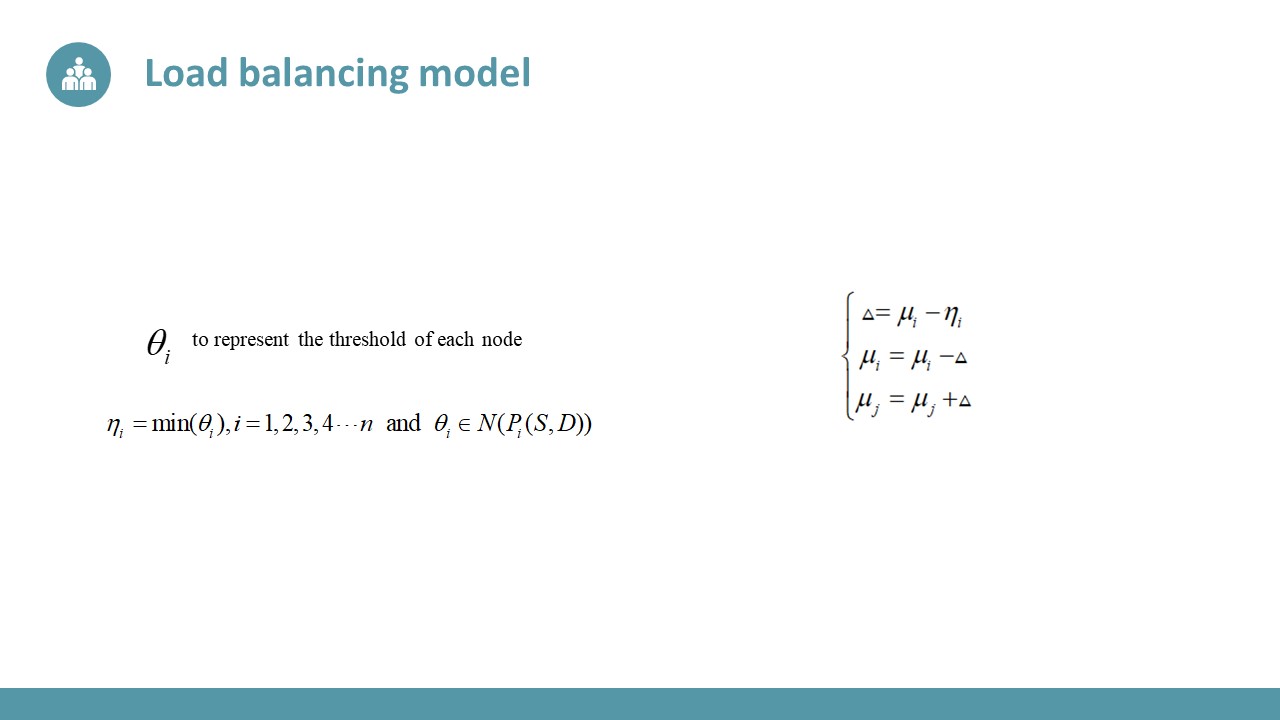 |
I propose the following model to understand load balancing, to represent the threshold of each node. represents the number of data packets on path i, represents the Minimum on a path i from the source node S to the destination node D. If the number of packets on path i is greater than the threshold, the excess number of packets is allocated to path j
|
|
ICACT20210251 Slide.09
[Big slide for presentation]
|
Chrome Text-to-Speach Click!! |
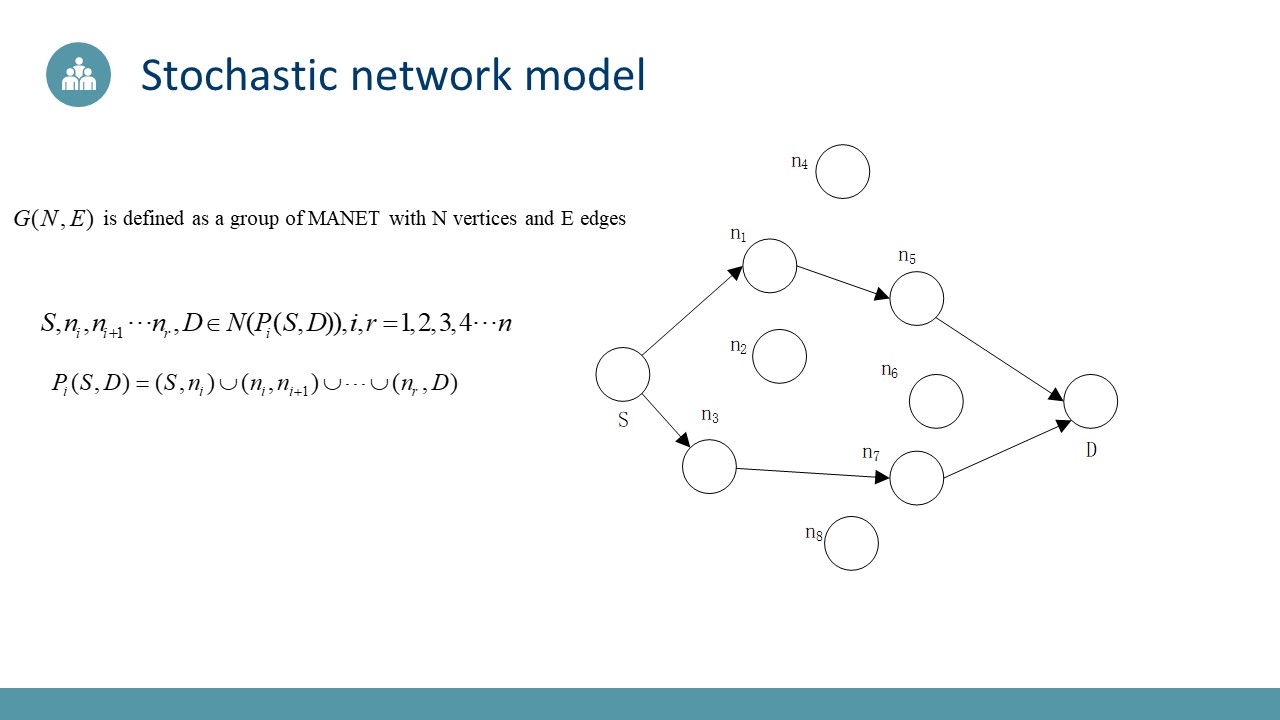 |
we can see the MANET model is generally stochastic. it is defined as a group of MANET with N vertices and E edges, ni is the node in the network, ; pi is the effective link from node to node in the network, which is randomly established during the route discovery process.excample p1 is s pass through n1, n5 to reach D.
|
|
ICACT20210251 Slide.08
[Big slide for presentation]
|
Chrome Text-to-Speach Click!! |
 |
The next part is the Stochastic network model and load balcing model.
|
|
ICACT20210251 Slide.07
[Big slide for presentation]
[YouTube] |
Chrome Text-to-Speach Click!! |
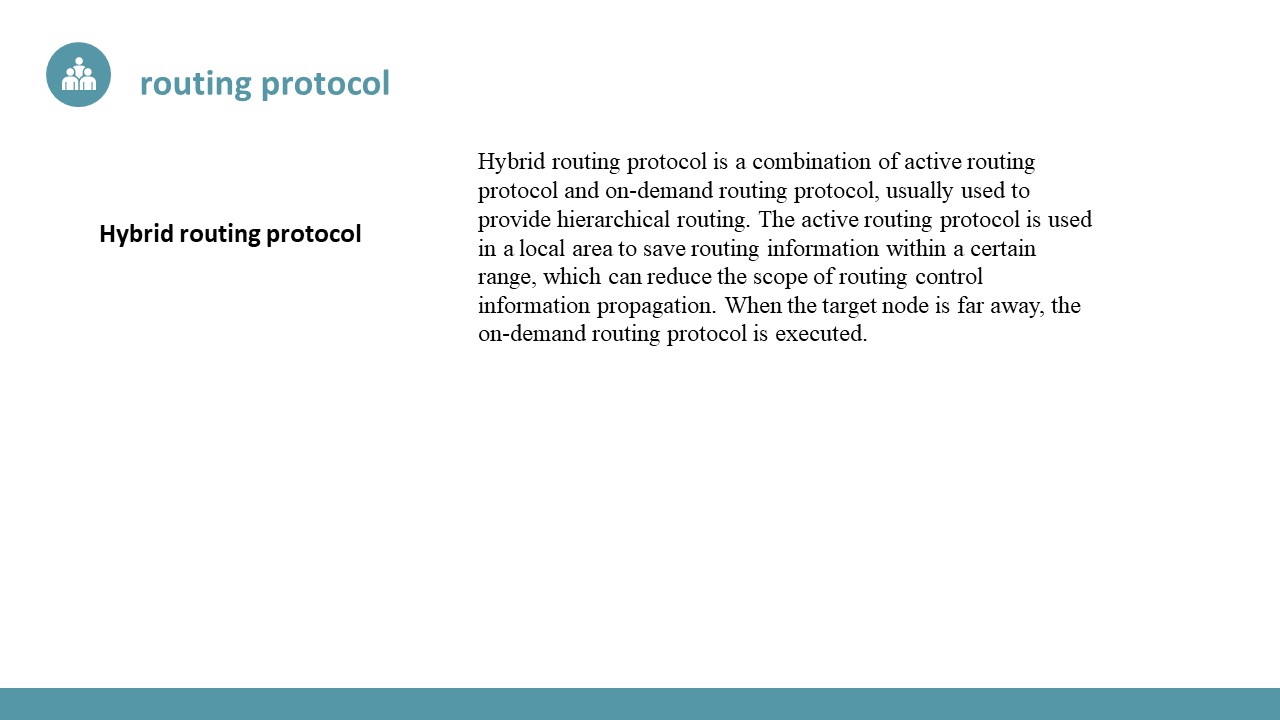 |
Hybrid routing protocol is a combination of active routing protocol and on-demand routing protocol, usually used to provide hierarchical routing.
|
|
ICACT20210251 Slide.06
[Big slide for presentation]
[YouTube] |
Chrome Text-to-Speach Click!! |
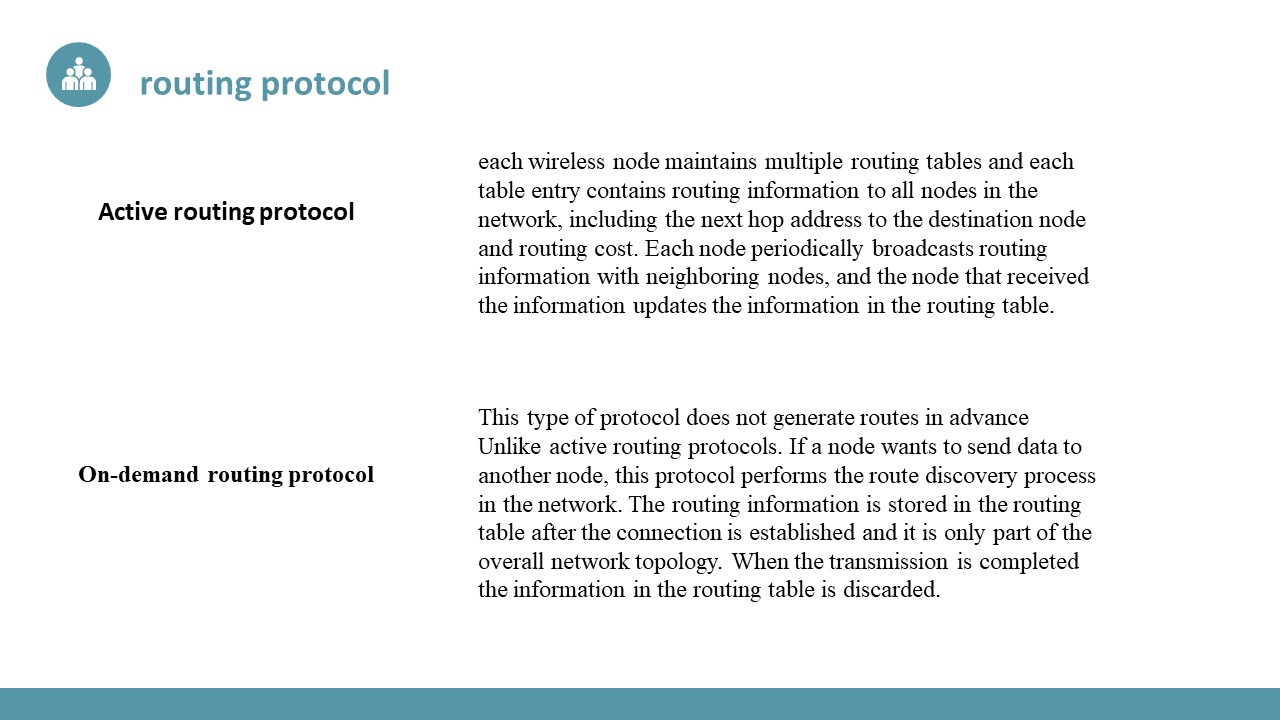 |
These protocols can be divided into active routing protocols, on-demand routing protocols and hybrid routing protocols from the perspective of usage.
Active routing protocol is also called table-driven protocol. each wireless node maintains multiple routing tables, including the next hop address to the destination node and routing cost. Each node periodically broadcasts routing information with neighboring nodes, and the node that received the information updates the information in the routing table.
The on-demand routing protocol is also called reactive routing protocol If a node wants to send data to another node, this protocol performs the route discovery process in the network. The routing information is stored in the routing table after the connection is established and it is only part of the overall network topology. When the transmission is completed the information in the routing table is discarded.
|
|
ICACT20210251 Slide.05
[Big slide for presentation]
[YouTube] |
Chrome Text-to-Speach Click!! |
 |
The second part is the routing protocol in Mobile Ad Hoc Network.
|
|
ICACT20210251 Slide.04
[Big slide for presentation]
[YouTube] |
Chrome Text-to-Speach Click!! |
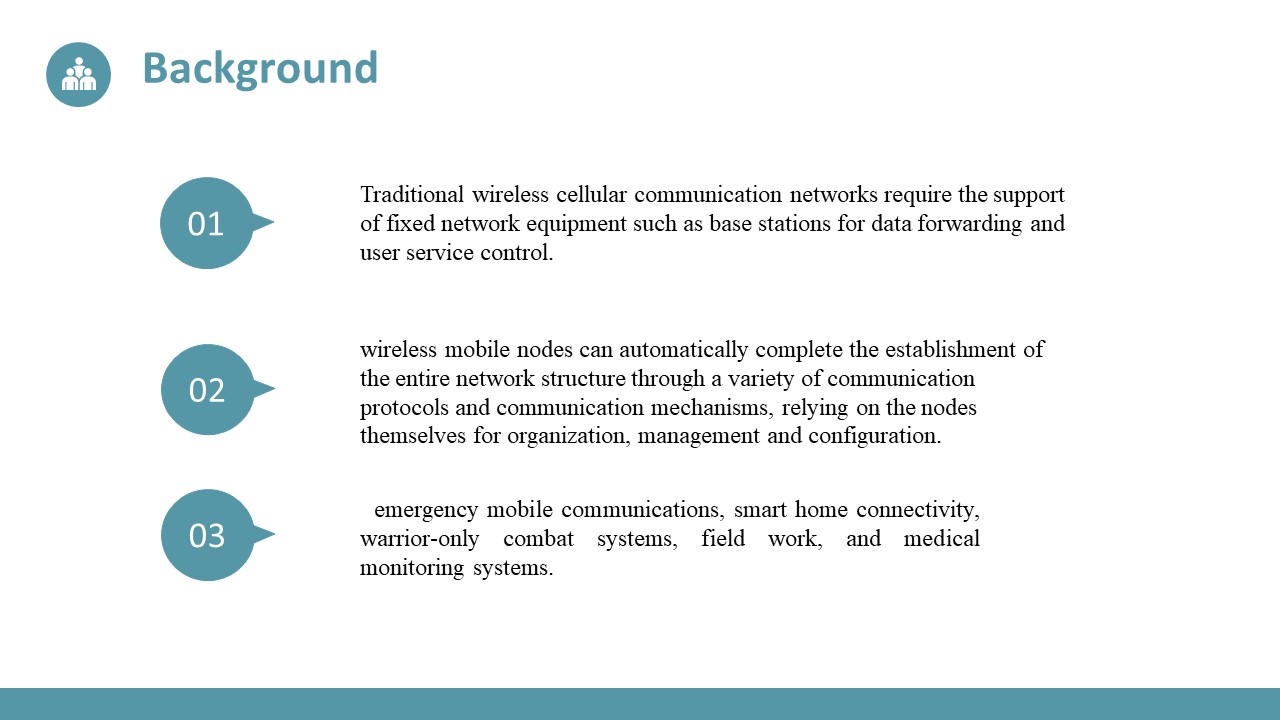 |
Mobile Ad Hoc Network (MANET) is a special kind of network that combines mobile communication and computer networks, it does not need to rely on a fixed network architecture, there is no centralized server for scheduling, wireless mobile nodes can automatically complete the establishment of the entire network structure through a variety of communication protocols and communication mechanisms, relying on the nodes themselves for organization, management and configuration. so mobile self-organizing networks are used in a variety of scenarios. For example, emergency mobile communications, smart home connectivity, warrior-only combat systems, field work, and medical monitoring systems.
|
|
ICACT20210251 Slide.03
[Big slide for presentation]
[YouTube] |
Chrome Text-to-Speach Click!! |
 |
Ok, let me introduce the background at first.
|
|
ICACT20210251 Slide.02
[Big slide for presentation]
[YouTube] |
Chrome Text-to-Speach Click!! |
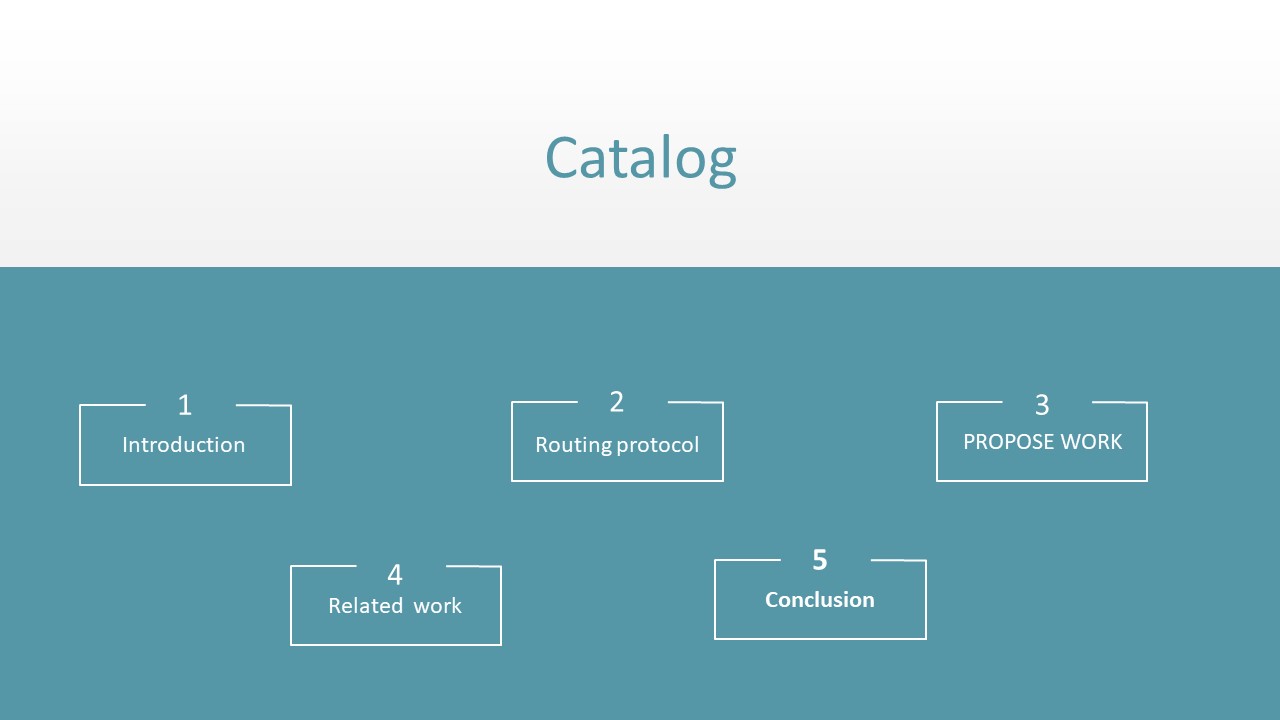 |
I will use the following
|
|
ICACT20210251 Slide.01
[Big slide for presentation]
[YouTube] |
Chrome Text-to-Speach Click!! |
 |
Hello everyone!I’m honor to speak here! Today I will introduce you a paper, which is called:“A Survey of Multi-path Load Balancing Based on Network Stochastic Model in MANET”. This paper examines some multi-path load-balanced routing schemes in MANET networks and provides the relative advantages and disadvantages of the protocols so that we can identify future directions for research.
|
















