 ICACT20220093 Slide.23
[Big slide for presentation] |
Chrome Text-to-Speach Click!! |
 |
The main findings of this study are as follows.
The green-noise diffused watermarking method is resistant to printing and scanning, and the embedded pattern is not easily visible. We extended this method to extract watermark information from cropped images by embedding markers. We used machine learning to improve the identifier accuracy and correct watermark extraction rate of over 95% are obtained from printed images. Furthermore, we embedded sub-information in the marker pattern to obtain accurate block synchronization from the cropped imagens.
|
|
ICACT20220093 Slide.22
[Big slide for presentation]
|
Chrome Text-to-Speach Click!! |
 |
Finally, I talk about the Conclusion.
|
|
ICACT20220093 Slide.21
[Big slide for presentation]
|
Chrome Text-to-Speach Click!! |
 |
A synchronization marker was embedded into an HD image (1920 × 1080) to evaluate its performance against cropping. The image of HD size was divided into 640 × 256 regions, and 318 bits (39 ASCII characters) were embedded into each region. The embedded area was identified by detecting the marker position. This figure shows the extraction of watermark information from the marker embedded image. Figure(a) shows the original image (1920 × 1080), figure(b) is the image divided into 640 × 256 and embedded, figure(c) is 950 × 512 by cropping, and (d) is the image obtained from the image in figure(c).
In figure(e), the embedded area was extracted from the position of the marker, and in figure(f), the watermark information was extracted, and the correct answer rate was 97.0%.
The detection of the marker position causes a detection error of several pixels, however, the Fourier transform is, resistant to synchronization fluctuations of several pixels, hence, the extraction error is low.
|
|
ICACT20220093 Slide.20
[Big slide for presentation]
[YouTube] |
Chrome Text-to-Speach Click!! |
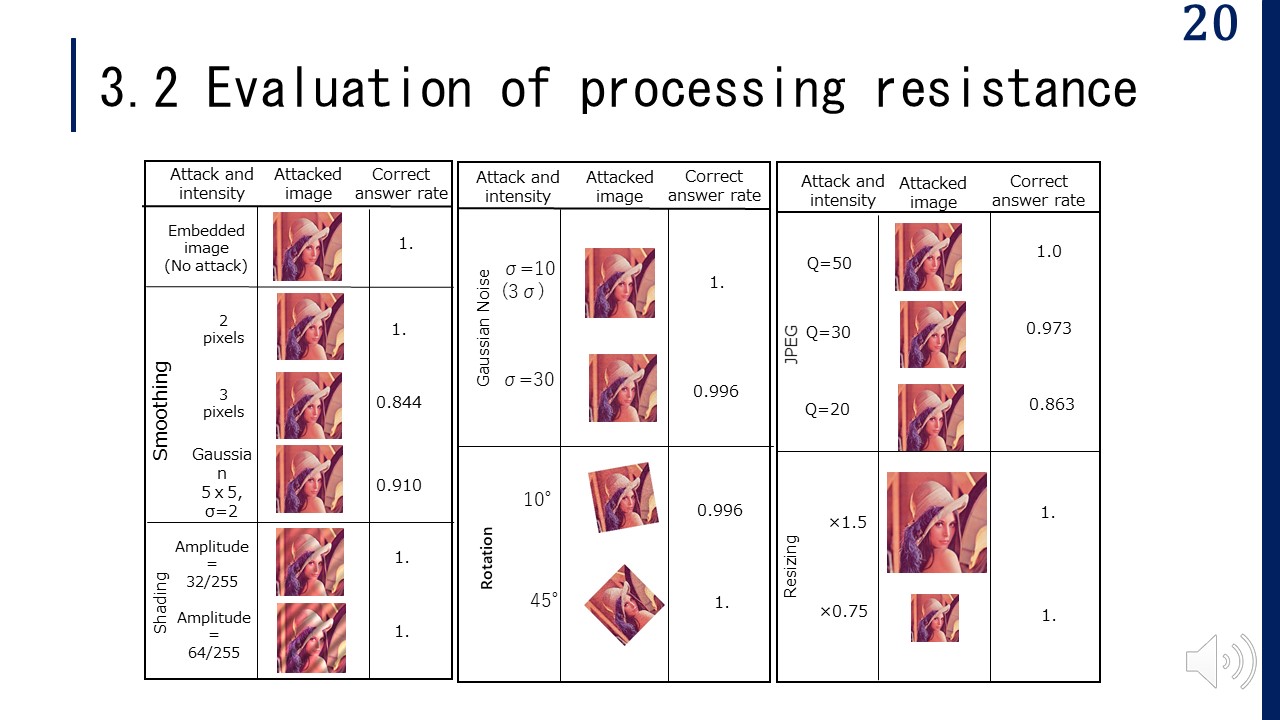 |
This figure shows the percentage of correct responses to various attacks by image editing and processing of Lena images (electronic data) with embedded watermarks. For processing that changes the image position or size (e.g., magnification or rotation), pixel interpolation was performed from the four edges of the image using bilinear transformation to create a corrected image of a predetermined size, after which the watermark was extracted.
The experimental results show that the watermark is robust to image processing that causes luminance changes (weak smoothing, shading, noise, JPEG compression), but the watermark disappears and the correct rate decreases when the cluster dot pattern is easily lost (strong smoothing, etc.).
The block size was 32×32, the extraction was completed using Fourier transform, and the watermark was not significantly affected by the luminance of each pixel of the dot pattern, but by the phase distribution of the dots, hence this confirms it is robust against block synchronization.
|
|
ICACT20220093 Slide.19
[Big slide for presentation]
|
Chrome Text-to-Speach Click!! |
 |
The experiment was conducted on six images (512×512), as shown in Figure . A total of 2048 bits (256 ASCII characters) were embedded in a block size of 32×32 with a gain of 0.125.
Embedding was performed by decomposing the image data into Y, Cb, and Cr, and embedding them into the luminance data.
The upper table shows the correct response rates for electronic data reading. This was more than 98.8%. The experiment was also conducted with images printed using a Canon TS5030 inkjet printer at 175 ppi (pixels per inch) (print size 74.3 mm). The image was scanned with a scanner built into the printer at 600dpi. After reading, the images were cropped and formatted to 512×512 pixels, and watermark extraction was performed. The below Table shows the results of watermark identification. All the results showed a high rate of correct answers (greater than 95%)
As for embedded image quality, if print resistance is required, 𝑔𝑎𝑖𝑛 is about 0.125~0.1875, and the visual PSNR is about 26~28 dB.
|
|
ICACT20220093 Slide.18
[Big slide for presentation]
|
Chrome Text-to-Speach Click!! |
 |
Next, I talk about the Experimental results.
|
|
ICACT20220093 Slide.17
[Big slide for presentation]
|
Chrome Text-to-Speach Click!! |
 |
The dataset consists of 1k×1k pixels image of mandrill images (512× 512), as shown in Figure, which are combined in different orientations. This is because Mandrill images have a high spatial frequency and are difficult to identify; therefore, images that are as difficult to discriminate as possible are more effective for training. Of the total 5000 labelled patterns, 80% were used for training and 20% for testing. The back-propagation method was used for error propagation, and simulation was performed using python.
As a result of the machine learning training, the correctness rate exceeded 99% in the early stage of training and finally reached 99.875% on the training data and 99.5% on the test data. Because we plan to include ECC in the watermark extractor, which corrects about 10% of burst errors, this correct rate is sufficient for implementation.
|
|
ICACT20220093 Slide.16
[Big slide for presentation]
|
Chrome Text-to-Speach Click!! |
 |
The extraction of the watermark is achieved using extraction software, which is independent of the ID and camouflage pattern, and anyone can read and see the embedded information without a key.
In this research, we used discriminator based on neural network machine learning. The structure of the NN is illustrated in Figure. The number of neurons in the input layer was 256, the hidden layer (middle layer) was 50, and the output layer was five. The sigmoid function is used as the activation function, and the confidence information is obtained by softmax in the final stage.
|
|
ICACT20220093 Slide.15
[Big slide for presentation]
|
Chrome Text-to-Speach Click!! |
 |
The watermark information is embedded in real space (pixel space) in blocks. Let 𝑖𝑘 (x,y) be the image data of the kth block, gain be the embedding strength, and 𝑤𝑘 (x,y) be the image data in which the watermark is embedded. The watermark data to be embedded are decomposed into a 1D bit sequence and wm ∈ (0,1). The embedding is performed by extracting two bits from wm for each block, and the embedding into the kth block is expressed by this equations.
|
|
ICACT20220093 Slide.14
[Big slide for presentation]
|
Chrome Text-to-Speach Click!! |
 |
The synchronization marker pattern was superimposed and embedded as secondary information. The pattern of the secondary information m(x,y) should be set such that its spectral
distribution is in the high-frequency range that does not overlap with the spectrum of the main information, that is, the green noise pattern. For example, if checkerboard pattern are used for every other pixel, its spectrum will be the Nyquist frequency, and there will be no crosstalk with the spectrum of the green noise.
The sub-information is extracted by convolution with the embedded image in pixel space (real space) using the filters M0and M1 shown in Figure.
The figure shows the marker pattern with the embedded sub information, its spectrum, and the extraction sub-information.
|
|
ICACT20220093 Slide.13
[Big slide for presentation]
|
Chrome Text-to-Speach Click!! |
 |
This figure shows the extraction of patterns by block averaging operation when a Lena image is embedded. It can be observed that patterns are not extracted when camouflage is present.
|
|
ICACT20220093 Slide.12
[Big slide for presentation]
|
Chrome Text-to-Speach Click!! |
 |
Next, the phase shift pattern is one in which the starting position of the pattern is shifted. The shift amount was determined randomly by generating random numbers in the blocks.
This figure shows a phase shift pattern. Because of the randomness of the dots, it is difficult to see the boundary line even after the phase shift. The same spectral shape is also shown.
|
|
ICACT20220093 Slide.11
[Big slide for presentation]
|
Chrome Text-to-Speach Click!! |
 |
A collusion attack is an attack in which a large number of users collude to remove the watermark. In the case of block-wise watermarking, the attack can be easily carried out by cutting out the embedded pattern for each block from a single image and analysing the pattern without the collusion of many users. In order to avoid such attacks and to obtain higher security, “Camouflage patterns” are introduced, which show the same spectrum but have different dot patterns. The camouflage pattern consisted of an inversion pattern and a phase-shift pattern.
For the inversion pattern, eight patterns are generated for one ID pattern, and the i-th pattern 𝑝𝑖,𝜎𝑖(x,y) are as follows.
The vertical and horizontal directions are relative to the major and minor axes of the ellipse, respectively. The negative pattern is a pattern in which the white and black dots are reversed. Because the numbers of white and black dots are the same, the number of dots does not change even if they are reversed. Figure3(a) shows the inverted pattern for R=32. The pattern 𝜎𝑖was generated by a random number generator and randomized for each block.
|
|
ICACT20220093 Slide.10
[Big slide for presentation]
|
Chrome Text-to-Speach Click!! |
 |
To link patterns and information anisotropy are introduced for the watermark embedding pattern and a four-level embedding pattern 𝑝𝑖(i=0,1,2,3) and a marker pattern H are generated by filtering. At this time, a random number pattern with the embedder's ID as the seed value is used as the initial value for filtering . The obtained pattern pi shows the green noise characteristics shown in Figure , and different patterns can be obtained by changing the seed value. The ID pattern can be regarded as a two-dimensional pattern, such as a fingerprint unique to the copyright holder. The pattern is stored as a secret key ‘Key (M)’, and the watermark can be removed, appended, or rewritten as required. 4-level patterns are mapped to an embedding code, which is a Gray Code with a Hamming distance of 1.
|
|
ICACT20220093 Slide.09
[Big slide for presentation]
|
Chrome Text-to-Speach Click!! |
 |
I explain how to make green noise.
Step 1: Fill half of the image with random black and the other half with white dots. This random seed will be a key. Step 2: Next, perform a two-dimensional fourier transform of the dot pattern to obtained image P. Step 3:For frequency picture-transformed image P, filter D which has a constant value (=1) in the band confined to a certain region is filtered to obtain a new image P’. Step 4: Perform an inverse Fourier transform on image P' to obtain a multi-level dot pattern 𝑝′.Step 5: Calculate the error function e, and invert the same number of white and black dots in descending order of the error values. Step 6: Repeat Step 2~5 to obtain the desired dot pattern.
|
|
ICACT20220093 Slide.08
[Big slide for presentation]
|
Chrome Text-to-Speach Click!! |
 |
Green noise is a noise whose frequency is confined to a certain region. If the frequency is too small, it is easily recognized by the human eye, and if the frequency is too high, the pattern cannot be expressed by printing. Therefore, the green noise pattern is used in this research as a printable pattern that is difficult to be recognized by the human eye.
|
|
ICACT20220093 Slide.07
[Big slide for presentation]
|
Chrome Text-to-Speach Click!! |
 |
Next, I start by talking about the algorithm of Green-Noise Diffusion Method.
|
|
ICACT20220093 Slide.06
[Big slide for presentation]
|
Chrome Text-to-Speach Click!! |
 |
In this research, for copyright protection, the following requirements is assumed. First, any image viewer can read the embedded information without a key using publicly available watermark extraction software. This excludes watermarking methods that cannot be read without a key. Second, the purchaser can remove/add/rewrite the watermark using the "key". In other words, the watermark cannot be removed without a key. For this purpose, the watermark must be reversible using a key. Third, Electronic and printed data can be traceable and detected for unauthorized use. This requires a watermarking method that possesses print/scan resistance. Last, the loss of the key can be minimized. In other words, the key should be identified for each image, and the lost/stolen key should not have the ability to remove the watermark from other images.
|
|
ICACT20220093 Slide.05
[Big slide for presentation]
|
Chrome Text-to-Speach Click!! |
 |
In this research, we propose a print/scan-resistant watermarking method using the green noise diffusion method . This method divides an image into blocks, embeds watermark information in each block, and has the characteristics of print resistance. Usually, copyright protection applications deal with large-sized images as target images. Therefore, it is necessary to extract the watermark from the cropped image of the image. In this study, we investigate a green-noise diffusion method that embeds marker patterns and can be applied to cropped images. For this purpose, identifier based on machine learning are used to detect watermark patterns, including marker patterns with high accuracy. To obtain block synchronization, sub-information are introduced and we investigated block synchronization from cropped images. Furthermore, we aimed to create a highly secure watermarking method using camouflage patterns.
|
|
ICACT20220093 Slide.04
[Big slide for presentation]
|
Chrome Text-to-Speach Click!! |
 |
In today's digital information society, the reproduction of information has enabled many people to share information, which has greatly advanced society. However, this convenience has led to the illegal reproduction and distribution of personal work, which has caused problems such as copyright infringement. In the case of printed images, the high image quality of imaging devices in recent years has made it easy to obtain reproductions that look exactly the same as the originals, which has encouraged not only illegal copying that infringes copyrights but also malicious criminal acts such as counterfeiting banknotes and securities.
Digital watermarking technology has been attracting attention as a countermeasure against such fraudulent activities. Unlike encryption and digital rights management, digital watermarking embeds information directly into documents and images, thus providing the ultimate security technology for protecting copyrights and tracking.
|
|
ICACT20220093 Slide.03
[Big slide for presentation]
|
Chrome Text-to-Speach Click!! |
 |
Now I start by talking about Introduction.
|
|
ICACT20220093 Slide.02
[Big slide for presentation]
|
Chrome Text-to-Speach Click!! |
 |
My presentation consists of 4 parts. First, I`d like to start by talking about Introduction. Second, I talk about the algorithm of Green Noise Diffusion Method. After that I explain the results of the experiment. Finally, I talked about the conclusions.
|
|
ICACT20220093 Slide.01
[Big slide for presentation]
[YouTube] |
Chrome Text-to-Speach Click!! |
 |
I’m very happy to be able to talk to you today. Today I’d like to talk about the Watermarking based on Green Noise Diffusion Method.
|
















