ICACT20220181 Slide.20
[Big slide for presentation]
[YouTube]
ICACT20220181 Slide.20
[Big slide for presentation]
[YouTube] |
Chrome Text-to-Speach Click!! Click!! |
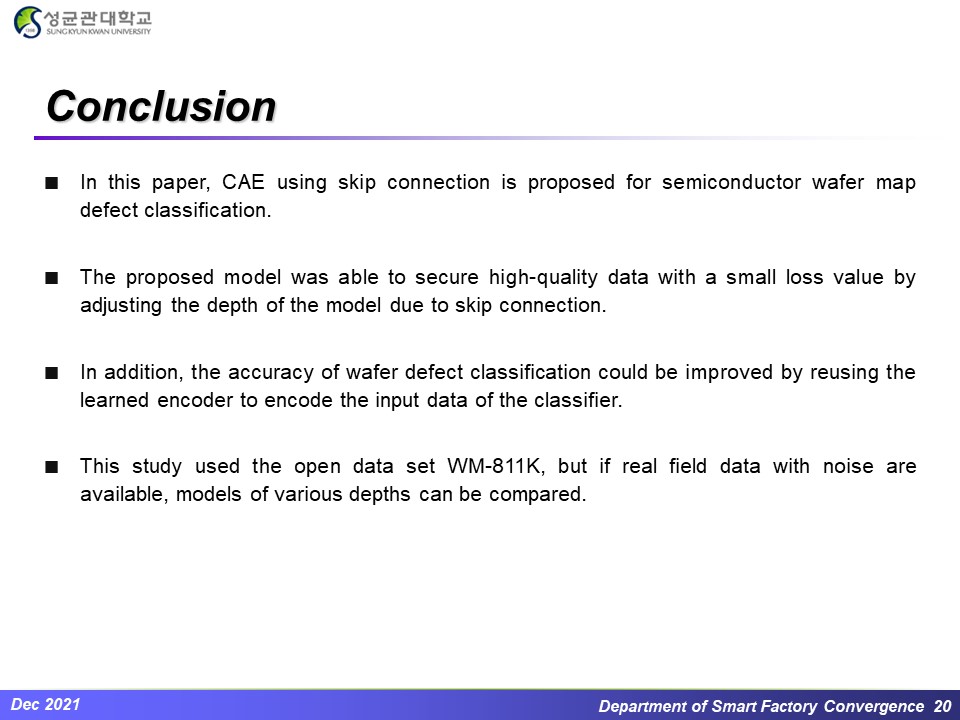 |
In this paper, CAE using skip connection is proposed for semiconductor wafer map defect classification.
The proposed model was able to secure high-quality data with a small loss value by adjusting the depth of the model due to skip connection.
In addition, the accuracy of wafer defect classification could be improved by reusing the learned encoder to encode the input data of the classifier.
This study used the open data set WM-811K, but if real field data with noise are available, models of various depths can be compared.
|
|
ICACT20220181 Slide.19
[Big slide for presentation]
[YouTube] |
Chrome Text-to-Speach Click!! |
 |
This is the conclusion section.
|
|
ICACT20220181 Slide.18
[Big slide for presentation]
[YouTube] |
Chrome Text-to-Speach Click!! |
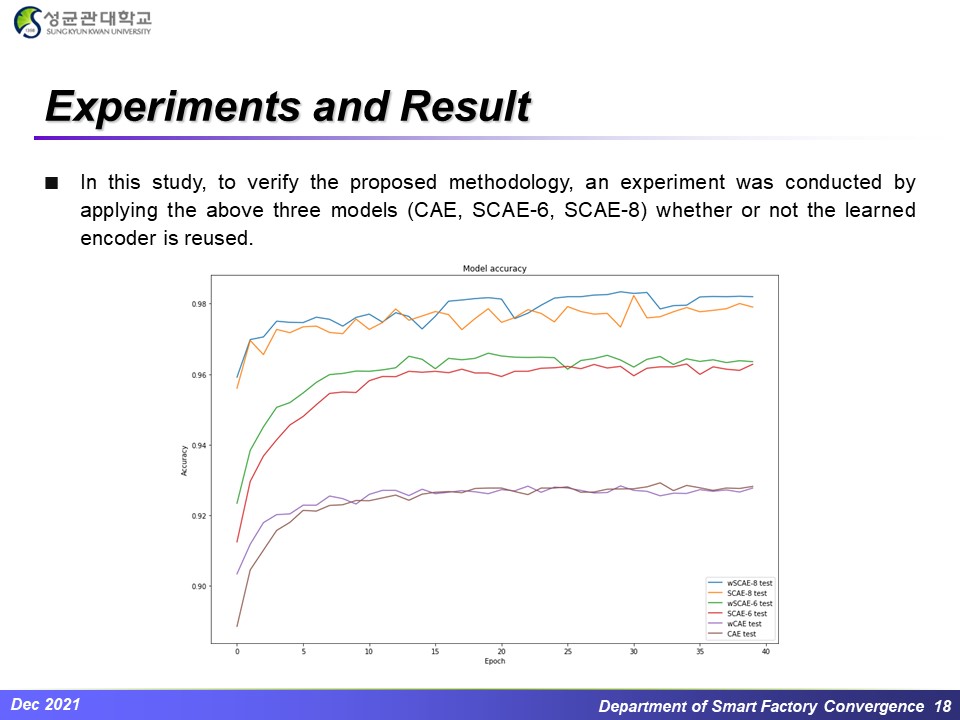 |
In this study, to verify the proposed methodology, an experiment was conducted by applying the above three models (CAE, SCAE-6, SCAE-8) whether or not the learned encoder is reused.
The accuracy of the test set was high in the order of SCAE-8, SCAE-6, and CAE, and when the learned encoder was reused, the accuracy was slightly increased.
|
|
ICACT20220181 Slide.17
[Big slide for presentation]
[YouTube] |
Chrome Text-to-Speach Click!! |
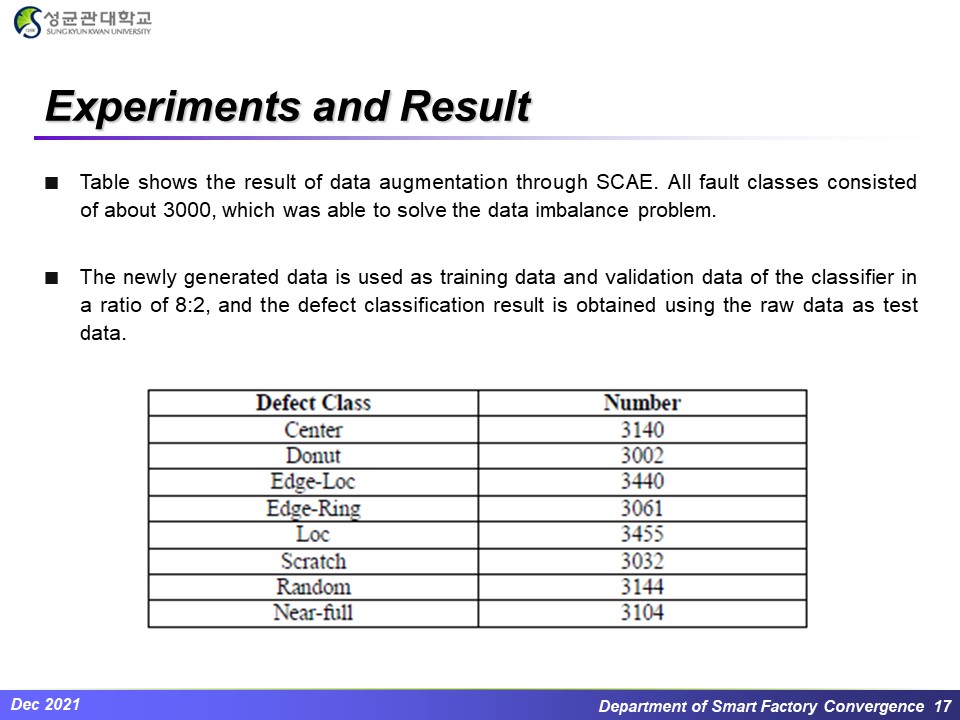 |
Table shows the result of data augmentation through SCAE. All fault classes consisted of about 3000, which was able to solve the data imbalance problem.
The newly generated data is used as training data and validation data of the classifier in a ratio of 8:2, and the defect classification result is obtained using the raw data as test data.
|
|
ICACT20220181 Slide.16
[Big slide for presentation]
[YouTube] |
Chrome Text-to-Speach Click!! |
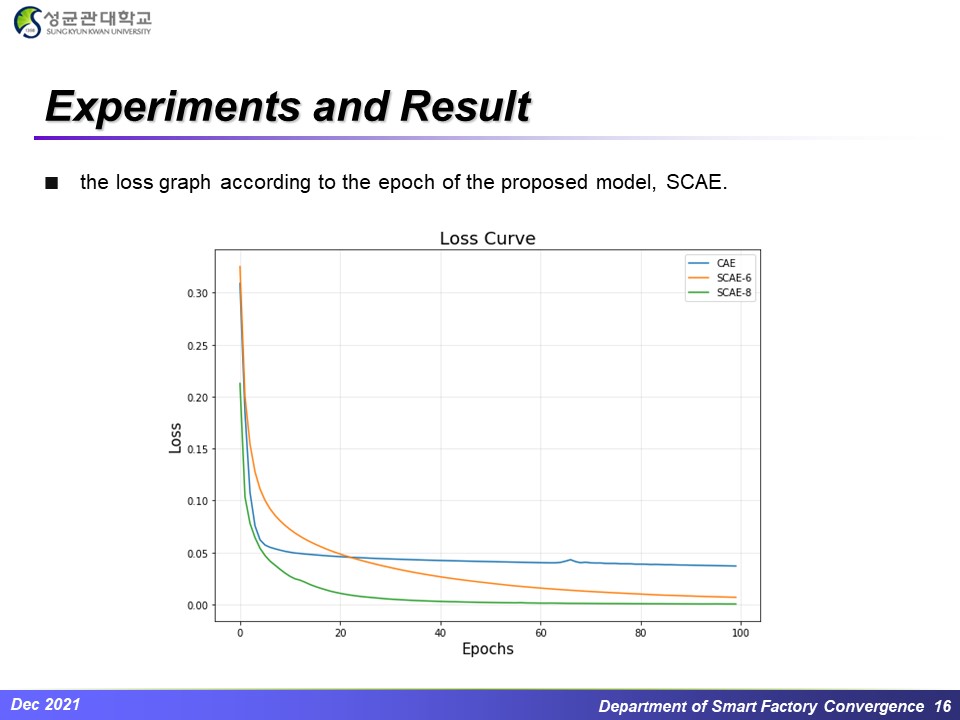 |
The loss graph according to the epoch of the proposed model, SCAE.
It can be seen that the loss value is lower when skip connection is used.
And as a result of comparing the design depth of the model differently, better performance can be confirmed when 8 convolutional blocks are used.
A low loss value in an autoencoder-based model means that the encoder extracts important features from the input data.
|
|
ICACT20220181 Slide.15
[Big slide for presentation]
[YouTube] |
Chrome Text-to-Speach Click!! |
 |
The data set used in the study, WM-811K, has a ratio of labeled data and non-labeled data of 78:21, among which data with a defect pattern corresponds to 1/6.
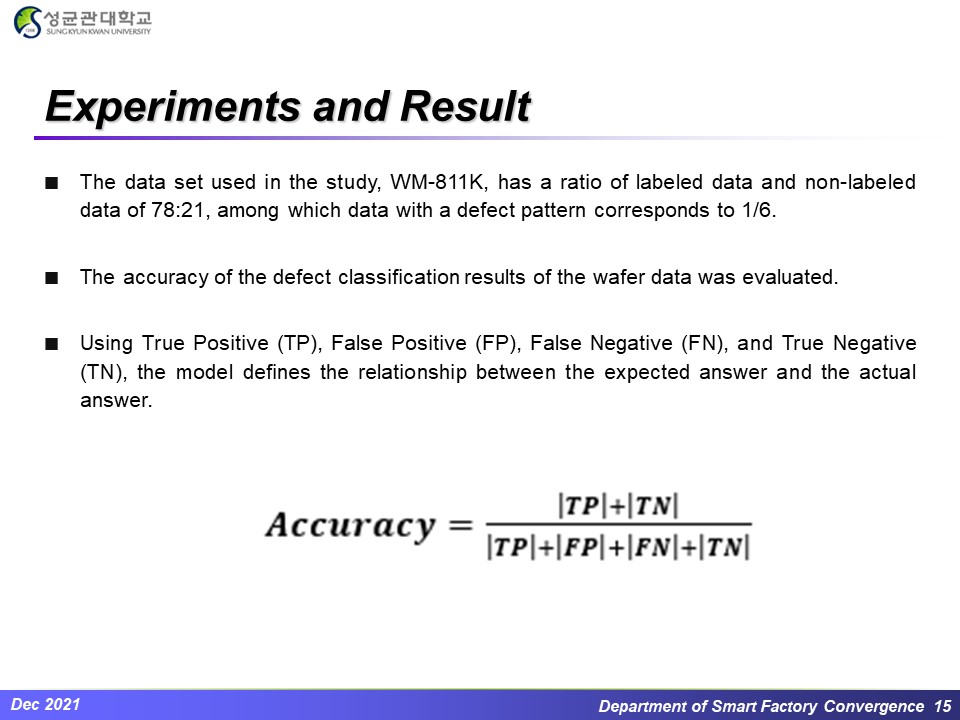
The accuracy of the defect classification results of the wafer data was evaluated.
Using True Positive (TP), False Positive (FP), False Negative (FN), and True Negative (TN), the model defines the relationship between the expected answer and the actual answer.
|
|
ICACT20220181 Slide.14
[Big slide for presentation]
[YouTube] |
Chrome Text-to-Speach Click!! |
 |
This is the experiments and result section.
|
|
ICACT20220181 Slide.13
[Big slide for presentation]
[YouTube] |
Chrome Text-to-Speach Click!! |
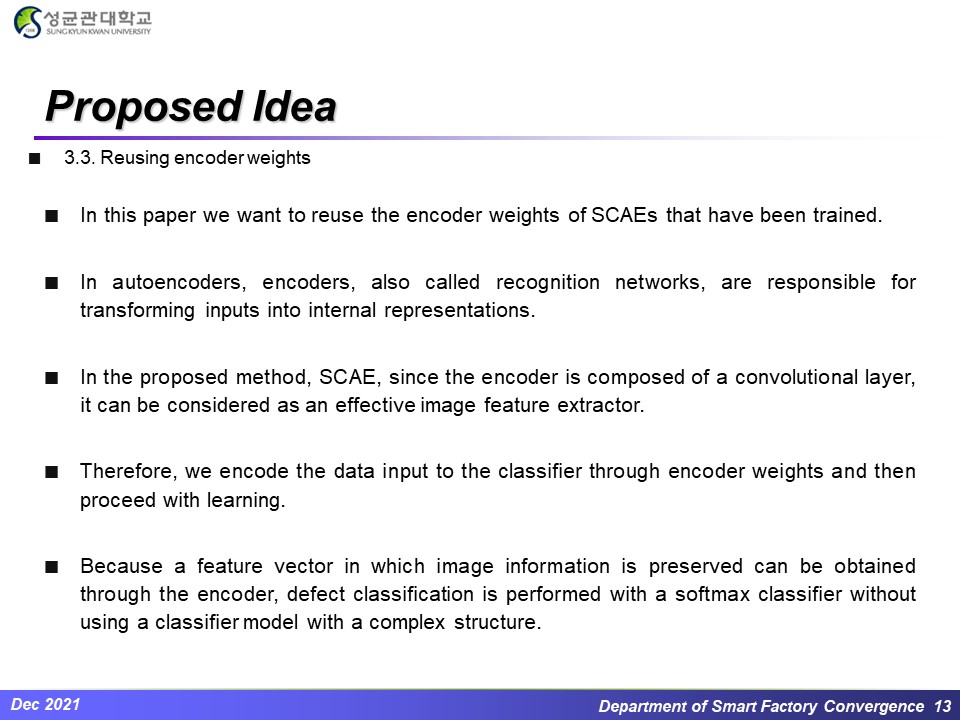 |
In this paper we want to reuse the encoder weights of SCAEs that have been trained.
In autoencoders, encoders, also called recognition networks, are responsible for transforming inputs into internal representations.
In the proposed method, SCAE, since the encoder is composed of a convolutional layer, it can be considered as an effective image feature extractor.
Therefore, we encode the data input to the classifier through encoder weights and then proceed with learning.
Because a feature vector in which image information is preserved can be obtained through the encoder, defect classification is performed with a softmax classifier without using a classifier model with a complex structure.
|
|
ICACT20220181 Slide.12
[Big slide for presentation]
[YouTube] |
Chrome Text-to-Speach Click!! |
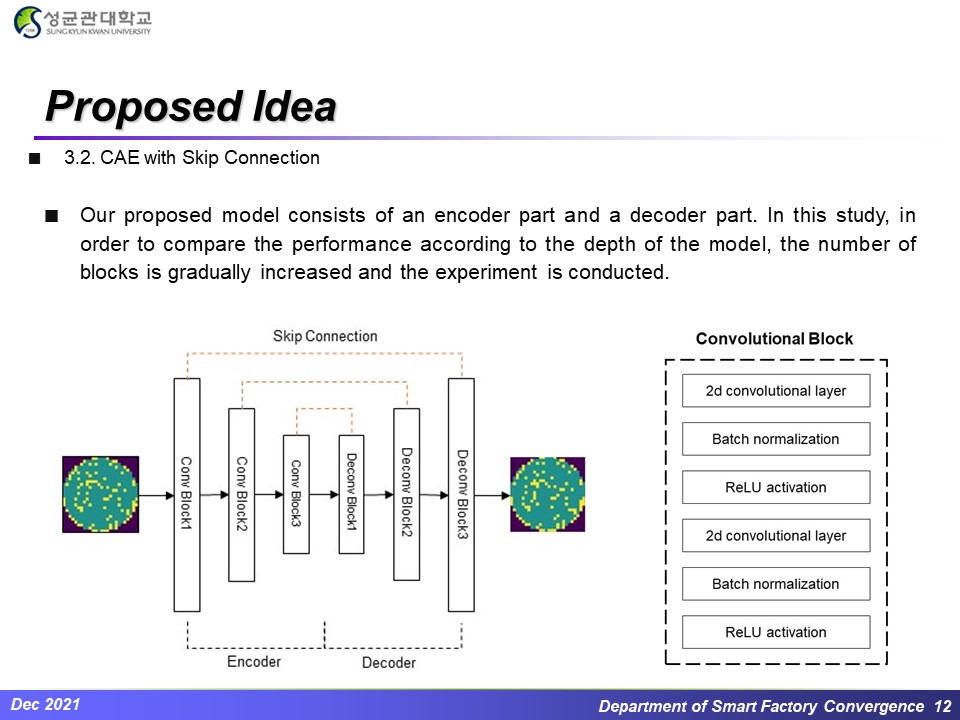 |
The convolutional block has two 3x3 kernel size 2d convolutional layers, and batch normalization and ReLU follow each convolutional layer.
A maxpooling layer is constructed between each convolutional block to prevent overfitting.
The decoder has a symmetrical structure with the encoder, and the convolutional layer is replaced by the deconvolutional layer.
The rest of the blocks are the same, and an upsampling layer is formed between each deconvolutional block to restore the image size reduced by the maxpooling layer.
|
|
ICACT20220181 Slide.11
[Big slide for presentation]
[YouTube] |
Chrome Text-to-Speach Click!! |
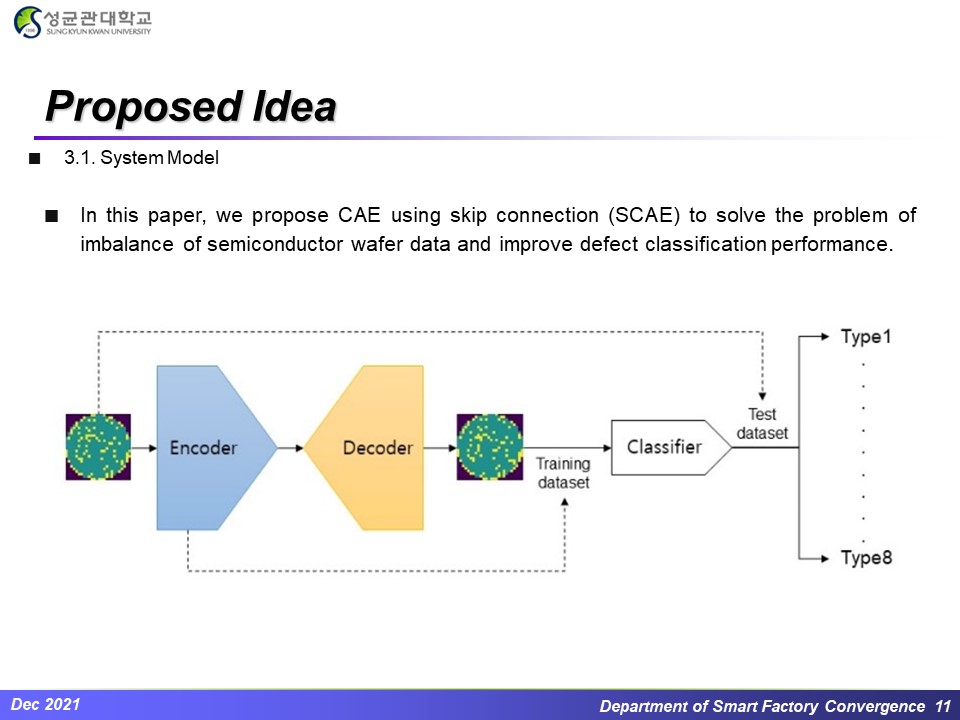 |
In this paper, we propose CAE using skip connection (SCAE) to solve the problem of imbalance of semiconductor wafer data and improve defect classification performance. And we propose a method of encoding the input data of the classifier by reusing the learned encoder.
|
|
ICACT20220181 Slide.10
[Big slide for presentation]
[YouTube] |
Chrome Text-to-Speach Click!! |
 |
This is the proposed idea section.
|
|
ICACT20220181 Slide.09
[Big slide for presentation]
[YouTube] |
Chrome Text-to-Speach Click!! |
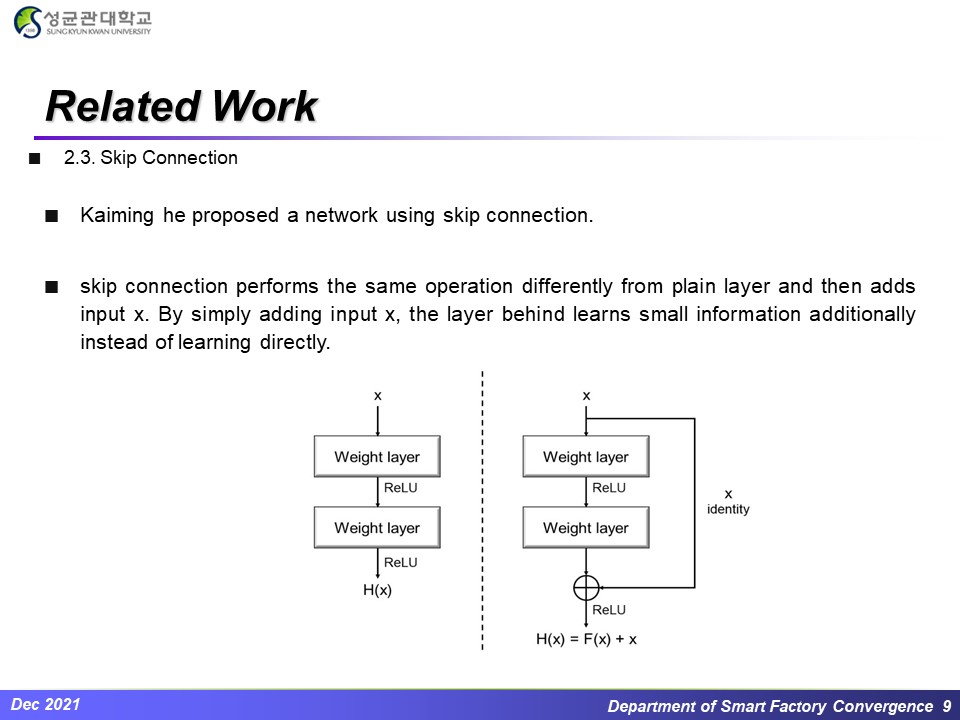 |
Kaiming he proposed a network using skip connection.
skip connection performs the same operation differently from plain layer and then adds input x. By simply adding input x, the layer behind learns small information additionally instead of learning directly.
|
|
ICACT20220181 Slide.08
[Big slide for presentation]
[YouTube] |
Chrome Text-to-Speach Click!! |
 |
Autoencoder is a deep learning model proposed by Bengio in 2007.
Autoencoder consists of an encoder that converts input data into different values and a decoder that restores the original format.
Convolutional autoencoder is a model using CNN for the structure of autoencoder.
CNN is a representative image classification network that extracts features and classifies images through convolution operation while maintaining spatial/regional information of input images.
|
|
ICACT20220181 Slide.07
[Big slide for presentation]
[YouTube] |
Chrome Text-to-Speach Click!! |
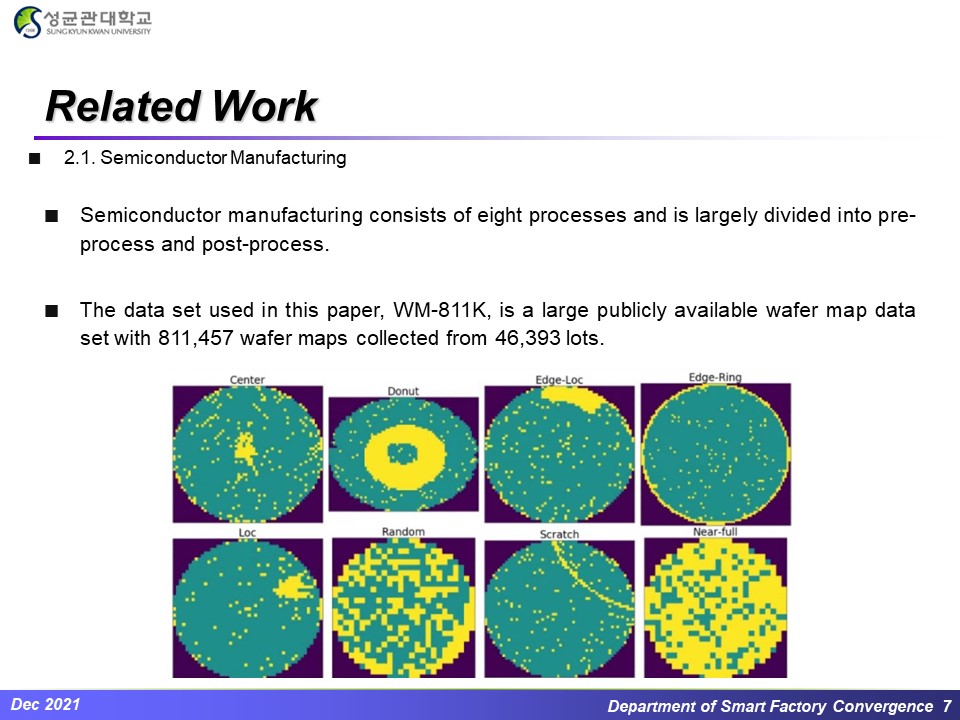 |
Semiconductor manufacturing consists of eight processes and is largely divided into pre-process and post-process.
In particular, the pre-process is also called a wafer process, and it is a step in which a single semiconductor chip is made by repeatedly forming and cutting various types of films on the wafer surface while composing an electronic circuit.
The data set used in this paper, WM-811K, is a large publicly available wafer map data set with 811,457 wafer maps collected from 46,393 lots.
|
|
ICACT20220181 Slide.06
[Big slide for presentation]
[YouTube] |
Chrome Text-to-Speach Click!! |
 |
This is the Related work section.
|
|
ICACT20220181 Slide.05
[Big slide for presentation]
[YouTube] |
Chrome Text-to-Speach Click!! |
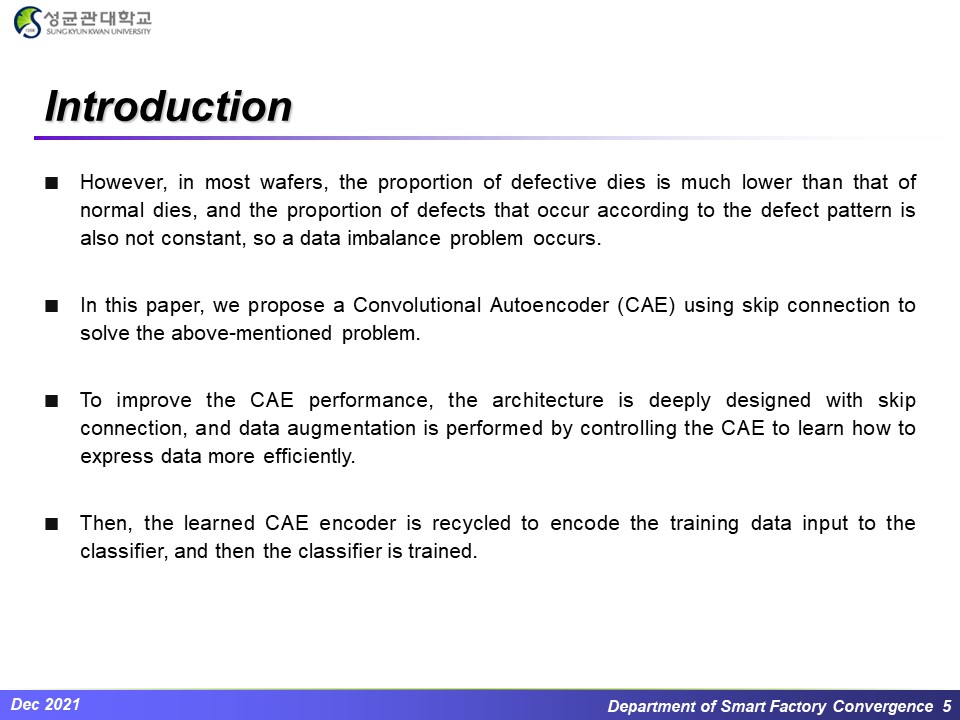 |
However, in most wafers, the proportion of defective dies is much lower than that of normal dies, and the proportion of defects that occur according to the defect pattern is also not constant, so a data imbalance problem occurs.
In this paper, we propose a Convolutional Autoencoder (CAE) using skip connection to solve the above-mentioned problem.
To improve the CAE performance, the architecture is deeply designed with skip connection, and data augmentation is performed by controlling the CAE to learn how to express data more efficiently.
Then, the learned CAE encoder is recycled to encode the training data input to the classifier, and then the classifier is trained.
|
|
ICACT20220181 Slide.04
[Big slide for presentation]
[YouTube] |
Chrome Text-to-Speach Click!! |
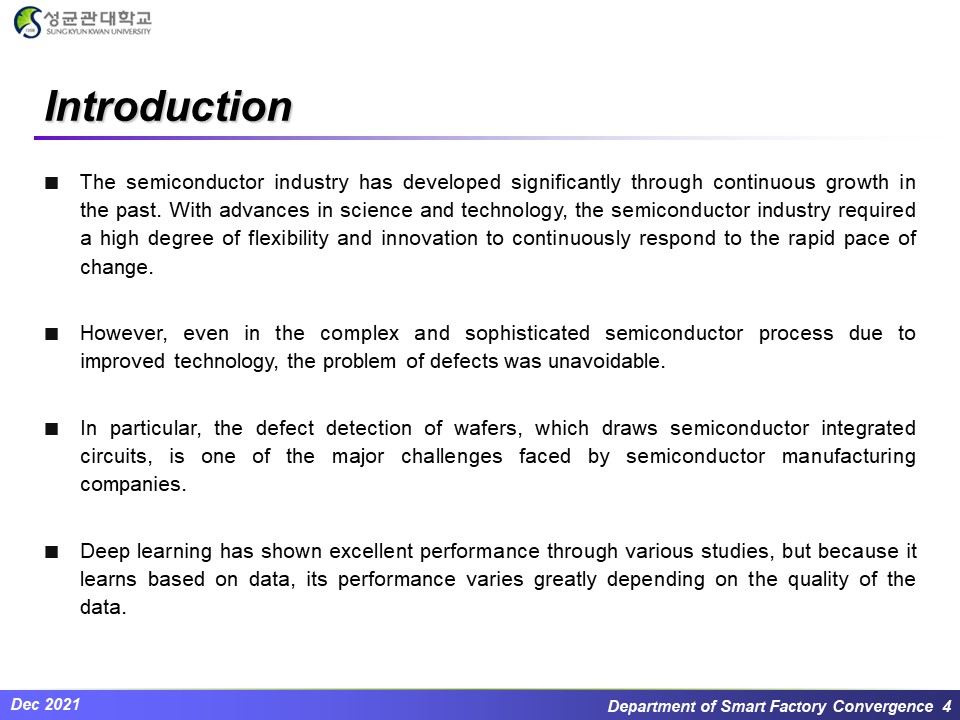 |
The semiconductor industry has developed significantly through continuous growth in the past. With advances in science and technology, the semiconductor industry required a high degree of flexibility and innovation to continuously respond to the rapid pace of change.
However, even in the complex and sophisticated semiconductor process due to improved technology, the problem of defects was unavoidable.
In particular, the defect detection of wafers, which draws semiconductor integrated circuits, is one of the major challenges faced by semiconductor manufacturing companies.
Deep learning has shown excellent performance through various studies, but because it learns based on data, its performance varies greatly depending on the quality of the data.
|
|
ICACT20220181 Slide.03
[Big slide for presentation]
[YouTube] |
Chrome Text-to-Speach Click!! |
 |
This is the Introduction section.
|
|
ICACT20220181 Slide.02
[Big slide for presentation]
[YouTube] |
Chrome Text-to-Speach Click!! |
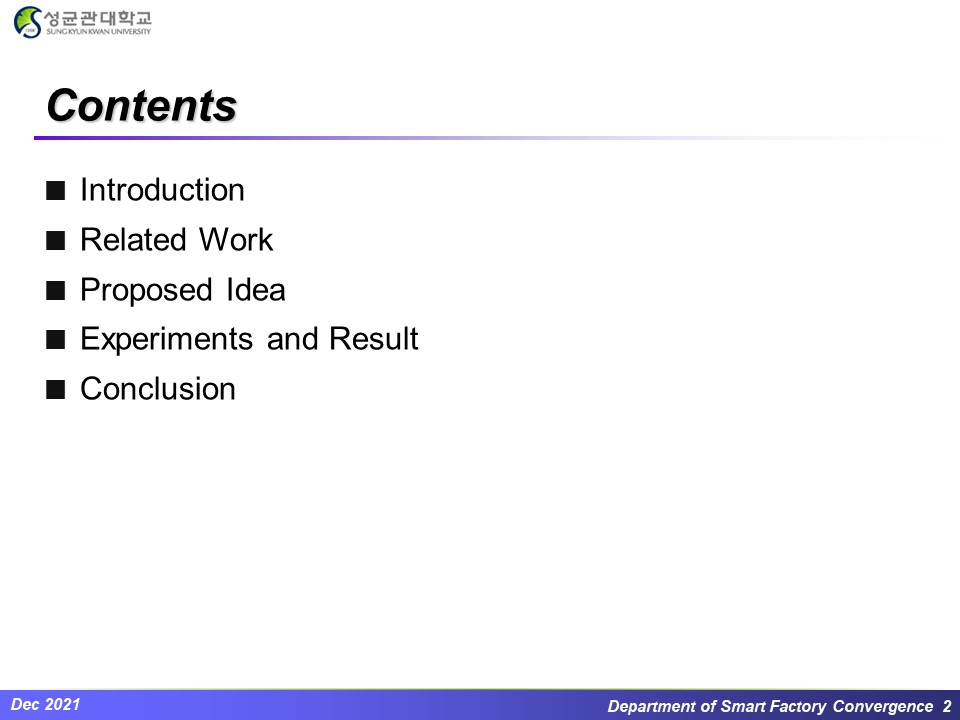 |
The contents of the presentation are introduction, related work, proposed idea, experiments and result, and conclusion.
|
|
ICACT20220181 Slide.01
[Big slide for presentation]
[YouTube] |
Chrome Text-to-Speach Click!! |
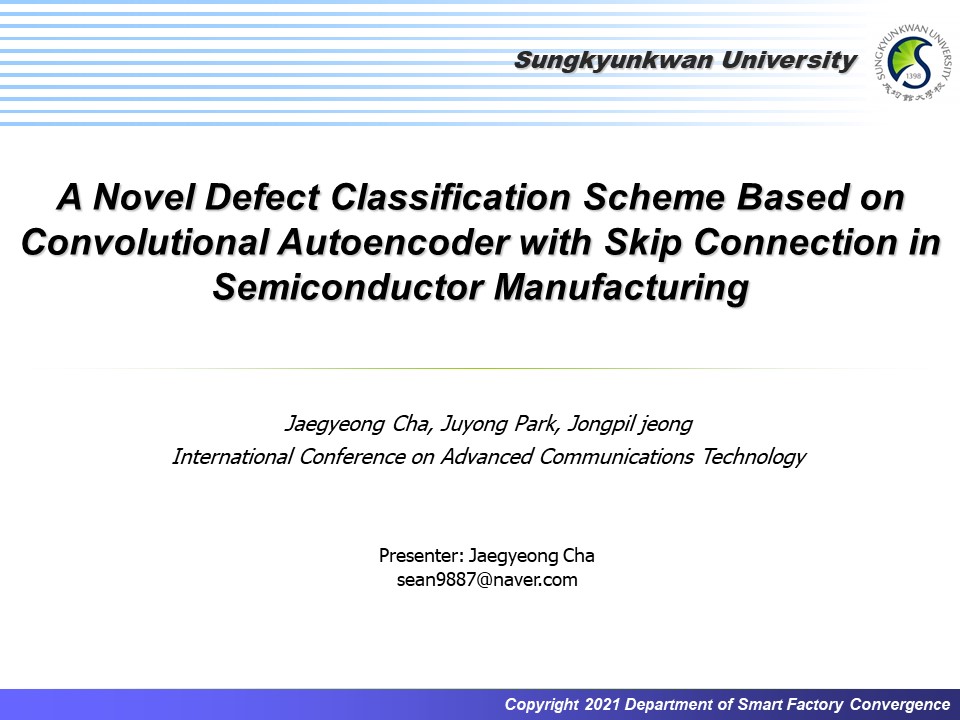 |
Hi everybody, my name is Jaegyeong Cha.
For ICACT 2022, I have cooperated with two partners from Mr. Juyong Park and Jongpil Jeong.
Our paper¡¯s title is a novel defect classification scheme based on convolutional autoencoder with skip connection in semiconductor manufacturing.
|