 ICACT20230044 Slide.23
[Big slide for presentation]
[YouTube] |
Chrome Text-to-Speach Click!! |
 |
Thank you for listening the presentation. Any question for better suggest?
|
|
ICACT20230044 Slide.22
[Big slide for presentation]
[YouTube] |
Chrome Text-to-Speach Click!! |
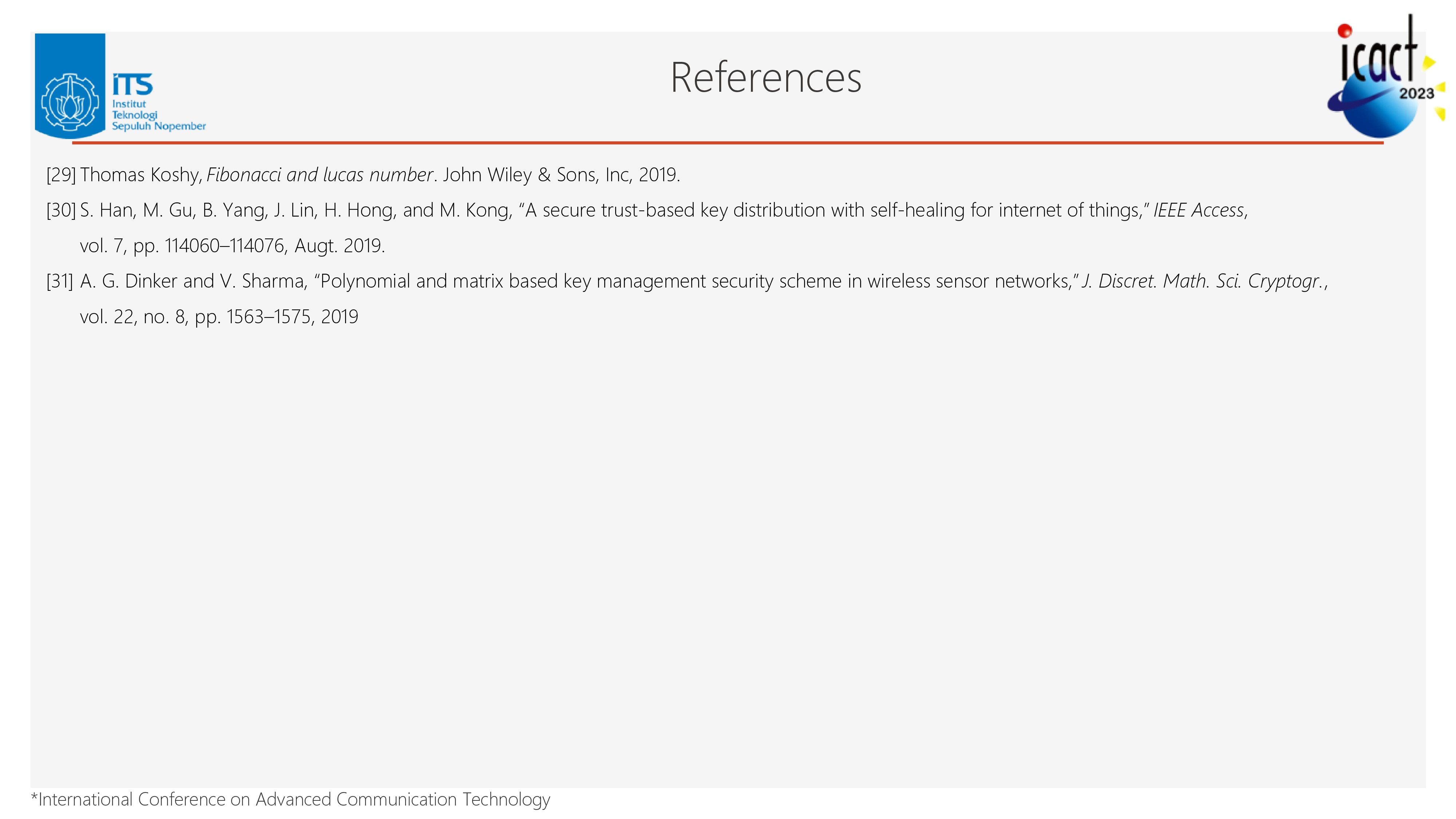 |
This is the last slide of the used references of the paper.
|
|
ICACT20230044 Slide.21
[Big slide for presentation]
[YouTube] |
Chrome Text-to-Speach Click!! |
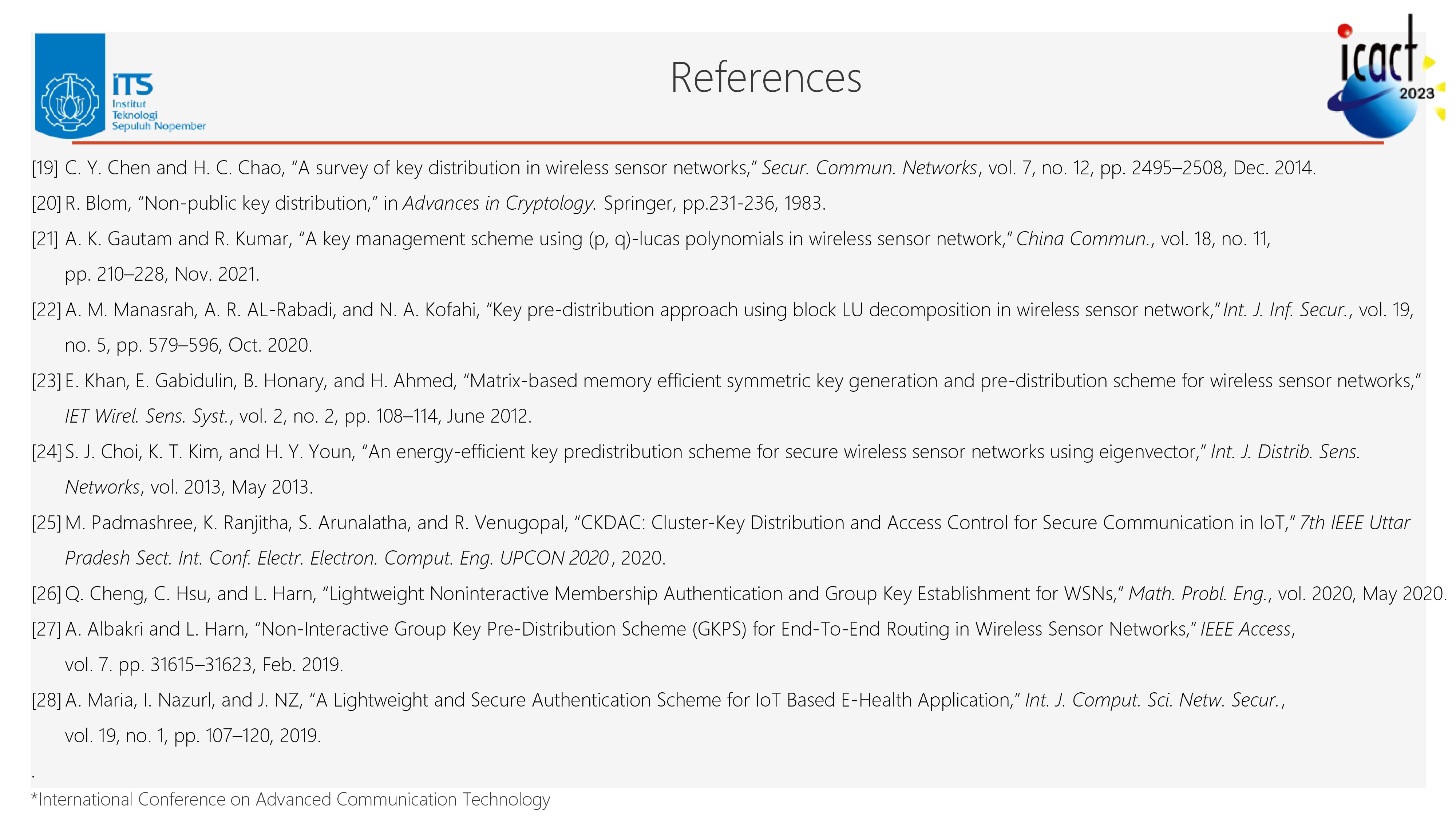 |
This is the used references from 19 to 28.
|
|
ICACT20230044 Slide.20
[Big slide for presentation]
[YouTube] |
Chrome Text-to-Speach Click!! |
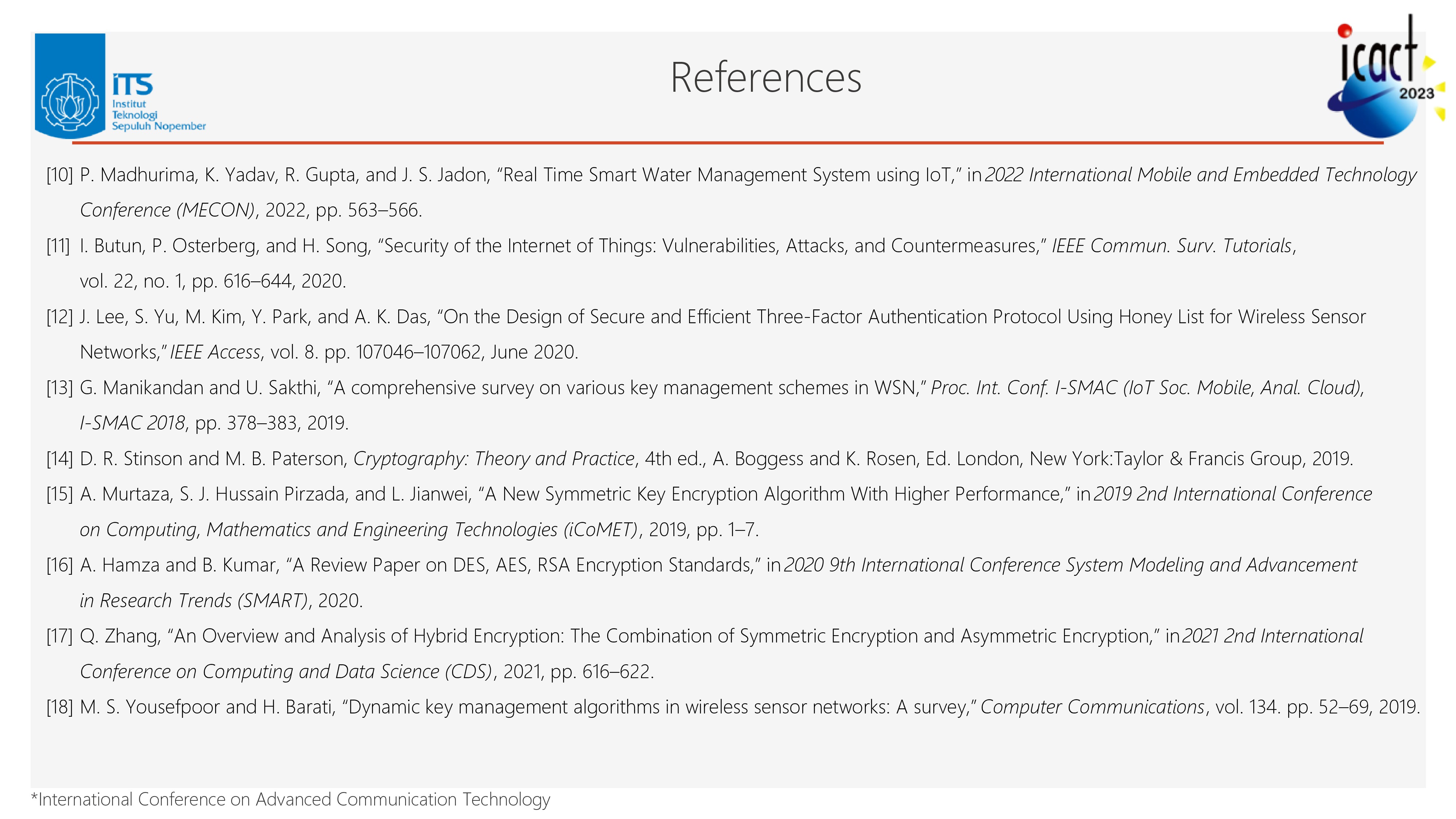 |
This is the used references of the paper from 10 to 18.
|
|
ICACT20230044 Slide.19
[Big slide for presentation]
[YouTube] |
Chrome Text-to-Speach Click!! |
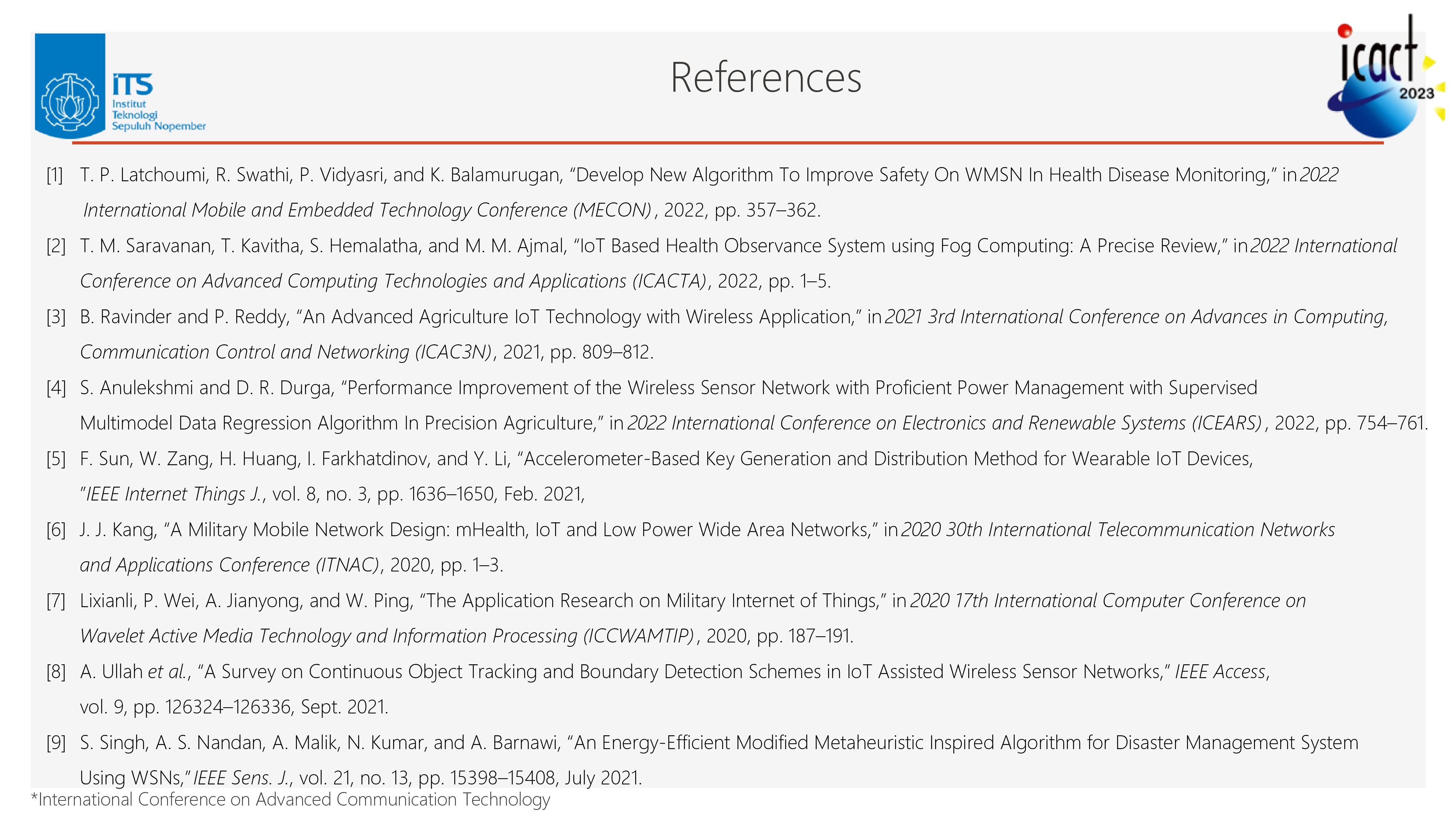 |
This is the used references of the paper from 1 to 9.
|
|
ICACT20230044 Slide.18
[Big slide for presentation]
[YouTube] |
Chrome Text-to-Speach Click!! |
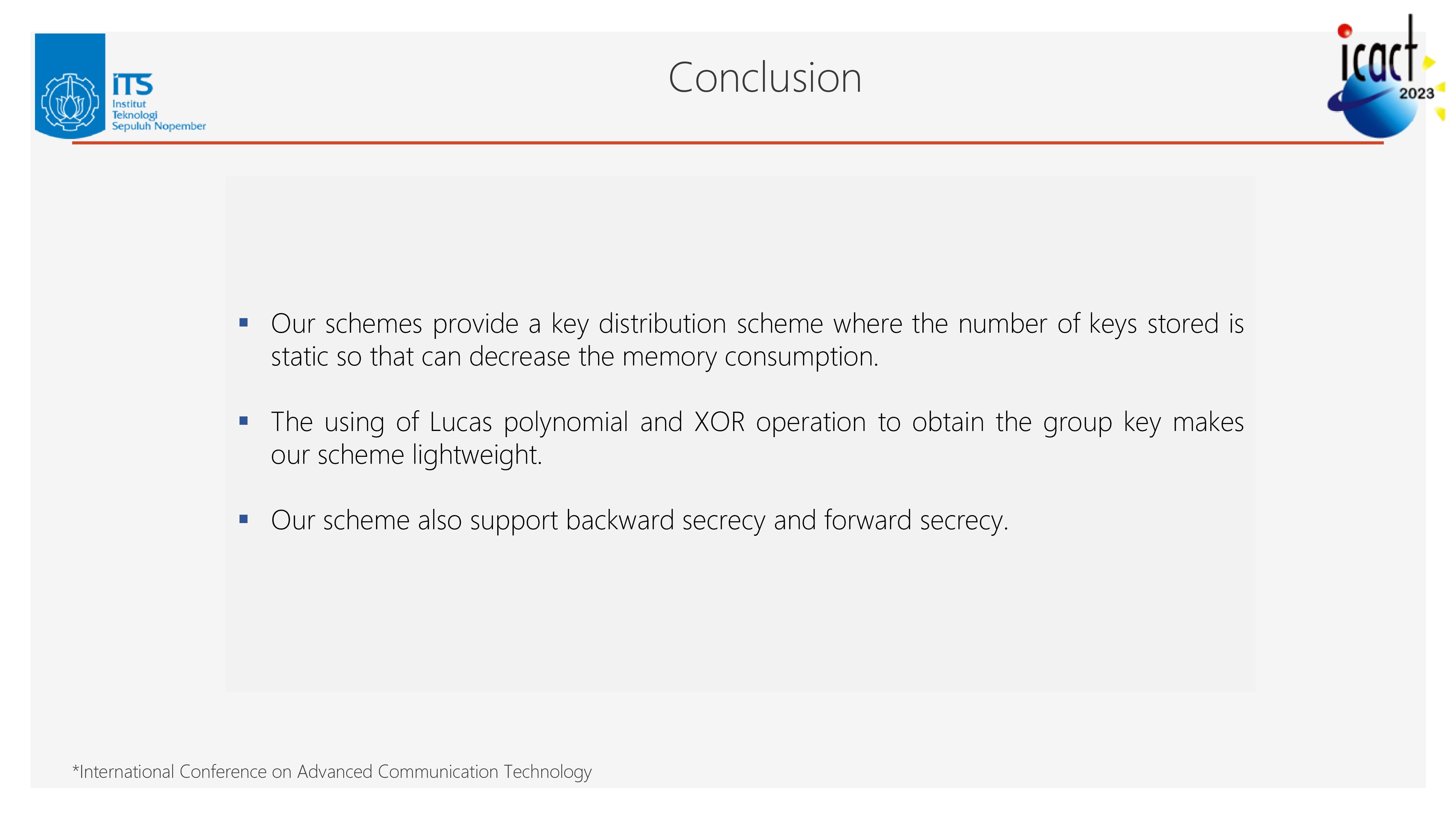 |
From the results, we can conclude that:
Our schemes provide a key distribution scheme where the number of keys stored is static so that can decrease the memory consumption.
The using of Lucas polynomial and XOR operation to obtain the group key makes our scheme lightweight.
Our scheme also support backward secrecy and forward secrecy.
|
|
ICACT20230044 Slide.17
[Big slide for presentation]
[YouTube] |
Chrome Text-to-Speach Click!! |
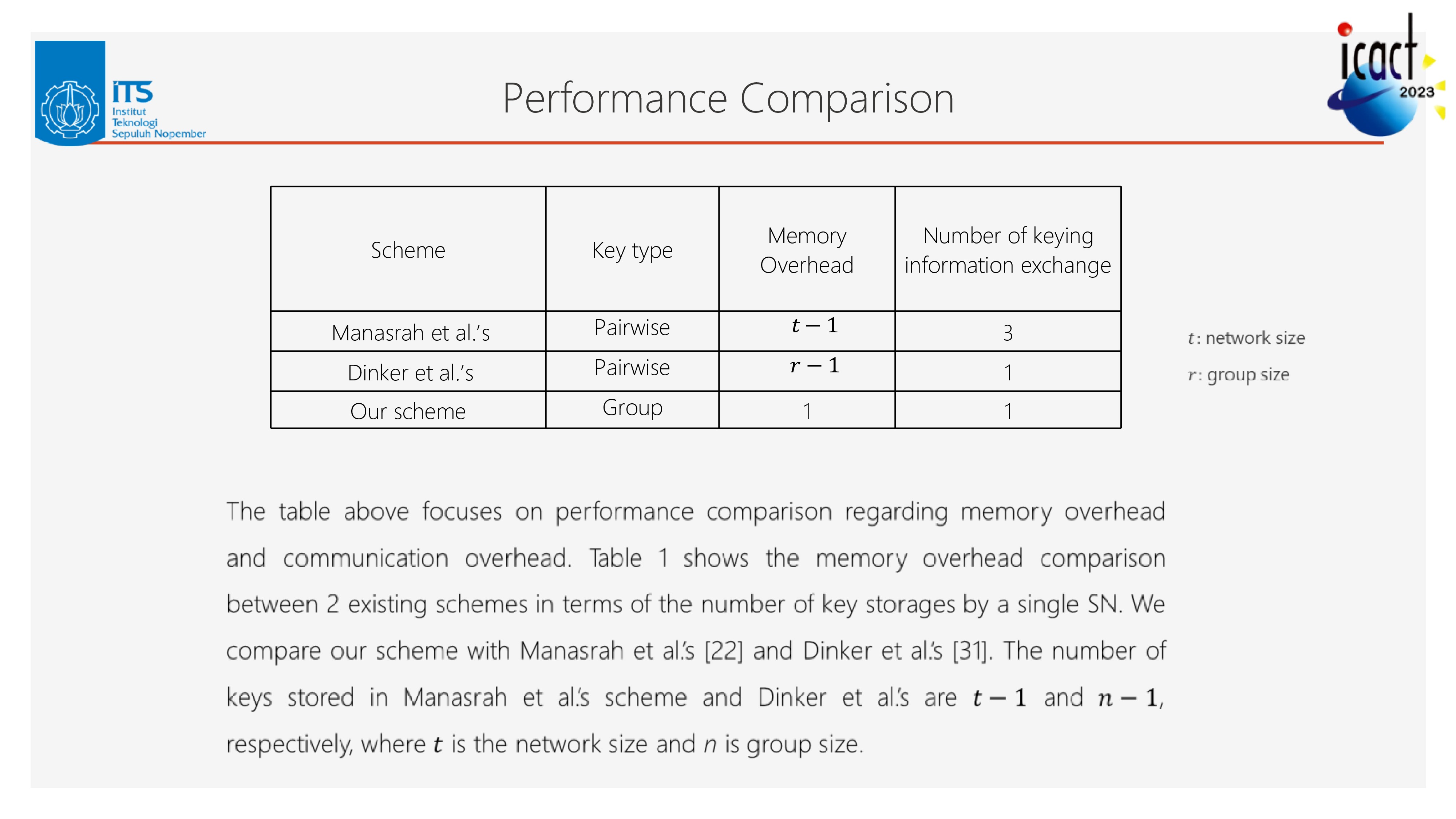 |
The table above focuses on performance comparison regarding memory overhead and communication overhead. Table 1 shows the memory overhead comparison between 2 existing schemes in terms of the number of key storages by a single SN. We compare our scheme with Manasrah et al.’s [22] and Dinker et al.’s [31]. The number of keys stored in Manasrah et al.’s scheme and Dinker et al.’s are 𝑡−1 and 𝑛−1, respectively, where 𝑡 is the network size and n is group size.
|
|
ICACT20230044 Slide.16
[Big slide for presentation]
[YouTube] |
Chrome Text-to-Speach Click!! |
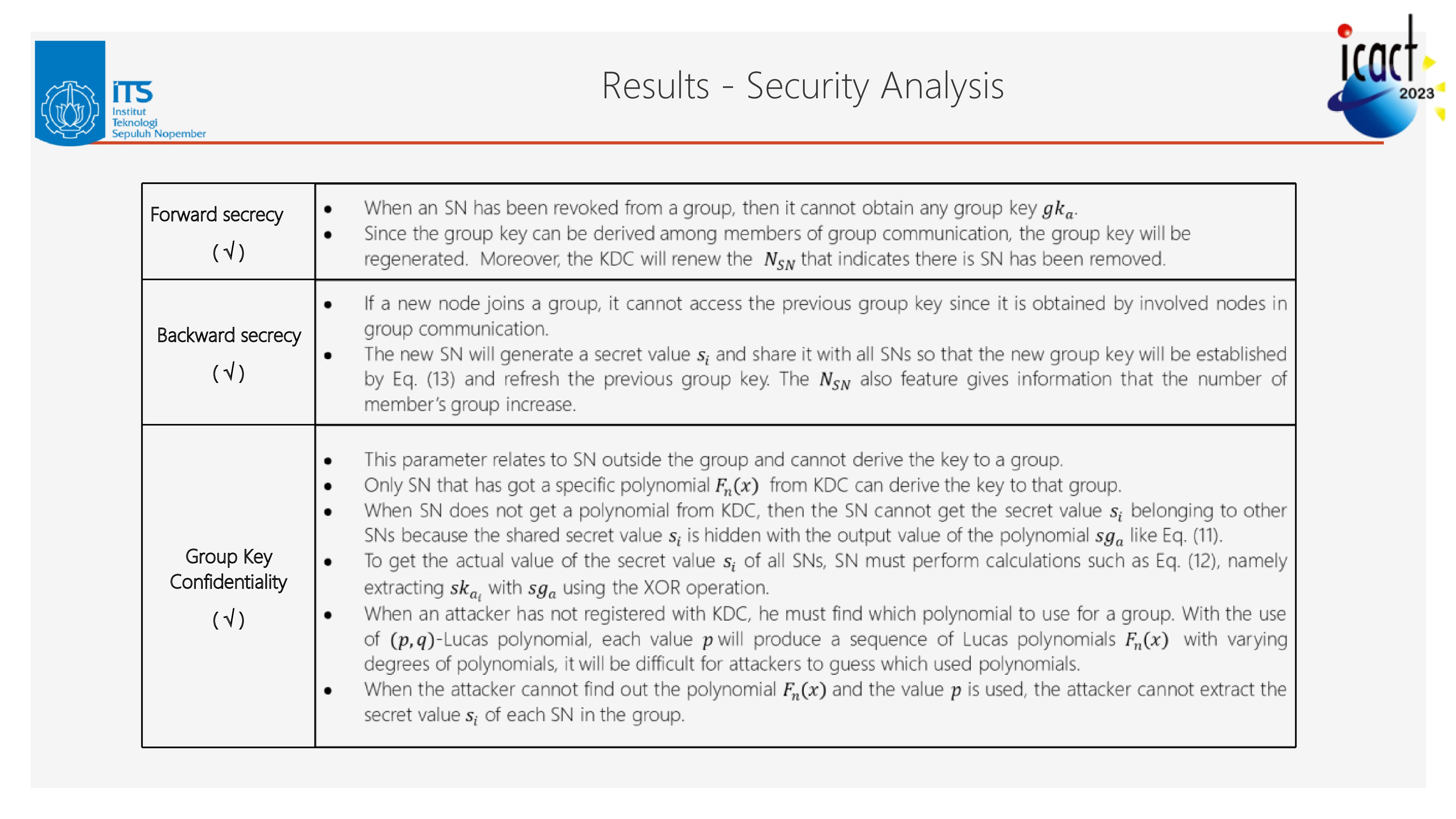 |
Forward secrecy:
-When an SN has been revoked from a group, then it cannot obtain any group key.
-Since the group key can be derived among members of group communication, the group key will be regenerated. Moreover, the KDC will renew the 𝑁_𝑆𝑁 that indicates there is SN has been removed.
Backward secrecy:
-If a new node joins a group, it cannot access the previous group key since it is obtained by involved nodes in group communication.
-The new SN will generate a secret value and share it with all SNs so that the new group key will be established by Eq. (13) and refresh the previous group key. The 𝑁_𝑆𝑁 also feature gives information that the number of member’s group increase.
Group key confidentiality:
-This parameter relates to SN outside the group and cannot derive the key to a group.
-Only SN that has got a specific polynomial 𝐹_𝑛(𝑥) from KDC can derive the key to that group.
-When SN does not get a polynomial from KDC, then the SN cannot get the secret value belonging to other SNs because the shared secret value is hidden with the output value of the polynomial like Eq. (11).
-To get the actual value of the secret value of all SNs, SN must perform calculations such as Eq. (12).
-When an attacker has not registered with KDC, he must find which polynomial to use for a group. With the use of (𝑝,𝑞)-Lucas polynomial, each value 𝑝 will produce a sequence of Lucas polynomials 𝐹_𝑛(𝑥) with varying degrees of polynomials, it will be difficult for attackers to guess which used polynomials.
When the attacker cannot find out the polynomial 𝐹_𝑛(𝑥) and the value 𝑝 is used, the attacker cannot extract the secret value of each SN in the group.
|
|
ICACT20230044 Slide.15
[Big slide for presentation]
[YouTube] |
Chrome Text-to-Speach Click!! |
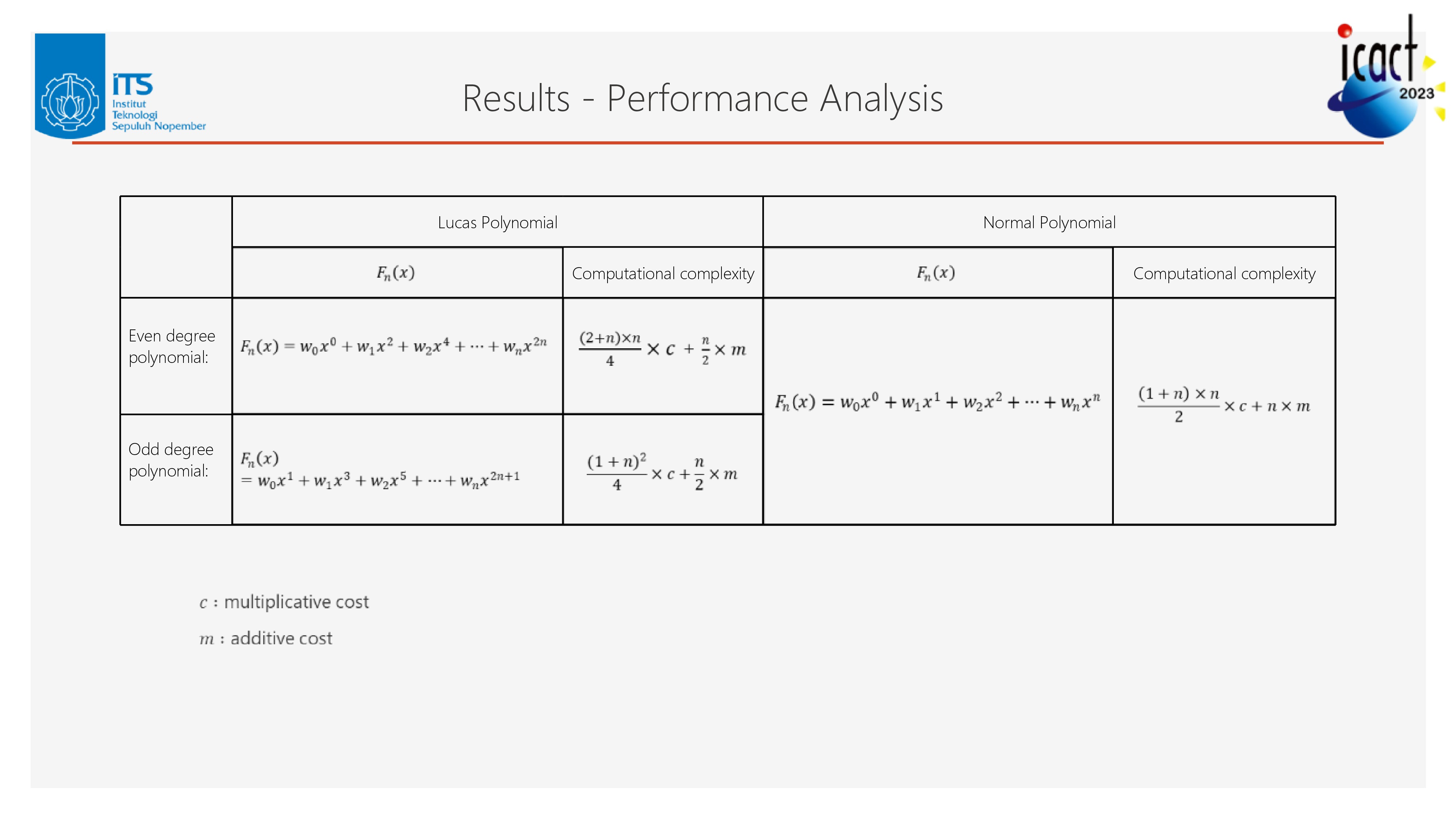 |
We compared the computational complexity between Lucas Polynomial and Normal Polynomial. From the table, it shows that using Lucas Polynomial can decrease the computational complexity.
|
|
ICACT20230044 Slide.14
[Big slide for presentation]
[YouTube] |
Chrome Text-to-Speach Click!! |
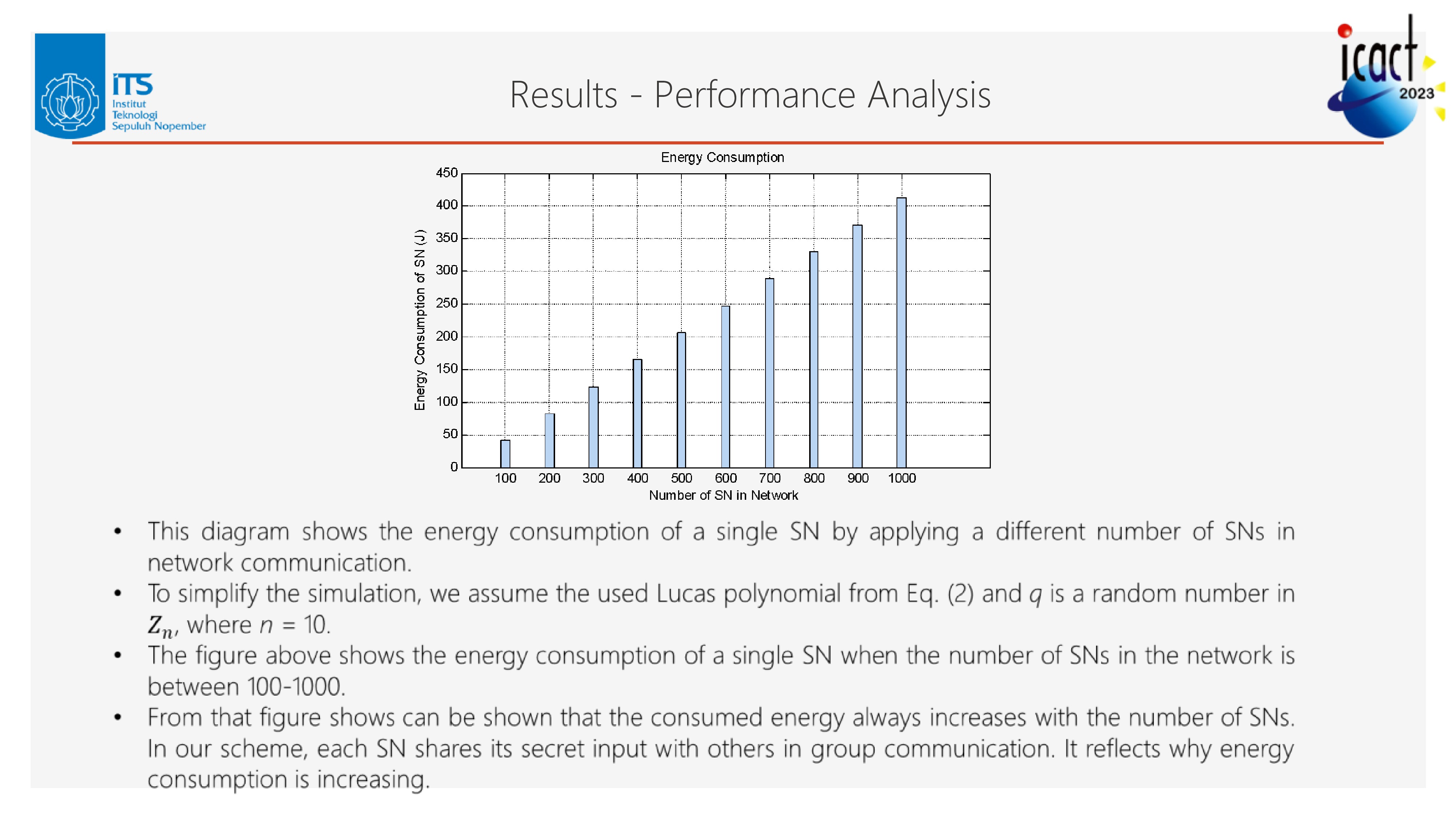 |
The figure shows the energy consumption of a single SN when the number of SNs in the network is between 100-1000. From that figure shows can be shown that the consumed energy always increases with the number of SNs. In our scheme, each SN shares its secret input with others in group communication. It reflects why energy consumption is increasing.
|
|
ICACT20230044 Slide.13
[Big slide for presentation]
[YouTube] |
Chrome Text-to-Speach Click!! |
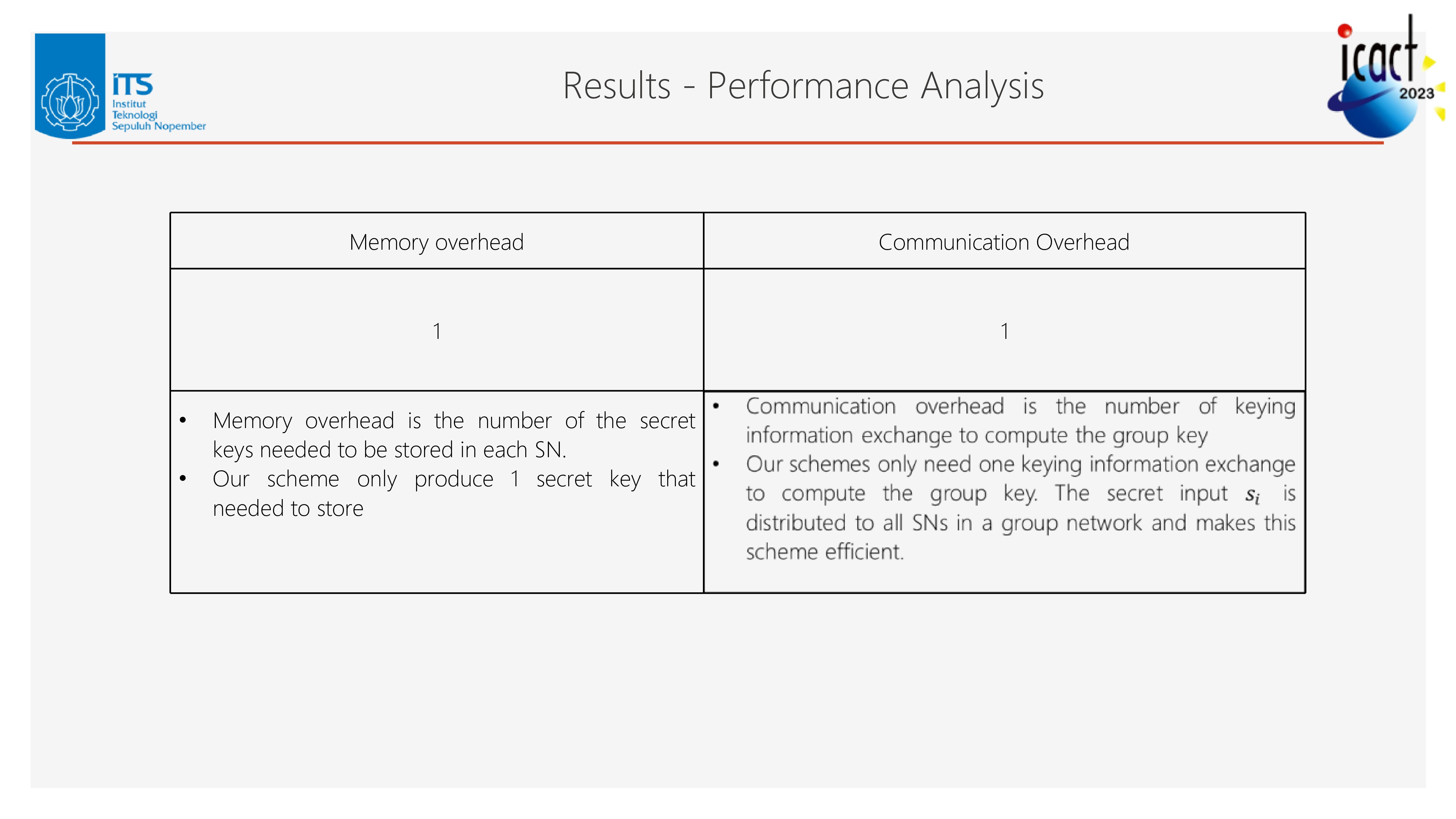 |
From the proposed method, the performance analysis of memory overhead and communication overhead are 1. In this case, Memory overhead is the number of the secret keys needed to be stored in each SN. Our scheme only produce 1 secret key that needed to store. Communication overhead is the number of keying information exchange to compute the group key. Our schemes only need one keying information exchange to compute the group key. The secret input 𝑠_𝑖 is distributed to all SNs in a group network and makes this scheme efficient.
|
|
ICACT20230044 Slide.12
[Big slide for presentation]
[YouTube] |
Chrome Text-to-Speach Click!! |
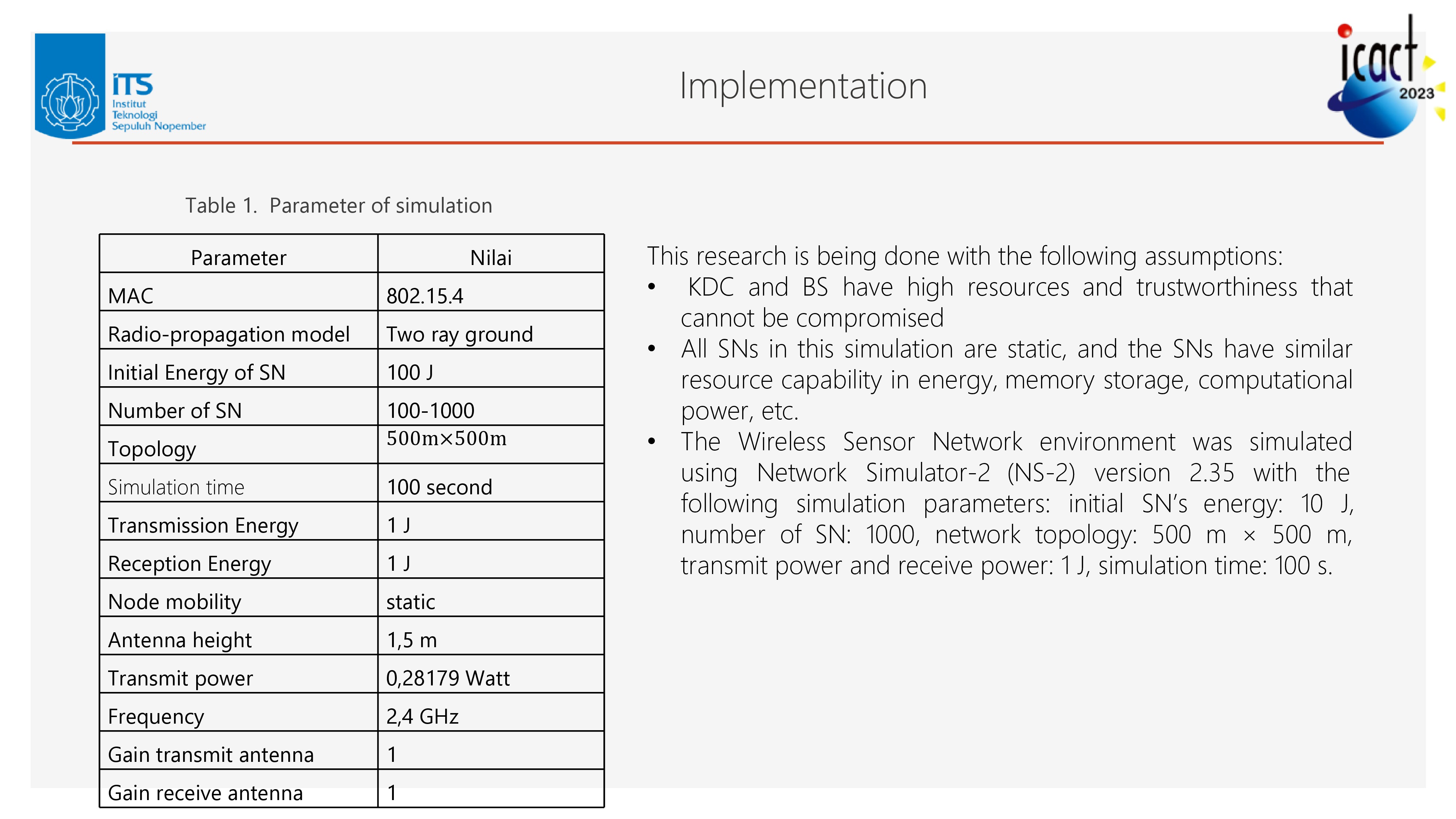 |
This research is being done with the following assumptions:
- KDC and BS have high resources and trustworthiness that cannot be compromised
- All SNs in this simulation are static, and the SNs have similar resource capability in energy, memory storage, computational power, etc.
- The Wireless Sensor Network environment was simulated using Network Simulator-2 (NS-2) version 2.35 with the simulation parameters as shown in Table 1.
|
|
ICACT20230044 Slide.11
[Big slide for presentation]
[YouTube] |
Chrome Text-to-Speach Click!! |
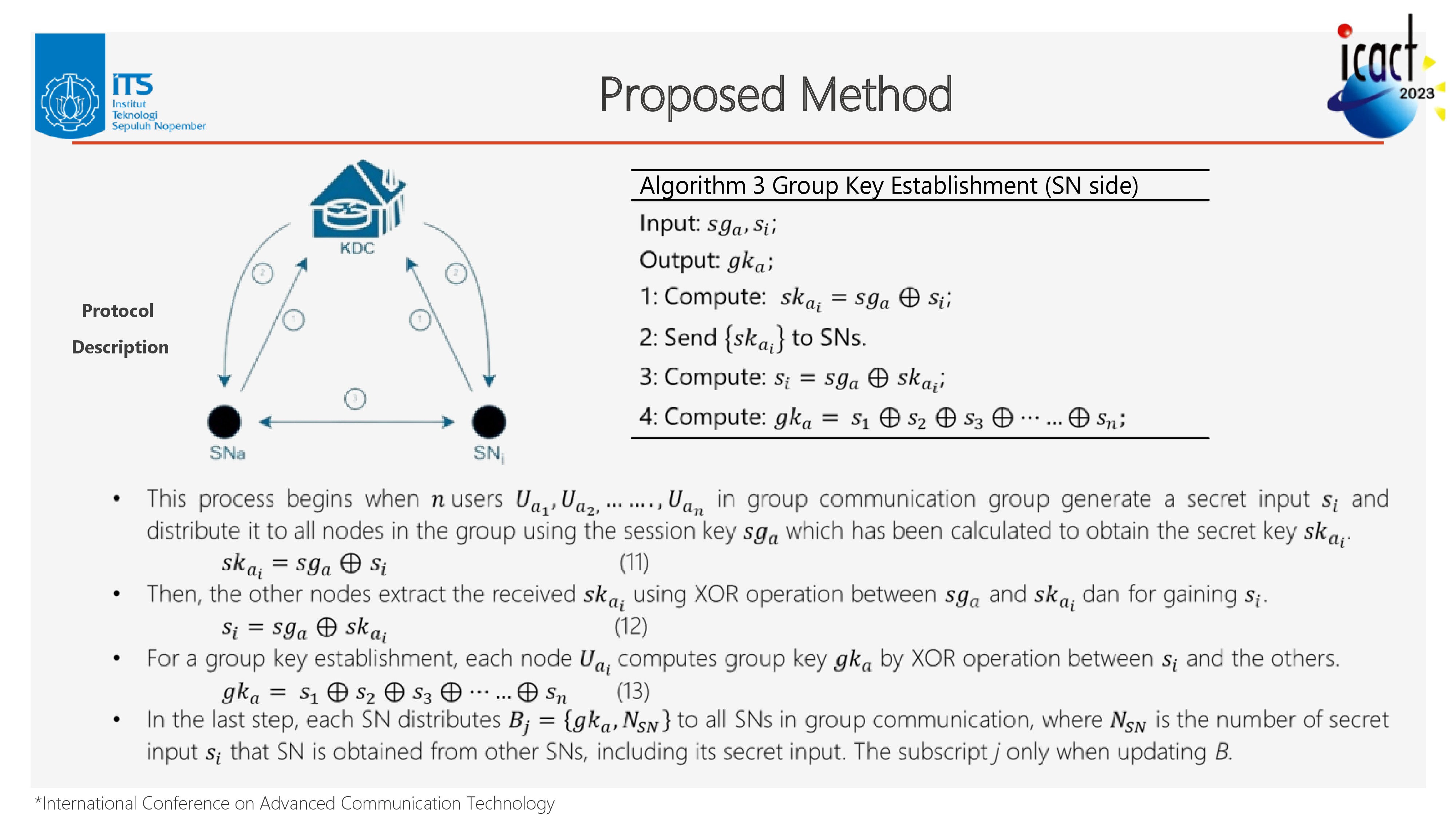 |
This process begins when 𝑛 users in group communication group generate a secret input and distribute it to all nodes in the group using the session key which has been calculated to obtain the secret key using equation 11. Then, the other nodes extract it using XOR operation by equation 12 for gaining secret input.
For a group key establishment, each node computes group key by equation 13.
|
|
ICACT20230044 Slide.10
[Big slide for presentation]
[YouTube] |
Chrome Text-to-Speach Click!! |
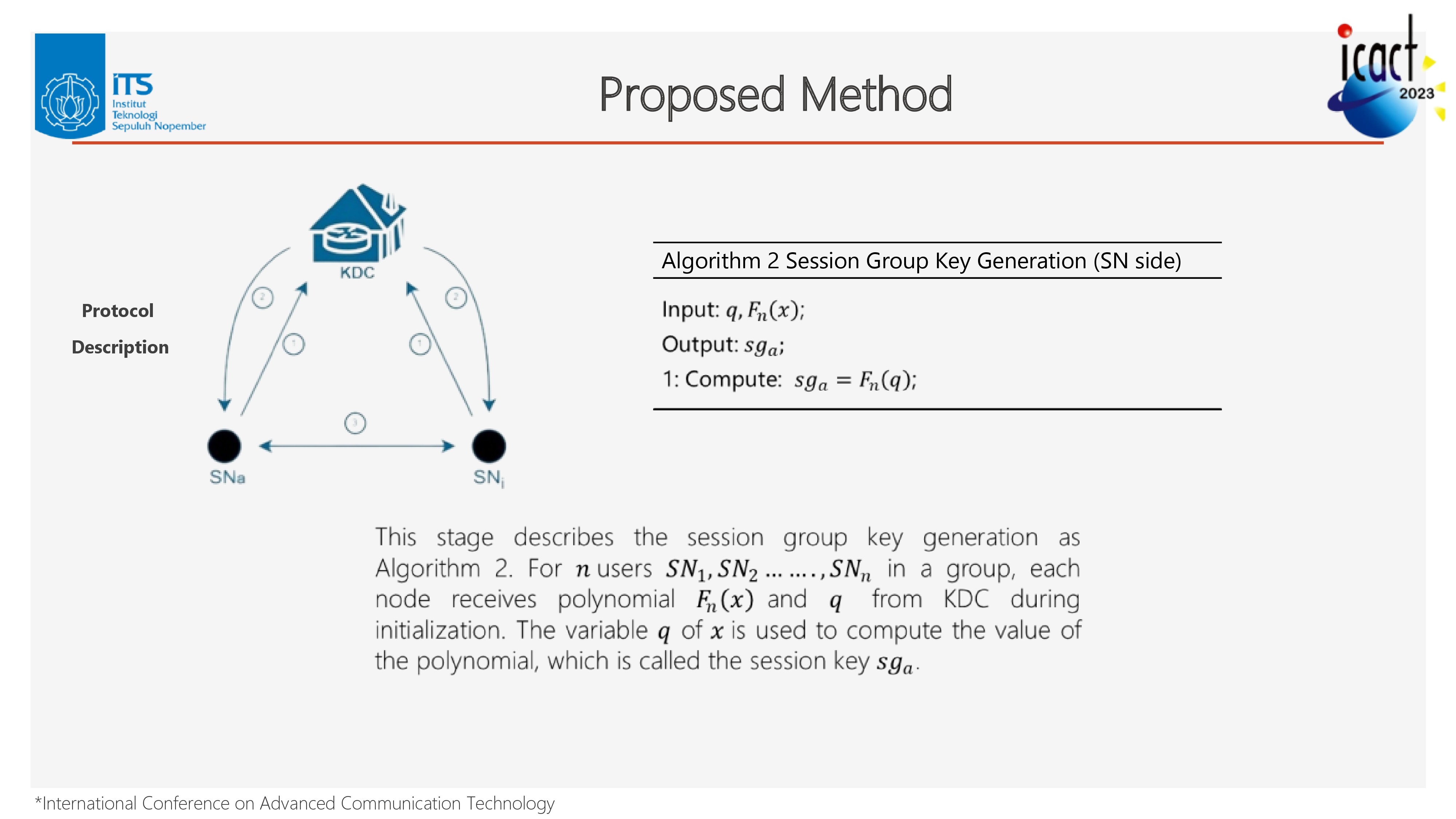 |
This stage describes the session group key generation as Algorithm 2. For 𝑛 users in a group, each node receives polynomial 𝐹_𝑛(𝑥) and 𝑞 from KDC during initialization. The variable 𝑞 of 𝑥 is used to compute the value of the polynomial, which is called the session key .
|
|
ICACT20230044 Slide.09
[Big slide for presentation]
[YouTube] |
Chrome Text-to-Speach Click!! |
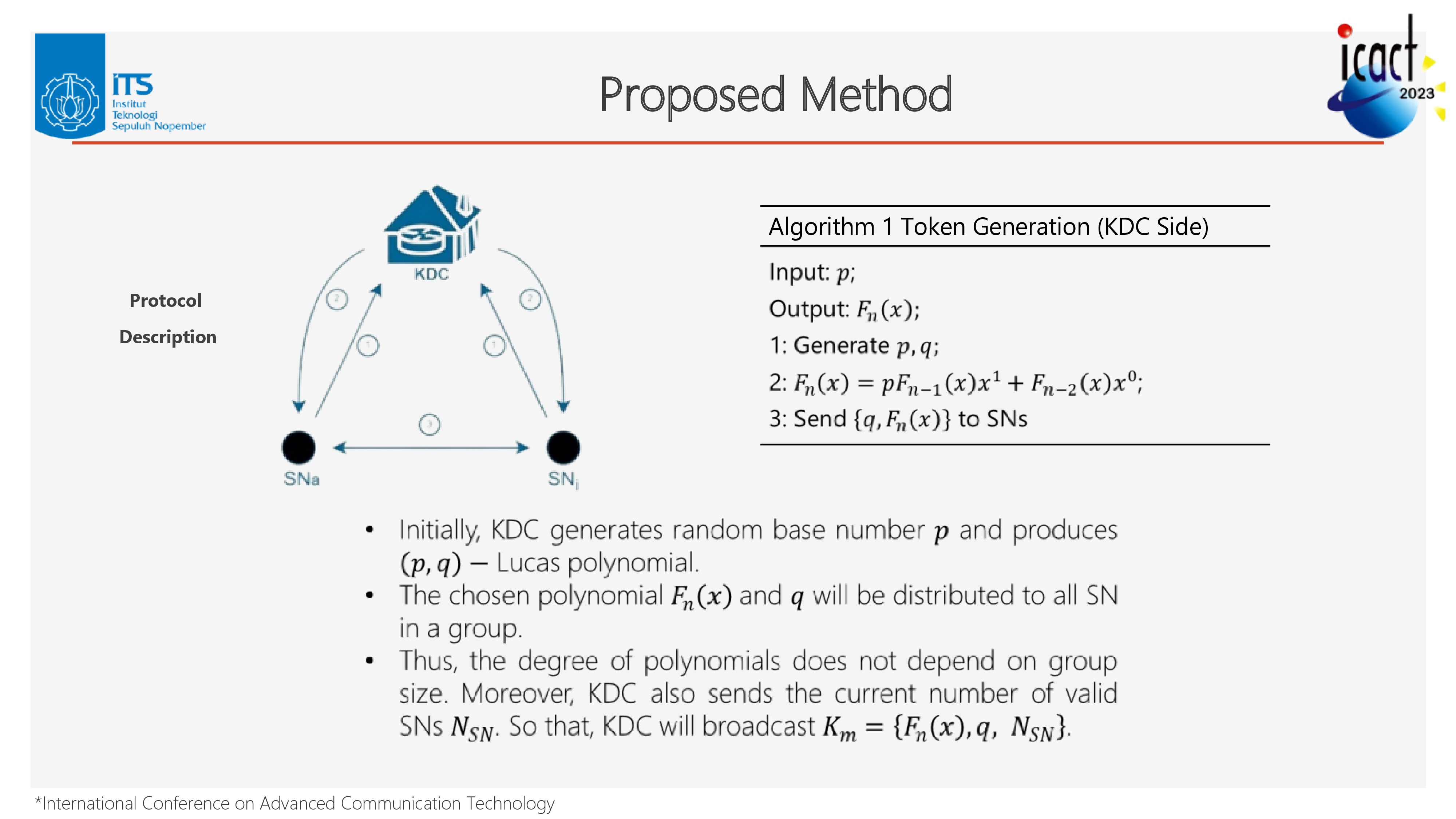 |
Initially, KDC generates random base number 𝑝 and produces (𝑝,𝑞)− Lucas polynomial. The chosen polynomial 𝐹_𝑛 (𝑥) and 𝑞 will be distributed to all SN in a group. Thus, the degree of polynomials does not depend on group size. Moreover, KDC also sends the current number of valid SNs 𝑁_𝑆𝑁. So that, KDC will broadcast 𝐾_𝑚={𝐹_𝑛 (𝑥), ├ 〖𝑞, 𝑁〗_𝑆𝑁 }┤
|
|
ICACT20230044 Slide.08
[Big slide for presentation]
[YouTube] |
Chrome Text-to-Speach Click!! |
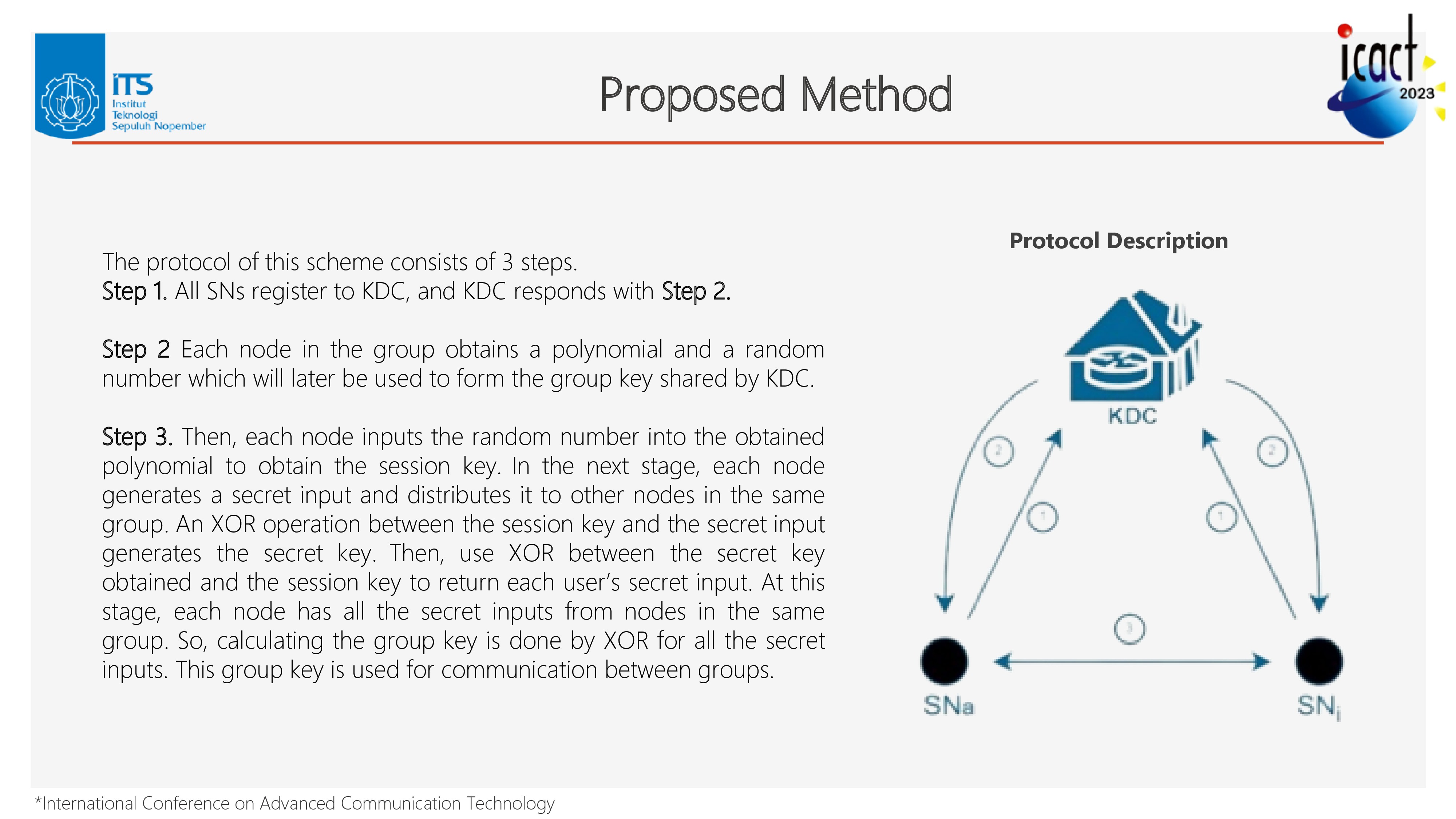 |
The protocol of this scheme consists of 3 steps.
Step 1. All SNs register to KDC, and KDC responds with Step 2.
Step 2 Each node in the group obtains a polynomial and a random number which will later be used to form the group key shared by KDC.
Step 3. Then, each node inputs the random number into the obtained polynomial to obtain the session key. In the next stage, each node generates a secret input and distributes it to other nodes in the same group. An XOR operation between the session key and the secret input generates the secret key. Then, use XOR between the secret key obtained and the session key to return each user’s secret input. At this stage, each node has all the secret inputs from nodes in the same group. So, calculating the group key is done by XOR for all the secret inputs. This group key is used for communication between groups.
|
|
ICACT20230044 Slide.07
[Big slide for presentation]
[YouTube] |
Chrome Text-to-Speach Click!! |
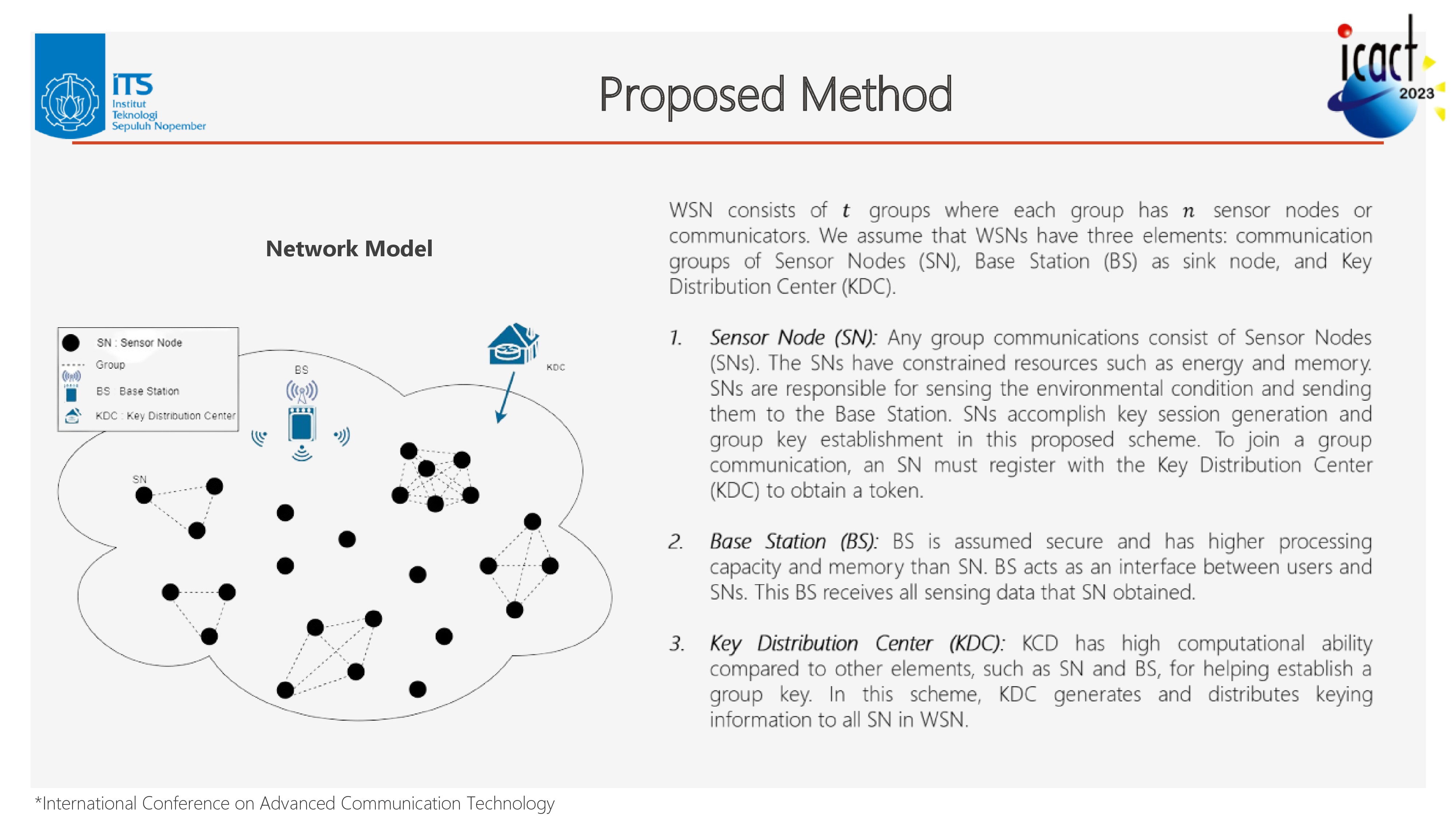 |
The left side is the figure of Network Model that we used in this research. The network model consist of Sensor Node, Base Station, and Key Distribution Center. SNs are responsible for sensing the environmental condition and sending them to the Base Station. Base Station acts as an interface between users and Sensor Nodes and receives all sensing data that Sensor Node obtained. Key Distribution Center generates and distributes keying information to all Sensor Node in Wireless Sensor Network. The Sensor Nodes grouped into several groups in the network.
|
|
ICACT20230044 Slide.06
[Big slide for presentation]
[YouTube] |
Chrome Text-to-Speach Click!! |
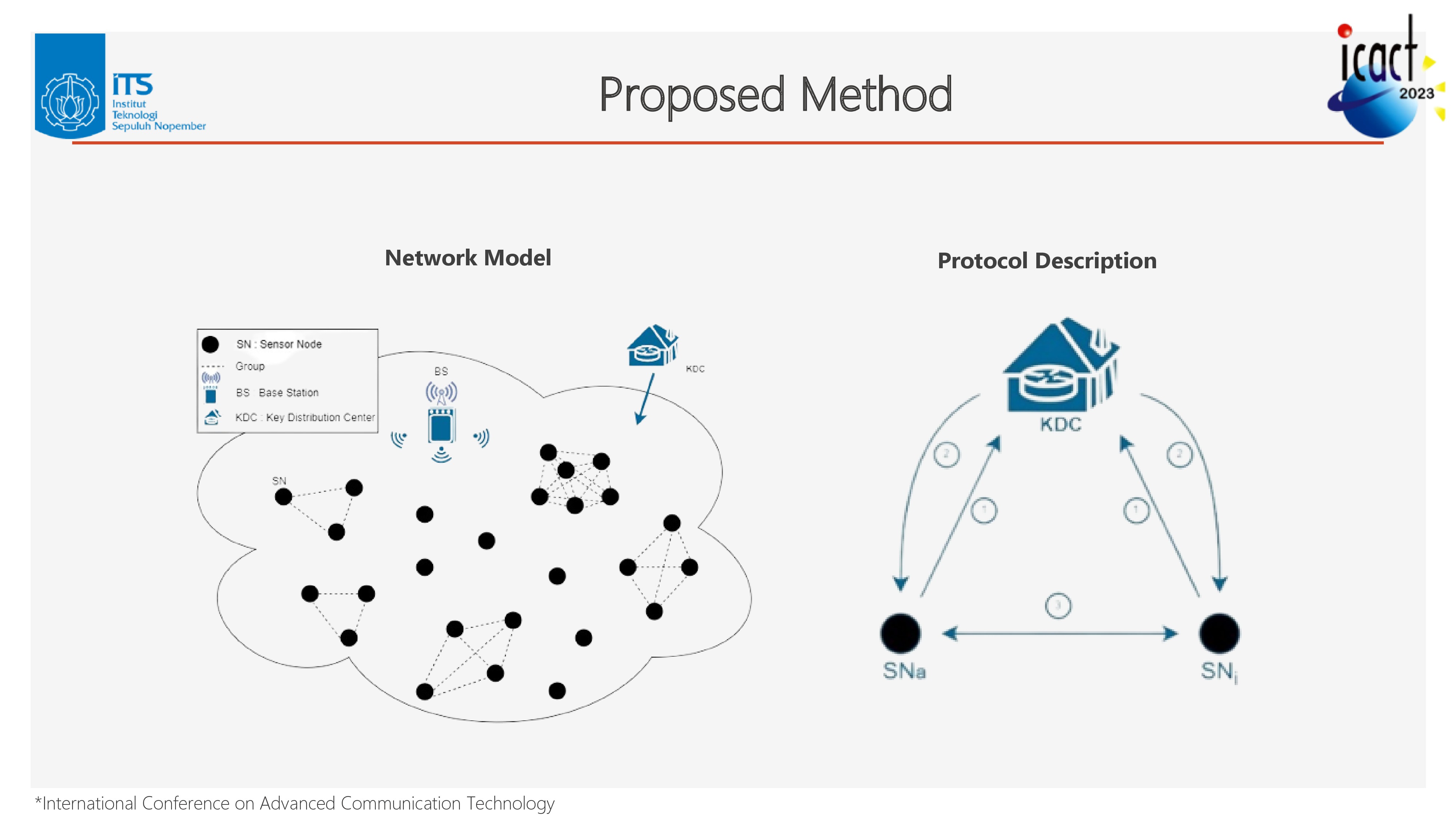 |
Our proposed method is divided into two parts, Network Model and Protocol Description.
|
|
ICACT20230044 Slide.05
[Big slide for presentation]
[YouTube] |
Chrome Text-to-Speach Click!! |
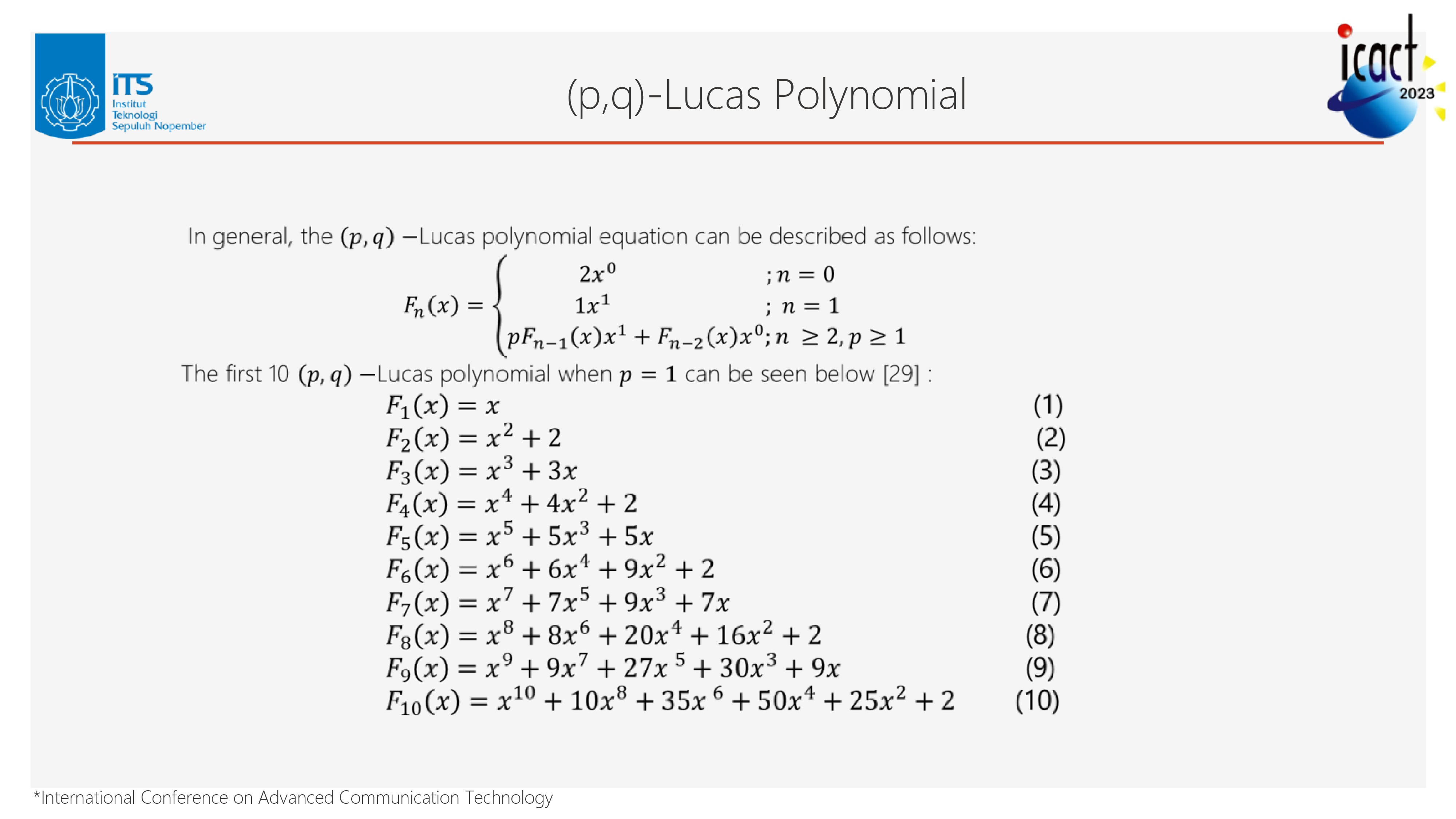 |
Before going to the proposed method, I want to describe the concept of Lucas Polynomial. This slide shows how the (p,q)-Lucas polynomial sequences is formed. The (𝑝,𝑞)−Lucas polynomial can be formed by equation 𝐹_𝑛(𝑥). If 𝑛=0, then 𝐹_𝑛(𝑥)= 2. If 𝑛=1, then 𝐹_𝑛(𝑥)= 𝑥, and if the 𝑛≥2, 𝑝≥1 so 𝐹_𝑛(𝑥)=𝑝𝐹_(𝑛−1)(𝑥) 𝑥+𝐹_(𝑛−2)(𝑥). The equations (1) until (10) are the Lucas polynomial sequence when 𝑝=1.
|
|
ICACT20230044 Slide.04
[Big slide for presentation]
[YouTube] |
Chrome Text-to-Speach Click!! |
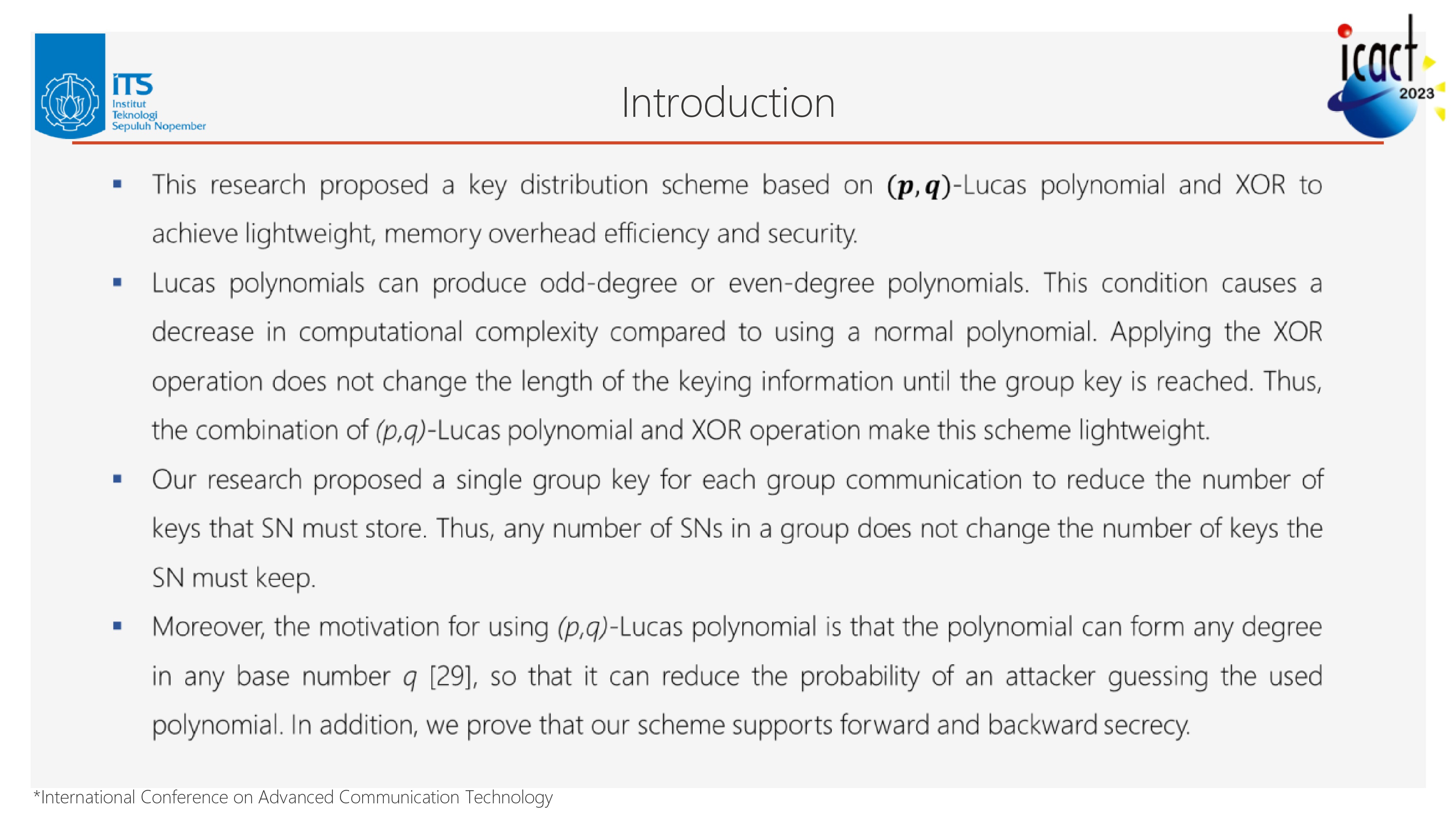 |
This research proposed a key distribution scheme based on (𝒑,𝒒)-Lucas polynomial and XOR to achieve lightweight, memory overhead efficiency and security.
Lucas polynomials can produce odd-degree or even-degree polynomials. This condition causes a decrease in computational complexity compared to using a normal polynomial. Applying the XOR operation does not change the length of the keying information until the group key is reached. Thus, the combination of (p,q)-Lucas polynomial and XOR operation make this scheme lightweight.
Our research proposed a single group key for each group communication to reduce the number of keys that SN must store. Thus, any number of SNs in a group does not change the number of keys the SN must keep.
Moreover, the motivation for using (p,q)-Lucas polynomial is that the polynomial can form any degree in any base number q [29], so that it can reduce the probability of an attacker guessing the used polynomial. In addition, we prove that our scheme supports forward and backward secrecy.
|
|
ICACT20230044 Slide.03
[Big slide for presentation]
[YouTube] |
Chrome Text-to-Speach Click!! |
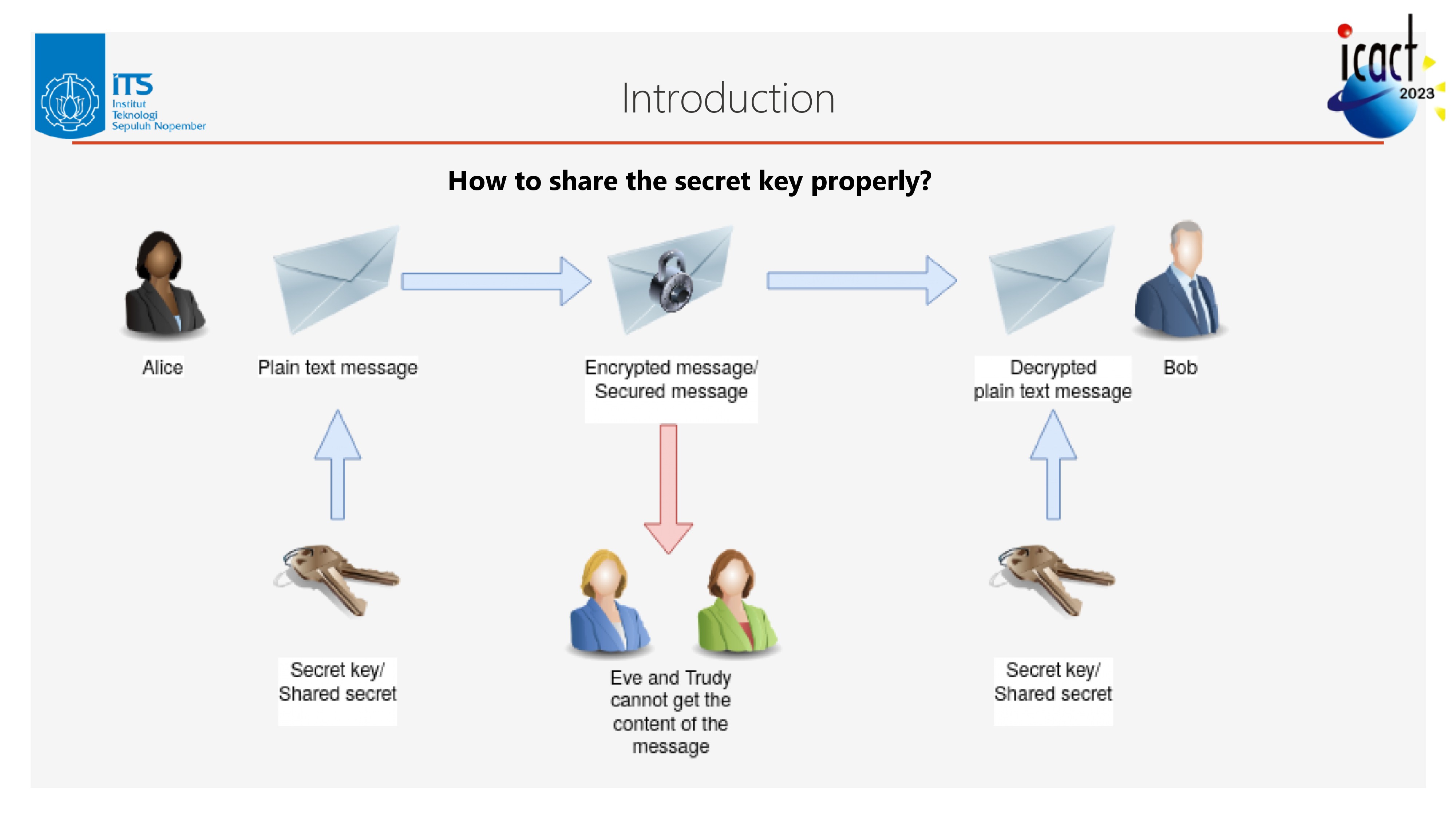 |
This figure shows the illustration of encryption technique. There are Alice and Bob that communicating each other. Alice encrypted the message with secret key/shared key so that Eve and Trudy cannot get the content of the message and send that encrypted message to Bob. Bob can obtain the content of the message if he has the secret key as Alice used. So, the problem is how to share the secret key properly from Alice to Bob?
|
|
ICACT20230044 Slide.02
[Big slide for presentation]
[YouTube] |
Chrome Text-to-Speach Click!! |
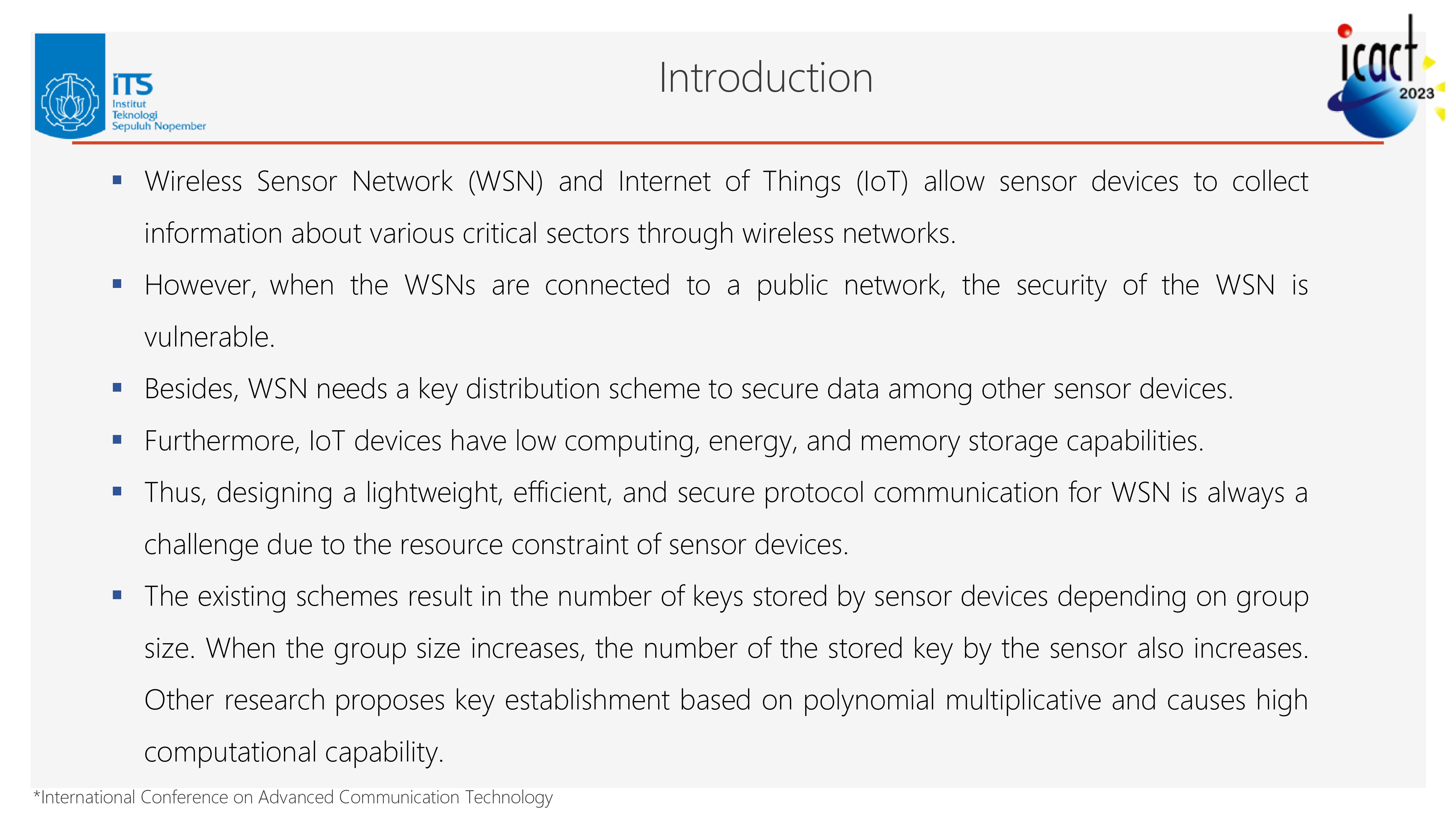 |
Wireless Sensor Network (WSN) and Internet of Things (IoT) allow sensor devices to collect information about various critical sectors through wireless networks.
However, when the WSNs are connected to a public network, the security of the WSN is vulnerable.
Besides, WSN needs a key distribution scheme to secure data among other sensor devices.
Furthermore, IoT devices have low computing, energy, and memory storage capabilities.
Thus, designing a lightweight, efficient, and secure protocol communication for WSN is always a challenge due to the resource constraint of sensor devices.
The existing schemes result in the number of keys stored by sensor devices depending on group size. When the group size increases, the number of the stored key by the sensor also increases. Other research proposes key establishment based on polynomial multiplicative and causes high computational capability
|
|
ICACT20230044 Slide.01
[Big slide for presentation]
[YouTube] |
Chrome Text-to-Speach Click!! |
 |
Hi everyone! My name is Siti Agustini. I am a Doctoral Student in Institut Teknologi Sepuluh Nopember. I have cooperated with my supervisors namely Wirawan and Gamantyo Hendrantoro. Our research is about Lightweight Group Key Establishment for reducing memory. For acknowledgement, this reported work was made possible by the BPI scholarship funding to the first author, that is me from the Indonesian government through PUSLAPDIK and LPDP
|
















