 ICACT20230191 Slide.15
[Big slide for presentation] |
Chrome Text-to-Speach Click!! |
 |
Thanks.
|
|
ICACT20230191 Slide.14
[Big slide for presentation]
|
Chrome Text-to-Speach Click!! |
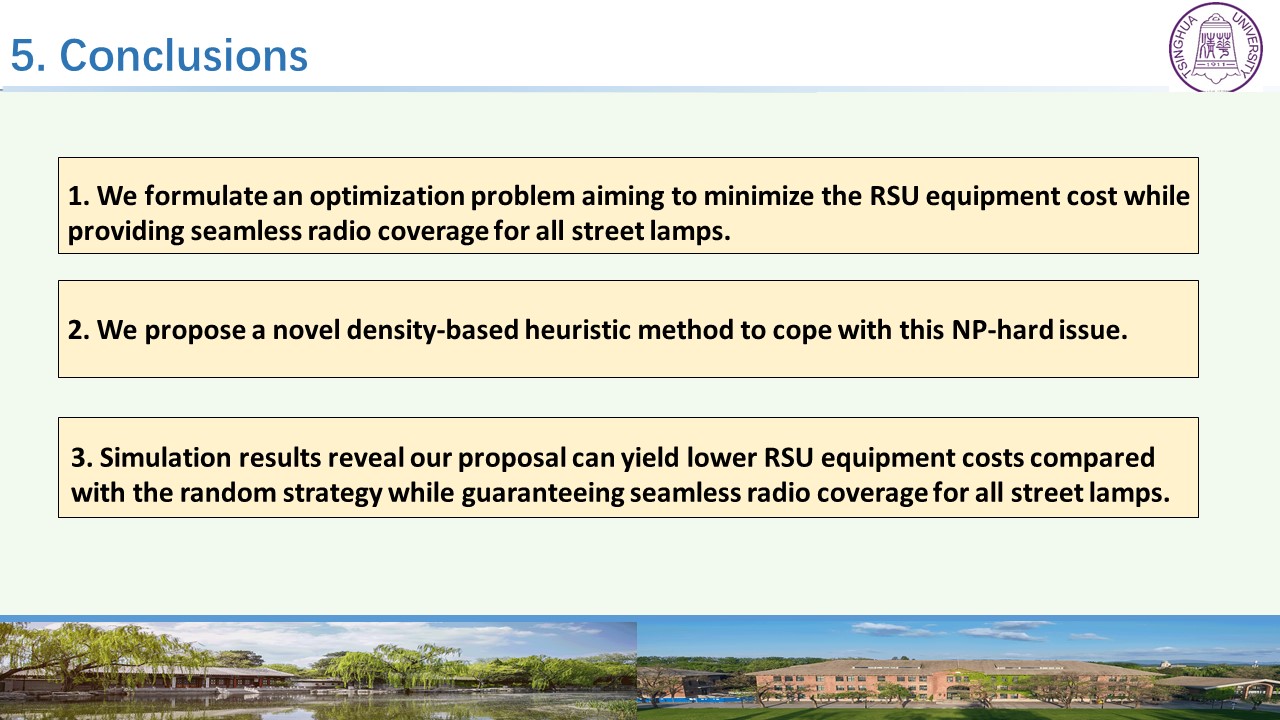 |
In this paper, we focus on the RSU deployment for vehicular communication networks based on existing street lamps. We formulate an optimization problem aiming to minimize the RSU equipment cost while providing seamless radio coverage for all street lamps. Since it is an NP-hard issue, we propose a novel density-based heuristic method to cope with it. The relevant simulation results show that our proposal can yield lower RSU equipment costs compared with the random strategy while guaranteeing seamless radio coverage for all street lamps. Our findings provide some insights into the V2X wireless communications.
|
|
ICACT20230191 Slide.13
[Big slide for presentation]
|
Chrome Text-to-Speach Click!! |
 |
5. CONCLUSIONS
|
|
ICACT20230191 Slide.12
[Big slide for presentation]
|
Chrome Text-to-Speach Click!! |
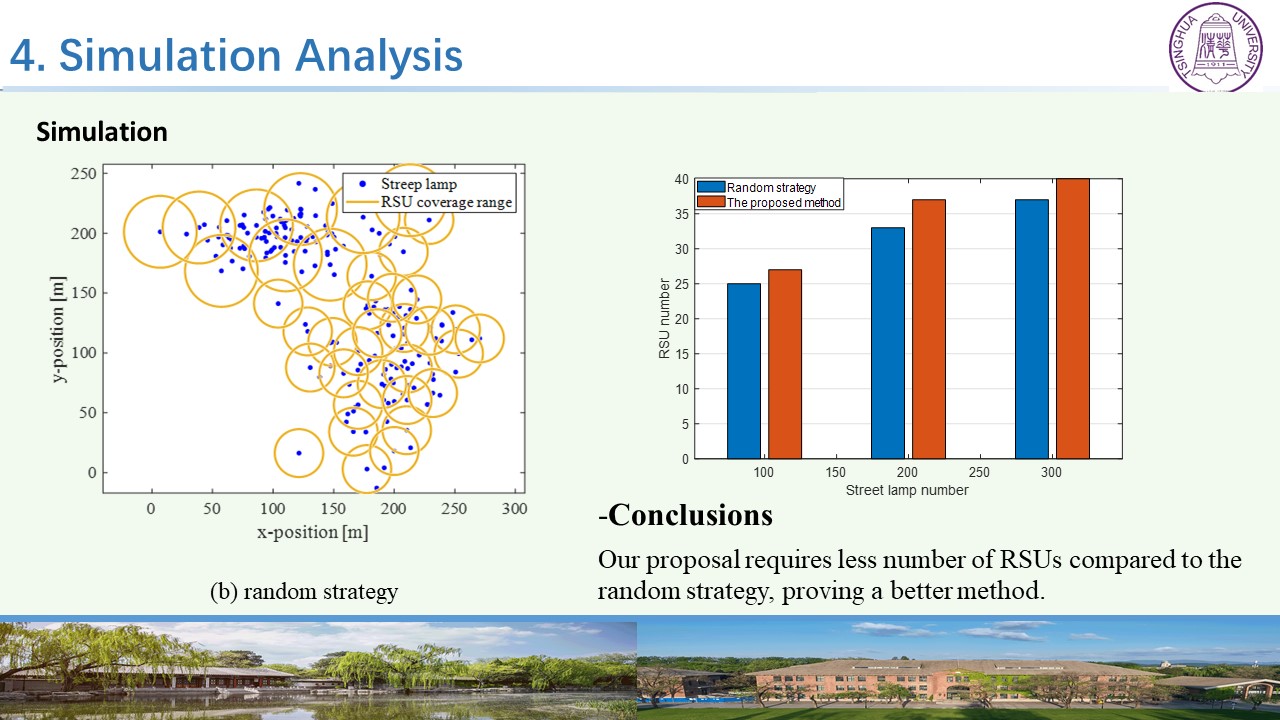 |
To better highlight the benefits of our proposed heuristic strategy, we also compare the results with the random strategy with different street lamp numbers as shown in the left figure. Specifically, we randomly generate street lamps with different numbers within the same simulation area. The corresponding RSU number results are plotted in the right figure.
|
|
ICACT20230191 Slide.11
[Big slide for presentation]
|
Chrome Text-to-Speach Click!! |
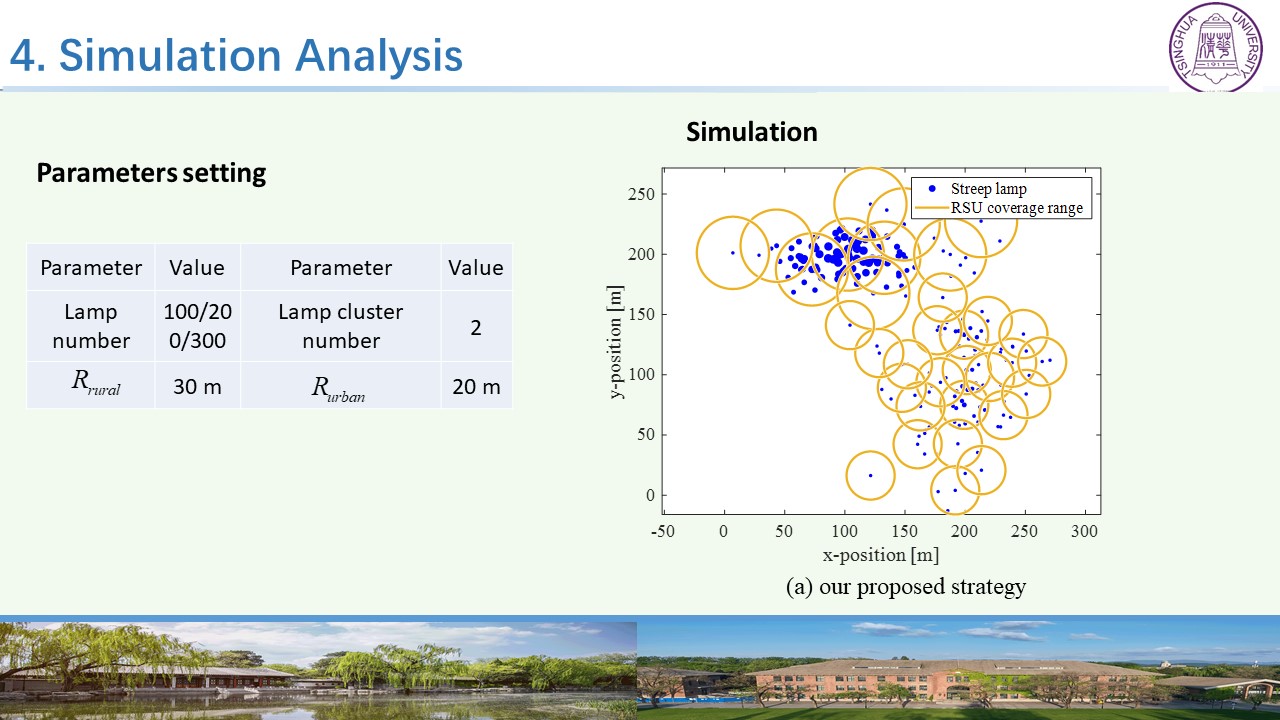 |
In this section, we will conduct some simulation works and verify our proposal. The simulation scenario with a size of about 300m×250m. The yellow circles mean the radio coverage for given street lamps. The blue scatterers represent the street lamps, which can be identified as two clusters. Obviously, the corresponding RSU coverage at the first cluster is larger than that in the second cluster. Other detailed parameters settings are presented in this table.
|
|
ICACT20230191 Slide.10
[Big slide for presentation]
|
Chrome Text-to-Speach Click!! |
 |
4. SIMULATION ANALYSIS
|
|
ICACT20230191 Slide.09
[Big slide for presentation]
|
Chrome Text-to-Speach Click!! |
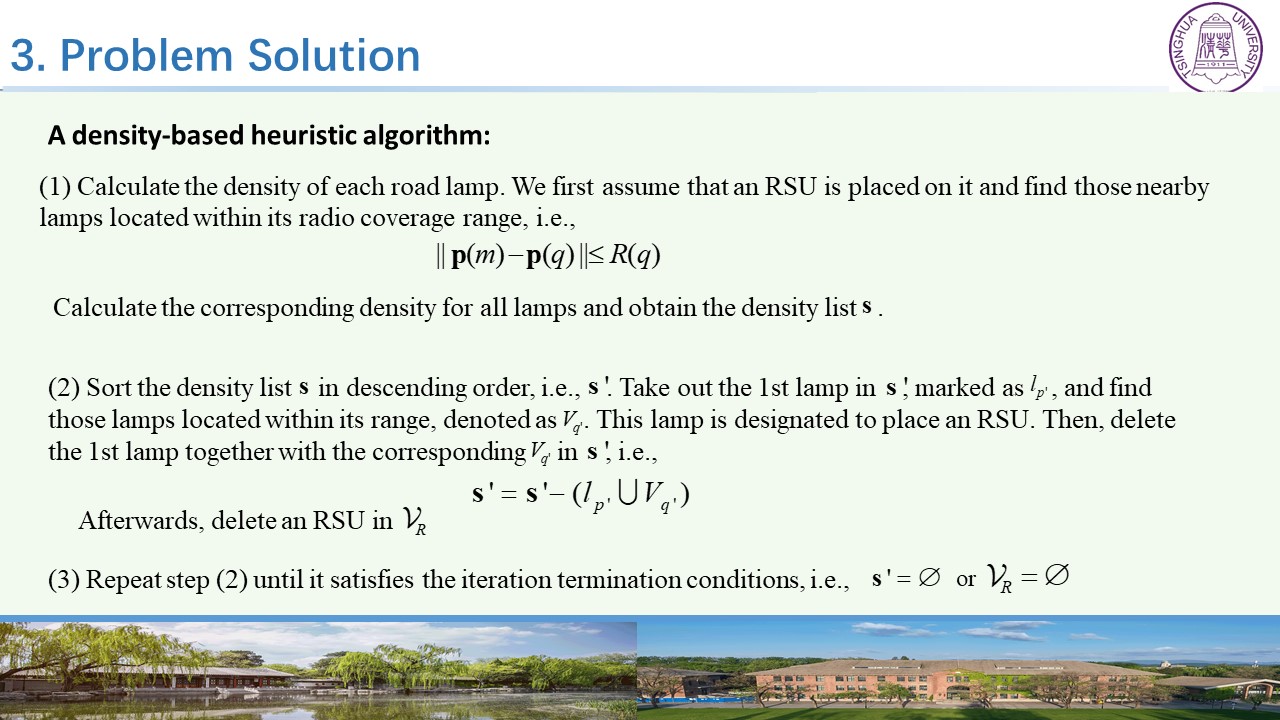 |
In this section, we will provide a detailed solution to the formulated problem. Since it is an NP-hard problem, it is impossible to find the optimal solution within a given finite time or steps. Hence, we propose a density-based heuristic algorithm to solve this problem herein. Our method contains 3 phases and is elaborated as follows.
1. Calculate the density of each road lamp. We first assume that an RSU is placed on it and find those nearby lamps located within its radio coverage range. Then, calculate the corresponding density for all lamps and obtain the density list.
2. Sort the density list in descending order. Take out the 1st lamp in s’, and find those lamps located within its range. This lamp is designated to place an RSU. Then, delete the 1st lamp together with the corresponding elements in s’. Afterwards, delete the RSU .
3. Repeat step (2) until it satisfies the iteration termination conditions.
|
|
ICACT20230191 Slide.08
[Big slide for presentation]
|
Chrome Text-to-Speach Click!! |
 |
3. PROBLEM SOLUTION
|
|
ICACT20230191 Slide.07
[Big slide for presentation]
|
Chrome Text-to-Speach Click!! |
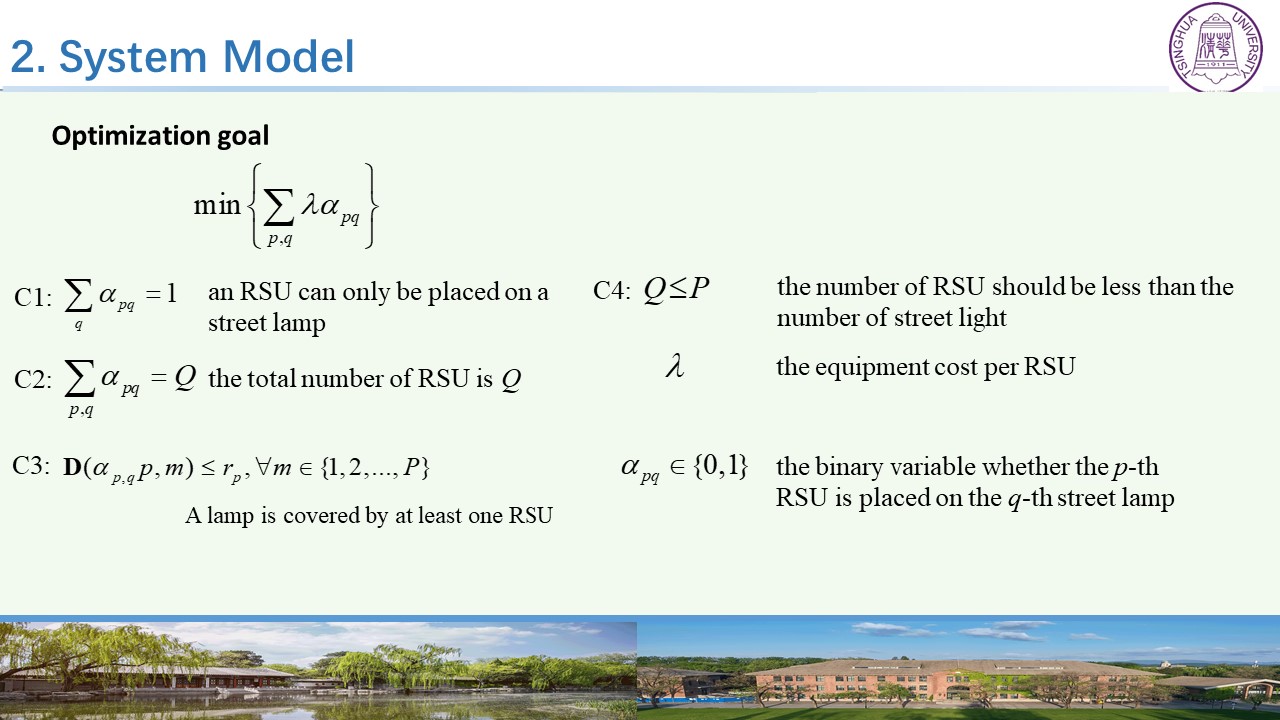 |
Let P denote the total number of street lamp, then this goal can be expressed as this equation. 4 constraints are presented here. Constraint (1) means that an RSU can only be placed on a street lamp. Constraint (2) infers that the total number of RSU is Q. Constraint (3) means that a lamp is covered by at least one RSU. And constraint (4) means the number of RSU should be less than the number of street light.
|
|
ICACT20230191 Slide.06
[Big slide for presentation]
|
Chrome Text-to-Speach Click!! |
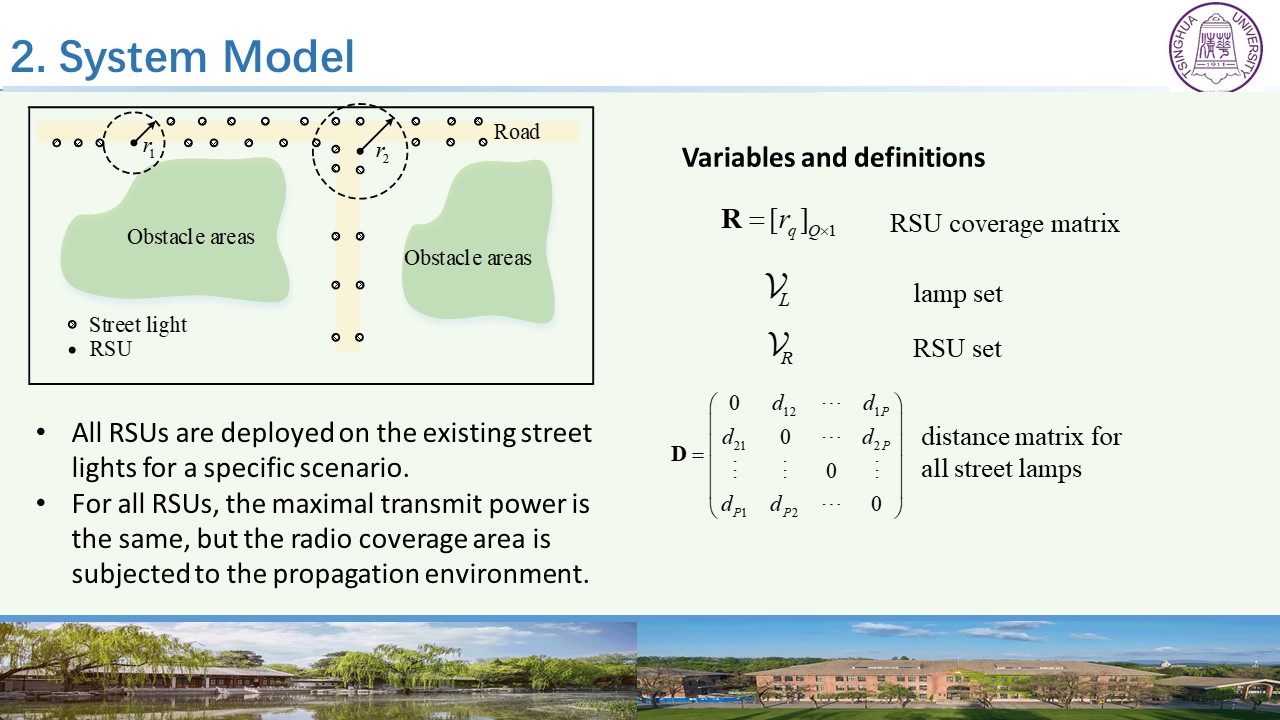 |
As shown in this figure, we assume that all RSUs are deployed on the existing street lights for a specific scenario, of which the corresponding positions are known in advance. For all RSUs, the maximal transmit power is the same, but the radio coverage area is subjected to the propagation environment. As shown in this figure, two RSUs cover a circular area with different radii. Under the same transmit power, the corresponding coverage radius is larger in the open area than that in a narrow area. Some important variables and the corresponding definitions are listed in the right side.
|
|
ICACT20230191 Slide.05
[Big slide for presentation]
|
Chrome Text-to-Speach Click!! |
 |
2. SYSTEM MODEL
|
|
ICACT20230191 Slide.04
[Big slide for presentation]
|
Chrome Text-to-Speach Click!! |
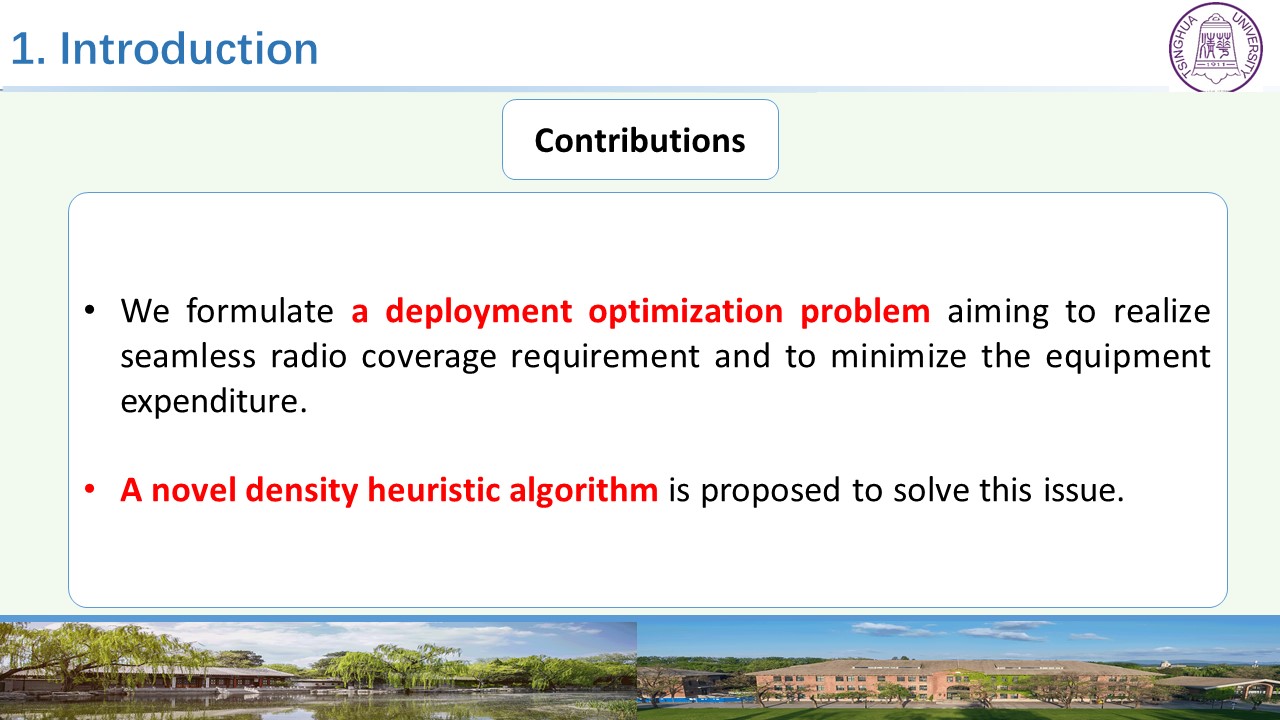 |
In this paper, we formulate a deployment optimization problem aiming to realize seamless radio coverage requirement and to minimize the equipment expenditure. Besides, a novel density heuristic algorithm is proposed to solve this issue.
|
|
ICACT20230191 Slide.03
[Big slide for presentation]
|
Chrome Text-to-Speach Click!! |
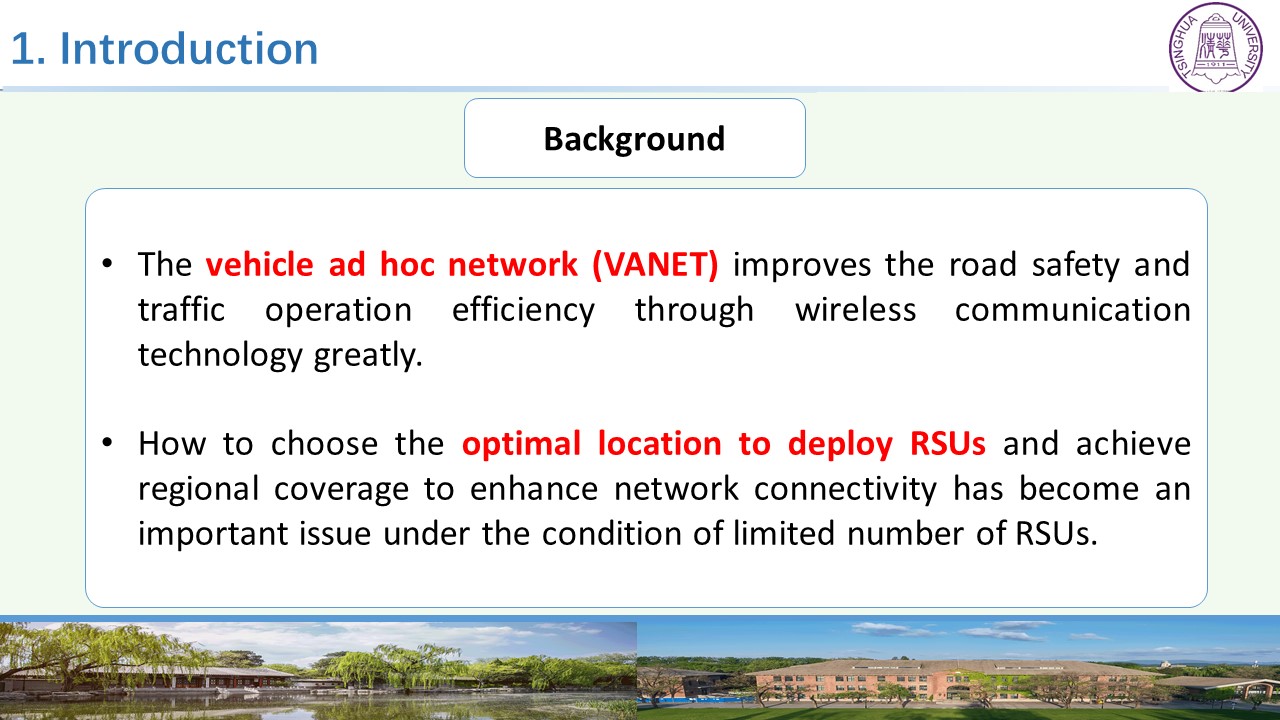 |
As an important part of modern intelligent transportation system, the vehicle ad hoc network (VANET) improves the road safety and traffic operation efficiency through wireless communication technology greatly. As an auxiliary communication facility of VANET, roadside units (RSUs) can cope with the dynamic topology changes caused by the movement of nodes in VANET, which can improve the communication quality between vehicle nodes efficiently. Hence, How to choose the optimal location to deploy RSUs and achieve regional coverage to enhance network connectivity has become an important issue under the condition of limited number of RSUs.
|
|
ICACT20230191 Slide.02
[Big slide for presentation]
|
Chrome Text-to-Speach Click!! |
 |
Here is the 1st part.
|
|
ICACT20230191 Slide.01
[Big slide for presentation]
|
Chrome Text-to-Speach Click!! |
 |
My report contains the following 4 aspects.
|
|
ICACT20230191 Slide.00
[Big slide for presentation]
|
Chrome Text-to-Speach Click!! |
 |
Hello, ladies and gentlemen. I am Yi Feng from Tsinghua University, China. Here, I will introduce our work. The topic is A Density-Based RSU Deployment and Optimization Heuristic Method for Vehicular Networks.
|
















