 ICACT20230203 Slide.16
[Big slide for presentation]
[YouTube] |
Chrome Text-to-Speach Click!! |
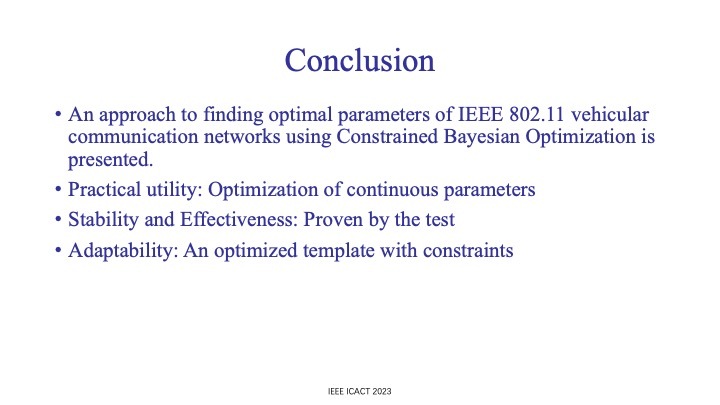 |
This paper presents a successful and feasible method for optimizing the parameters of a communication network.
|
|
ICACT20230203 Slide.15
[Big slide for presentation]
[YouTube] |
Chrome Text-to-Speach Click!! |
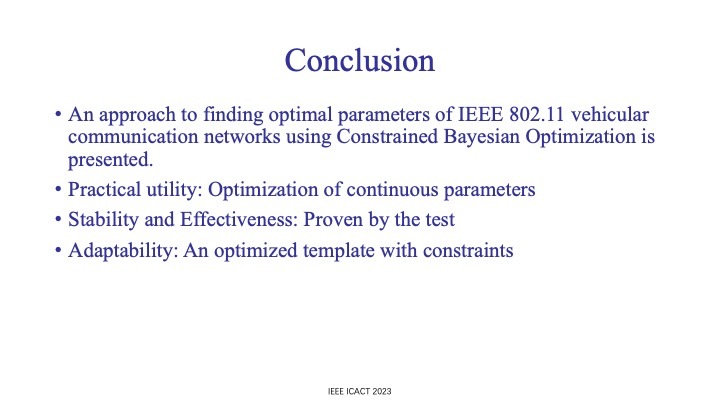 |
This paper presents a successful and feasible method for optimizing the parameters of a communication network.
|
|
ICACT20230203 Slide.14
[Big slide for presentation]
|
Chrome Text-to-Speach Click!! |
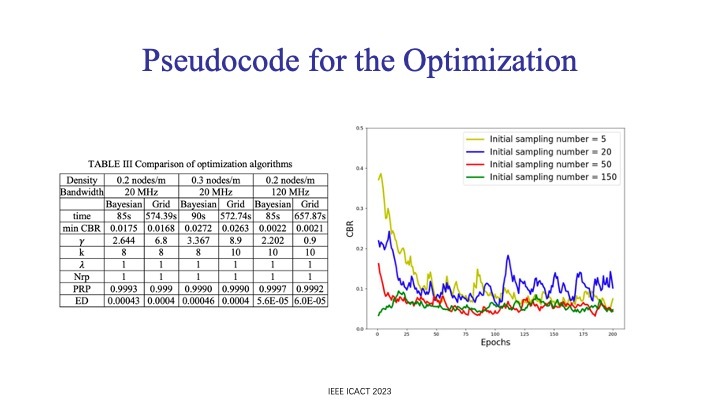 |
This figure shows the effect of the different initial numbers of sampling points on the convergence.
|
|
ICACT20230203 Slide.13
[Big slide for presentation]
|
Chrome Text-to-Speach Click!! |
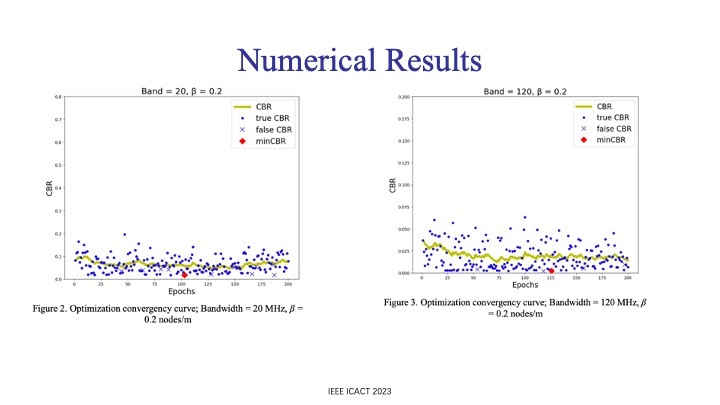 |
We used SVM to test our algorithm.
|
|
ICACT20230203 Slide.12
[Big slide for presentation]
|
Chrome Text-to-Speach Click!! |
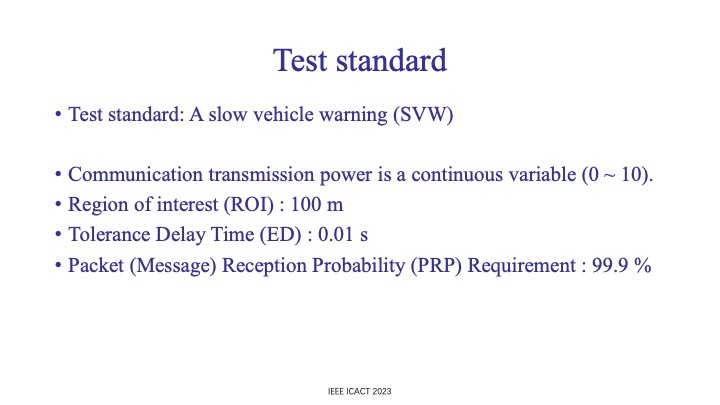 |
We used SVM to test our algorithm.
|
|
ICACT20230203 Slide.11
[Big slide for presentation]
|
Chrome Text-to-Speach Click!! |
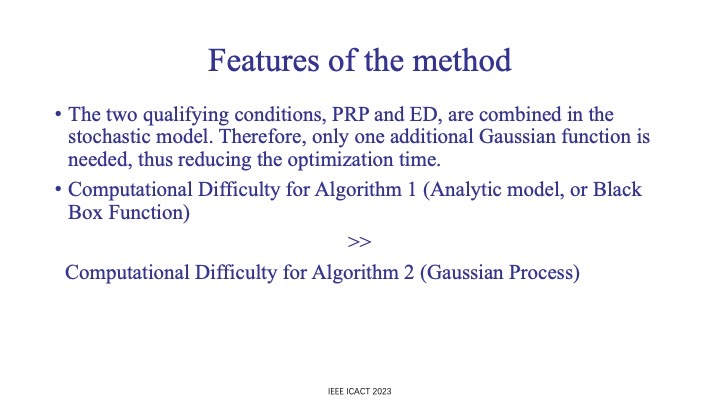 |
We have uniquely designed the algorithm to ensure that the program runs efficiently.
|
|
ICACT20230203 Slide.10
[Big slide for presentation]
|
Chrome Text-to-Speach Click!! |
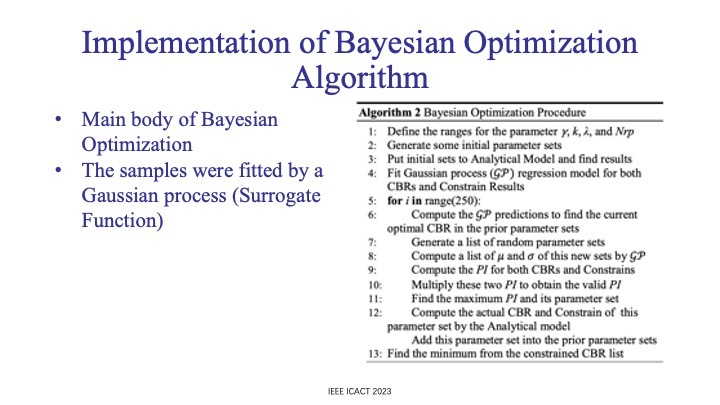 |
This pseudo-code shows the details of the restricted Bayesian optimization.
|
|
ICACT20230203 Slide.09
[Big slide for presentation]
|
Chrome Text-to-Speach Click!! |
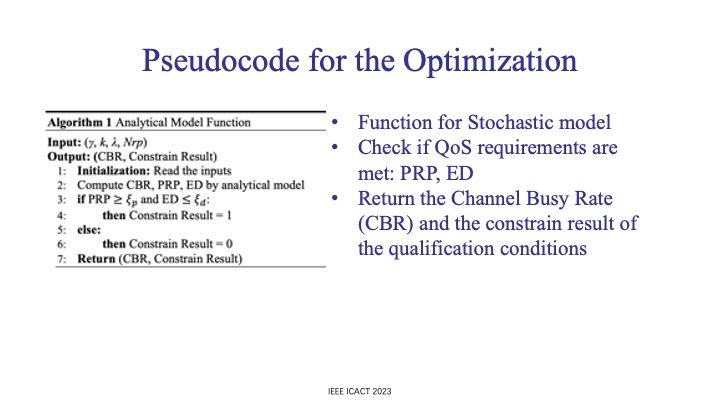 |
This photo of the pseudo-code shows the details of the algorithm. This pseudo-code represents the stochastic model.
|
|
ICACT20230203 Slide.08
[Big slide for presentation]
|
Chrome Text-to-Speach Click!! |
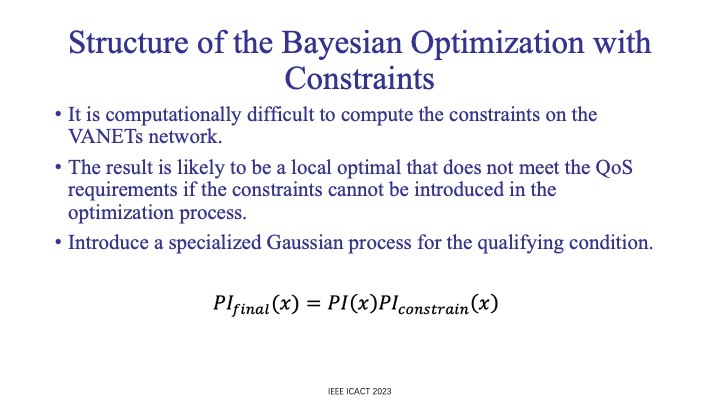 |
However, the original Bayesian approach is insufficient for solving the existing problem. So we need to add qualifications to the Bayesian optimization. Since the qualifier in the stochastic model is also computationally intensive, I use a Gaussian process to create an alternative function.
|
|
ICACT20230203 Slide.07
[Big slide for presentation]
|
Chrome Text-to-Speach Click!! |
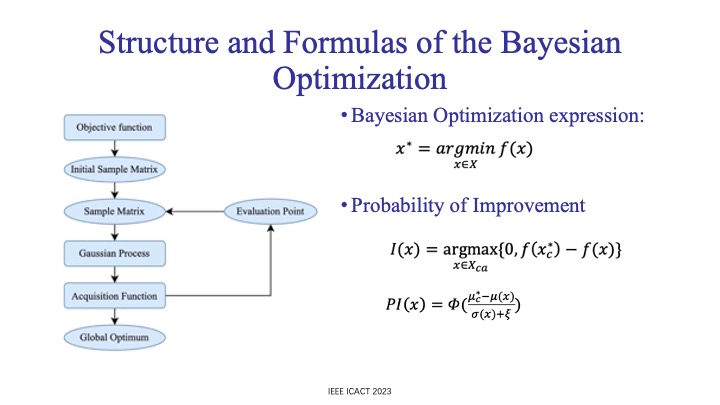 |
The flowchart below describes the structure of the Bayesian approach. The formulas next to it are the specific mathematical formulas in the Bayesian approach.
|
|
ICACT20230203 Slide.06
[Big slide for presentation]
|
Chrome Text-to-Speach Click!! |
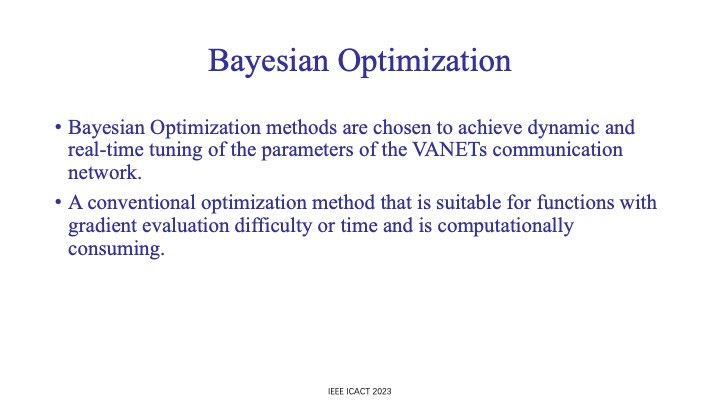 |
After understanding our stochastic model, I will introduce Bayesian optimization. Bayesian optimization is the technical core of the whole paper. It is a traditional and robust optimization method.
|
|
ICACT20230203 Slide.05
[Big slide for presentation]
|
Chrome Text-to-Speach Click!! |
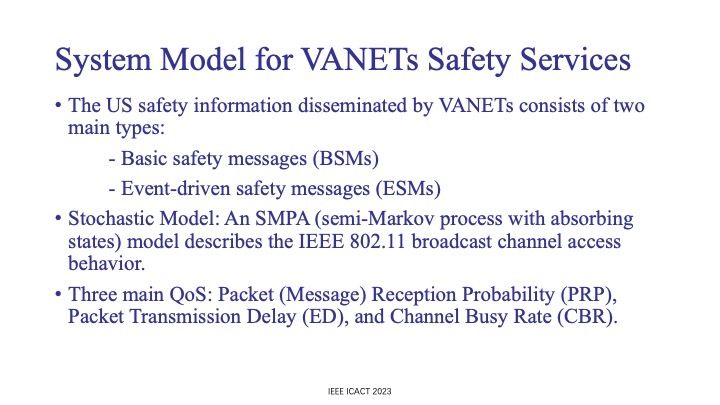 |
Next, I will describe the model used in the paper. We have chosen VANETs safety services as the object of optimization. In the optimization, we did not sample the actual network. Instead, we used a stochastic model to simulate the channel performance.
|
|
ICACT20230203 Slide.04
[Big slide for presentation]
|
Chrome Text-to-Speach Click!! |
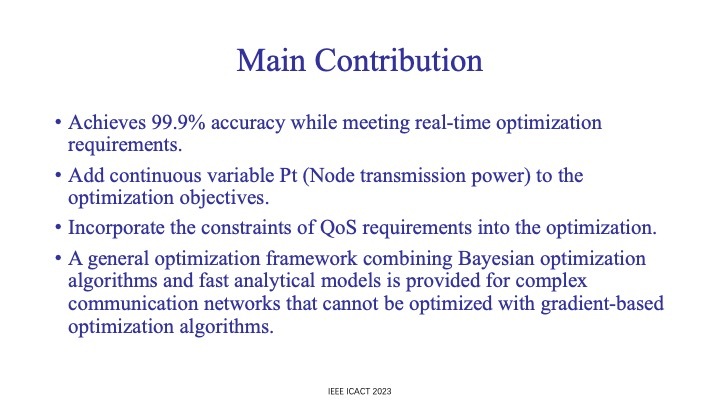 |
To solve these problems, I propose a method using restricted Bayesian optimization in this thesis. This method successfully solves the existing technical issues.
|
|
ICACT20230203 Slide.03
[Big slide for presentation]
|
Chrome Text-to-Speach Click!! |
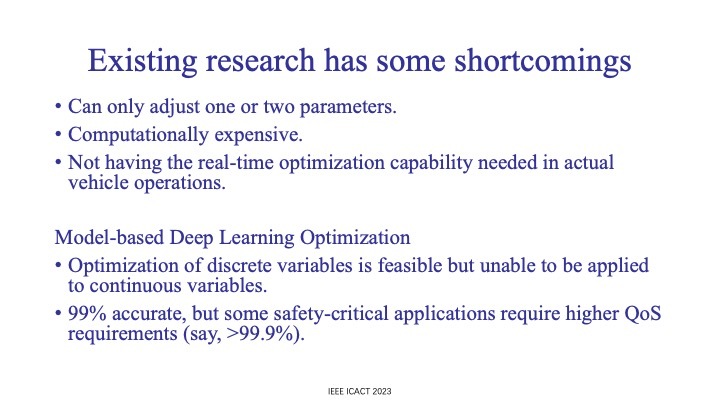 |
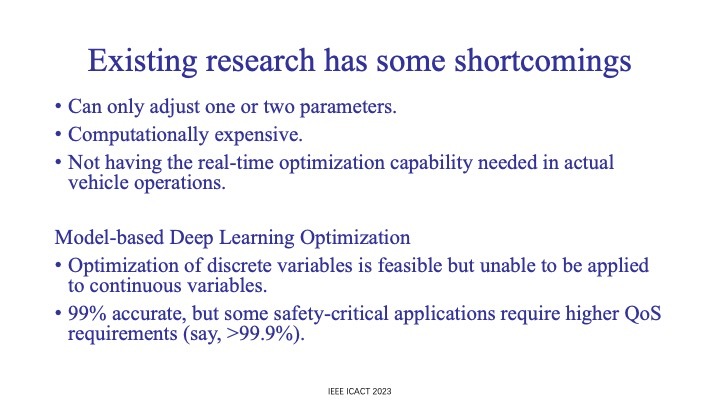
The current research has some problems as follows. They are usually limited to tuning single or two parameters and do not apply to real-time optimization. To solve this problem, I proposed a neural network-based optimization method in my previous paper. However, this method has some limitations.
|
|
ICACT20230203 Slide.02
[Big slide for presentation]
|
Chrome Text-to-Speach Click!! |
 |
This thesis is centered on the optimization of VANET systems. Three main communication systems support VANETs. The main goal of this thesis is to achieve real-time optimization of the communication parameters of VANETs.
|
|
ICACT20230203 Slide.01
[Big slide for presentation]
|
Chrome Text-to-Speach Click!! |
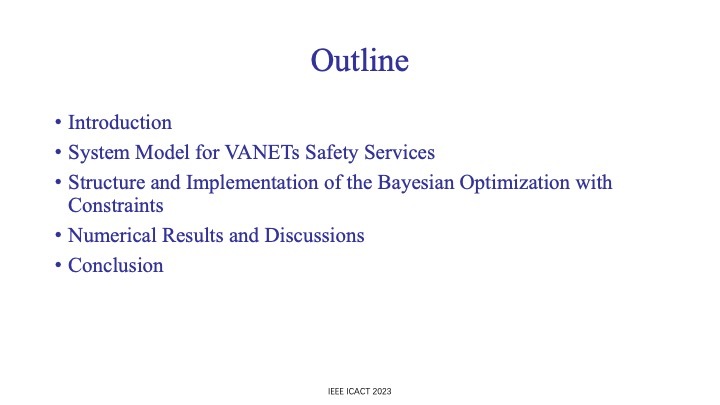 |
First, I would like to introduce the general structure of the presentation. These slides will cover five main topics: Introduction, System Model for VANETs Safety Services, Structure and Implementation of the Bayesian Optimization with Constraints, Numerical Results and Discussions, and Conclusion. In the introductory session, I will focus on the background and technical support for writing this paper. In System Model for VANETs Safety Services and Structure and Implementation of the Bayesian Optimization with Constraints, I will present the technical approach of this paper. In Numerical Results and Discussions, I will explain the experiments and results of this paper. I will conclude with a summary.
|
|
ICACT20230203 Slide.00
[Big slide for presentation]
[YouTube] |
Chrome Text-to-Speach Click!! |
 |
Hi everyone; I am going to present my paper today. The paper is titled Bayesian Constrained Optimization of IEEE 802.11 VANET for Safety Applications.
|
















