ICACT20220059 Slide.18
[Big slide for presentation]
[YouTube]
ICACT20220059 Slide.18
[Big slide for presentation]
[YouTube] |
Chrome Text-to-Speach Click!! Click!! |
 |
Thank you for listening to the presentation on this paper so far.
|
|
ICACT20220059 Slide.17
[Big slide for presentation]
[YouTube] |
Chrome Text-to-Speach Click!! |
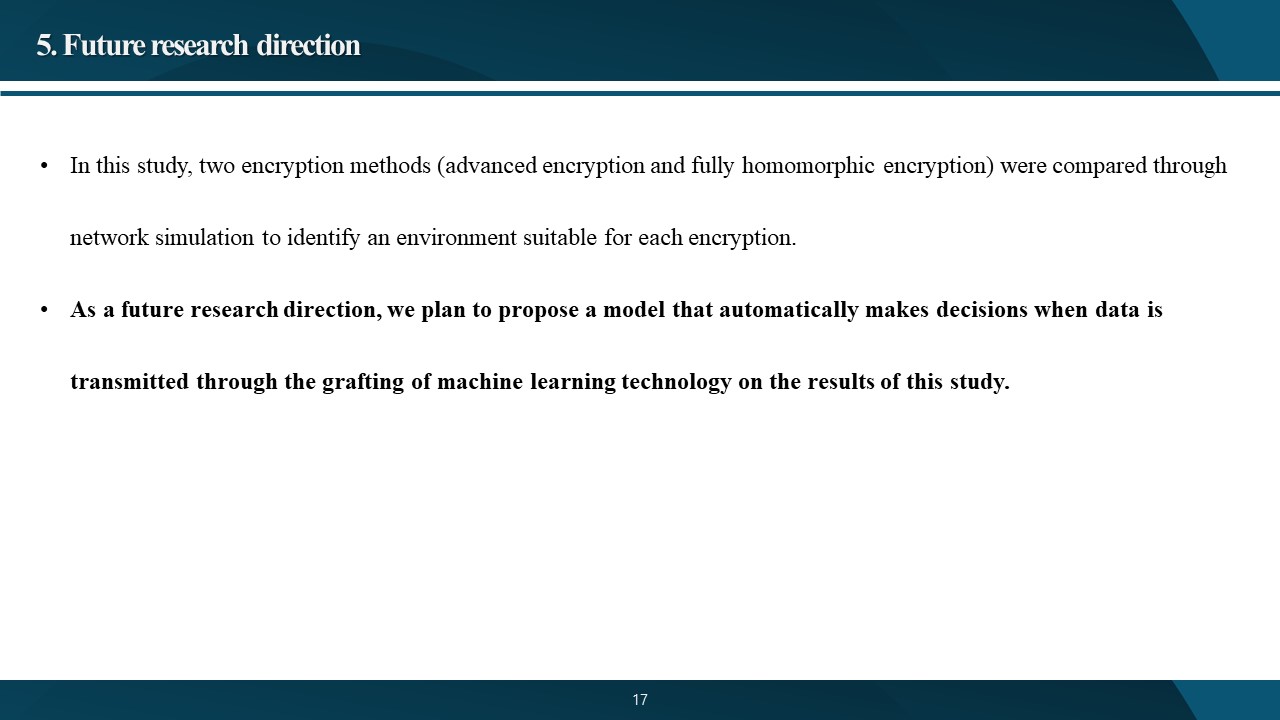 |
Finally, it is the direction of future research.
As a future research direction, we plan to propose a model that automatically makes decisions when data is transmitted through the grafting of machine learning technology on the results of this study.
|
|
ICACT20220059 Slide.16
[Big slide for presentation]
[YouTube] |
Chrome Text-to-Speach Click!! |
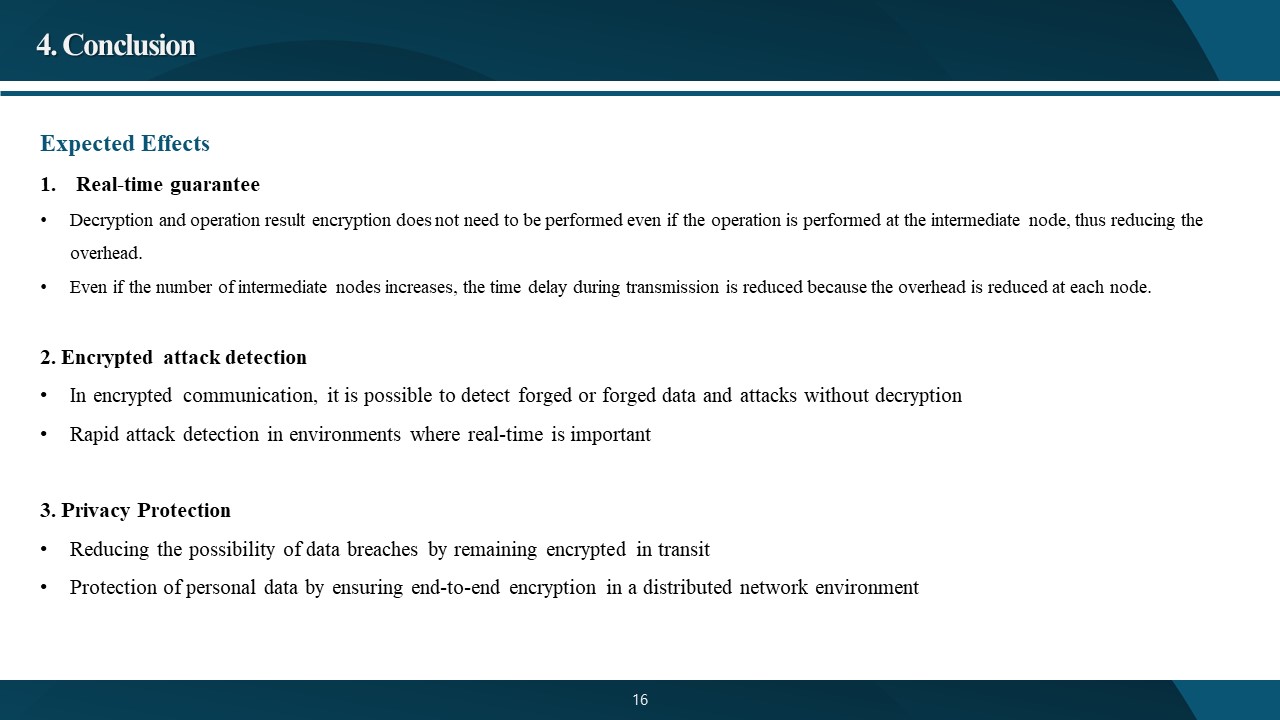 |
The first of the effects of this is real-time guarantees. Even if you operate on an intermediate node, overhead is reduced because decryption and operation result encryption is not required. In addition, Even if the number of intermediate nodes increases, the time delay during transmission is reduced because the overhead is reduced at each node.
The second is encrypted attack detection. In encrypted communication, it is possible to detect forged or forged data and attacks without decryption and can detect attacks quickly in real-time critical environments.
The third is Privacy Protection. We reduce the possibility of data breaches by remaining encrypted in transit and Protecting personal data by ensuring end-to-end encryption in a distributed network environment.
|
|
ICACT20220059 Slide.15
[Big slide for presentation]
[YouTube] |
Chrome Text-to-Speach Click!! |
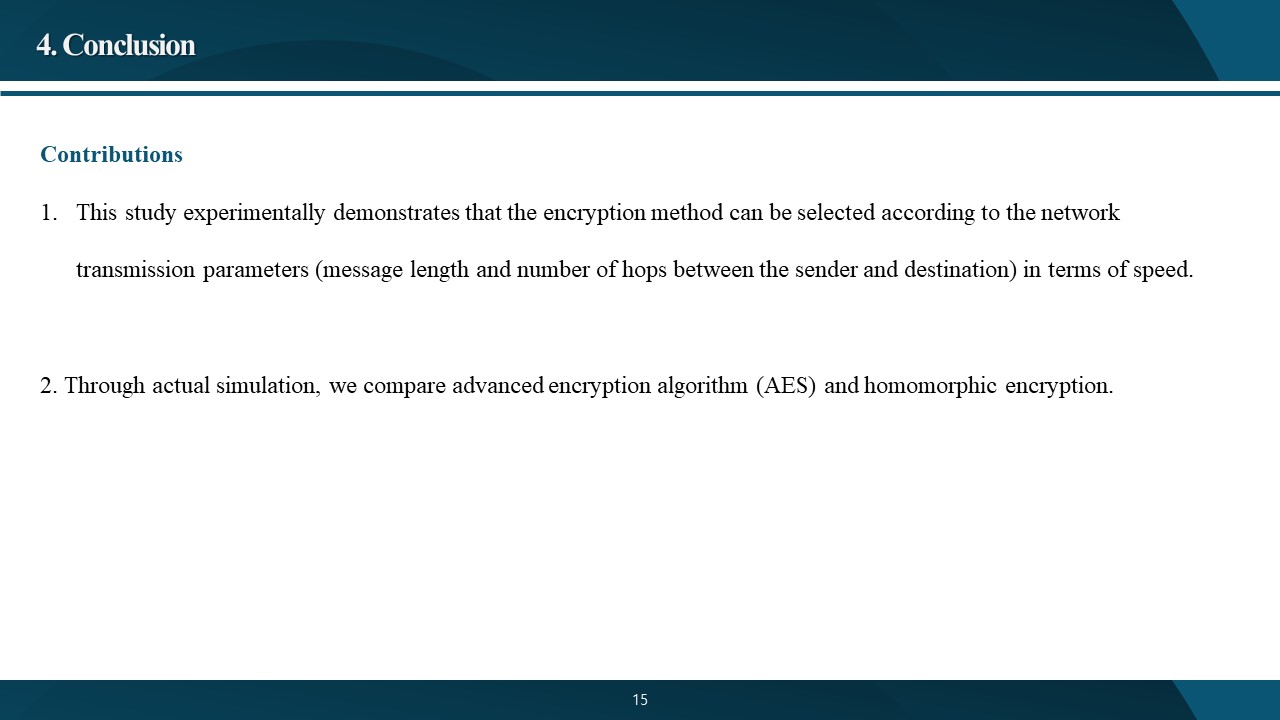 |
The contribution of our paper is
First, This study experimentally demonstrates that the encryption method can be selected according to the network transmission parameters in terms of speed.
Second, Through actual simulation, we compare AES and homomorphic encryption.
|
|
ICACT20220059 Slide.14
[Big slide for presentation]
[YouTube] |
Chrome Text-to-Speach Click!! |
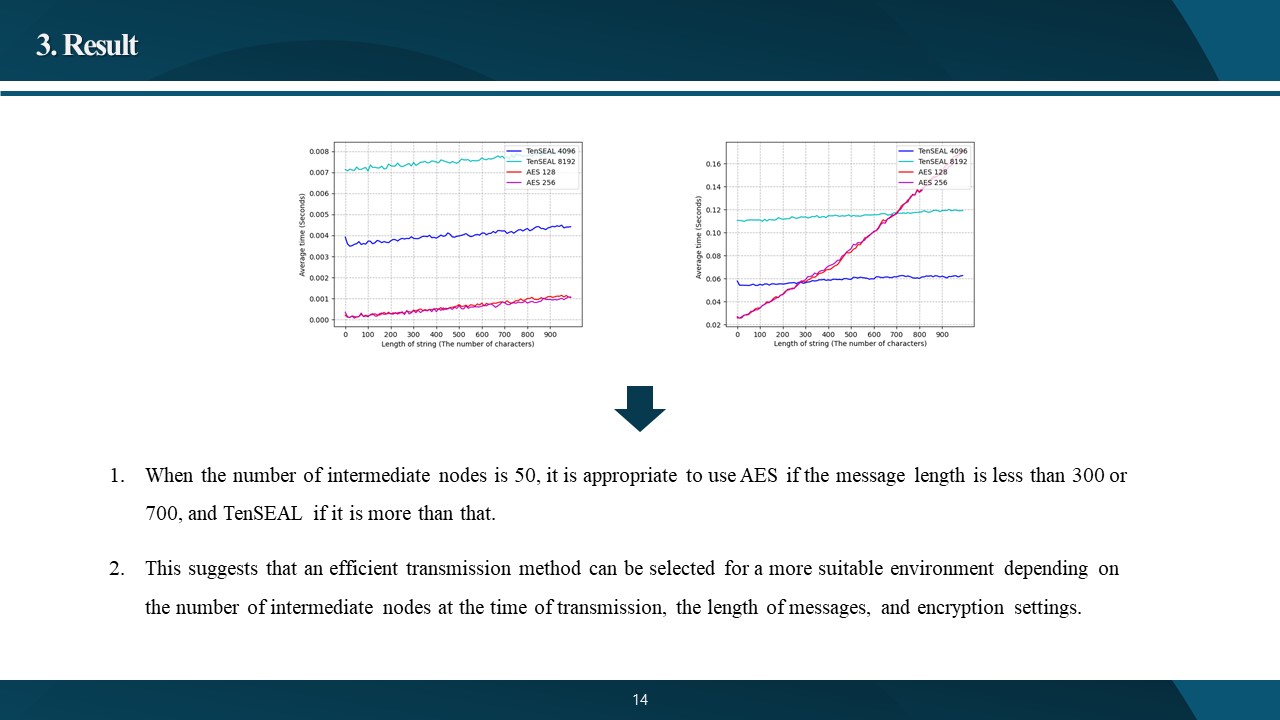 |
Therefore, the following conclusions are drawn.
When the number of intermediate nodes is 50, it is appropriate to use AES if the message length is less than 300 or 700 and TenSEAL if it is more than that. This suggests that an efficient transmission method can be selected for a more suitable environment depending on the number of intermediate nodes at the time of transmission, the length of messages, and encryption settings.
|
|
ICACT20220059 Slide.13
[Big slide for presentation]
[YouTube] |
Chrome Text-to-Speach Click!! |
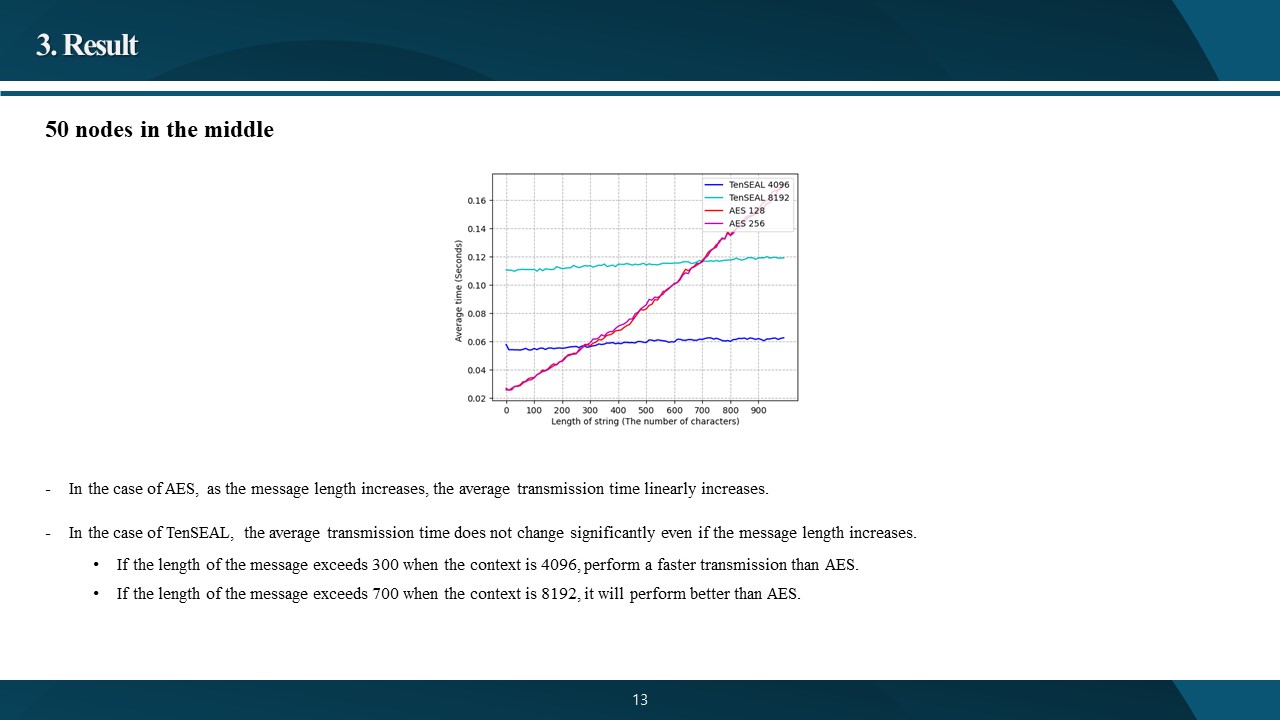 |
When there are 50 intermediate nodes, for AES, the average transmission time increases linearly as the message length increases. However, for TenSEAL, the average transmission time does not change significantly even if the message length increases.
Therefore, if the length of the message exceeds 300 when the context is 4096, perform a faster transmission than AES.
If the length of the message exceeds 700 when the context is 8192, it will perform better than AES.
|
|
ICACT20220059 Slide.12
[Big slide for presentation]
[YouTube] |
Chrome Text-to-Speach Click!! |
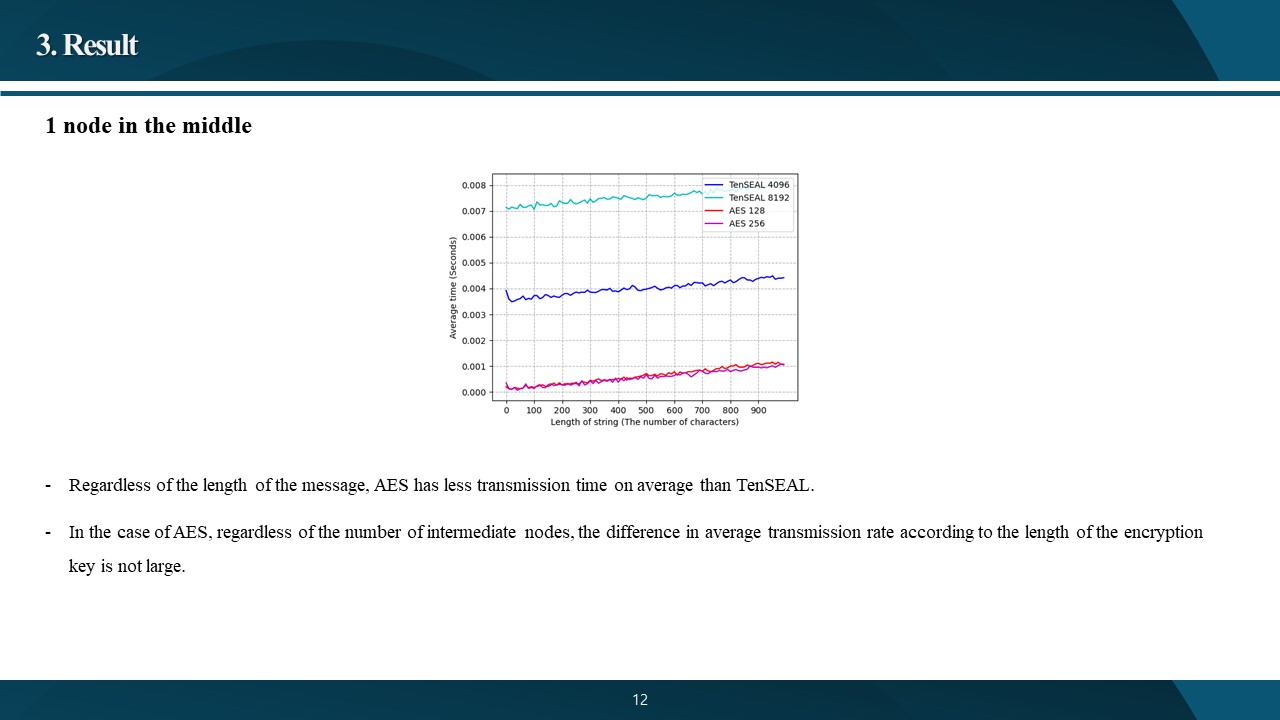 |
The results of this experiment can be checked by dividing it into one intermediate node and 50 nodes.
When there is one intermediate node, AES has on average less transmission time than tenSEAL regardless of the length of the message. In the case of AES, regardless of the number of intermediate nodes, the difference in average transmission rate according to the length of the encryption key is not significant.
|
|
ICACT20220059 Slide.11
[Big slide for presentation]
[YouTube] |
Chrome Text-to-Speach Click!! |
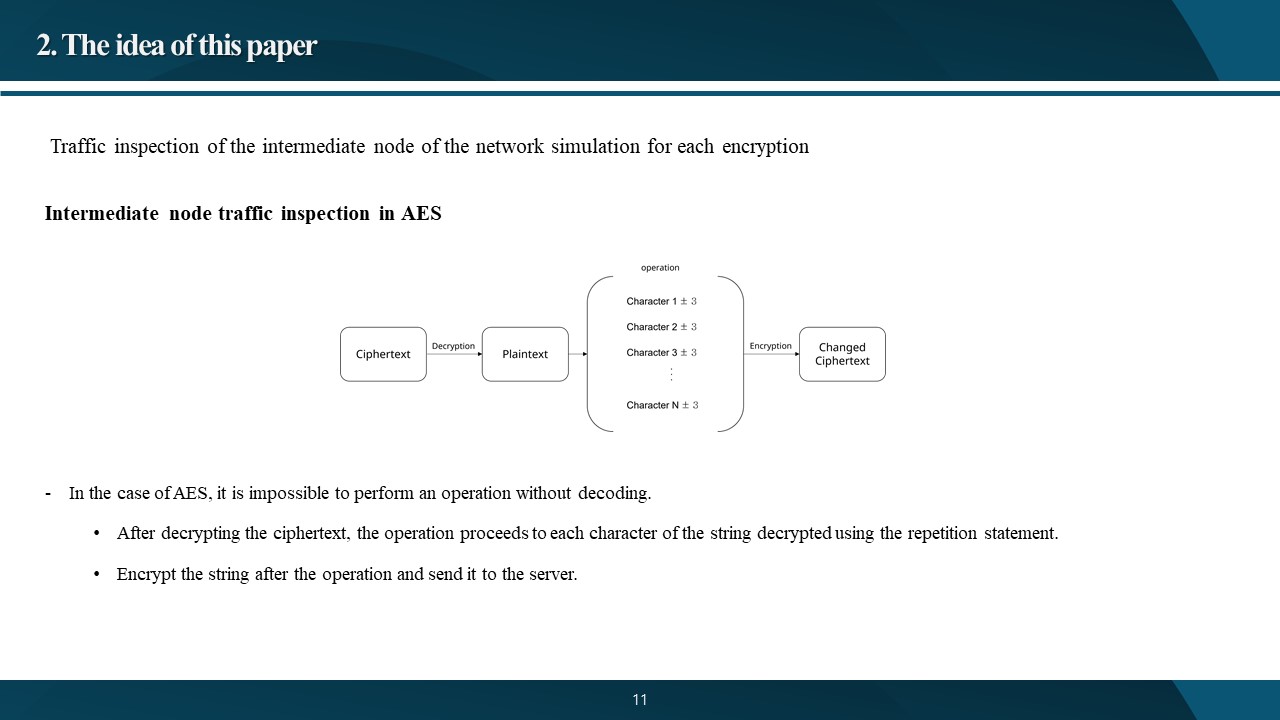 |
In the case of AES, it is impossible to calculate without decoding. Therefore, After decrypting the ciphertext, the operation proceeds to each character of the string decrypted using the repetition statement.
Encrypt the string after the operation and send it to the server.
|
|
ICACT20220059 Slide.10
[Big slide for presentation]
[YouTube] |
Chrome Text-to-Speach Click!! |
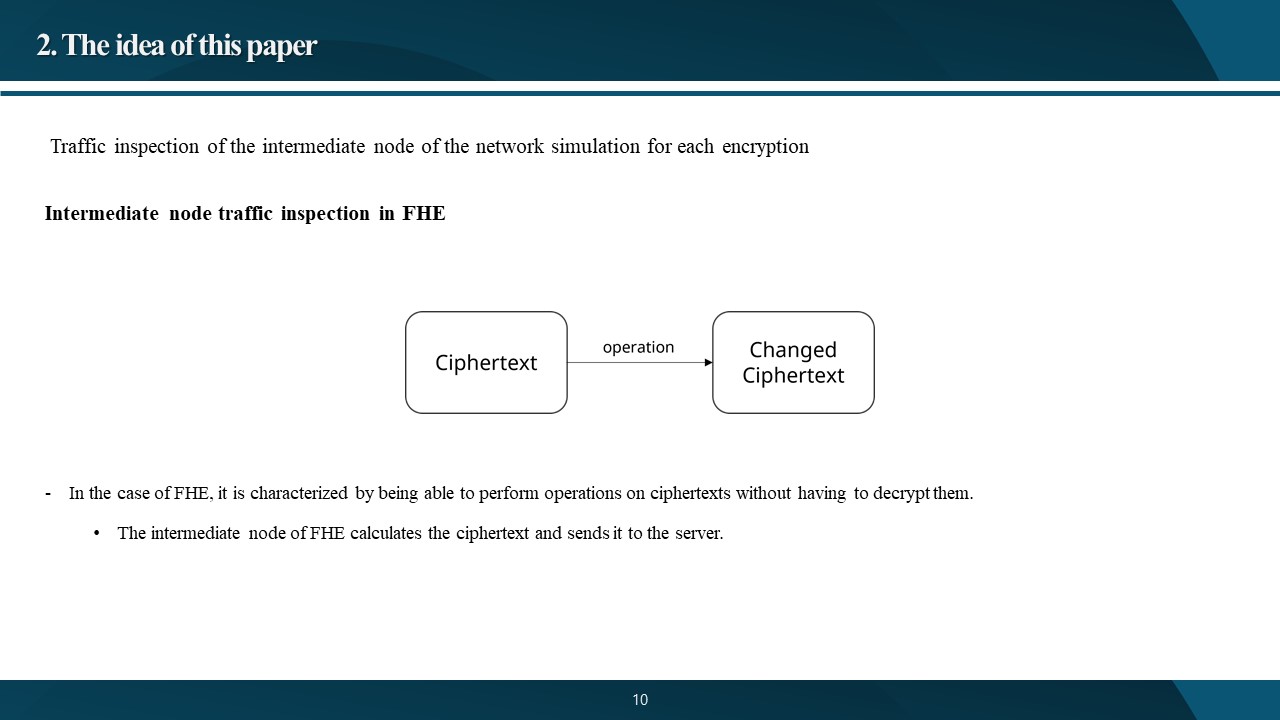 |
The following is a Traffic inspection of the intermediate node of the network simulation for each encryption. This was done in two cases.
First, In the case of FHE, it is characterized by performing operations on ciphertexts without having to decrypt them. Therefore, The middle node of FHE calculates the ciphertext and sends it to the server.
|
|
ICACT20220059 Slide.09
[Big slide for presentation]
[YouTube] |
Chrome Text-to-Speach Click!! |
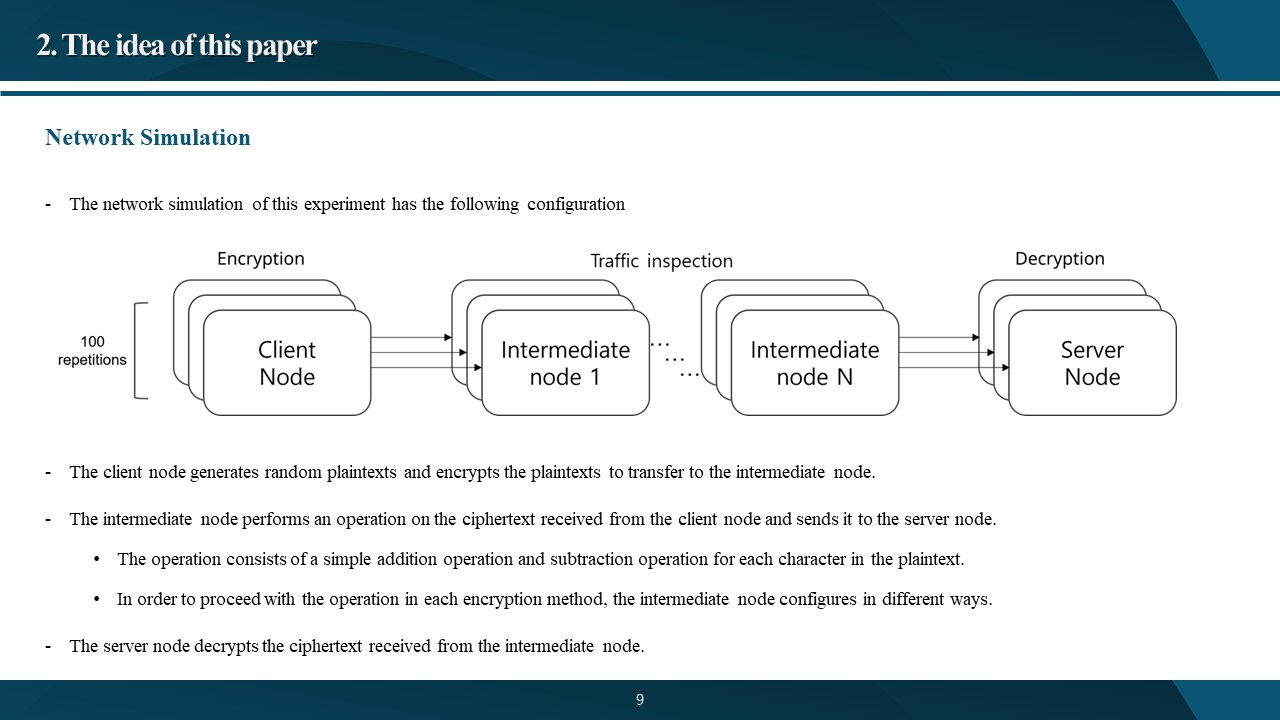 |
These network simulations have three node configurations as follows.
The client node generates random plaintexts and encrypts the plaintexts to transfer to the intermediate node.
The intermediate node operates on the ciphertext received from the client node and sends it to the server node.
Operations consist of simple addition operations and subtraction operations for each character in plain text, and intermediate nodes construct different ways to proceed with each encryption method.
The server node decrypts the ciphertext received from the intermediate node.
|
|
ICACT20220059 Slide.08
[Big slide for presentation]
[YouTube] |
Chrome Text-to-Speach Click!! |
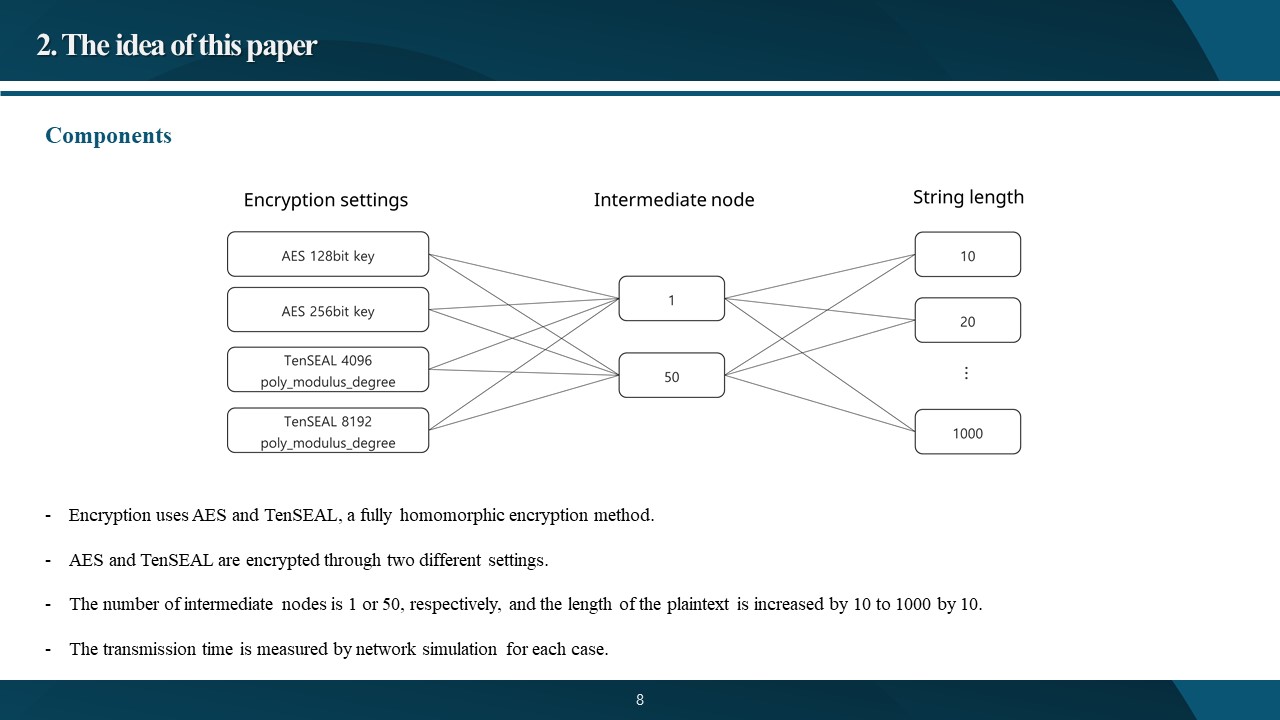 |
The following are the components of network simulation.
As shown in the figure at the top, encryption uses AES and TenSEAL, a fully homomorphic encryption method.
At this time, AES and TenSEAL are encrypted through two different settings.
The number of intermediate nodes is 1 or 50, respectively, and the plaintext length is increased by 10 to 1000 by 10.
The transmission time is measured by network simulation for each case.
|
|
ICACT20220059 Slide.07
[Big slide for presentation]
[YouTube] |
Chrome Text-to-Speach Click!! |
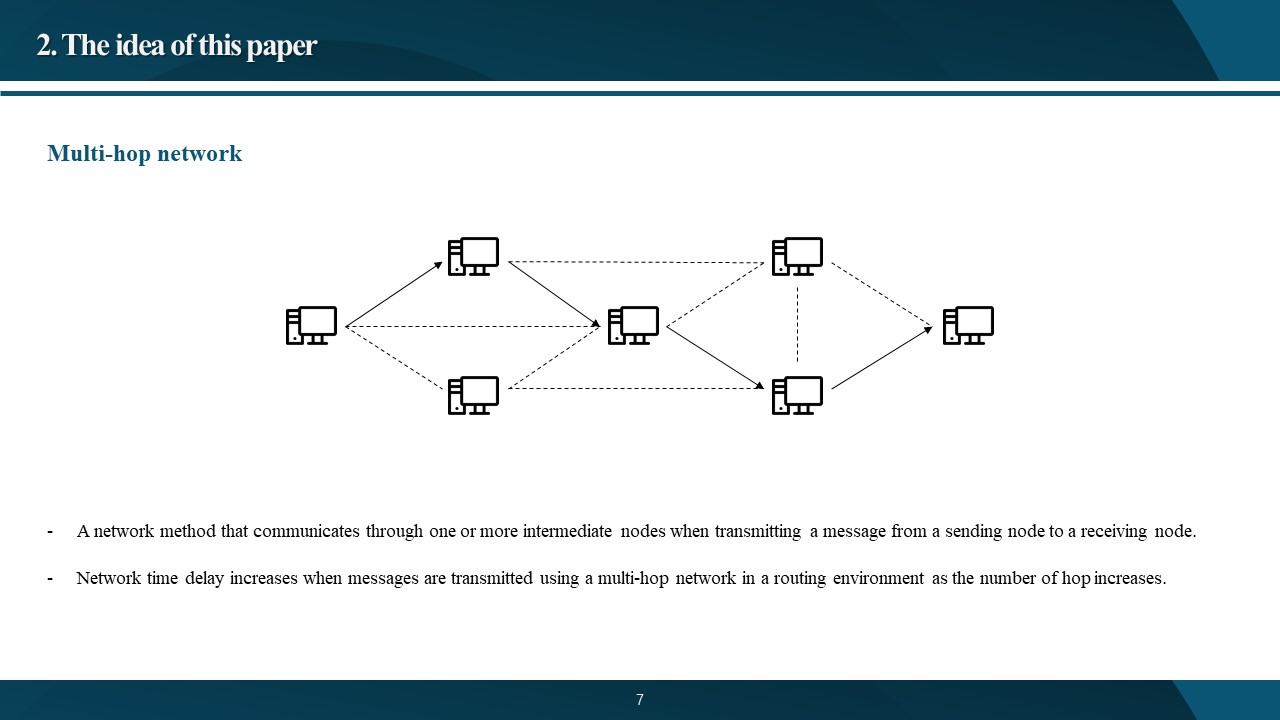 |
A multi-hop network is a network method that communicates through one or more intermediate nodes when transmitting a message from a sending node to a receiving node.
The network time delay increases when messages are transmitted using a multi-hop network in a routing environment as hop increases.
|
|
ICACT20220059 Slide.06
[Big slide for presentation]
[YouTube] |
Chrome Text-to-Speach Click!! |
 |
Before looking at the ideas of the paper, let us look at the concepts used in the paper.
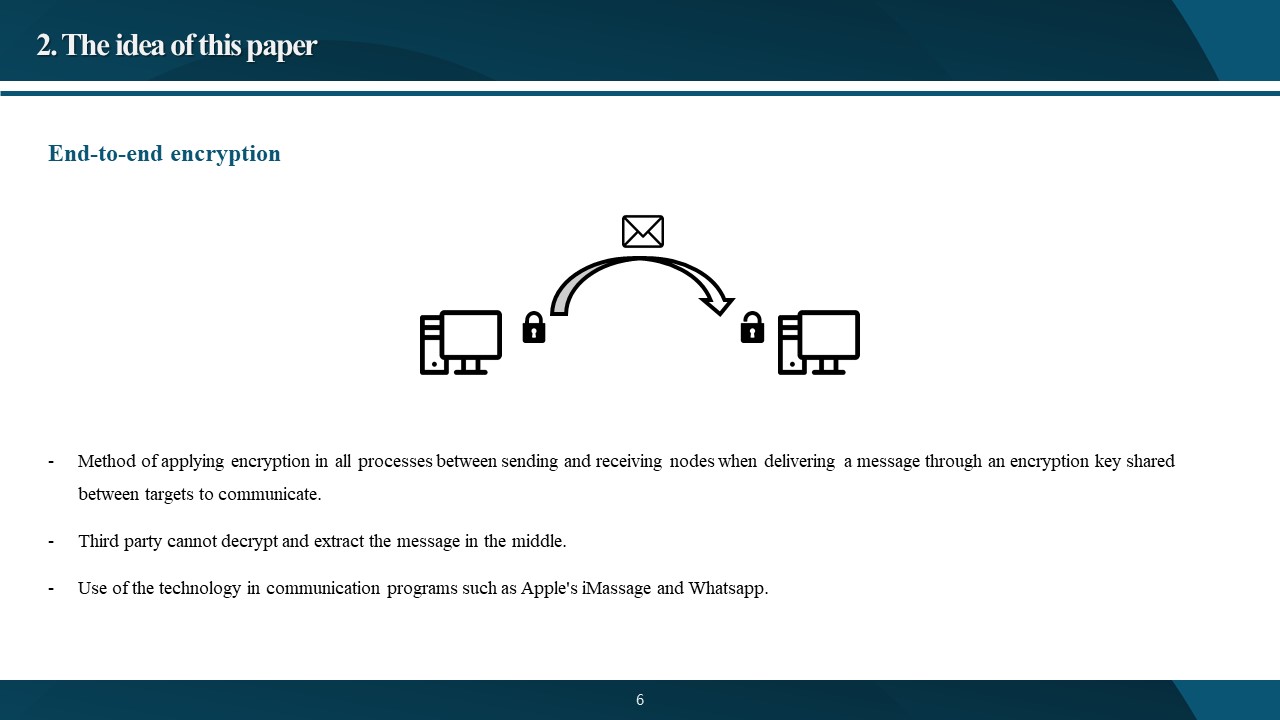
First, end-to-end encryption applies encryption in all processes between sending and receiving nodes when delivering a message through an encryption key shared between targets to communicate. Therefore, third-party cannot decrypt and extract messages in the middle. This technology is used for communication programs like Apple's I-Massage and WhatsApp.
|
|
ICACT20220059 Slide.05
[Big slide for presentation]
[YouTube] |
Chrome Text-to-Speach Click!! |
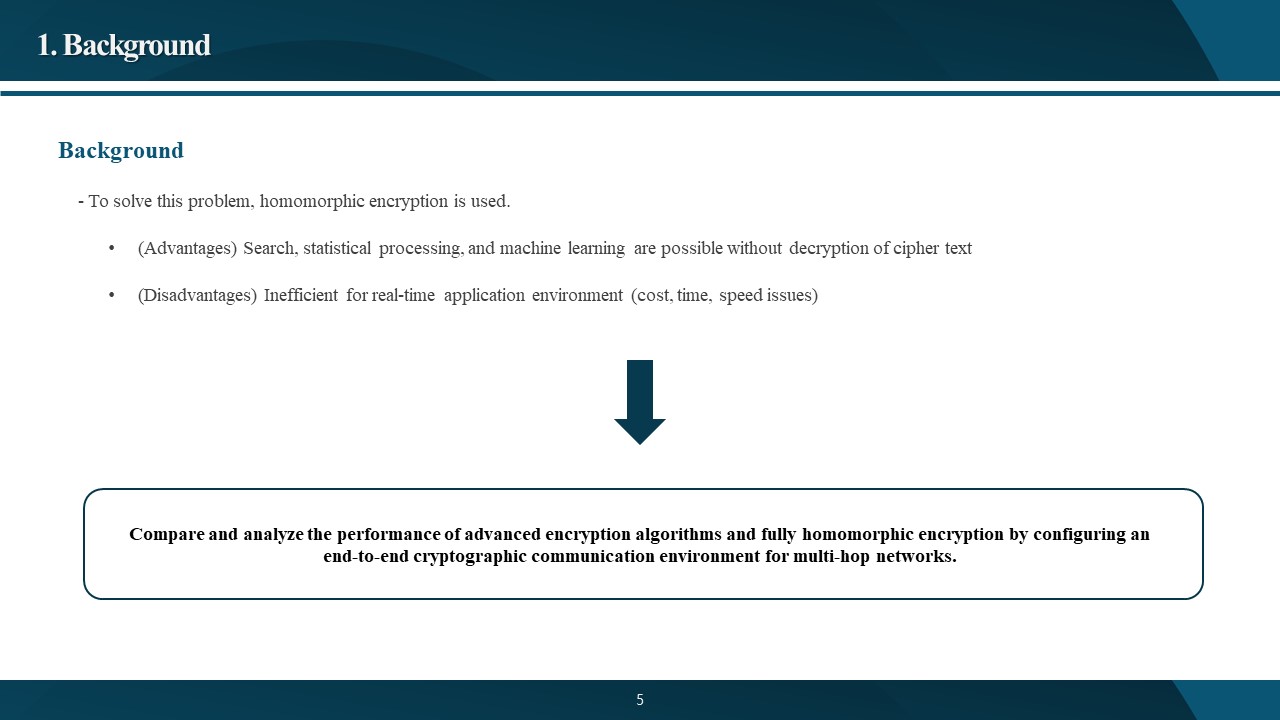 |
To solve this problem, homomorphic encryption is used
The advantages of homomorphic encryption are that it enables search, statistical processing, and machine learning without decryption of ciphertext.
The disadvantage is that it is inefficient for real-time applications due to cost, time, and speed problems.
Therefore, we compare and analyze the performance of advanced encryption algorithms and fully homomorphic encryption by configuring an end-to-end cryptographic communication environment for multi-hop networks.
|
|
ICACT20220059 Slide.04
[Big slide for presentation]
[YouTube] |
Chrome Text-to-Speach Click!! |
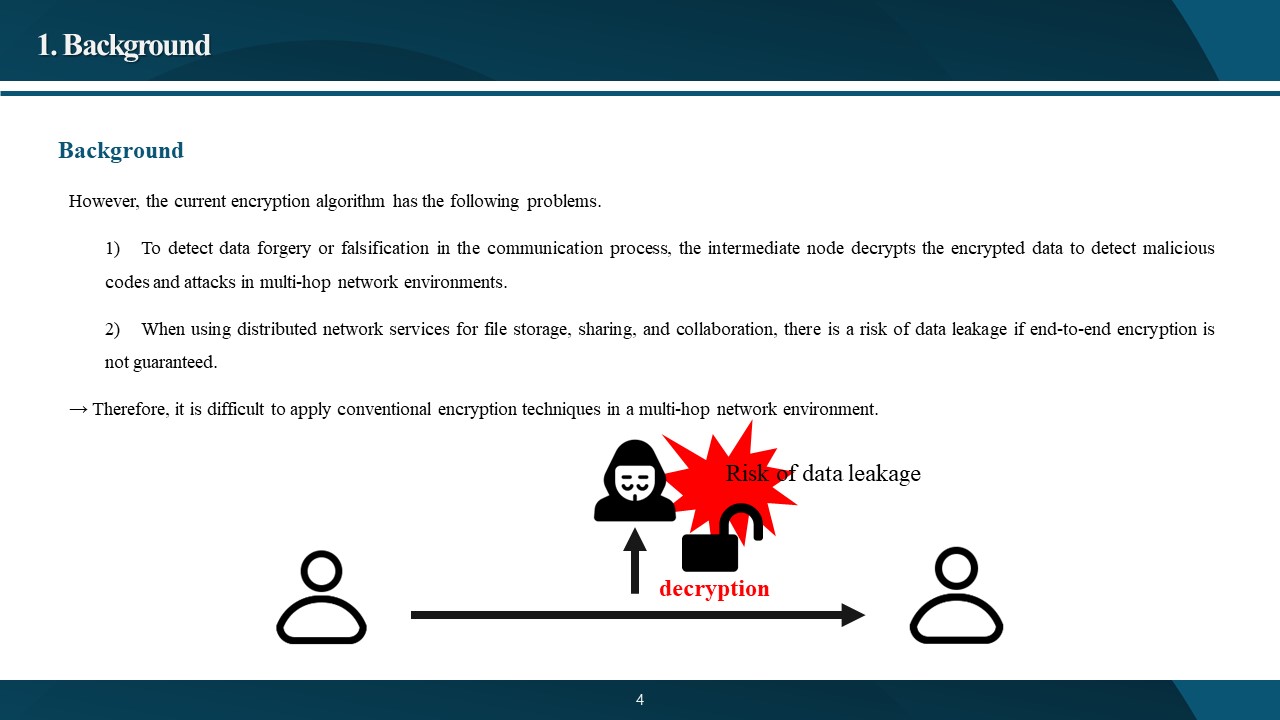 |
However, the current encryption algorithm has the following problems.
First, To detect data forgery or falsification in the communication process, the intermediate node decrypts the encrypted data to detect malicious codes and attacks in multi-hop network environments.
Second, When using distributed network services for file storage, sharing, and collaboration, data leakage risk if end-to-end encryption is not guaranteed.
Therefore, it is challenging to apply conventional encryption techniques in a multi-hop network environment.
|
|
ICACT20220059 Slide.03
[Big slide for presentation]
[YouTube] |
Chrome Text-to-Speach Click!! |
 |
First, it is the background of the study.
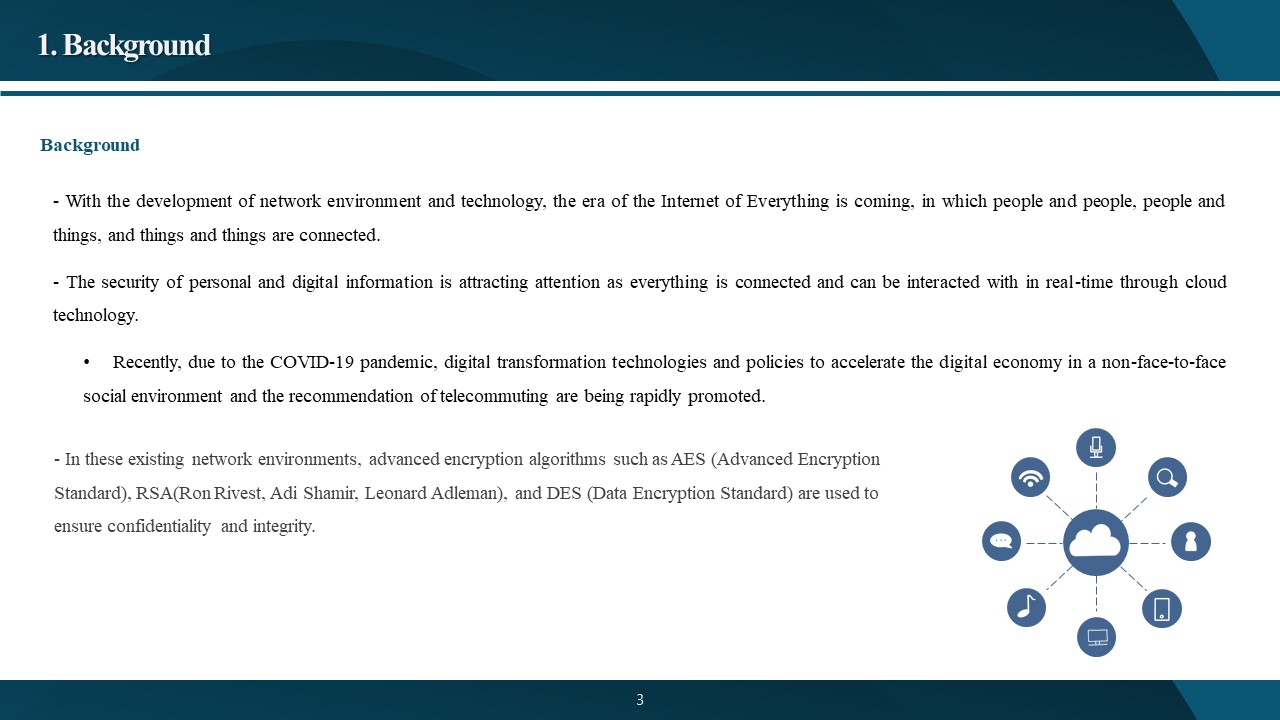
With the development of network environment and technology, the era of the Internet of Everything is coming, in which people and people, people and things, and things and things are connected.
In this situation, personal and digital information security is attracting attention as everything is connected and can be interacted with in real-time through cloud technology.
In addition, with the recent COVID-19 pandemic, digital transformation technologies and policies to accelerate the digital economy in a non-face-to-face social environment and the recommendation of telecommuting is being rapidly promoted.
In these existing network environments, advanced encryption algorithms such as AES, RSA, and DES ensure confidentiality and integrity.
|
|
ICACT20220059 Slide.02
[Big slide for presentation]
[YouTube] |
Chrome Text-to-Speach Click!! |
 |
The presentation first explains the background of the paper, followed by the idea of this paper. Moreover, I will explain the result and conclusion of research on this idea and introduce future research directions.
|
|
ICACT20220059 Slide.01
[Big slide for presentation]
[YouTube] |
Chrome Text-to-Speach Click!! |
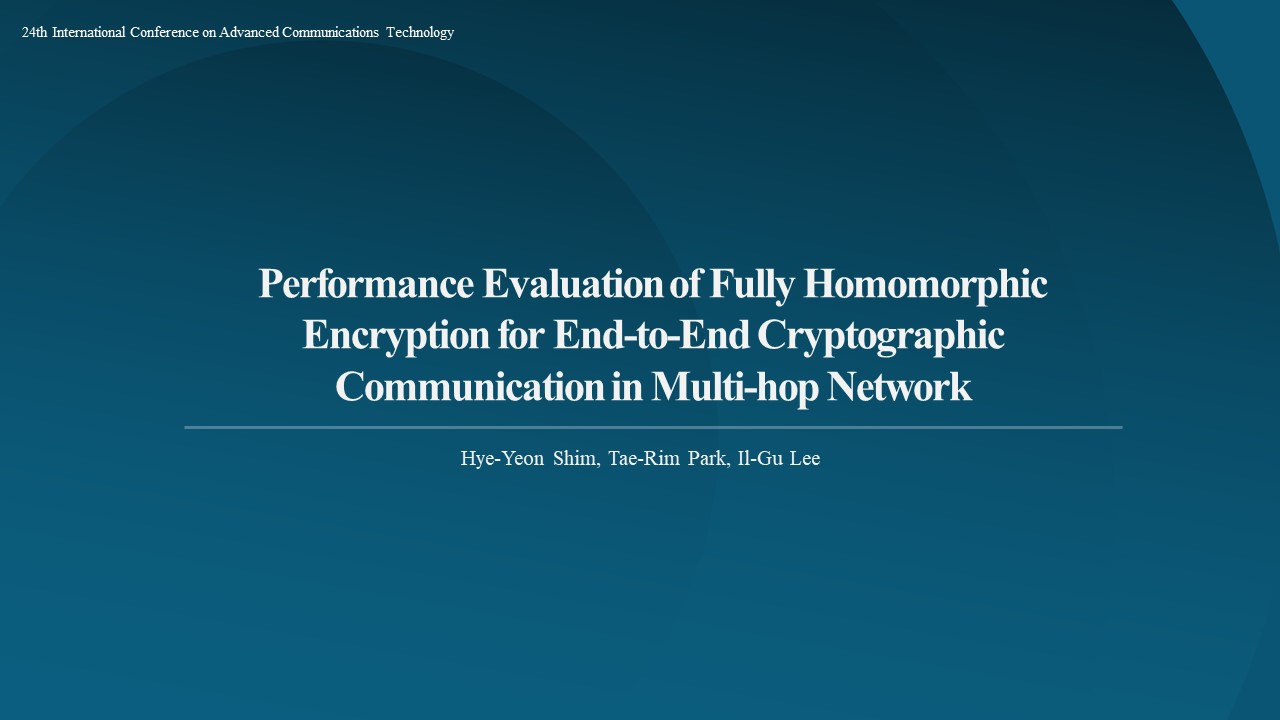 |
Let us begin the presentation on the "Performance Evaluation of Fully Homomorphic Encryption for End-to-End Cryptographic Communication in Multi-hop Network" paper. I'm presenter, Hyeyeon Shim.
|