 ICACT20230133 Slide.20
[Big slide for presentation]
[YouTube] |
Chrome Text-to-Speach Click!! |
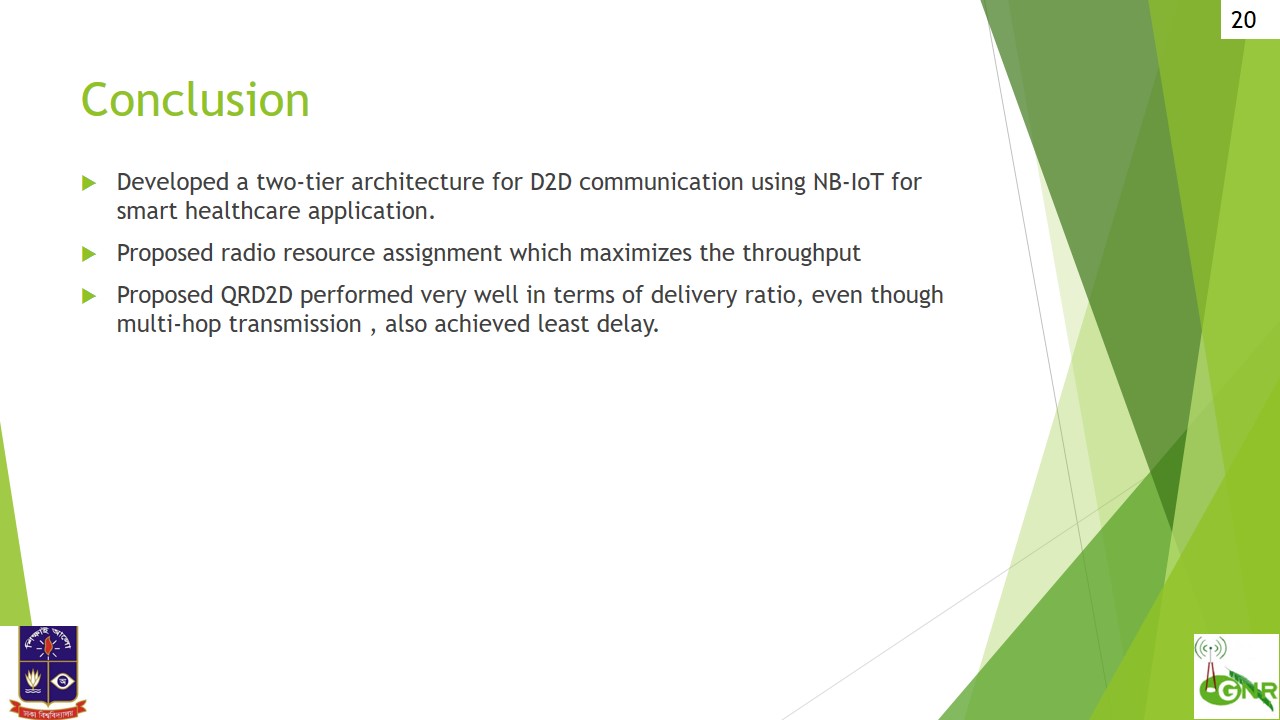 |
This proposed system performed well in terms of delivery ratio, even though multi hop transmission had a steadily decreasing delivery ratio because of its pairing approach.
|
|
ICACT20230133 Slide.19
[Big slide for presentation]
[YouTube] |
Chrome Text-to-Speach Click!! |
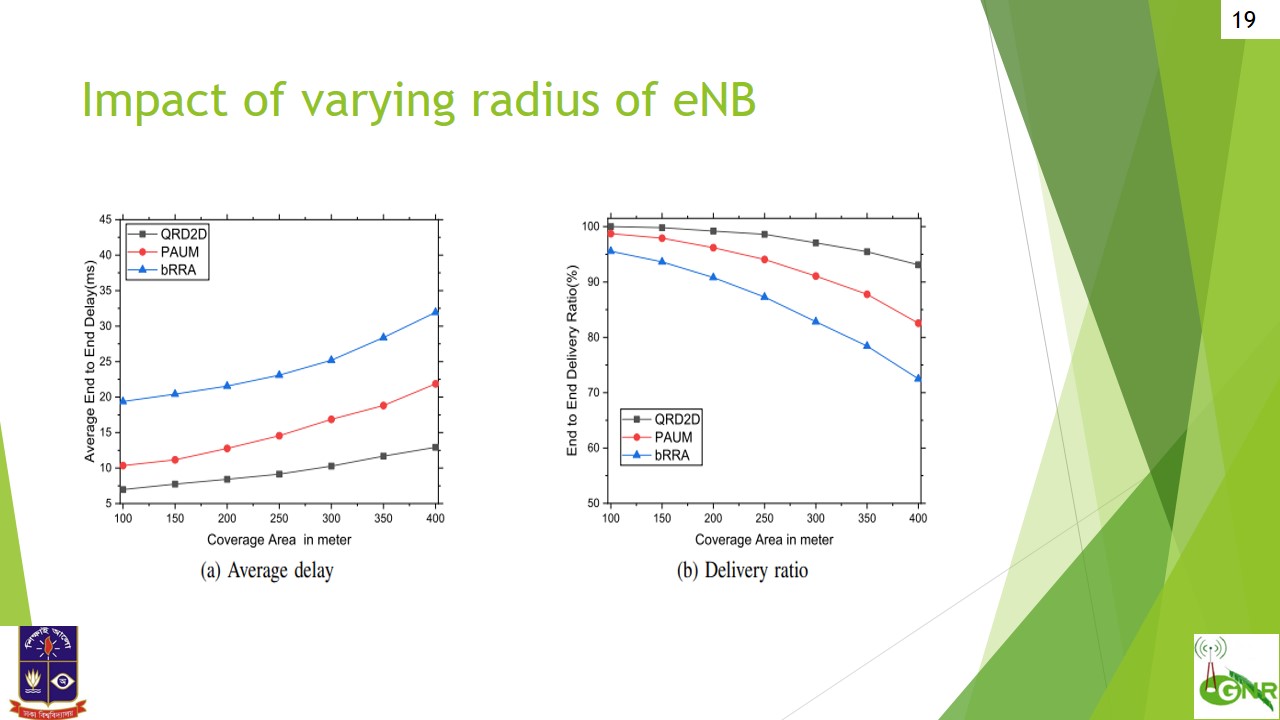 |
Due to D2D communication the system achieved least delay despite having broader coverage, which enables the highest possible data throughput. As a result of D2D communication’s ability to increase coverage and relay data to base station via cellular user, which reduce average hop distance of transmitted data packets.
|
|
ICACT20230133 Slide.18
[Big slide for presentation]
[YouTube] |
Chrome Text-to-Speach Click!! |
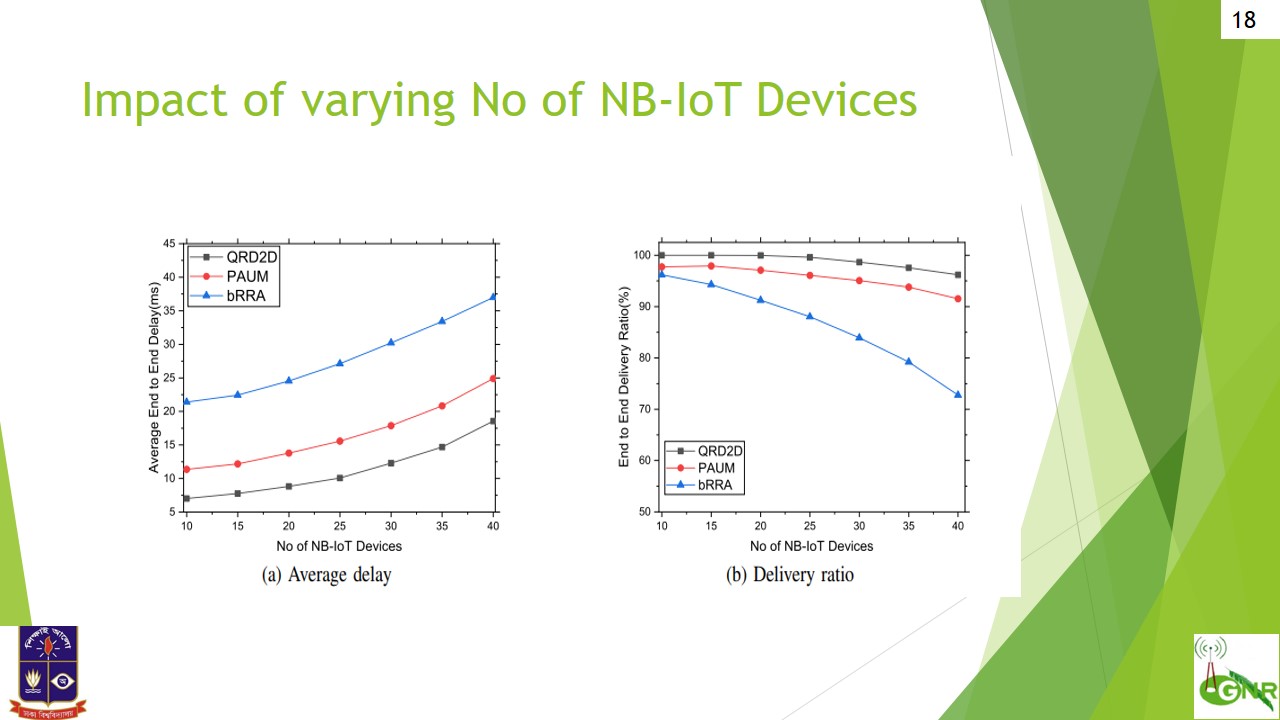 |
As the number of devices grows, the average packet delivery delays or all systems examined increase continuously as shown in the figure. Throughput is maximized while resource allocation is jointly optimized, resulting in least delay . Next, even a slight rise in the NB-IoT devices can maintain a consistent delivery ratio for all devices.
|
|
ICACT20230133 Slide.17
[Big slide for presentation]
[YouTube] |
Chrome Text-to-Speach Click!! |
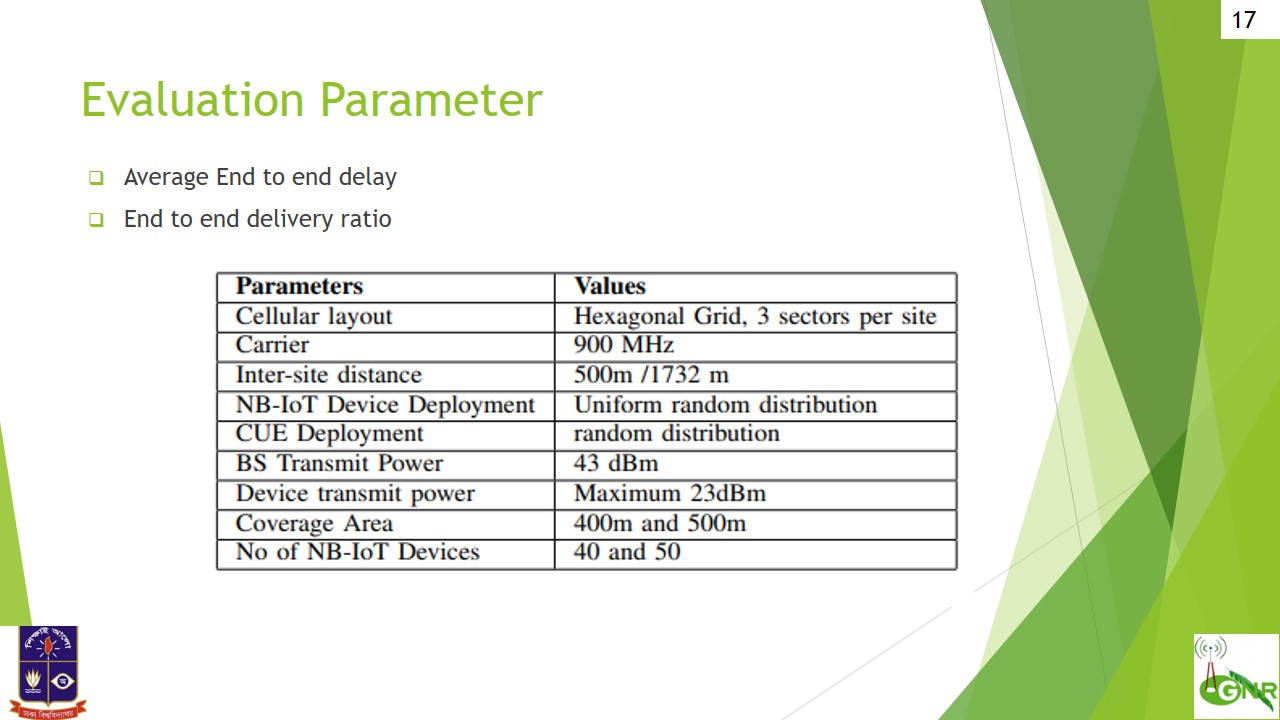 |
We consider two evaluation parameter to measure the performance of our system, they are: average end to end delay and end to end delivery ratio
|
|
ICACT20230133 Slide.16
[Big slide for presentation]
[YouTube] |
Chrome Text-to-Speach Click!! |
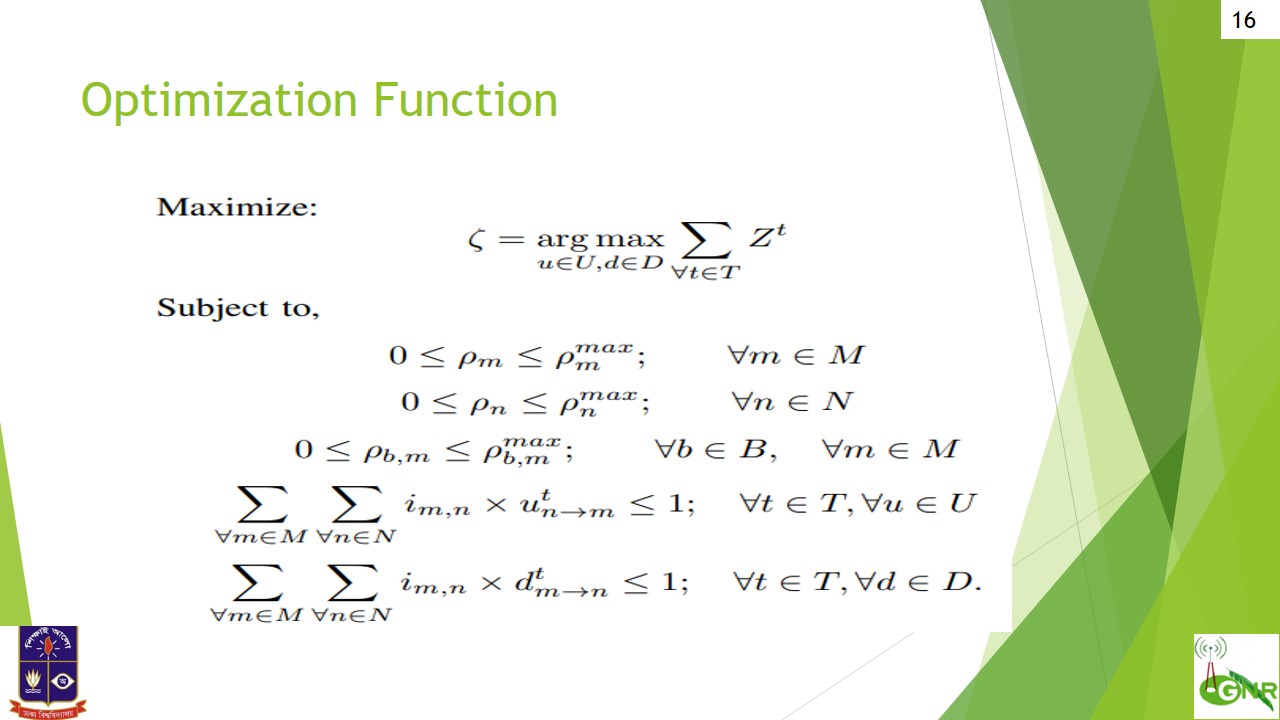 |
Finally, this paper is proposing an optimal solution of resource allocation between cellular user and D2D users offer by eNB. The proposed joint resource allocation aims to identify the higher data rate with relay paired coefficient which could optimize overall cell throughput and satisfy QoS requirements. The objective function is formulated as an MNILP which maximizes power, throughput with allocated channel and its data rate for all users outputs an optimum solution with some effective constraints.
|
|
ICACT20230133 Slide.15
[Big slide for presentation]
[YouTube] |
Chrome Text-to-Speach Click!! |
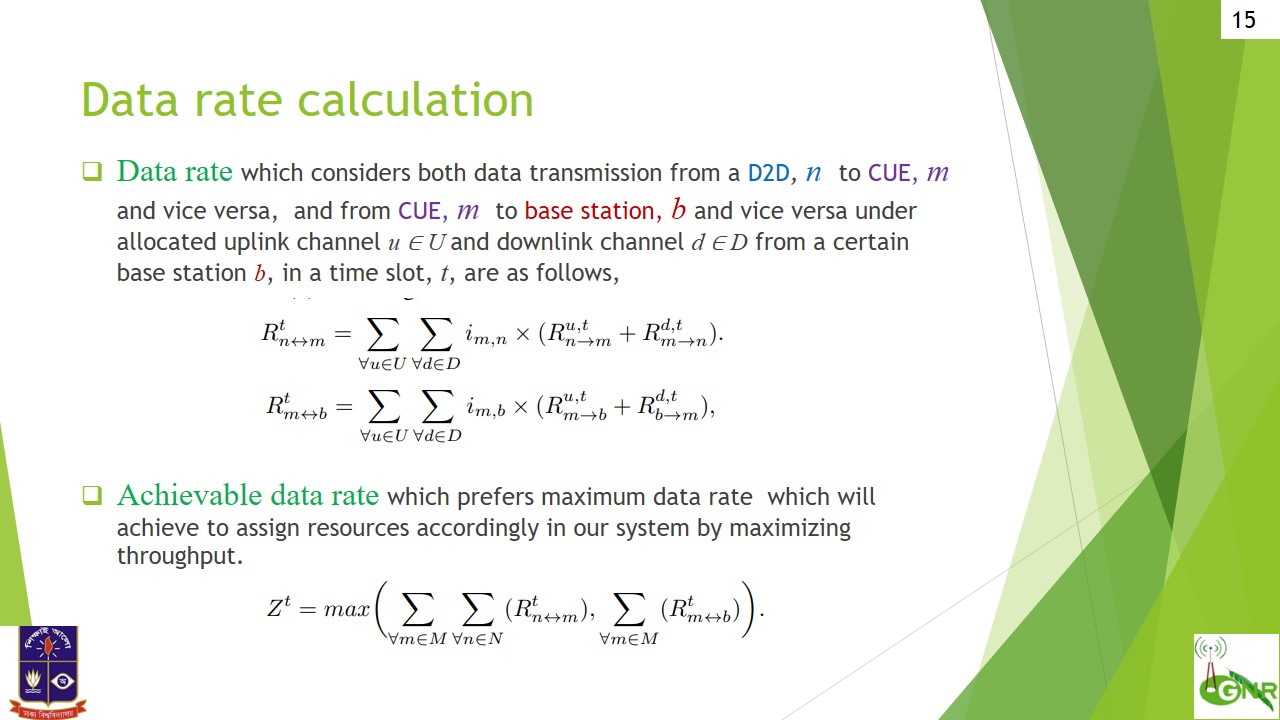 |
In to achieve high data rates, maximize D2D communication coverage and minimize interference base station is suppose to offer bandwidth resources to the CUEs and D2Ds.This approach is done in a smart that communicates with an eNB through a CUE by selecting near proximity. This slide is approaching with joint data calculation followed by achievable data rate . First two equations are representing data rate from device to CUE and vice versa, next is representing data rate from CUE to base station and vice versa. Finally , choosing the higher data rate is considering as achievable data rate.
|
|
ICACT20230133 Slide.14
[Big slide for presentation]
[YouTube] |
Chrome Text-to-Speach Click!! |
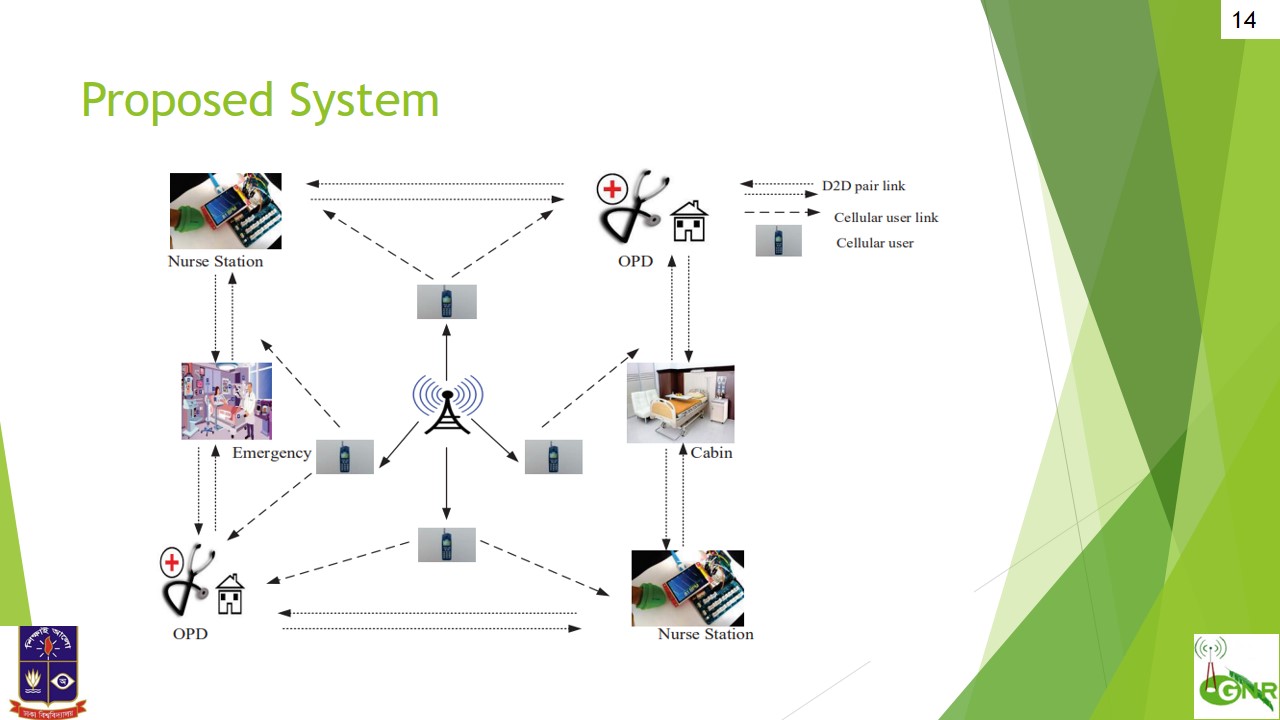 |
The system architecture of a D2D communication system in a smart is expressed in this proposed figure. In this system, any device can make pair with others and send data for transmission. Here, CUE relays the data to the eNB to increase data throughput and improve communication efficiency of emergent/critical event.
|
|
ICACT20230133 Slide.13
[Big slide for presentation]
[YouTube] |
Chrome Text-to-Speach Click!! |
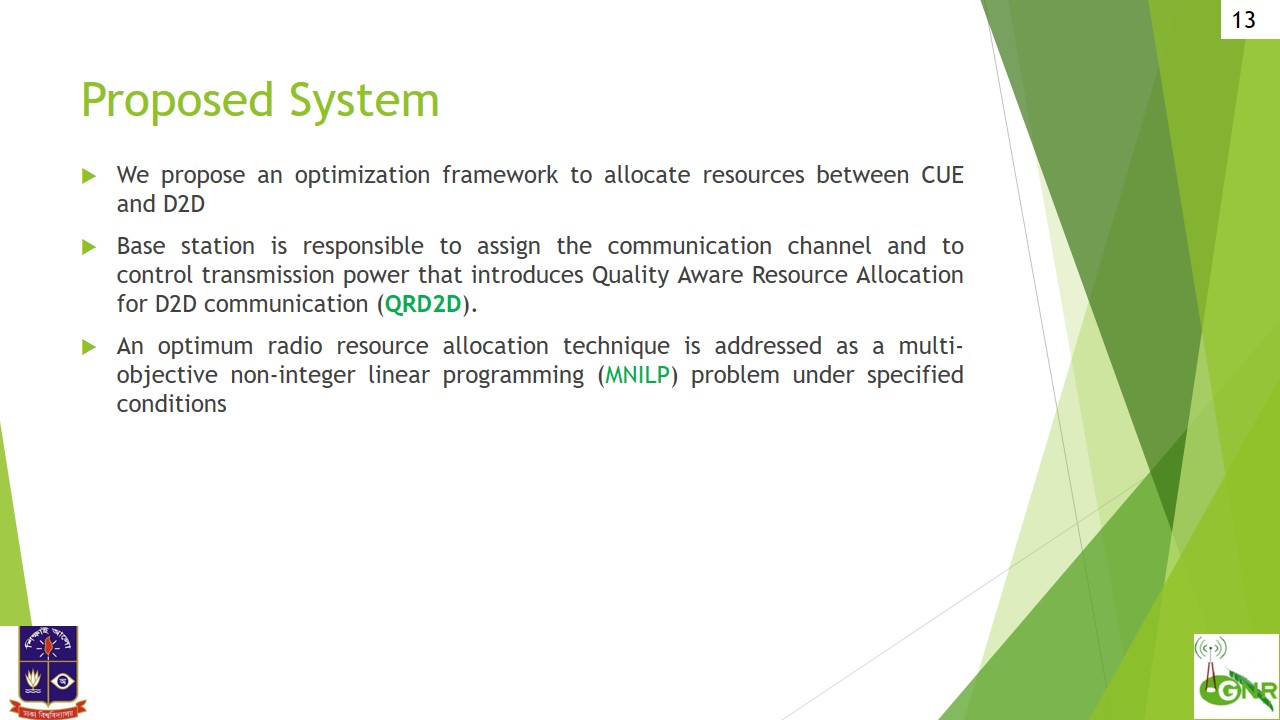 |
In this paper, we consider two layer network architecture that combines NB-IoT devices (D2D), cellular users (CUE) and NB-IoT base station (eNB). The network model considers the case of a smart where D2Ds are required to convey urgently important data while timely relevant data exchanges take places with other devices close to the coverage region.
|
|
ICACT20230133 Slide.12
[Big slide for presentation]
[YouTube] |
Chrome Text-to-Speach Click!! |
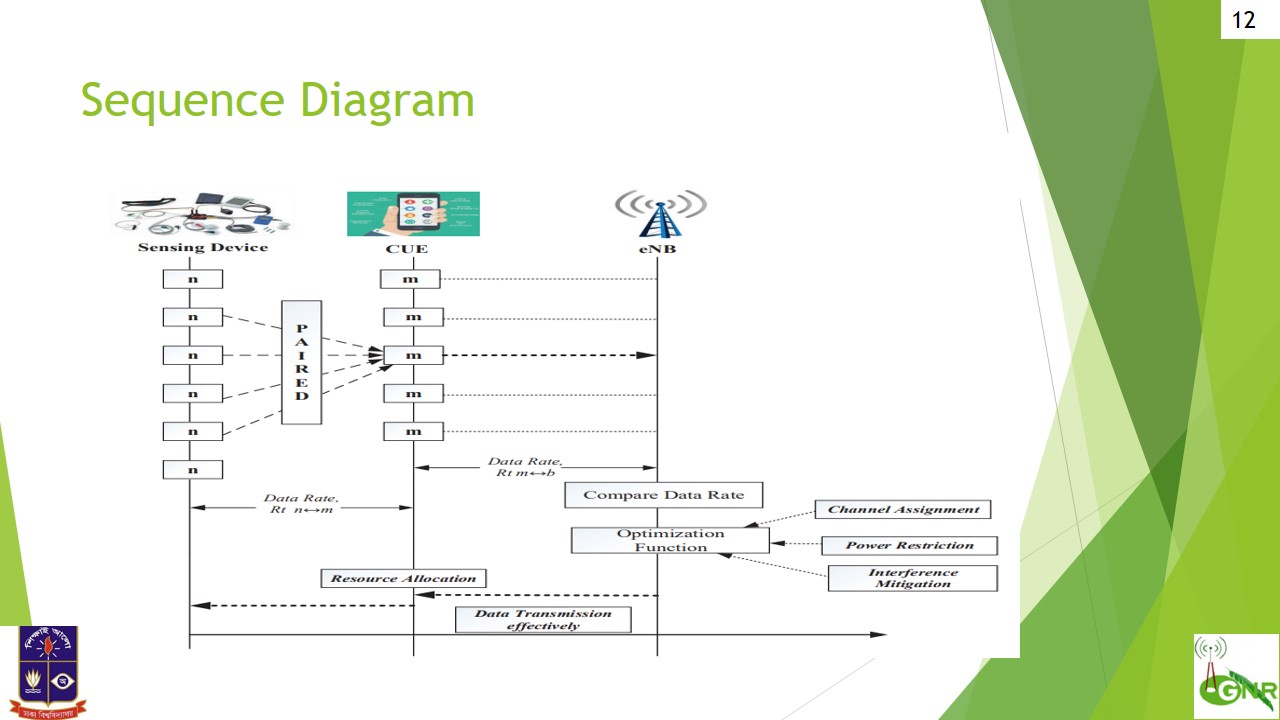 |
This paper explored how to establish an efficient heterogeneous data transmission based on event necessity from different locations of a smart using D2D NB-IoT and how to optimally allocate radio resources which is sketched in this figure.
|
|
ICACT20230133 Slide.11
[Big slide for presentation]
[YouTube] |
Chrome Text-to-Speach Click!! |
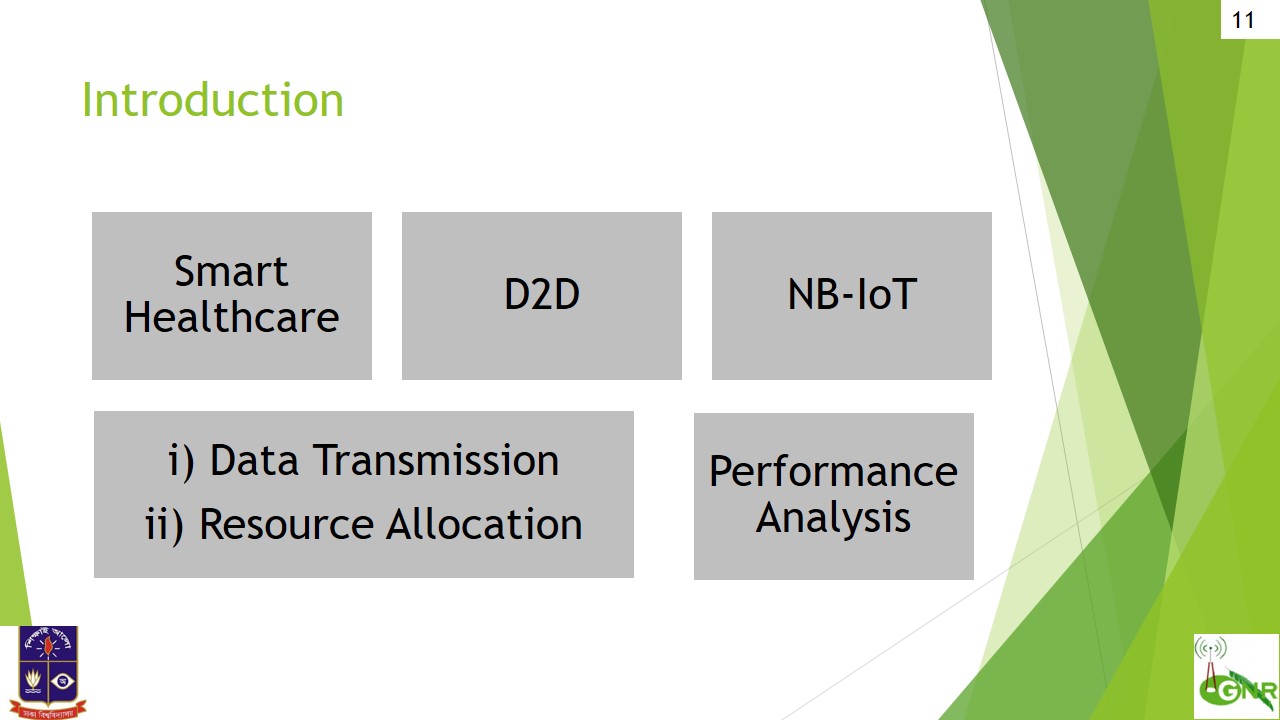 |
In our paper, at first we introduce NB-IoT. Then how D2D integrated NB-IoT is more suitable for Smart Healthcare and propose an optimum resource allocation for D2D based Smart healthcare using NB-IoT technology and finally analyze the performance of the system using NS-3.
|
|
ICACT20230133 Slide.10
[Big slide for presentation]
[YouTube] |
Chrome Text-to-Speach Click!! |
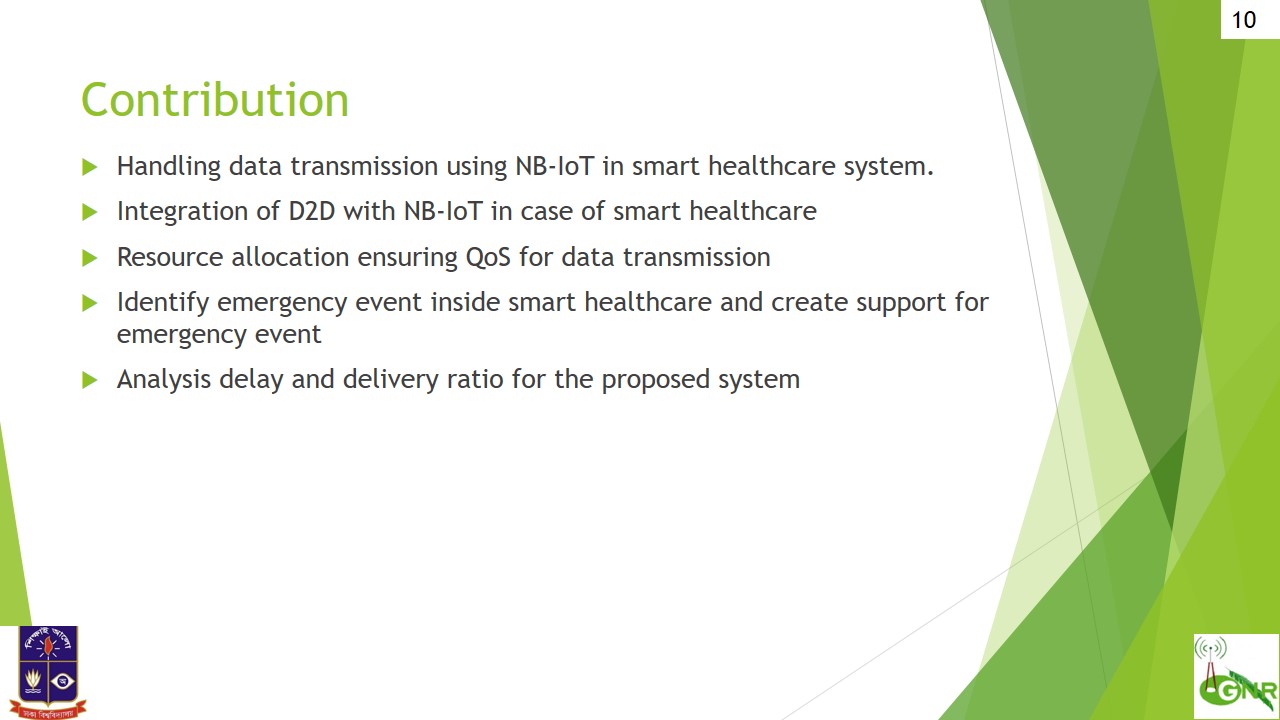 |
Here are the contributions of this paper where ,we investigate the use of Device to Device (D2D) integrated NBIoT to ensure the Quality of service (QoS) while allocating radio resources to maximize the data rate of an application’s urgency in smart healthcare.
|
|
ICACT20230133 Slide.09
[Big slide for presentation]
[YouTube] |
Chrome Text-to-Speach Click!! |
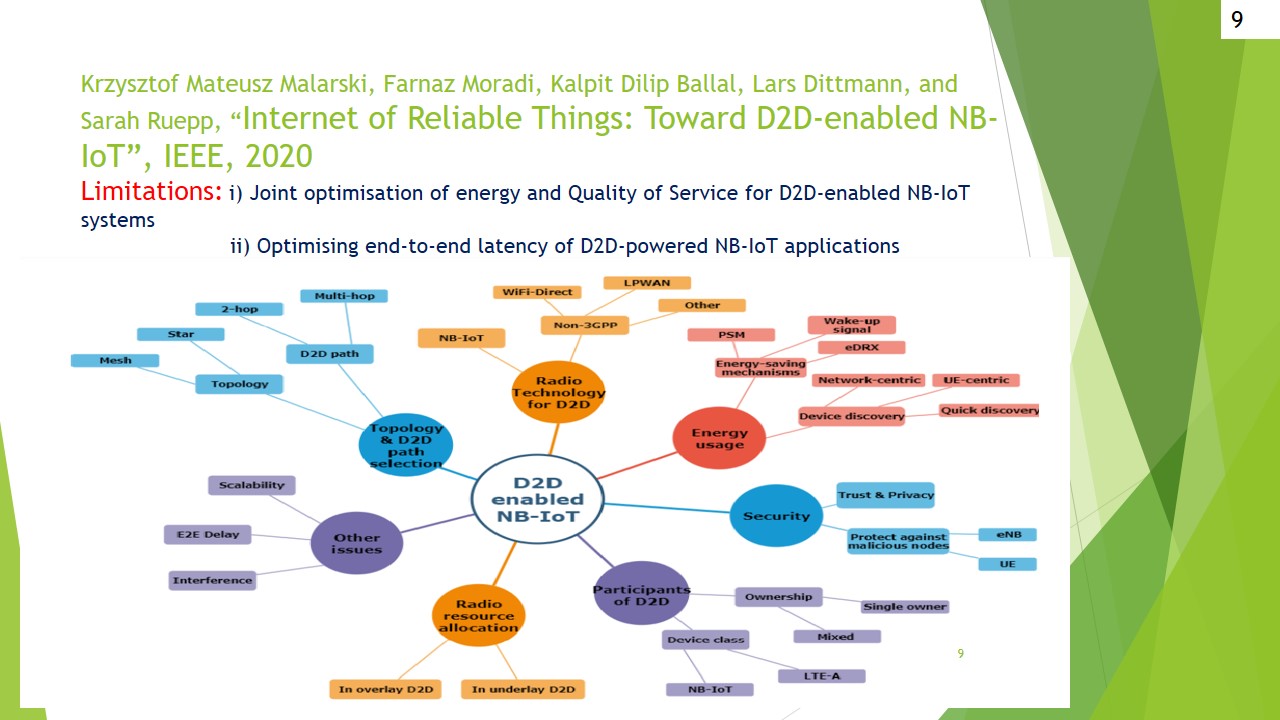 |
Next paper, signifies D2D communication which are used in the scope of NB-IoT to alleviate the issue of significant battery drains during low power, long range communication. The ideal resource allocation algorithms for underlay and overlay D2D communication as well as the future direction of E2E latency for D2D powered NB-IoT applications were defined in this paper.
|
|
ICACT20230133 Slide.08
[Big slide for presentation]
[YouTube] |
Chrome Text-to-Speach Click!! |
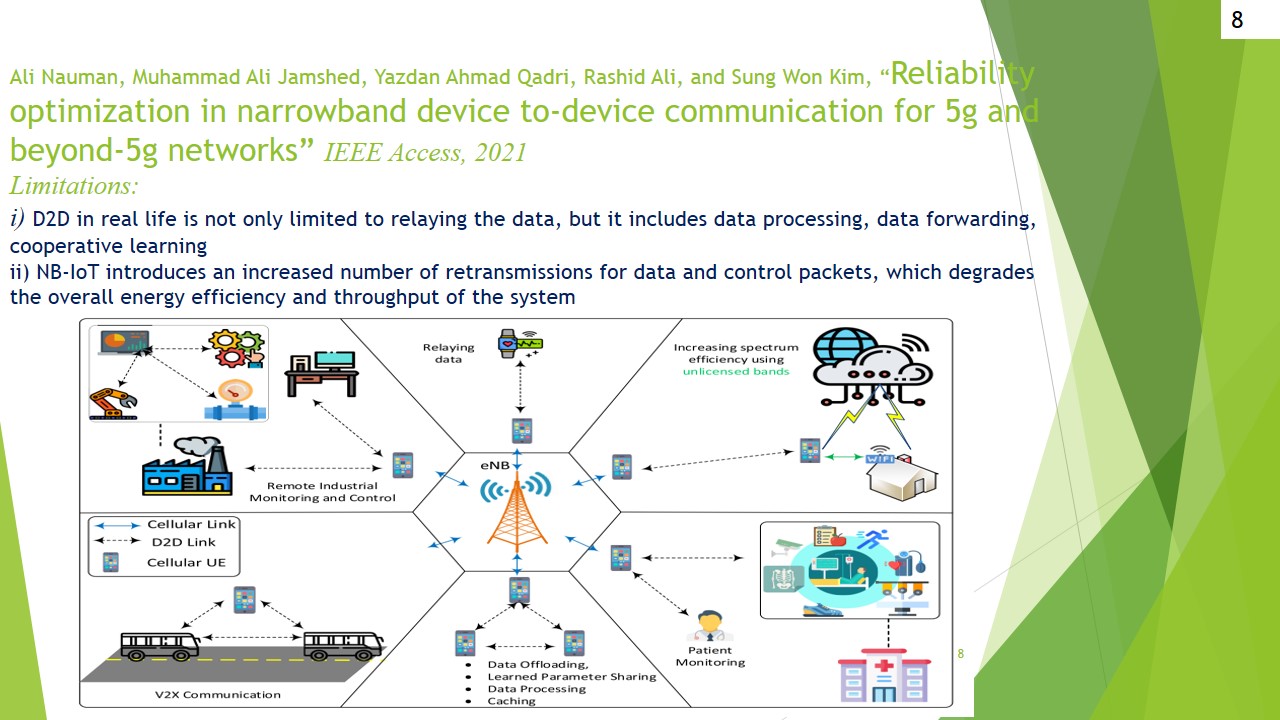 |
Now, I am going to discuss, how the existing studies have worked on this problem as a part. A part of our problem has been discussed in this paper.
D2D communication for NB-IoT delay sensitive applications are investigated to obtain higher end to end delivery ratio. Two limitations are also described in the slide.
|
|
ICACT20230133 Slide.07
[Big slide for presentation]
[YouTube] |
Chrome Text-to-Speach Click!! |
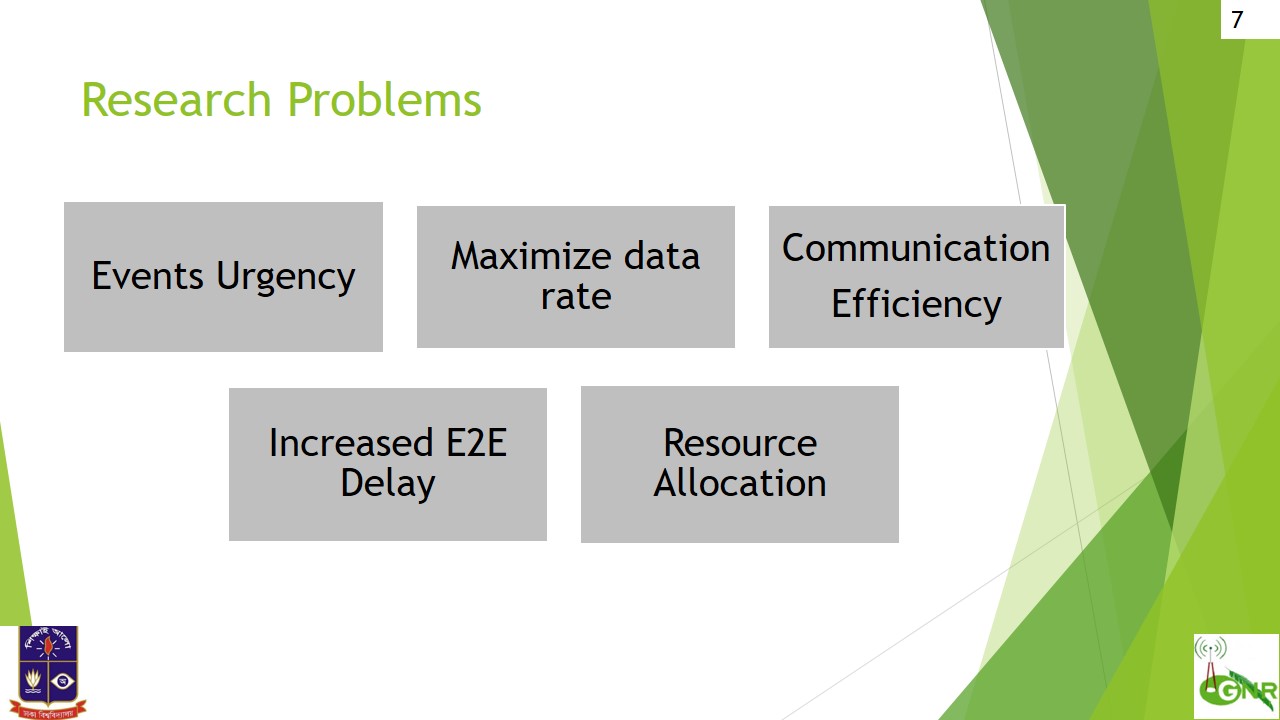 |
So, finally we define events urgency as the major research problem in smart healthcare environment and consequently communication efficiency, increased end to end delay and resource allocation.
|
|
ICACT20230133 Slide.06
[Big slide for presentation]
[YouTube] |
Chrome Text-to-Speach Click!! |
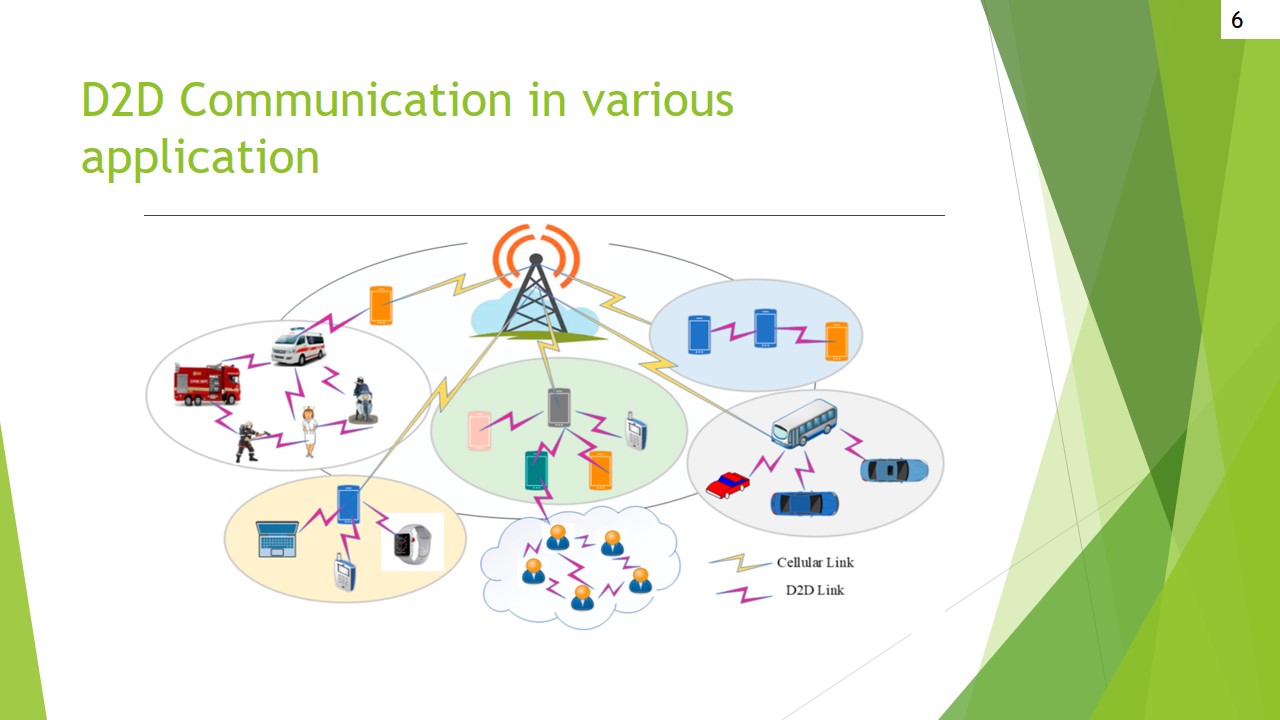 |
Device to Device communication can be applied in various application due to its unique characteristics.
|
|
ICACT20230133 Slide.05
[Big slide for presentation]
[YouTube] |
Chrome Text-to-Speach Click!! |
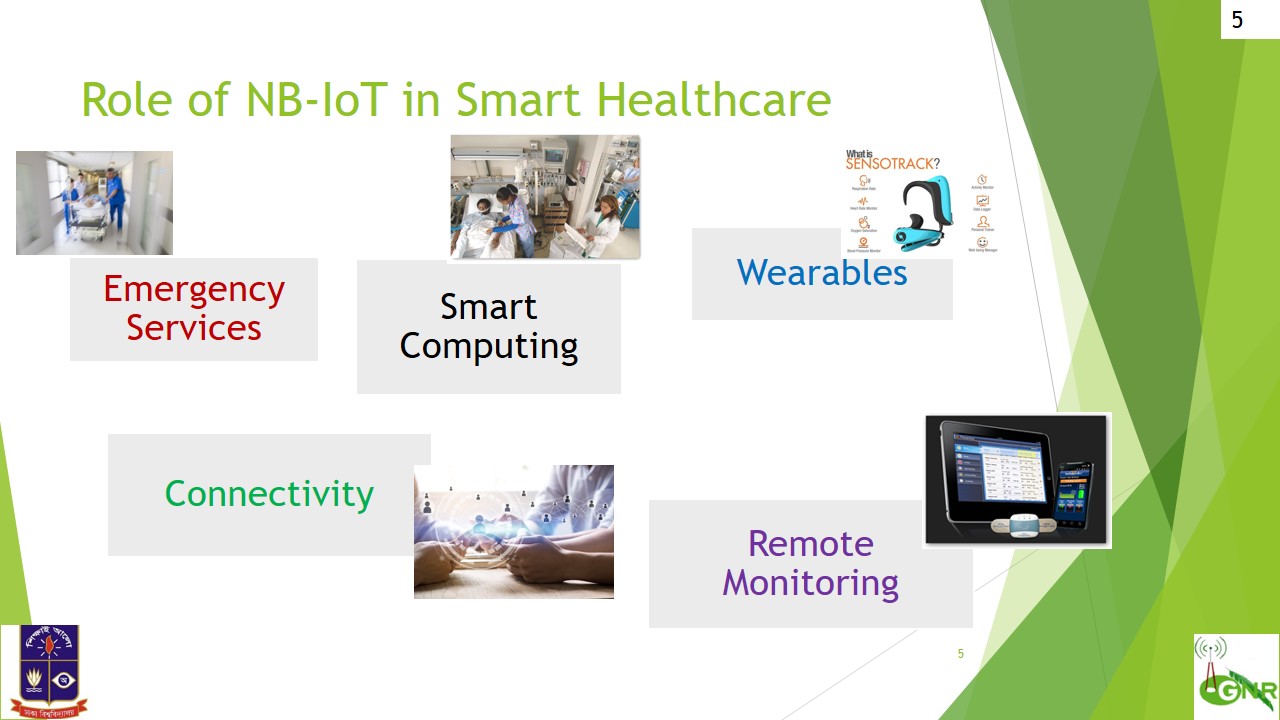 |
This slide is representing some roles and applications of NB-IoT in smart healthcare like emergency services, smart computing, remote monitoring etc.
|
|
ICACT20230133 Slide.04
[Big slide for presentation]
[YouTube] |
Chrome Text-to-Speach Click!! |
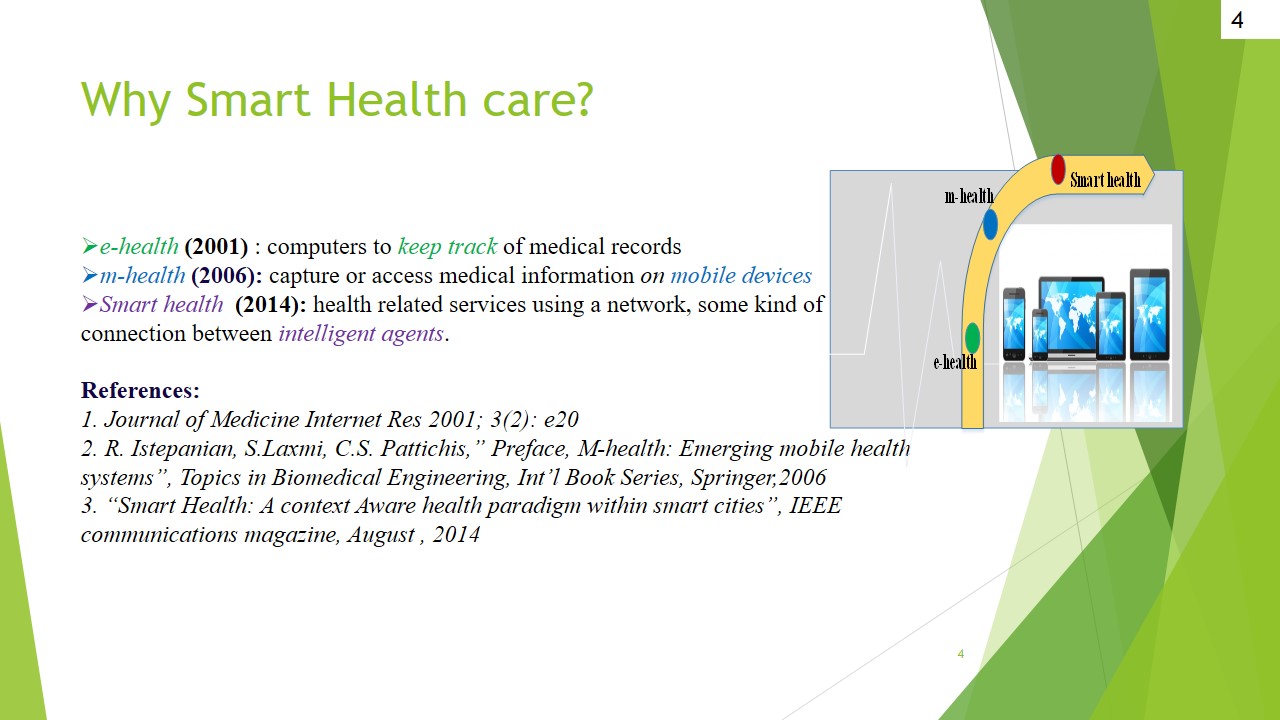 |
Now we are going to approach why smart healthcare is necessary to integrate patients and doctors onto a common platform for intelligent monitoring by analyzing. It was a huge transition research turns from WSN to IoT, which impacts on agriculture, sector, grid computing etc. Smart is the provision of services will have to overcome a number of challenges in to be a reality..
|
|
ICACT20230133 Slide.03
[Big slide for presentation]
[YouTube] |
Chrome Text-to-Speach Click!! |
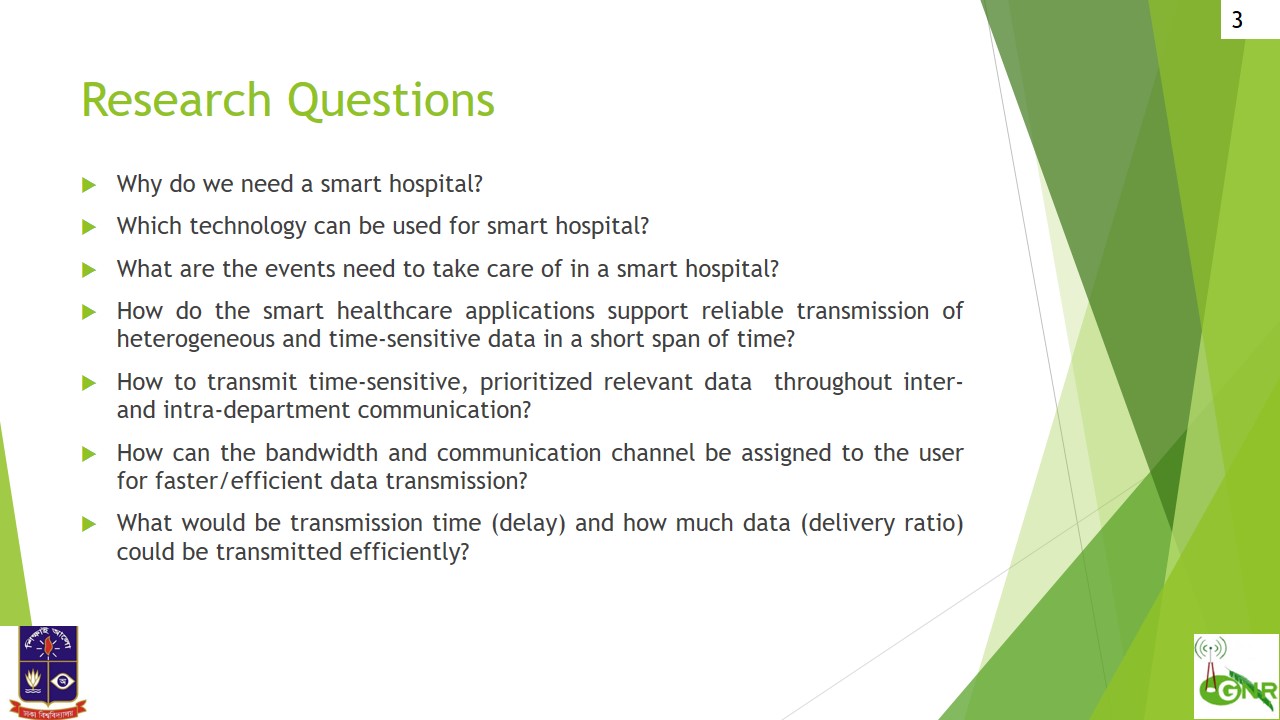 |
After studying all those, we realize that real time classification for diseases and diagnosis and proper communication with appropriate authority within a short period of time is challenging. Our research focus is to ensure fast and reliable data delivery in healthcare environment. To meet that reason, we develop some research questions. They are presented in this slide.
|
|
ICACT20230133 Slide.02
[Big slide for presentation]
[YouTube] |
Chrome Text-to-Speach Click!! |
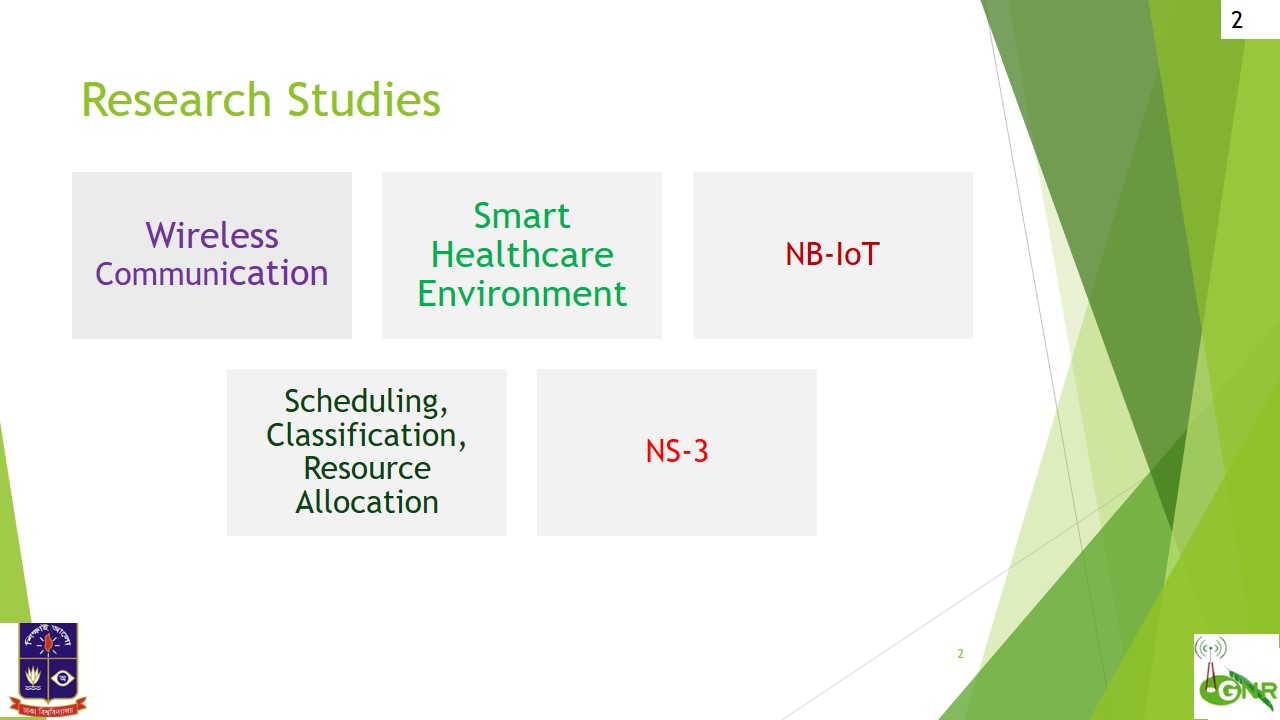 |
So far I have studied on these topics which are related to my research area, i.e. wireless communication, smart healthcare environment, NB-IoT and so on. After that, to make deep analysis on scheduling, classification and resource allocation. To simulate the system studied about NS-3.
|
|
ICACT20230133 Slide.01
[Big slide for presentation]
[YouTube] |
Chrome Text-to-Speach Click!! |
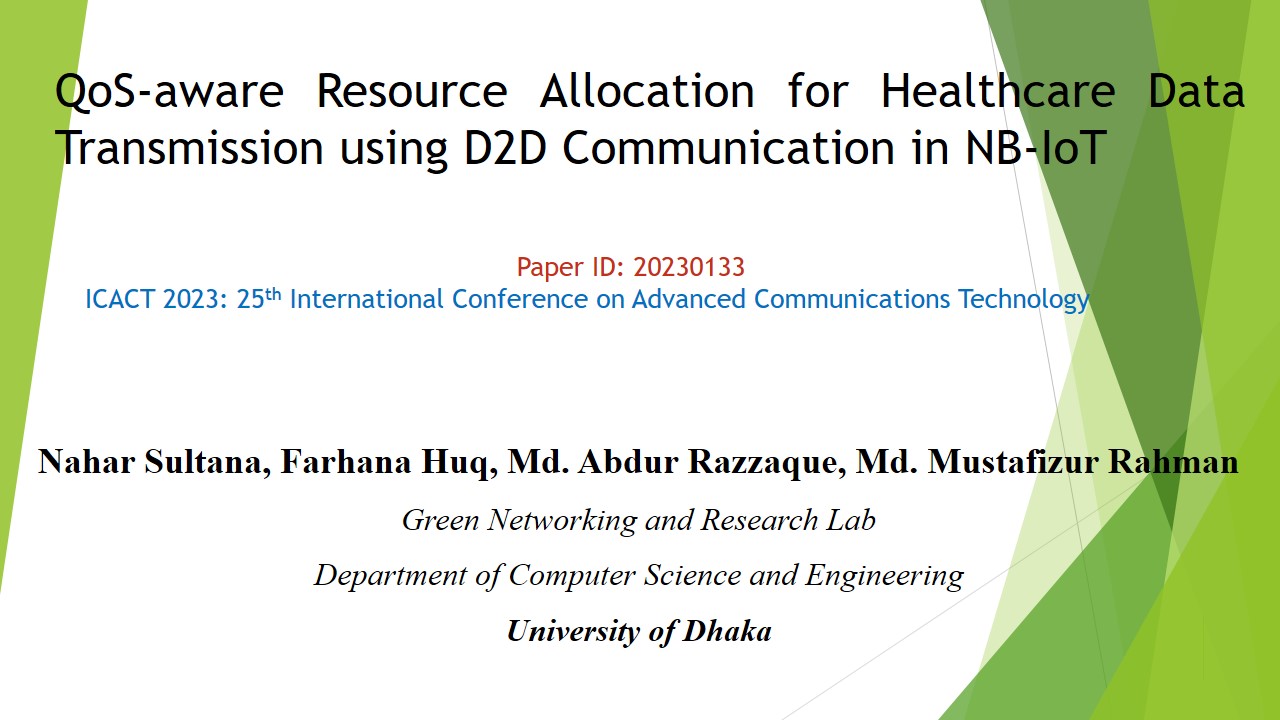 |
Hello everyone, I am Nahar Sultana, Ph.D student from of Dhaka, Bangladesh. Thank you ICACT organizing committee for giving such a platform to present my work.
|
















