 ICACT20230135 Slide.17
[Big slide for presentation]
[YouTube] |
Chrome Text-to-Speach Click!! |
 |
Thanks for your attention! Now! Welcome any comment or question.
|
|
ICACT20230135 Slide.16
[Big slide for presentation]
[YouTube] |
Chrome Text-to-Speach Click!! |
 |
And finally, the conclusion. we propose a fuze jamming signal detector based on time-frequency analysis and convolutional neural network (TFA-CNN). First, the original jammed fuze signal is converted into a time-frequency image by pre-processing, and the jamming signal features can be extracted in the time and frequency domains jointly. Then, the time-frequency image is input to the TFA-CNN detector for jamming signal recognition. Simulation results have shown that the proposed detector can achieve excellent recognition accuracy in both low and high SINR regions. Moreover, the proposed detector outperforms the existing TFI-CNN, LeNet, and DNN detectors and achieves a better balance between recognition accuracy and model complexity.
|
|
ICACT20230135 Slide.15
[Big slide for presentation]
[YouTube] |
Chrome Text-to-Speach Click!! |
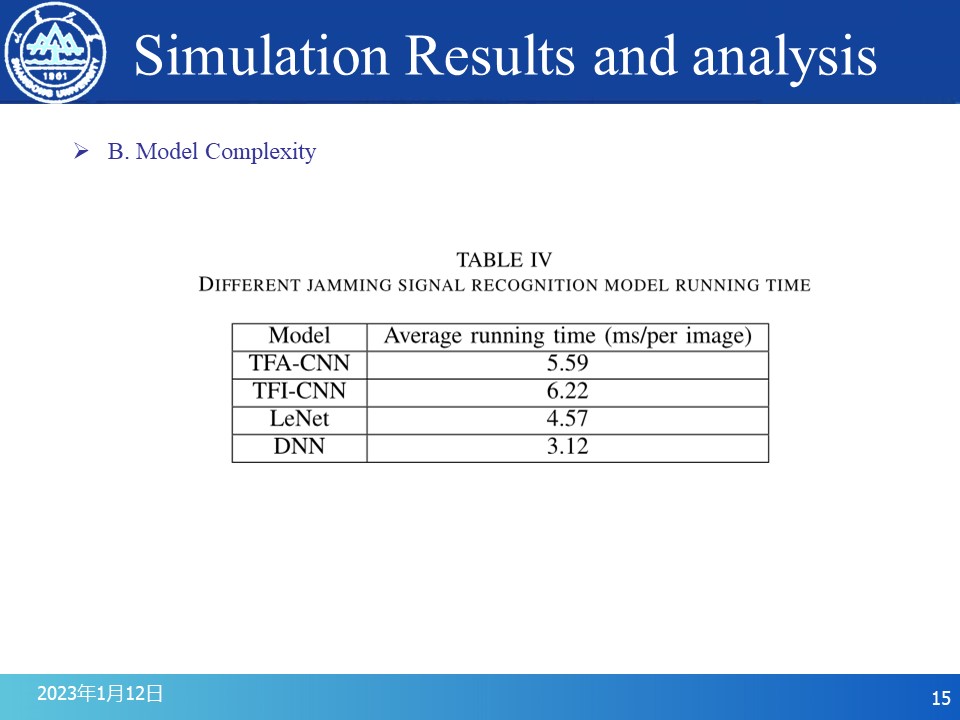 |
To give a comprehensive comparison based on the analysis of the recognition performance of the proposed detector, we also further analyzed the complexity of the proposed and existing detectors. It is described in TABLE IV regarding the complexity of the proposed and existing detectors. Here, the running time is chosen to measure the complexity, and 500 images from the test dataset are randomly selected for testing. We can see from TABLE IV that the TFA-CNN detector has a shorter running time than the TFI-CNN detector. Although the running time of the LeNet and DNN detectors is slightly shorter than that of the TFA-CNN detector, their recognition accuracy is obviously poor.
|
|
ICACT20230135 Slide.14
[Big slide for presentation]
[YouTube] |
Chrome Text-to-Speach Click!! |
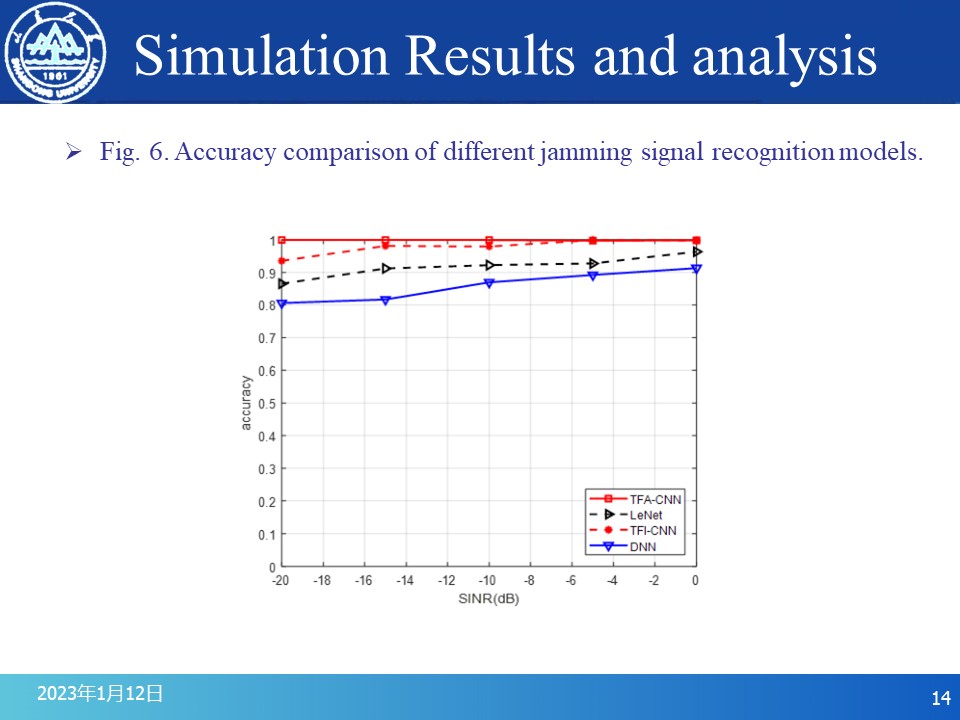 |
Fig. 6 demonstrates the recognition performance of the proposed TFA-CNN and typical LeNet, TFI-CNN, and DNN detectors. It is noticed that the recognition accuracy of the proposed TFA-CNN detector is obviously better than that of the other detectors, especially in the low SINR region. For 15(fifteen) jamming types, the TFA-CNN detector can achieve an average recognition accuracy of 99.8%(ninety-nine point eight percent) in all the SINR regions. The average recognition accuracy of the DNN detector gets the lowest since the DNN detector mainly performs global feature extraction at each layer during the training process and does not consider the structural characteristics of the images. In contrast, the CNN detector considers the contextual information of the features within each convolution, and the integration of features occurs slowly and orderly. Therefore, the CNN detector achieves an advantage over the DNN detector in image processing. The LeNet and TFI-CNN detectors perform poorly in the low SINR region because the structure of these two detectors is not sufficient to learn the features of all jamming signals, which degrades the average recognition accuracy.
|
|
ICACT20230135 Slide.13
[Big slide for presentation]
[YouTube] |
Chrome Text-to-Speach Click!! |
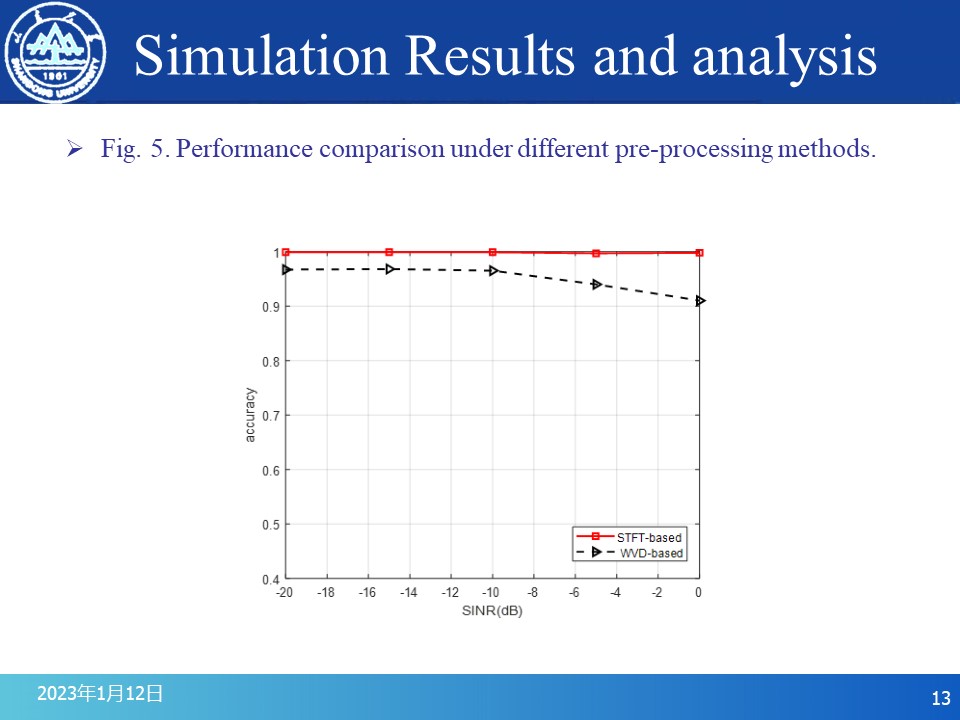 |
The recognition performance the proposed STFT-based and conventional Wigner-Ville distribution-based (WVD-based) methods is illustrated in Fig. 5. We can see that the recognition accuracy by STFT preprocessing is significantly higher than that of WVD preprocessing because the cross-term interference occurs inevitably in WVD, leading to a low recognition accuracy. In particular, the cross-term interference is more severe in the high SINR region, which causes a decrease in the recognition accuracy.
|
|
ICACT20230135 Slide.12
[Big slide for presentation]
[YouTube] |
Chrome Text-to-Speach Click!! |
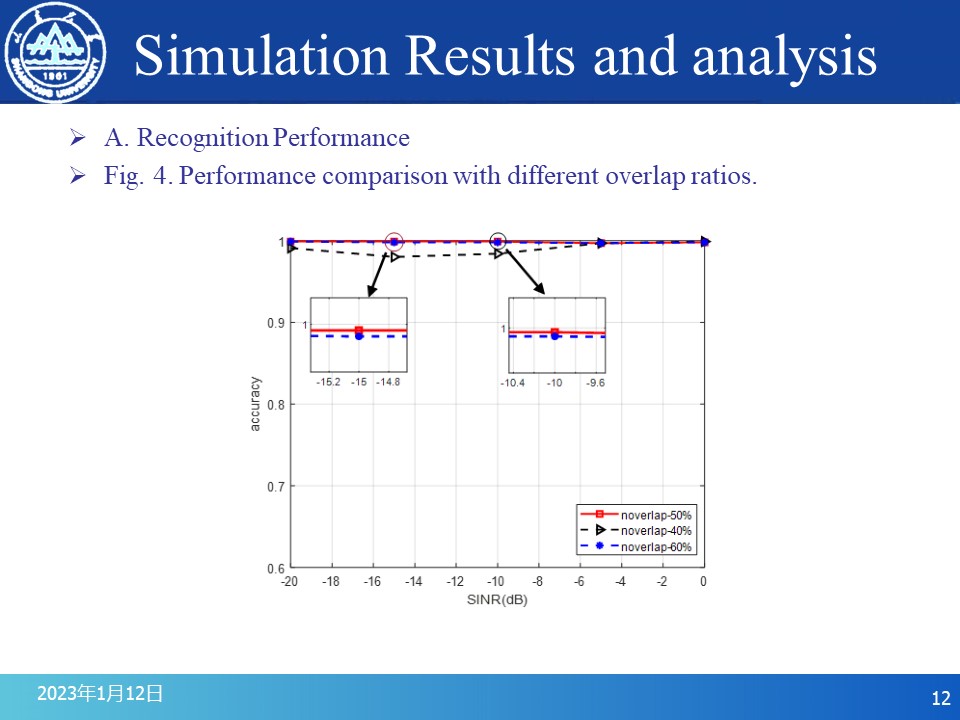 |
Next is the simulation results and analysis. The recognition performance of the TFA-CNN detector considering the trained dataset with different overlap ratio is shown in Fig. 4. It is observed that the accuracy of the proposed model achieves the highest when the overlap ratio is about 50%(fifty percent). Meanwhile, the recognition performance becomes the worst with a 40% overlap ratio. This phenomenon happens since the time and frequency domain resolutions after STFT pre-processing cannot be achieved simultaneously. Moreover, the overlap ratio affects the quality of the generated images, influencing the model performance directly. In order to achieve a balance between the time and frequency domain resolutions of the generated images and the model recognition performance, we choose the overlap ratio as 50%.
|
|
ICACT20230135 Slide.11
[Big slide for presentation]
[YouTube] |
Chrome Text-to-Speach Click!! |
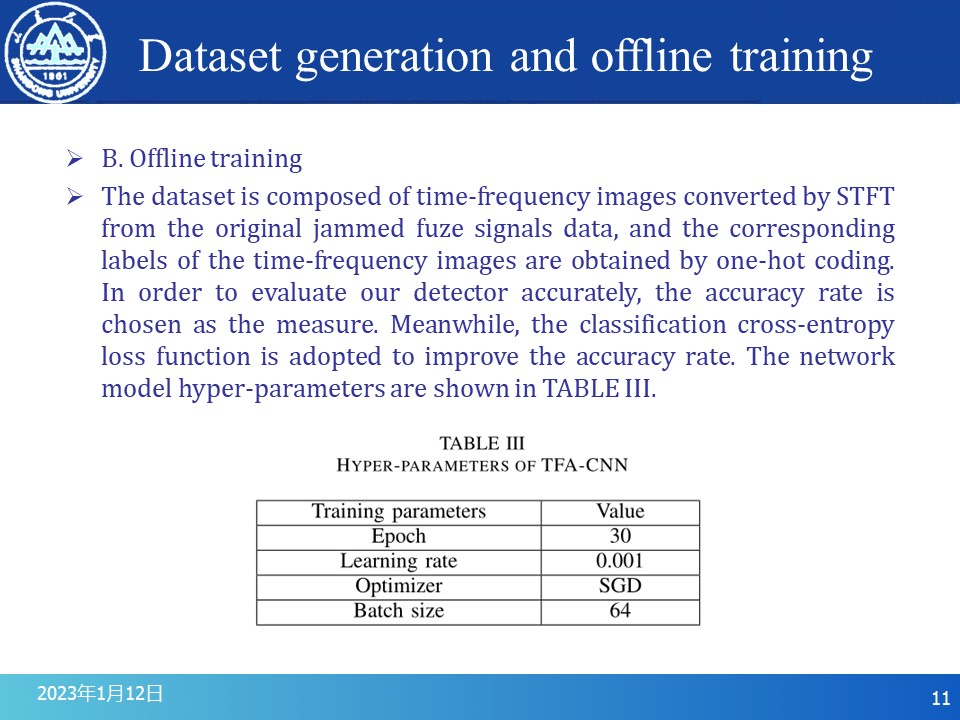 |
The corresponding labels of the time-frequency images are obtained by one-hot coding. In order to evaluate our detector accurately, the accuracy rate is chosen as the measure. Meanwhile, the classification cross-entropy loss function is adopted to improve the accuracy rate. The network model hyper-parameters are shown in TABLE III.
|
|
ICACT20230135 Slide.10
[Big slide for presentation]
[YouTube] |
Chrome Text-to-Speach Click!! |
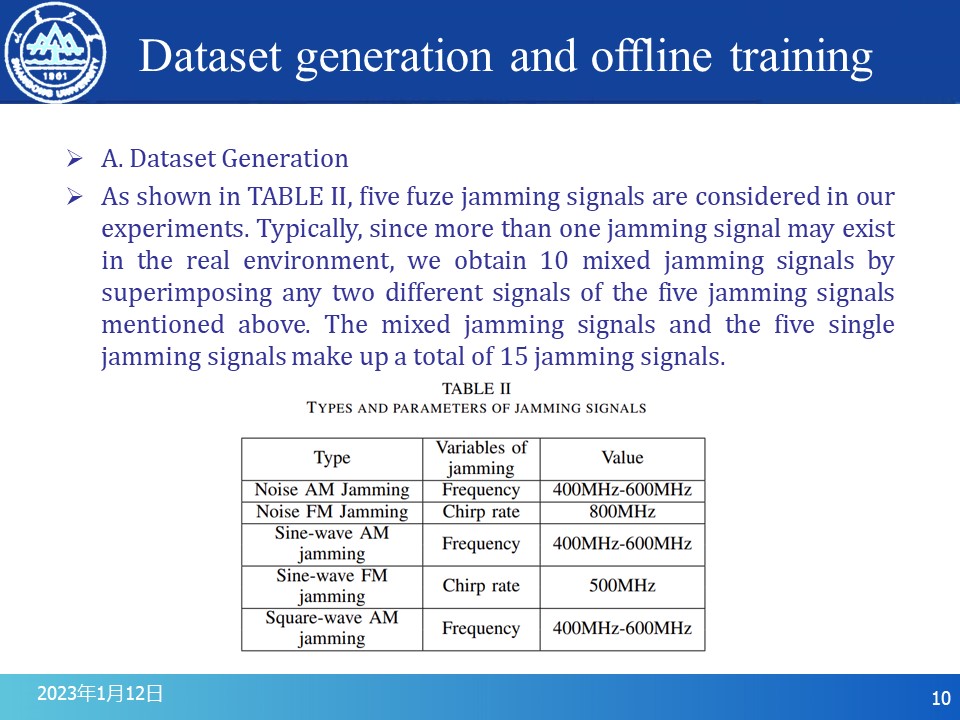 |
The next part is the dataset generation and offline training. As shown in TABLE II, five fuze jamming signals are considered in our experiments. Typically, since more than one jamming signal may exist in the real environment, we obtain 10 mixed jamming signals by superimposing any two different signals of the five jamming signals mentioned above. The mixed jamming signals and the five single jamming signals make up a total of 15 jamming signals.
|
|
ICACT20230135 Slide.09
[Big slide for presentation]
[YouTube] |
Chrome Text-to-Speach Click!! |
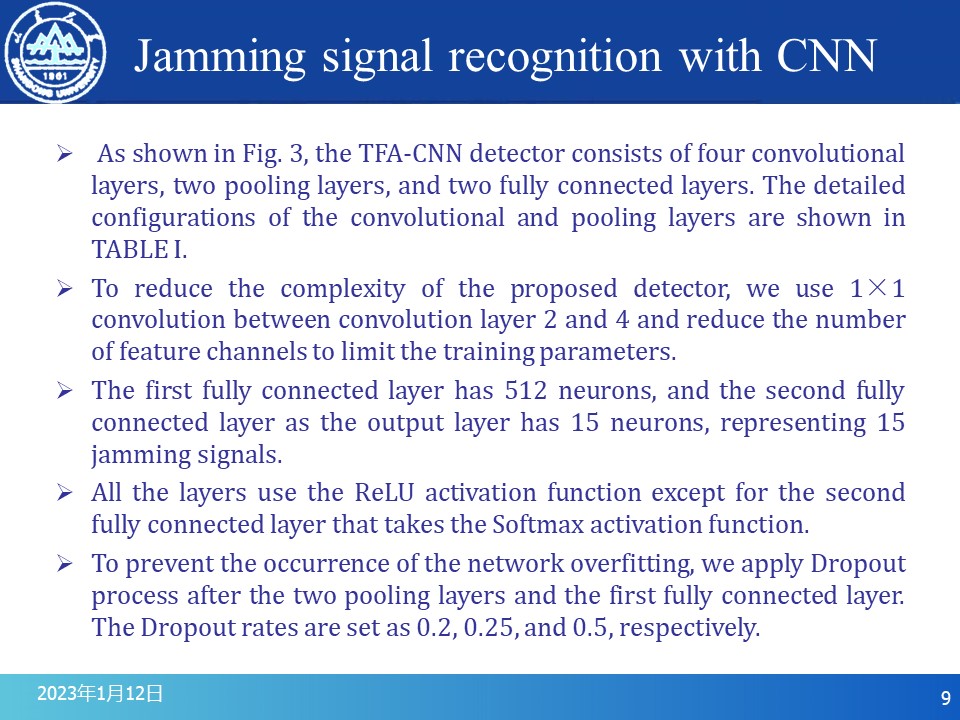 |
To reduce the complexity of the proposed detector, we use 1×1 convolution between convolution layer 2 and 4 and reduce the number of feature channels to limit the training parameters. The first fully connected layer has 512 neurons, and the second fully connected layer as the output layer has 15(fifteen) neurons, representing 15 jamming signals. All the layers use the ReLU activation function except for the second fully connected layer that takes the Softmax activation function. To prevent the occurrence of the network overfitting, we apply Dropout process after the two pooling layers and the first fully connected layer. The Dropout rates are set as 0.2, 0.25(zero point two five), and 0.5, respectively.
|
|
ICACT20230135 Slide.08
[Big slide for presentation]
[YouTube] |
Chrome Text-to-Speach Click!! |
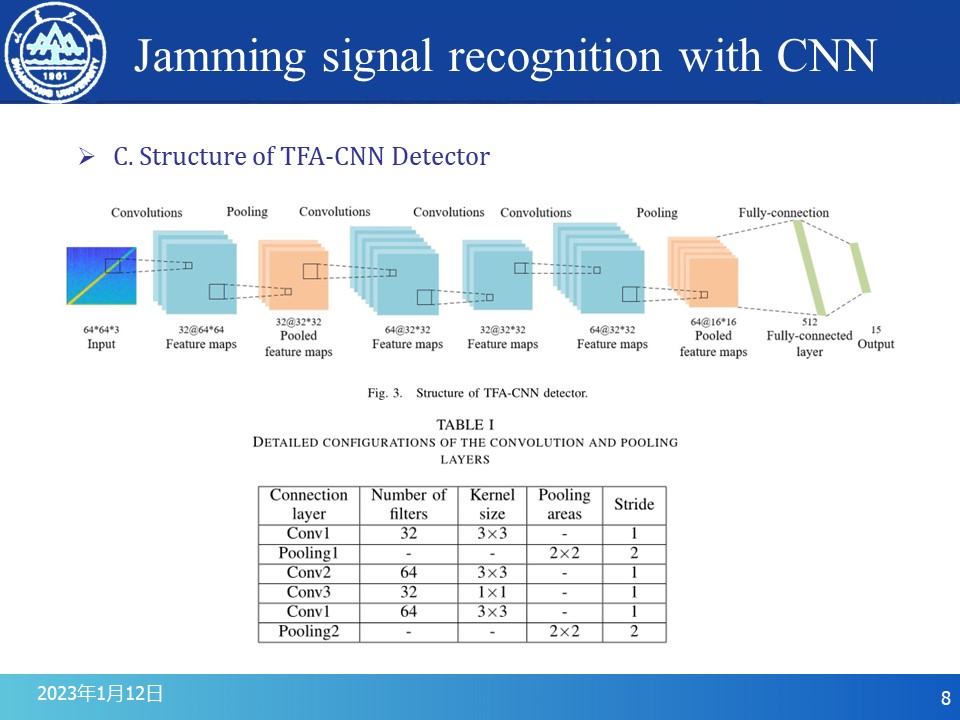 |
The figure shows the structure of the TFA-CNN detector. The TFA-CNN detector consists of four convolutional layers, two pooling layers, and two fully connected layers. The detailed configurations of the convolutional and pooling layers are shown in TABLE I.
|
|
ICACT20230135 Slide.07
[Big slide for presentation]
[YouTube] |
Chrome Text-to-Speach Click!! |
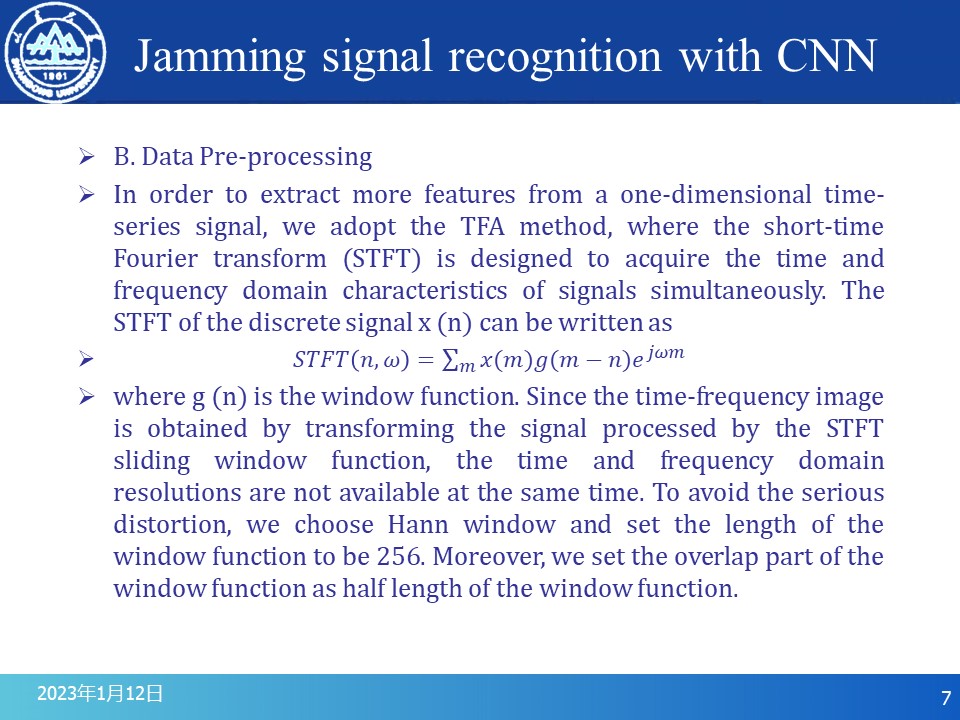 |
Next is data pre-processing. In order to extract more features from a one-dimensional time-series signal, we adopt the TFA method, where the short-time Fourier transform (STFT) is designed to acquire the time and frequency domain characteristics of signals simultaneously. The STFT of the discrete signal x (n) can be written as this. where g (n) is the window function. Since the time-frequency image is obtained by transforming the signal processed by the STFT sliding window function, the time and frequency domain resolutions are not available at the same time. To avoid the serious distortion, we choose Hann window and set the length of the window function to be 256. Moreover, we set the overlap part of the window function as half length of the window function.
|
|
ICACT20230135 Slide.06
[Big slide for presentation]
[YouTube] |
Chrome Text-to-Speach Click!! |
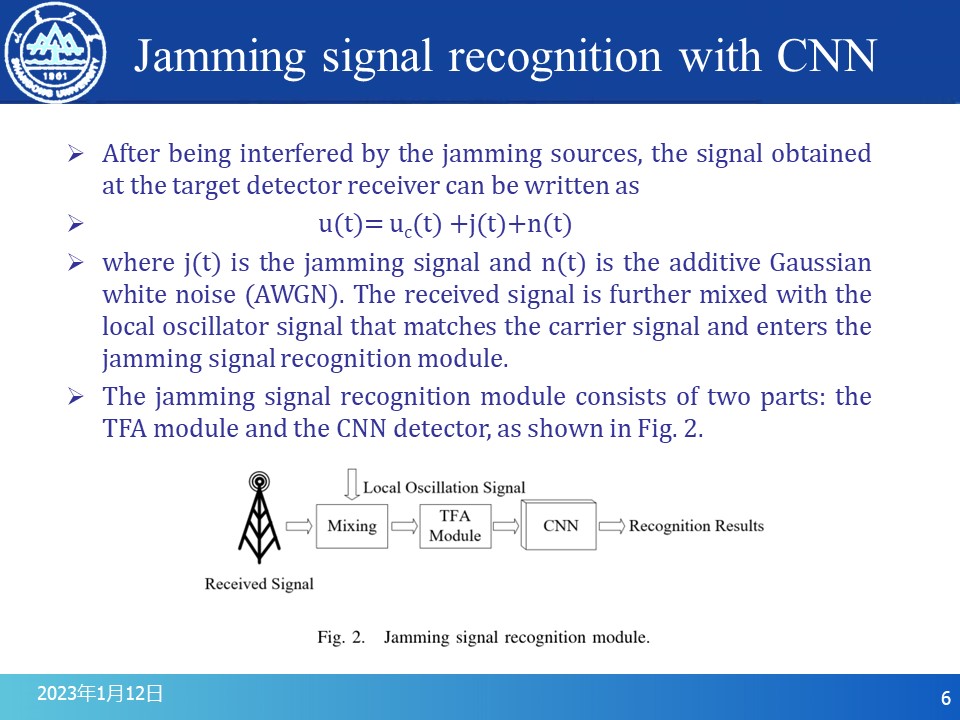 |
After being interfered by the jamming sources, the signal obtained at the target detector receiver can be written as this. where j(t) is the jamming signal and n(t) is the additive Gaussian white noise (AWGN). From this figure we can see the process of fuze jamming signal recognition. The received signal is further mixed with the local oscillator signal that matches the carrier signal and enters the jamming signal recognition module. The jamming signal recognition module consists of two parts: the TFA module and the CNN detector. The TFA module converts jamming signals into time-frequency images. The CNN detector extracts time-frequency images features and recognizes the jamming signals correctly.
|
|
ICACT20230135 Slide.05
[Big slide for presentation]
[YouTube] |
Chrome Text-to-Speach Click!! |
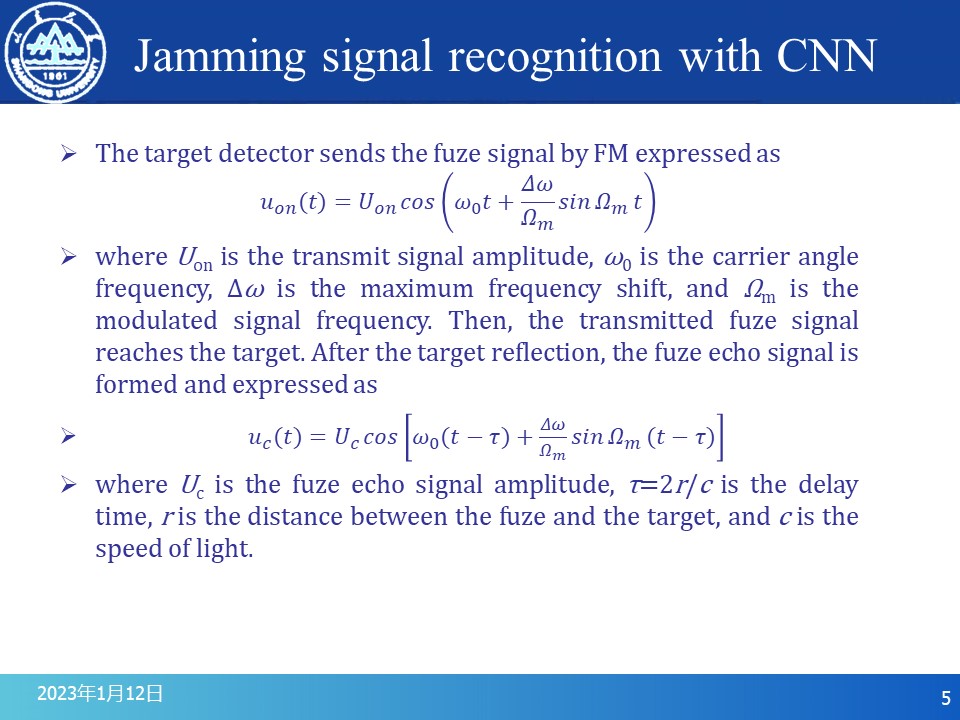 |
The target detector sends the fuze signal by FM expressed as this. where Uon is the transmit signal amplitude, ω0 is the carrier angle frequency, Δω is the maximum frequency shift, and Ωm is the modulated signal frequency. Then, the transmitted fuze signal reaches the target. After the target reflection, the fuze echo signal is formed and expressed as this. where Uc is the fuze echo signal amplitude, τ=2r/c is the delay time, r is the distance between the fuze and the target, and c is the speed of light.
|
|
ICACT20230135 Slide.04
[Big slide for presentation]
[YouTube] |
Chrome Text-to-Speach Click!! |
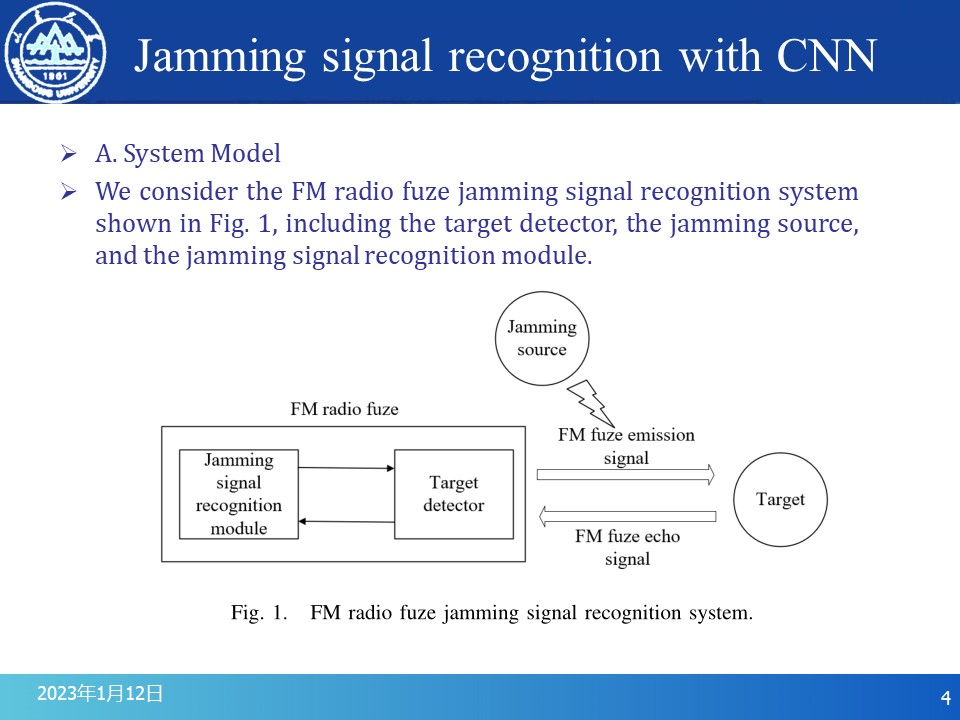 |
Next is the system model. From the figure we can see that the FM radio fuze jamming signal recognition system includes the target detector, the jamming source, and the jamming signal recognition module.
|
|
ICACT20230135 Slide.03
[Big slide for presentation]
[YouTube] |
Chrome Text-to-Speach Click!! |
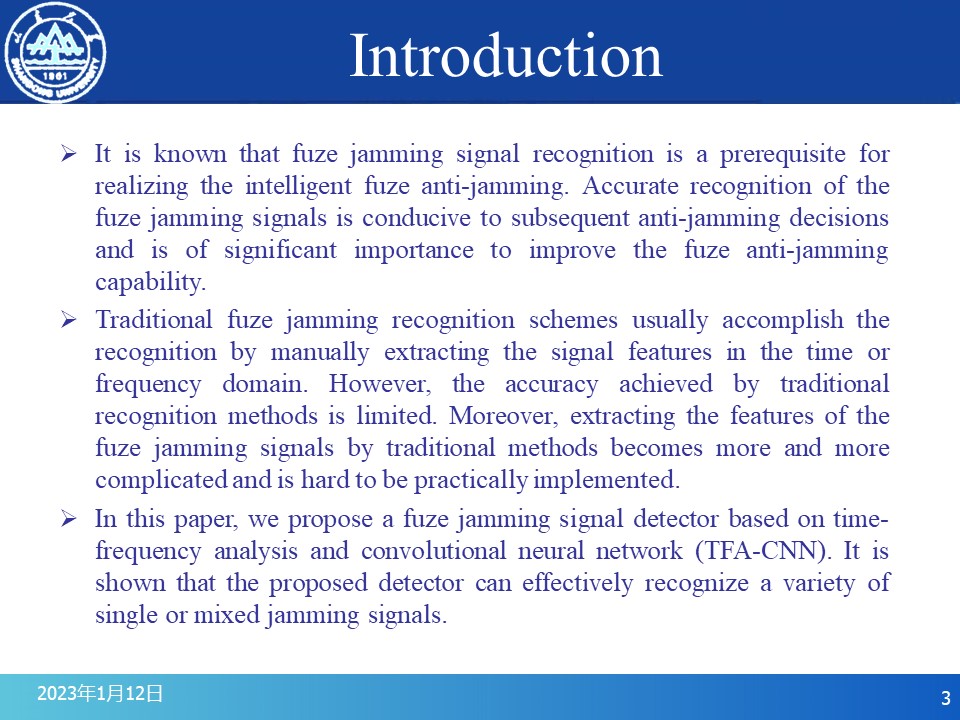 |
Fuze play an important role in electronic warfare nowadays. With the continuous development of jamming means, the development of intelligent fuze anti-jamming is imminent. Now the recognition of fuze jamming signal is the prerequisite to realize intelligent fuze anti-jamming. In order to enhance the anti-jamming ability of the fuze, first we should accurately recognize the fuze jamming signal. Traditional fuze jamming recognition schemes usually accomplish the recognition by manually extracting the signal features in the time or frequency domain. However, the accuracy achieved by traditional recognition methods is limited. Moreover, extracting the features of the fuze jamming signals by traditional methods becomes more and more complicated and is hard to be practically implemented. To address the limitations imposed by traditional methods, we propose a fuze jamming signal detector based on time-frequency analysis and convolutional neural network (TFA-CNN).
|
|
ICACT20230135 Slide.02
[Big slide for presentation]
[YouTube] |
Chrome Text-to-Speach Click!! |
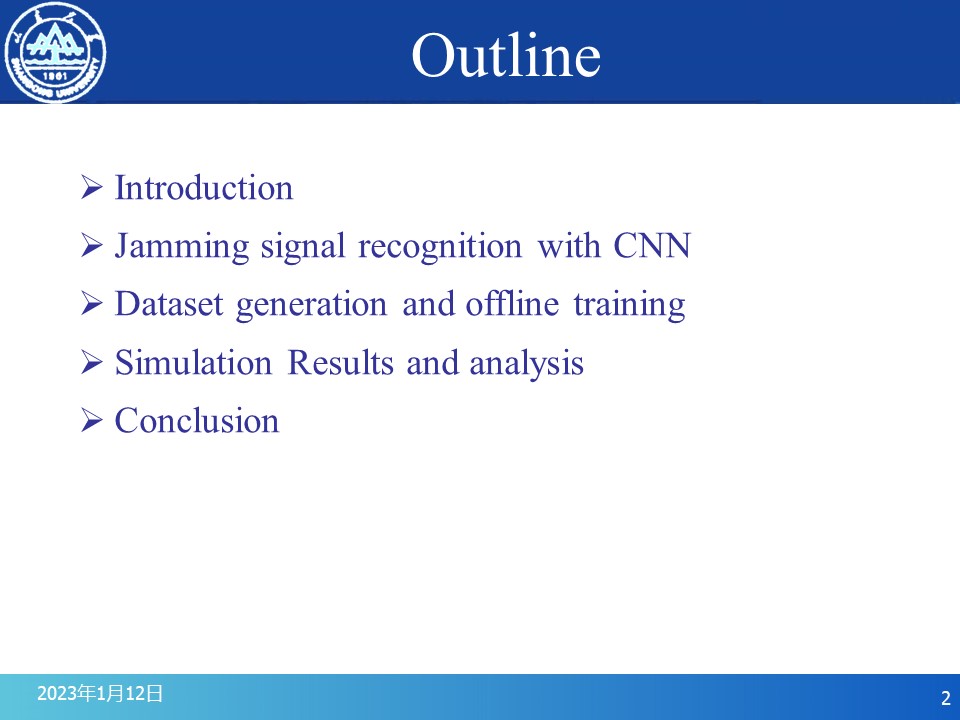 |
Next, I will explain the above five parts to you. First is the introduction, followed by jamming signal recognition with CNN, dataset generation and offline training, simulation results and analysis, and finally the conclusion.
|
|
ICACT20230135 Slide.01
[Big slide for presentation]
[YouTube] |
Chrome Text-to-Speach Click!! |
 |
Hello everyone, my name is Jikai Yang. Today my presentation is about jamming signal recognition, that we called Time-frequency Analysis and Convolutional Neural Network Based Fuze Jamming Signal Recognition.
|
















