 ICACT20210234 Slide.21
[Big slide for presentation] |
Chrome Text-to-Speach Click!! |
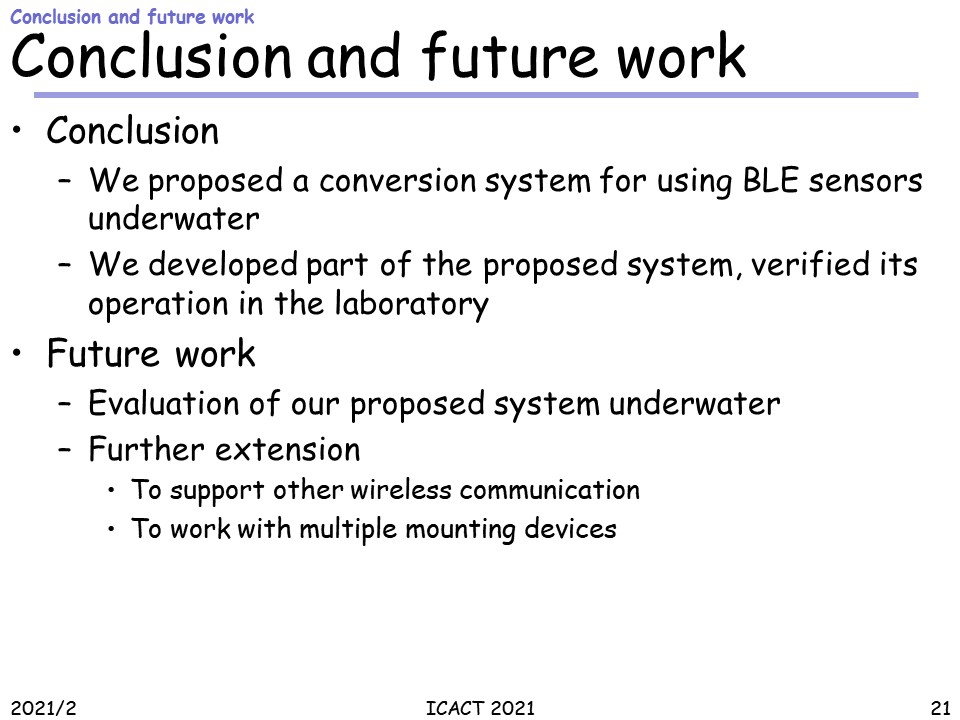 |
In this research, we proposed a conversion system for using BLE sensors underwater.
In addition, we developed part of the proposed system, verified its operation in the laboratory, and evaluated its basic communication performance.
As future work, it is necessary to evaluate our proposed system underwater.
We also plan to extend the developed system so that not only BLE but also other wireless communication methods such as Wi-Fi can be used underwater.
Furthermore, our system needs to be expanded to work with multiple mounting devices.
|
|
ICACT20210234 Slide.20
[Big slide for presentation]
|
Chrome Text-to-Speach Click!! |
 |
Now I will conclude today¡¯s presentation.
|
|
ICACT20210234 Slide.19
[Big slide for presentation]
|
Chrome Text-to-Speach Click!! |
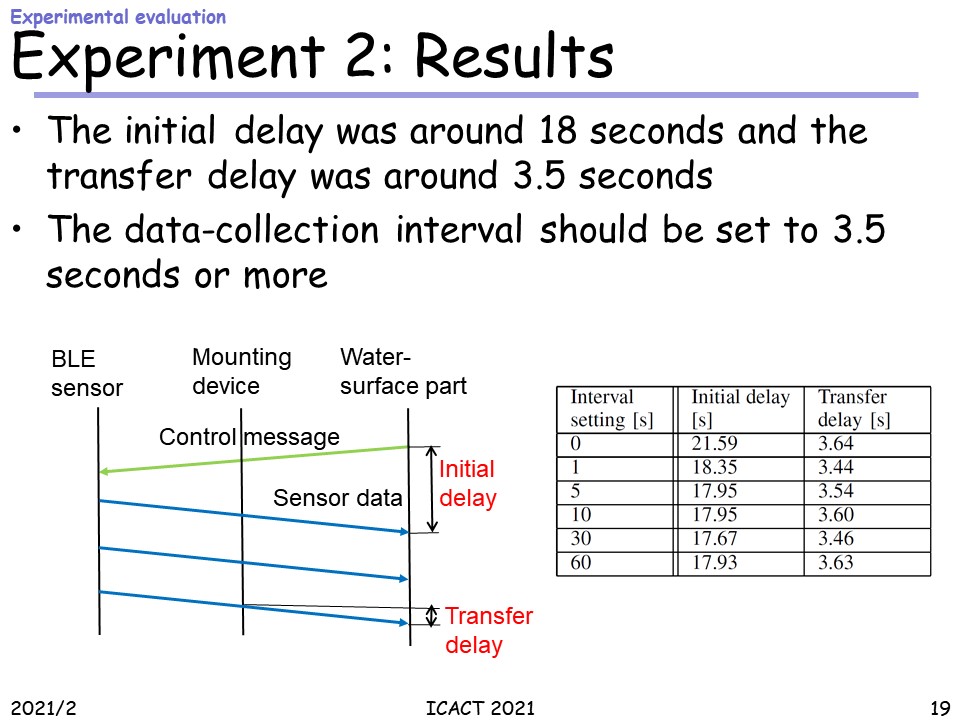 |
The results given in this table are the averages of 10 measurements.
It was confirmed that the initial delay was around 18 seconds and the transfer delay was around 3.5 seconds regardless of the interval settings.
Therefore, the data-collection interval should be set to 3.5 seconds or more.
|
|
ICACT20210234 Slide.18
[Big slide for presentation]
|
Chrome Text-to-Speach Click!! |
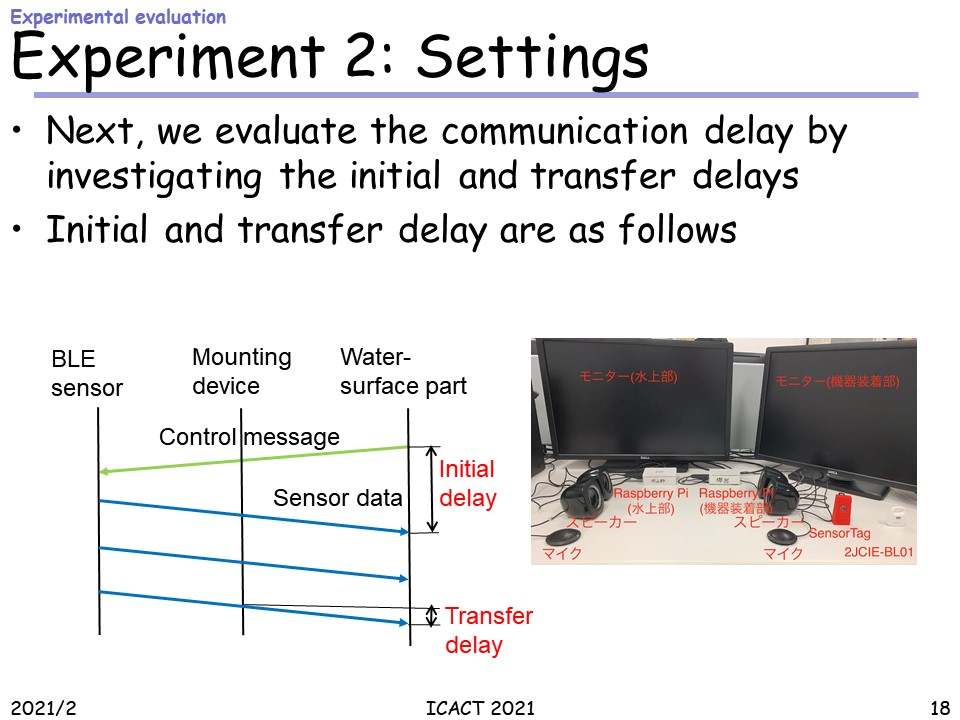 |
Next, we evaluate the communication delay by investigating the initial and transfer delays.
The initial delay is the time from when the water-surface part transmits the control message to when it receives the first item of sensor data.
The transfer delay is the time from when the mounting device receives the data from the BLE sensor to when the water-surface part receives the data.
Experiments were conducted with various data-collection intervals.
|
|
ICACT20210234 Slide.17
[Big slide for presentation]
|
Chrome Text-to-Speach Click!! |
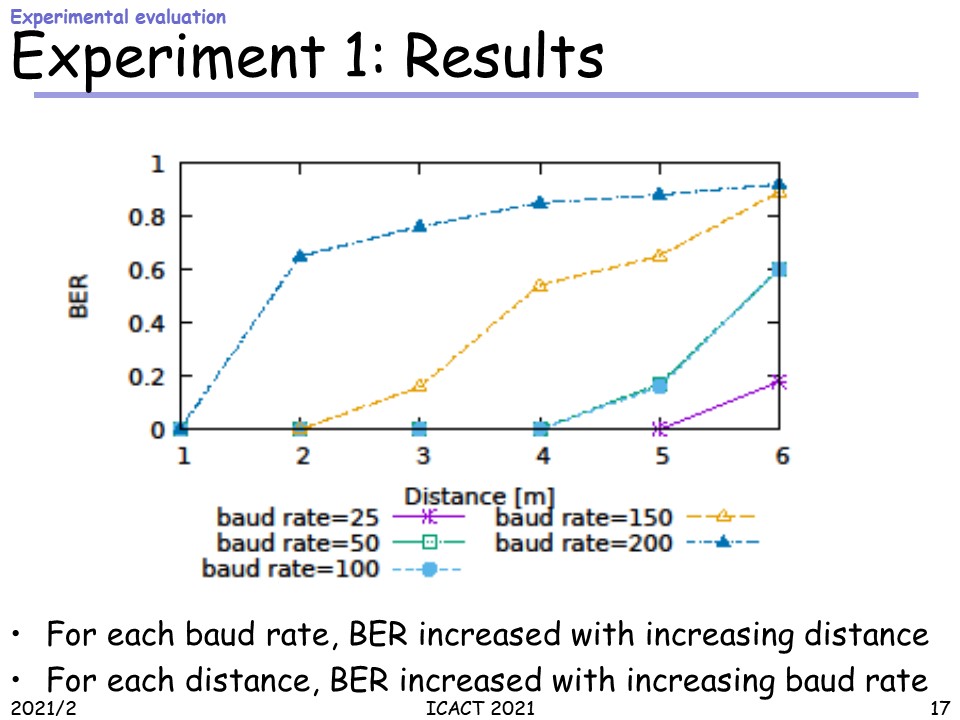 |
The results are shown in this figure.
As can be seen, for each baud rate, the bit error rate increased with increasing distance.
Also, for each distance, the bit error rate increased with increasing baud rate.
Here, at each baud rate, no communication was possible beyond 6 m.
To increase the communication distance, we must consider improvements such as increasing the speaker volume, using a microphone with better performance, and using a frequency with less noise.
These improvements are for future work.
Also, to carry out future experiments underwater, we must use either waterproof cases or a waterproof microphone and speaker.
Experiments in water constitute a also future topic.
|
|
ICACT20210234 Slide.16
[Big slide for presentation]
|
Chrome Text-to-Speach Click!! |
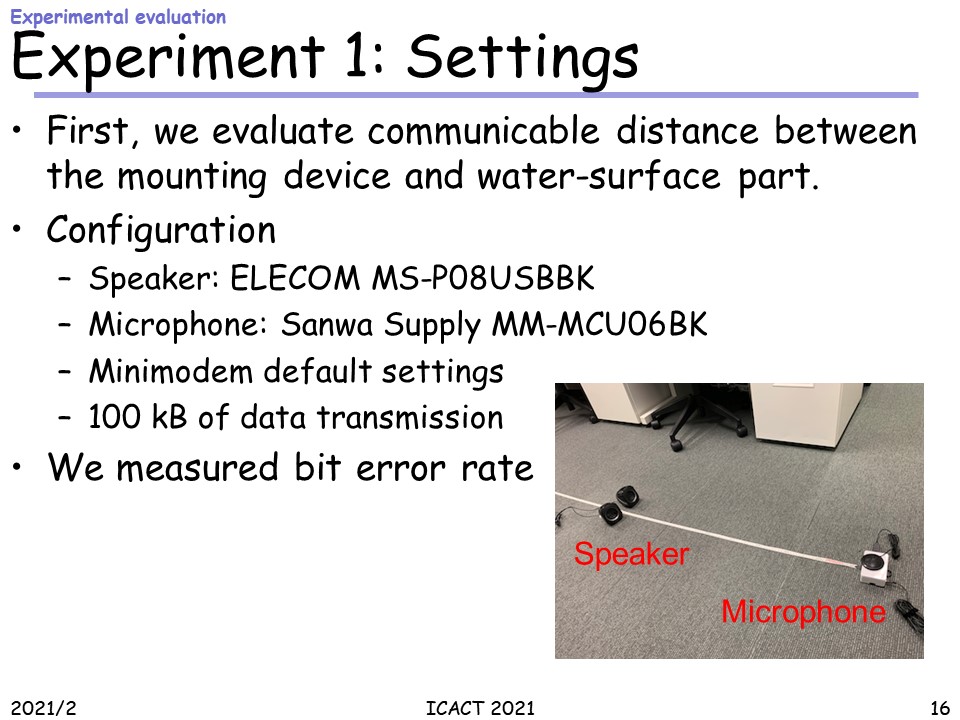 |
In this study, to evaluate the basic characteristics of our implemented system, we subjected it to indoor experimental evaluation.
Underwater evaluation is a future issue.
First, we assessed the communicable distance between the mounting device and water-surface part.
We measured the bit error rate for different values of the distance between the speaker and the microphone and the baud rate.
In each experiment, 100 kB of sensor information were transmitted and received.
|
|
ICACT20210234 Slide.15
[Big slide for presentation]
|
Chrome Text-to-Speach Click!! |
 |
Now I will explain experimental evaluation results.
|
|
ICACT20210234 Slide.14
[Big slide for presentation]
|
Chrome Text-to-Speach Click!! |
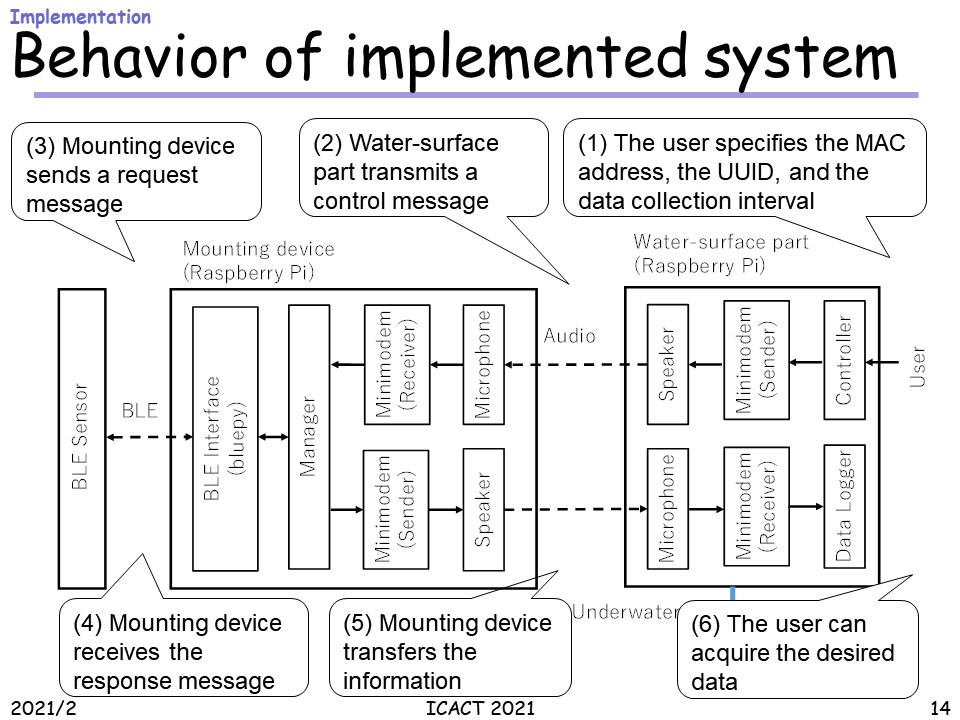 |
When collecting data from an underwater BLE sensor, the user first accesses the water-surface part and specifies the MAC address of the target BLE sensor, the UUID corresponding to the sensor data to be acquired, and the data collection interval. The water-surface part then transmits a control message to the mounting device using acoustic communication.
Upon receiving the control message, the mounting device sends a request message to the sensor corresponding to the specified MAC address and UUID at a predetermined frequency. After the mounting device receives the response message from the BLE sensor, it transfers the information about the UUID and sensor data included in the message to the water-surface part using acoustic communication. As a result, the user can acquire the desired data from the underwater BLE sensor.
|
|
ICACT20210234 Slide.13
[Big slide for presentation]
|
Chrome Text-to-Speach Click!! |
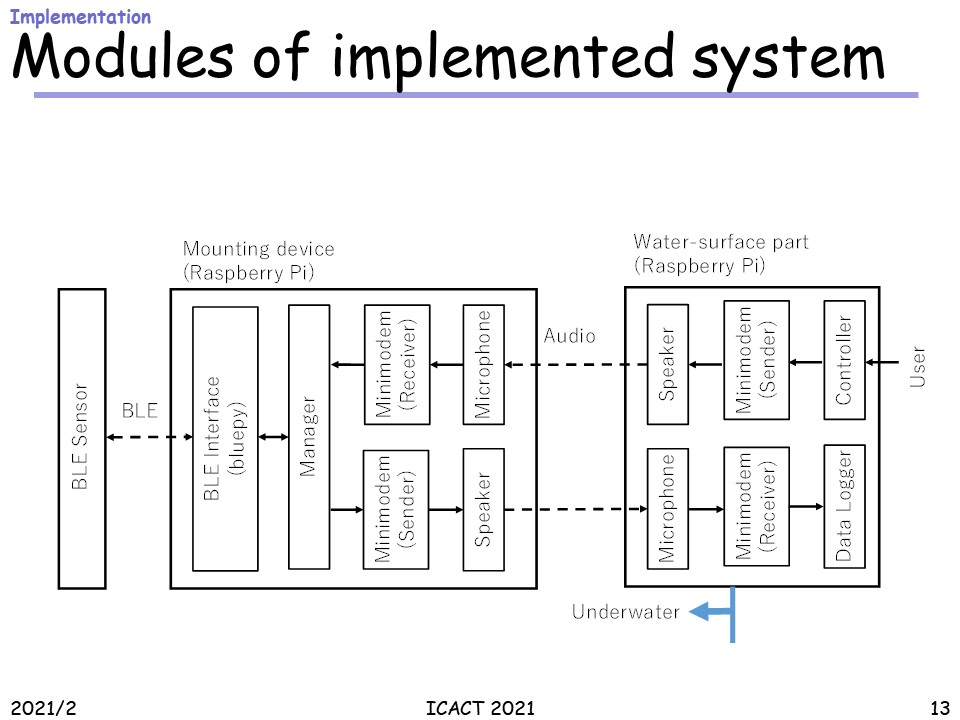 |
The modules of our implemented system is shown in this slide.
In this study, to communicate with the BLE sensor at the mounting device, we developed a code based on the Python library bluepy.
We also used a software FSK audio modem, minimodem, to perform acoustic-wave modulation and demodulation at both the mounting device and water-surface part.
|
|
ICACT20210234 Slide.12
[Big slide for presentation]
|
Chrome Text-to-Speach Click!! |
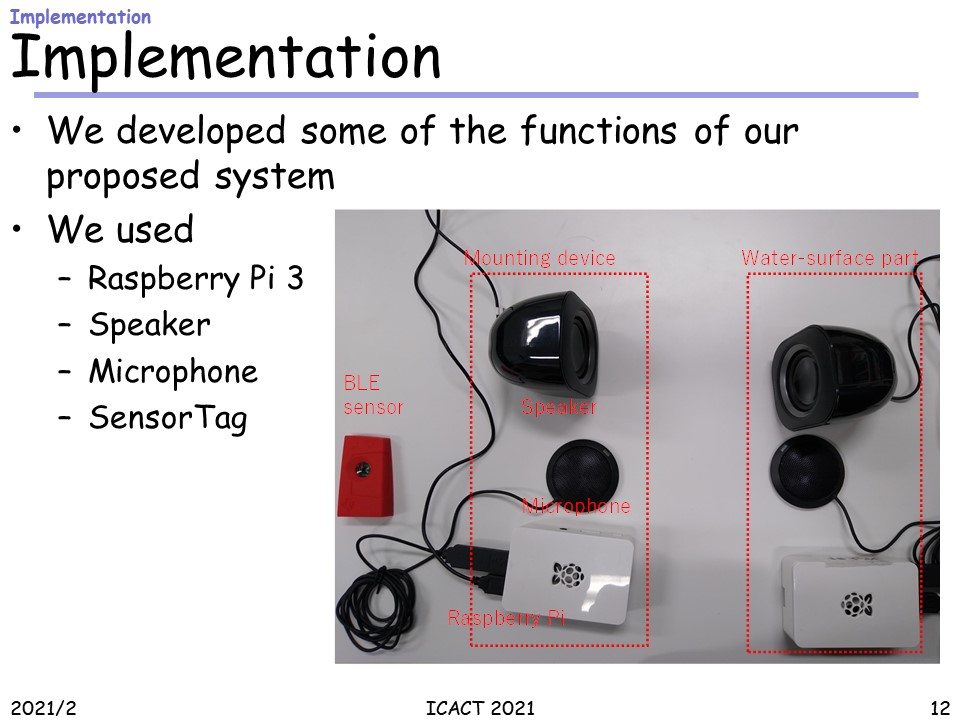 |
In this research, we developed and evaluated some of the functions of our proposed system using a Raspberry Pi and a commercially available microphone, speaker, and software audio modem.
For simplicity, we assume only one mounting device.
A photograph of our implemented system is shown in this slide.
As the main part of the mounting device and water-surface part, we used a Raspberry Pi 3 with the Raspbian operating system.
We assumed SensorTag as a BLE sensor.
The SensorTag has multiple sensors for temperature, humidity, barometric pressure, acceleration, angular velocity, and magnet field, and its specifications are in the public domain.
|
|
ICACT20210234 Slide.11
[Big slide for presentation]
|
Chrome Text-to-Speach Click!! |
 |
Now I will explain our proposed system.
|
|
ICACT20210234 Slide.10
[Big slide for presentation]
|
Chrome Text-to-Speach Click!! |
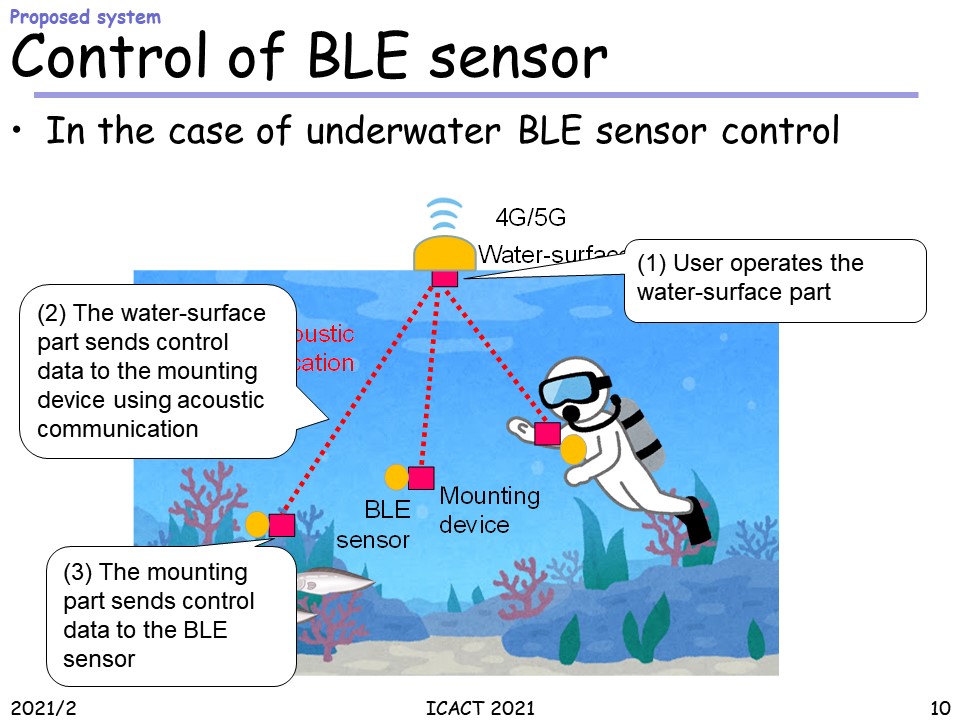 |
Meanwhile, if a remote user wants to control the underwater BLE sensor, then the user operates the water-surface part to send control data to the mounting device using acoustic communication.
When the mounting device receives the acoustic waves, it demodulates the control data and send them to the BLE sensor.
Our system enables existing BLE equipment to be used underwater.
|
|
ICACT20210234 Slide.09
[Big slide for presentation]
|
Chrome Text-to-Speach Click!! |
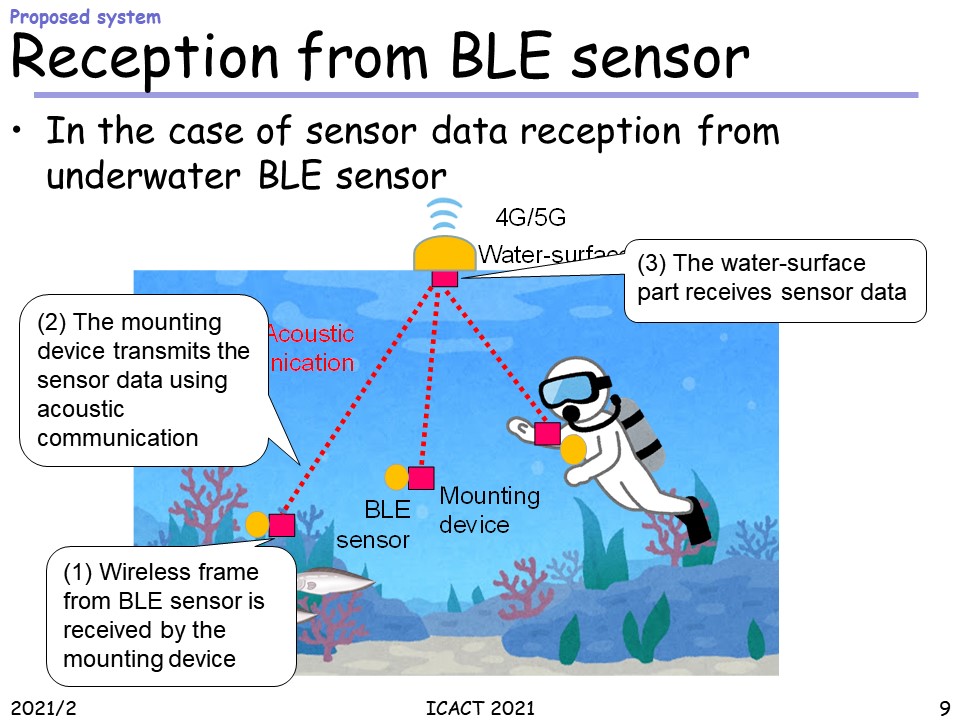 |
In our system, a general-purpose terminal equipped with a BLE module, a microphone, and a speaker is used for both the mounting device and the water-surface part.
First, the wireless frame transmitted by the underwater BLE sensor is received by the BLE module mounted on the mounting device.
The mounting device then converts the data received from the BLE sensor into acoustic waves and transmits them from the speaker.
Finally, the water-surface part demodulates the acoustic waves received via its microphone and obtains the data transmitted by the BLE sensor, and a user located remotely acquires those data.
|
|
ICACT20210234 Slide.08
[Big slide for presentation]
|
Chrome Text-to-Speach Click!! |
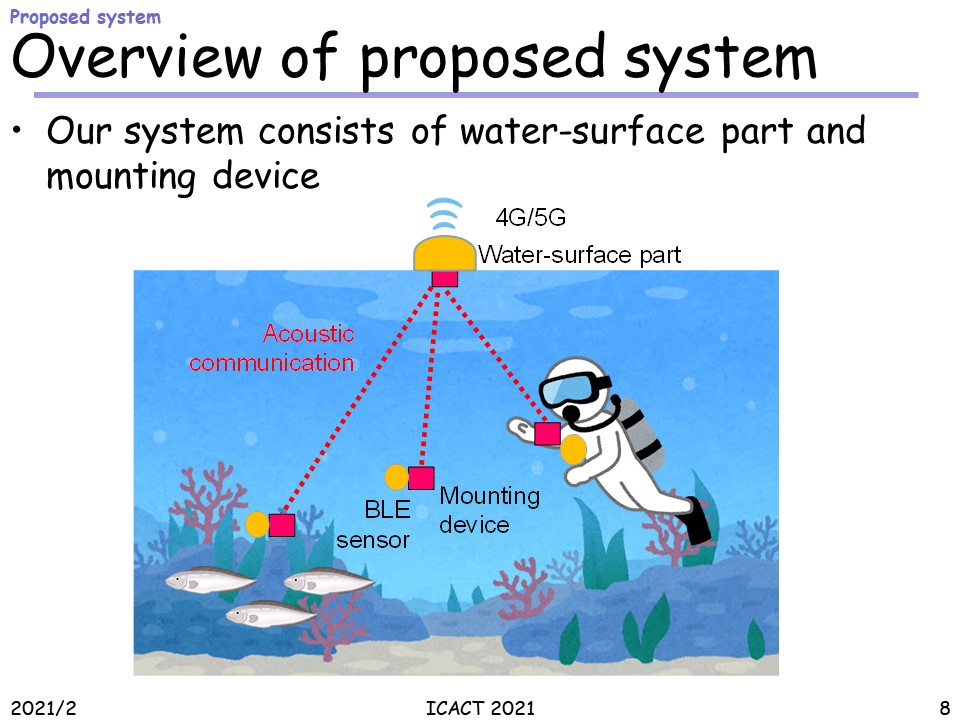 |
This slide shows our proposed system. Our system comprises a mounting device connected to the underwater BLE sensor and a part installed on the water surface.
We assume a simple BLE sensor that broadcasts its data periodically and whose configuration is easily changed by sending control packets.
The BLE sensor and the mounting device are either pre-waterproofed or put in waterproof cases for use.
As with the underwater communication cable, it is assumed that the mounting device and the BLE sensor can communicate wirelessly.
The water-surface part is connected to an existing network via a mobile network and can be controlled by a remote user.
|
|
ICACT20210234 Slide.07
[Big slide for presentation]
|
Chrome Text-to-Speach Click!! |
 |
Now I will explain our proposed system.
|
|
ICACT20210234 Slide.06
[Big slide for presentation]
|
Chrome Text-to-Speach Click!! |
 |
In this research, we propose a system for using a commercially available BLE sensor underwater.
In addition, we develop and evaluate some of the functions of our proposed system using commercially available products.
|
|
ICACT20210234 Slide.05
[Big slide for presentation]
|
Chrome Text-to-Speach Click!! |
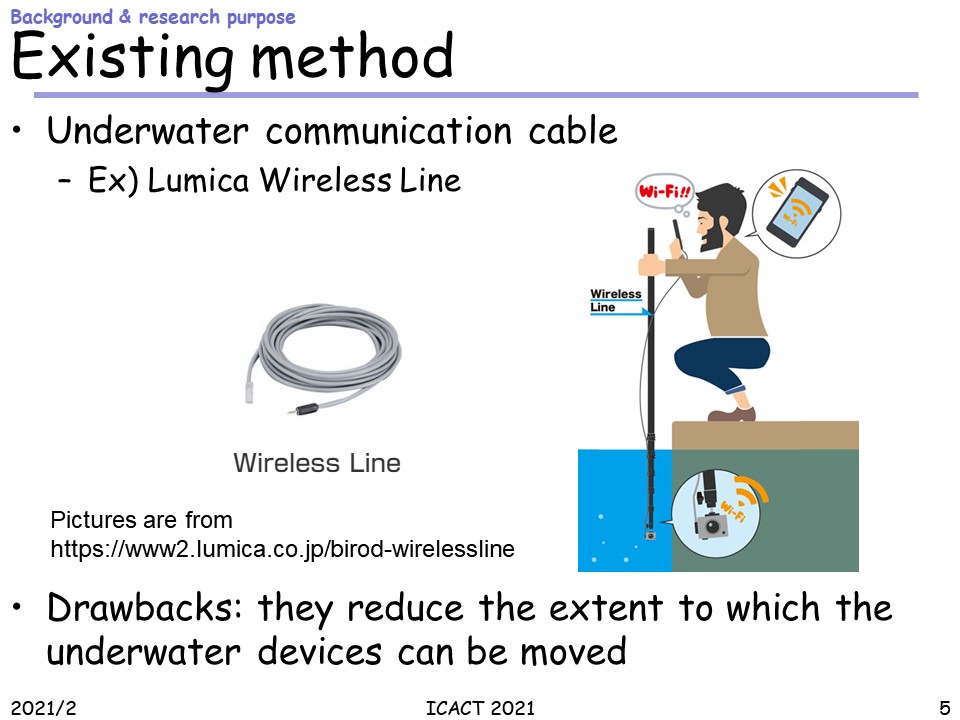 |
One way to use would-be wireless communication devices underwater is via underwater communication cables. The signal from the device propagates through the cable instead, thereby facilitating data communication between the underwater device and a terrestrial device.
For example, the Lumica Wireless Line is for use with a submerged waterproof Wi-Fi camera when fishing to view the underwater situation from above the water.
However, the use of cables is limited because they reduce the extent to which the underwater devices can be moved.
|
|
ICACT20210234 Slide.04
[Big slide for presentation]
|
Chrome Text-to-Speach Click!! |
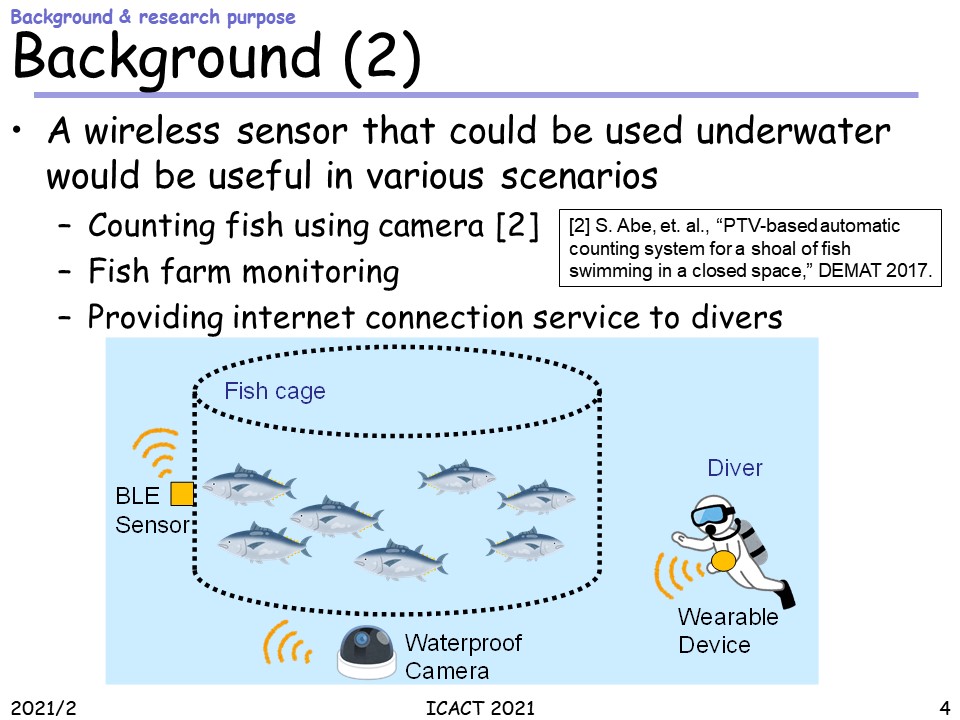 |
However, a wireless sensor that could be used underwater would be useful in various scenarios.
For example, Reference 2 imagined installing a commercially available waterproof camera under a cage of a fish farm to measure the number of fish therein. In that case, it would be useful if the data acquired by the underwater camera could be seen in real time above the water.
Alternatively, using inexpensive commercially available BLE sensors to assess in real time the water temperature and how the shape of the cage was changing would help to make aquaculture more efficient.
In addition, if the smartwatches or smartphones worn by divers could connect to the Internet while underwater, the divers could use various services while underwater.
|
|
ICACT20210234 Slide.03
[Big slide for presentation]
|
Chrome Text-to-Speach Click!! |
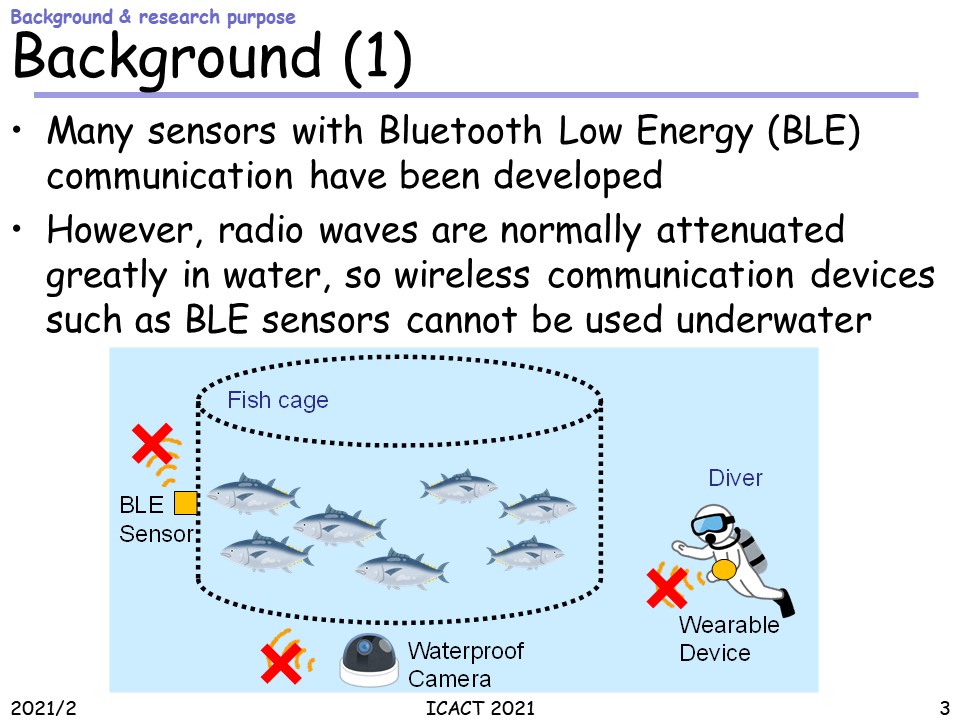 |
Bluetooth Low Energy is used widely. Compared to conventional Bluetooth, BLE is focused on saving power, and many sensors with BLE communication have been developed. Normally, radio waves are attenuated greatly in water, so wireless communication devices such as BLE sensors cannot be used underwater.
|
|
ICACT20210234 Slide.02
[Big slide for presentation]
|
Chrome Text-to-Speach Click!! |
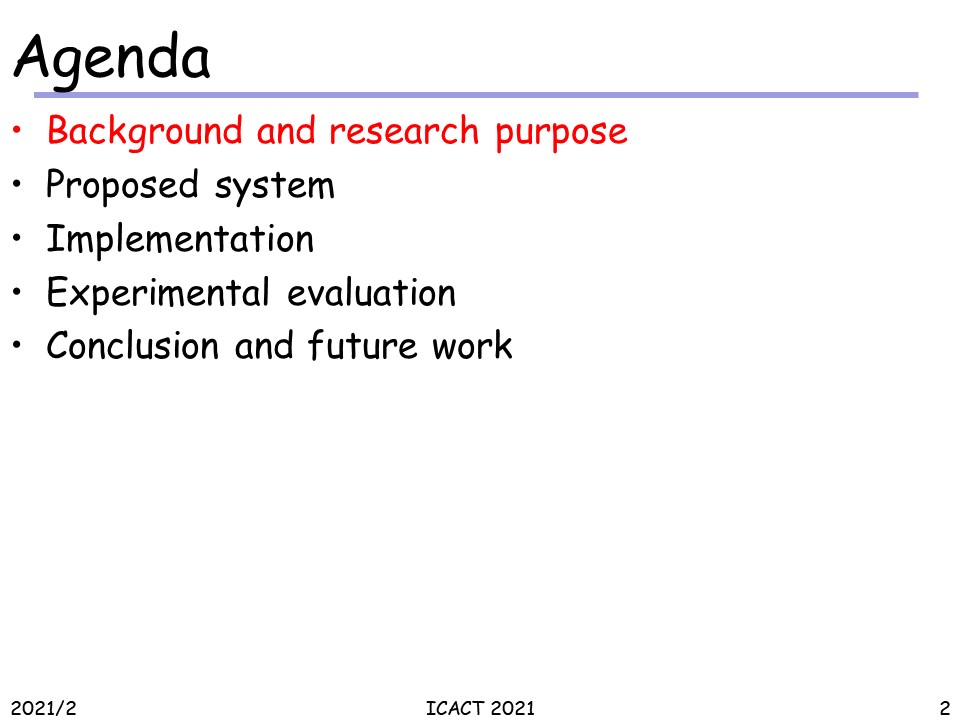 |
This slide shows the agenda of today's presentation. First, I will explain research background and research purpose. Then, I will explain our proposed system, which is a conversion system based on acoustic communication for using BLE sensors underwater. After that, I will explain its implementation and evaluation results. Finally, I will conclude this presentation.
|
|
ICACT20210234 Slide.01
[Big slide for presentation]
[YouTube] |
Chrome Text-to-Speach Click!! |
 |
My name is Yoshiaki Taniguchi from Kindai University, Japan. Now, I will give my presentation titled A Conversion System Based on Acoustic Communication for Using Bluetooth Low Energy Sensors Underwater.
|
















