 ICACT20220404 Slide.17
[Big slide for presentation]
[YouTube] |
Chrome Text-to-Speach Click!! |
 |
Thank you.
|
|
ICACT20220404 Slide.16
[Big slide for presentation]
[YouTube] |
Chrome Text-to-Speach Click!! |
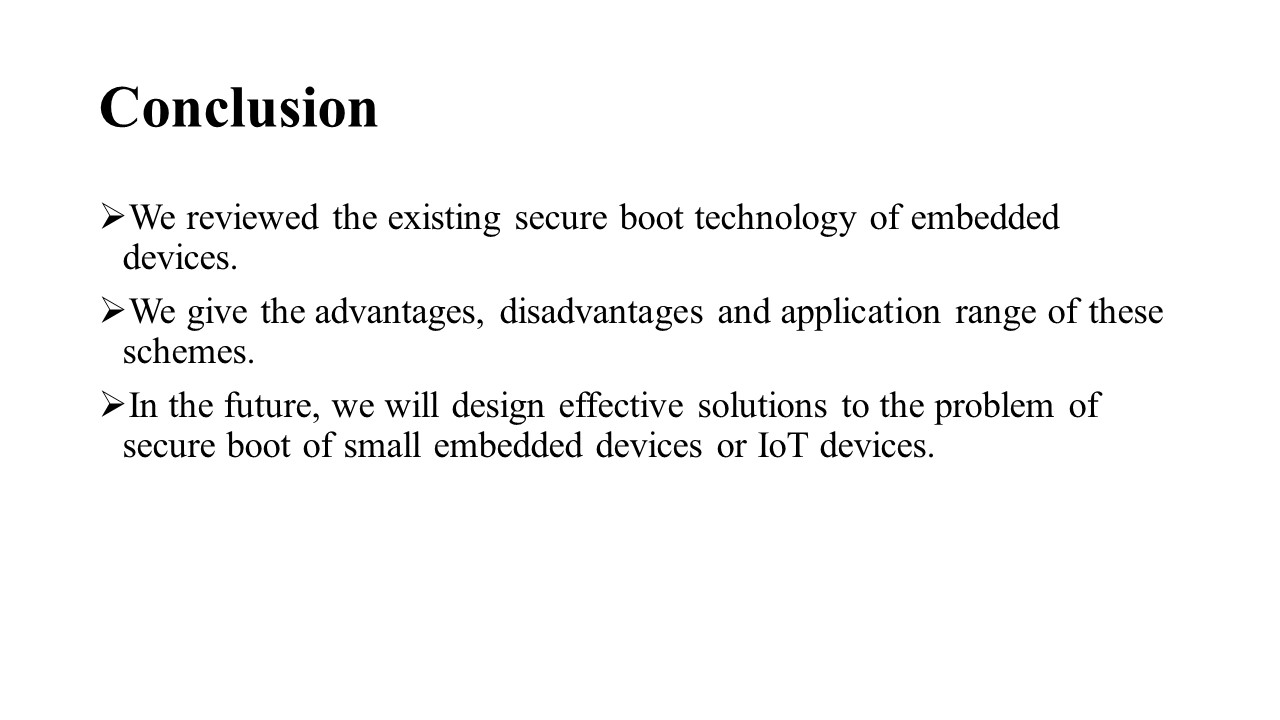 |
In this paper, the secure boot technology of embedded devices is studied deeply and the existing solutions are summarized. Then the advantages and disadvantages of these schemes are given. In the future, we will design effective solutions to the problem of secure boot of small embedded devices or IoT devices.
|
|
ICACT20220404 Slide.15
[Big slide for presentation]
[YouTube] |
Chrome Text-to-Speach Click!! |
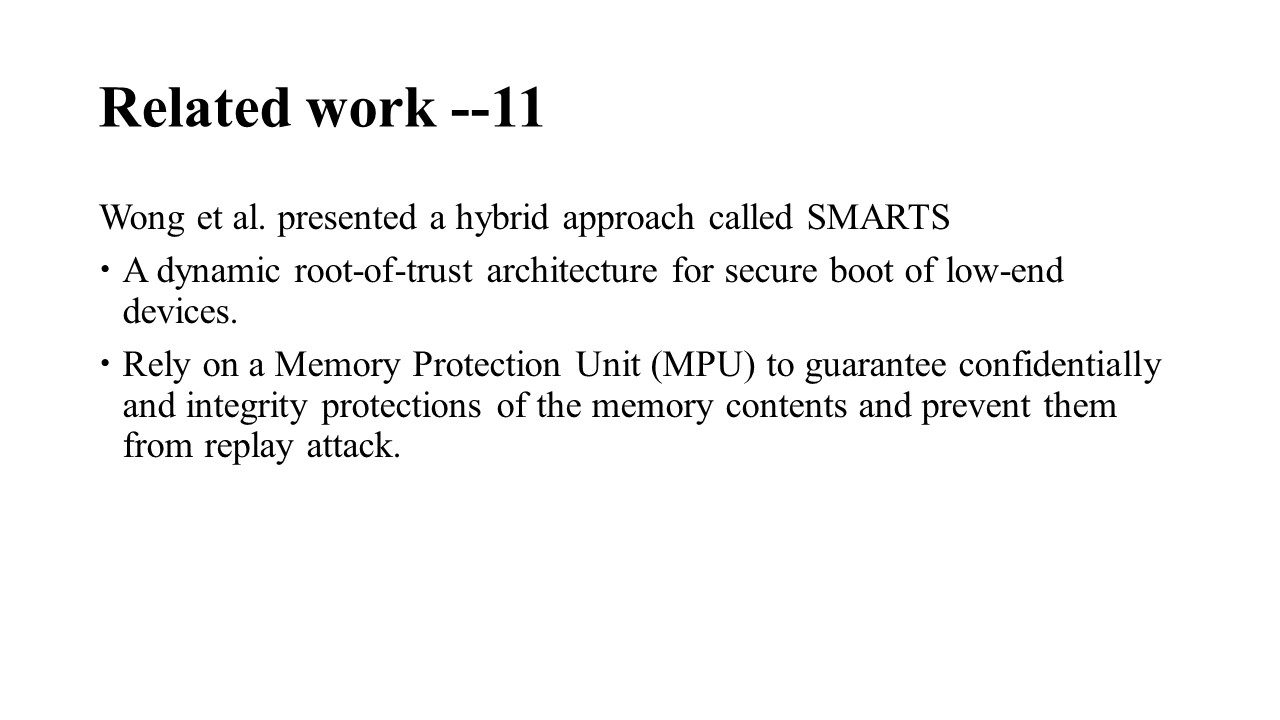 |
Wong et al. presented a hybrid approach called SMARTS. It is a dynamic root-of-trust architecture for secure boot of low-end devices, and relies on a Memory Protection Unit (MPU) to guarantee confidentially and integrity protections of the memory contents and prevent them from replay attack.
|
|
ICACT20220404 Slide.14
[Big slide for presentation]
[YouTube] |
Chrome Text-to-Speach Click!! |
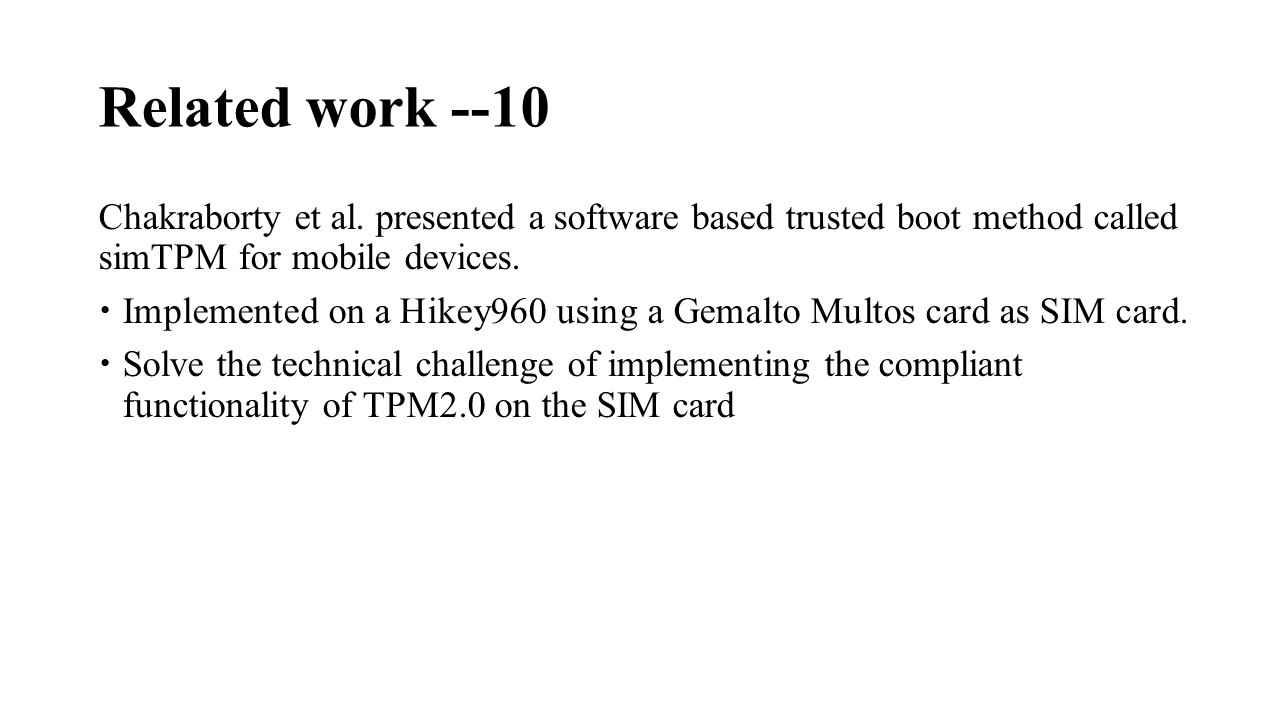 |
Chakraborty et al. presented a software-based trusted boot method called simTPM for mobile devices. It's implemented on a Hikey960 and solves the technical challenge of implementing the compliant functionality of TPM2.0 on the SIM card.
|
|
ICACT20220404 Slide.13
[Big slide for presentation]
[YouTube] |
Chrome Text-to-Speach Click!! |
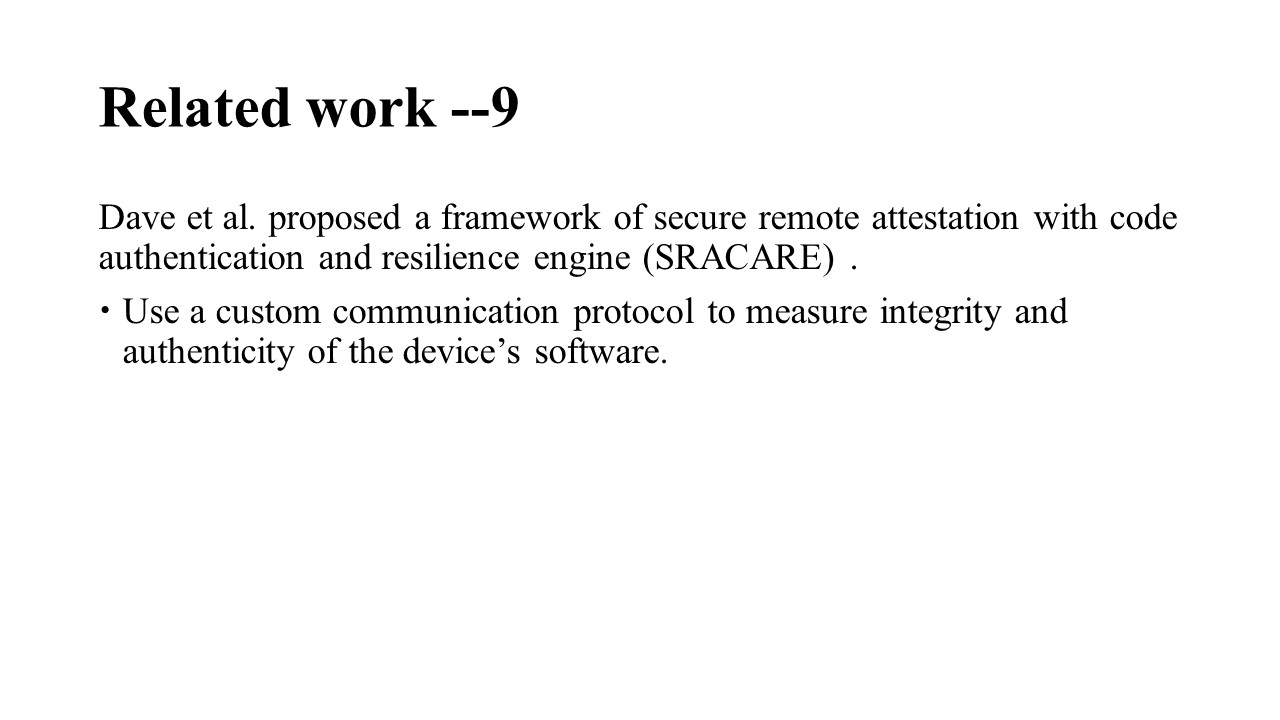 |
Dave et al. proposed a framework of secure remote attestation with code authentication and resilience engine (SRACARE) for trusted boot of untrusted embedded or IoT devices that verified by trusted devices that have trusted boot. It uses a custom communication protocol to measure integrity and authenticity of the device’s software.
|
|
ICACT20220404 Slide.12
[Big slide for presentation]
[YouTube] |
Chrome Text-to-Speach Click!! |
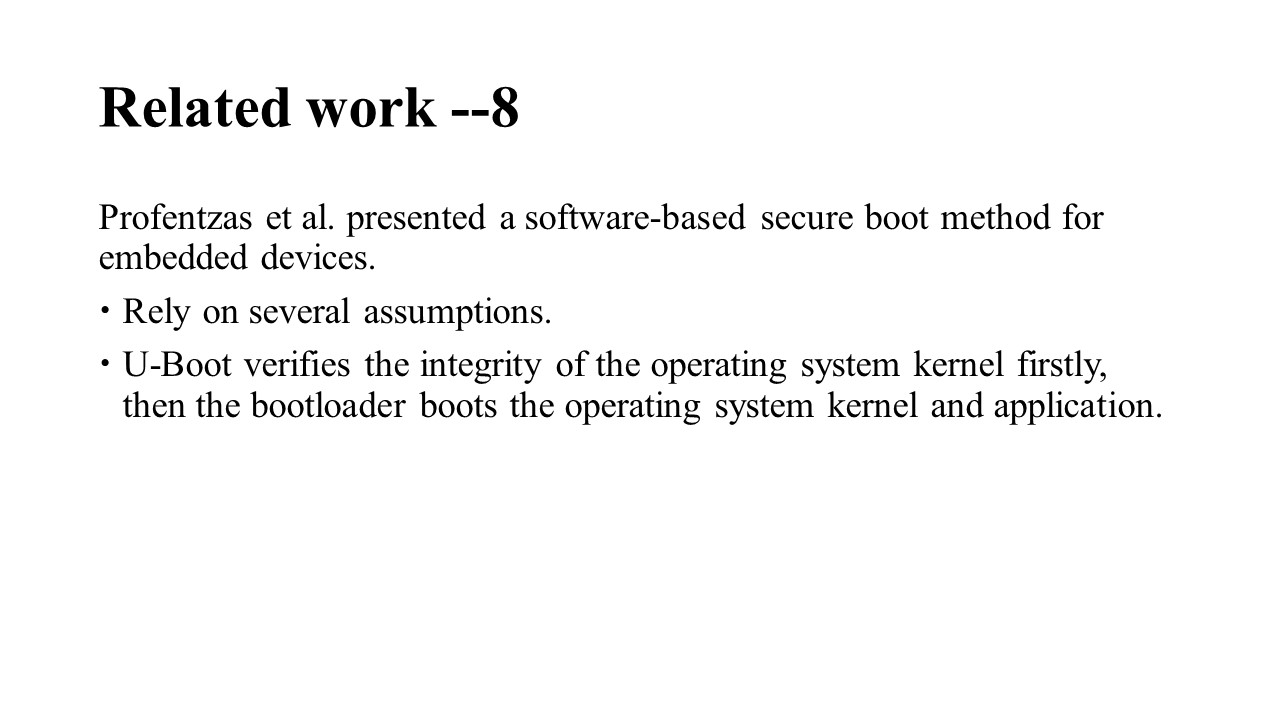 |
Profentzas et al. presented a software-based secure boot method for embedded devices. This method relies on several assumptions. When to begin the secure boot process, the bootloader U-Boot verifies the integrity of the operating system kernel firstly. If the verification result is successfully, then the bootloader boots the operating system kernel and application.
|
|
ICACT20220404 Slide.11
[Big slide for presentation]
[YouTube] |
Chrome Text-to-Speach Click!! |
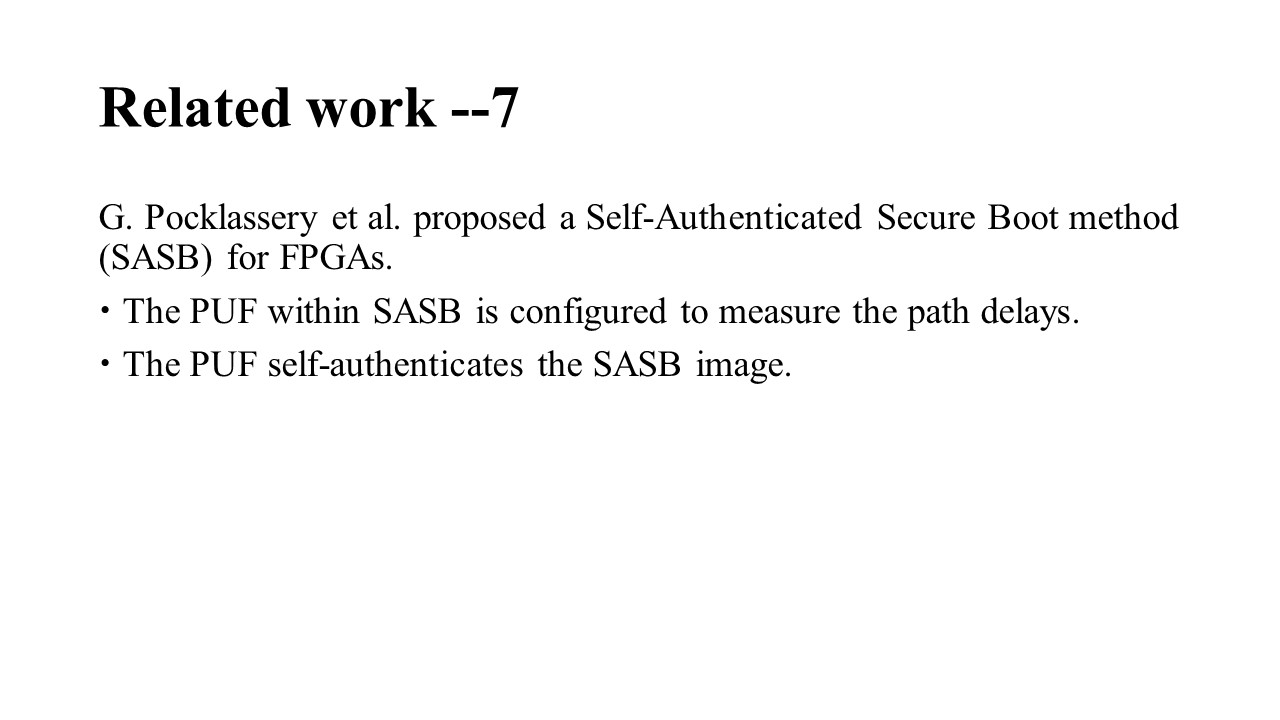 |
G. Pocklassery et al. proposed a Self-Authenticated Secure Boot method (SASB) for FPGAs. the PUF within SASB is configured to measure the path delays and self-authenticates the SASB image.
|
|
ICACT20220404 Slide.10
[Big slide for presentation]
[YouTube] |
Chrome Text-to-Speach Click!! |
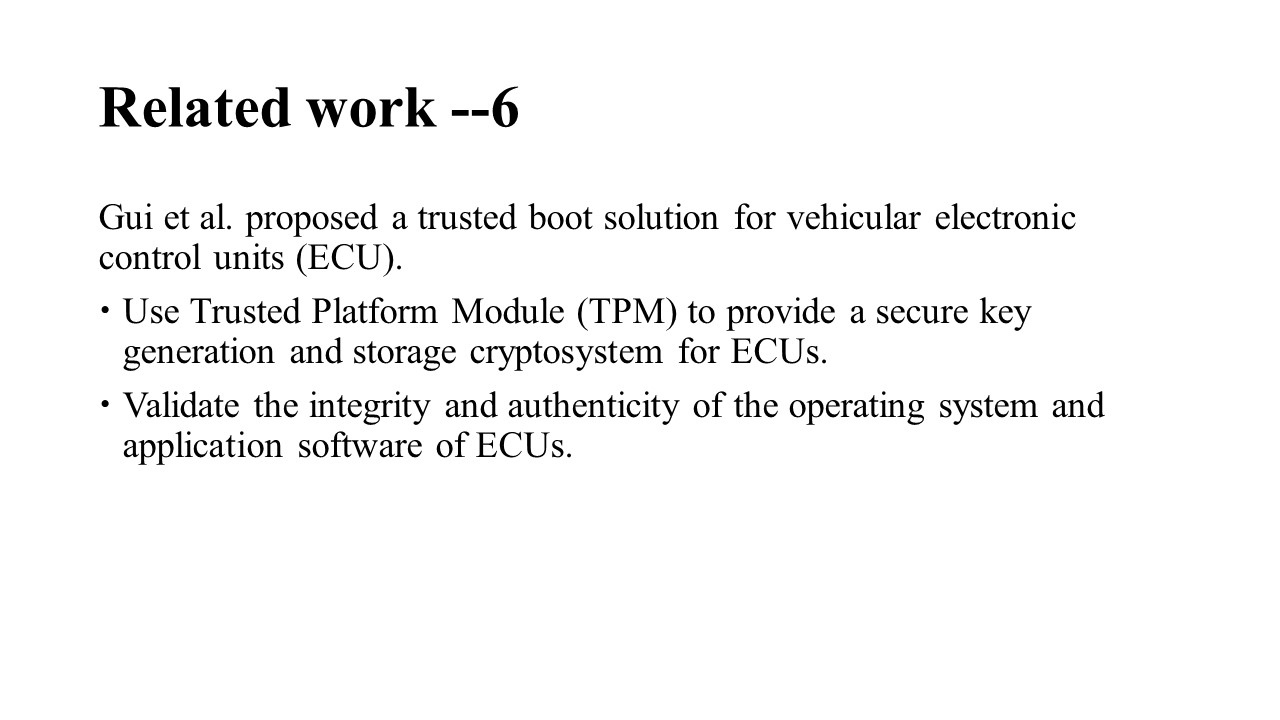 |
Gui et al. proposed a trusted boot solution for vehicular electronic control units (ECU). it uses Trusted Platform Module (TPM) to provide a secure key generation and storage cryptosystem for ECUs and validate the integrity and authenticity of the operating system and application software of ECUs.
|
|
ICACT20220404 Slide.09
[Big slide for presentation]
[YouTube] |
Chrome Text-to-Speach Click!! |
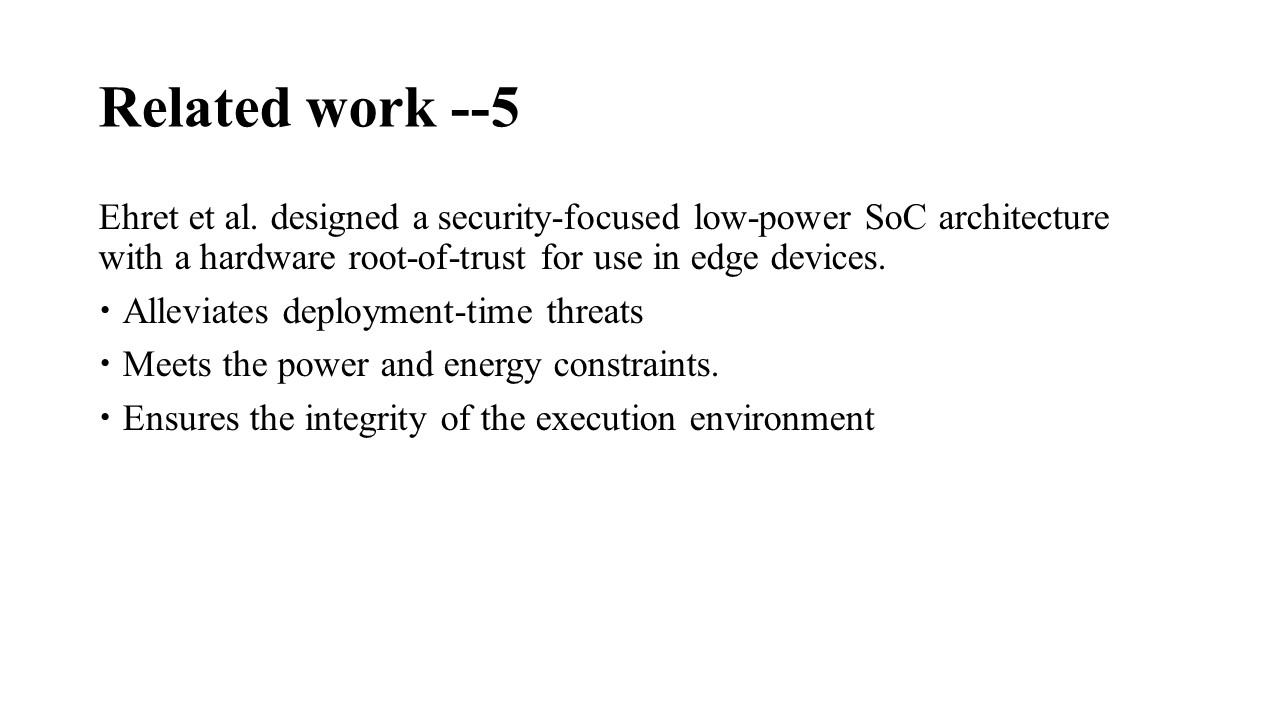 |
Ehret et al. designed a security-focused low-power SoC architecture with a hardware root-of-trust for use in edge devices. it alleviates deployment-time threats, meets the power and energy constraints and ensures the integrity of the execution environment.
|
|
ICACT20220404 Slide.08
[Big slide for presentation]
[YouTube] |
Chrome Text-to-Speach Click!! |
 |
Kim et al. proposed a method based on platform integrity verification for activating a mobile trusted module (MTM). It is based on tamper-proof Integrated Circuit (IC) card and is a hardware security module.
|
|
ICACT20220404 Slide.07
[Big slide for presentation]
[YouTube] |
Chrome Text-to-Speach Click!! |
 |
Kumar et al. proposed a method called Post-Quantum Secure Boot. It’s based on the eXtended Merkle Signature Scheme (XMSS) and implemented by fully hardware.
|
|
ICACT20220404 Slide.06
[Big slide for presentation]
[YouTube] |
Chrome Text-to-Speach Click!! |
 |
Zimmo et al. proposed a trusted boot method for embedded systems using hypothesis testing benchmark. This method contains two parts, which are achieving the hypothesis testing benchmark values and the trusted boot method based on the hypothesis testing benchmark values.
|
|
ICACT20220404 Slide.05
[Big slide for presentation]
[YouTube] |
Chrome Text-to-Speach Click!! |
 |
Jiang et al. proposed an ARM-based secure boot scheme for the isolated execution environment, which is based on TrustZone technology and can prevent the malicious attack. The trust chain is proved by Demper-Shafer theory.
|
|
ICACT20220404 Slide.04
[Big slide for presentation]
[YouTube] |
Chrome Text-to-Speach Click!! |
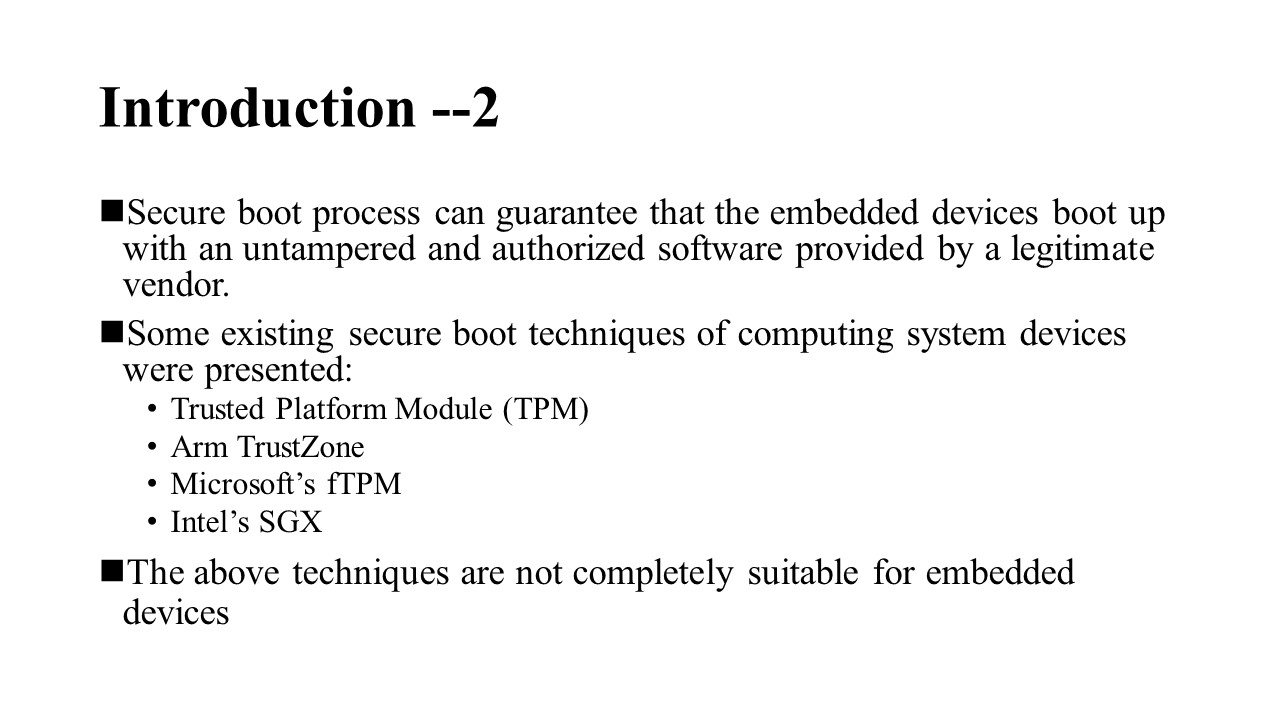 |
Secure boot process can guarantee that the embedded devices boot up with a trusted software provided by a legitimate vendor. In order to realize the secure boot of computing system devices, some advanced techniques such as Trusted Platform Module (TPM), Arm TrustZone, Microsoft’s fTPM, Intel’s SGX have been designed and implemented to protect the operating system kernel and application software running on these computing system devices. The above techniques are not completely suitable for embedded devices.
|
|
ICACT20220404 Slide.03
[Big slide for presentation]
[YouTube] |
Chrome Text-to-Speach Click!! |
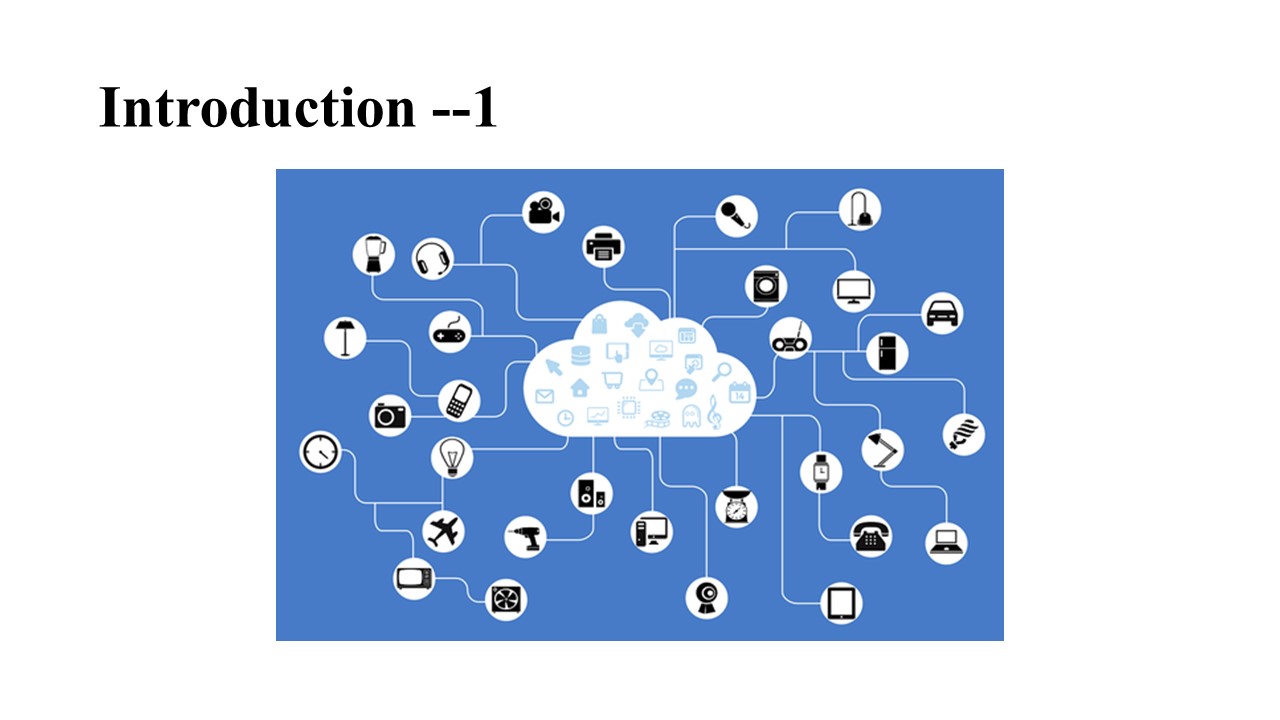 |
Embedded devices are widely used in our daily, but they lack of in-build security mechanisms for ensuring safety of these devices.
|
|
ICACT20220404 Slide.02
[Big slide for presentation]
[YouTube] |
Chrome Text-to-Speach Click!! |
 |
Now I will introduce my paper from three aspects, Firstly, I will tell the background of my research. Secondly, to talk about the existing research works. And then I will give the conclusion.
|
|
ICACT20220404 Slide.01
[Big slide for presentation]
[YouTube] |
Chrome Text-to-Speach Click!! |
 |
Hello everyone. My name is Wang Rui, I come from Xidian University. I’m very glad to share my research job with you. My paper title is A Survey of Secure Boot Schemes for Embedded Devices.
|
















