 ICACT20230032 Slide.16
[Big slide for presentation] |
Chrome Text-to-Speach Click!! |
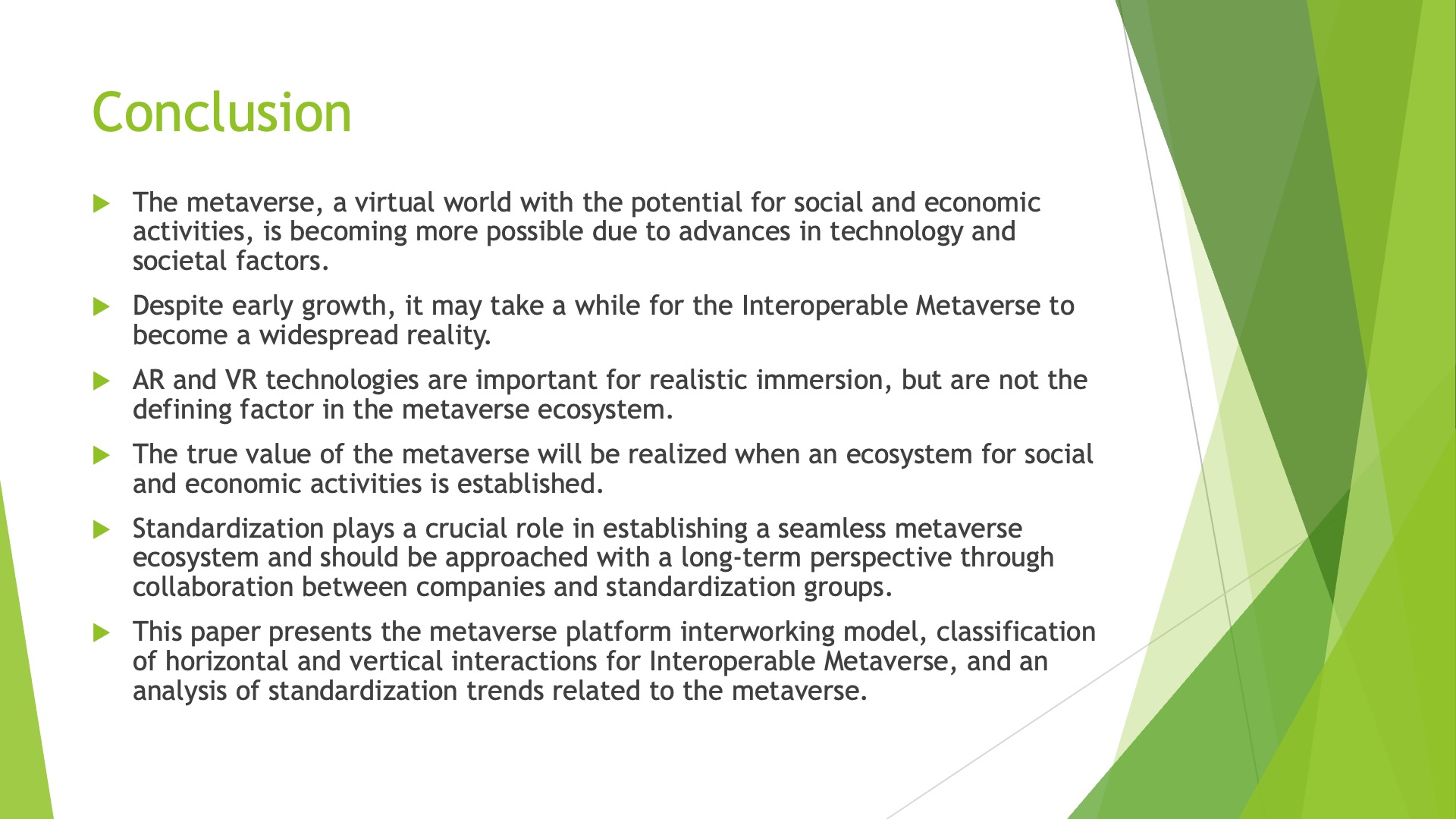 |
The metaverse, a virtual world, is becoming a reality due to advancements in technology and social conditions. However, there are still existing barriers in terms of technology, society, and economy that need to be overcome. The true value of the metaverse will be realized once an ecosystem that supports social and economic activities is established. AR and VR technologies are necessary for providing immersive elements but they are not the only necessary technologies. Standards play a crucial role in the formation of a huge metaverse ecosystem and require a long-term approach through close collaboration between companies and standardization groups. This paper presents a metaverse platform interworking model and discusses the standardization trend related to the metaverse.
|
|
ICACT20230032 Slide.15
[Big slide for presentation]
|
Chrome Text-to-Speach Click!! |
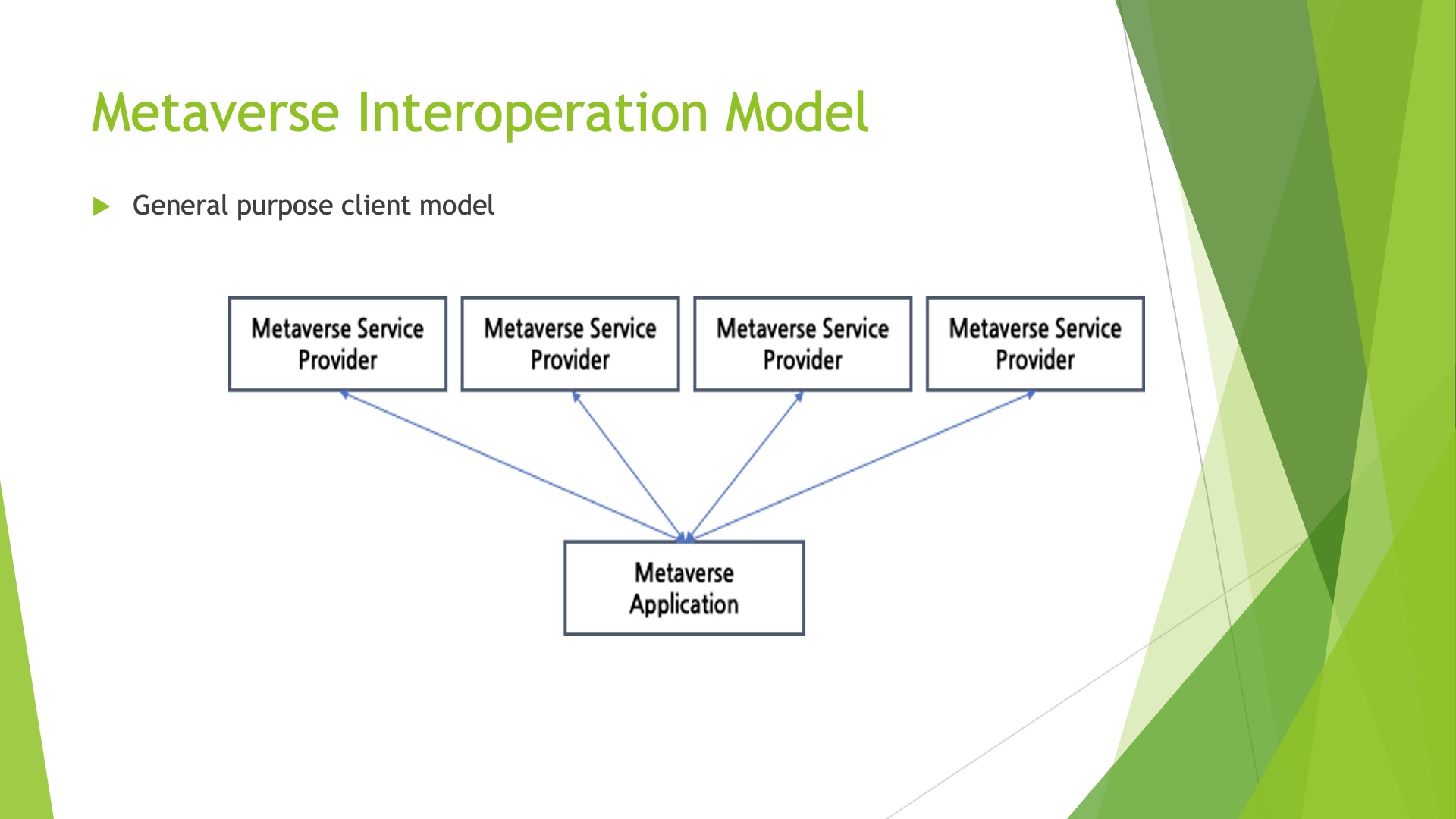 |
The most effective long-term solution for the Metaverse Application (MA) is to have a general-purpose MA client that connects to multiple Metaverse Service Providers (MSPs), allowing the user full access to their data stored on blockchain without being restricted to any one platform. This client is likely to be a web browser and the W3C is continuously developing high-performing technologies such as WebXR, WebVR, WebAsm, and WebGPU. WebGPU, in particular, shows potential for high performance by directly accessing GPU resources from the JavaScript code of the web browser. Although it is still in the standardization stage, it has a bright future as a competitive technology in the long term.
|
|
ICACT20230032 Slide.14
[Big slide for presentation]
|
Chrome Text-to-Speach Click!! |
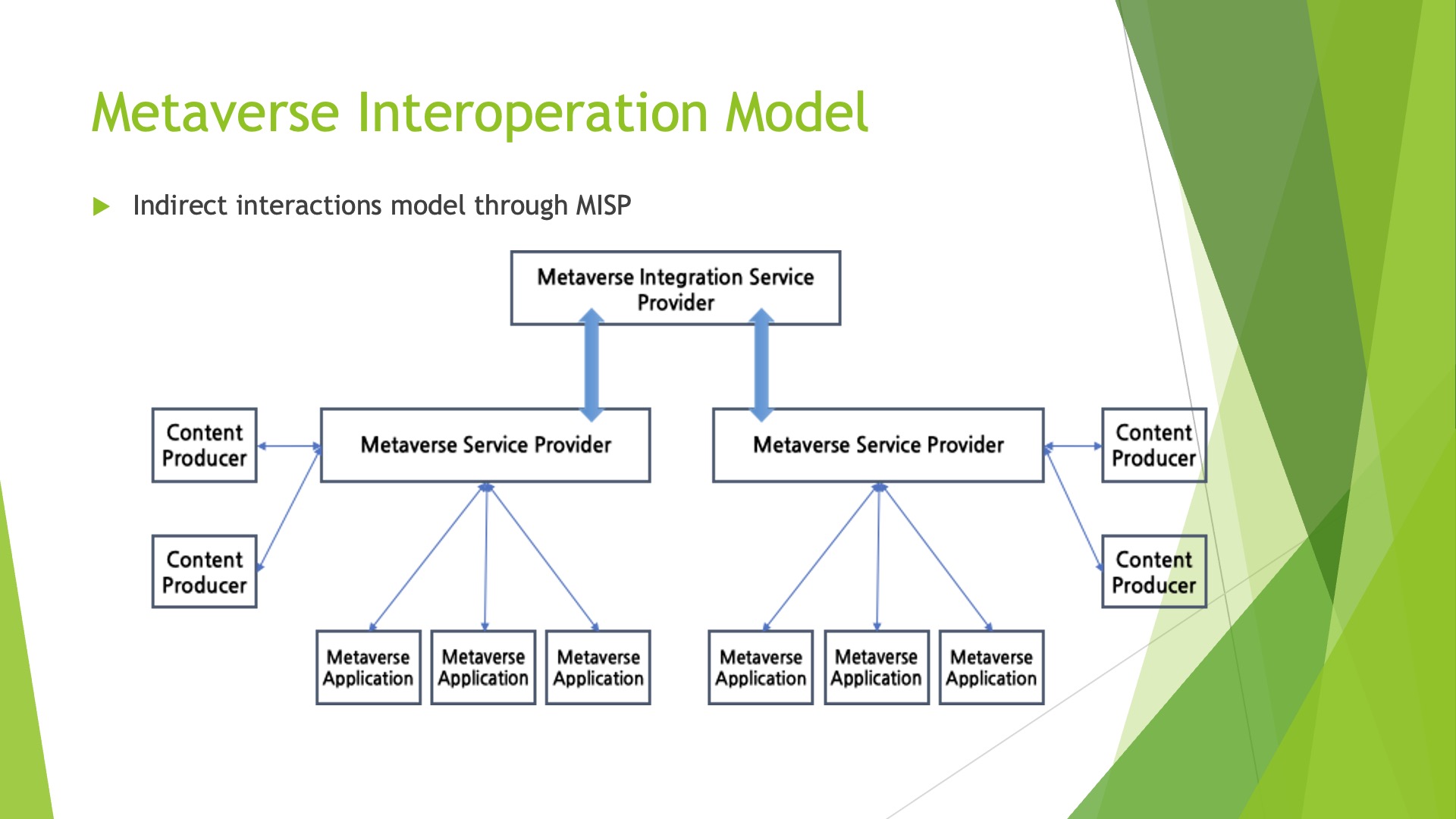 |
The method uses a bilateral agreement for conversion, while this model utilizes a rule-based conversion process through a MISP (Metaverse Integration Service Provider). The MISP acts as a gateway or intermediary between metaverse platforms.
|
|
ICACT20230032 Slide.13
[Big slide for presentation]
|
Chrome Text-to-Speach Click!! |
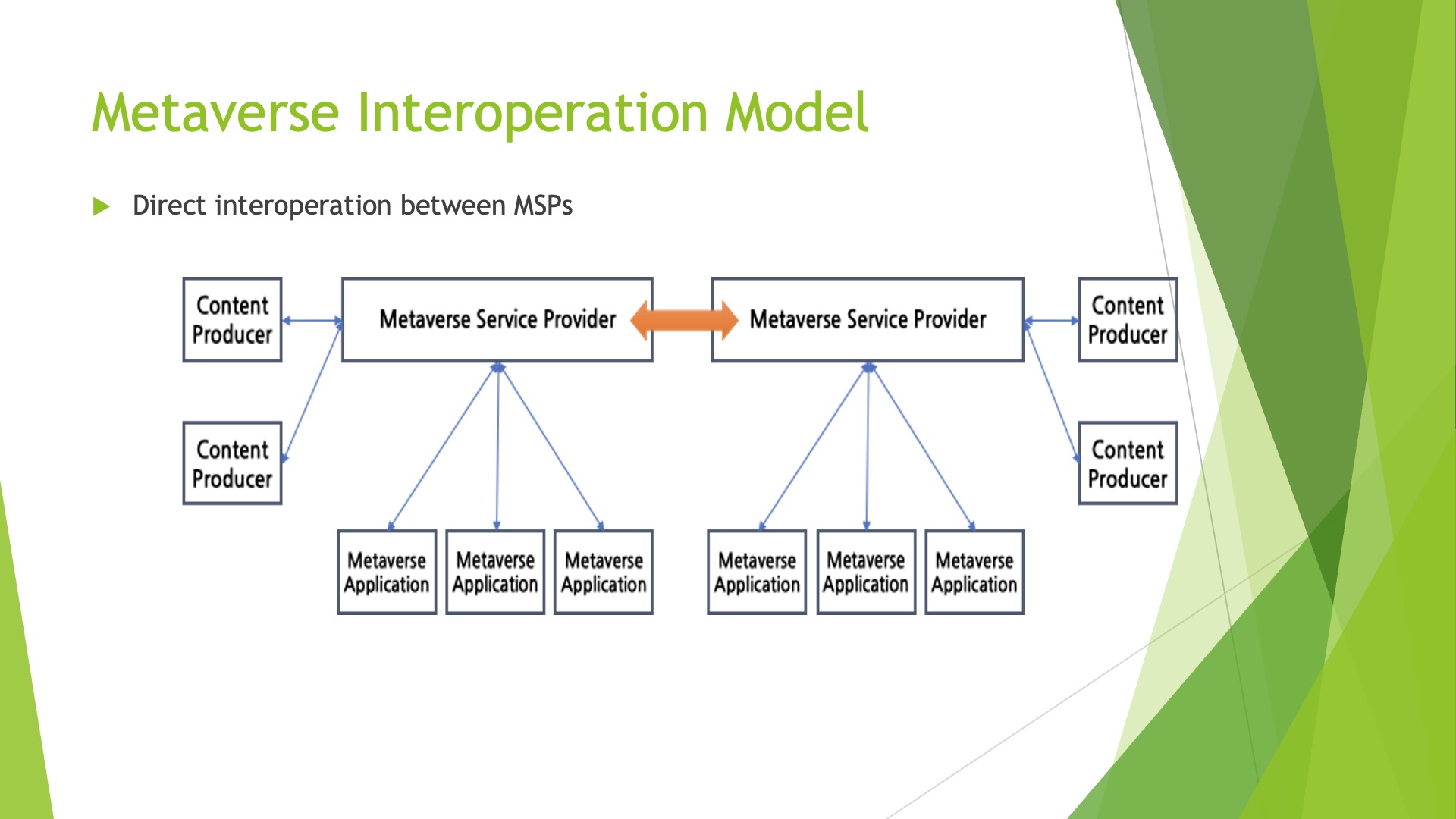 |
The metaverse platform interworking model allows for information exchange between metaverse service providers (MSPs) for avatar movement, content reuse, and item compatibility. However, the model may lead to dependency on a specific MSP and difficulty with compatibility between MSPs. Despite this, it offers a highly realistic experience by utilizing maximum performance. The model defines compatible information and conversion rules through agreements between metaverse platform providers, where avatars and their attribute values can be converted when moving between metaverses.
|
|
ICACT20230032 Slide.12
[Big slide for presentation]
|
Chrome Text-to-Speach Click!! |
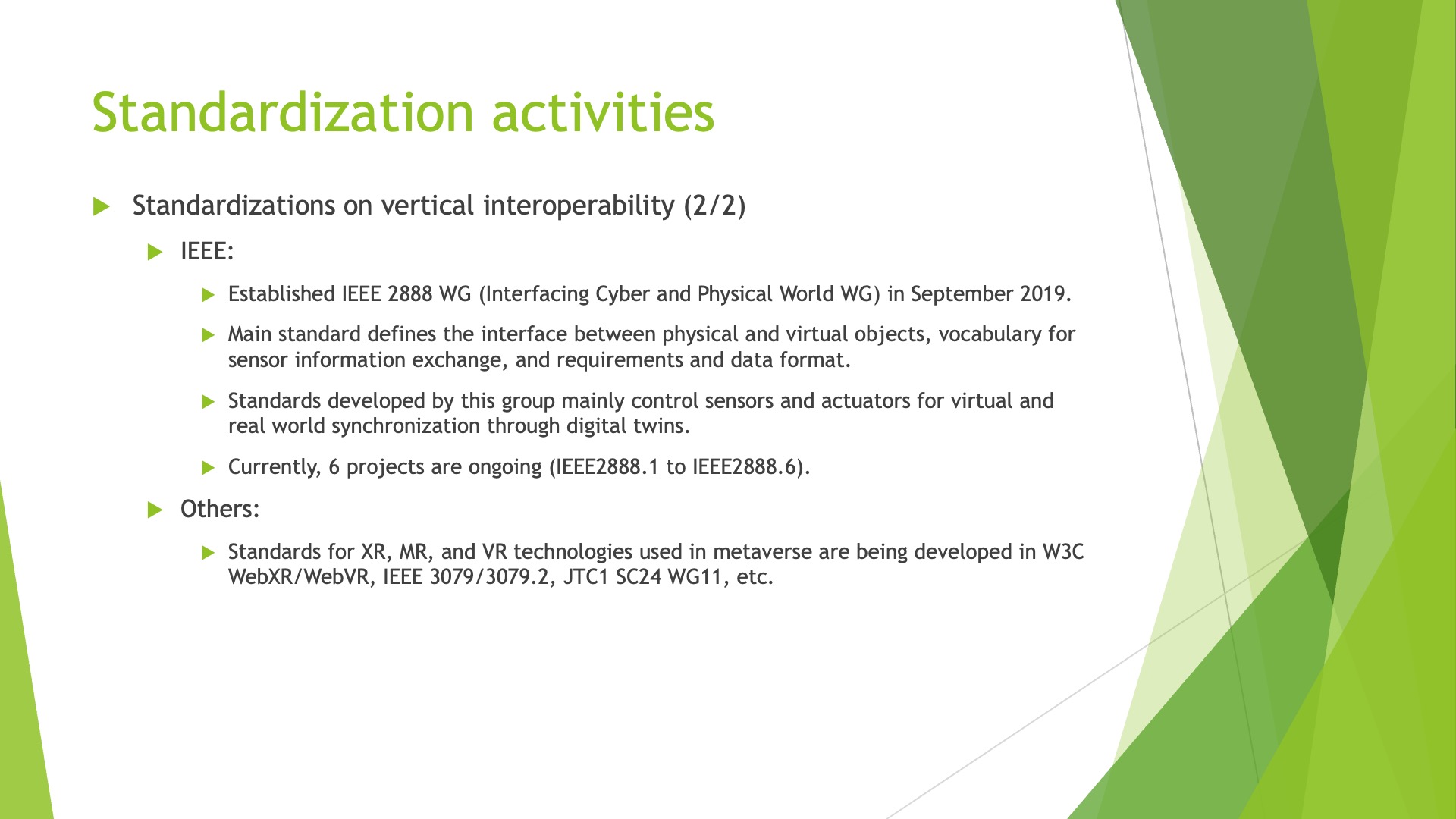 |
IEEE established the Interfacing Cyber and Physical World Working Group (IEEE 2888 WG) in September 2019 with the goal of defining the interface between physical and virtual objects, establishing a vocabulary for sensor information exchange, and setting requirements and data formats. The main focus of this group is to control sensors and actuators for synchronization between the virtual and real world through the use of digital twins. Currently, there are 6 ongoing projects (IEEE2888.1 to IEEE2888.6) under this group. In addition to IEEE 2888, standards for XR, MR, and VR technologies used in the metaverse are being developed by organizations such as W3C WebXR/WebVR, IEEE 3079/3079.2, and JTC1 SC24 WG11.
|
|
ICACT20230032 Slide.11
[Big slide for presentation]
|
Chrome Text-to-Speach Click!! |
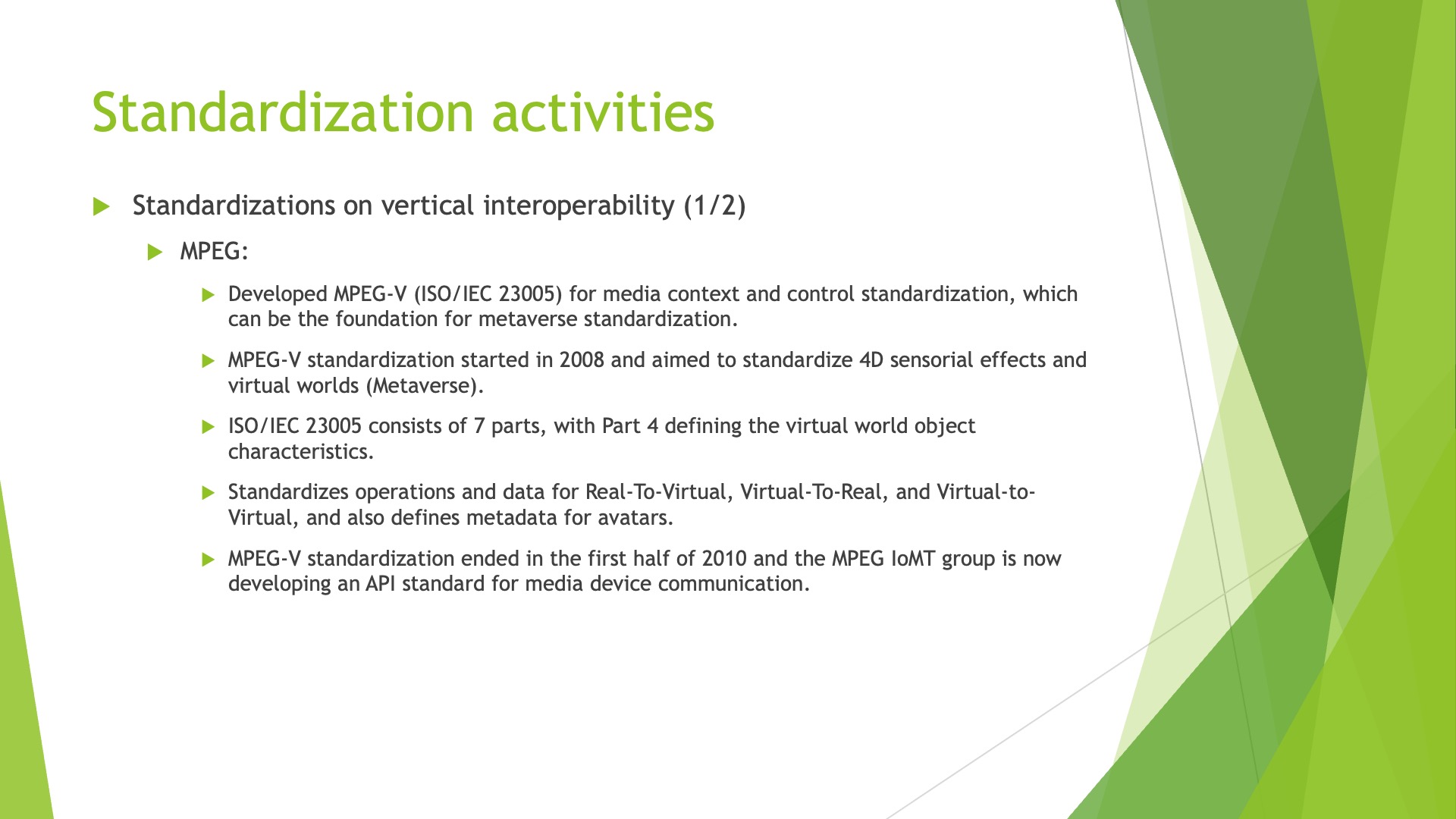 |
The MPEG-V (ISO/IEC 23005) standard for media context and control has been developed as a foundation for metaverse standardization. The standardization process started in 2008 with the goal of standardizing 4D sensorial effects and virtual worlds, including metaverse. ISO/IEC 23005 consists of 7 parts, with Part 4 defining virtual world object characteristics. It standardizes operations and data for Real-To-Virtual, Virtual-To-Real, and Virtual-to-Virtual, and includes metadata for avatars. The standardization process was completed in the first half of 2010, and the MPEG IoMT group is now working on developing an API standard for media device communication.
|
|
ICACT20230032 Slide.10
[Big slide for presentation]
|
Chrome Text-to-Speach Click!! |
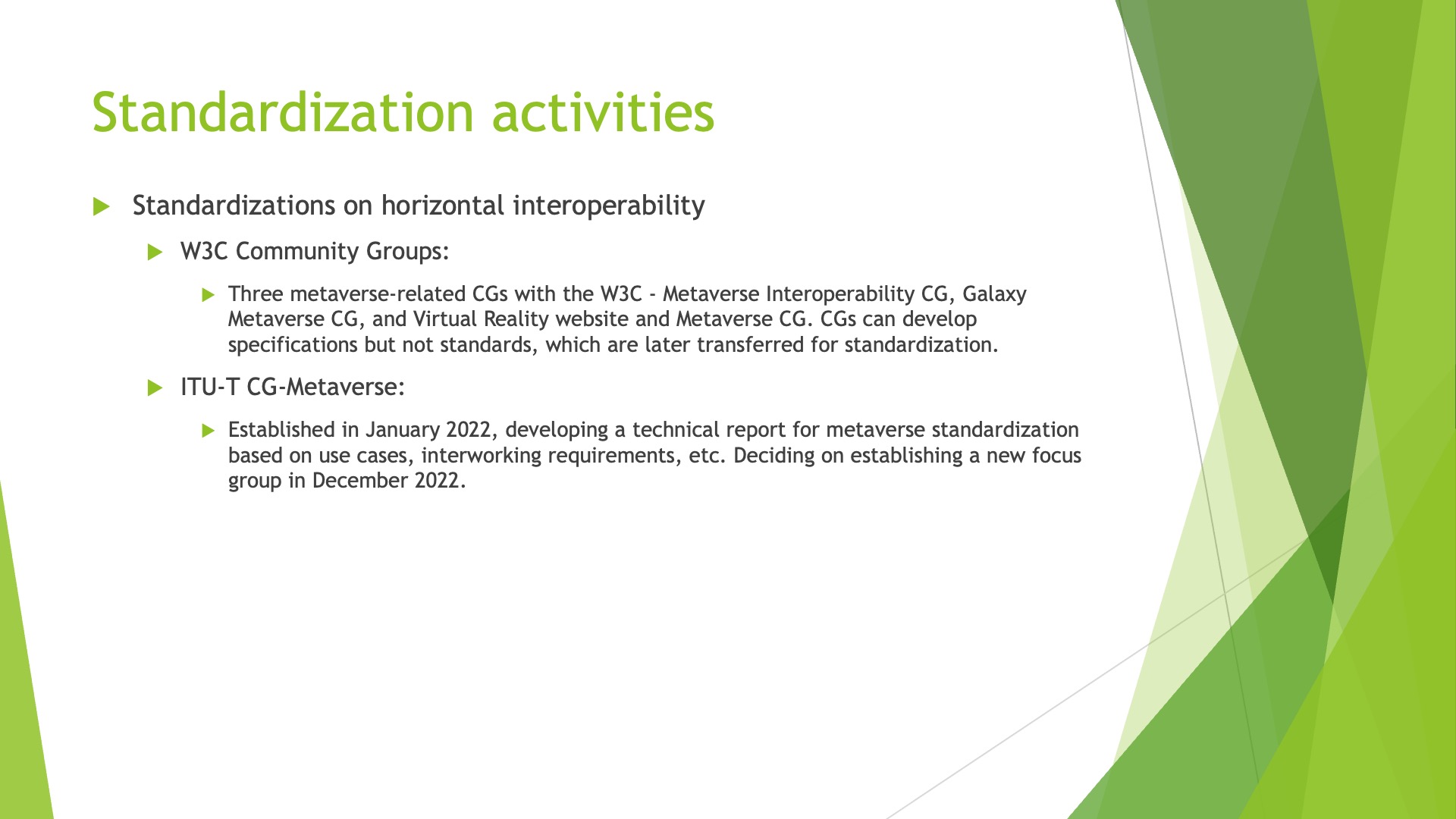 |
W3C Community Groups have formed three metaverse-related groups within the organization - the Metaverse Interoperability Community Group, the Galaxy Metaverse Community Group, and the Virtual Reality Website and Metaverse Community Group. These groups work on developing specifications which are later transferred for standardization. Meanwhile, the ITU-T CG-Metaverse, established in January 2022, is dedicated to developing a technical report for metaverse standardization based on use cases and interworking requirements, with plans to establish a new focus group in December 2022.
|
|
ICACT20230032 Slide.09
[Big slide for presentation]
|
Chrome Text-to-Speach Click!! |
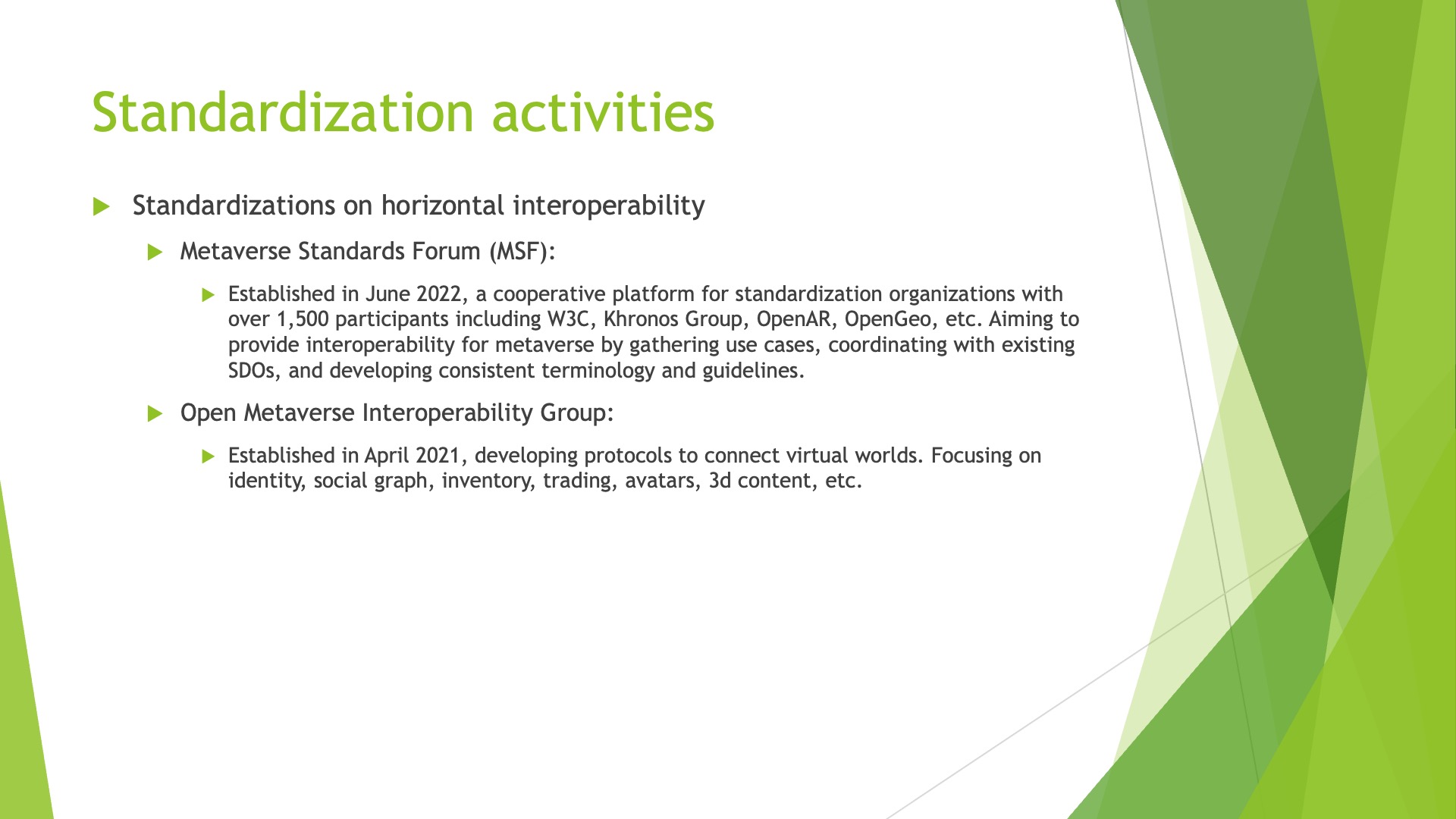 |
As for the standardizations on horizontal interoperability, we can see several SDOs.
The Metaverse Standards Forum (MSF) was established in June 2022, as a collaborative platform for standardization organizations. It has over 1,500 participants, including organizations such as the W3C, Khronos Group, OpenAR, and OpenGeo. MSF aims to provide interoperability for the metaverse by collecting use cases, working with existing standardization organizations, and developing a consistent terminology and set of guidelines. The Open Metaverse Interoperability Group, established in April 2021, is dedicated to developing protocols to connect virtual worlds. The group focuses on important areas such as identity, social graphs, inventory, trading, avatars, and 3D content.
|
|
ICACT20230032 Slide.08
[Big slide for presentation]
|
Chrome Text-to-Speach Click!! |
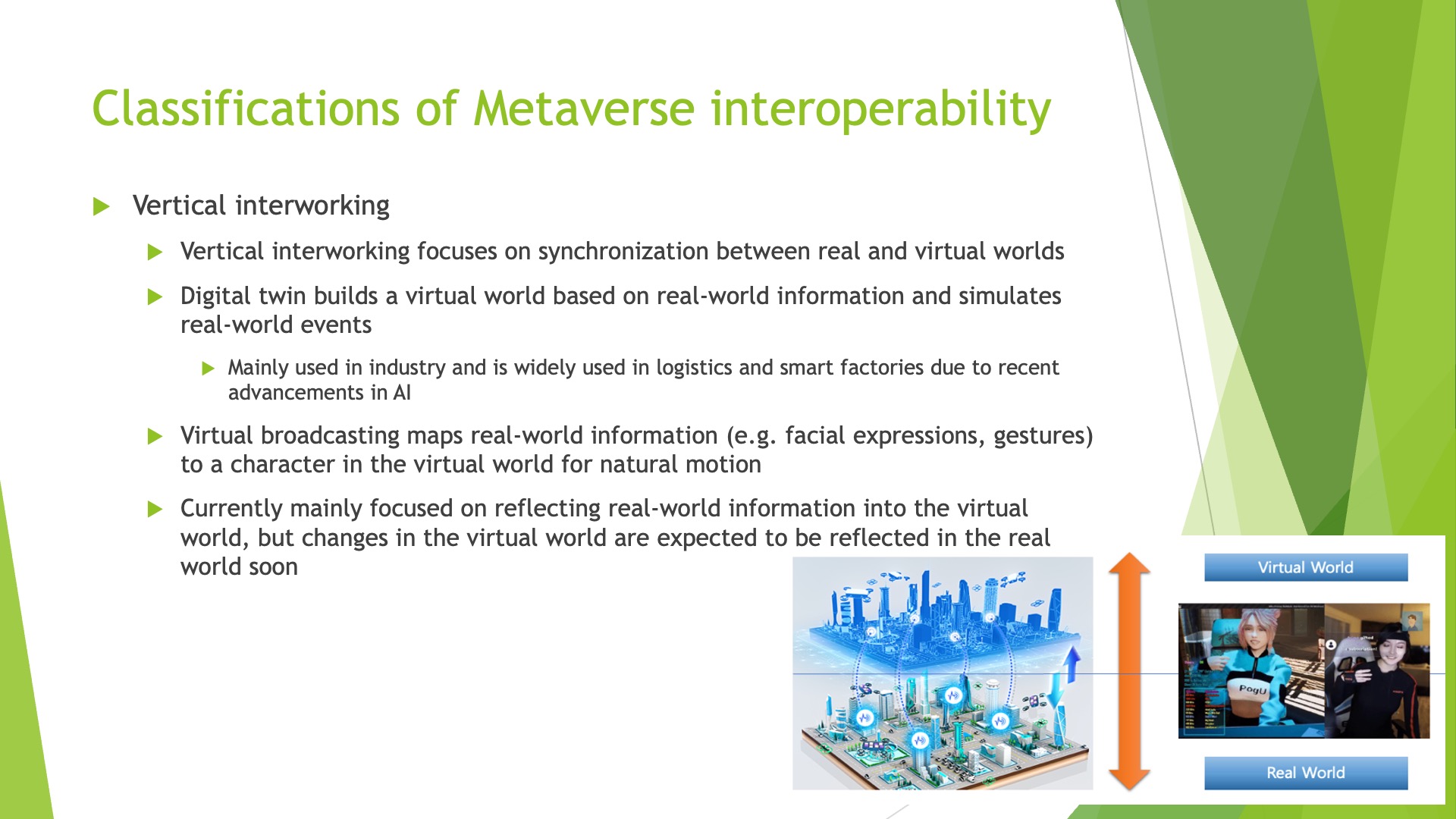 |
Vertical interworking focuses on synchronizing the real and virtual worlds, and a digital twin builds a virtual world based on real-world information and simulates real-world events. This technology is mainly used in industries such as logistics and smart factories due to recent advancements in AI. Virtual broadcasting maps real-world information, such as facial expressions and gestures, to a character in the virtual world, creating natural motion. Currently, the focus is mainly on reflecting real-world information into the virtual world, but soon changes in the virtual world are expected to be reflected in the real world as well.
|
|
ICACT20230032 Slide.07
[Big slide for presentation]
|
Chrome Text-to-Speach Click!! |
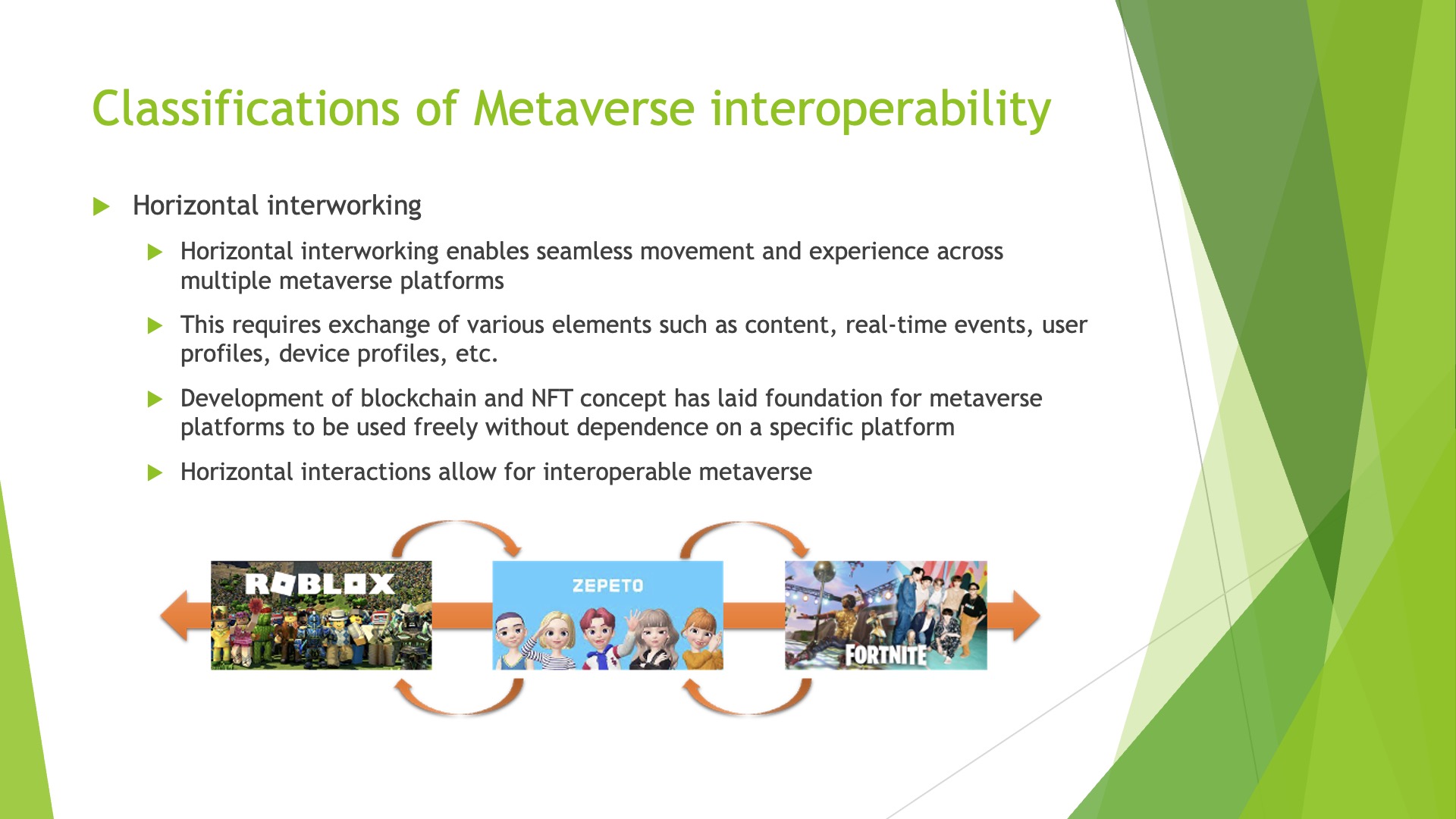 |
Horizontal interworking enables a seamless movement and experience across multiple metaverse platforms by exchanging various elements such as content, real-time events, user profiles, device profiles, and more. The development of blockchain technology and the concept of Non-fungible Tokens (NFTs) have laid the foundation for metaverse platforms to be used freely, without dependence on a specific platform. These horizontal interactions allow for an interoperable metaverse.
|
|
ICACT20230032 Slide.06
[Big slide for presentation]
|
Chrome Text-to-Speach Click!! |
 |
The COVID-19 pandemic has led to a rapid increase in non-face-to-face society and a significant rise in the use of video conferencing services, with an overall increase of 48% and a 535% increase for Zoom. The market for video conferencing services is projected to grow from $6.03 billion in 2021 to $50 billion by 2026. According to a 2022 Statista survey, 92.16% of respondents believe that the pandemic has driven the development of metaverse technology.
|
|
ICACT20230032 Slide.05
[Big slide for presentation]
|
Chrome Text-to-Speach Click!! |
 |
5G technology brings about immersive real-time services and provides sophisticated user location information with its ultra-low latency and high-speed transmission, enabling real and virtual synchronization. Multiaccess Edge Computing (MEC) can efficiently predict or distribute load for application services with Mixed Reality (MR) and Location Based Services (LBS). The requirements for the metaverse, such as ubiquitous access, lightweight XR devices, cloud and edge-cloud capabilities, standardized interfaces, and easy developer access to communication services, can be met through the implementation of 5G technology.
|
|
ICACT20230032 Slide.04
[Big slide for presentation]
|
Chrome Text-to-Speach Click!! |
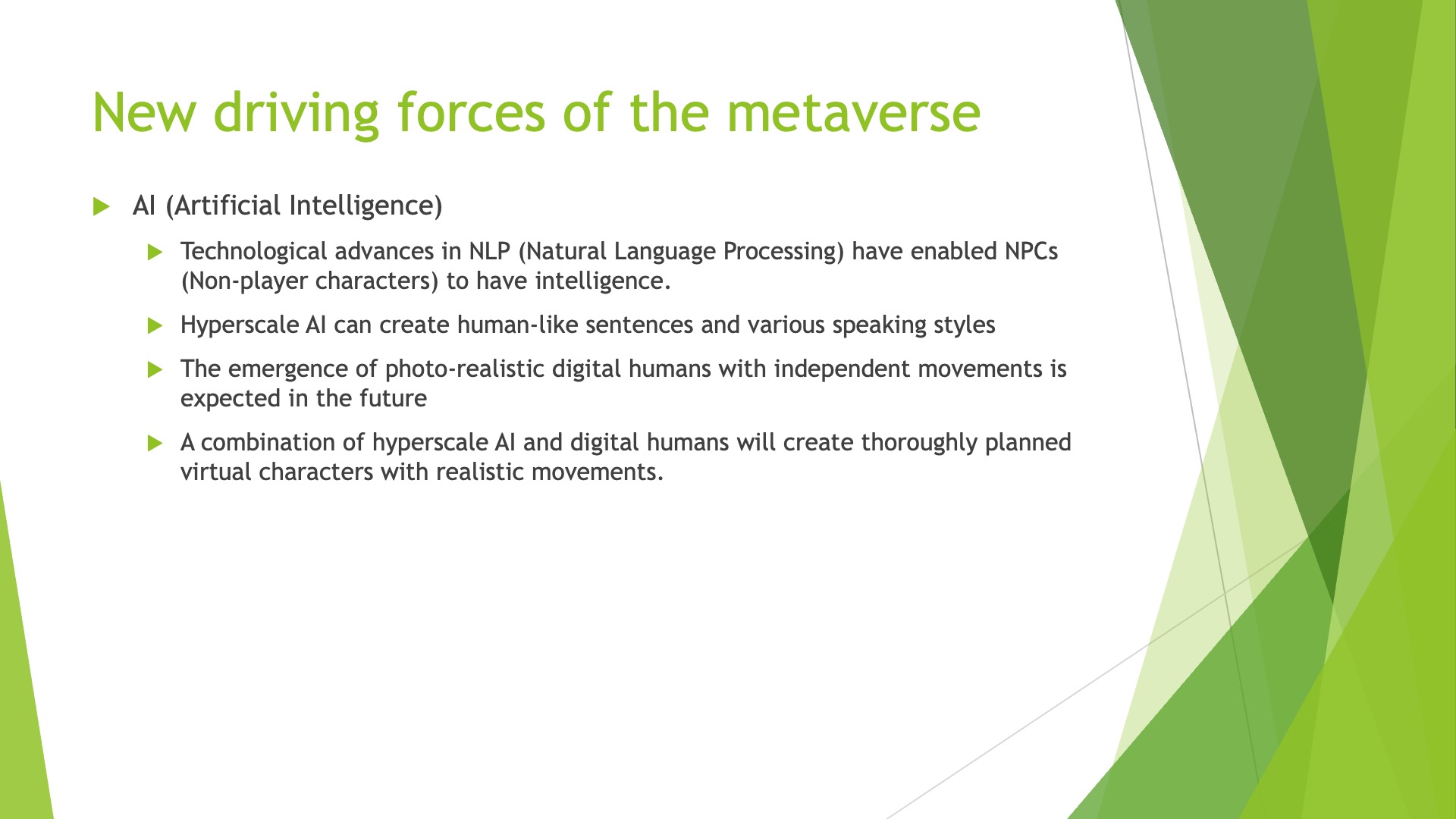 |
Advances in Natural Language Processing (NLP) technology have enabled Non-player characters (NPCs) to have a higher level of intelligence. With the development of hyperscale AI, the creation of human-like sentences and a variety of speaking styles has become possible. In the future, we can expect the emergence of photo-realistic digital humans with independent movements. By combining hyperscale AI and digital humans, thoroughly planned virtual characters with realistic movements can be created.
|
|
ICACT20230032 Slide.02
[Big slide for presentation]
|
Chrome Text-to-Speach Click!! |
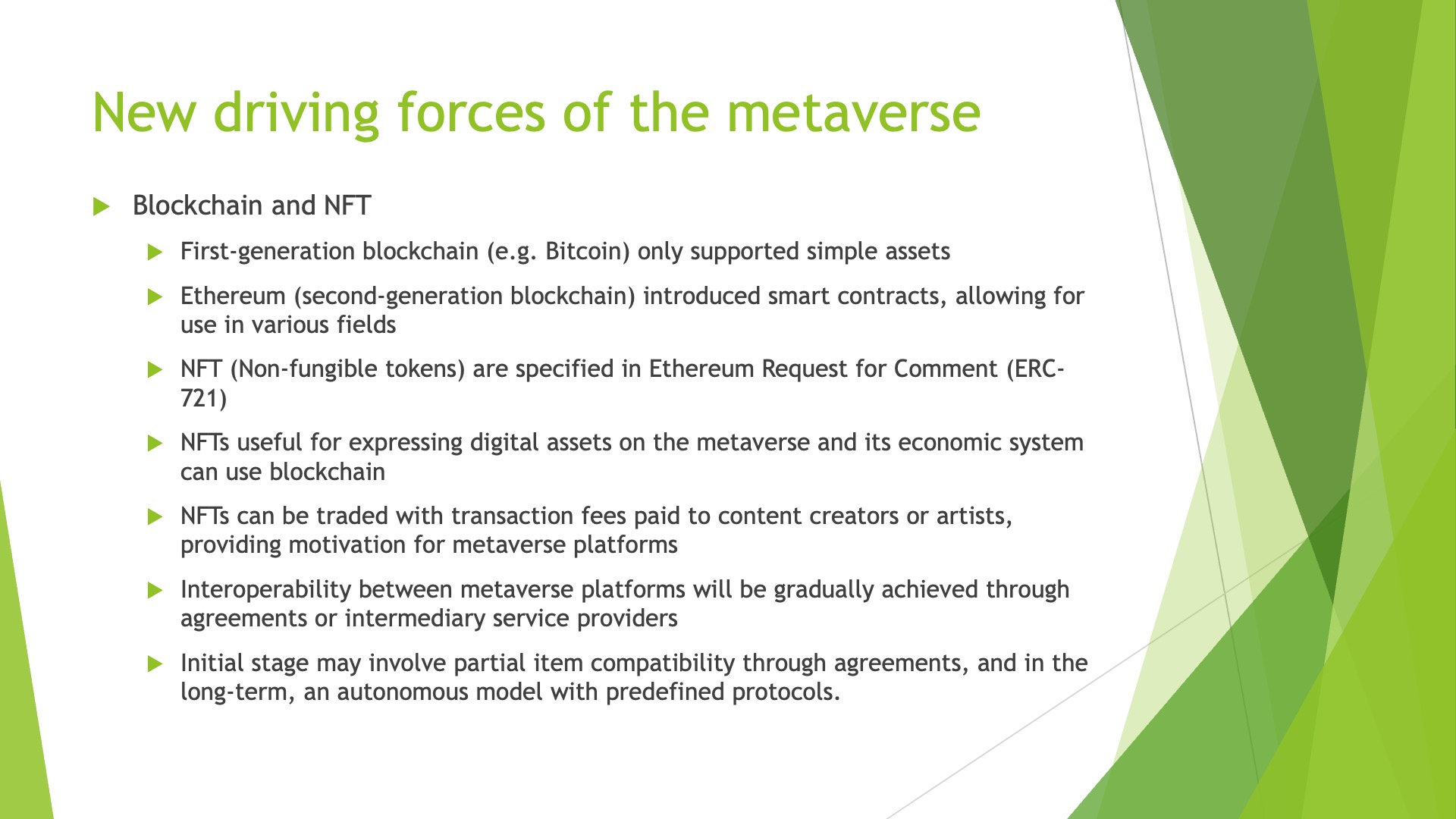 |
First-generation blockchain technology, such as Bitcoin, only supported simple assets. However, with the introduction of Ethereum, the second-generation blockchain, smart contracts became possible, leading to its use in various fields. The concept of Non-fungible tokens (NFTs) was specified in the Ethereum Request for Comment (ERC-721), and they have proven to be useful in expressing digital assets on the metaverse and its economic system through blockchain technology. NFTs can be traded with transaction fees paid to content creators or artists, providing motivation for metaverse platforms. Interoperability between metaverse platforms will be gradually achieved through agreements or intermediary service providers. In the initial stage, this may involve partial item compatibility through agreements, but in the long-term, an autonomous model with predefined protocols is expected.
|
|
ICACT20230032 Slide.01
[Big slide for presentation]
|
Chrome Text-to-Speach Click!! |
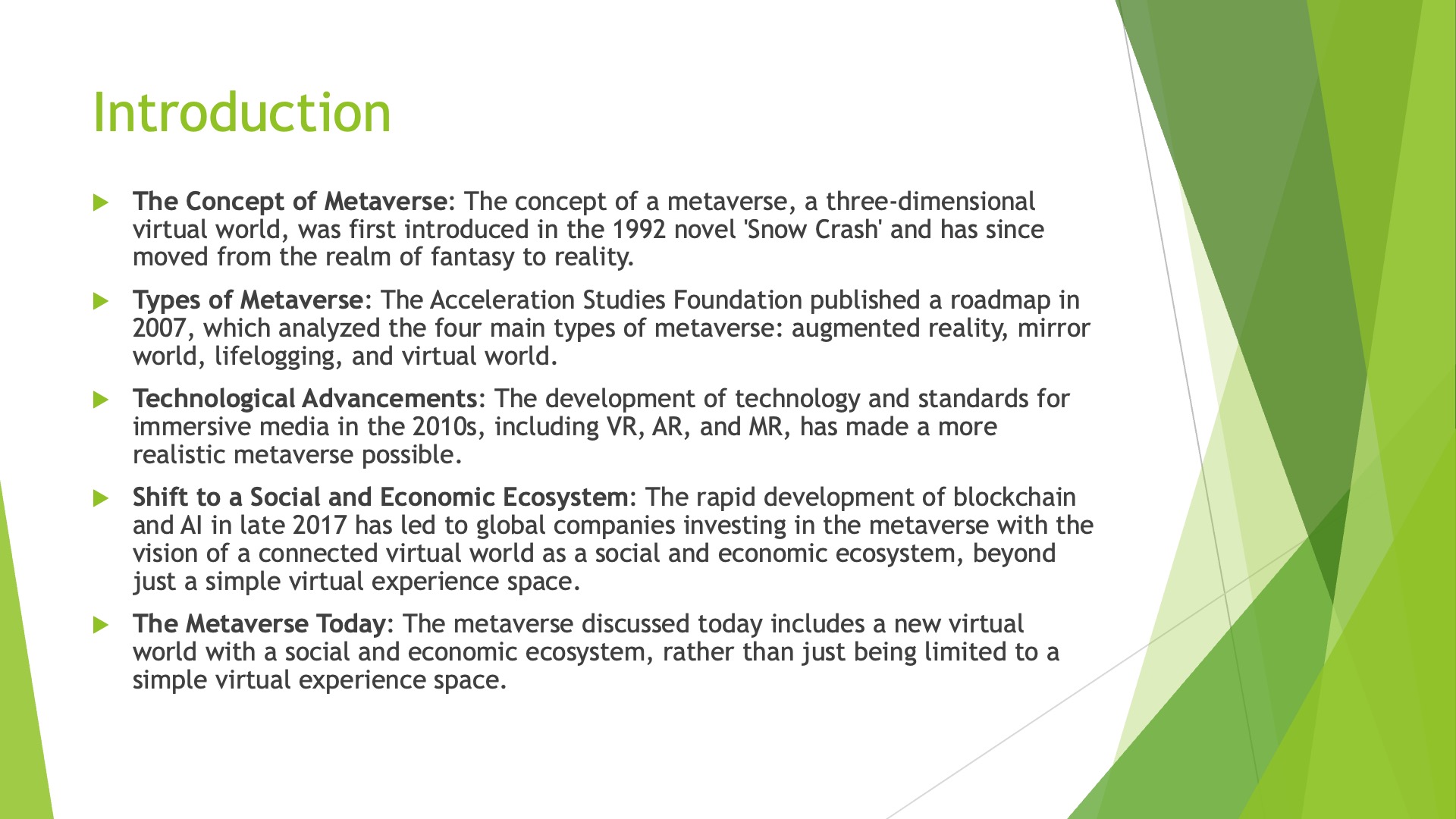 |
The concept of a metaverse, a three-dimensional virtual world, was first introduced in the 1992 novel "Snow Crash" and has since moved from fiction to reality. The Acceleration Studies Foundation published a roadmap in 2007, which categorized the four main types of metaverse as augmented reality, mirror world, lifelogging, and virtual world. The advancements in technology and standards for immersive media, such as VR, AR, and MR, in the 2010s, have made a more realistic metaverse possible. The rise of blockchain and AI in late 2017 has prompted global companies to invest in the metaverse with the vision of a connected virtual world that functions as a social and economic ecosystem, rather than just a simple virtual experience space. Today's metaverse is more than just a virtual experience space, it is a social and economic ecosystem that is constantly evolving.
|
|
ICACT20230032 Slide.00
[Big slide for presentation]
[YouTube] |
Chrome Text-to-Speach Click!! |
 |
Good morning/afternoon, everyone, and thank you for joining our virtual presentation on the topic of standardization for the interoperable metaverse. As we continue to explore the virtual world through online means, it is crucial that we have a standardized approach for seamless integration and interoperability across multiple platforms and systems. The demand for standardization in the metaverse has never been higher, and our study will examine the potential benefits and challenges of standardization in this rapidly growing field, and its impact on the future of virtual reality. Today, we will share with you our findings and provide recommendations on how standardization can support the development and growth of the metaverse, making it a more accessible and inclusive online environment for all.
|
















