 ICACT20250166 Slide.20
[Big slide for presentation]
[YouTube] |
Chrome Text-to-Speach Click!! |
 |
That’s all. Thank you for your listening~
|
|
ICACT20250166 Slide.19
[Big slide for presentation]
[YouTube] |
Chrome Text-to-Speach Click!! |
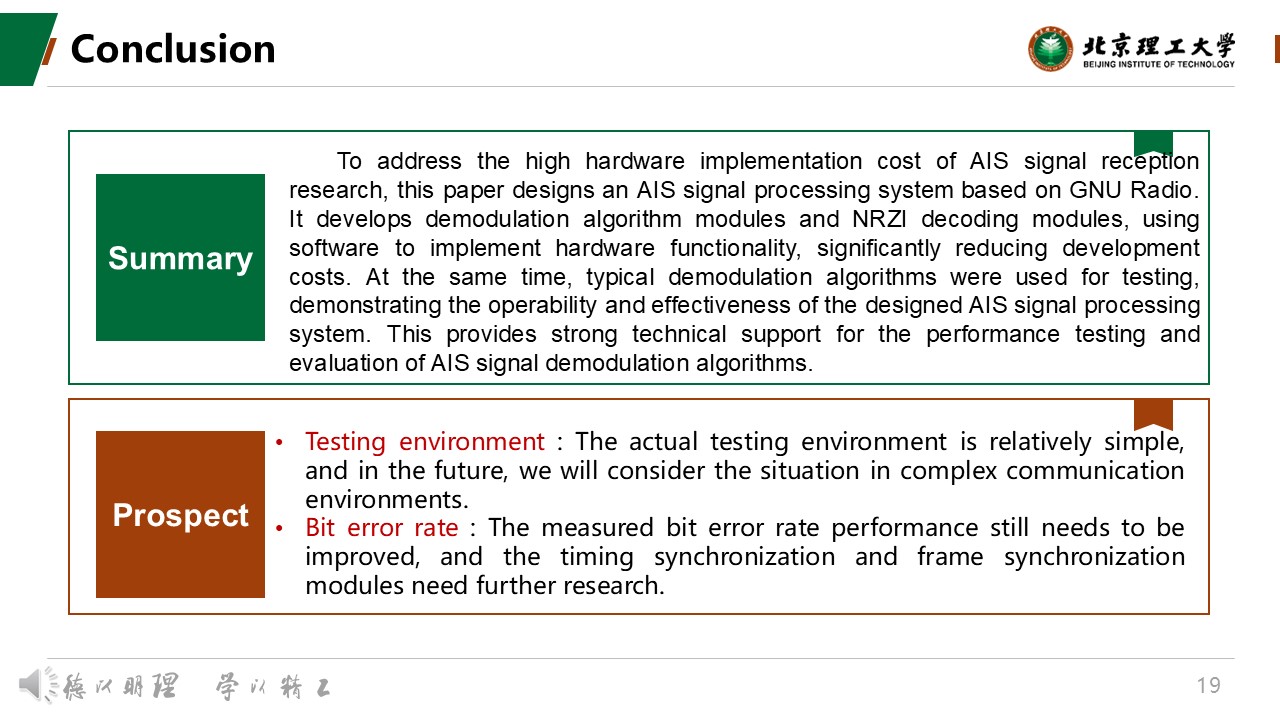 |
This paper mainly proposes an AIS signal processing system based on GNU Radio. The innovation of this paper is using software to implement hardware functionality, significantly reducing development costs.
However there still exist some shortages in the aspect of Testing environment and Bit error rate . So, in the future, my team and I will go on optimizing the approach on these issues.
|
|
ICACT20250166 Slide.18
[Big slide for presentation]
[YouTube] |
Chrome Text-to-Speach Click!! |
 |
In the last section, I will summarize the results of the paper, and look forward the future work.
|
|
ICACT20250166 Slide.17
[Big slide for presentation]
[YouTube] |
Chrome Text-to-Speach Click!! |
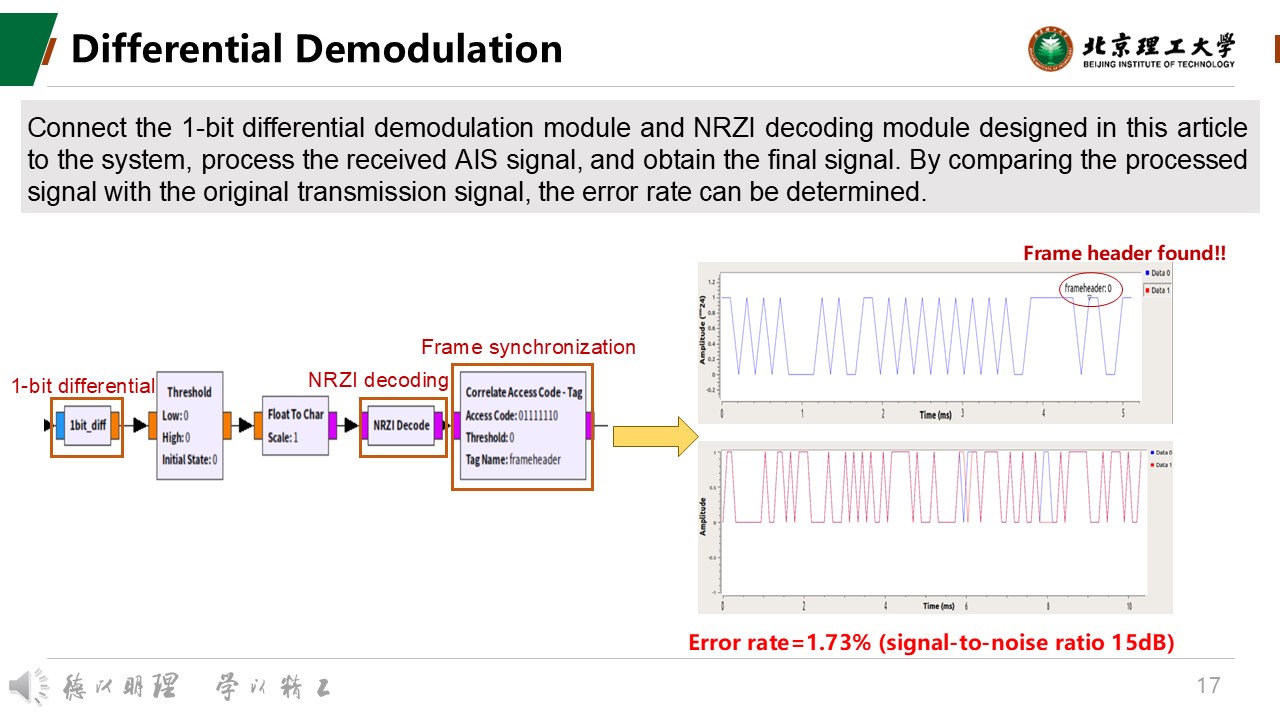 |
For the Differential Demodulation part, connect the 1-bit differential demodulation module and NRZI decoding module designed in this article to the system, process the received AIS signal, and obtain the final signal.
As shown in the upper right image, we have found the frame header of the signal and successfully decoded and demodulated the AIS signal. By comparing the final signal with the initial transmission signal, the error rate can be calculated to be 1.73% at a signal-to-noise ratio of 15dB.
|
|
ICACT20250166 Slide.16
[Big slide for presentation]
[YouTube] |
Chrome Text-to-Speach Click!! |
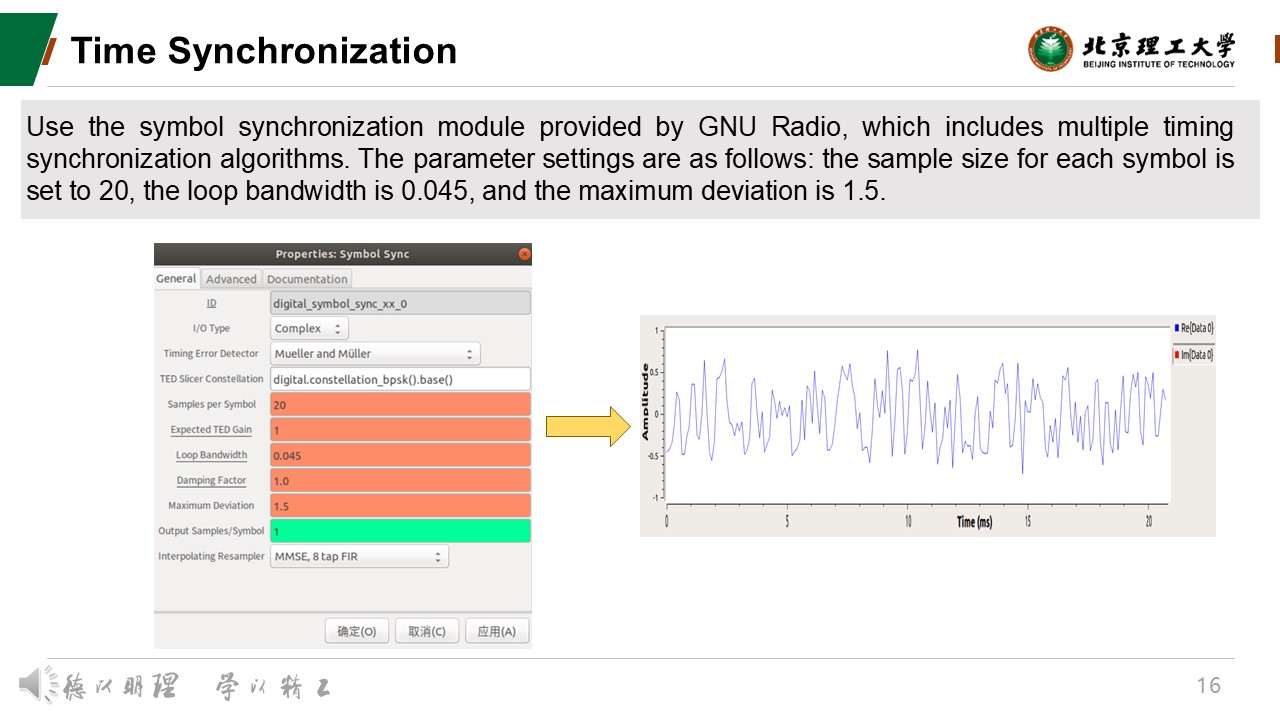 |
For the time synchronization part, use the symbol synchronization module provided by GNU Radio, set the corresponding parameters, and ensure that the receiving end can accurately restore the symbol timing of the sending end.
|
|
ICACT20250166 Slide.15
[Big slide for presentation]
[YouTube] |
Chrome Text-to-Speach Click!! |
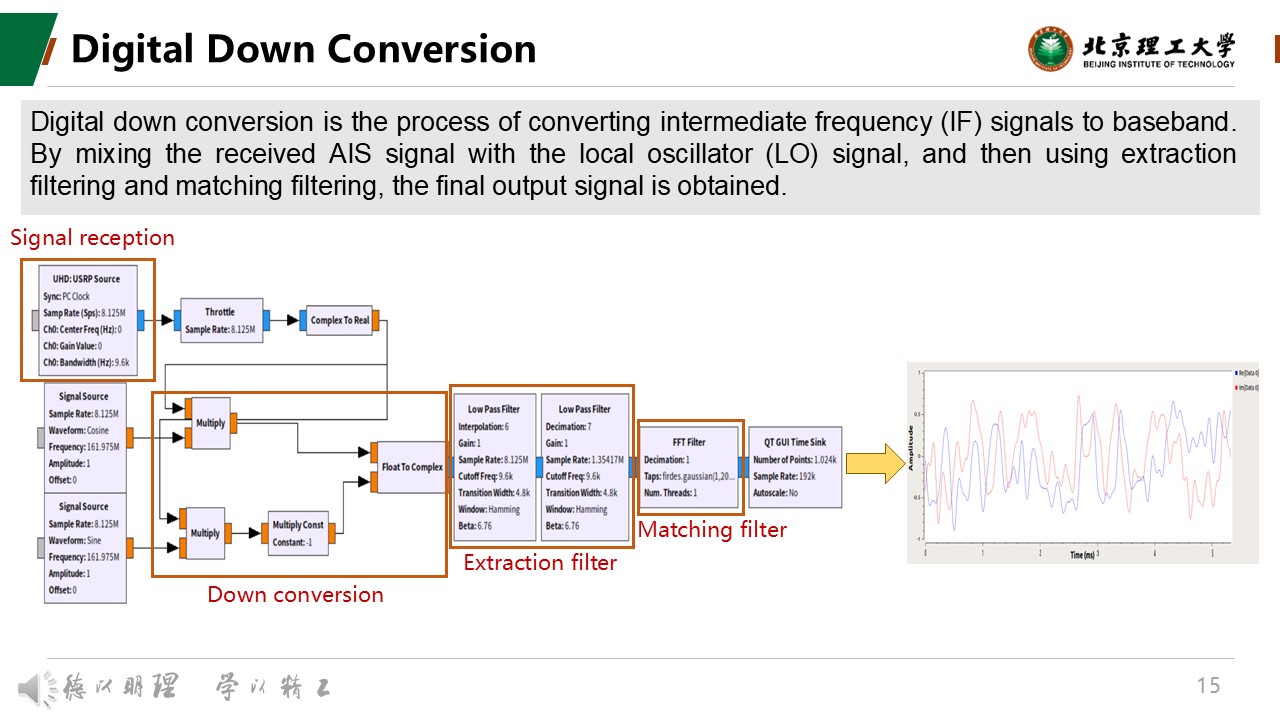 |
Digital down conversion is the process of converting intermediate frequency signals to baseband. By mixing the received AIS signal with the local oscillator signal, and then using extraction filter and matching filter, the final output signal is obtained.
The right figure shows the AIS signal after digital down conversion.
|
|
ICACT20250166 Slide.14
[Big slide for presentation]
[YouTube] |
Chrome Text-to-Speach Click!! |
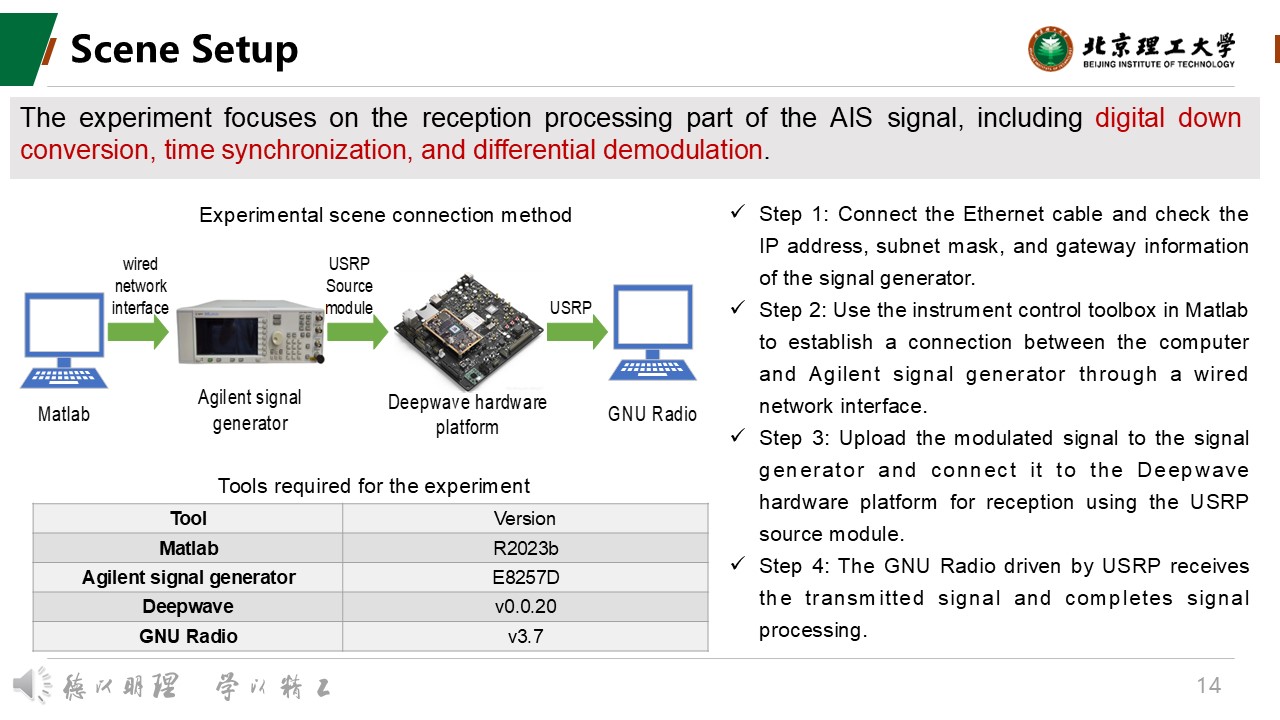 |
The experimental scenario is shown in the figure. Matlab, Agilent signal generator, Deepwave hardware platform, and GNU Radio are connected to simulate the entire process of AIS signal transmission and reception.
The experiment focuses on the reception processing part, including digital down conversion, time synchronization, and differential demodulation.
Now, I will provide a detailed introduction to each section.
|
|
ICACT20250166 Slide.13
[Big slide for presentation]
[YouTube] |
Chrome Text-to-Speach Click!! |
 |
To prove the proposed Module practical, testing experiments are carried out in this part.
|
|
ICACT20250166 Slide.12
[Big slide for presentation]
[YouTube] |
Chrome Text-to-Speach Click!! |
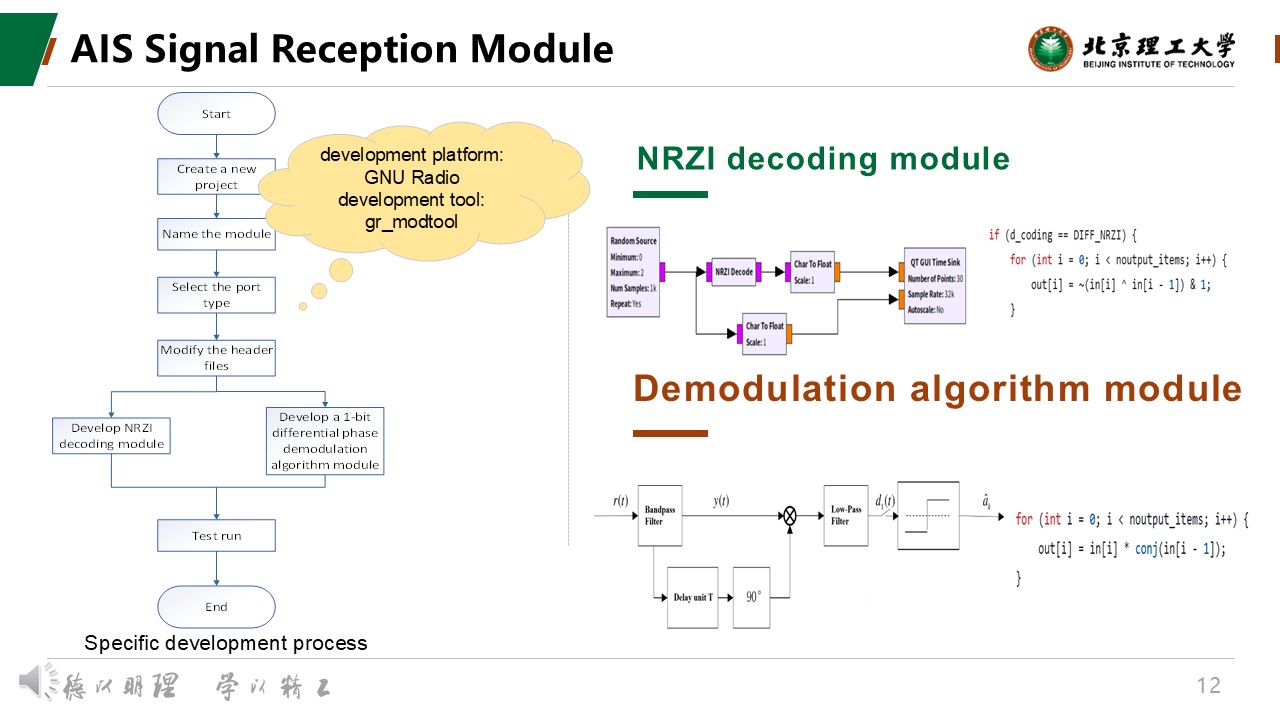 |
According to system requirements, it is necessary to independently develop the demodulation algorithm module and the NRZI decoding module, while other functions can be directly called from the GNU Radio software platform. Using the gr_modtool, first create a new project, then navigate to the directory and name the module. After that, select the port type, modify the header files, and adjust the C++ files to complete the custom module development. The specific development process is shown here.
For the NRZI decoding module, each output item depends on the state of the current input item and the previous input item. By using the XOR operation, the changes in the signal can be determined, and then through negation and the AND operation, the corresponding decoded result is ultimately output.
For the decoding algorithm module, this paper has chosen the classic 1-bit differential phase demodulation algorithm as the system testing algorithm, which performs the conjugate multiplication of the current symbol with the previous symbol.
|
|
ICACT20250166 Slide.11
[Big slide for presentation]
[YouTube] |
Chrome Text-to-Speach Click!! |
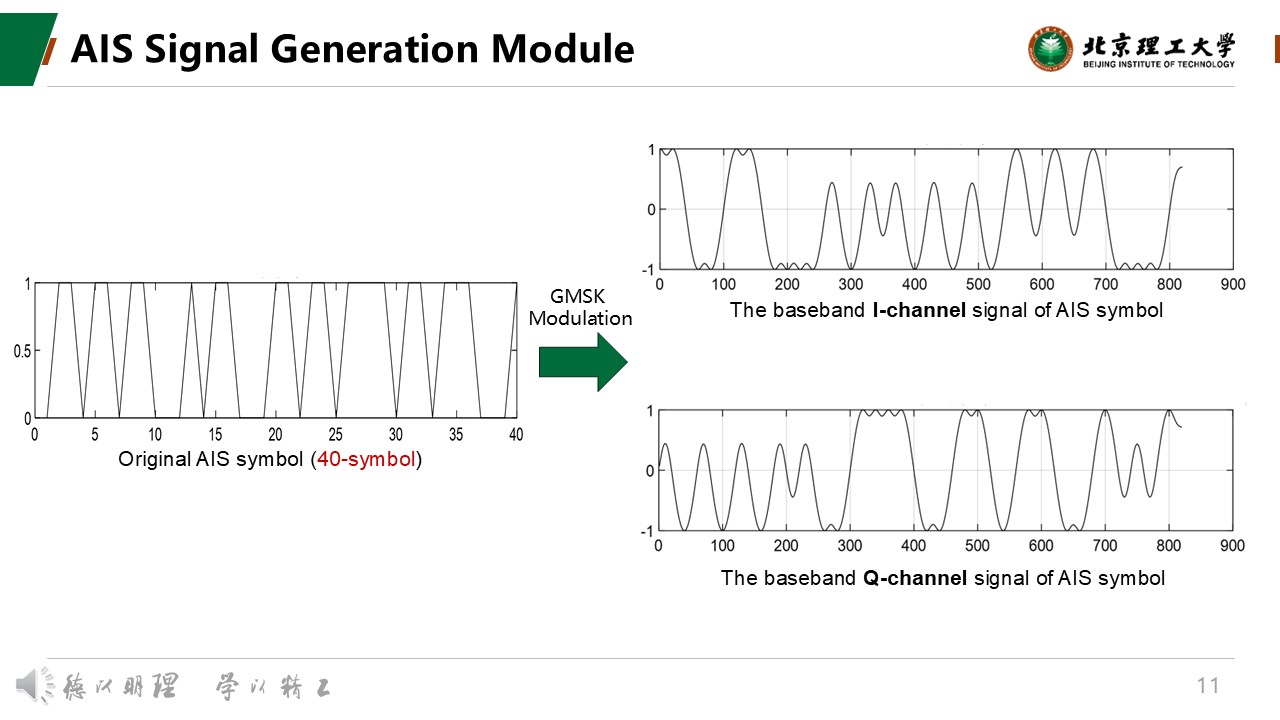 |
Using a 40-symbol example, The left image shows the Original AIS signal, which is modulated by GMSK to generate the final modulated signal on the right, divided into I channel and Q channel
|
|
ICACT20250166 Slide.10
[Big slide for presentation]
[YouTube] |
Chrome Text-to-Speach Click!! |
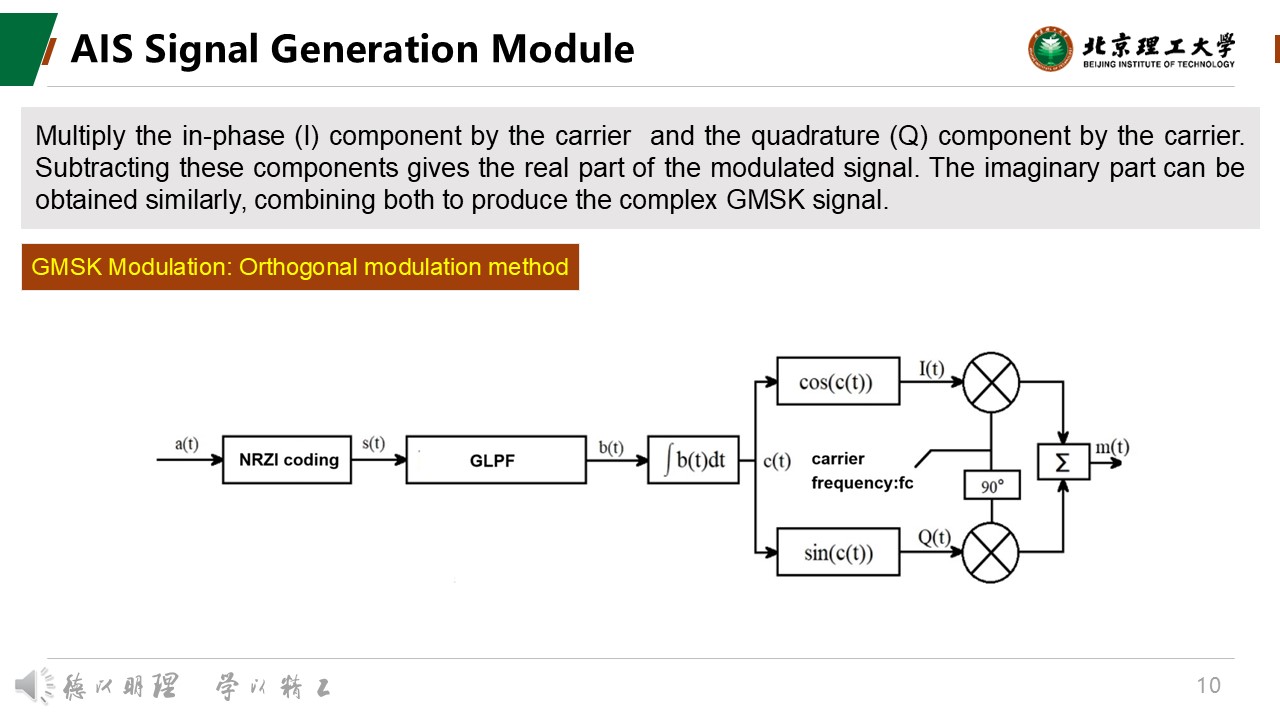 |
In the AIS Signal Generation Module, GMSK orthogonal method is used for modulation, and the filtered waveform is modulated with sine and cosine carriers to generate real and imaginary components.
|
|
ICACT20250166 Slide.09
[Big slide for presentation]
[YouTube] |
Chrome Text-to-Speach Click!! |
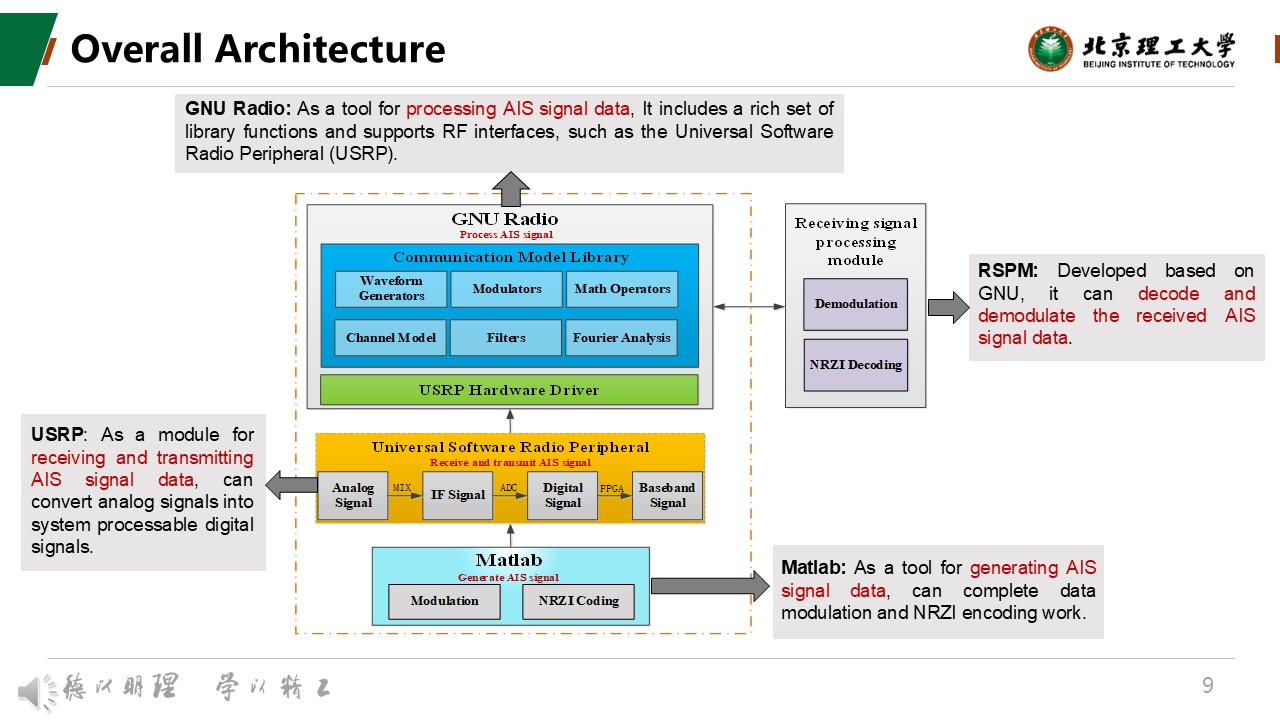 |
The AIS reception signal processing system considered in this paper is here.
This architecture is mainly composed of GNU Radio, USRP, matlab, and RSPM.
Each part cooperates with each other co-ordinately, and plays their respective roles.
|
|
ICACT20250166 Slide.08
[Big slide for presentation]
[YouTube] |
Chrome Text-to-Speach Click!! |
 |
Then, I’ll show you the details of the modeling methods.
|
|
ICACT20250166 Slide.07
[Big slide for presentation]
[YouTube] |
Chrome Text-to-Speach Click!! |
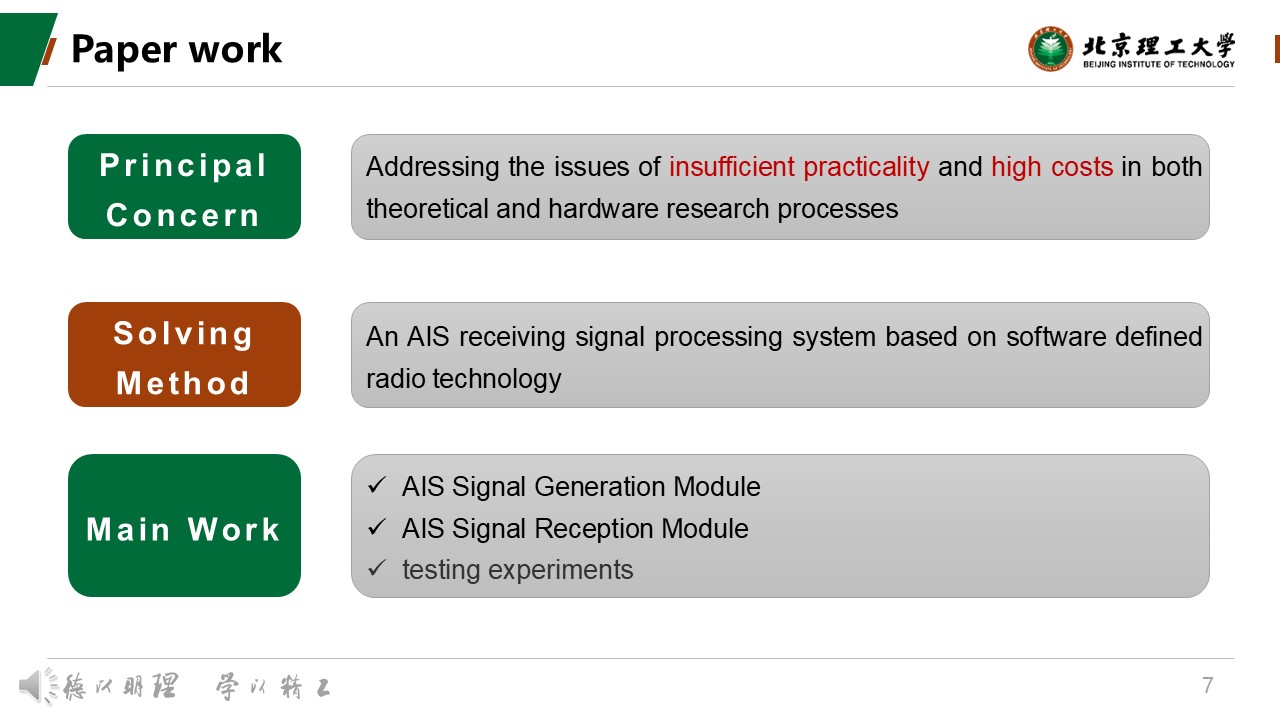 |
Therefore, the work of this paper is summarized as shown.
Aiming at addressing the issues of insufficient practicality and high costs in both theoretical and hardware research processes, the AIS Signal Generation Module and AIS Signal Reception Module are modeled. We propose an AIS reception signal processing system based on GNU Radio, and conduct some testing experiments on this system.
|
|
ICACT20250166 Slide.06
[Big slide for presentation]
[YouTube] |
Chrome Text-to-Speach Click!! |
 |
The accuracy of AIS receivers in processing received signals directly impacts the BER and PER of AIS systems. A well-designed signal processing scheme can enhance the robustness and anti-interference capabilities of AIS systems.
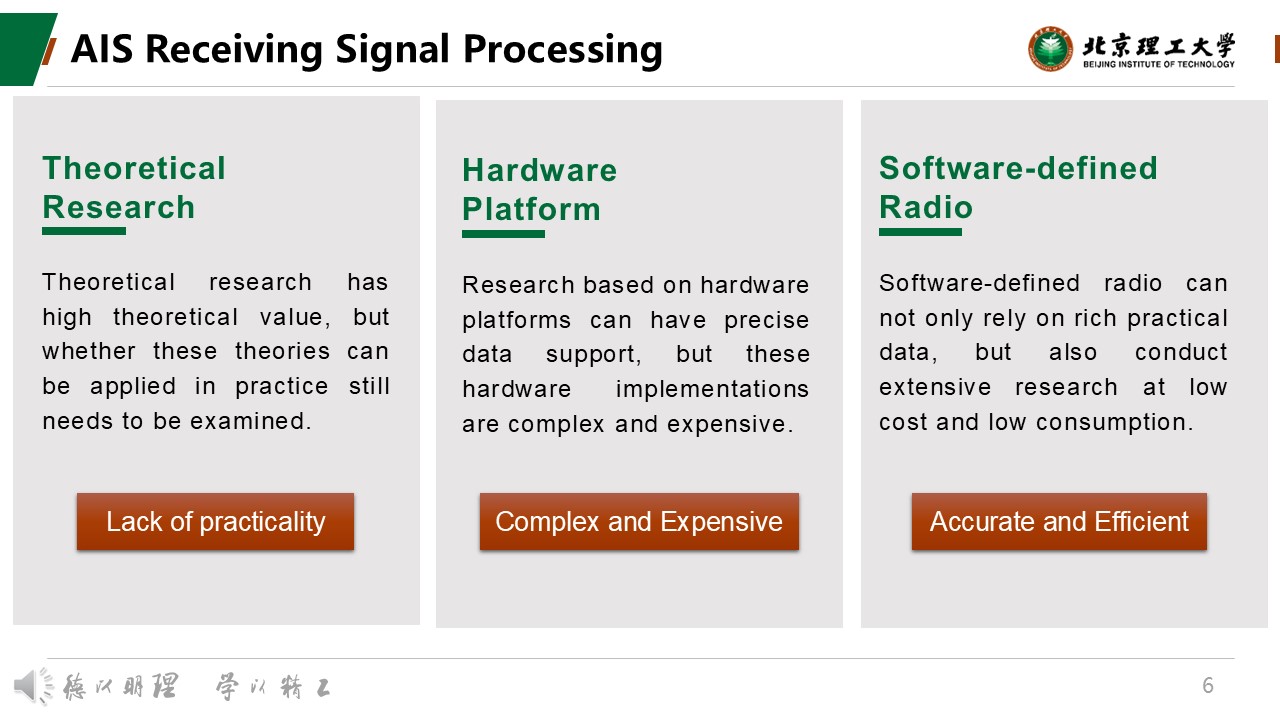
At present, there are three main approaches to research on AIS signal reception technology: Theoretical Research, Hardware Platform, and Software-defined Radio.
Among them, software defined radio summarizes the advantages and disadvantages of theoretical research and hardware Platform, not only based on rich practical data, but also capable of conducting extensive research at low cost and low consumption.
Thus, this paper utilizes software defined radio technology and conducts research based on GNU Radio software.
|
|
ICACT20250166 Slide.05
[Big slide for presentation]
[YouTube] |
Chrome Text-to-Speach Click!! |
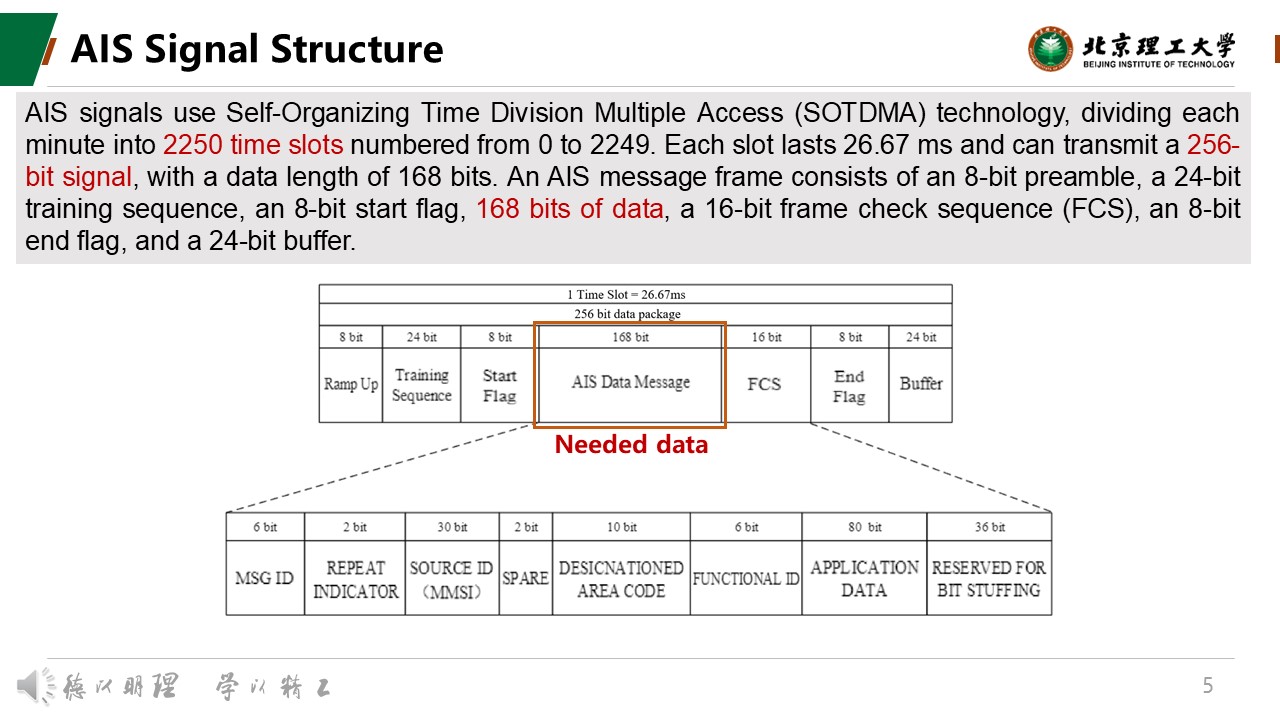 |
The AIS Signal Structure, as shown in the figure, consists of 2250 time slots, including 168 bits of data, which is what we need to parse.
|
|
ICACT20250166 Slide.04
[Big slide for presentation]
[YouTube] |
Chrome Text-to-Speach Click!! |
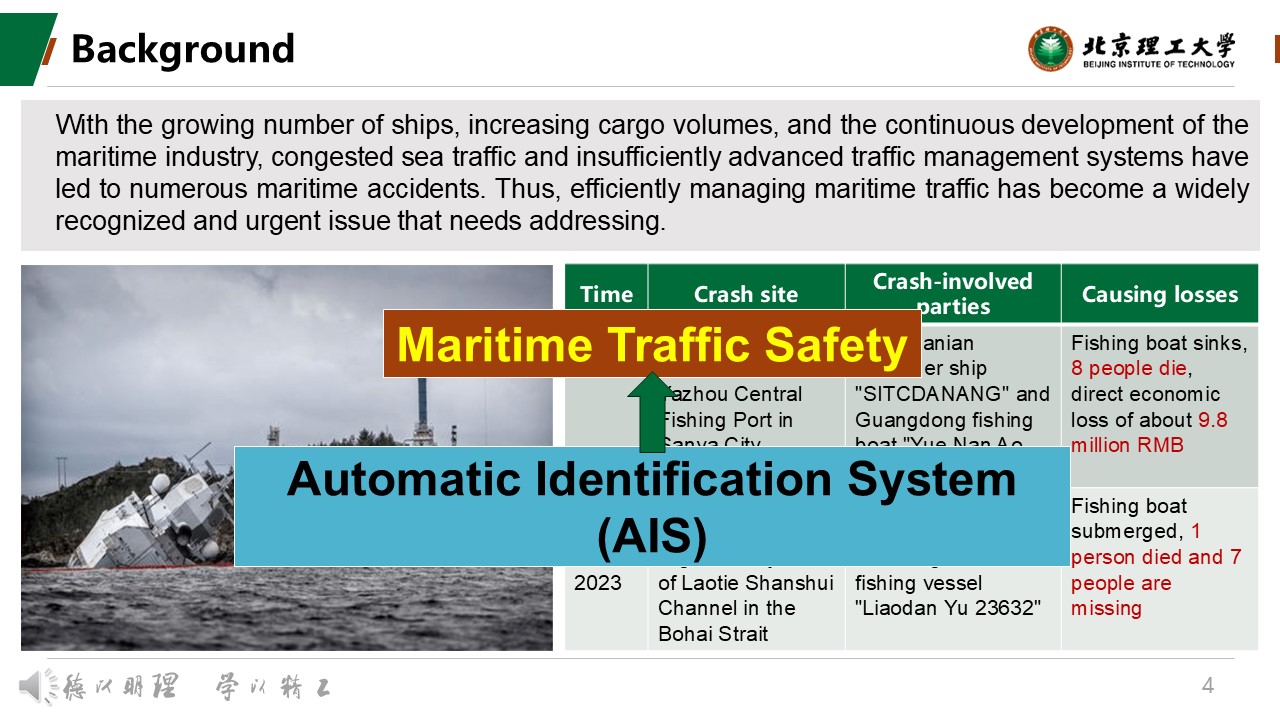 |
With the growing number of ships, increasing cargo volumes, and the continuous development of the maritime industry, congested sea traffic and insufficiently advanced traffic management systems have led to numerous maritime accidents.
For example, two major maritime traffic accidents occurred in April 2024 and September 2023, resulting in significant losses.
Thus, efficiently managing maritime traffic has become a widely recognized and urgent issue that needs addressing.
In order to solve the problem of maritime traffic safety, researchers have proposed an Automatic Identification System, which provides an effective way to avoid traffic accidents.
|
|
ICACT20250166 Slide.03
[Big slide for presentation]
[YouTube] |
Chrome Text-to-Speach Click!! |
 |
Let’s look at the introduction part first.
In this part, I’ll show you the research background, the common used technology and my paper contribution.
|
|
ICACT20250166 Slide.02
[Big slide for presentation]
[YouTube] |
Chrome Text-to-Speach Click!! |
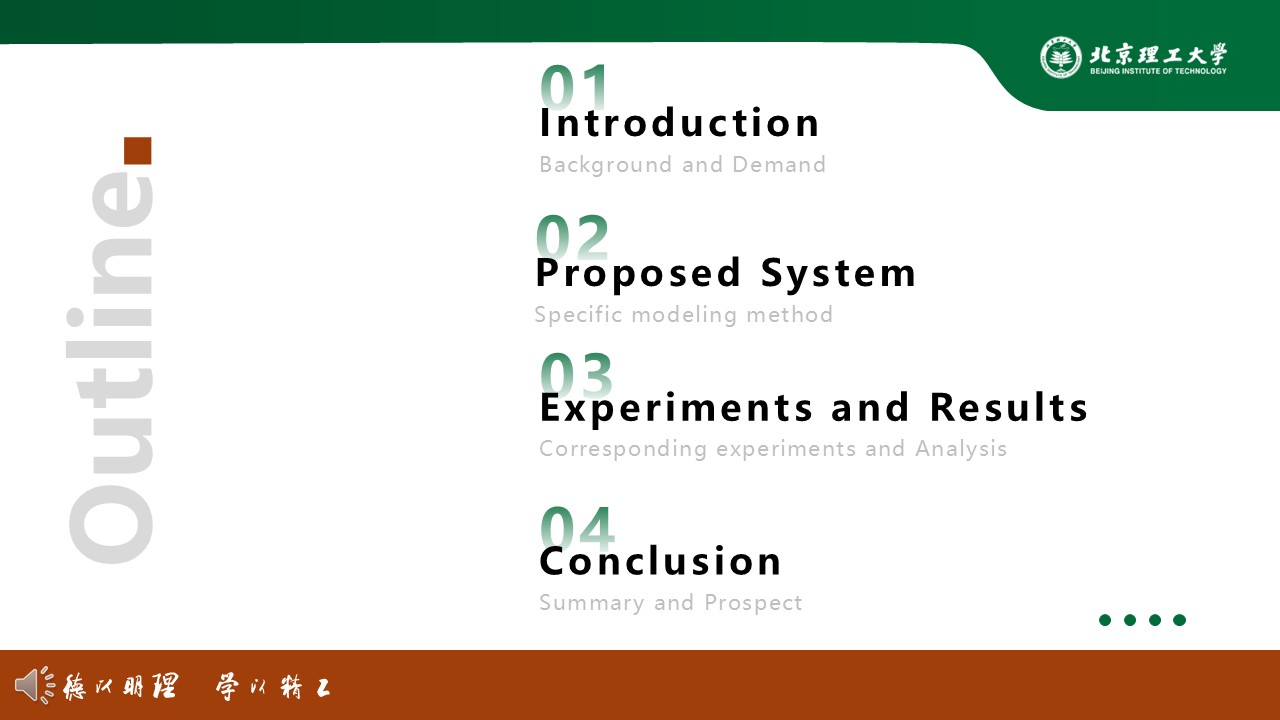 |
My presentation is organized in 4 parts——introduction, proposed System, experiments and results and conclusion.
|
|
ICACT20250166 Slide.01
[Big slide for presentation]
[YouTube] |
Chrome Text-to-Speach Click!! |
 |
Hello, everyone! I’m Zijiao Zhou from Beijing Institute of Technology. I’m so glad to be here to share you with my paper. The title is Research and Design of AIS Reception Signal Processing System Based on GNU Radio.
|
















