 ICACT20210195 Slide.16
[Big slide for presentation]
[YouTube] |
Chrome Text-to-Speach Click!! |
 |
Thank you very much for your time. Please post any questions you have.
|
|
ICACT20210195 Slide.15
[Big slide for presentation]
[YouTube] |
Chrome Text-to-Speach Click!! |
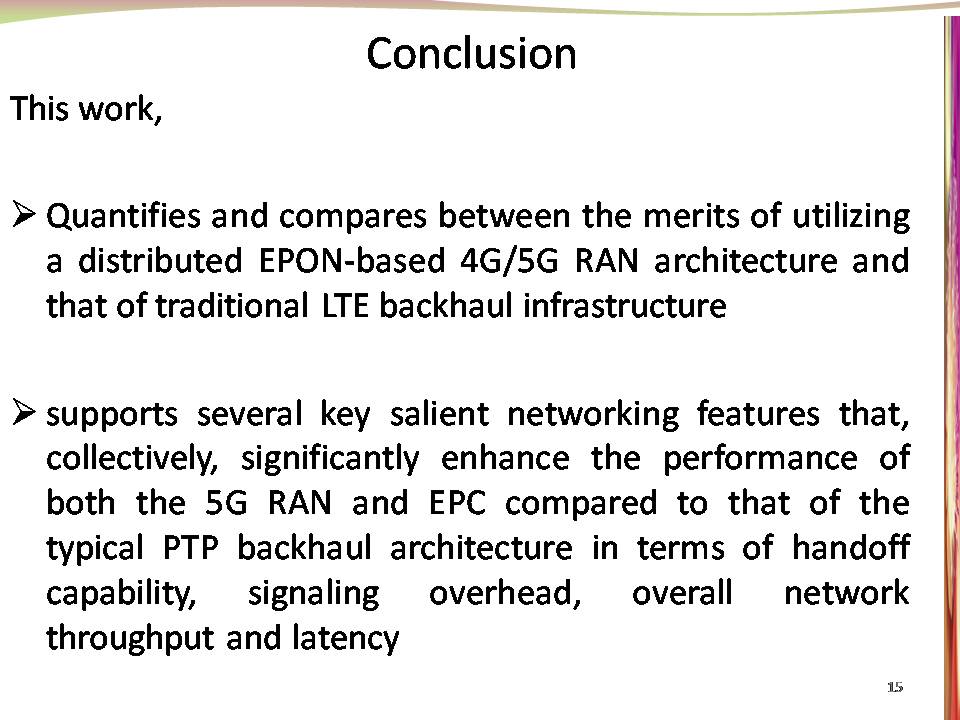 |
In conclusion, this work Quantifies and compares between the merits of utilizing a distributed EPON-based 4G/5G RAN architecture and that of traditional LTE backhaul infrastructure.
It also supports several key salient networking features that, collectively, significantly enhance the performance of both the 5G RAN and EPC compared to that of the typical PTP backhaul architecture in terms of handoff capability, signaling overhead, overall network throughput and latency.
|
|
ICACT20210195 Slide.14
[Big slide for presentation]
[YouTube] |
Chrome Text-to-Speach Click!! |
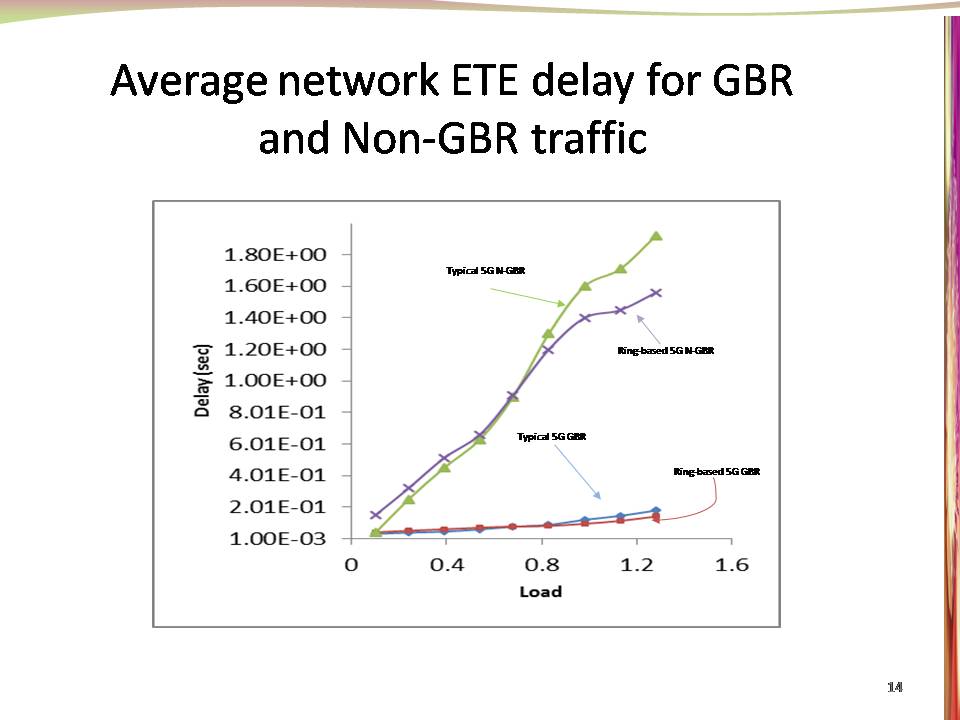 |
This slide shows simulation results of the comparison of average End-to-end delay for both ring-based and typical 5G architectures. Again, ring-based 5G architecture shows less end-to-end delay than typical 5G for both Guaranteed bit rate and non guaranteed bit rat traffic.
|
|
ICACT20210195 Slide.13
[Big slide for presentation]
[YouTube] |
Chrome Text-to-Speach Click!! |
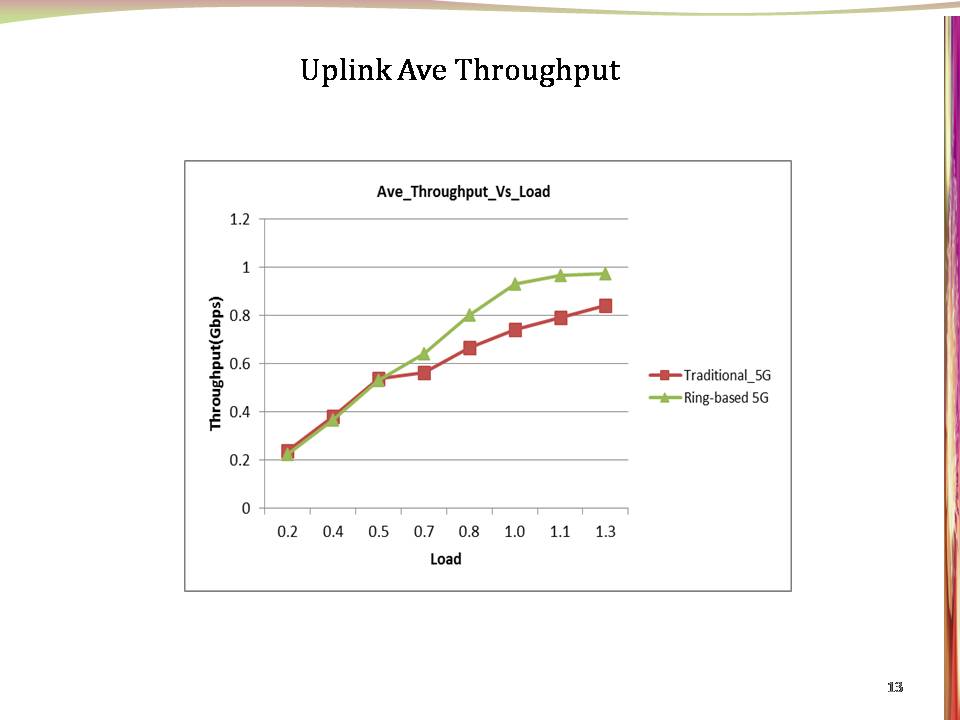 |
This slide shows simulation results of Average uplink throughput of ring-based 5G versus typical 5G architecture. Both architectures show similar performance at low network loads upto 0.5. However at network load of more than 0.6, our proposed ring-based architecture shows superior performance.
|
|
ICACT20210195 Slide.12
[Big slide for presentation]
[YouTube] |
Chrome Text-to-Speach Click!! |
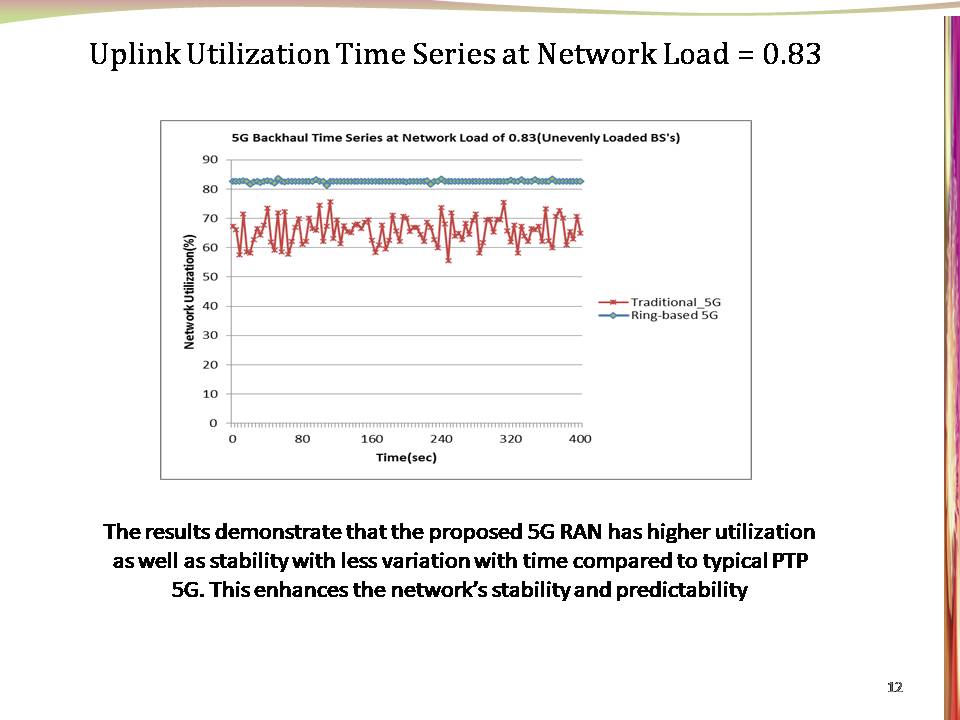 |
This slide shows simulation results of Uplink Utilization Time Series at Network Load = 0.83. The results demonstrate that the proposed 5G RAN has higher utilization as well as stability with less variation with time compared to typical PTP 5G. This enhances the network’s stability and predictability
|
|
ICACT20210195 Slide.11
[Big slide for presentation]
[YouTube] |
Chrome Text-to-Speach Click!! |
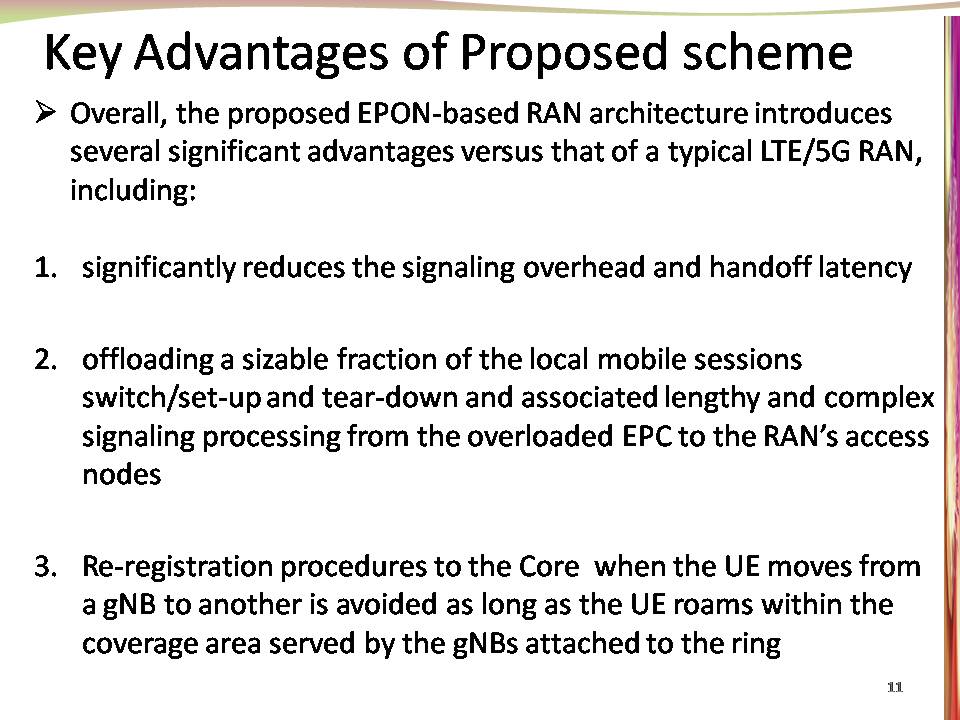 |
Overall, the proposed EPON-based RAN architecture introduces several significant advantages versus that of a typical LTE/5G RAN such as it significantly reduces the signaling overhead and handoff latency, offloading a sizable fraction of the local mobile sessions switch/set-up and tear-down and associated lengthy and complex signaling processing from the overloaded EPC to the RAN’s access nodes. Finally, Re-registration procedures to the Core when the UE moves from a gNB to another is avoided as long as the UE roams within the coverage area served by the gNBs attached to the ring
|
|
ICACT20210195 Slide.10
[Big slide for presentation]
[YouTube] |
Chrome Text-to-Speach Click!! |
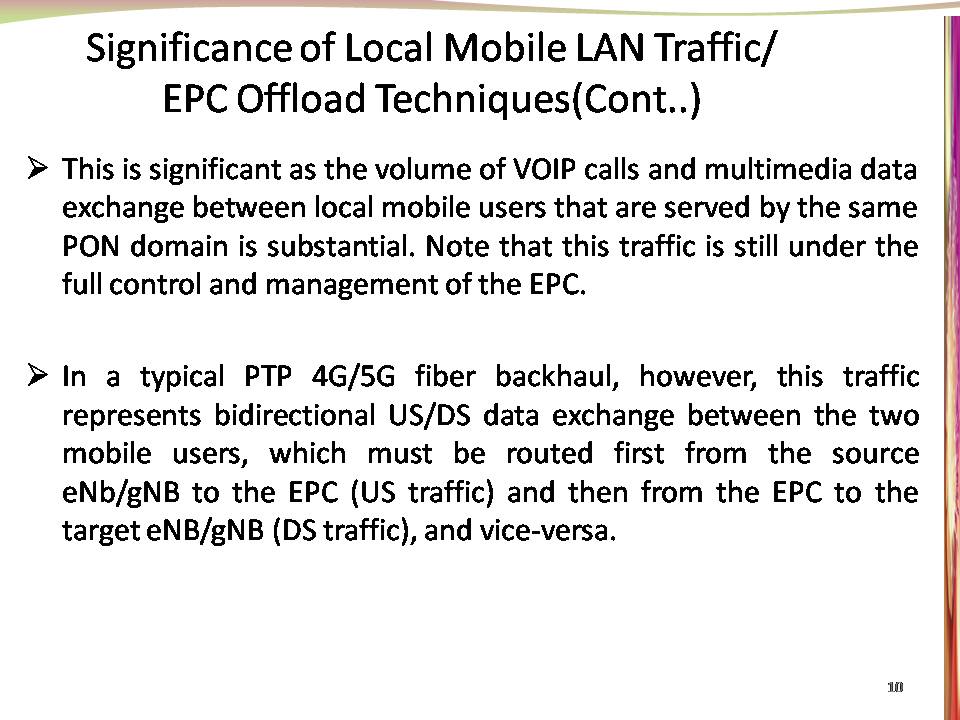 |
The local traffic is significant as the volume of VOIP calls and multimedia data exchange between local mobile users that are served by the same PON domain is substantial.
In contrast, a typical PTP 4G/5G fiber backhaul, however, this traffic represents bidirectional US/DS data exchange between the two mobile users, which must be routed first from the source eNb/gNB to the EPC (US traffic) and then from the EPC to the target eNB/gNB (DS traffic), and vice-versa.
|
|
ICACT20210195 Slide.09
[Big slide for presentation]
[YouTube] |
Chrome Text-to-Speach Click!! |
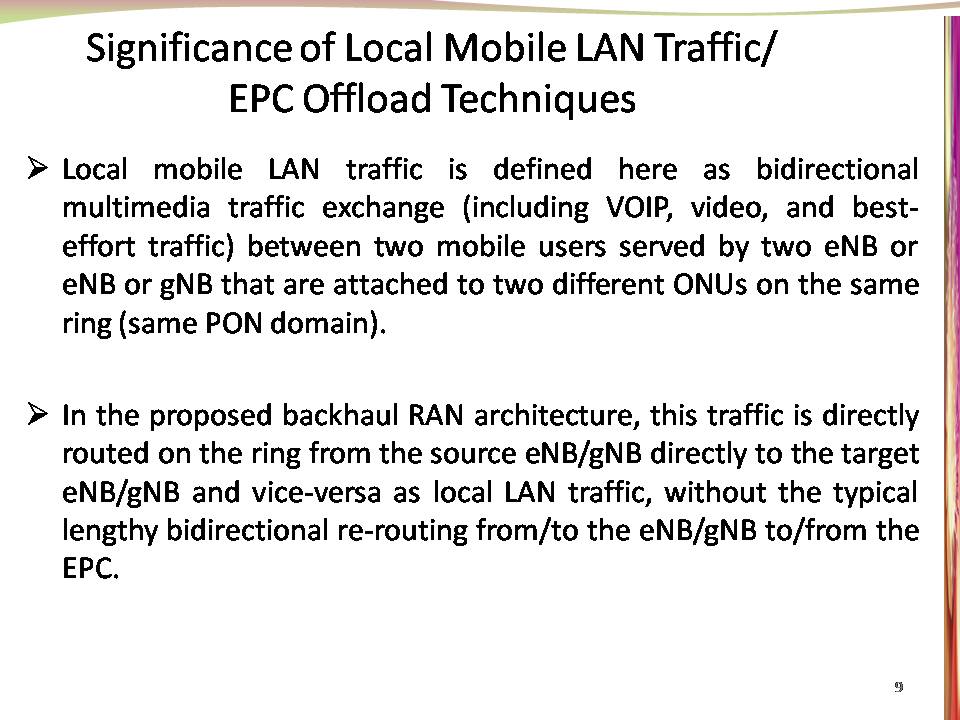 |
This slide shows Significance of Local Mobile LAN Traffic/EPC Offload Techniques.Local mobile LAN traffic is defined here as bidirectional multimedia traffic exchange between two mobile users served by two eNB or eNB or gNB that are attached to two different ONUs on the same ring (same PON domain).
In the proposed backhaul RAN architecture, this traffic is directly routed on the ring from the source eNB/gNB directly to the target eNB/gNB and vice-versa as local LAN traffic, without the typical lengthy bidirectional re-routing from/to the eNB/gNB to/from the EPC.
|
|
ICACT20210195 Slide.08
[Big slide for presentation]
[YouTube] |
Chrome Text-to-Speach Click!! |
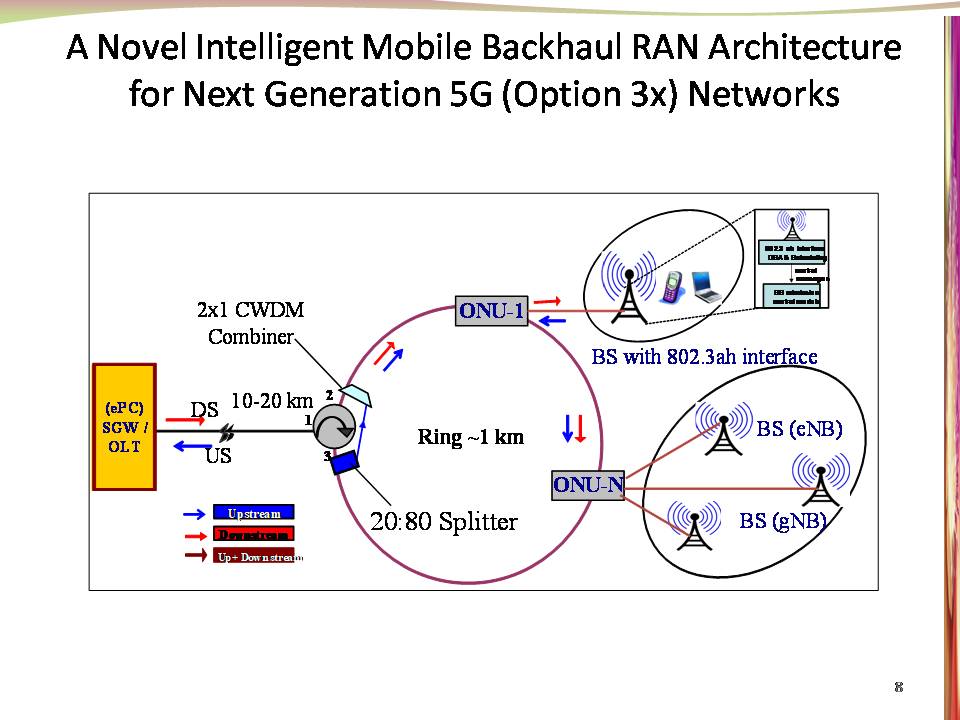 |
This slide shows A Novel Intelligent Mobile Backhaul RAN Architecture for Next Generation 5G (Option 3x) Networks. The figure shows how eNBs and gNBs can be collocated with the given ONU.
|
|
ICACT20210195 Slide.07
[Big slide for presentation]
[YouTube] |
Chrome Text-to-Speach Click!! |
 |
The standalone ring-based EPON architecture can be evolved to a 5G backhaul RAN architecture by simply collocating (overlying) the eNBs and the gNB with the ONUs, while capitalizing on existing fiber. gNBs can be deployed using a low-height (2-4 m) antenna mounted on or near the ONU is typically assumed in the 100-300 m range and the gNB-gNB cell inter-site distance (ISD) is assumed to be in the 400-500 m range.
It is further assumed that the gNB are placed around the periphery of existing eNB serving area (> 700 m from the nearest eNB site), thus improving the poor coverage near the eNB perimeter.
|
|
ICACT20210195 Slide.06
[Big slide for presentation]
[YouTube] |
Chrome Text-to-Speach Click!! |
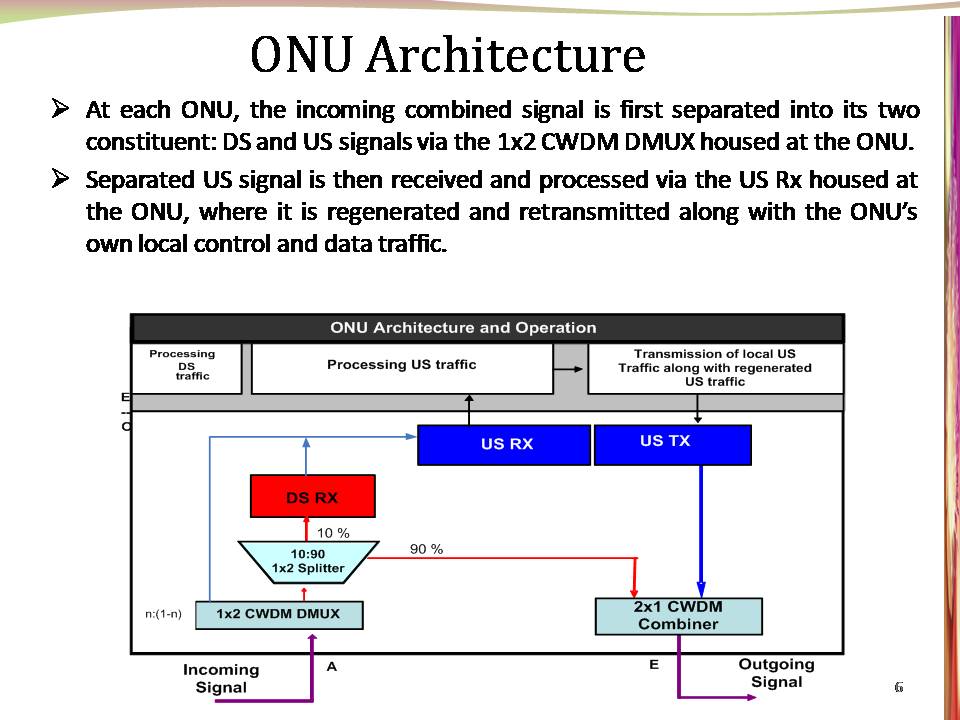 |
This slide shows the ONU architecture. As shown in figure, at each ONU, the incoming combined signal is first separated into its two constituent: DS and US signals via the 1x2 CWDM DMUX housed at the ONU.
Separated US signal is then received and processed via the US Rx housed at the ONU, where it is regenerated and retransmitted along with the ONU’s own local control and data traffic.
|
|
ICACT20210195 Slide.05
[Big slide for presentation]
[YouTube] |
Chrome Text-to-Speach Click!! |
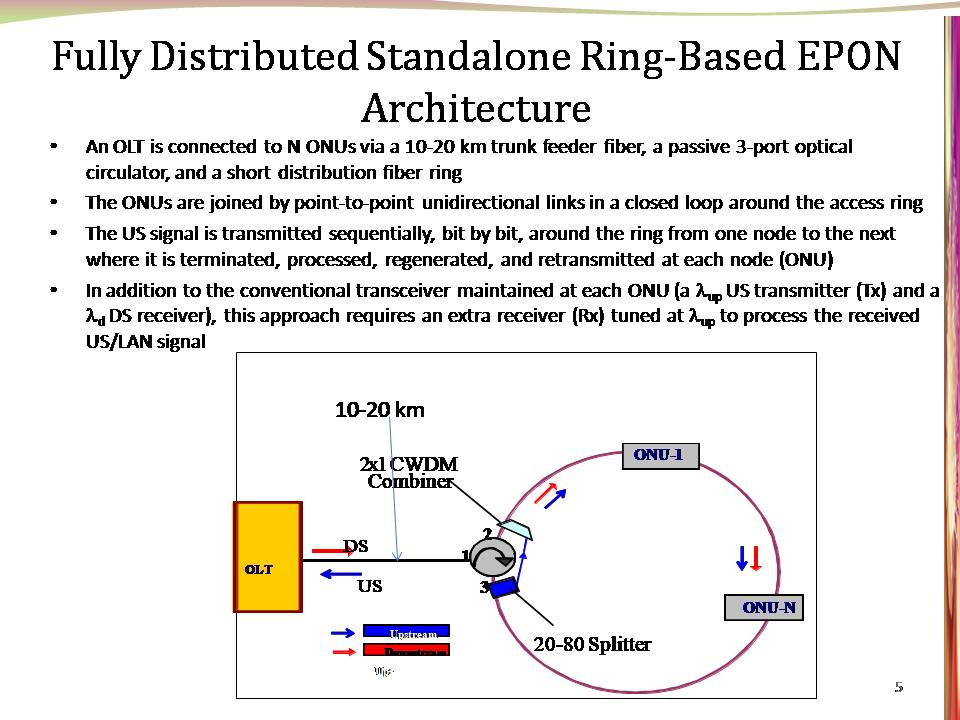 |
Fully Distributed Standalone Ring-Based EPON Architecture is shown in the figure. An OLT is connected to N ONUs via a 10-20 km trunk feeder fiber, a passive 3-port optical circulator, and a short distribution fiber ring.
The ONUs are joined by point-to-point unidirectional links in a closed loop around the access ring.
The upstream (US) signal is transmitted sequentially, bit by bit, around the ring from one node to the next where it is terminated, processed, regenerated, and retransmitted at each node (ONU)
|
|
ICACT20210195 Slide.04
[Big slide for presentation]
[YouTube] |
Chrome Text-to-Speach Click!! |
 |
The purpose of this work is to propose and devise a cost-effective PON-based mobile backhaul 5G (deployment Option 3x) RAN architecture that can leverages existing fibered and powered facilities associated with a PON-based fiber-to-the-Node/Home (FTTN/FTTH) residential access network.
Moreover, it enables the support of efficient ground-breaking mobile data and signaling traffic offload techniques, which significantly enhance the performance of both 4G/5G RAN and mobile core network (EPC)
|
|
ICACT20210195 Slide.03
[Big slide for presentation]
[YouTube] |
Chrome Text-to-Speach Click!! |
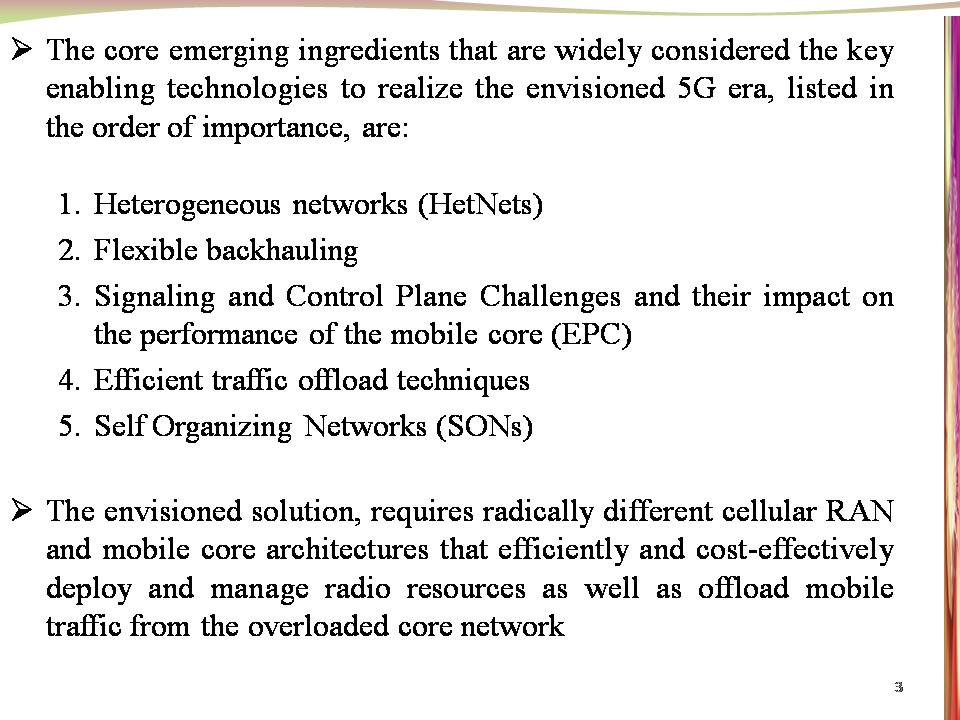 |
The key enabling technologies to realize the envisioned 5G era are:
Heterogeneous networks (HetNets)
Flexible backhauling
Signaling and Control Plane Challenges and their impact on the performance of the mobile core (EPC)
Efficient traffic offload techniques
Self Organizing Networks (SONs)
The envisioned solution, requires radically different cellular RAN and mobile core architectures that efficiently and cost-effectively deploy and manage radio resources as well as offload mobile traffic from the overloaded core network
|
|
ICACT20210195 Slide.02
[Big slide for presentation]
[YouTube] |
Chrome Text-to-Speach Click!! |
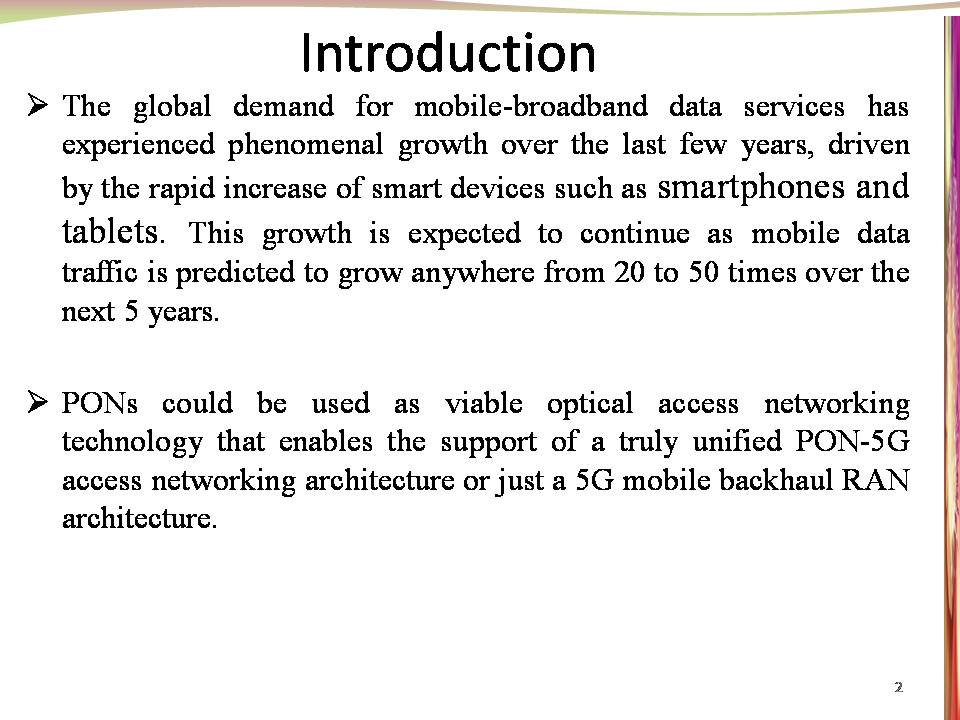 |
The global demand for mobile-broadband data services has experienced phenomenal growth over the last few years, driven by the rapid increase of smart devices such as smartphones and tablets. This growth is predicted to grow anywhere from 20 to 50 times over the next 5 years.
PONs could be used as viable optical access networking technology that enables the support of a truly unified PON-5G access networking architecture.
|
|
ICACT20210195 Slide.01
[Big slide for presentation]
[YouTube] |
Chrome Text-to-Speach Click!! |
 |
Hi Everyone I am Syed Rashid Zaidi from Bronx Community College of the City University of New York. I am presenting this paper, “An efficient & Cost-Effective EPON-Based Next Generation 5G Mobile Backhaul RAN Architecture”. I am partnering this paper with Dr. Ajaz Sana from same University and Dr. Shahab Hussain from Nokia.
|
















