 ICACT20220347 Slide.39
[Big slide for presentation]
[YouTube] |
Chrome Text-to-Speach Click!! |
 |
That's all there is to this video, thanks for watching.
|
|
ICACT20220347 Slide.38
[Big slide for presentation]
[YouTube] |
Chrome Text-to-Speach Click!! |
 |
The Fourth one we would like to discuss is Code Open Source. We note that out of the seven secure aggregation protocols we investigated, only the code of SAFELearn is open source, which is not very conducive to the development of secure aggregation protocols. From the perspective of secure aggregation protocols alone, we suggest and hope that more advanced secure aggregation protocols will be open-sourced.
|
|
ICACT20220347 Slide.37
[Big slide for presentation]
[YouTube] |
Chrome Text-to-Speach Click!! |
 |
The Third one we would like to discuss is User Dropout Robustness. We note that all current secure aggregation protocols that we are aware of use threshold sharing schemes to solve the user dropout problem. Since threshold sharing involves extensive sharing between users for secret shares and communication between users is typically left to the server, this approach introduces significant communication overhead and additional communication rounds. This single technical limitation also leads to secure aggregation protocols for scenarios that must have user dropout robustness to use only secret sharing primitives for encryption. We hope that in the future development of secure aggregation more solutions to the user dropout problem will emerge or targeted sharing solutions with better performance can be proposed, and FastShare gives us a good start.
|
|
ICACT20220347 Slide.36
[Big slide for presentation]
[YouTube] |
Chrome Text-to-Speach Click!! |
 |
The Second one we would like to discuss is Flexibility in Safety and Efficiency Trade-Offs. Trade-offs between security and efficiency have always been a focus of cryptographic protocols. Being able to strike a good balance with various cost levels based on the security required for each practical use case helps improve the utility and flexibility of security aggregation protocols. Fixed security and cost combinations in protocols often tend to result in a few scenarios that can be used in practice. SecAgg and SAFER split the protocol into two and four versions, improving flexibility and balancing security and cost when the protocol is used in practice, but this is still not enough for practical applications. SecAgg+, although it is also similar to SecAgg+ is also divided into two versions like SecAgg, but SecAgg+ can calculate the appropriate k (number of neighboring users per user) to adjust the cost according to the security requirements, which greatly improves the flexibility of SecAgg+. The flexibility of a secure aggregation protocol is a very important property. Flexibility can also be a research point for a secure aggregation protocol. We hope that more flexible security aggregation protocols will emerge in the future.
|
|
ICACT20220347 Slide.35
[Big slide for presentation]
[YouTube] |
Chrome Text-to-Speach Click!! |
 |
The first one we would like to discuss is cost. Cost reduction is one of the most important research directions for secure aggregation protocols, especially in the context that secure aggregation protocols are so far too expensive to be practically applied, every secure aggregation protocol researcher is racking their brains to reduce the protocol cost. Research on more efficient security aggregation protocols is the most direct research direction
|
|
ICACT20220347 Slide.34
[Big slide for presentation]
[YouTube] |
Chrome Text-to-Speach Click!! |
 |
The last section is a discussion of some of the security aggregation protocols.
|
|
ICACT20220347 Slide.33
[Big slide for presentation]
[YouTube] |
Chrome Text-to-Speach Click!! |
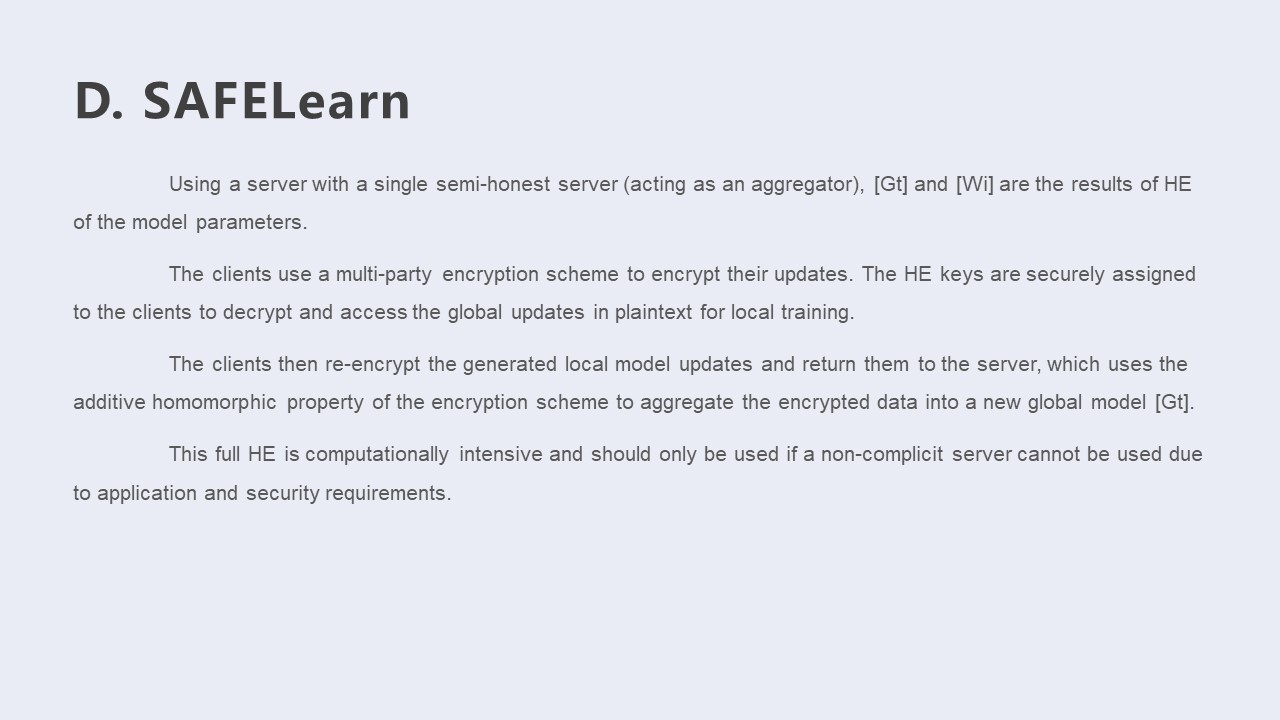 |
Next is the implementation of SAFELearn with homomorphic encryption. Using a server with a single semi-honest server (acting as an aggregator), [Gt] and [Wi] are the results of HE of the model parameters. The clients use a multi-party encryption scheme to encrypt their updates. The HE keys are securely assigned to the clients to decrypt and access the global updates in plaintext for local training. The clients then re-encrypt the generated local model updates and return them to the server, which uses the additive homomorphic property of the encryption scheme to aggregate the encrypted data into a new global model [Gt]. This full HE is computationally intensive and should only be used if a non-complicit server cannot be used due to application and security requirements.
|
|
ICACT20220347 Slide.32
[Big slide for presentation]
[YouTube] |
Chrome Text-to-Speach Click!! |
 |
The last protocol is POSEIDON. The paper extends SPINDLE (Privacy-Preserving Training and Evaluation for Generalized Linear Models) by building a new system (named POSEIDON) that enables privacy-preserving training and evaluation of more complex neural network models in a distributed setting through multiparty HE, providing end-to-end protection: training data for all parties, the resulting model, and evaluation data for the querier. The weights of the neural network models are always encrypted during training and evaluation.
|
|
ICACT20220347 Slide.31
[Big slide for presentation]
[YouTube] |
Chrome Text-to-Speach Click!! |
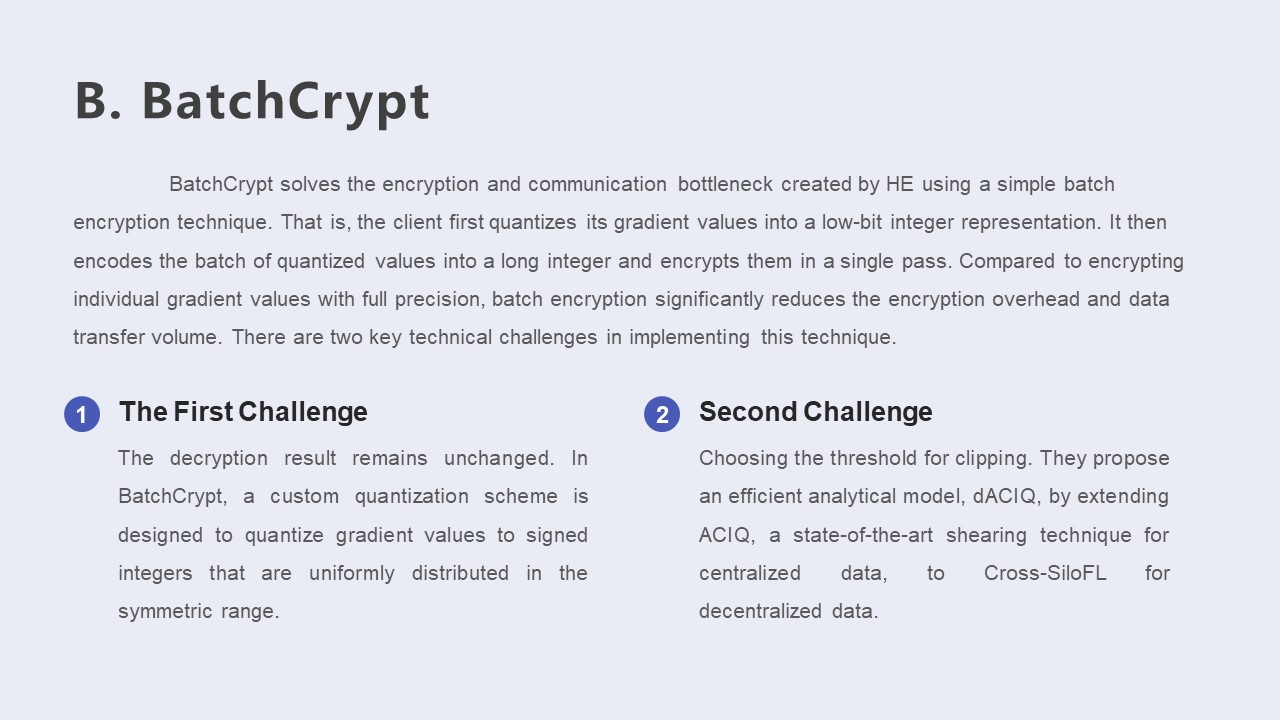 |
BatchCrypt solves the encryption and communication bottleneck created by HE using a simple batch encryption technique. That is, the client first quantizes its gradient values into a low-bit integer representation. It then encodes the batch of quantized values into a long integer and encrypts them in a single pass. Compared to encrypting individual gradient values with full precision, batch encryption significantly reduces the encryption overhead and data transfer volume. There are two key technical challenges in implementing this technique. The First Challenge is The decryption result remains unchanged. In BatchCrypt, a custom quantization scheme is designed to quantize gradient values to signed integers that are uniformly distributed in the symmetric range. In addition, to support simple additive forms of gradient aggregation and to add gradients that do not cause overflow to corrupt the encoding, they developed a new batch encoding scheme that uses two signed bits to represent the complementary representation of two of the quantized values. In addition, padding and advance scaling are used to avoid overflow. All these techniques allow performing gradient aggregation on the ciphertext of an encoded batch without first decrypting i. The Second Challenge is Choosing the threshold for clipping. They propose an efficient analytical model, dACIQ, by extending ACIQ, a state-of-the-art shearing technique for centralized data, to Cross-SiloFL for decentralized data. dACIQ allows the selection of the optimal shearing threshold with minimum cumulative error.
|
|
ICACT20220347 Slide.30
[Big slide for presentation]
[YouTube] |
Chrome Text-to-Speach Click!! |
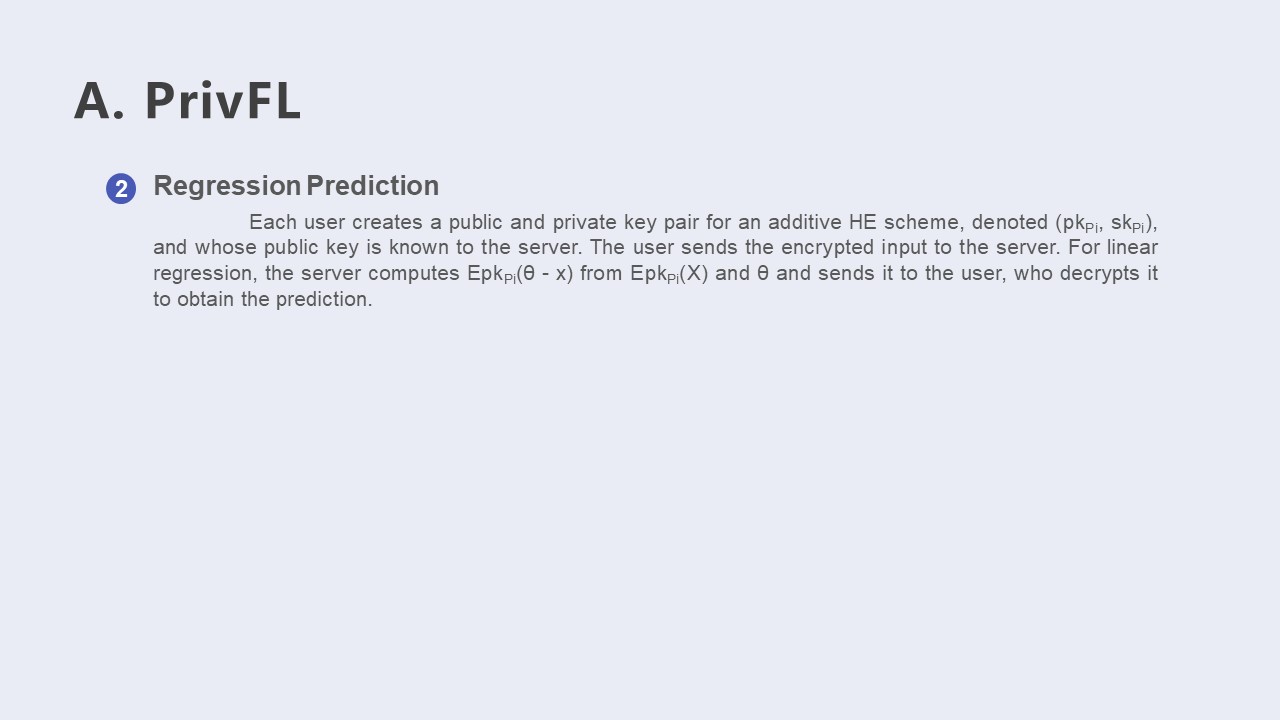 |
The basic idea of Regression Prediction is that Each user creates a public and private key pair for an additive HE scheme, denoted (pkPi, skPi), and whose public key is known to the server. The user sends the encrypted input to the server. For linear regression, the server computes EpkPi(θ - x) from EpkPi(X) and θ and sends it to the user, who decrypts it to obtain the prediction.
|
|
ICACT20220347 Slide.29
[Big slide for presentation]
[YouTube] |
Chrome Text-to-Speach Click!! |
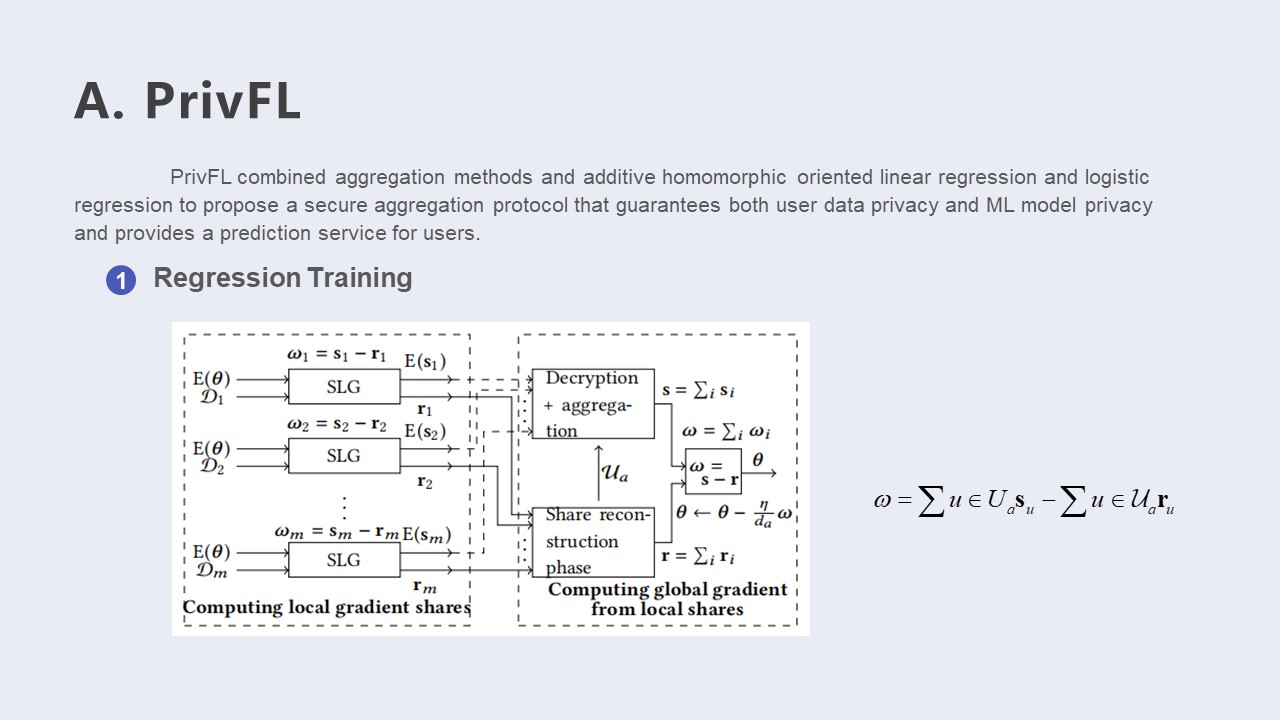 |
The first HE-based protocol was PrivFL. PrivFL combined aggregation methods and additive homomorphic oriented linear regression and logistic regression to propose a secure aggregation protocol that guarantees both user data privacy and ML model privacy and provides a prediction service for users. Look at the picture below. It represents the basic idea of Regression Training. The server performs additive HE on the model θ to obtain E(θ) and sends E(θ) to user Pi, each user derives E(si) and ri by SLG algorithm with E(θ) and Di (data of user pi) as input such that si - ri = ωi (ωi is the local gradient). The server then decrypts the received E(si) and computes the si sum for all users, followed by using the aggregation protocol to solve for ri as input and output the ri sum for all users to the server. Finally the server can then compute ω and update θ after by the formula on the left of the picture where Ua is the set of users.
|
|
ICACT20220347 Slide.28
[Big slide for presentation]
[YouTube] |
Chrome Text-to-Speach Click!! |
 |
HE-based secure aggregation protocols are more suitable for Cross-Silo federation learning than the other two secure aggregation protocols for two reasons: The first reason is Because Cross-Silo federation learning has fewer clients, it is vulnerable to inference attacks on structural models. Whereas, in a secure aggregation protocol based on HE, the model is private. The second reason is HE has a high overhead, while the clients in Cross-Silo federation learning have stable communication and abundant computational resources and can afford the overhead of HE to some extent. Some secure aggregation protocols based on HE are described below.
|
|
ICACT20220347 Slide.27
[Big slide for presentation]
[YouTube] |
Chrome Text-to-Speach Click!! |
 |
The last technique we will introduce is homomorphic encryption.
|
|
ICACT20220347 Slide.26
[Big slide for presentation]
[YouTube] |
Chrome Text-to-Speach Click!! |
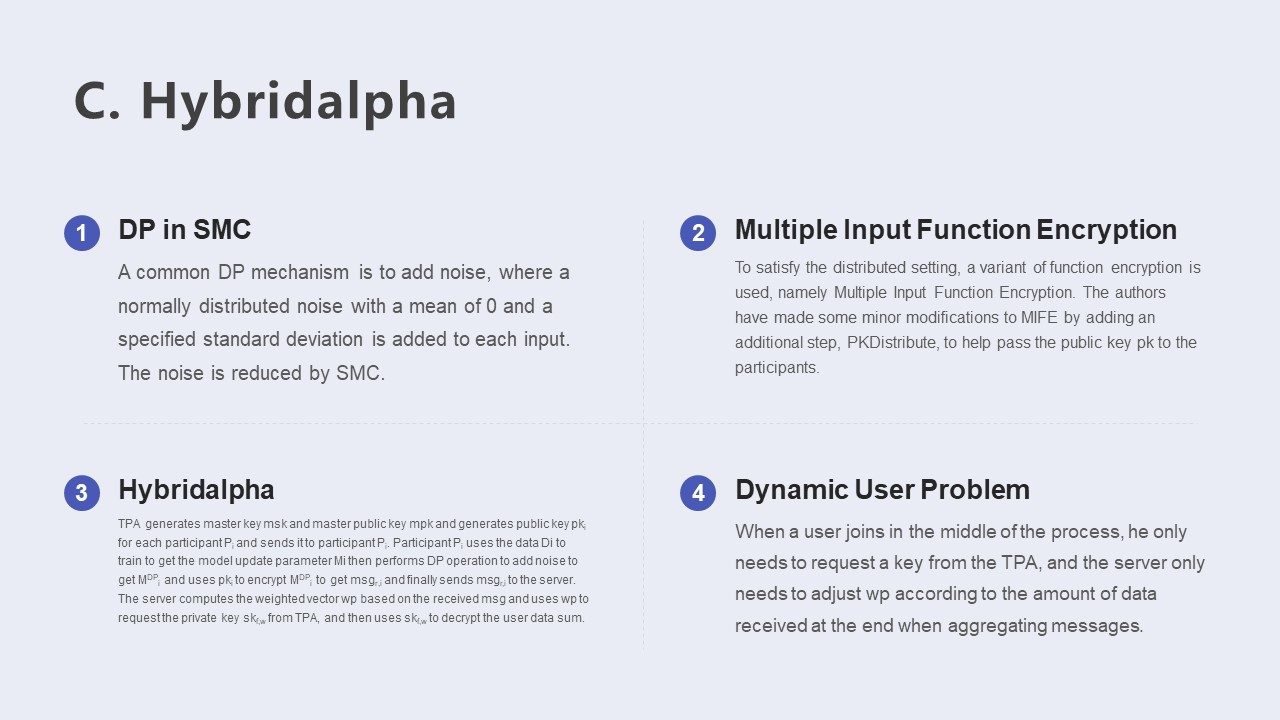 |
Hybridalpha protocol leverages two important points. The first one is DP in SMC. A common DP mechanism is to add noise, where a normally distributed noise with a mean of 0 and a specified standard deviation is added to each input. The noise is reduced by SMC. The second one is Multiple Input Function Encryption. To satisfy the distributed setting, a variant of function encryption is used, namely Multiple Input Function Encryption. The authors have made some minor modifications to MIFE by adding an additional step, PKDistribute, to help pass the public key pk to the participants. So Hybridalpha general process is TPA generates master key msk and master public key mpk and generates public key pki for each participant Pi and sends it to participant Pi. Participant Pi uses the data Di to train to get the model update parameter Mi then performs DP operation to add noise to get MDPi and uses pki to encrypt MDPi to get msgr,i and finally sends msgr,i to the server. The server computes the weighted vector wp based on the received msg and uses wp to request the private key skf,w from TPA, and then uses skf,w to decrypt the user data sum. Hybridalpha also has a very good nature. It solves the problem of dynamic users. When a user joins in the middle of the process, he only needs to request a key from the TPA, and the server only needs to adjust wp according to the amount of data received at the end when aggregating messages.
|
|
ICACT20220347 Slide.25
[Big slide for presentation]
[YouTube] |
Chrome Text-to-Speach Click!! |
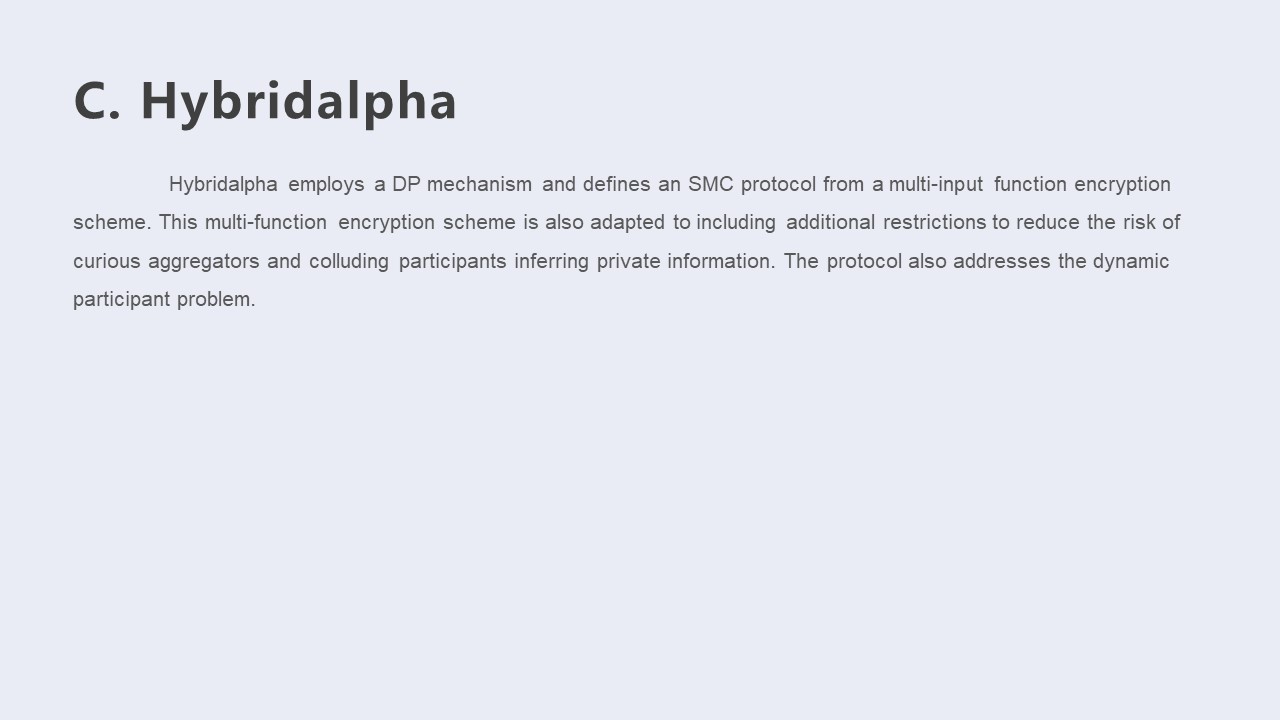 |
Next is an example of how differential privacy can easily be mixed with other technologies to form a hybrid protocol. Hybridalpha employs a DP mechanism and defines an SMC protocol from a multi-input function encryption scheme. This multi-function encryption scheme is also adapted to including additional restrictions to reduce the risk of curious aggregators and colluding participants inferring private information. The protocol also addresses the dynamic participant problem.
|
|
ICACT20220347 Slide.24
[Big slide for presentation]
[YouTube] |
Chrome Text-to-Speach Click!! |
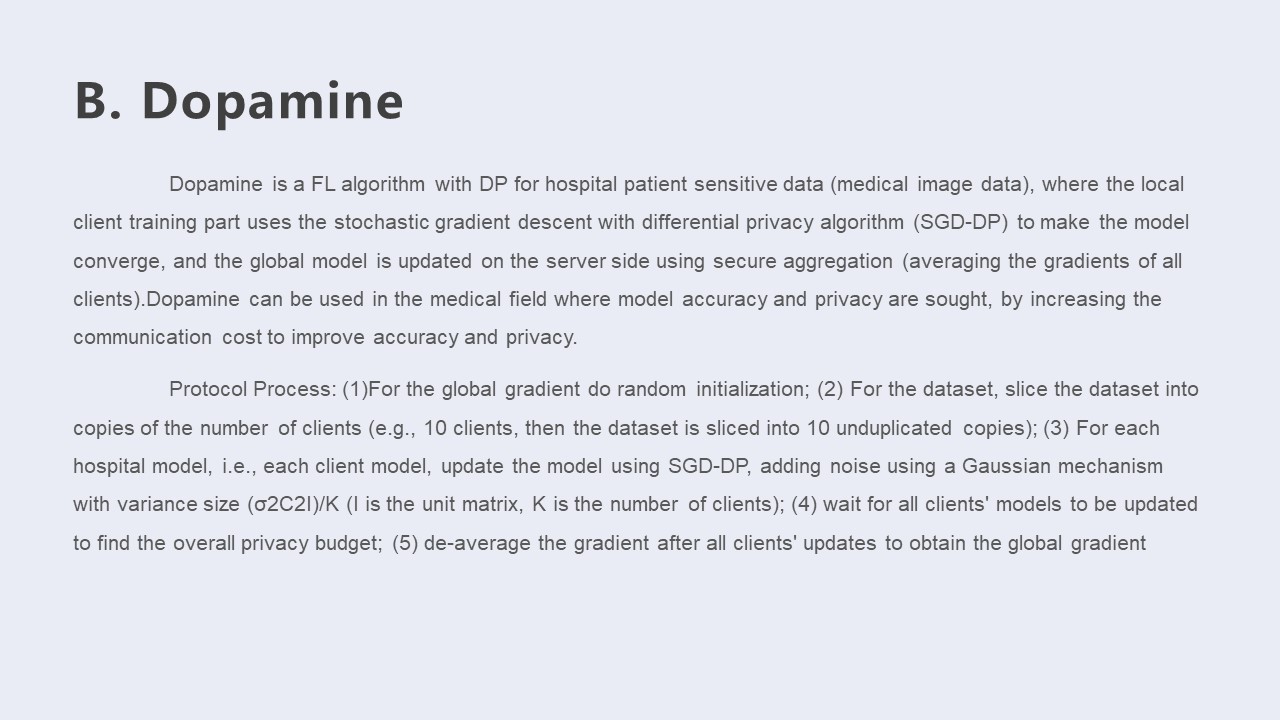 |
The next one is Dopamine. Dopamine is a FL algorithm with DP for hospital patient sensitive data (medical image data), where the local client training part uses the stochastic gradient descent with differential privacy algorithm (SGD-DP) to make the model converge, and the global model is updated on the server side using secure aggregation (averaging the gradients of all clients).Dopamine can be used in the medical field where model accuracy and privacy are sought, by increasing the communication cost to improve accuracy and privacy. The detailed process of the protocol is not repeated here, interested readers can read the following paragraph of the PPT in addition to this video.
|
|
ICACT20220347 Slide.23
[Big slide for presentation]
[YouTube] |
Chrome Text-to-Speach Click!! |
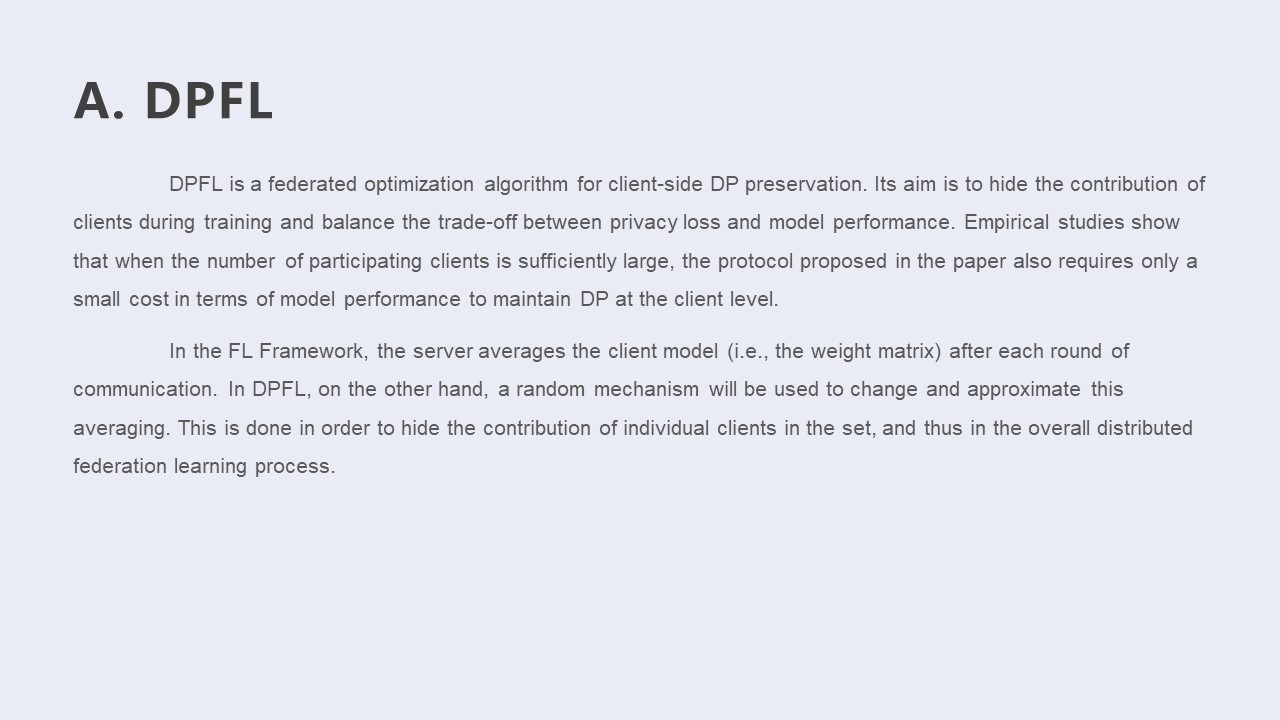 |
DPFL is a federated optimization algorithm for client-side DP preservation. Its aim is to hide the contribution of clients during training and balance the trade-off between privacy loss and model performance. Empirical studies show that when the number of participating clients is sufficiently large, the protocol proposed in the paper also requires only a small cost in terms of model performance to maintain DP at the client level. In the FL Framework, the server averages the client model (i.e., the weight matrix) after each round of communication. In DPFL, on the other hand, a random mechanism will be used to change and approximate this averaging. This is done in order to hide the contribution of individual clients in the set, and thus in the overall distributed federation learning process.
|
|
ICACT20220347 Slide.22
[Big slide for presentation]
[YouTube] |
Chrome Text-to-Speach Click!! |
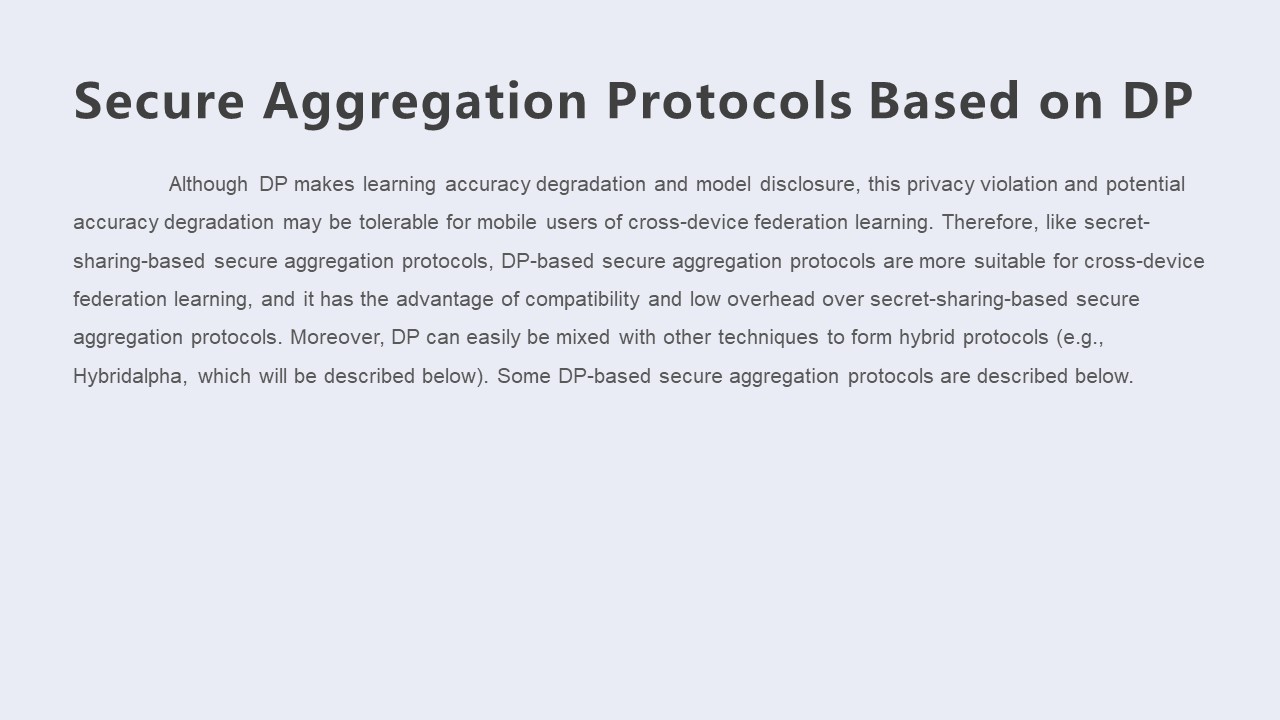 |
Although DP makes learning accuracy degradation and model disclosure, this privacy violation and potential accuracy degradation may be tolerable for mobile users of cross-device federation learning. Therefore, like secret-sharing-based secure aggregation protocols, DP-based secure aggregation protocols are more suitable for cross-device federation learning, and it has the advantage of compatibility and low overhead over secret-sharing-based secure aggregation protocols. Moreover, DP can easily be mixed with other techniques to form hybrid protocols (e.g., Hybridalpha, which will be described below). Some DP-based secure aggregation protocols are described below.
|
|
ICACT20220347 Slide.21
[Big slide for presentation]
[YouTube] |
Chrome Text-to-Speach Click!! |
 |
After talking about security aggregation based on secret sharing next we will talk about differential privacy based.
|
|
ICACT20220347 Slide.20
[Big slide for presentation]
[YouTube] |
Chrome Text-to-Speach Click!! |
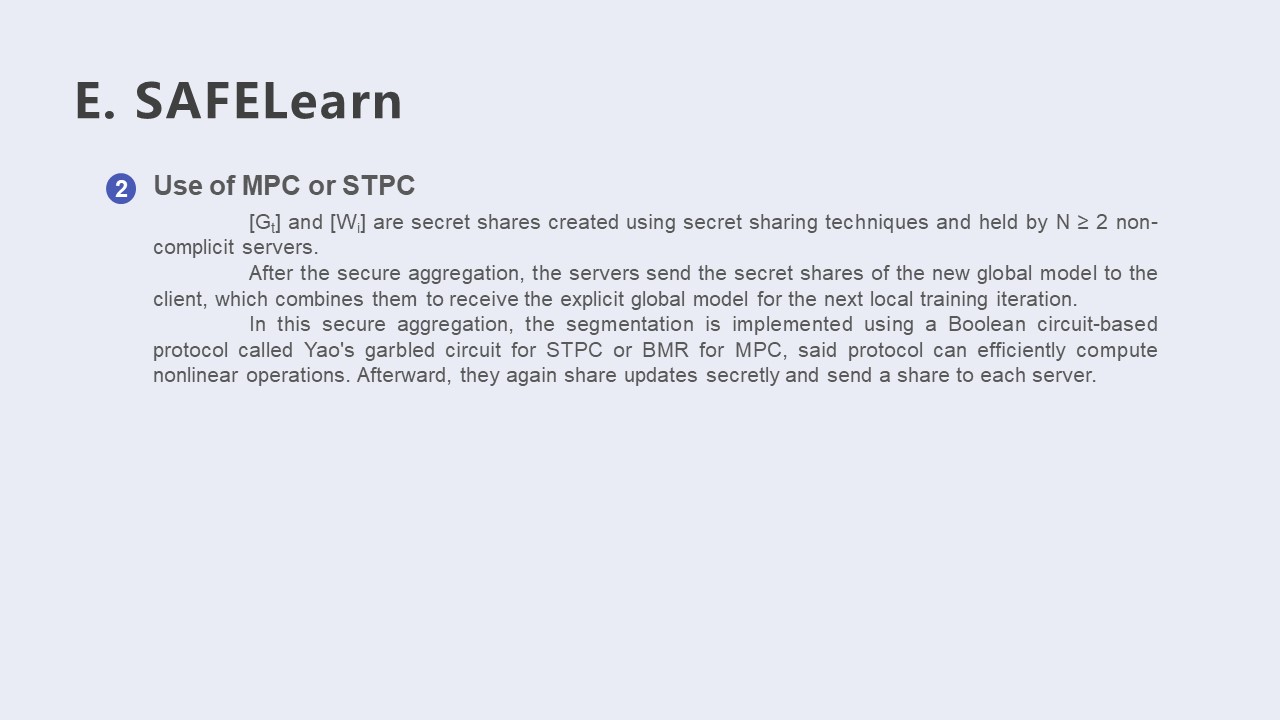 |
How to use MPC or STPC to implement SAFELearn? The methods are as follows. [Gt] and [Wi] are secret shares created using secret sharing techniques and held by N ≥ 2 non-complicit servers. After the secure aggregation, the servers send the secret shares of the new global model to the client, which combines them to receive the explicit global model for the next local training iteration. In this secure aggregation, the segmentation is implemented using a Boolean circuit-based protocol called Yao's garbled circuit for STPC or BMR for MPC, said protocol can efficiently compute nonlinear operations. Afterward, they again share updates secretly and send a share to each server.
|
|
ICACT20220347 Slide.19
[Big slide for presentation]
[YouTube] |
Chrome Text-to-Speach Click!! |
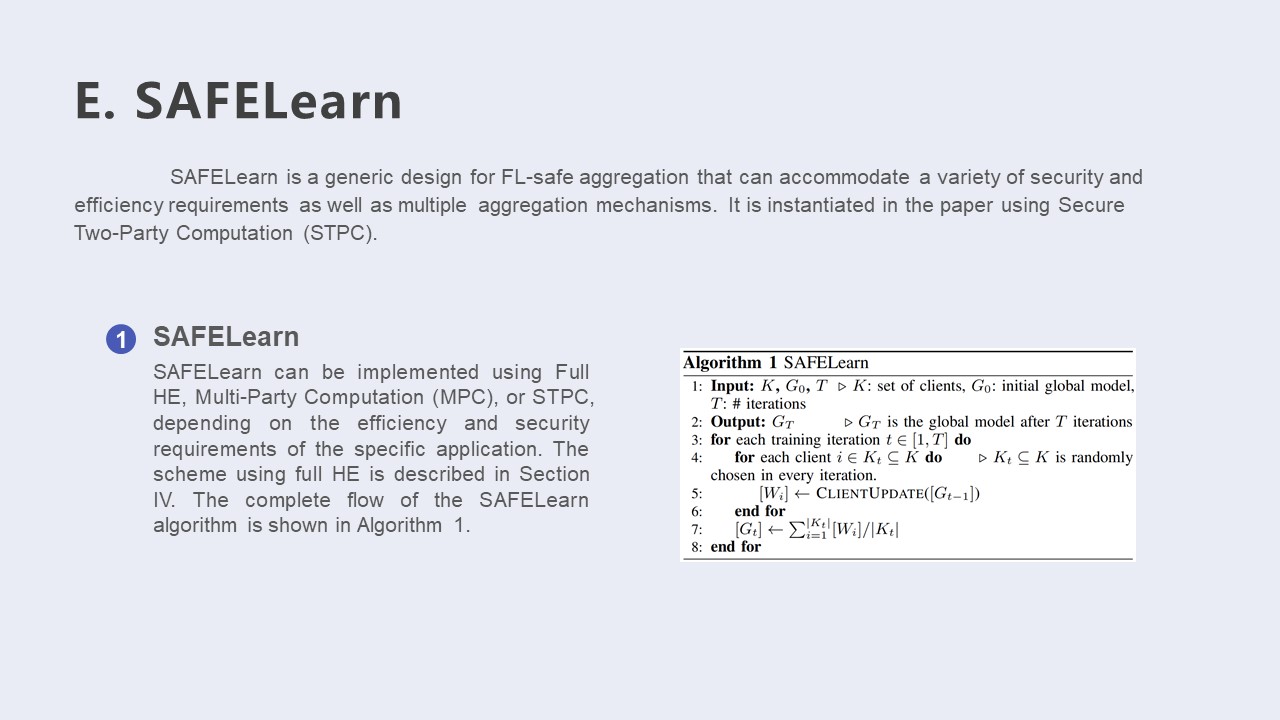 |
Let's move on to the next protocol SAFELearn. SAFELearn is a generic design for FL-safe aggregation that can accommodate a variety of security and efficiency requirements as well as multiple aggregation mechanisms. It is instantiated in the paper using Secure Two-Party Computation. SAFELearn can be implemented using Full HE, Multi-Party Computation, or STPC, depending on the efficiency and security requirements of the specific application. The scheme using full HE is described in Section IV. The complete flow of the SAFELearn algorithm is shown in Algorithm 1.
|
|
ICACT20220347 Slide.18
[Big slide for presentation]
[YouTube] |
Chrome Text-to-Speach Click!! |
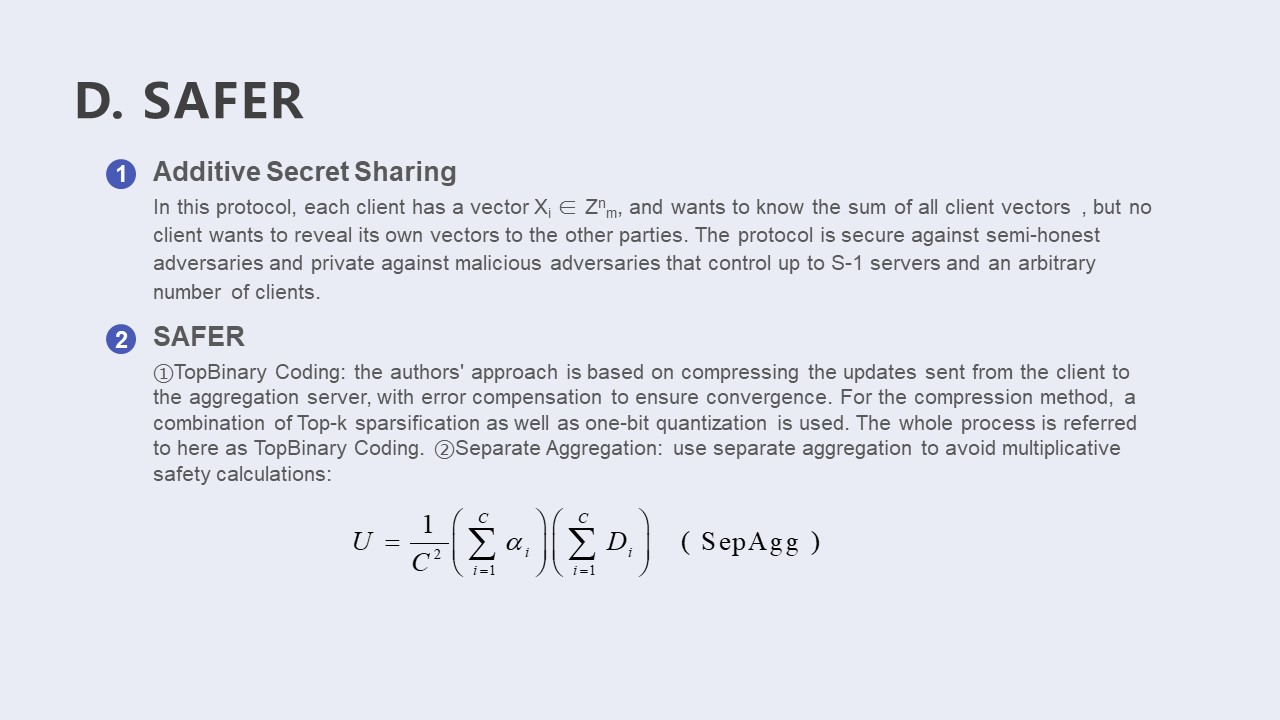 |
Next up is SAFER. SAFER combines neural network update compression techniques with additive secret sharing making neural update compression techniques compatible with secure multi-party computation, obtaining similar accuracy to non-secure uncompressed federation learning at lower communication cost and it allows a good trade-off between privacy and communication cost depending on the level of security required for each practical use case. Let's start by introducing Additive Secret Sharing. In this protocol, each client has a vector Xi ∈ Znm, and wants to know the sum of all client vectors, but no client wants to reveal its own vectors to the other parties. The protocol is secure against semi-honest adversaries and private against malicious adversaries that control up to S-1 servers and an arbitrary number of clients. Then SAFER has two points worth our attention. The first point is TopBinary Coding: the authors' approach is based on compressing the updates sent from the client to the aggregation server, with error compensation to ensure convergence. For the compression method, a combination of Top-k sparsification as well as one-bit quantization is used. The whole process is referred to here as TopBinary Coding. The second point is Separate Aggregation: use separate aggregation to avoid multiplicative safety calculations by the following formula.
|
|
ICACT20220347 Slide.17
[Big slide for presentation]
[YouTube] |
Chrome Text-to-Speach Click!! |
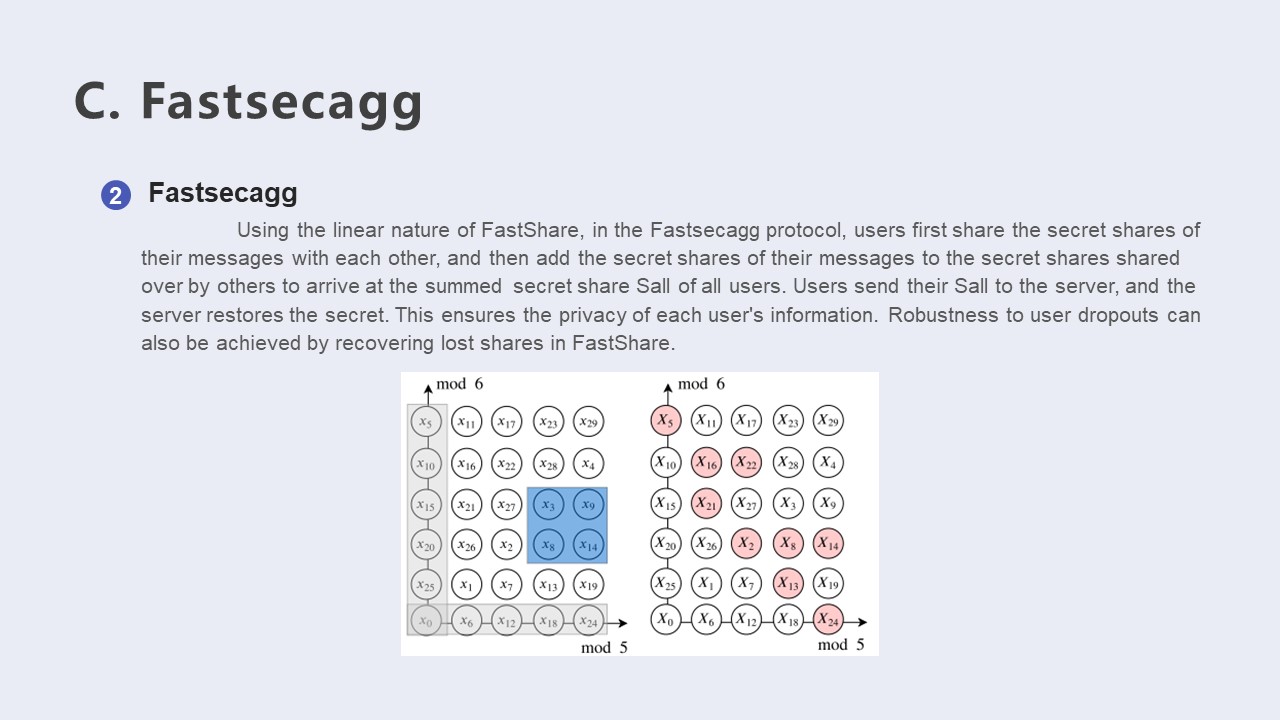 |
Using the linear nature of FastShare, in the Fastsecagg protocol, users first share the secret shares of their messages with each other, and then add the secret shares of their messages to the secret shares shared over by others to arrive at the summed secret share Sall of all users. Users send their Sall to the server, and the server restores the secret. This ensures the privacy of each user's information. Robustness to user dropouts can also be achieved by recovering lost shares in FastShare.
|
|
ICACT20220347 Slide.16
[Big slide for presentation]
[YouTube] |
Chrome Text-to-Speach Click!! |
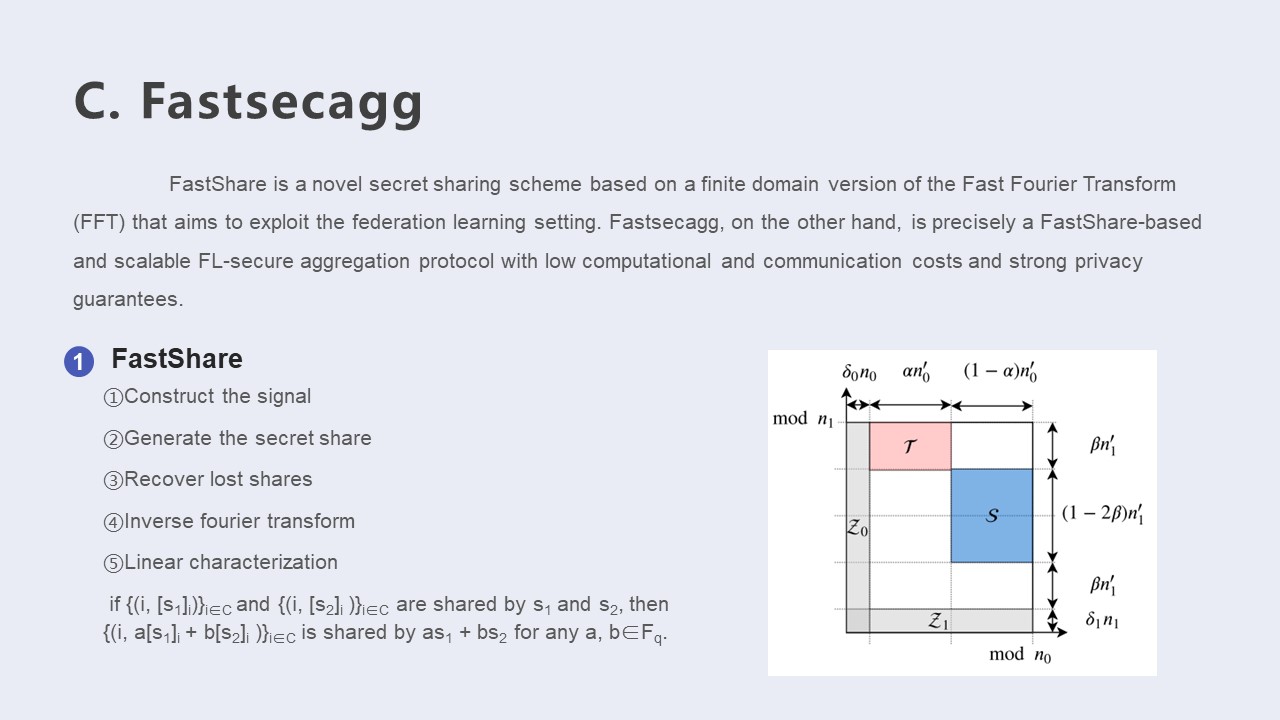 |
The next one is fastsecagg. FastShare is a novel secret sharing scheme based on a finite domain version of the Fast Fourier Transform that aims to exploit the federation learning setting. Fastsecagg, on the other hand, is precisely a FastShare-based and scalable FL-secure aggregation protocol with low computational and communication costs and strong privacy guarantees. before introducing fastsecagg let's introduce fastshare. The first step of fastshare is Construct the signal: Find two numbers, n0 and n1 such that signal length N = n0n1, and n0 and n1 are mutually prime. Applying the Chinese remainder theorem to establish a two-dimensional mesh of n×n. Set four domains Z0, Z1, S, and T. A secret is placed at index S and T is used as privacy proof. Random masks are placed in the other regions; 0 is placed at Z0 and at the index of Z1 such that the sum of each row and column is satisfied to equal 0 (to subsequently recover lost shares). The second step is Generate the secret share: Use the (fast) Fourier transform to generate secret shares. the third step is Recover lost shares: Iteratively recover all lost shares using a linear relationship between shares. Recover the missing share by iteratively decoding the missing share in rows and columns. the fourth step is Inverse Fourier transform: the secret share is inverse Fourier transformed to extract the secret information at the appropriate location to recover the secret. An important feature is Linear characterization.
|
|
ICACT20220347 Slide.15
[Big slide for presentation]
[YouTube] |
Chrome Text-to-Speach Click!! |
 |
The next talk is about the improved version of secagg, secagg plus. SecAgg+ reduces the computation and communication overhead by replacing the original SecAgg protocol of "one client communicates with the remaining n-1 clients" with "one client communicates with the surrounding log n clients". SecAgg+ also proposes two protocols for semi-honest attackers and malicious attackers. In semi-honest protocol, SecAgg+ builds an undirected graph suitable for the protocol by undirected graph building techniques using the user as the vertex, connecting each user with k = log n bits of other users, and when sharing the user only has to share with the user connected to him. users. k and the secret sharing threshold t are determined by ensuring security and user dropout robustness. In Semi-malicious protocol the overall idea is to first help the individual clients exchange keys, then generate a directed graph (both users are trusted unilaterally with each other), and finally execute the summation algorithm. When exchanging keys each client generates 2 pairs of keys, sends public key 1 and public key 2 to the server, and the server puts the received public key on top of the Merkle tree.
|
|
ICACT20220347 Slide.14
[Big slide for presentation]
[YouTube] |
Chrome Text-to-Speach Click!! |
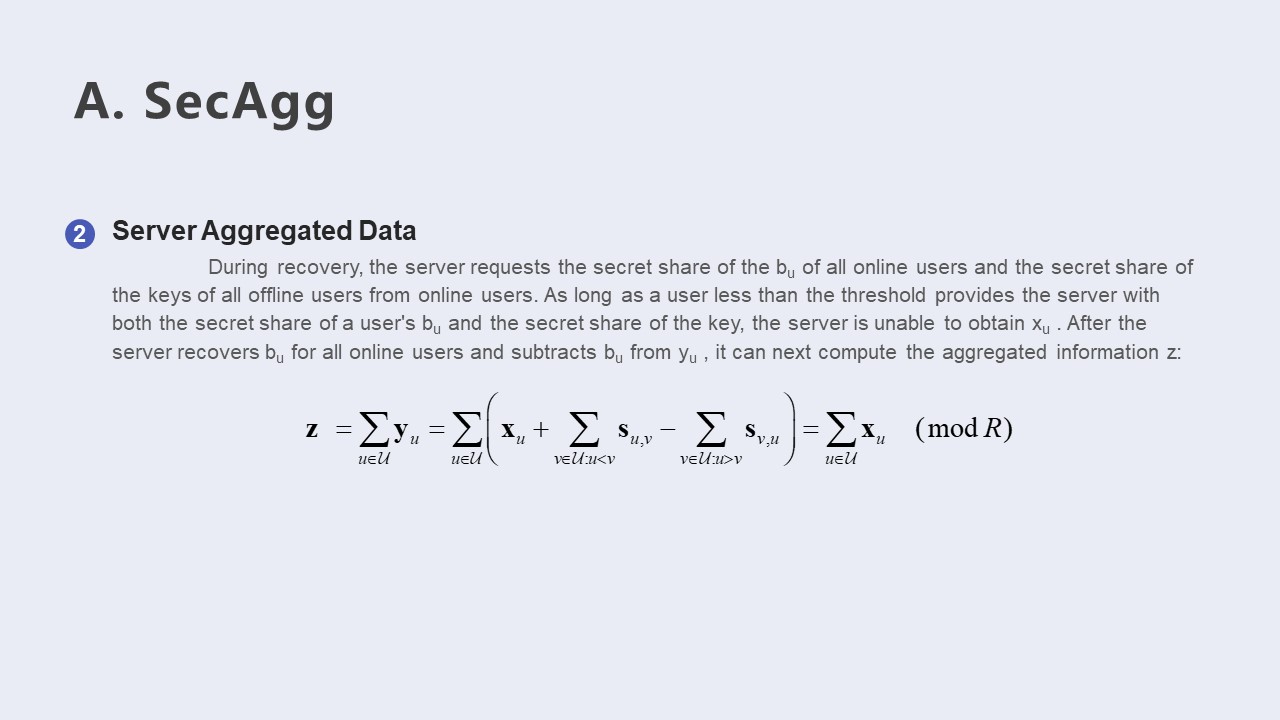 |
Then there is the method of server aggregation of data. During recovery, the server requests the secret share of the bu of all online users and the secret share of the keys of all offline users from online users. As long as a user less than the threshold provides the server with both the secret share of a user's bu and the secret share of the key, the server is unable to obtain xu . After the server recovers bu for all online users and subtracts bu from yu , it can next compute the aggregated information z by the following formula.
|
|
ICACT20220347 Slide.13
[Big slide for presentation]
[YouTube] |
Chrome Text-to-Speach Click!! |
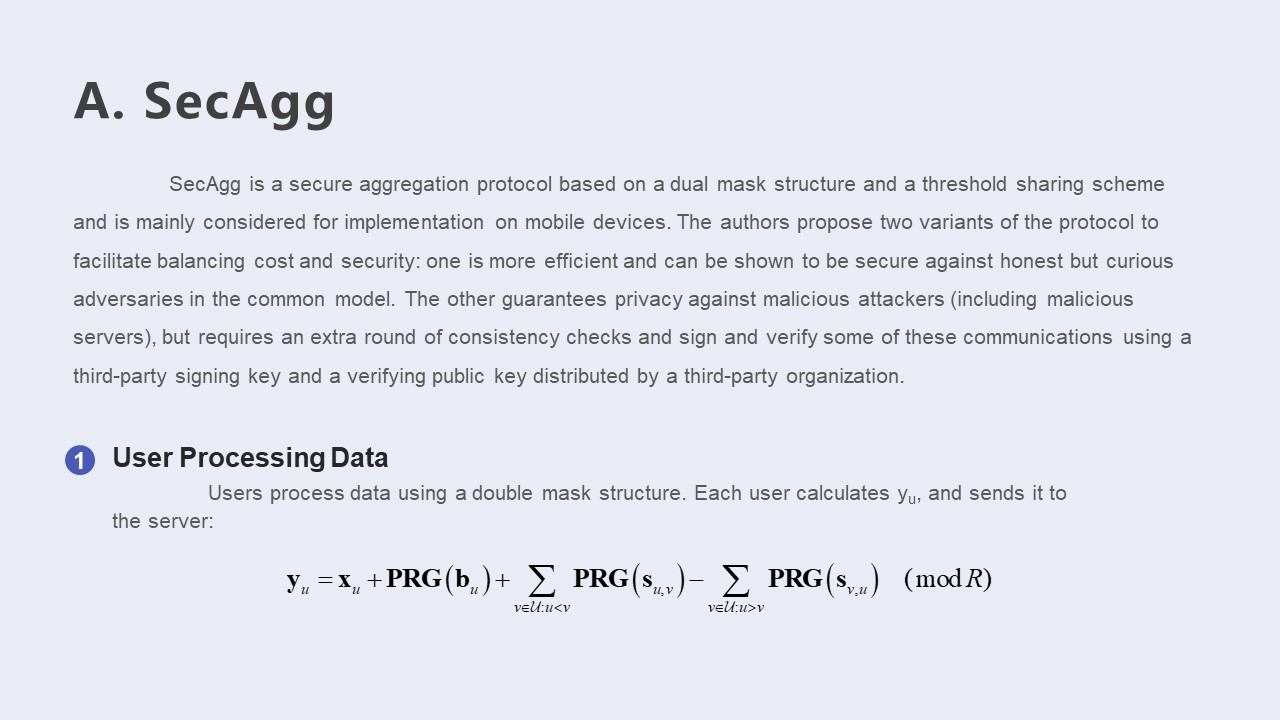 |
First, let's talk about the first protocol I want to introduce, secagg. SecAgg is a secure aggregation protocol based on a dual mask structure and a threshold sharing scheme and is mainly considered for implementation on mobile devices. The authors propose two variants of the protocol to facilitate balancing cost and security: one is more efficient and can be shown to be secure against honest but curious adversaries in the common model. The other guarantees privacy against malicious attackers (including malicious servers), but requires an extra round of consistency checks and sign and verify some of these communications using a third-party signing key and a verifying public key distributed by a third-party organization. In this protocol, users process data using a double mask structure. Each user calculates yu, and sends it to the server by the following formula where xu is the data of user u; U is the set of users. su,v is the shared secret value (unknown to the server) for user u and user v. Each user generates a random sample of bu and sends their share of bu secrets to all other users.
|
|
ICACT20220347 Slide.12
[Big slide for presentation]
[YouTube] |
Chrome Text-to-Speach Click!! |
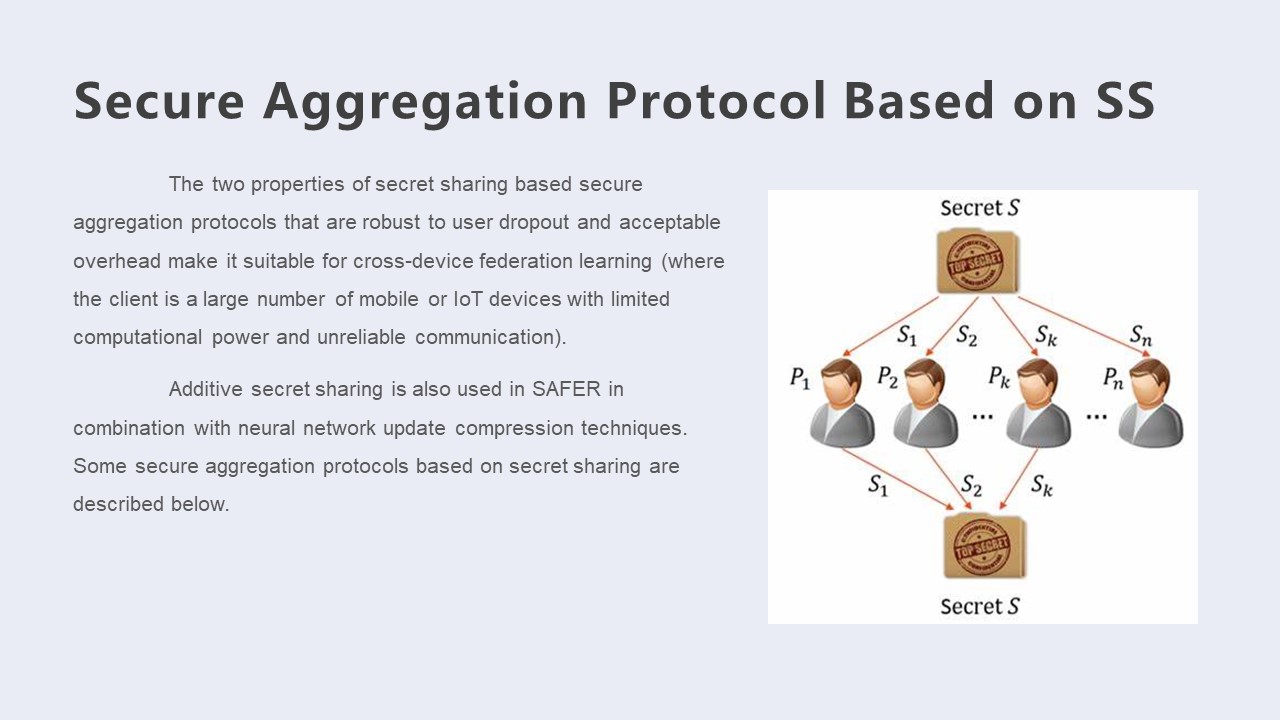 |
The two properties of secret sharing based secure aggregation protocols that are robust to user dropout and acceptable overhead make it suitable for cross-device federation learning (where the client is a large number of mobile or IoT devices with limited computational power and unreliable communication). Additive secret sharing is also used in SAFER in combination with neural network update compression techniques. As shown in the diagram, this is a schematic of a secret sharing. Some secure aggregation protocols based on secret sharing are described below.
|
|
ICACT20220347 Slide.11
[Big slide for presentation]
[YouTube] |
Chrome Text-to-Speach Click!! |
 |
Next, we will talk about Secure Aggregation Protocols Based on Secret Sharing in detail.
|
|
ICACT20220347 Slide.10
[Big slide for presentation]
[YouTube] |
Chrome Text-to-Speach Click!! |
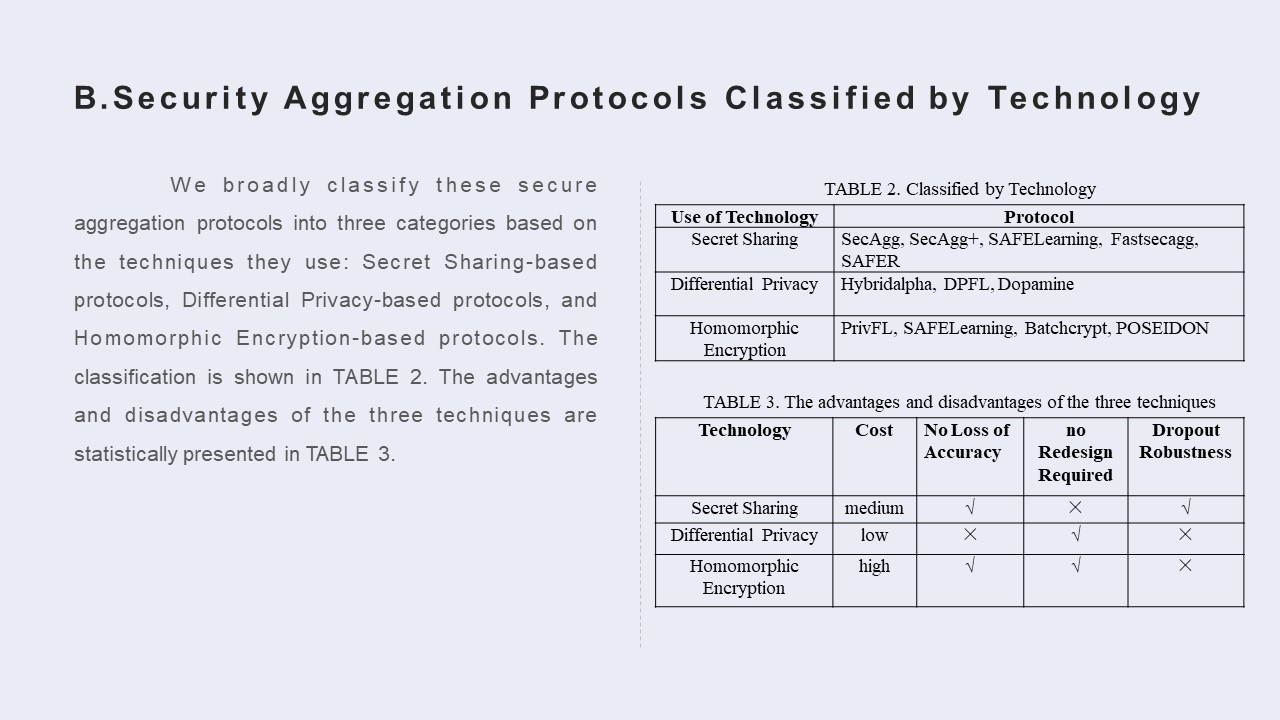 |
We broadly classify these secure aggregation protocols into three categories based on the techniques they use: Secret Sharing-based protocols, Differential Privacy-based protocols, and Homomorphic Encryption-based protocols. The classification is shown in TABLE 2. The advantages and disadvantages of the three techniques are statistically presented in TABLE 3. Looking at this Table 3,[0.5秒] the highest cost is homomorphic encryption, and of course, his nature will be the best. Next is secret sharing and differential privacy. And then neither of the two techniques except differential privacy leads to accuracy loss. And then only secret sharing requires protocol redesign. And for the robustness of dropout, only secret sharing supports it.
|
|
ICACT20220347 Slide.09
[Big slide for presentation]
[YouTube] |
Chrome Text-to-Speach Click!! |
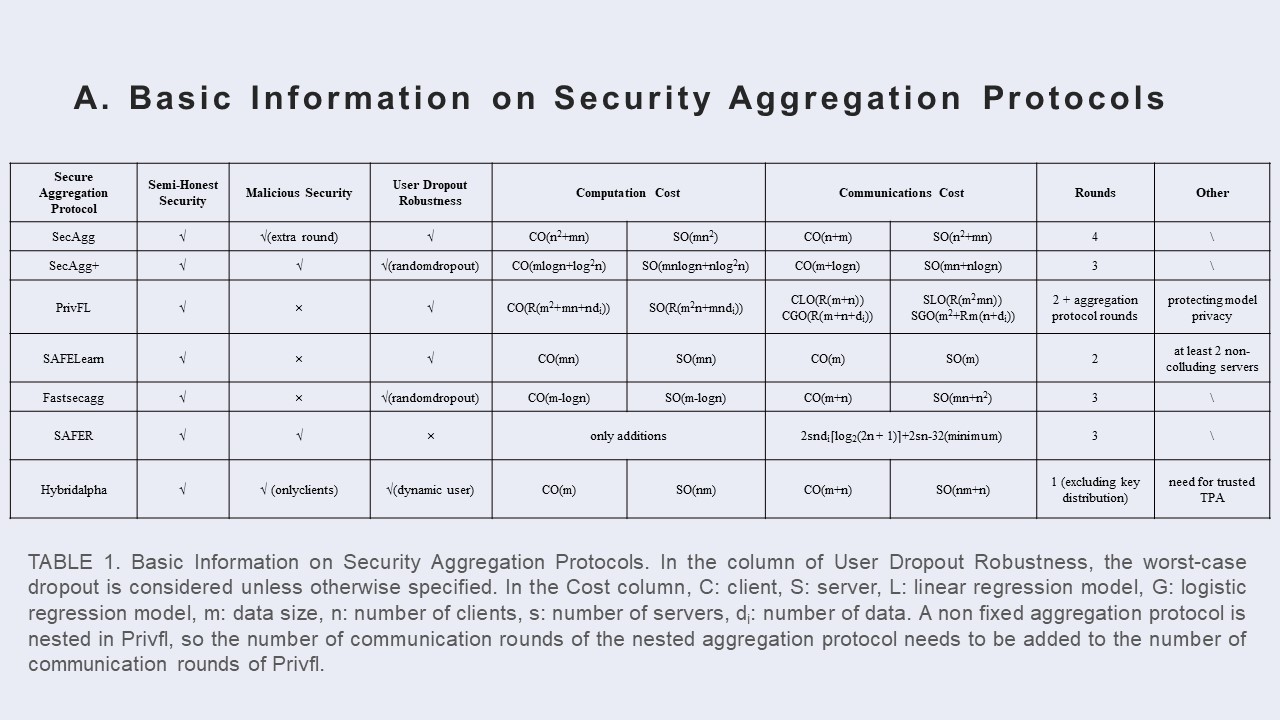 |
This is a table about Basic Information on Security Aggregation Protocols which includes semi-honest security, malicious security, user dropout robustness, computational cost, communication cost, number of communication rounds, and some other features. Semi-honest security is arguably one of the most essential conditions for judging a secure aggregation protocol to be practical. The secure aggregation protocols we investigated all guarantee semi-honest security well (all provide proofs of semi-honest security in their papers). Malicious security is a stronger security guarantee than semi-honest security. In practice (and in the security aggregation protocols we investigated), security against malicious adversaries is implemented as a malicious abort scheme, where if malicious activity is detected, the protocol will abort and the malicious adversaries will not cause a wrong answer nor gain additional information but may cause the protocol to abort resulting in no answer at all. Only SecAgg, SAFER and SecAgg+ of the security aggregation protocols we investigated can implement a full malicious abort scheme (where both the server and the user can be malicious attackers), while Hybridalpha can only implement a malicious abort scheme where the malicious attacker is only the user. In existing security aggregation schemes, the cost of guaranteeing malicious security is very high and is generally accompanied by high computational communication costs and communication rounds. SecAgg, for example, requires not only an additional signature of the data using a digital signature and an additional round of operations added to the protocol but also a trusted third-party dispatch key to guarantee malicious security. Computational cost, communication cost, and the number of communication rounds is the most intuitive elements to measure the practicality of a protocol. Improving security, functionality, and robustness while keeping costs within acceptable limits is the most immediate goal in the development of secure aggregation protocols. Also finding the best balance between security and cost is a very important research element. The unacceptable growth method of cost with the number of users, data volume, etc. is one of the biggest obstacles to move towards practical applications of secure aggregation protocols today. Storage costs are not as important as they used to be (compared to computational and communication costs) due to the rapid advances in storage technology today.
|
|
ICACT20220347 Slide.08
[Big slide for presentation]
[YouTube] |
Chrome Text-to-Speach Click!! |
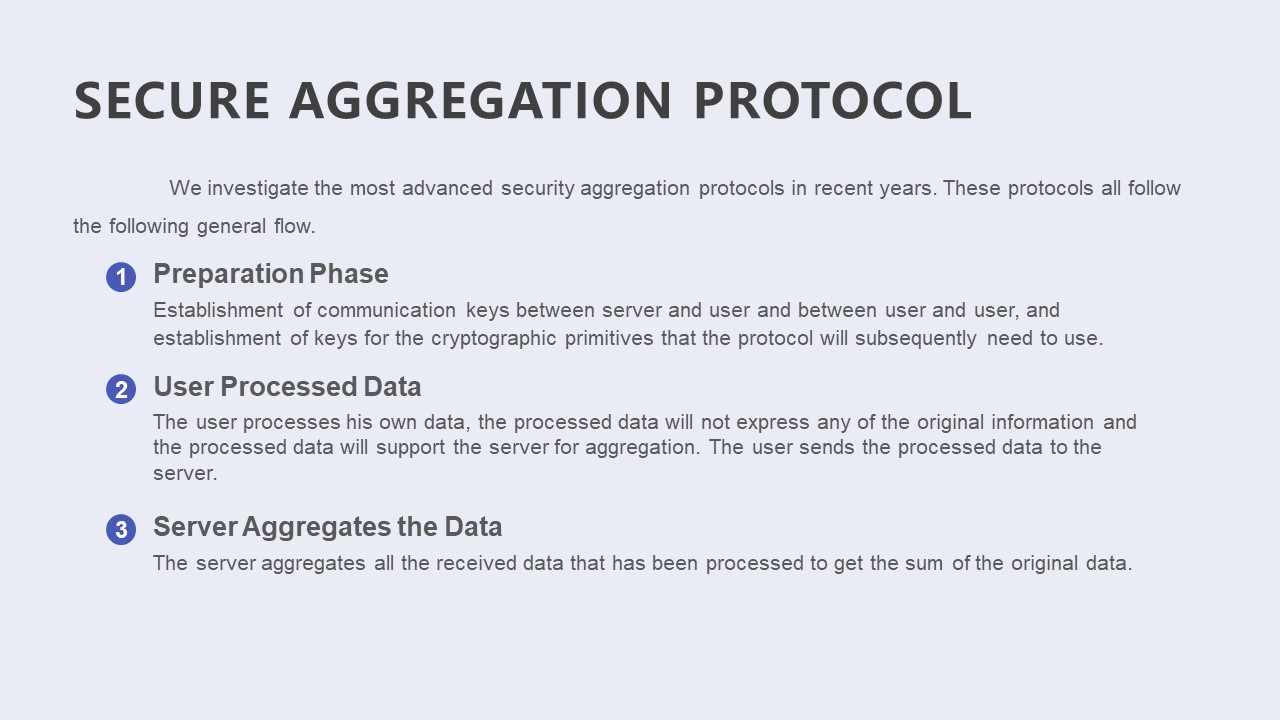 |
We investigate the most advanced security aggregation protocols in recent years. These protocols all follow the following general flow. mainly investigate security aggregation protocols that have been proposed one after another after Keith Bonawitz et al. proposed SecAgg in 2017. These protocols all follow the following general flow. Step 1: Preparation Phase: Establishment of communication keys between server and user and between user and user, and establishment of keys for the cryptographic primitives that the protocol will subsequently need to use. Step 2: User Processed Data: The user processes his own data, the processed data will not express any of the original information and the processed data will support the server for aggregation. The user sends the processed data to the server. Step 3: Server Aggregates the Data: The server aggregates all the received data that has been processed to get the sum of the original data.
|
|
ICACT20220347 Slide.07
[Big slide for presentation]
[YouTube] |
Chrome Text-to-Speach Click!! |
 |
After a brief introduction to the background of security aggregation, let's move on to the second section, the security aggregation protocol.
|
|
ICACT20220347 Slide.06
[Big slide for presentation]
[YouTube] |
Chrome Text-to-Speach Click!! |
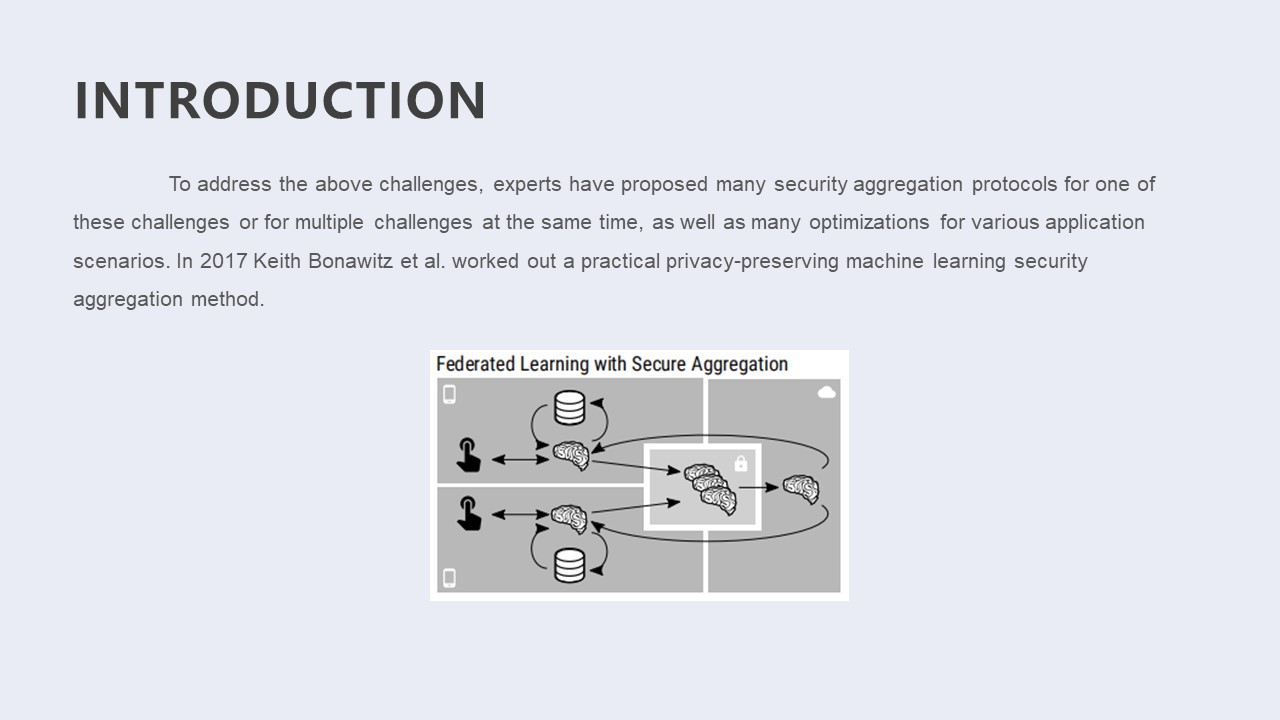 |
To address the above challenges, experts have proposed many security aggregation protocols for one of these challenges or for multiple challenges at the same time, as well as many optimizations for various application scenarios. In 2017 Keith Bonawitz et al. worked out a practical privacy-preserving machine learning security aggregation method which proposes a secret sharing and its innovative double-mask structure based on a secure aggregation protocol for FL that not only protects against semi-honest and malicious attackers but also is robust to users' mid-way dropout. After this study was published, many scholars joined the study of secure aggregation for FL and proposed many innovative secure aggregation protocols, although their performance makes them unsuitable for most practical applications. However, they have created a very active research area in the design and implementation of secure aggregation protocols. As a result of these efforts, the performance and usability of secure aggregation protocols have steadily improved. The following diagram expresses the basic idea of secure aggregation. Based on federated learning, the user's gradients are aggregated by an aggregator and then sent to the server to ensure the privacy of each individual user's gradient.
|
|
ICACT20220347 Slide.05
[Big slide for presentation]
[YouTube] |
Chrome Text-to-Speach Click!! |
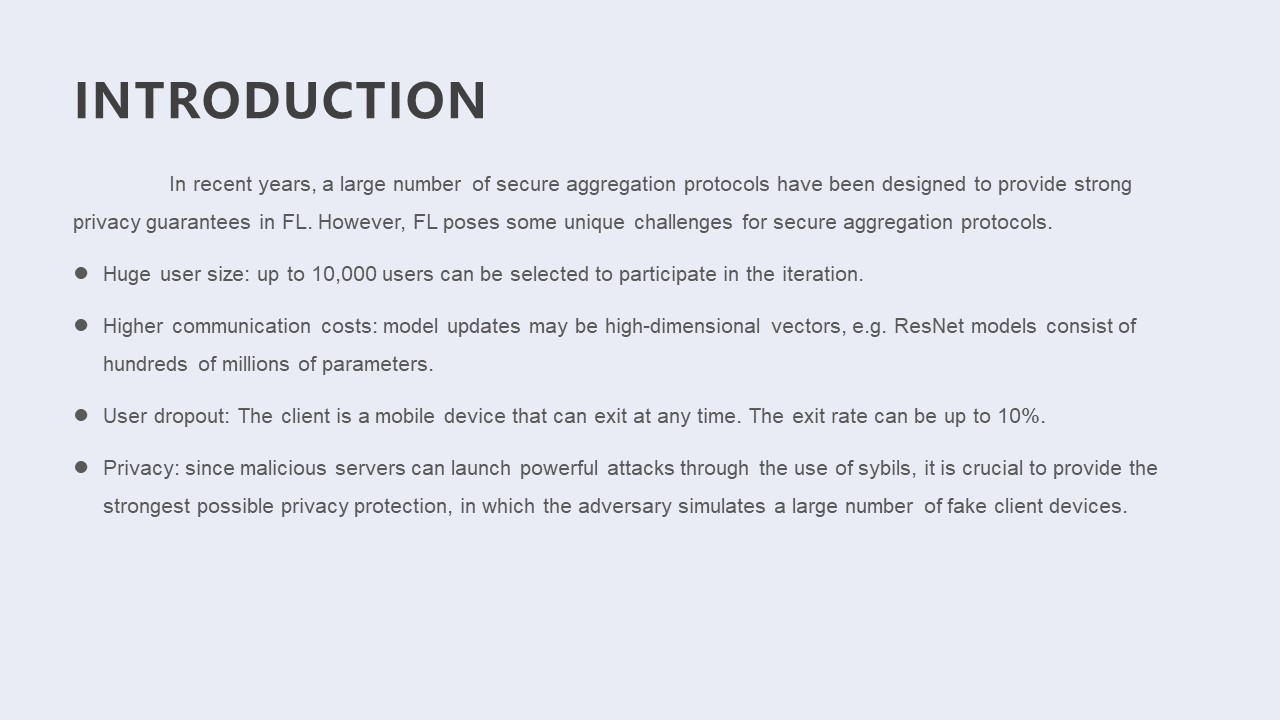 |
The problem of secure aggregation has been an area of research with different approaches including works based on secret sharing, differential privacy, homomorphic encryption , etc. In recent years, a large number of secure aggregation protocols have been designed to provide strong privacy guarantees in FL. However, FL poses some unique challenges for secure aggregation protocols. The first one is Huge user size: up to 10,000 users can be selected to participate in the iteration. The second one is Higher communication costs: model updates may be high-dimensional vectors, e.g. ResNet models consist of hundreds of millions of parameters. The third one is User dropout: The client is a mobile device that can exit at any time. The exit rate can be up to 10%. The fourth one is Privacy: since malicious servers can launch powerful attacks through the use of sybils, it is crucial to provide the strongest possible privacy protection, in which the adversary simulates a large number of fake client devices.
|
|
ICACT20220347 Slide.04
[Big slide for presentation]
[YouTube] |
Chrome Text-to-Speach Click!! |
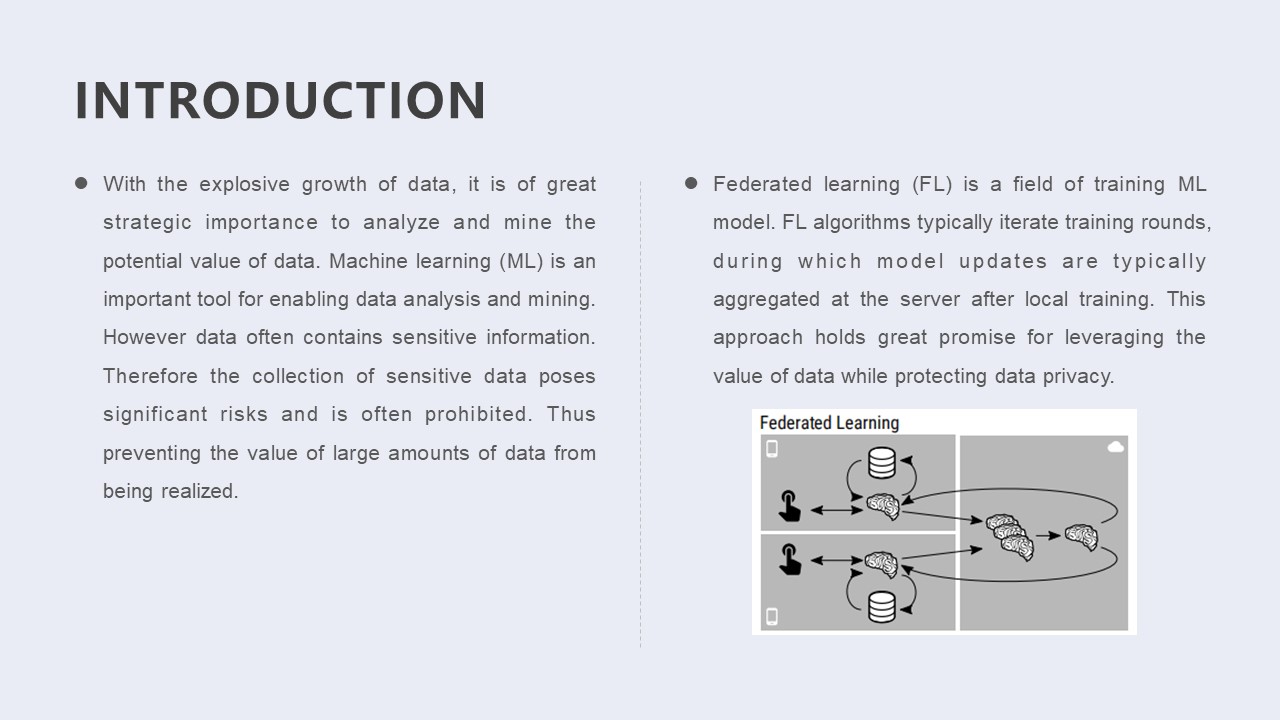 |
With the explosive growth of data, it is of great strategic importance to analyze and mine the potential value of data. Machine learning is an important tool for enabling data analysis and mining. However data often contains sensitive information. Therefore the collection of sensitive data poses significant risks and is often prohibited. Thus preventing the value of large amounts of data from being realized. Federated learning is a field of training ML model. FL algorithms typically iterate training rounds, during which model updates are typically aggregated at the server after local training. This approach holds great promise for leveraging the value of data while protecting data privacy. This pair of pictures depicts federaled learning. The client sends only the gradients derived from training with its own data to the server.
|
|
ICACT20220347 Slide.03
[Big slide for presentation]
[YouTube] |
Chrome Text-to-Speach Click!! |
 |
Let's move to the first section, INTRODUCTION
|
|
ICACT20220347 Slide.02
[Big slide for presentation]
|
Chrome Text-to-Speach Click!! |
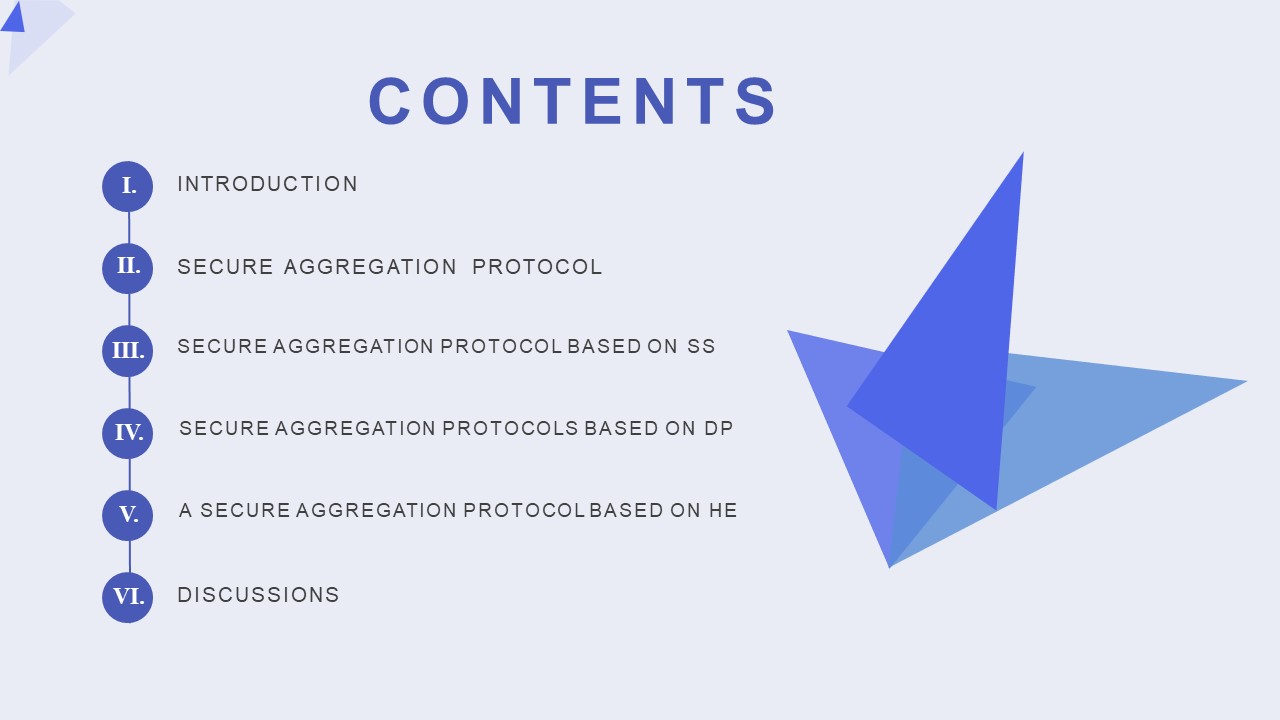 |
In this paper, we broadly evaluate some secure aggregation protocols and discuss them categorically by technique in Section II. This is followed by a description of secure aggregation protocols based on secret sharing, differential privacy, and homomorphic encryption in sections III, IV, and V, respectively. In Section VI, the future development of secure aggregation protocols is given an outlook and possible future research directions are proposed. As a start, we'll start with an introduction to the background of security aggregation in the Section I.
|
|
ICACT20220347 Slide.01
[Big slide for presentation]
[YouTube] |
Chrome Text-to-Speach Click!! |
 |
This is a Survey of security aggregation. By studying this paper you will help you gain a general understanding of security aggregation and research advances in this direction in recent years.
|
















