 ICACT20230252 Slide.16
[Big slide for presentation]
[YouTube] |
Chrome Text-to-Speach Click!! |
 |
Thanks for your listening. That's all.
|
|
ICACT20230252 Slide.15
[Big slide for presentation]
[YouTube] |
Chrome Text-to-Speach Click!! |
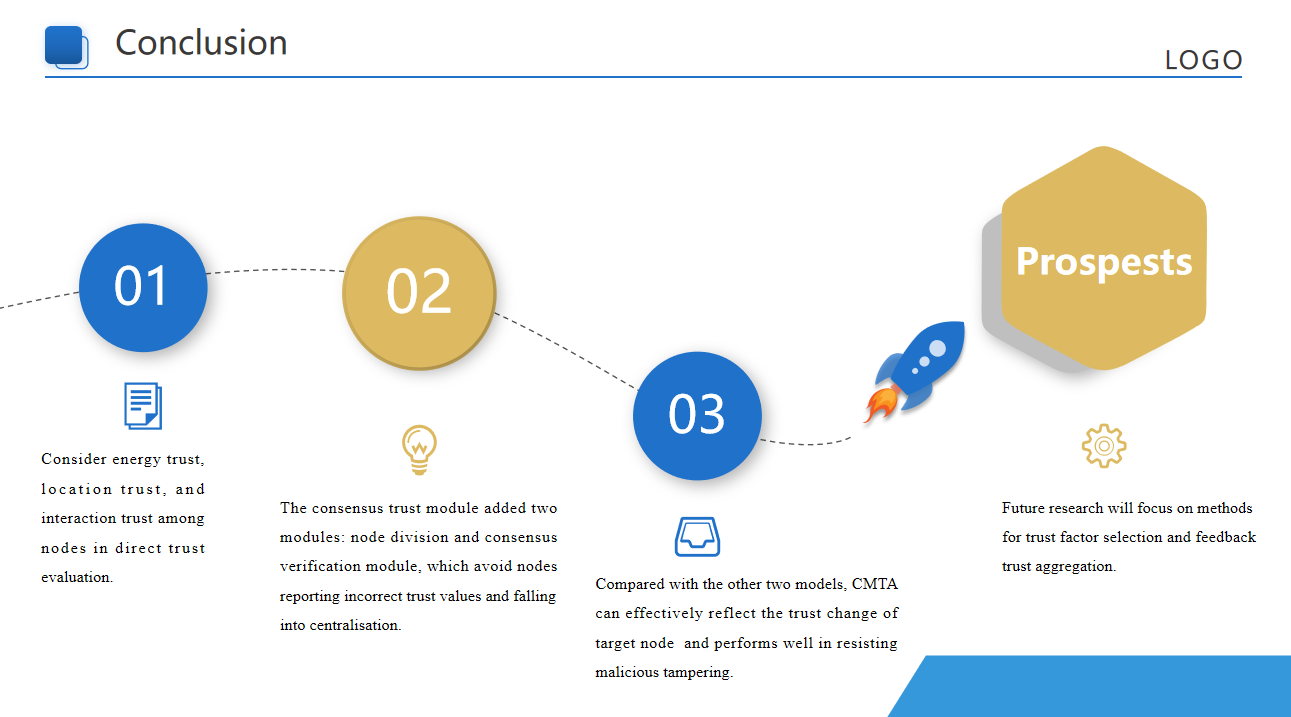 |
In this paper, we propose a trust evaluation method for end devices in an edge computing environment, which combines node reputation and consensus mechanism to carry out the evaluation, considering energy trust, location trust, and interaction trust among nodes in direct trust evaluation, and selecting recently active nodes considering the time decay of node trust. To ensure the security of consensus, the initial reputation is determined by voting in the initial stage, which effectively resists malicious nodes from tampering with the reputation value at will. The proposed consensus verification module effectively alleviates the problem of master nodes falsely reporting the uploading of incorrect trust values and failing to objectively evaluate the target nodes.
|
|
ICACT20230252 Slide.14
[Big slide for presentation]
[YouTube] |
Chrome Text-to-Speach Click!! |
 |
Then come to the conclusion.
|
|
ICACT20230252 Slide.13
[Big slide for presentation]
[YouTube] |
Chrome Text-to-Speach Click!! |
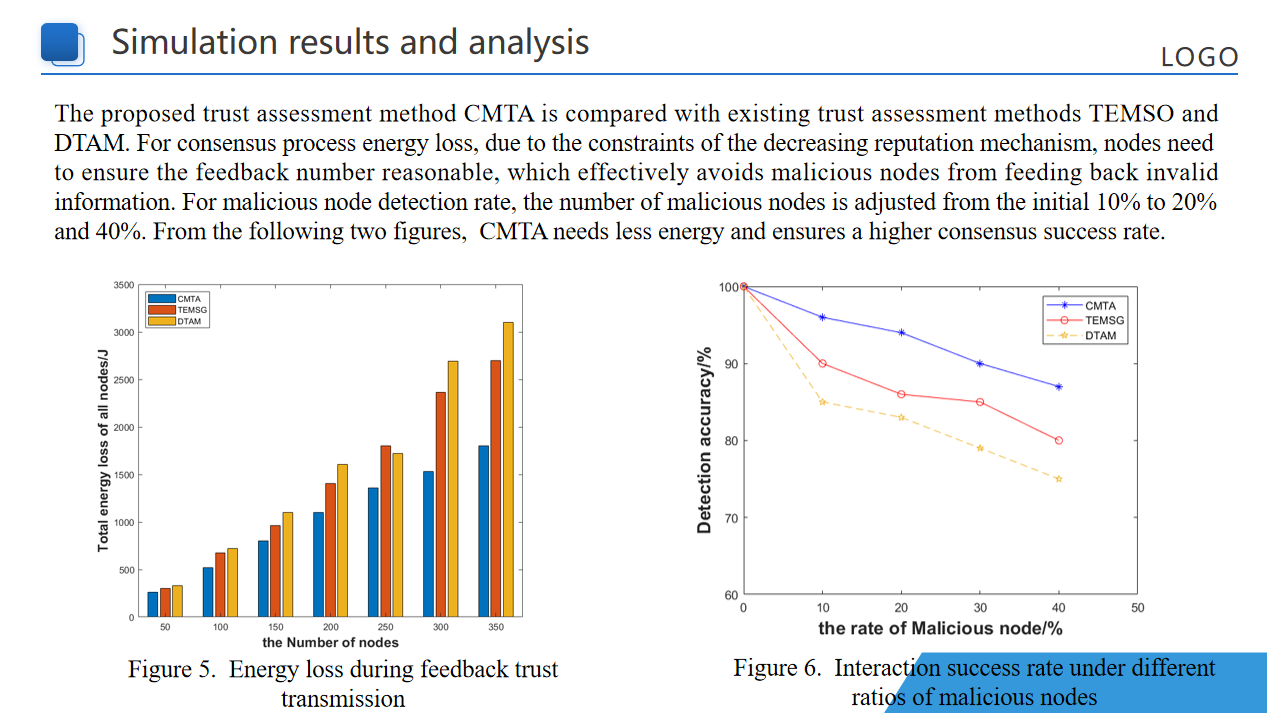 |
The proposed trust assessment method CMTA is compared with existing trust assessment methods TEMSO and DTAM. For consensus process energy loss, due to the constraints of the decreasing reputation mechanism, nodes need to ensure the feedback number reasonable, which effectively avoids malicious nodes from feeding back invalid information. For malicious node detection rate, the number of malicious nodes is adjusted from the initial 10% to 20% and 40%. From the following two figures, CMTA needs less energy and ensures a higher consensus success rate.
|
|
ICACT20230252 Slide.12
[Big slide for presentation]
[YouTube] |
Chrome Text-to-Speach Click!! |
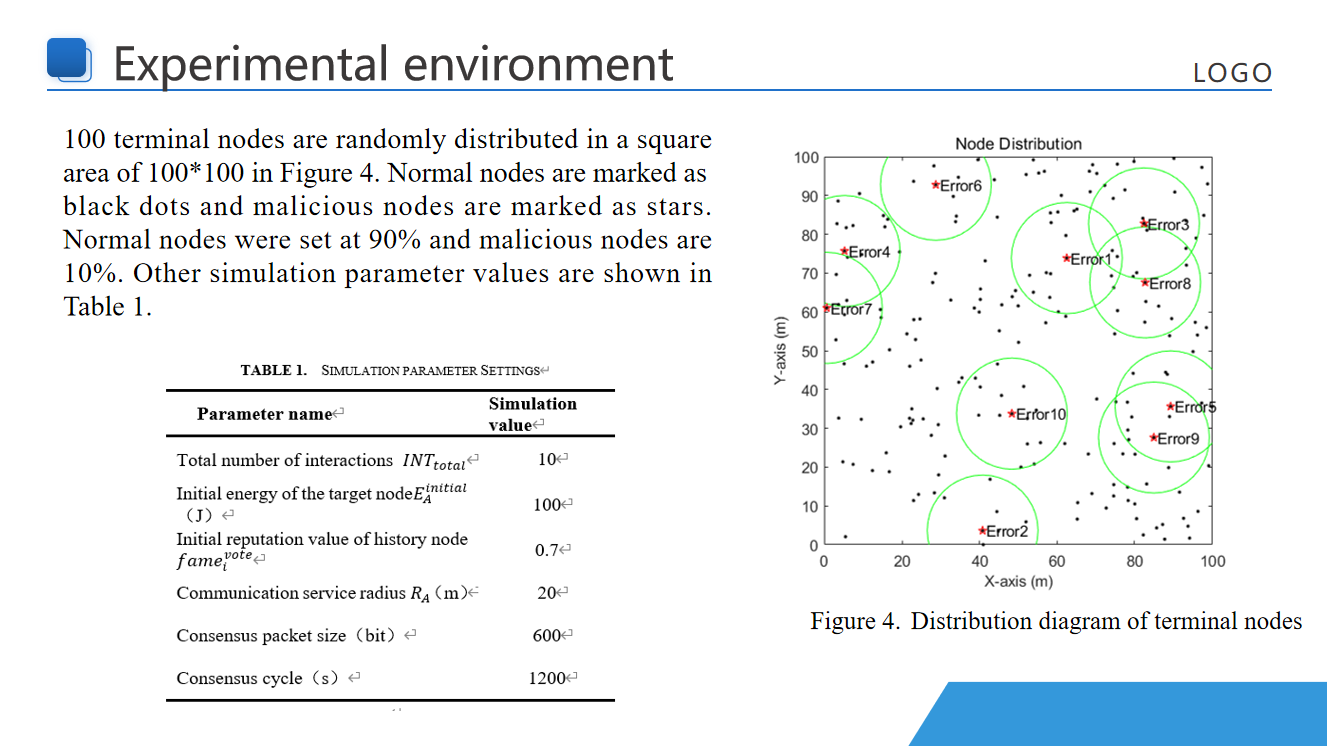 |
To verify whether the model can effectively reflect the trust value and defend against malicious nodes, we build a simulation environment in Matlab.
|
|
ICACT20230252 Slide.11
[Big slide for presentation]
[YouTube] |
Chrome Text-to-Speach Click!! |
 |
The third part is results analysis.
|
|
ICACT20230252 Slide.10
[Big slide for presentation]
[YouTube] |
Chrome Text-to-Speach Click!! |
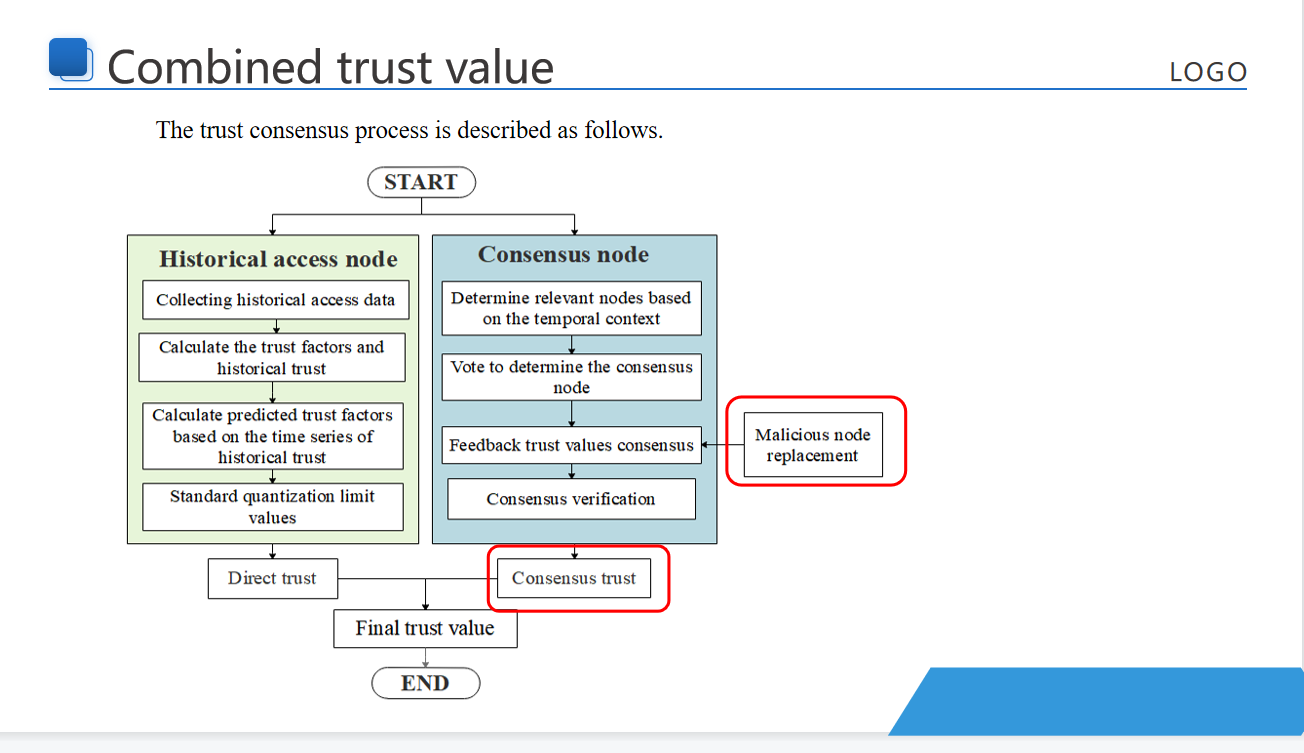 |
The server weights the aggregated direct trust value and consensus trust value to obtain the integrated trust value and uses adaptive dynamic weights to assign the weight coefficients.
|
|
ICACT20230252 Slide.09
[Big slide for presentation]
[YouTube] |
Chrome Text-to-Speach Click!! |
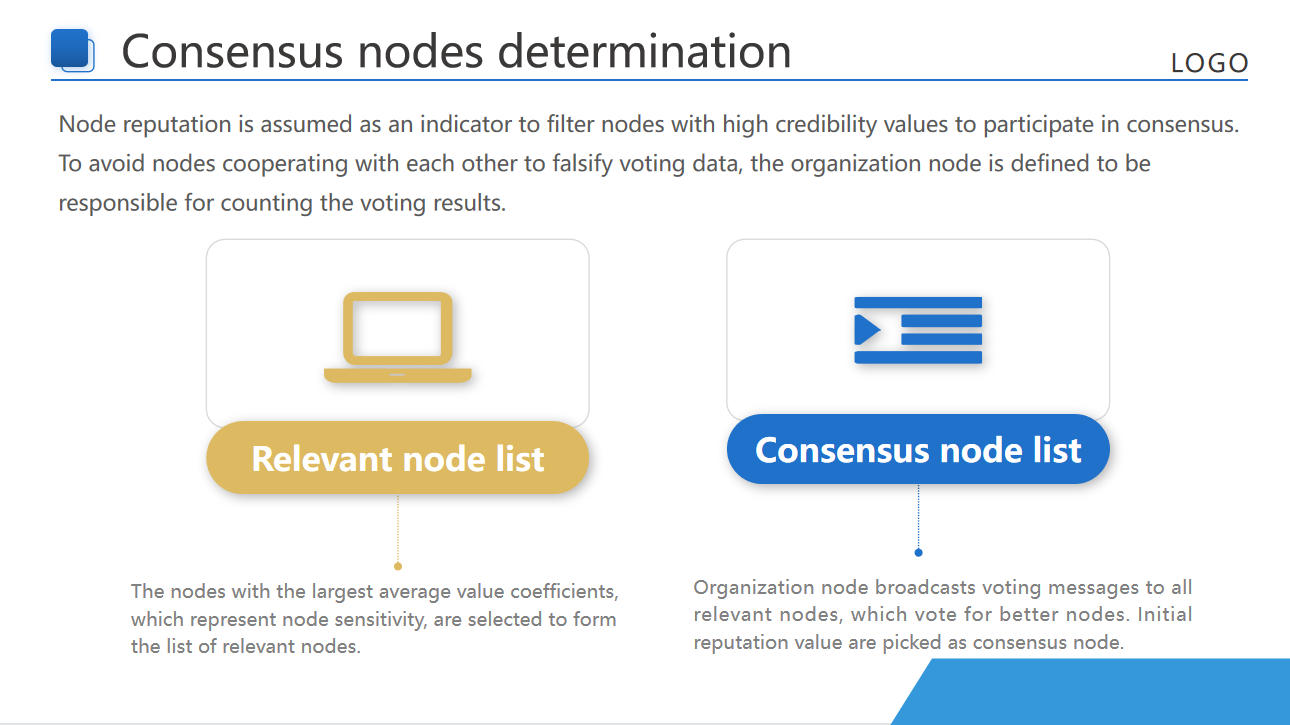 |
The nodes with the largest average value coefficients, which represent node sensitivity, are selected to form the list of relevant nodes. The node that the target node has visited most recently is selected as an organization node, which broadcasts voting messages to all relevant nodes. Other nodes receive the message, vote on all involved nodes in turn, and send the voting result to the organization node.
|
|
ICACT20230252 Slide.08
[Big slide for presentation]
[YouTube] |
Chrome Text-to-Speach Click!! |
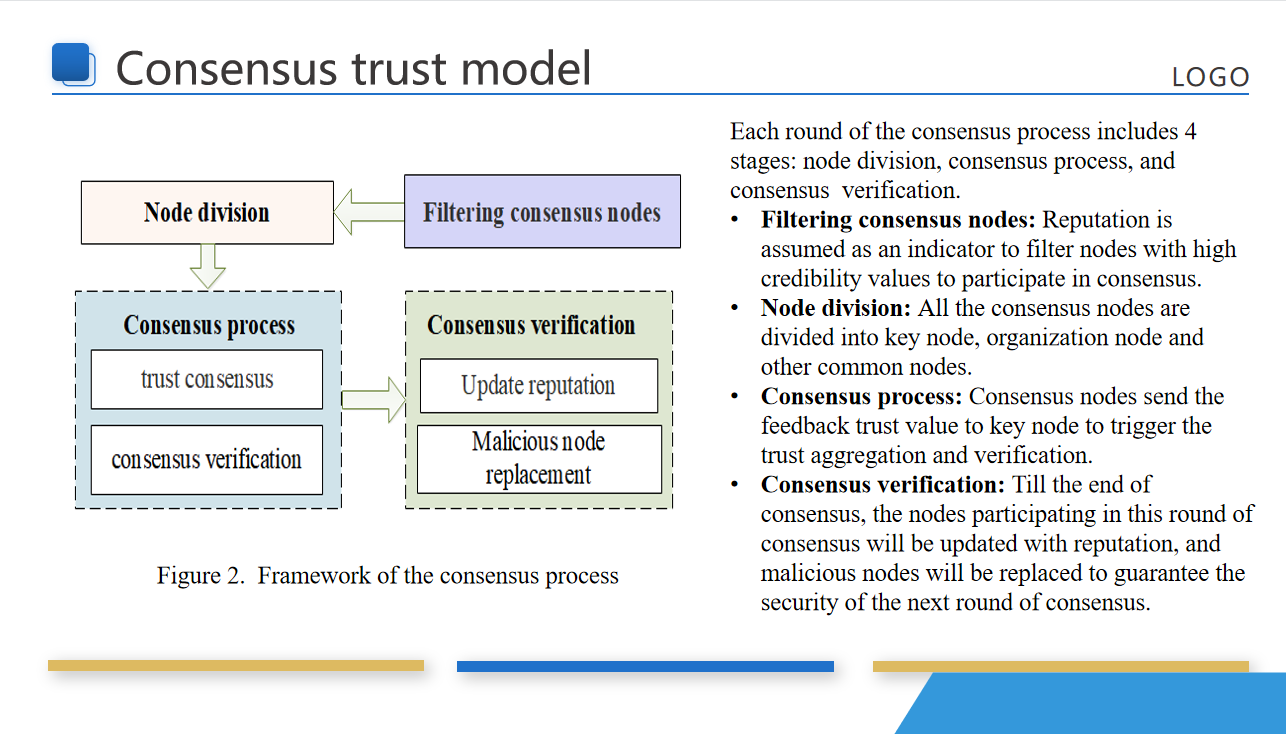 |
A consensus mechanism for indirect trust assessment is introduced in this paper. The specific consensus process is shown in Figure 2. Each round of the consensus process includes 3 stages: node division, consensus process, and consensus verification. Before the first round, the list of consensus nodes that can participate in the consensus needs to be filtered. The consensus nodes will send the feedback trust value to the master node to trigger the trust aggregation and verification mechanism. Till the end of consensus, the nodes participating in this round of consensus will be updated with reputation, and malicious nodes will be replaced to guarantee the security of the next round of consensus.
|
|
ICACT20230252 Slide.07
[Big slide for presentation]
[YouTube] |
Chrome Text-to-Speach Click!! |
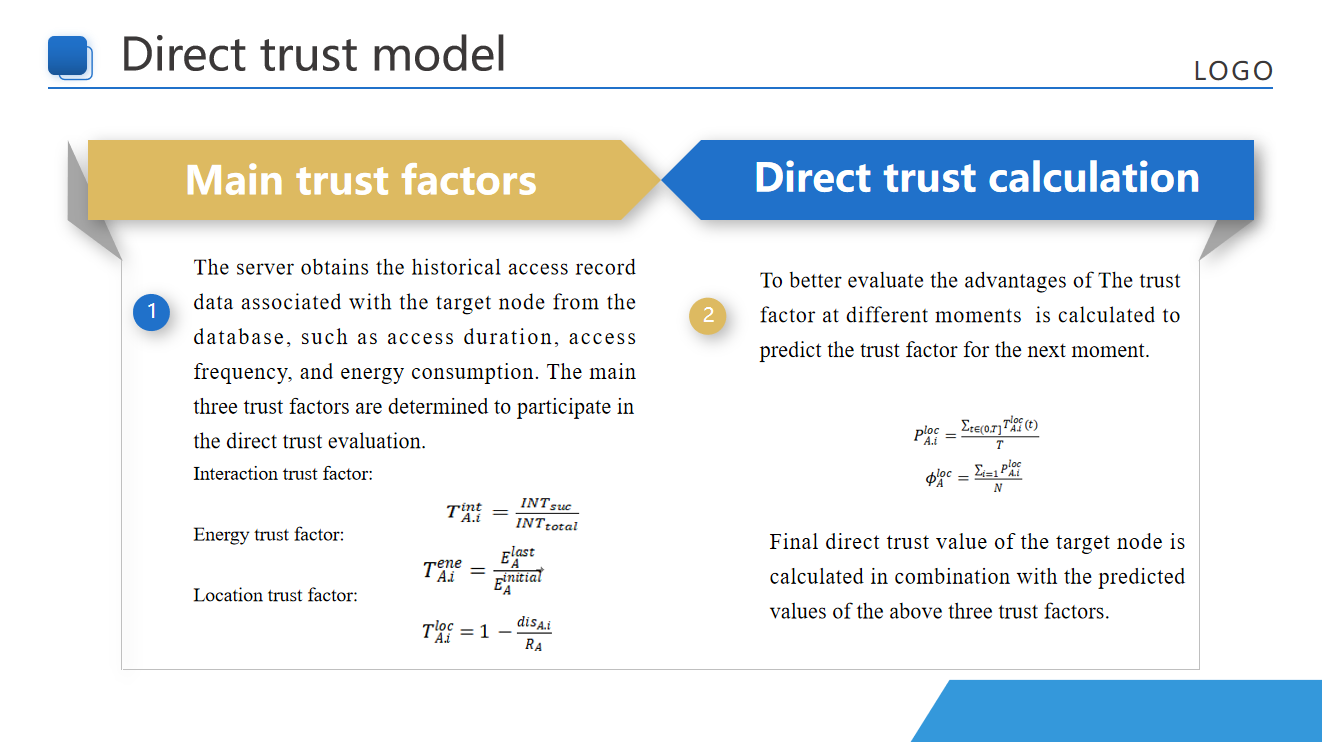 |
The direct trust values in traditional trust models are obtained based on Bayesian theory. In this paper, the direct trust calculation includes two modules: acquiring the node history data module and calculating direct trust value module. The server obtains the historical access record data associated with the target node from the database, such as access duration, access frequency, and energy consumption. The main trust factors will be determined to participate in the final direct trust evaluation. The current trust value of the target node is obtained, which is noted as the direct trust value.
|
|
ICACT20230252 Slide.06
[Big slide for presentation]
[YouTube] |
Chrome Text-to-Speach Click!! |
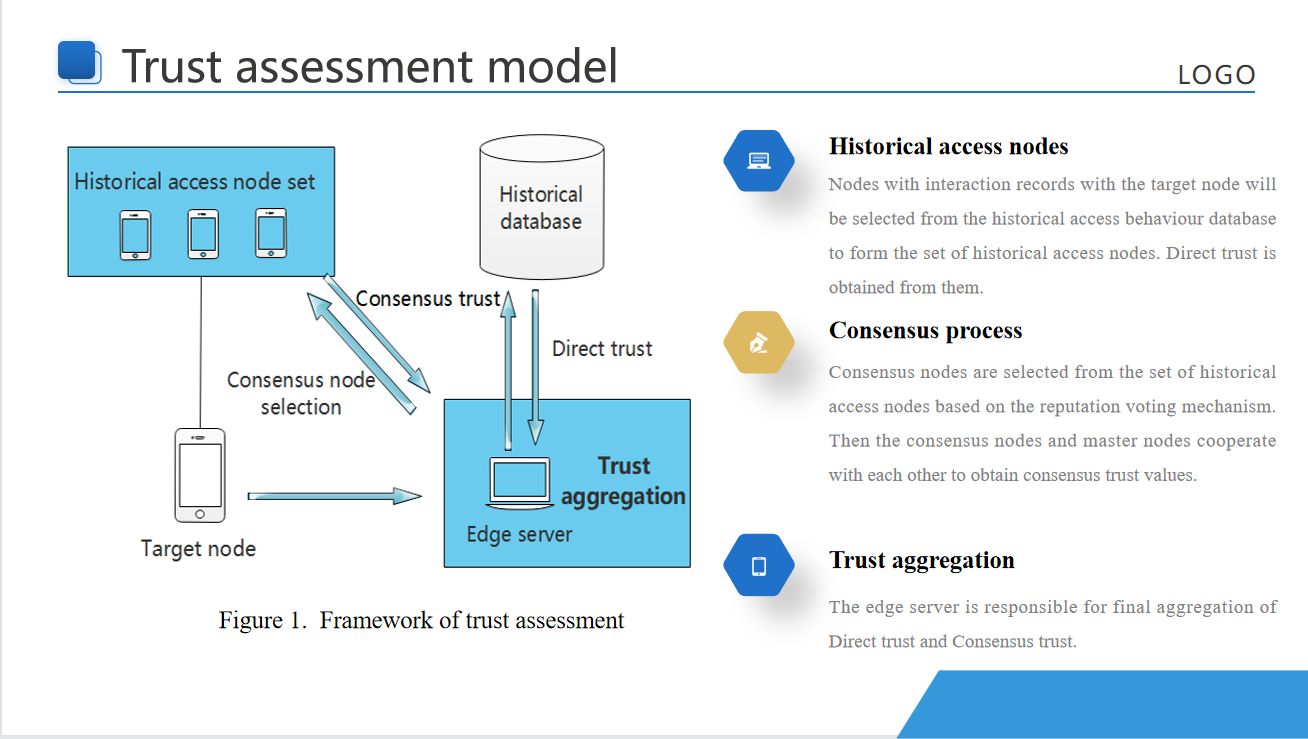 |
Trust assessment in distributed network can be defined as the analysis of the future trust situation of a terminal node based on its historical access behaviour. As shown in Figure 1, each terminal node has a relationship with the edge server. Nodes with interaction records with the target node will be selected from the historical access behaviour database to form the set of historical access nodes. Based on the historical trust assessment value, the direct trust value will be predicted. In the consensus process, consensus nodes are selected from the set of historical access nodes based on the reputation voting mechanism. Consensus nodes and master nodes cooperate with each other to obtain consensus trust values, which is sent to the edge server for final trust aggregation
|
|
ICACT20230252 Slide.05
[Big slide for presentation]
[YouTube] |
Chrome Text-to-Speach Click!! |
 |
The second part is modeling.
|
|
ICACT20230252 Slide.04
[Big slide for presentation]
[YouTube] |
Chrome Text-to-Speach Click!! |
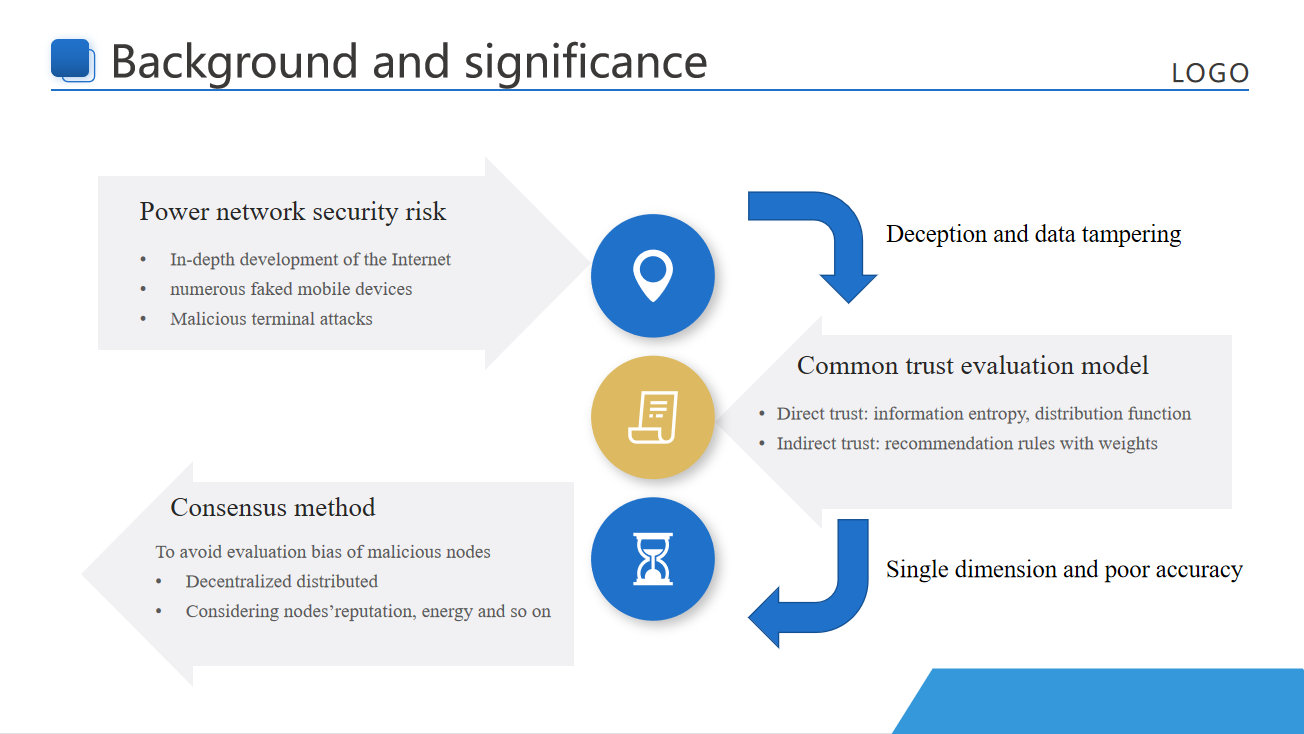 |
With the in-depth development of the Internet and the widespread application of new technologies such as IoT in the power industry, the types and numbers of mobile terminal devices accessed in power networks have increased sharply. It poses a serious challenge to power network security in [1].In terms of power network security defense, internal system attacks are far more serious than external attacks, and these malicious terminals existing within the system can be faked into legitimate terminals to invade the system. The security of the accessed terminal can be judged by whether it is authenticated and authorized. As a decentralized distributed database, blockchain [10] can store data in block form and transmit it according to the chained data structure. Based on the great characteristics of blockchain, we try to insert it into trust assessment model.
|
|
ICACT20230252 Slide.03
[Big slide for presentation]
[YouTube] |
Chrome Text-to-Speach Click!! |
 |
The first part is Background and Significance.
|
|
ICACT20230252 Slide.02
[Big slide for presentation]
[YouTube] |
Chrome Text-to-Speach Click!! |
 |
Here we will introduce our paper from the four parts: Background and Significance, Modeling,Results analysis and Conclusion.
|
|
ICACT20230252 Slide.01
[Big slide for presentation]
[YouTube] |
Chrome Text-to-Speach Click!! |
 |
Hi everybody, my name is Shixin Cheng. For ICACT 2023, I have cooperated with two partners Jinzhe Zhang and Liping Han. Our presentation today is about A Terminal Trust Assessment Method Based on Consensus Trust Aggregation.
|
















