Now 4582 visitors
Today:0 Yesterday:0
Total: 144687
215S 51P 5R
2026-10-21, Week 43 |
| Member Login |
| TACT Journal Homepage |
| Call for Paper |
| Committee |
| Find My Paper |
| Author Homepage |
| Statistics & History |
| Welcome Message |
| Paper Procedure |
| FAQ |
| Paper Archives |
| Outstanding Papers |
| Author Homepage |
| - Paper Procedure |
| - Journal Procedure |
| - Presentation Tips |
|
| Program & Proceedings |
| Program with Papers |
| Plenary Session |
| Tutorial Session |
|
| Presentation Platform |
| Hotel & Travel Info |
| About Korea |
| Accommodation |
| Transportation |
| VISA |
| Other Infomation |
|
| Photo Gallery |
| Scheduler Login |
| Seminar |
| Archives Login |
|
| Sponsors |

|

|

|

|

|

|

|

|

|

|
|
|
|
|
main_email:js.kim@etri.re.kr
| Save the slide and description |

|
*** You can edit any slide by selecting the Slide number below***
|
 ICACT20210124 Slide.15
[Big slide for presentation] |
Chrome Text-to-Speach Click!! |
 |
Thank you for listening.
|
|
ICACT20210124 Slide.14
[Big slide for presentation]
|
Chrome Text-to-Speach Click!! |
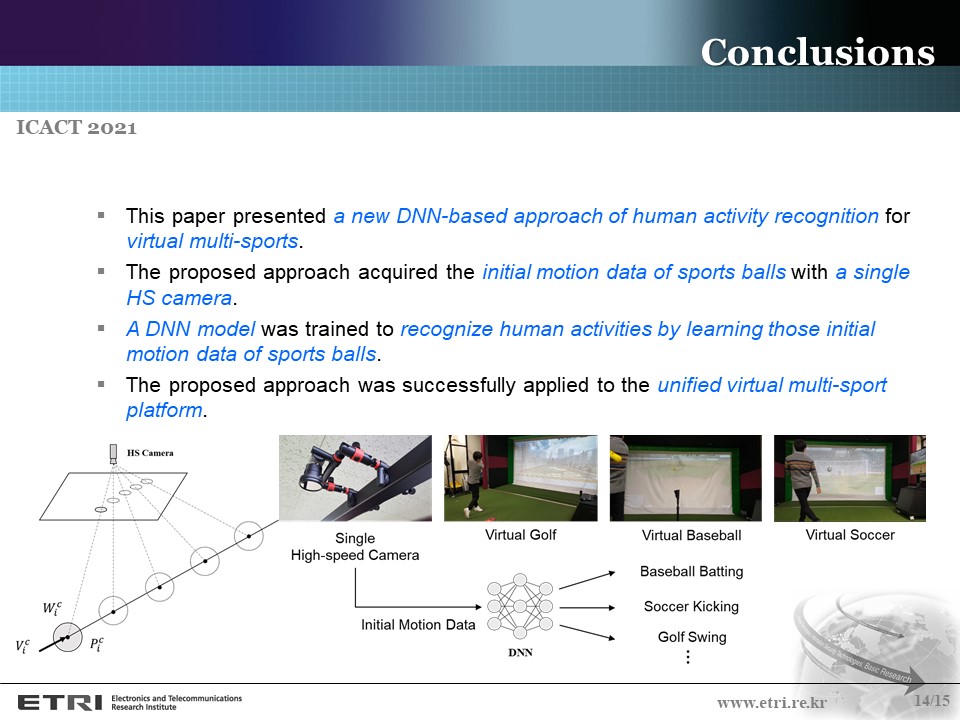 |
As conclusions, this paper presented a new deep neural network-based approach of human activity recognition for virtual multi-sports.
The proposed approach acquired the initial motion data of sports balls with a single HS camera.
A deep neural network model was trained to recognize human activities by learning those initial motion data of sports balls.
The proposed approach was successfully applied to the unified virtual multi-sport platform.
|
|
ICACT20210124 Slide.13
[Big slide for presentation]
|
Chrome Text-to-Speach Click!! |
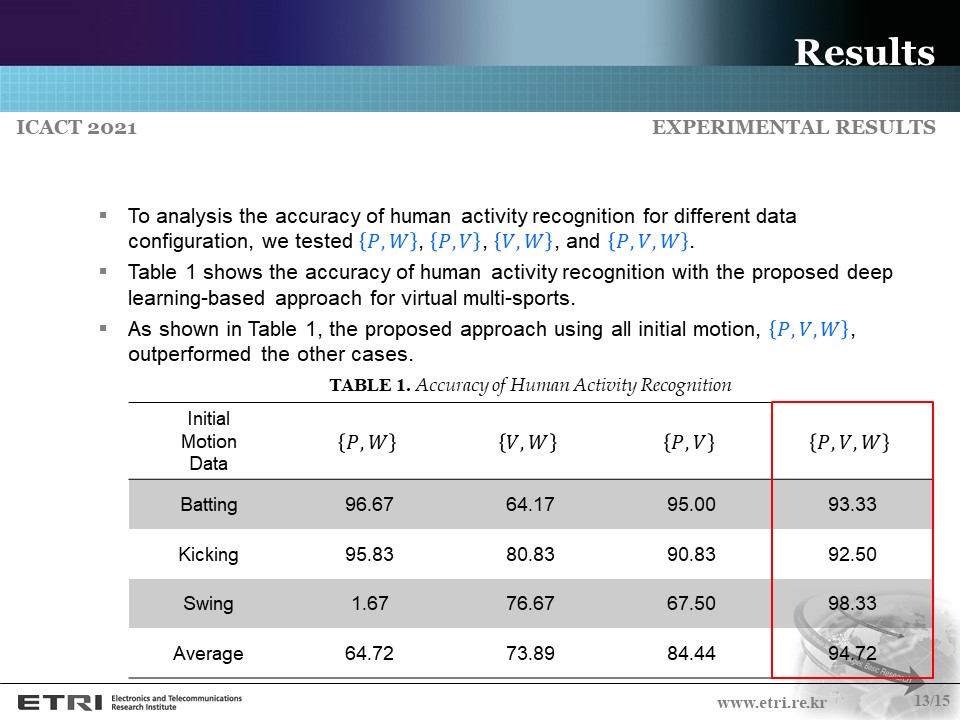 |
To analysis the accuracy of human activity recognition for different data configuration, we tested P and W vector, P and V vector, V and W vector, and P, W, and W vector.
Table 1 shows the accuracy of human activity recognition with the proposed deep learning-based approach for virtual multi-sports.
As shown in Table 1, the proposed approach using all initial motion outperformed the other cases.
|
|
ICACT20210124 Slide.12
[Big slide for presentation]
|
Chrome Text-to-Speach Click!! |
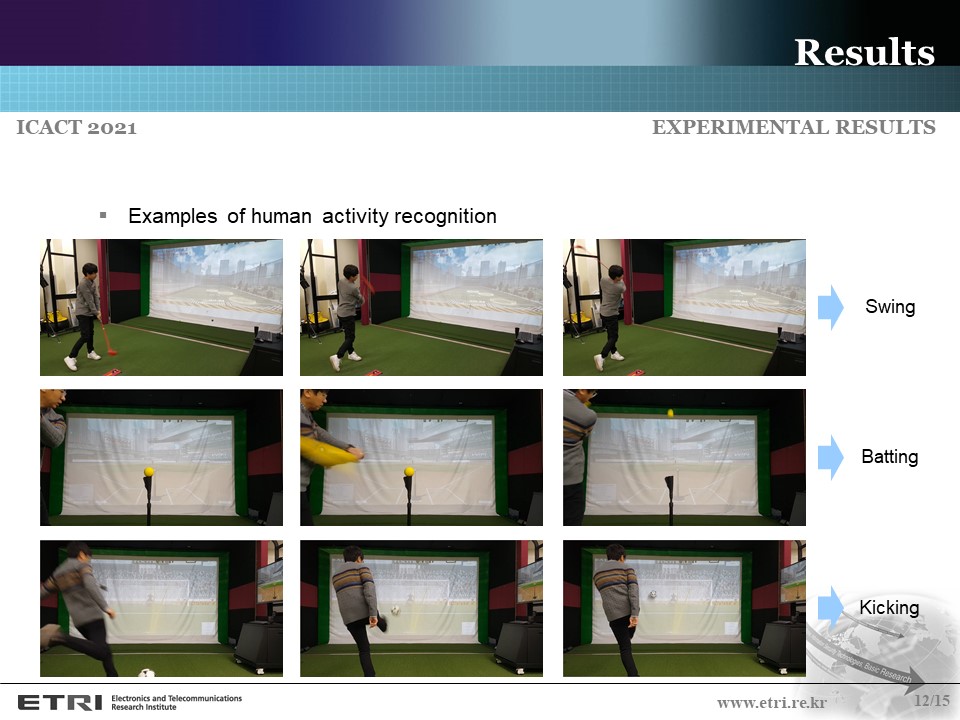 |
This slide shows some examples of human activity recognition tested in our unified multi-sports platform.
|
|
ICACT20210124 Slide.11
[Big slide for presentation]
|
Chrome Text-to-Speach Click!! |
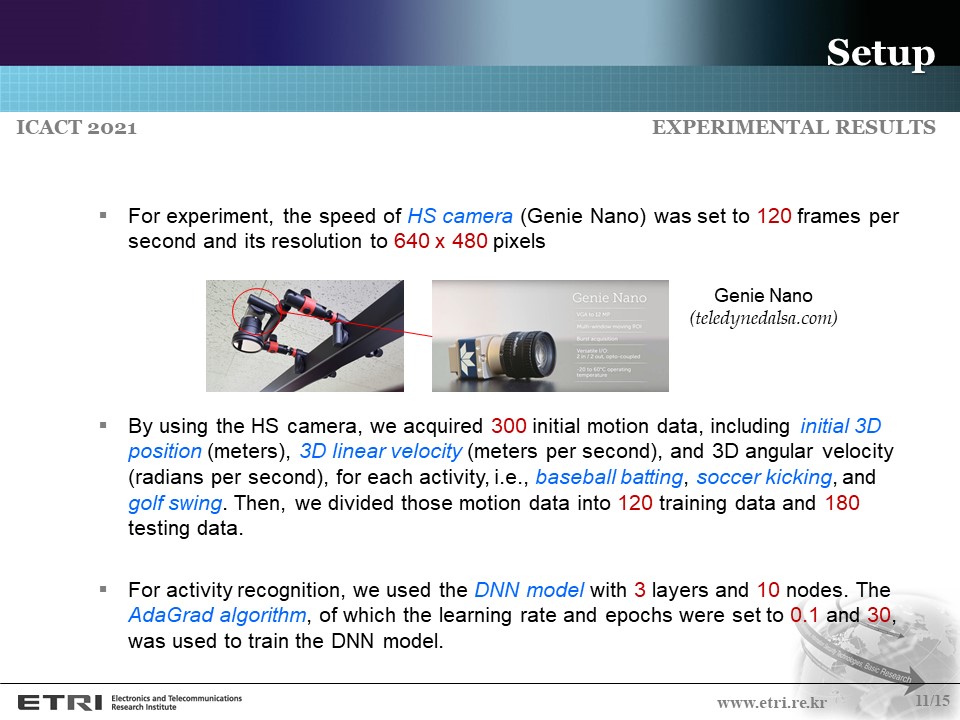 |
For experiment, the speed of high-speed camera, Genie Nano, was set to 120 frames per second and its resolution to 640 by 480 pixels.
By using the high-speed camera, we acquired 300 initial motion data, including initial 3D position in meters, 3D linear velocity in meters per second, and 3D angular velocity in radians per second, for each activity. Then, we divided those motion data into 120 training data and 180 testing data.
For activity recognition, we used the deep neural network model with 3 layers and 10 nodes. The AdaGrad algorithm, of which the learning rate and epochs were set to 0.1 and 30, was used to train the deep neural network model.
|
|
ICACT20210124 Slide.10
[Big slide for presentation]
|
Chrome Text-to-Speach Click!! |
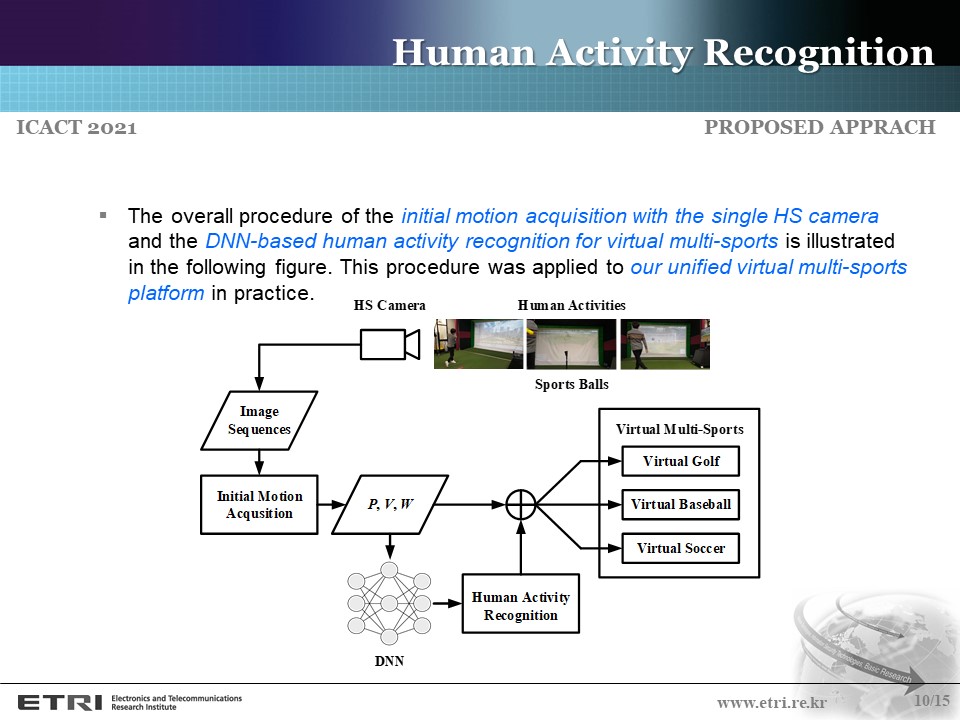 |
The overall procedure of the initial motion acquisition with the single high-speed camera and the deep neural network-based human activity recognition for virtual multi-sports is illustrated in the following figure. This procedure was applied to our unified virtual multi-sports platform in practice.
|
|
ICACT20210124 Slide.09
[Big slide for presentation]
|
Chrome Text-to-Speach Click!! |
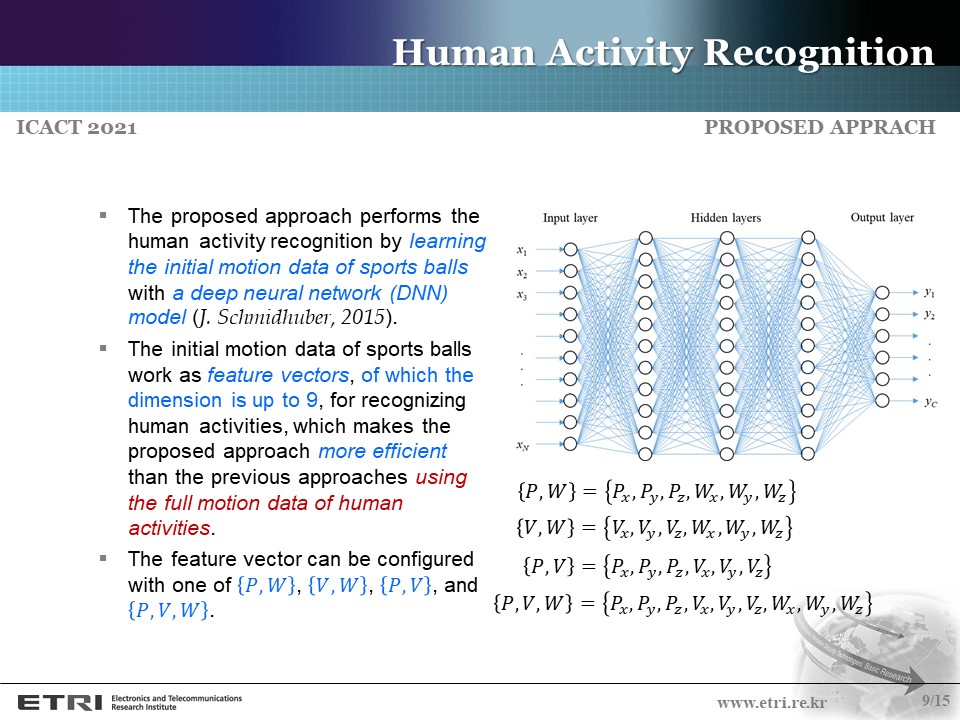 |
The proposed approach performs the human activity recognition by learning the initial motion data of sports balls with a deep neural network model.
The initial motion data of sports balls work as feature vectors, of which the dimension is up to 9, for recognizing human activities, which makes the proposed approach more efficient than the previous approaches using the full motion data of human activities.
The feature vector can be configured with one of these vectors.
|
|
ICACT20210124 Slide.08
[Big slide for presentation]
|
Chrome Text-to-Speach Click!! |
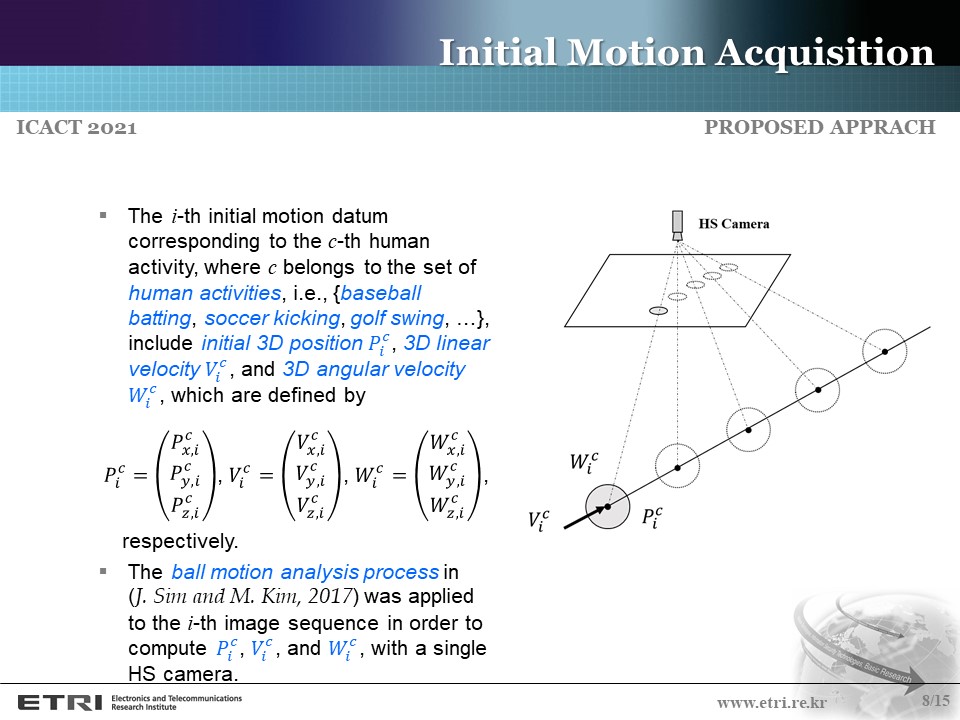 |
The i-th initial motion datum corresponding to the c-th human activity, where c belongs to the set of human activities, for example, baseball batting, soccer kicking, golf swing, and so on, include initial 3D position, 3D linear velocity, and 3D angular velocity, which are defined by the following equations, respectively.
The ball motion analysis process in our previous work was applied to the i-th image sequence in order to compute initial 3D position, 3D linear velocity, and 3D angular velocity, with a single high-speed camera.
|
|
ICACT20210124 Slide.07
[Big slide for presentation]
|
Chrome Text-to-Speach Click!! |
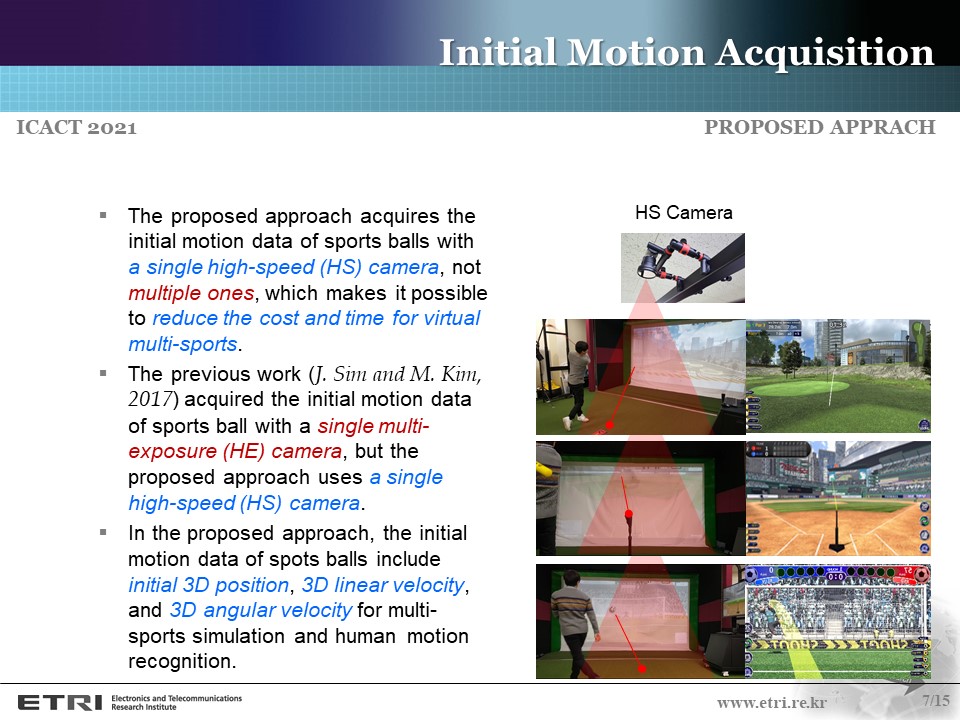 |
As shown in the figure at the right side, the proposed approach acquires the initial motion data of sports balls with a single high-speed camera, not multiple ones, which makes it possible to reduce the cost and time for virtual multi-sports.
The previous work acquired the initial motion data of sports ball with a single multi-exposure camera, but the proposed approach uses a single high-speed camera.
In the proposed approach, the initial motion data of spots balls include initial 3D position, 3D linear velocity, and 3D angular velocity for multi-sports simulation and human motion recognition.
|
|
ICACT20210124 Slide.06
[Big slide for presentation]
|
Chrome Text-to-Speach Click!! |
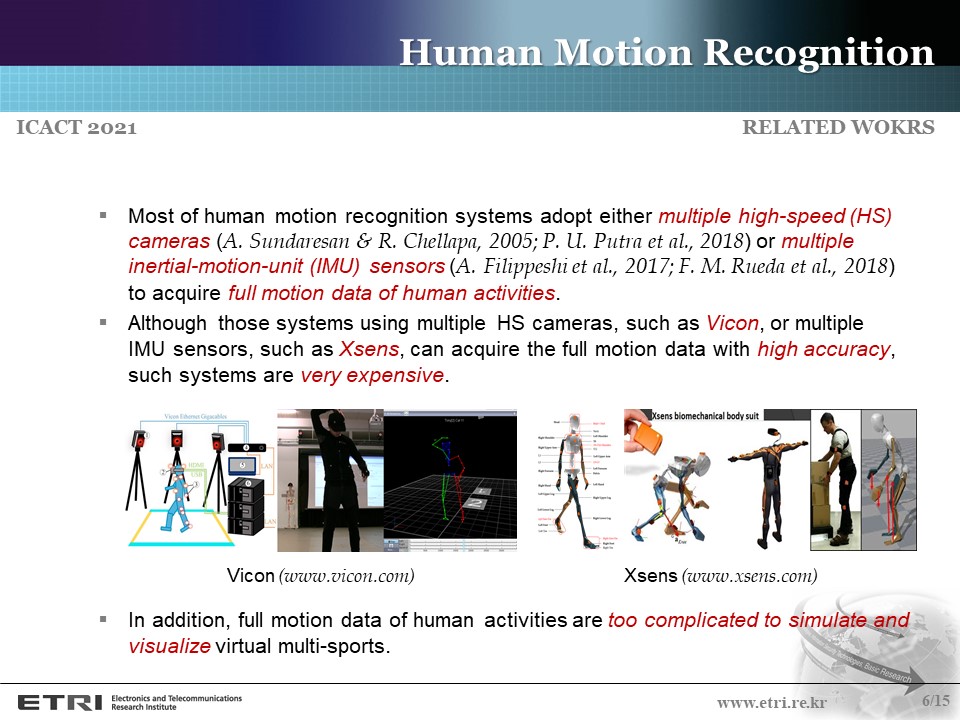 |
As far as we know, most of human motion recognition systems adopt either multiple high-speed cameras or multiple inertial-motion-unit sensors to acquire full motion data of human activities.
Although those systems using multiple HS cameras, such as Vicon, or multiple IMU sensors, such as Xsens, can acquire the full motion data with high accuracy, such systems are very expensive.
In addition, full motion data of human activities are too complicated to simulate and visualize virtual multi-sports.
|
|
ICACT20210124 Slide.05
[Big slide for presentation]
|
Chrome Text-to-Speach Click!! |
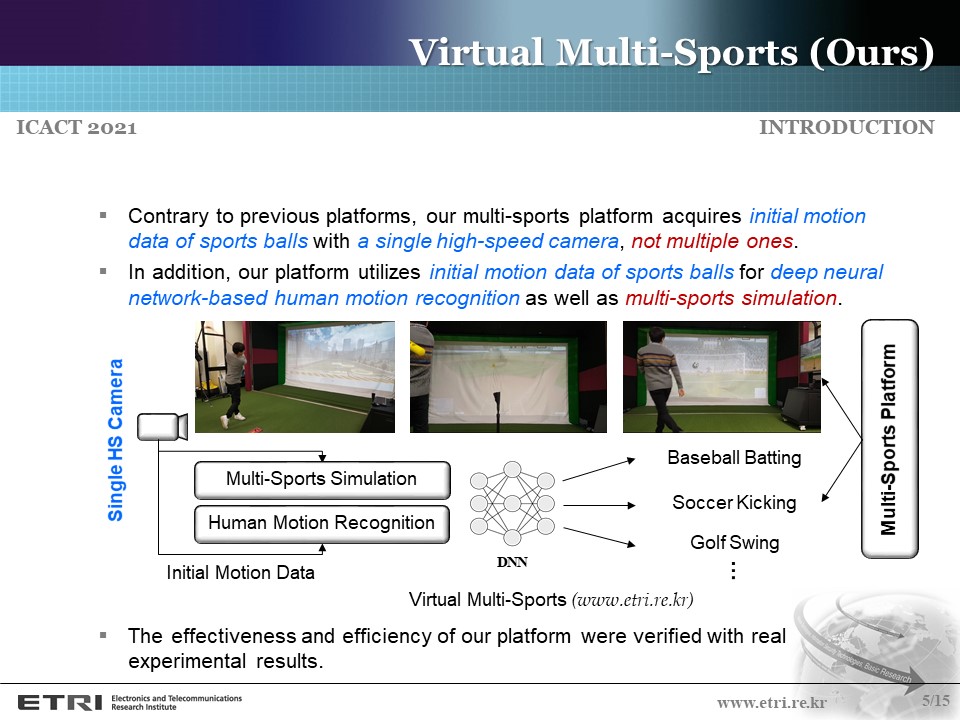 |
Contrary to previous platforms, our multi-sports platform acquires initial motion data of sports balls with a single high-speed camera, not multiple ones.
In addition, our platform utilizes initial motion data of sports balls for deep neural network-based human motion recognition as well as multi-sports simulation.
The effectiveness and efficiency of our platform were verified with real experimental results.
|
|
ICACT20210124 Slide.04
[Big slide for presentation]
|
Chrome Text-to-Speach Click!! |
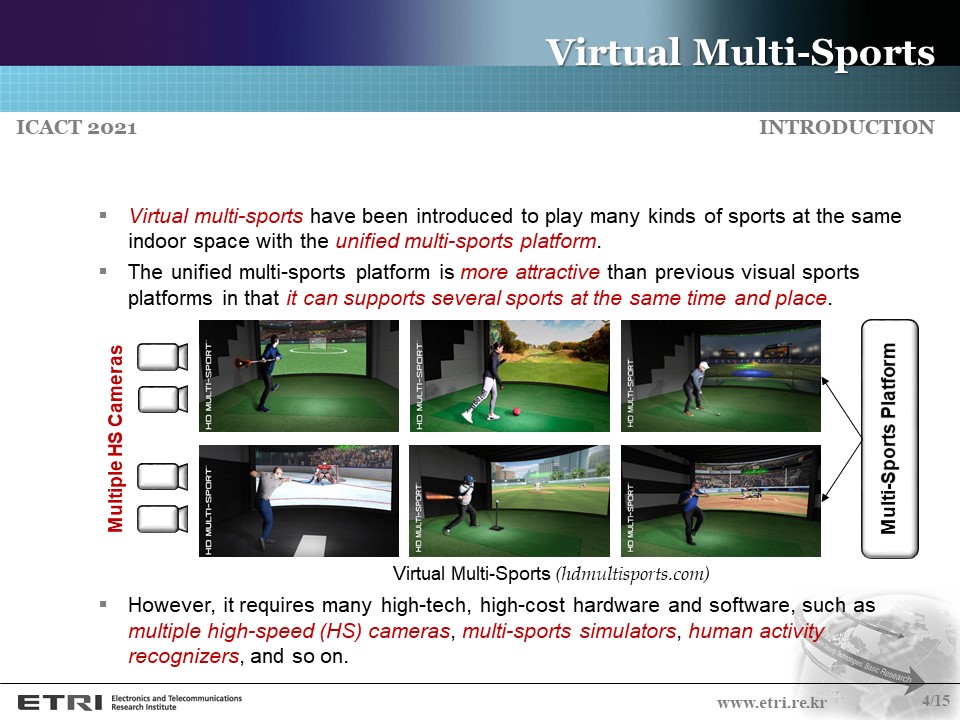 |
Recently, virtual multi-sports have been introduced to play many kinds of sports at the same indoor space with the unified multi-sports platform.
As we can see from the following figure, the unified multi-sports platform is more attractive than previous visual sports platforms in that it can supports several sports at the same time and place.
However, it requires many high-tech, high-cost hardware and software, such as multiple high-speed cameras, multi-sports simulators, human activity recognizers, and so on.
|
|
ICACT20210124 Slide.03
[Big slide for presentation]
|
Chrome Text-to-Speach Click!! |
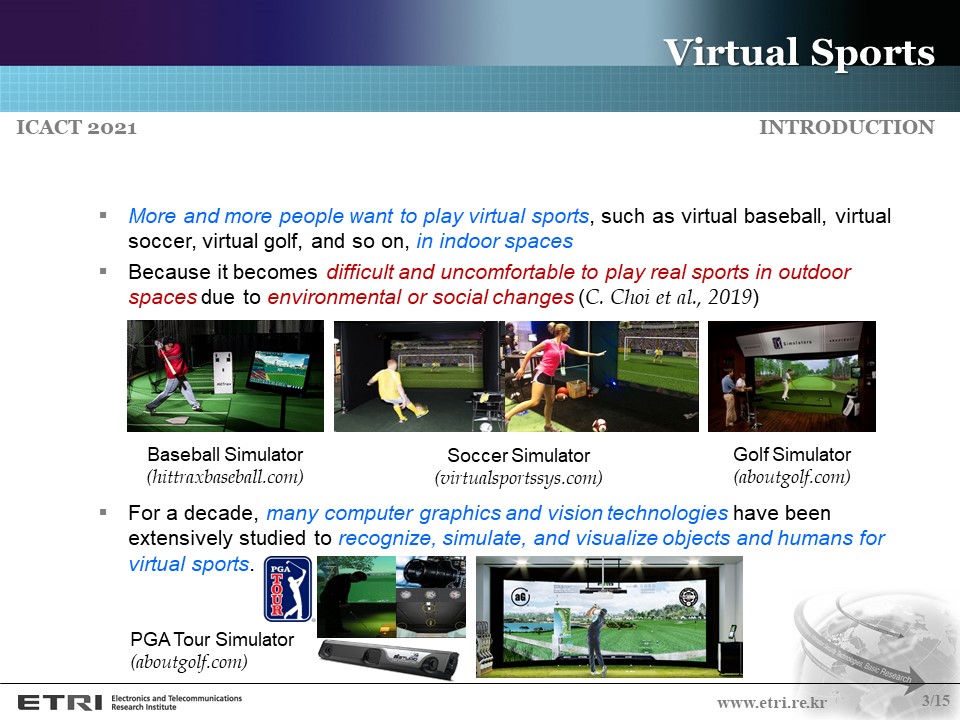 |
More and more people want to play virtual sports, such as virtual baseball, virtual soccer, virtual golf, and so on, in indoor spaces by using these sports simulators,
Because it becomes difficult and uncomfortable to play real sports in outdoor spaces due to environmental or social changes.
For a decade, many computer graphics and vision technologies have been extensively studied to recognize, simulate, and visualize objects and humans for virtual sports.
Nowadays, we can play virtual sports in indoor spaces regardless of weather conditions and place limitations.
|
|
ICACT20210124 Slide.02
[Big slide for presentation]
|
Chrome Text-to-Speach Click!! |
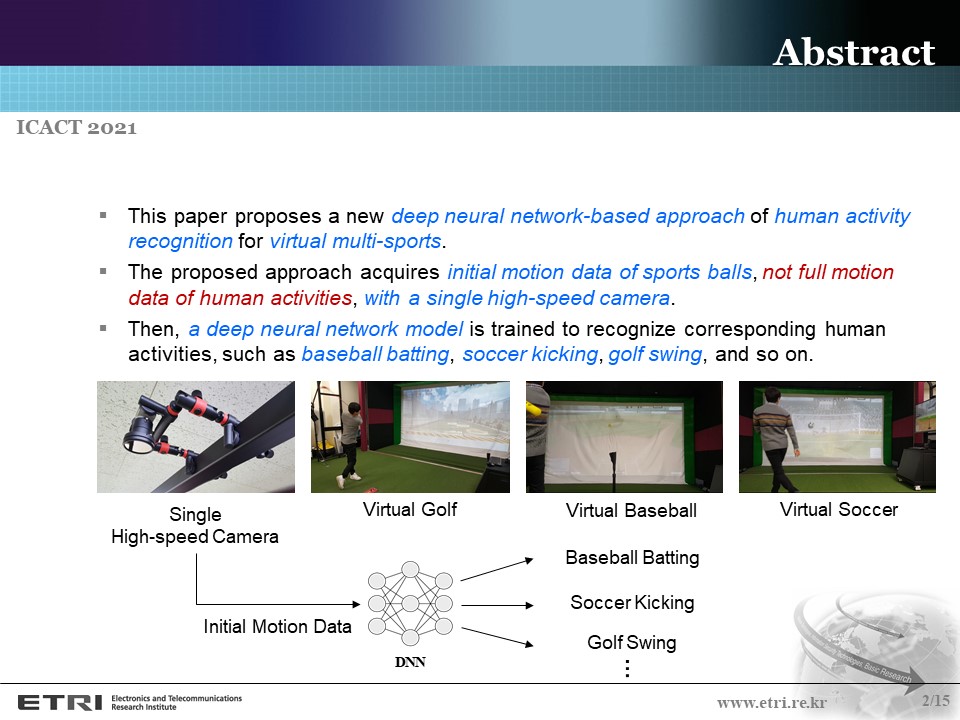 |
This paper proposes a new deep neural network-based approach of human activity recognition for virtual multi-sports.
As illustrated in the following figure, the proposed approach acquires initial motion data of sports balls, not full motion data of human activities, with a single high-speed camera.
Then, a deep neural network model is trained to recognize corresponding human activities, such as baseball batting, soccer kicking, golf swing, and so on.
|
|
ICACT20210124 Slide.01
[Big slide for presentation]
|
Chrome Text-to-Speach Click!! |
 |
Hi, my name is Jong-Sung Kim. I am working at Electronics and Telecommunications Research Institute in Korea. The tile of the paper I will present is “deep neural network-based Human activity recognition by learning initial motion data for virtual multi-sports”.
|
| |





