 ICACT20240480 Slide.19
[Big slide for presentation]
[YouTube] |
Chrome Text-to-Speach Click!! |
 |
Thank you
|
|
ICACT20240480 Slide.18
[Big slide for presentation]
[YouTube] |
Chrome Text-to-Speach Click!! |
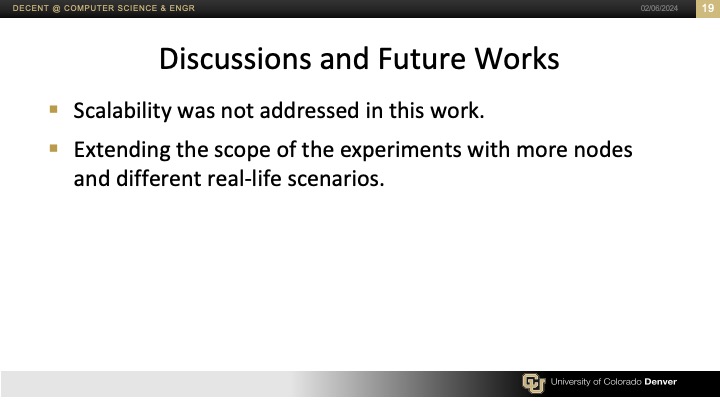 |
This paper presented a novel location-based NDN forwarding
scheme for mobile ad-hoc networks. We have proved that our approach could reduce network latency while improving data retrieval comparing to existing broadcasting technique in NDN. However, due to the limited scope of the experiments, we cannot verify the scalability of the framework. As part of our future work, we plan to address this by evaluating our approach with real-life and larger-scale network.
|
|
ICACT20240480 Slide.17
[Big slide for presentation]
[YouTube] |
Chrome Text-to-Speach Click!! |
 |
Result 3
|
|
ICACT20240480 Slide.16
[Big slide for presentation]
[YouTube] |
Chrome Text-to-Speach Click!! |
 |
Result 2
|
|
ICACT20240480 Slide.15
[Big slide for presentation]
[YouTube] |
Chrome Text-to-Speach Click!! |
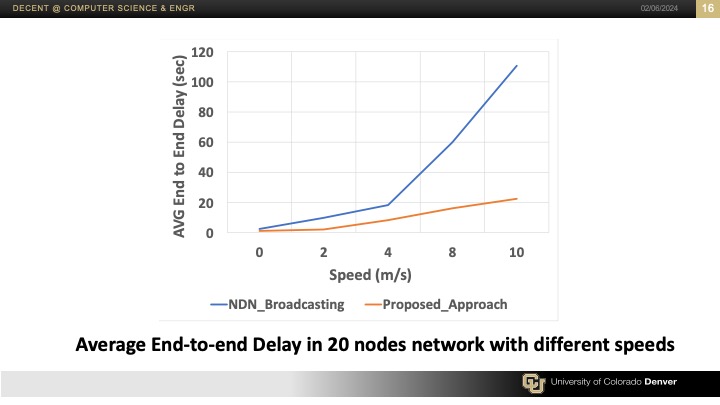 |
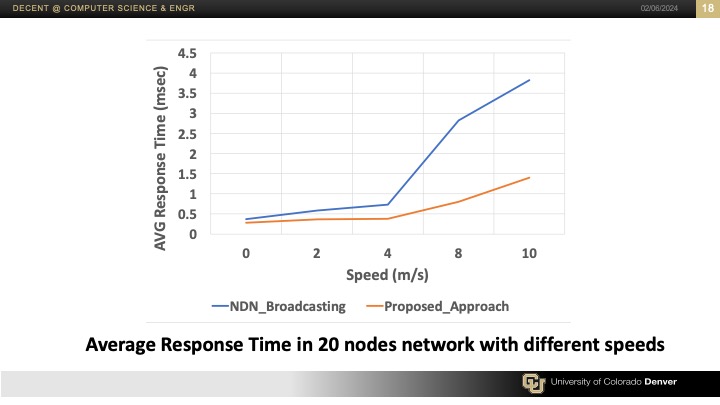
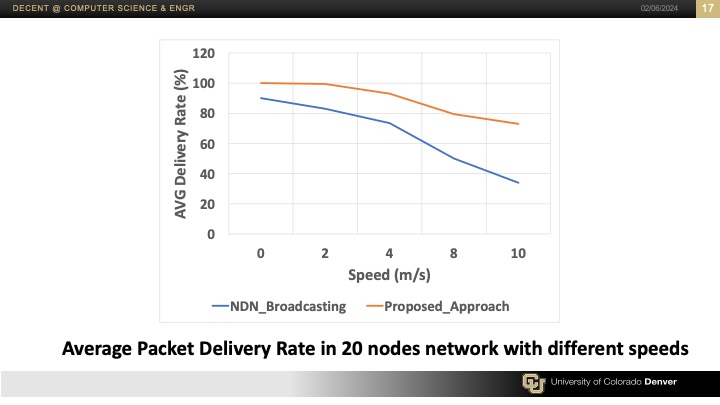
The next three slides shows the result of experiments for our proposed system and NDN broadcasting in a 20 nodes network. At lower
speeds (stationary to 4m/s), our approach performs better than NDN broadcasting across all metrics. However, it is not by a more significant margin, especially for the end-to-end delay and response time. The result of the packet delivery rate, however, clearly shows the disadvantage of the broadcasting approach. For the scenarios in which the nodes are either stationary or moving at lower speed, if the nodes are close together, broadcasting/flooding interest packets can lead to high frequency of packet collision in the network which in turn will result in lower delivery rate. When the nodes start moving faster, if the nodes are moving away from each other, it can help with the delivery rate of the broadcasting strategy as there are more spaces between each node (which can lead to less packet collision). However, this will come at the cost of introducing more traffics to the network. When we change the mobile nodes’ moving speed from 4m/s to 8m/s, NDN broadcasting suffers a sharp increase in both response time and end-to-end delay while the change of
speed has a much lesser effect on our approach’s performance. The increase in response time and end-to-end delay in our approach is due to the slight overheads incurred by recalculating the neighbor information when neighboring nodes start moving away from their original positions.
|
|
ICACT20240480 Slide.14
[Big slide for presentation]
[YouTube] |
Chrome Text-to-Speach Click!! |
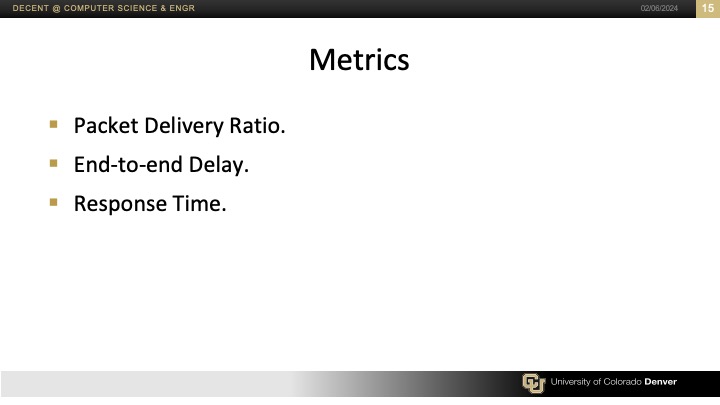 |
We use packet delivery ratio, end-to-end delay, and response time as performance metrics. Packet Delivery Ratio is the ratio of the number of data packets successfully received at the consumer application with respect to the number of unique Interests sent. End-to-end Delay is the average round-trip time measured
at the consumer applications. And Response Time is the average time it takes for a consumer application to receive the first data packet with respect to the Interest sent.
|
|
ICACT20240480 Slide.13
[Big slide for presentation]
[YouTube] |
Chrome Text-to-Speach Click!! |
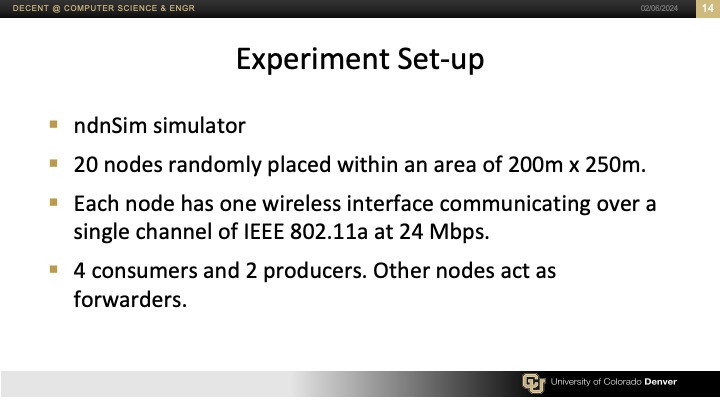 |
To evaluate our proposed system, we devise a series of simulations using ndnSim simulator. For our simulations, we place the nodes randomly within an area of 200m x 250m for 20 nodes network. Each node has a fixed transmission range of 50 meters in diameter. Each node has only one wireless interface communicating over a single channel of IEEE 802.11a at 24Mbps. The system consists of 4 consumers and 2 producers, with the other nodes serving as forwarders. Each consumer will request 50 different data packets of
512 bytes, each using a constant bit-rate application. The consumers will start randomly during the 5 seconds period after the simulation starts. We apply the random waypoint mobility model for the nodes’ mobility. The speed of the nodes is set to be 0m/s (stationary) first, then changed to be 2m/s, 4m/s, 8m/s, and 10m/s for each scenario.
|
|
ICACT20240480 Slide.12
[Big slide for presentation]
[YouTube] |
Chrome Text-to-Speach Click!! |
 |
Evaluation
|
|
ICACT20240480 Slide.11
[Big slide for presentation]
[YouTube] |
Chrome Text-to-Speach Click!! |
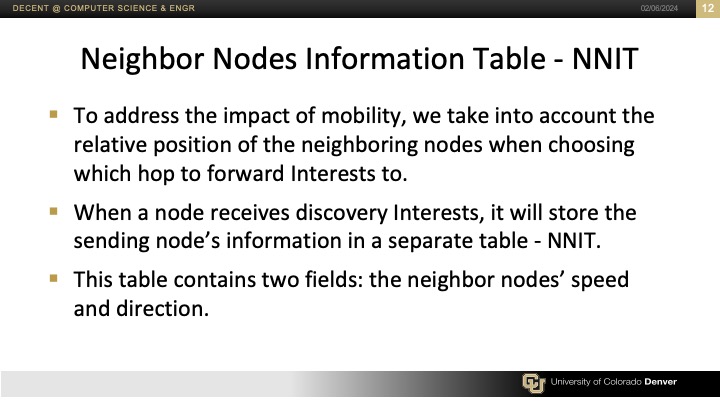 |
When a node receives discovery Interests, it will store the sending node’s information in a separate table. This table contains two fields: the neighbor nodes’ speed and the neighbor nodes’ direction.If the nodes are heading toward each other and the distance between the two nodes is constant, the direction value is set to one. Otherwise, the direction value is set to 0. Each of the neighbor nodes in the table will then be rated based on these two values. Suppose a neighbor node has a direction value of 1 and a lower speed. In that case, it will be ranked higher as a connection with a node that moves slower and heads toward or in the same direction will have a higher probability of lasting longer.
|
|
ICACT20240480 Slide.10
[Big slide for presentation]
[YouTube] |
Chrome Text-to-Speach Click!! |
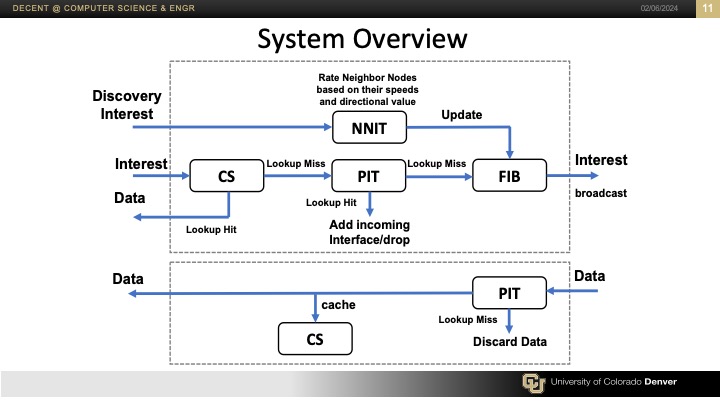 |
To address the impact of nodes’ mobility in mobile ad-hoc networks, we take into account the position of the neighboring nodes when choosing which hop to forward Interests to. We assume that nodes are equipped with a global position system (GPS) and connect to each other using an omnidirectional antenna. Each node will regularly send discovery Interests with its current position to its neighbor nodes. Based on this information, mobile nodes can compute the speed and distance with respect to the neighbor nodes and will use this information to determine which path to forward the Interests.
This is done while maintaining the core pipeline of NDN broadcasting/flooding.
|
|
ICACT20240480 Slide.09
[Big slide for presentation]
[YouTube] |
Chrome Text-to-Speach Click!! |
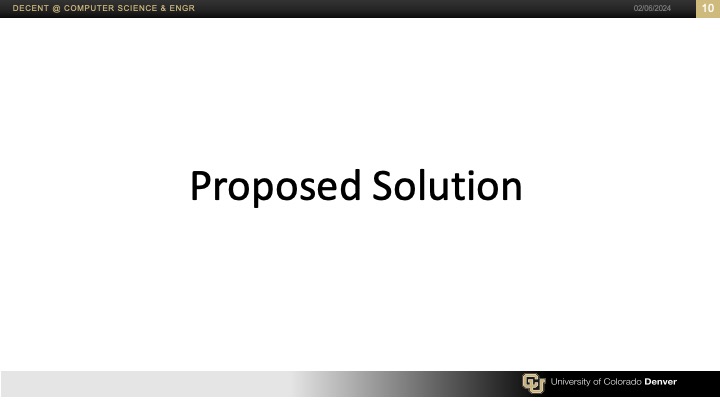 |
Because of these issues, in this work we want to propose a novel NDN based data forwarding technique for mobile ad-hoc environment utilizing neighboring nodes' location information to determine the most reliable path to forward Interest packet.
|
|
ICACT20240480 Slide.08
[Big slide for presentation]
[YouTube] |
Chrome Text-to-Speach Click!! |
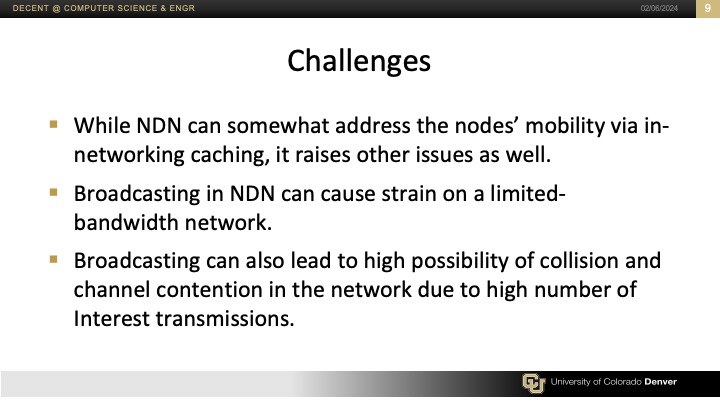 |
The main disadvantage of broadcasting/flooding in NDN over mobile ad-hoc network is that it can lead to a high possibility of collision and channel contention in the network due to high number of Interest transmissions (and retransmissions caused by nodes’ mobility). Also, it can cause strain on limited bandwidth network.
|
|
ICACT20240480 Slide.07
[Big slide for presentation]
[YouTube] |
Chrome Text-to-Speach Click!! |
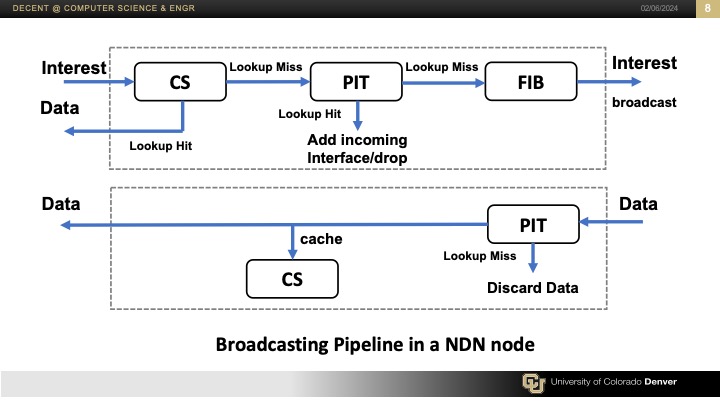 |
However, this is not true for a broadcast-based (or flooding) NDN strategy. The FIB hit/miss status is ignored in this case; all Interests are broadcast after passing through the PIT. The rationale behind this is that it can potentially increase data retrieval possibility through multiple possible paths between a consumer and data node(s). This scenario also has no NACK, as every packet transmission is broadcast.
|
|
ICACT20240480 Slide.06
[Big slide for presentation]
[YouTube] |
Chrome Text-to-Speach Click!! |
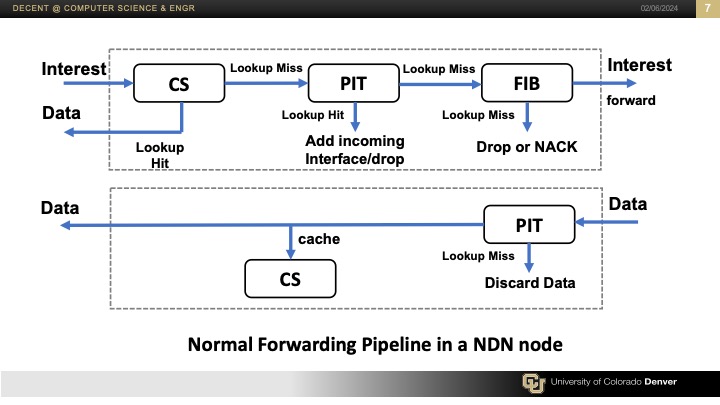 |
To demonstrate these issues of broadcasting in NDN, first let take a look at how it works. NDN broadcast-based forwarding strategy follows the general NDN architecture. An NDN consumer sends an Interest with a name when it wants to retrieve data. Upon receiving the Interest, a node will look at its Content Store (CS) and replies with data on a name match. Otherwise, the Interest is passed to
the Pending Interest Table (PIT). If there is an entry with the same name in the PIT, the Interest is discarded, and the entry is updated to include the new request. If no entry in the PIT matches the Interest’s name, a new entry is created with the incoming interface and passes the Interest to its Forwarding Information Base (FIB). Next, the node performs the longest common prefix match to existing FIB prefix entries. With the general NDN architecture, the node forwards the Interest through the associated interface(s) to the next hop node(s) if a match is found. If a match is not found, it either drops the Interest or sends a NACK (negative acknowledgment) back. This will inform the other nodes that a route through this node is unavailable.
|
|
ICACT20240480 Slide.05
[Big slide for presentation]
[YouTube] |
Chrome Text-to-Speach Click!! |
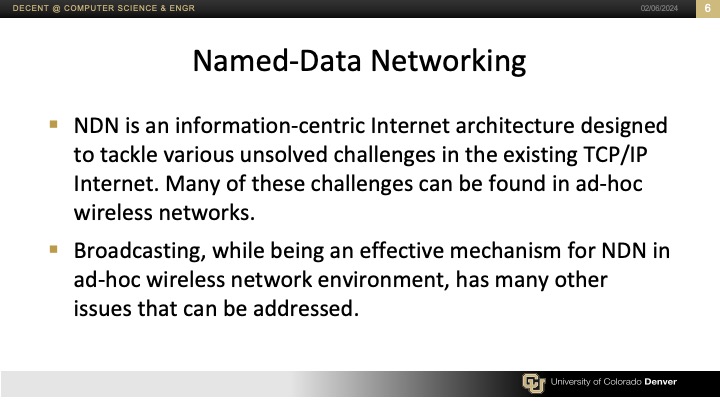 |
Named Data Networking or NDN is an information-centric Internet architecture designed to tackle various unsolved challenges in the existing TCP/IP Internet. Many of these challenges can be found during network deployment for ad-hoc wireless networks, such as involving various communication protocols, insufficient infrastructure routing support, and deteriorated performance due to unstable network environment.
Broadcasting/Flooding, while being an effective mechanism for NDN in ad-hoc wireless network environment, has many other issues that can addressed.
|
|
ICACT20240480 Slide.04
[Big slide for presentation]
[YouTube] |
Chrome Text-to-Speach Click!! |
 |
Background and Challenges
|
|
ICACT20240480 Slide.03
[Big slide for presentation]
[YouTube] |
Chrome Text-to-Speach Click!! |
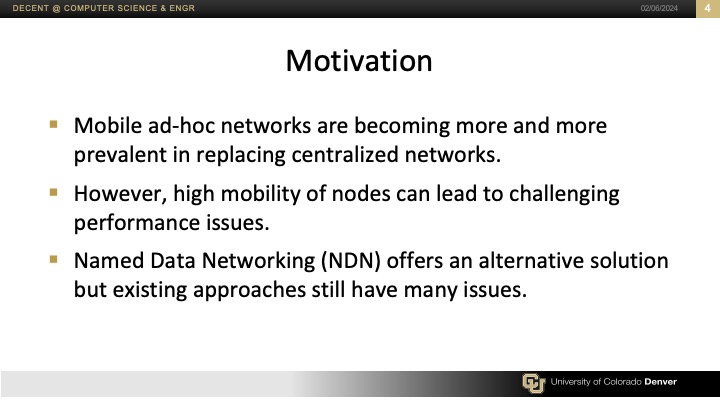 |
With the ever-increasing usage and deployment of mobile devices, mobile ad-hoc networks have become more and more prevalent in replacing centralized networks. However, high mobility of nodes can lead to challenging performance issues, such as high packet loss, frequent path failures causing high route-reinitiating overheads, and significant data retrieval delay.
Named Data Networking (NDN) offers an alternative solution to these problems. However, existing NDN-based solutions still have many issues and can be further improved.
Because of this, with this paper we want to propose a novel location-based approach to address existing challenges of using NDN in mobile ad-hoc networks and improve the performance of existing works.
|
|
ICACT20240480 Slide.02
[Big slide for presentation]
[YouTube] |
Chrome Text-to-Speach Click!! |
 |
Motivation
|
|
ICACT20240480 Slide.01
[Big slide for presentation]
[YouTube] |
Chrome Text-to-Speach Click!! |
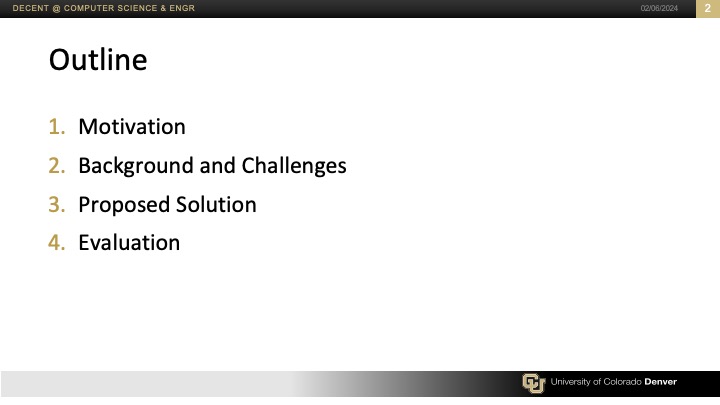 |
My presentation will contain four main parts. First I will talk about the motivation for my work. Then, I will present some background information and challenges of this work. After that I will go over the proposed solution. And lastly the evaluation of the proposed system.
|
|
ICACT20240480 Slide.00
[Big slide for presentation]
[YouTube] |
Chrome Text-to-Speach Click!! |
 |
Hello everybody, my name is Hieu Nguyen a Ph.D student from University of Colorado Denver. Today, I will present my work on a location based data centric forwarding solution for mobile ad-hoc networks.
|
















