 ICACT20250045 Slide.21
[Big slide for presentation]
[YouTube] |
Chrome Text-to-Speach Click!! |
 |
Thank you very much for listening.
|
|
ICACT20250045 Slide.20
[Big slide for presentation]
[YouTube] |
Chrome Text-to-Speach Click!! |
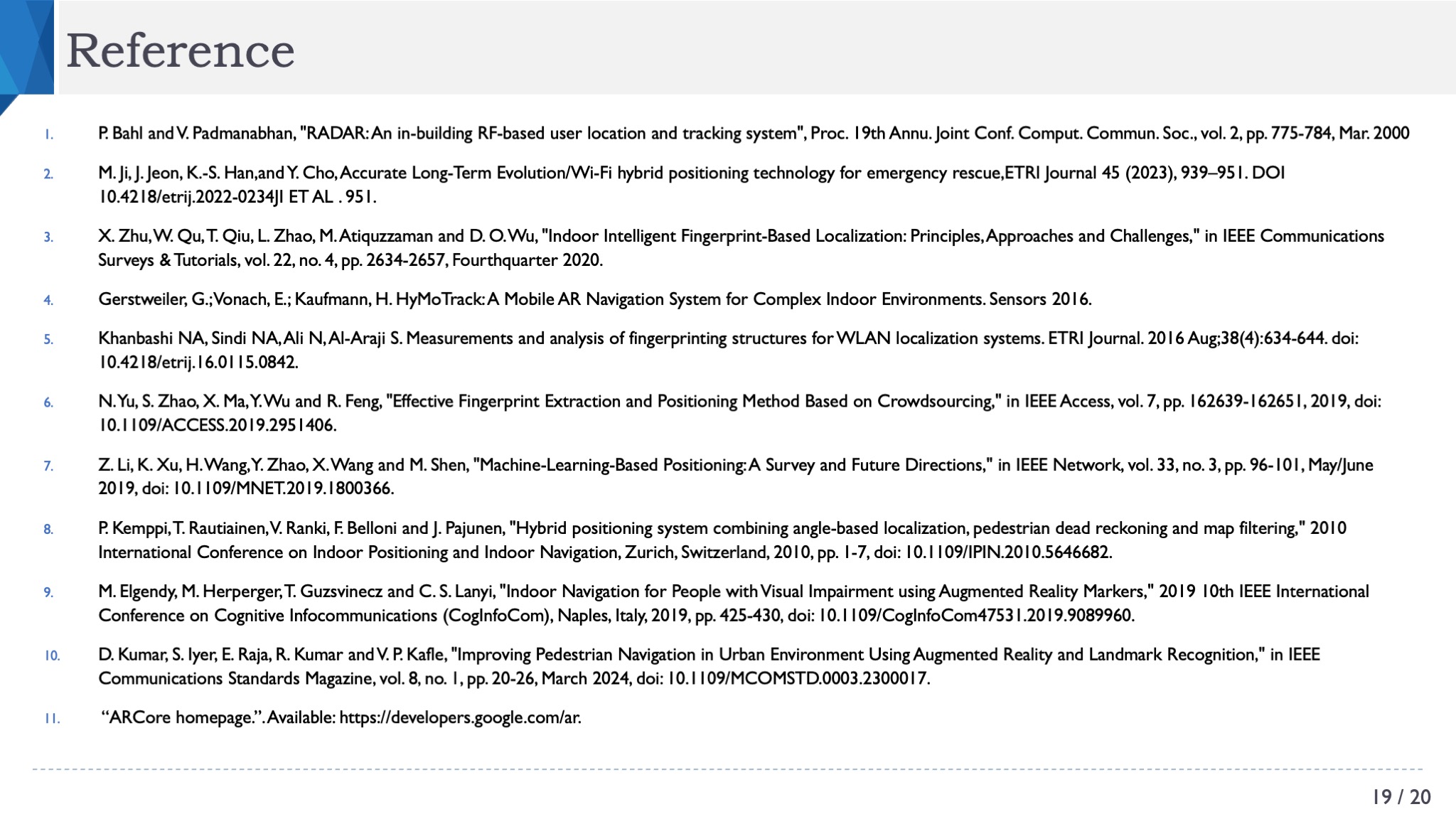 |
This is the references of our paper.
|
|
ICACT20250045 Slide.19
[Big slide for presentation]
[YouTube] |
Chrome Text-to-Speach Click!! |
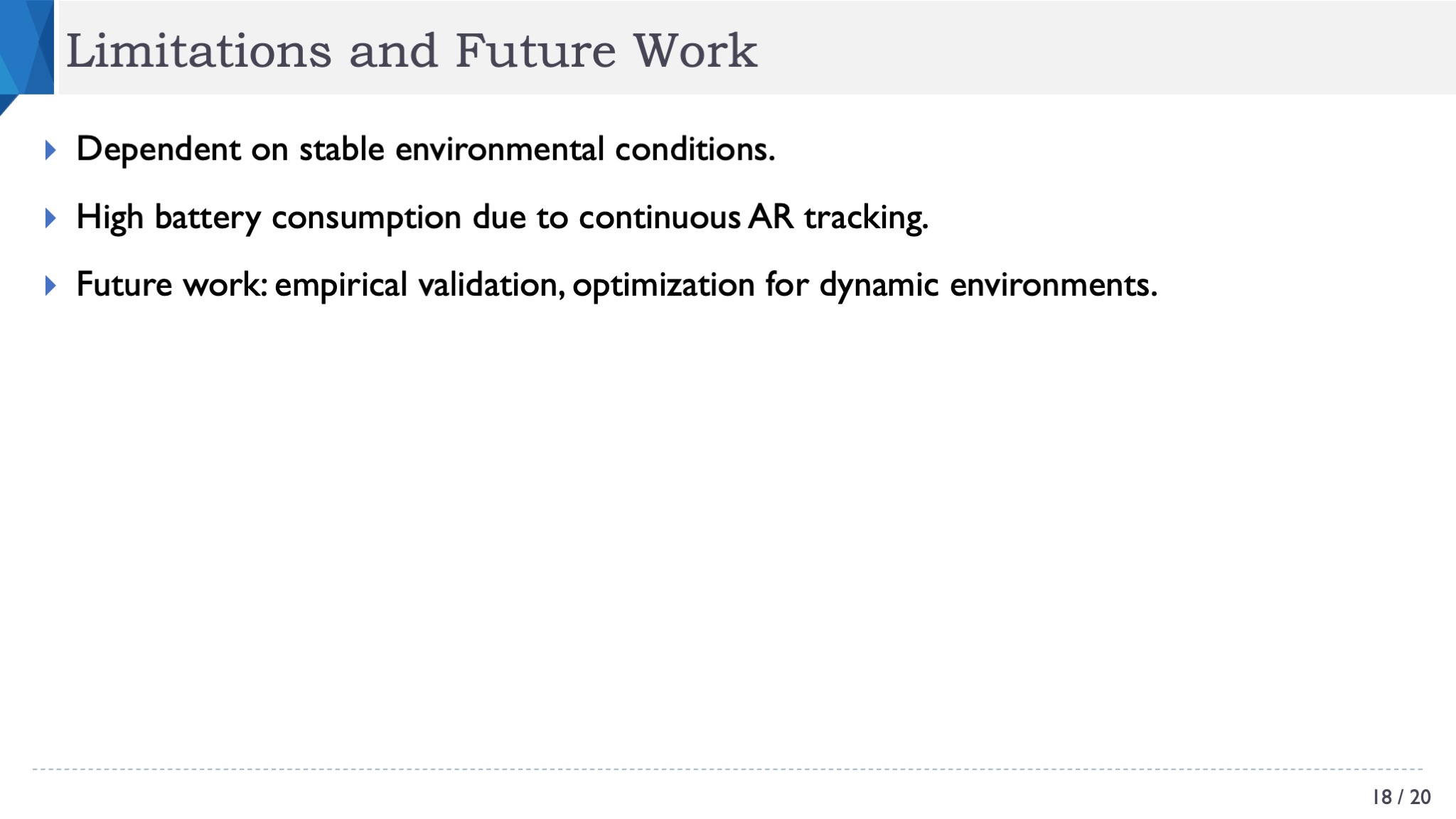 |
While our approach offers many advantages, there are some limitations. The system relies on stable environmental conditions for optimal performance, and continuous AR processing leads to high battery consumption.
Future work will focus on addressing these issues through optimization techniques, including energy-efficient processing and adaptation for dynamic environments.
|
|
ICACT20250045 Slide.18
[Big slide for presentation]
[YouTube] |
Chrome Text-to-Speach Click!! |
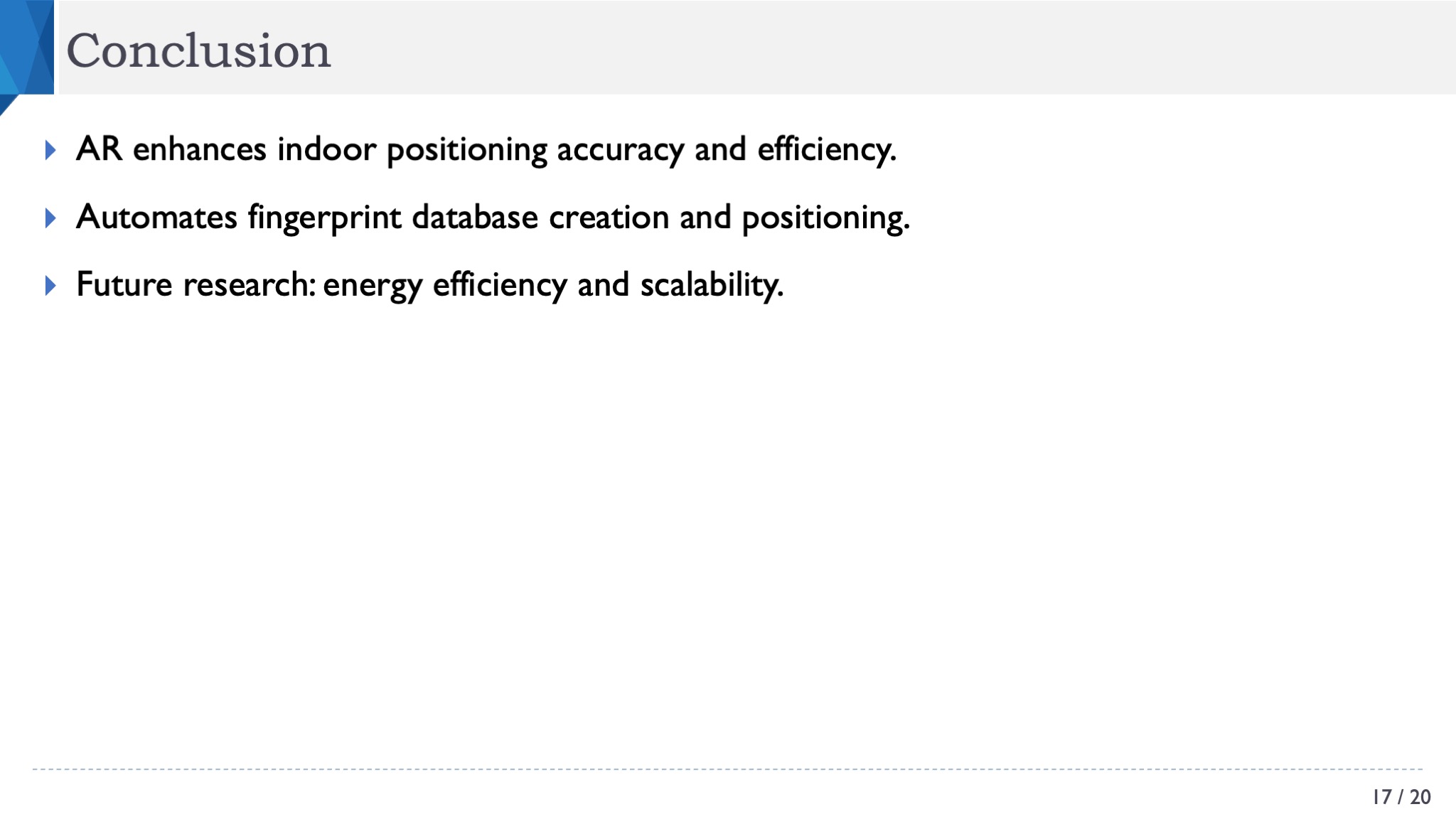 |
To summarize, our AR-enhanced positioning system offers a novel approach to improving indoor positioning accuracy and efficiency.
By automating fingerprint database creation and integrating multiple sources of location data, we significantly reduce errors and manual effort. Moving forward, we aim to refine our system for broader deployment and enhanced scalability.
|
|
ICACT20250045 Slide.17
[Big slide for presentation]
[YouTube] |
Chrome Text-to-Speach Click!! |
 |
This is the conclusion section.
|
|
ICACT20250045 Slide.16
[Big slide for presentation]
[YouTube] |
Chrome Text-to-Speach Click!! |
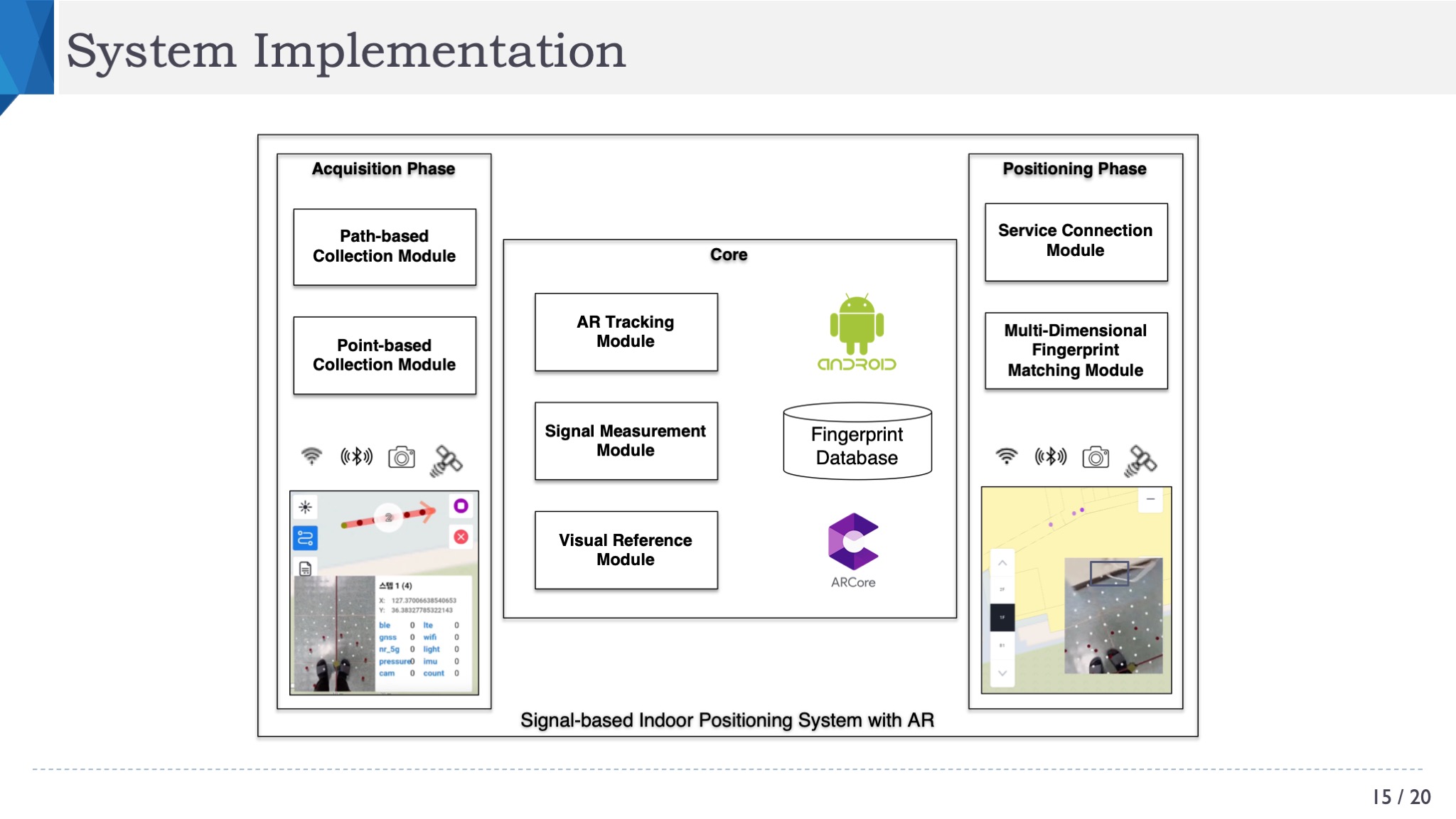 |
Our system is implemented on an Android platform using ARCore, Google's framework for augmented reality applications. The AR Tracking Module, which monitors user movement and distance. The Signal Measurement Module, responsible for collecting and mapping signal strength data. The Visual Reference Module, which captures and compares images for positioning verification.
We support two data collection methods. The first is path-based collection, where the user defines a route and captures data at predefined intervals.
The second is point-based collection, which allows users to move freely while the AR system automatically collects signal and visual data. These methods provide flexibility for different environments.
|
|
ICACT20250045 Slide.15
[Big slide for presentation]
[YouTube] |
Chrome Text-to-Speach Click!! |
 |
This is the implementation section.
|
|
ICACT20250045 Slide.14
[Big slide for presentation]
[YouTube] |
Chrome Text-to-Speach Click!! |
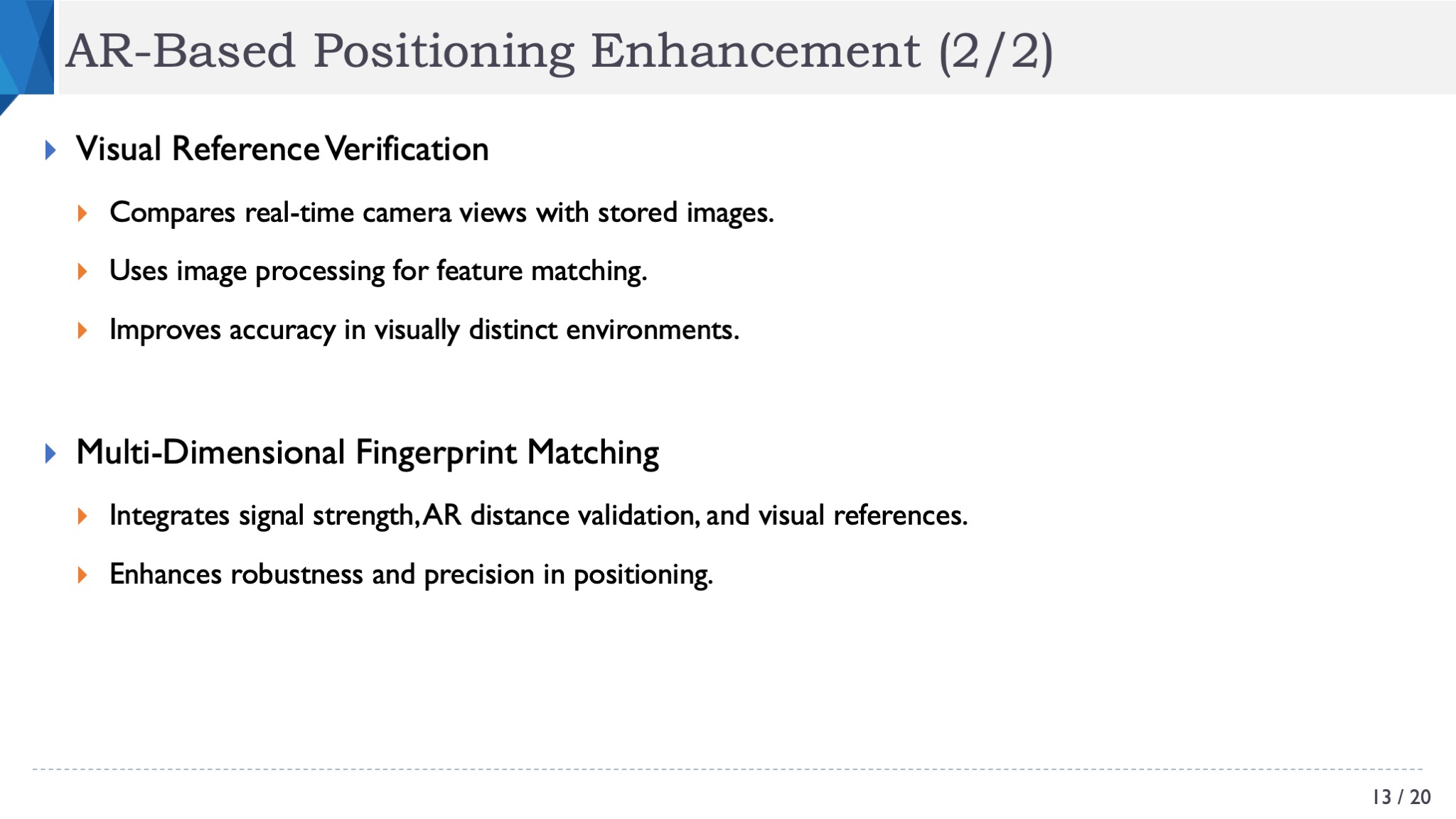 |
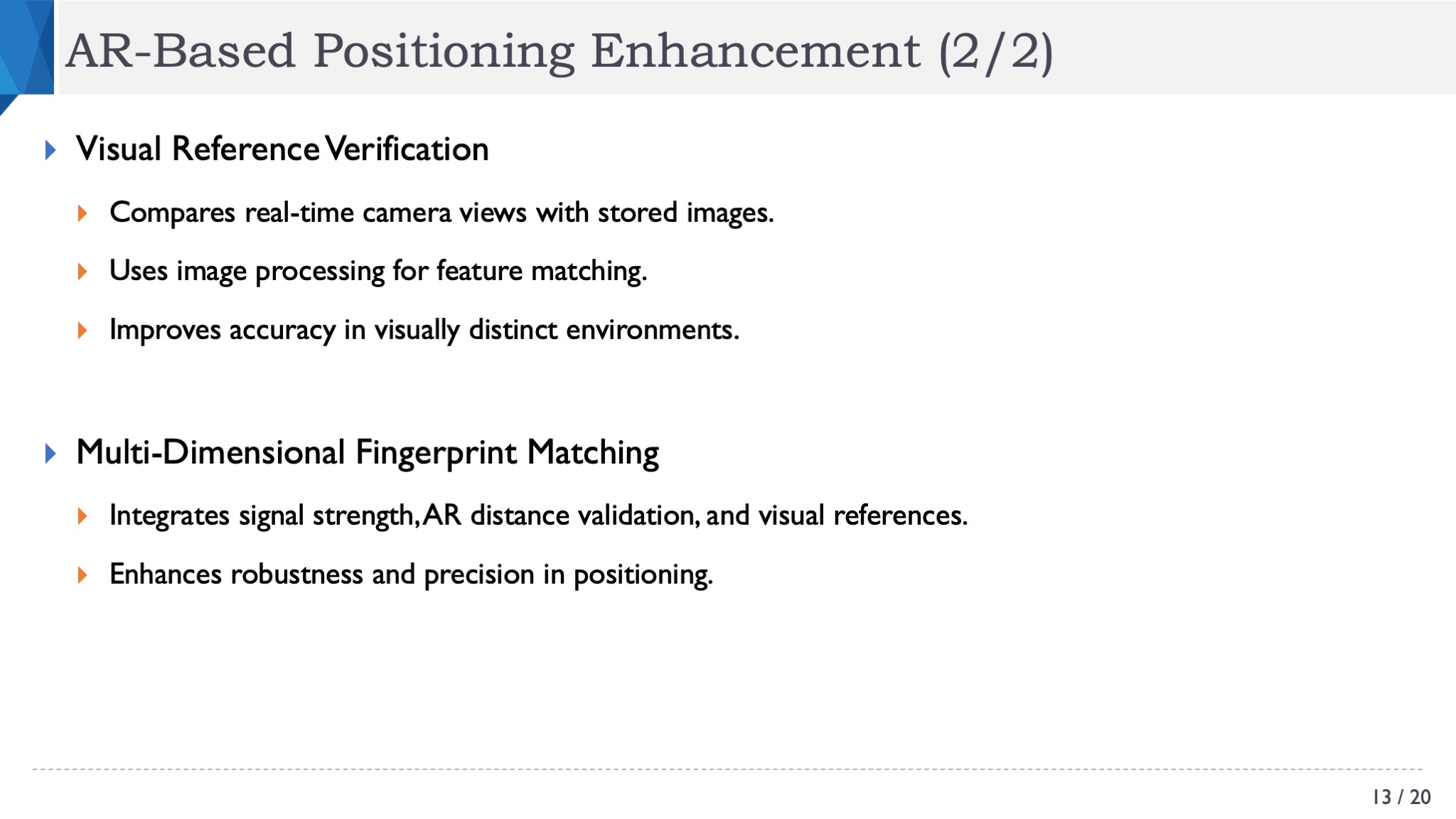
In addition to signal strength and distance calculations, our system performs visual reference verification. By comparing the real-time camera view with stored images, we can further refine location estimates.
This step is particularly useful in distinguishing areas with similar signal profiles, which could otherwise lead to mispositioning.
To ensure high positioning accuracy, our system combines three factors: signal strength similarity, AR-based distance validation, and visual reference matching.
This multi-dimensional fingerprint matching process ensures that inconsistencies in one data source are corrected by the other two, resulting in a more reliable indoor positioning system.
|
|
ICACT20250045 Slide.13
[Big slide for presentation]
[YouTube] |
Chrome Text-to-Speach Click!! |
 |
The AR-based distance calculation plays a key role in refining positioning estimates. Using the device’s camera and IMU sensors, our system continuously updates the user's movement and compares distances with stored fingerprint data.
This approach minimizes errors and provides more accurate location estimates, particularly in controlled environments.
|
|
ICACT20250045 Slide.12
[Big slide for presentation]
[YouTube] |
Chrome Text-to-Speach Click!! |
 |
This is the AR-Based Positioning Enhancement section.
|
|
ICACT20250045 Slide.11
[Big slide for presentation]
[YouTube] |
Chrome Text-to-Speach Click!! |
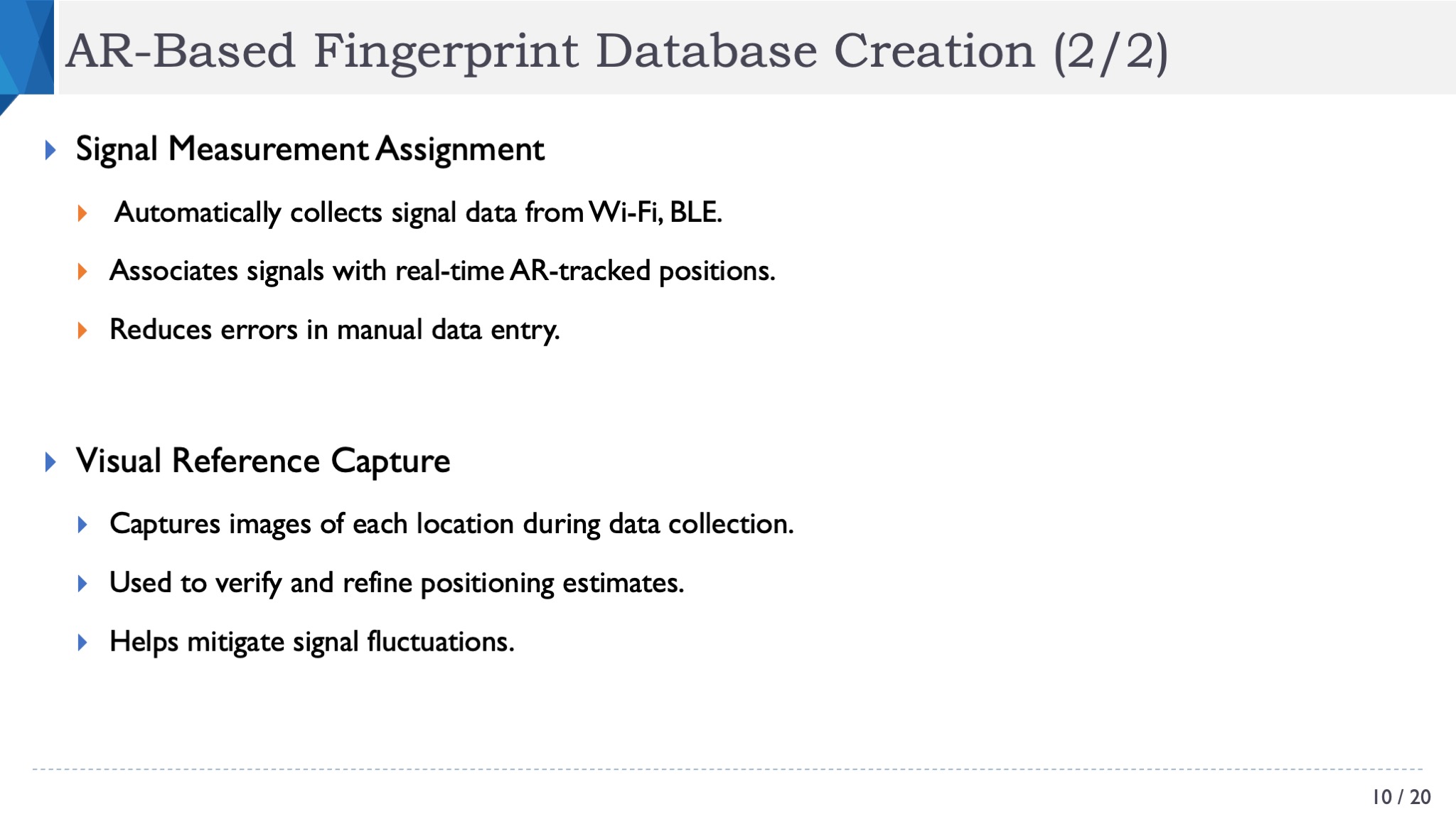 |
Another crucial aspect is the automatic assignment of signal strength data. As the AR system tracks movement, it continuously collects signal measurements from Wi-Fi and Bluetooth sources.
By automating this process, we eliminate inconsistencies that arise from manual data collection, ensuring that our fingerprint database remains accurate and reliable.
Visual reference capture further enhances our system’s accuracy. During fingerprint database creation, the AR system records images at each reference point.
Later, these images are used during the positioning phase to verify and refine location estimates, providing an additional layer of validation to mitigate signal fluctuation issues.
|
|
ICACT20250045 Slide.10
[Big slide for presentation]
[YouTube] |
Chrome Text-to-Speach Click!! |
 |
One of the key components of our system is automated distance measurement. Instead of relying on manual tools to measure distances between reference points, we use ARCore to track user movement in real-time.
This ensures that every signal measurement is mapped accurately to its corresponding location without requiring additional hardware.
|
|
ICACT20250045 Slide.09
[Big slide for presentation]
[YouTube] |
Chrome Text-to-Speach Click!! |
 |
This is the AR-Based Fingerprint Database Creation section.
|
|
ICACT20250045 Slide.08
[Big slide for presentation]
[YouTube] |
Chrome Text-to-Speach Click!! |
 |
Augmented Reality has been explored in indoor positioning mainly for visual navigation and improving accuracy, but its application for fingerprint database automation remains underdeveloped.
By leveraging AR’s capability to overlay digital information on the physical environment, we propose an innovative approach that not only improves positioning accuracy but also reduces the complexity of database creation.
|
|
ICACT20250045 Slide.07
[Big slide for presentation]
[YouTube] |
Chrome Text-to-Speach Click!! |
 |
Now, let’s discuss the background of signal-based positioning. Fingerprinting is one of the most widely used approaches, where a database of signal strength measurements at known locations is created.
This method is relatively simple and does not require additional infrastructure beyond existing Wi-Fi or Bluetooth networks. However, its key drawbacks include the labor-intensive data collection process and sensitivity to environmental changes that can degrade accuracy over time.
Augmented Reality has been explored in indoor positioning mainly for visual navigation and improving accuracy, but its application for fingerprint database automation remains underdeveloped.
By leveraging AR’s capability to overlay digital information on the physical environment, we propose an innovative approach that not only improves positioning accuracy but also reduces the complexity of database creation.
|
|
ICACT20250045 Slide.06
[Big slide for presentation]
[YouTube] |
Chrome Text-to-Speach Click!! |
 |
This is the background section.
|
|
ICACT20250045 Slide.05
[Big slide for presentation]
[YouTube] |
Chrome Text-to-Speach Click!! |
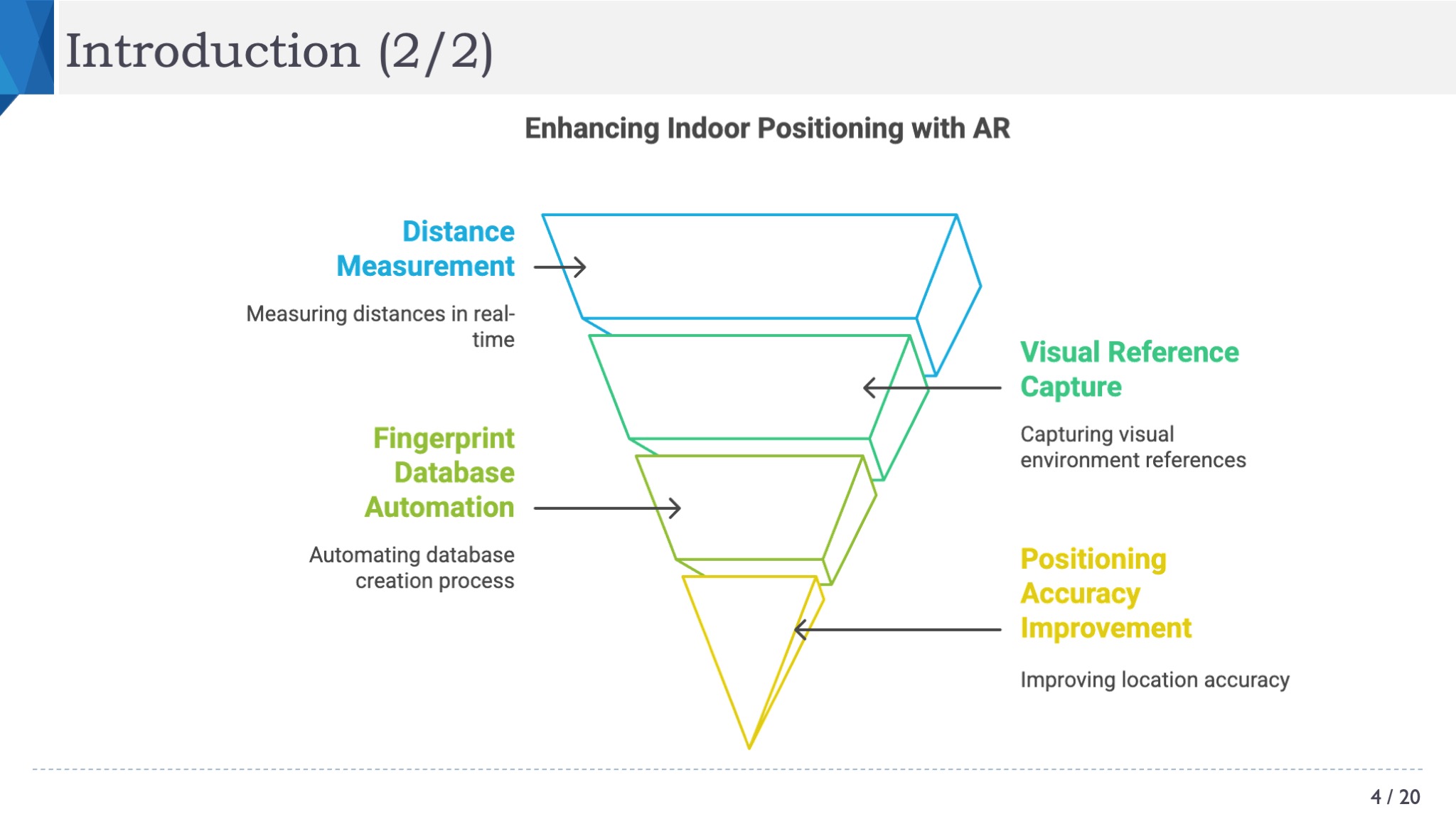 |
To address these challenges, we propose an Augmented Reality-enhanced system that automates the fingerprint database creation process and improves positioning accuracy.
By leveraging AR's ability to measure distances in real-time and capture visual references, our system significantly reduces manual effort while enhancing precision. The integration of AR ensures better consistency and reliability, particularly in controlled environments such as laboratories and cleanrooms.
|
|
ICACT20250045 Slide.04
[Big slide for presentation]
[YouTube] |
Chrome Text-to-Speach Click!! |
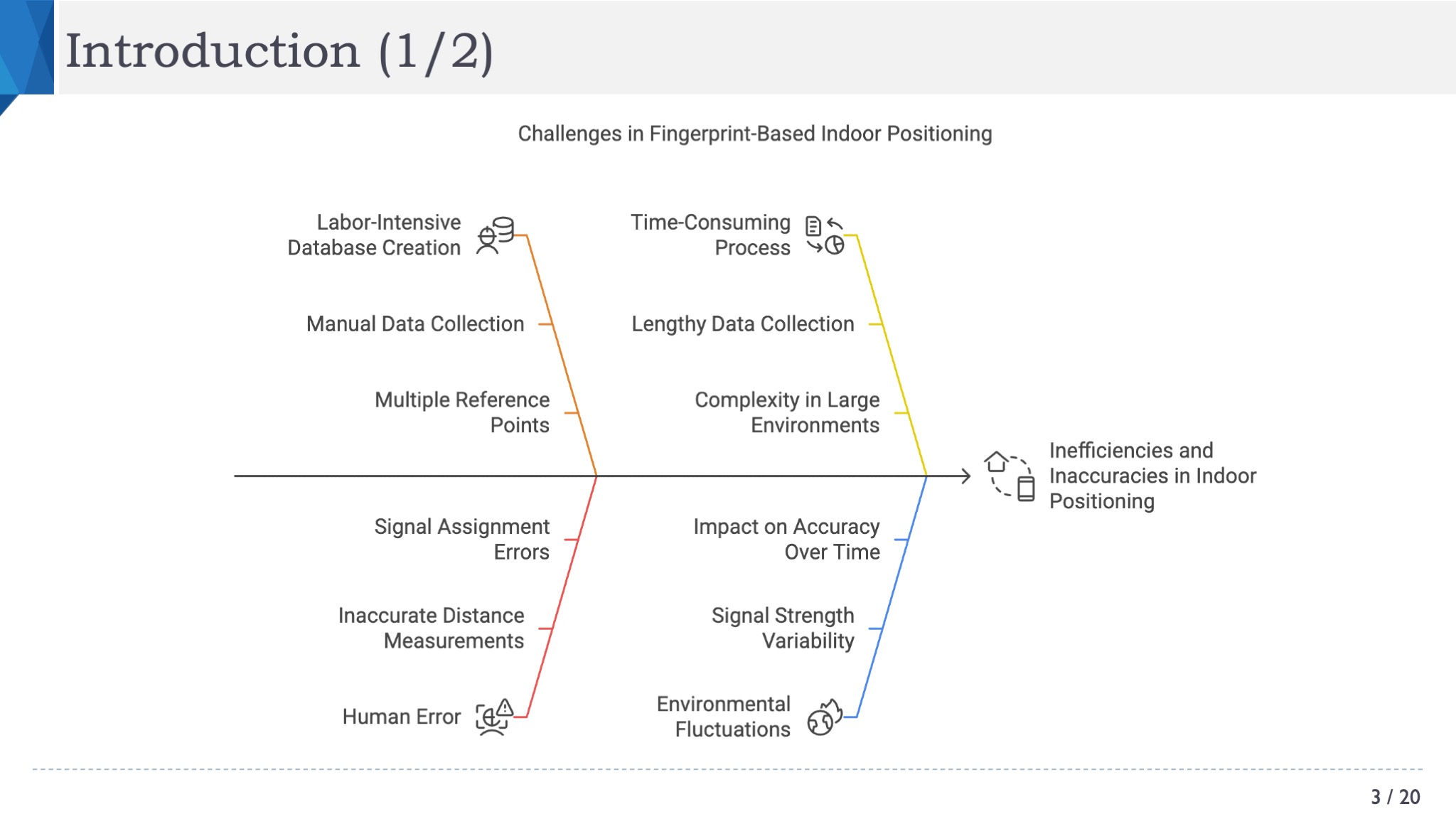 |
Let’s begin with an introduction to indoor positioning systems. As you know, they play a crucial role in various applications, ranging from navigation in large facilities like shopping malls and airports to tracking assets in warehouses and cleanrooms.
While GNSS provides accurate outdoor positioning, its signals struggle indoors due to interference from walls and other structures. As a result, alternative methods such as signal-based indoor positioning have been developed, utilizing technologies like Wi-Fi, Bluetooth, and Ultra-Wideband (UWB).
Despite their effectiveness, signal-based positioning systems have several limitations. The most notable challenges include the manual effort required to build a fingerprint database, fluctuations in signal strength due to environmental changes, and device dependency, where different hardware may lead to inconsistent results.
These factors significantly affect the accuracy and reliability of traditional indoor positioning systems, making them less effective in dynamic environments.
|
|
ICACT20250045 Slide.03
[Big slide for presentation]
[YouTube] |
Chrome Text-to-Speach Click!! |
 |
This is the introduction section.
|
|
ICACT20250045 Slide.02
[Big slide for presentation]
[YouTube] |
Chrome Text-to-Speach Click!! |
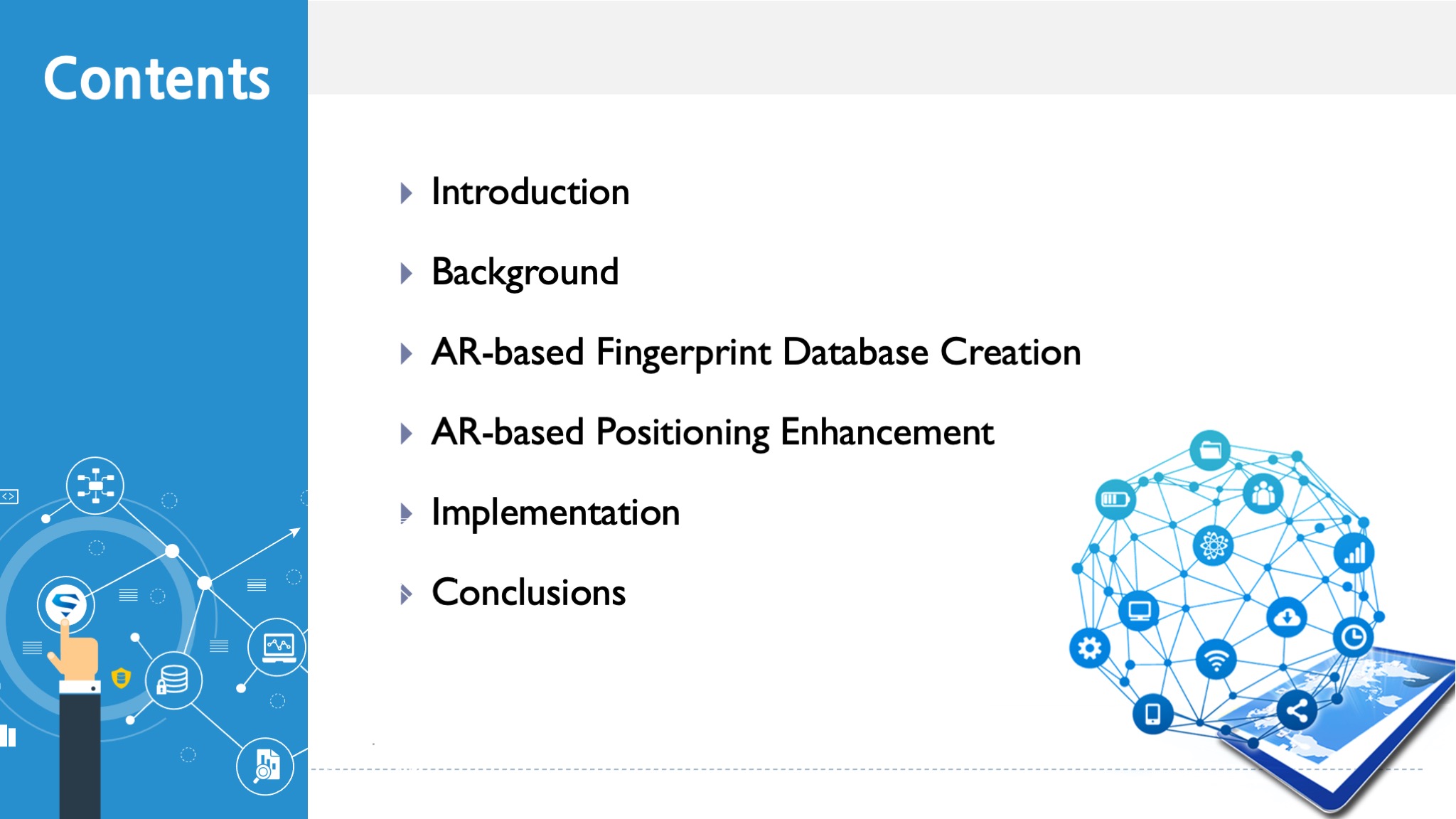 |
This is the content of my presentation today.
In the first section I will introduce some background knowledge about our work. Then I will talk about the main motivation and goals of our paper.
I then explain the process of AR-based Fingerprint Database Creation and AR-based Positioning Enhancement.
After that I will introduce the detailed implementation.
Then I summarize our presentation in conclusion section.
Final section will be the question and answer.
|
|
ICACT20250045 Slide.01
[Big slide for presentation]
[YouTube] |
Chrome Text-to-Speach Click!! |
 |
Hi everyone and welcome to my presentation. My name is Jiwoo Han, a senior researcher from ETRI in Korea. I’m here today to present our paper titled 'Enhancing Signal-Based Positioning Systems with Augmented Reality in Controlled Environments'.
This paper outlines the design of the AR-enhanced positioning system, focusing on its architecture, the process of automating fingerprint database creation, and the improvements made to the positioning phase through AR integration.
|
















