 ICACT20250130 Slide.17
[Big slide for presentation] |
Chrome Text-to-Speach Click!! |
 |
Thank you for your Attention !!
|
|
ICACT20250130 Slide.16
[Big slide for presentation]
|
Chrome Text-to-Speach Click!! |
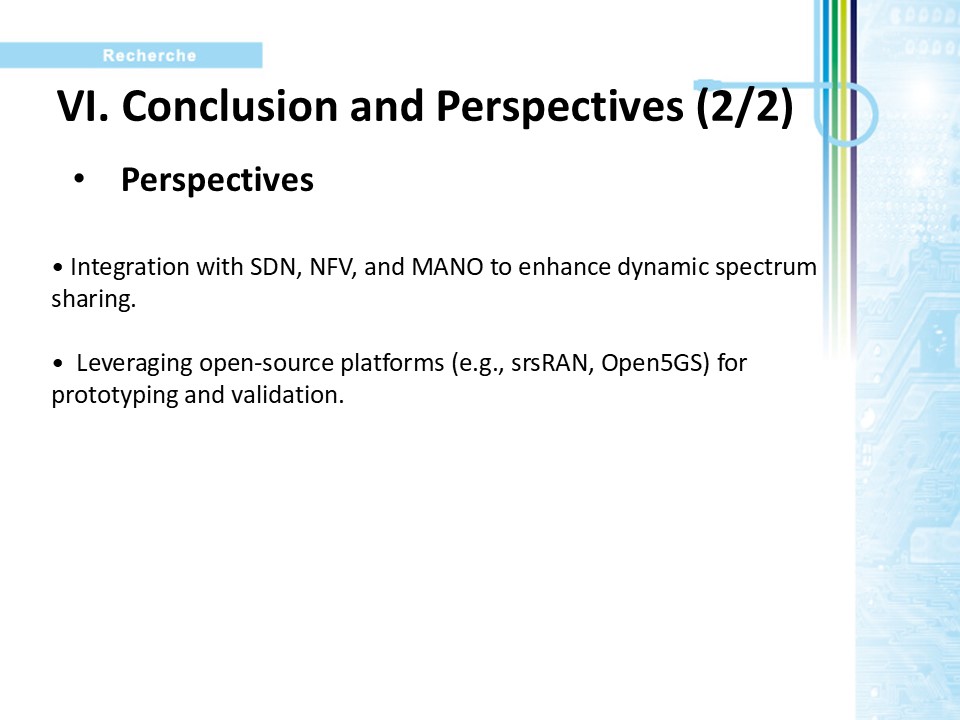 |
To further optimize dynamic spectrum sharing in 6G networks, two key research directions can be explored. First, integrating cognitive radio with software-defined networking (SDN), network function virtualization (NFV), and management and orchestration (MANO) will enhance flexibility and efficiency in spectrum management. These technologies enable more dynamic and programmable network architectures, which are essential for handling the growing demand for connectivity.
Second, leveraging open-source platforms such as srsRAN and Open5GS can facilitate the prototyping and validation of cognitive radio solutions. These platforms provide a cost-effective and adaptable environment for testing new spectrum-sharing mechanisms before large-scale deployment.
By focusing on these two aspects, we can accelerate the adoption of cognitive radio and maximize its impact in future 6G networks.
|
|
ICACT20250130 Slide.15
[Big slide for presentation]
|
Chrome Text-to-Speach Click!! |
 |
In conclusion :
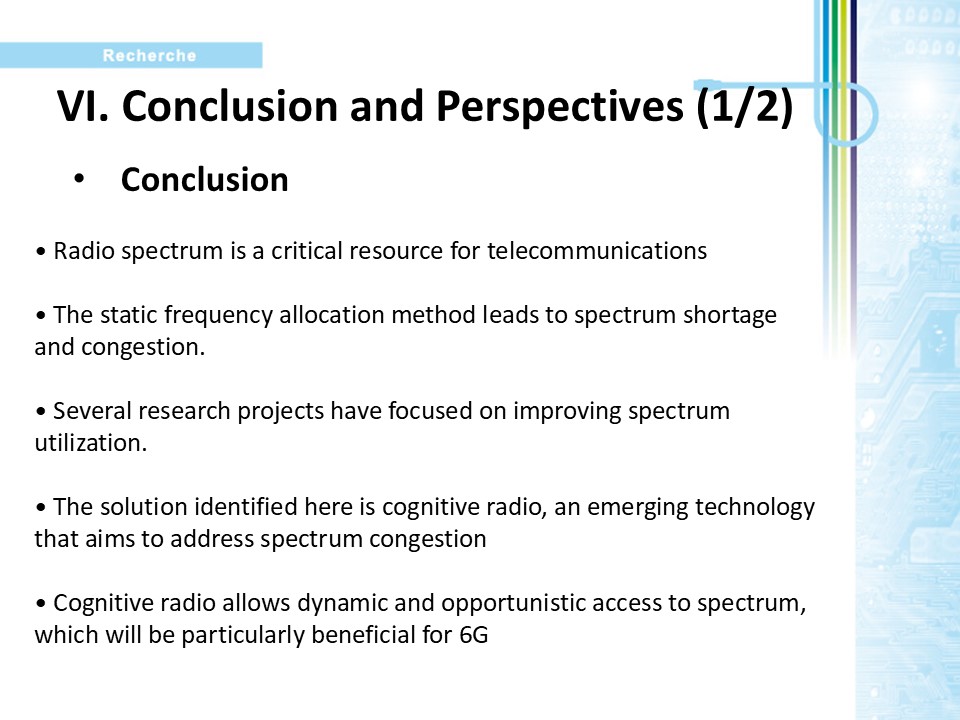
Spectrum is an indispensable resource in telecommunications in general, and in mobile networks in particular.
This resource, used by cell phone operators, is momentarily in use.
Certain frequency channels are therefore free due to the inactivity of mobile terminals on these frequencies. The static allocation of frequencies to operators leads to scarcity and congestion.
A number of research projects have been carried out to improve the use of these frequencies.
The solution found is cognitive radio, a new technology that will solve the problem of spectrum congestion and the temporary use of frequencies by primary users (PUs).
It will enable dynamic and opportunistic access to the frequency spectrum, which will be beneficial for 6G, which needs a larger frequency band than previous networks.
|
|
ICACT20250130 Slide.14
[Big slide for presentation]
|
Chrome Text-to-Speach Click!! |
 |
In the last scenario :
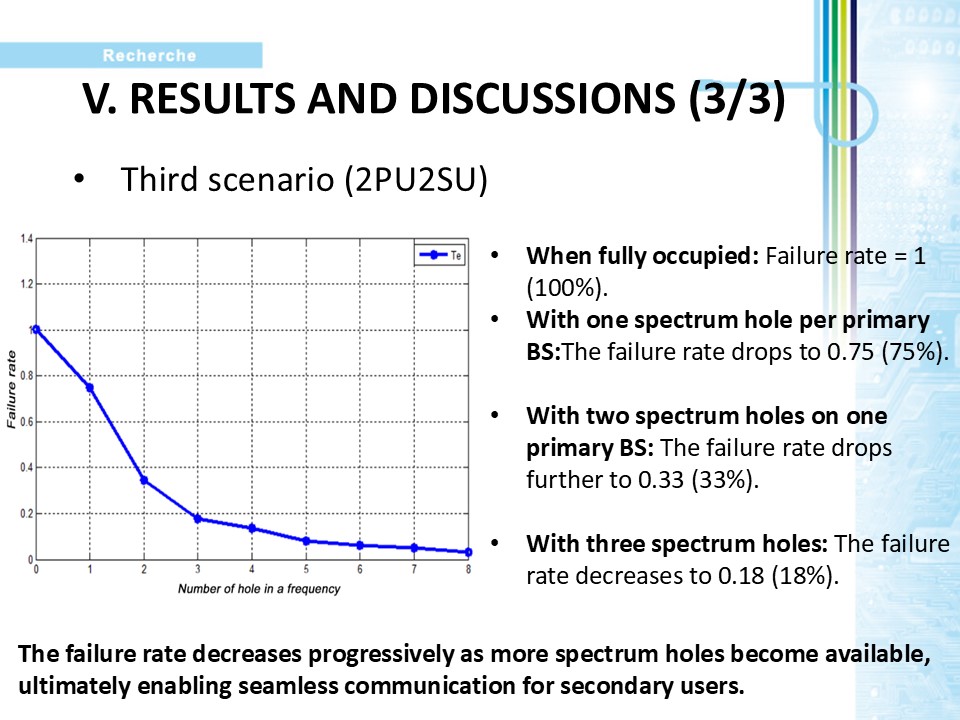
When the frequencies of both primary base stations are simultaneously busy, the failure rate is 1. This means that all channels are busy. This means that the two secondary SBs will not be able to transmit their SU's communications.
The rate drops from 1 to 0.75 when there is at least one available hole in each of the frequencies of the two primary SBs. The two SUs have at least one channel to communicate. This rate decreases to 0.33 when there are at least two holes available in either of the two primary SB frequencies.
In this way, the two secondary SBs each have at least two holes for transmitting their SU's communications. The rate decreases from 0.33 to 0.18 when at least three holes are available.
The rate decreases with the availability of holes in each frequency of the two primary SBs, until it reaches zero as the number of available holes increases.
|
|
ICACT20250130 Slide.13
[Big slide for presentation]
|
Chrome Text-to-Speach Click!! |
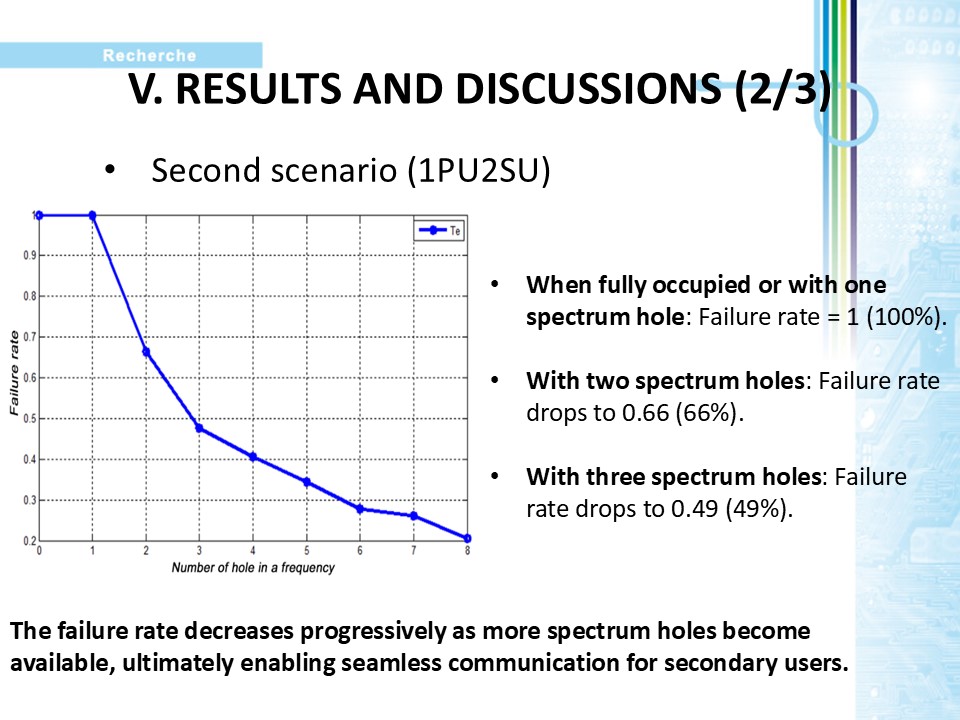 |
In the second scenario :
The failure rate in this case reaches its maximum value equal to 1 and remains constant even when there's a hole available, because the single hole is not enough for both SBs to communicate.
So the two secondary SBs will transmit one by one the communication of their SU on the only available hole.
The failure rate drops from 1 to 0.66 when at least two holes are available on the primary SB's frequency, enabling the two secondary base stations to transmit their SUs' communications.
The rate drops to 0.49 when at least 3 holes are available on the primary SB's frequency.
|
|
ICACT20250130 Slide.12
[Big slide for presentation]
|
Chrome Text-to-Speach Click!! |
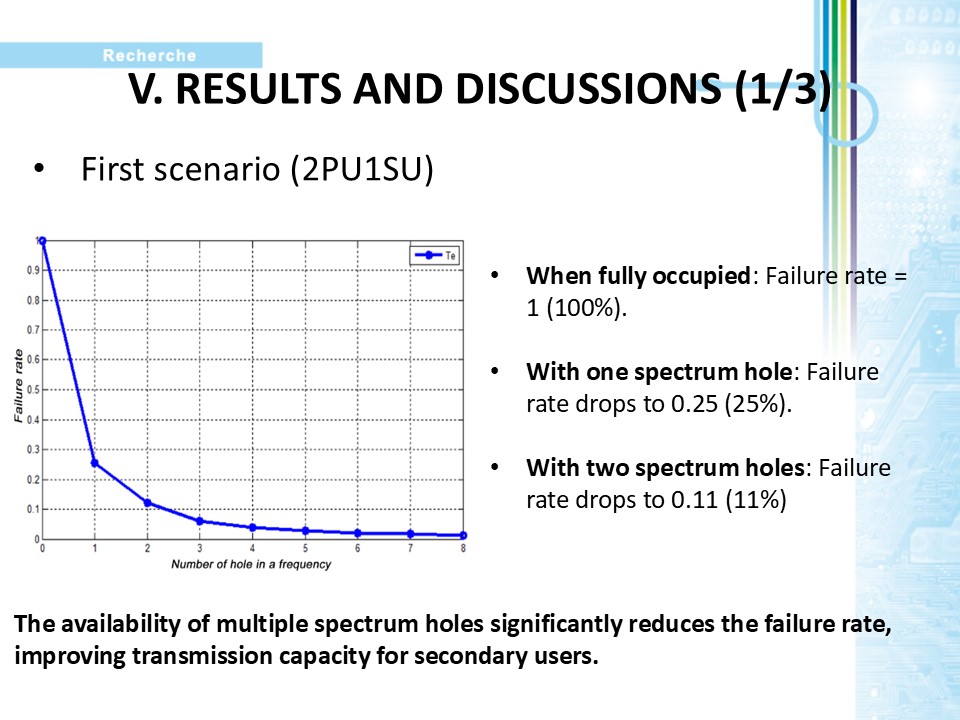 |
The result of our firt scenario is :
When both frequencies of the two primary stations are simultaneously occupied, the failure rate of the secondary SB is equal to 1, that is 100%.
This means that no SU communication is transmitted in the network.
The rate then drops from 1 to 0.25 when there is at least 1 hole available in one of the frequencies of each primary base station, giving the secondary SB at least one hole to transmit its SU's communication on the network.
This rate drops to 0.11 when there are at least two holes available on the frequencies of at least one of the primary SBs. The Secondary station has at least 2 channels and transmits the SU's communications.
The failure rate decreases with the availability of holes opened by the two primary base stations.
|
|
ICACT20250130 Slide.11
[Big slide for presentation]
|
Chrome Text-to-Speach Click!! |
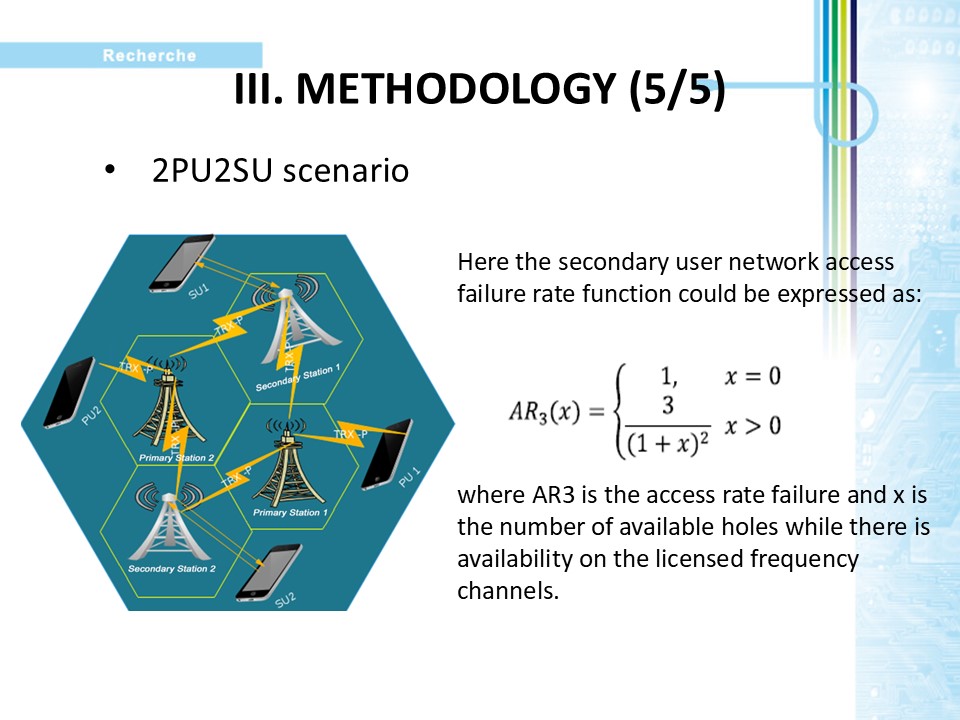 |
In this third scenario we consider an architecture with two neighboring primary base stations, each operating on a licensed frequency, and two secondary base stations neighboring the two primary base stations.
The two secondary base stations will use the holes available on each frequency of the two primary SBs, to transmit the communications.
This architecture saves two of the four frequencies that would be used if the architecture consisted solely of four primary SBs.
In this scenario, this formula calculates the call failure rate as a function of whether the two licensed frequencies are being used to make calls, or whether they are all busy or only one is free.
|
|
ICACT20250130 Slide.10
[Big slide for presentation]
|
Chrome Text-to-Speach Click!! |
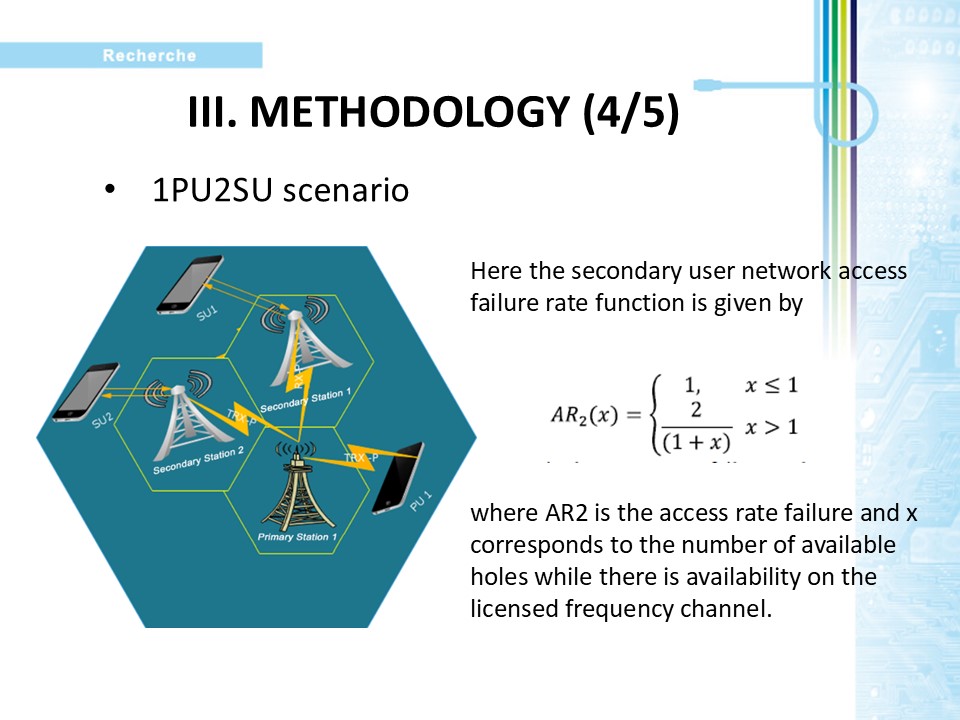 |
In this second scenario, we will consider an architecture comprising a primary base station, operating on a licensed frequency, and two secondary base stations adjacent to the primary SB.
The two secondary base stations will use the holes available on the primary SB's frequencyof the primary SB to transmit their SU's communications.
This architecture saves two frequencies out of the three frequencies used in an architecture consisting solely of three primary SBs.
In this scenario, this formula calculâtes the call failure rate as a function of whether the licensed frequency used to make the call is free or occupied, which represents x (available frequency holes).
|
|
ICACT20250130 Slide.09
[Big slide for presentation]
|
Chrome Text-to-Speach Click!! |
 |
This gives us our first possibility:
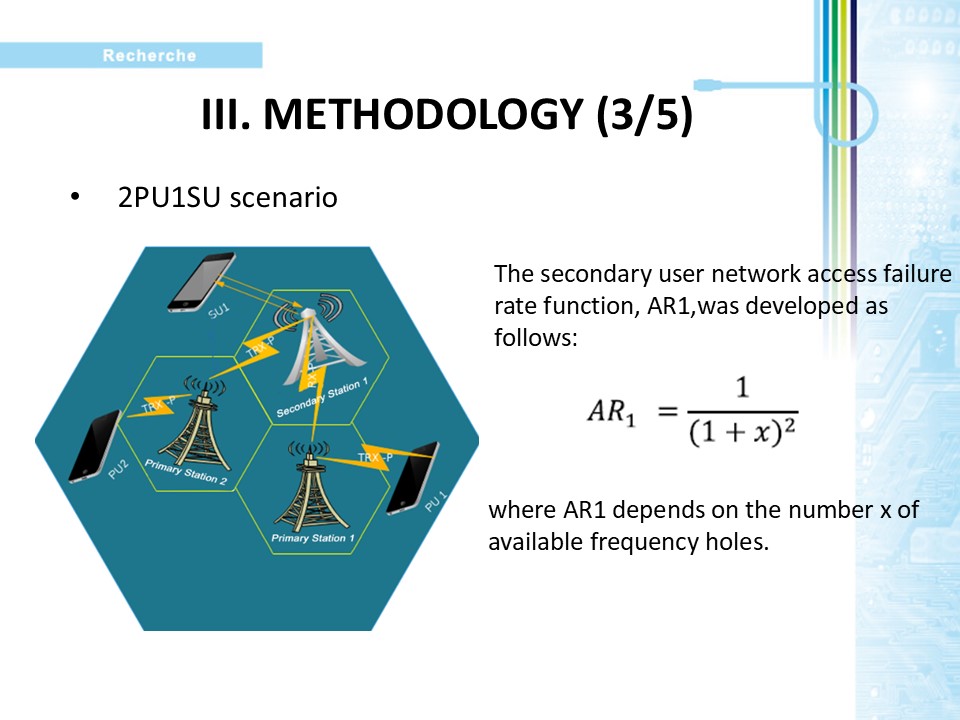
In this scenario, we consider an architecture with two neighboring primary stations, each operating on a licensed frequency, and a secondary station neighboring the two primary stations.
In this architecture, the secondary SB opportunely uses the holes available on each of the frequencies of the two primary SBs to transmit its SU's communications.
In this way, one frequency is saved out of three used in an architecture consisting of just three primary SBs.
In this scenario, this formula gives the failure rate as a function of the number of license frequencies used to make a call and the number x of available frequency holes.
AR1 is The secondary user network access failure rate function.
And AR1 depends on the number x of availabl frequency holes.
In this case x can only be less than or equal to one
(x inferior or equal to 1)
|
|
ICACT20250130 Slide.08
[Big slide for presentation]
|
Chrome Text-to-Speach Click!! |
 |
To put this into practice,we announced :
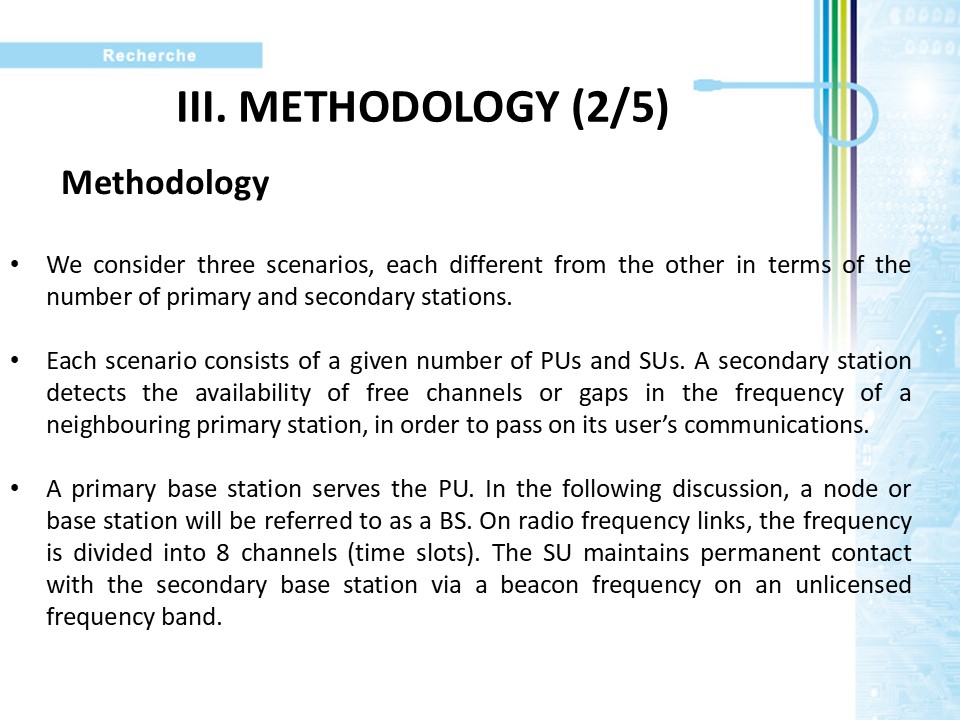
We consider three scenarios, all different from each other in terms of the number of primary and secondary stations
.Each scenario consists of a given number of UPs and Uss. A secondary station detects the availability of free channels or gaps in the frequency of a neighboring primary station, in order to transmit its user's communications.
A primary base station serves the PU. In the following discussion, a node or base station will be referred to as a BS. On radio frequency links, the frequency is divided into 8 channels (time slots). The SU maintains permanent contact with the secondary base station via a beacon frequency on an unlicensed frequency band.
|
|
ICACT20250130 Slide.07
[Big slide for presentation]
|
Chrome Text-to-Speach Click!! |
 |
Thus, we have :
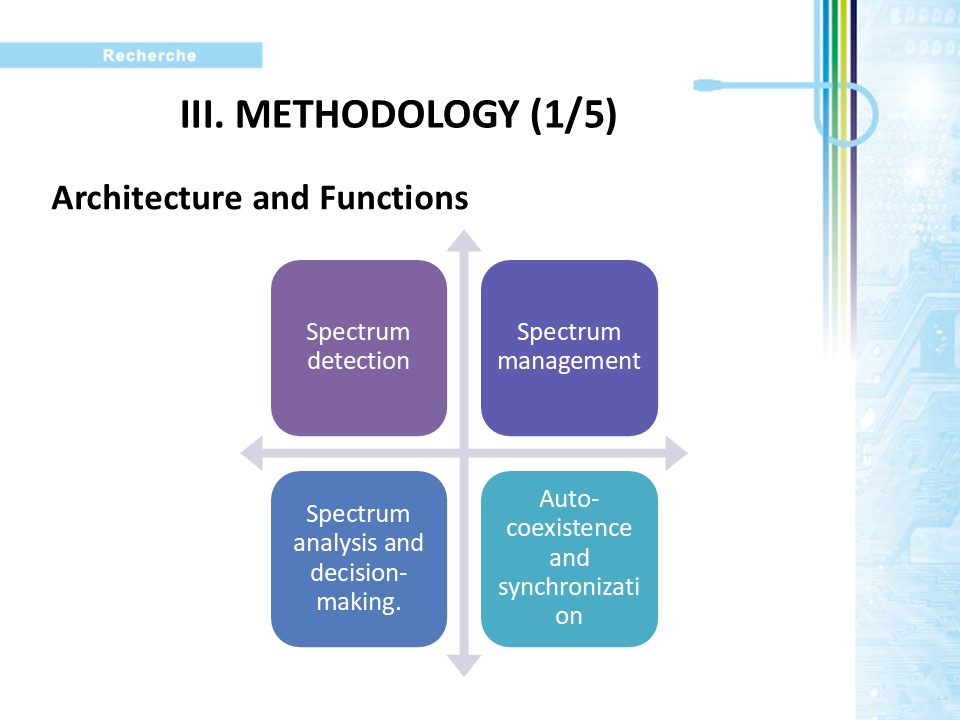
The main functions of CR are as follows:
Spectrum detection: Detection of spectrum areas available for use, identifying “holes” in the spectrum that can be accessed without interfering with primary users.
Spectrum management: Several processes are applied to capture the best available frequencies to meet users' communication needs.
Spectrum analysis: The results of spectrum sensing are analyzed to estimate spectrum quality, ensuring that the CR system selects high-quality channels for optimal communication.
Spectrum decision: This decision is based on a model and on user behavior, as follows:
-Decision model required for spectrum access, capable of analyzing spectrum to take into account the multiple needs of secondary users.
- Competition and cooperation in a multi-user environment, with each user maximizing his or her own objectives. In a cooperative environment, users work together to achieve a common goal, with possible coordination by a central controller.
|
|
ICACT20250130 Slide.06
[Big slide for presentation]
|
Chrome Text-to-Speach Click!! |
 |
This is a zoom of :
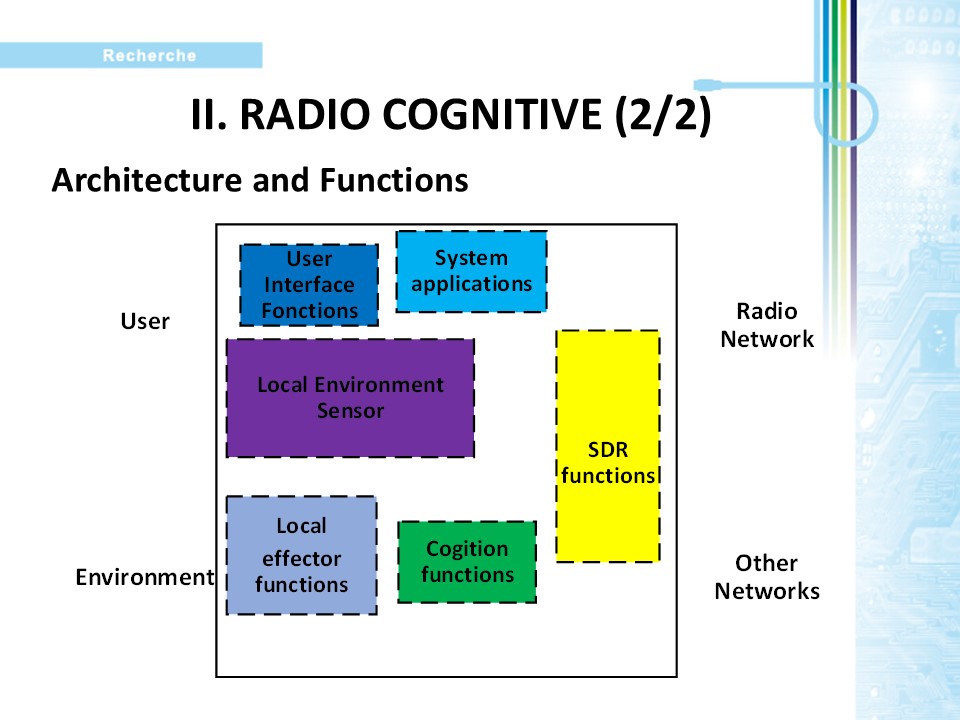
The simple architecture of a cognitive radio with a minimalist set of functional components.
-The user's sensory perception interface includes detection and perception functions, both visual and acoustic.
-Local environmental sensors (position, temperature, acceleration, etc.). System applications (independent media services such as a network game).
Software-defined radio (SDR) functions (including RF detection and SDR radio applications).
Cognitive functions (control, planning, learning) -Local functions (text-to-speech, text, graphics, multimedia).
|
|
ICACT20250130 Slide.05
[Big slide for presentation]
|
Chrome Text-to-Speach Click!! |
 |
First of all : What is Cognitive radio?
Cognitive radio is defined as a software radio characterized by a coherent set of rules and a design in which specific components perform a series of functions and services.
This gives it the ability to:
Make a terminal interact with its environment.
Perceive, model and adapt to its environment.
Detect free frequencies and use them, contributing to greater spectral efficiency.
|
|
ICACT20250130 Slide.04
[Big slide for presentation]
|
Chrome Text-to-Speach Click!! |
 |
Based on the above:
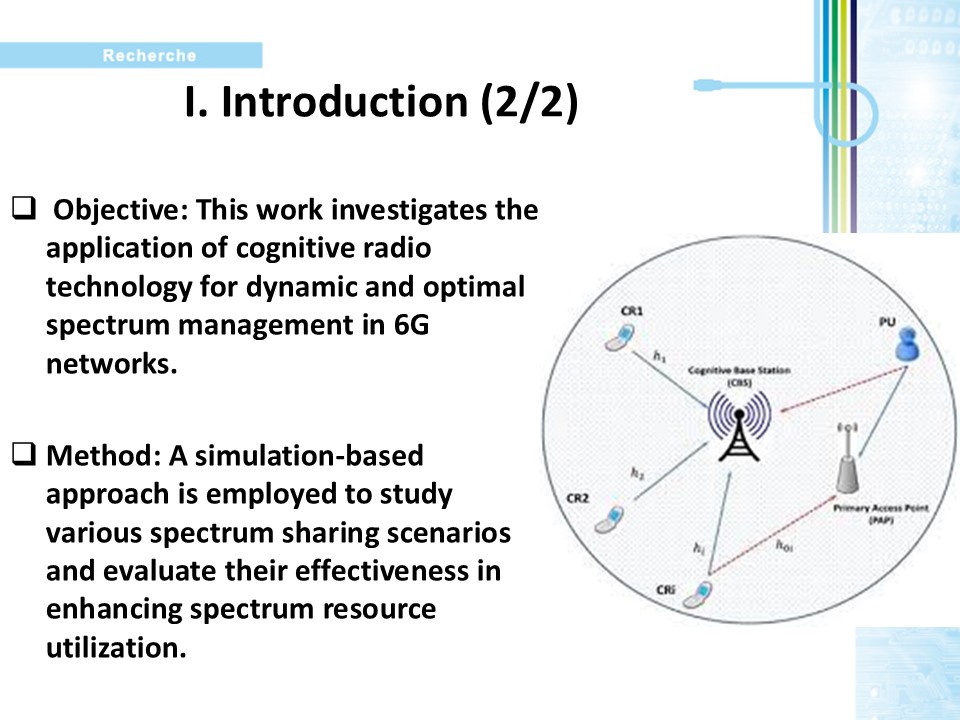
Our research objective is to propose a solution for optimal spectrum management. This proposed solution is the use of cognitive radio.
This technique will be integrated into 6G mobile equipment and will be able to use unused long-range frequencies to carry high data capacities.
The effectiveness of this method will be demonstrated by simulation across several spectrum sharing scenarios.
|
|
ICACT20250130 Slide.03
[Big slide for presentation]
|
Chrome Text-to-Speach Click!! |
 |
Let me start by saying:
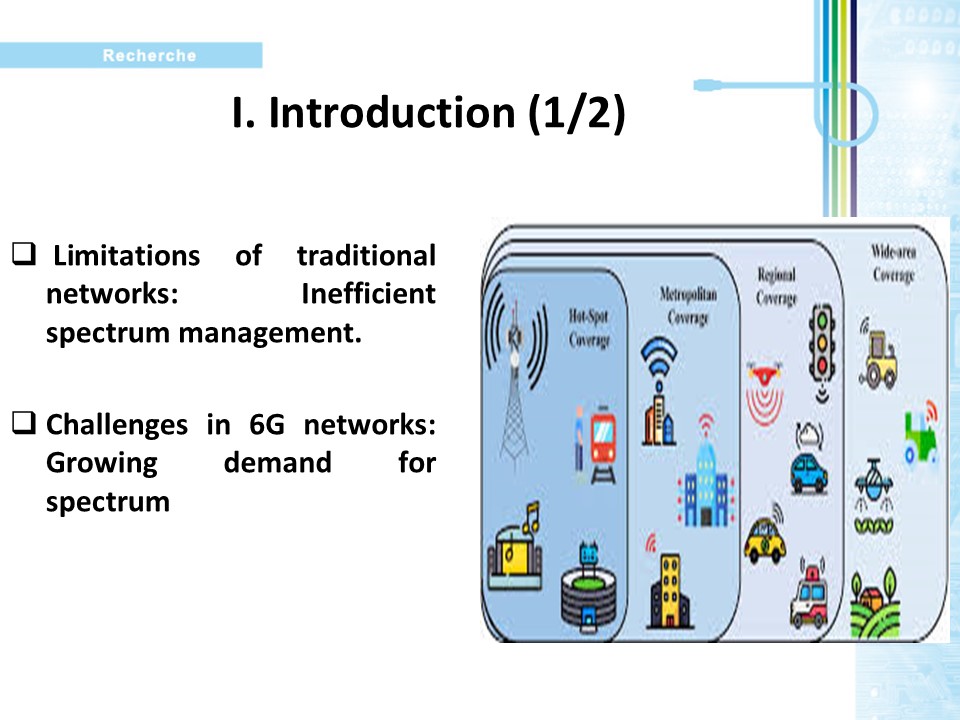
The 21st century has seen a multiplicity of generations of mobile networks in the world of telecommunications.
Numerous studies have shown that these generations of mobile digital communication networks operate with a static frequency allocation, which limits the use of this resource and creates a situation of its inefficiency and scarcity.
And with a Sixth Generation mobile network whose aim is to correct all the shortcomings of previous generations to provide an innovative, high-quality service.
So the challenge facing this sixth-generation mobile network is first and foremost to create the mechanisms needed for users to access spectrum resources. The solution to this problem is to make access to this frequency resource more dynamic.
|
|
ICACT20250130 Slide.02
[Big slide for presentation]
|
Chrome Text-to-Speach Click!! |
 |
This presentation will follow the following plan:
First a : Introduction
Followed by a brief description of : Cognitive radio
Then the means and procedures used for this study: Methodology
AND then announce the: Results and discussions
To finish with a: Conclusion
|
|
ICACT20250130 Slide.01
[Big slide for presentation]
|
Chrome Text-to-Speach Click!! |
 |
My name is : Dourahamane IDE BARKIRE ,PhD student
I'm here to talk about: 6G access network performance based on dynamic spectrum sharing,This work was done with the collaboration of :
Dr Benjamin Kone
and Pr Kora
And myself Dourahamane IDE BARKIRE , PhD student
|
















