 ICACT20220026 Slide.22
[Big slide for presentation] |
Chrome Text-to-Speach Click!! |
 |
Thank you for your listening!. Looking forward to your comment and contribution.
|
|
ICACT20220026 Slide.21
[Big slide for presentation]
|
Chrome Text-to-Speach Click!! |
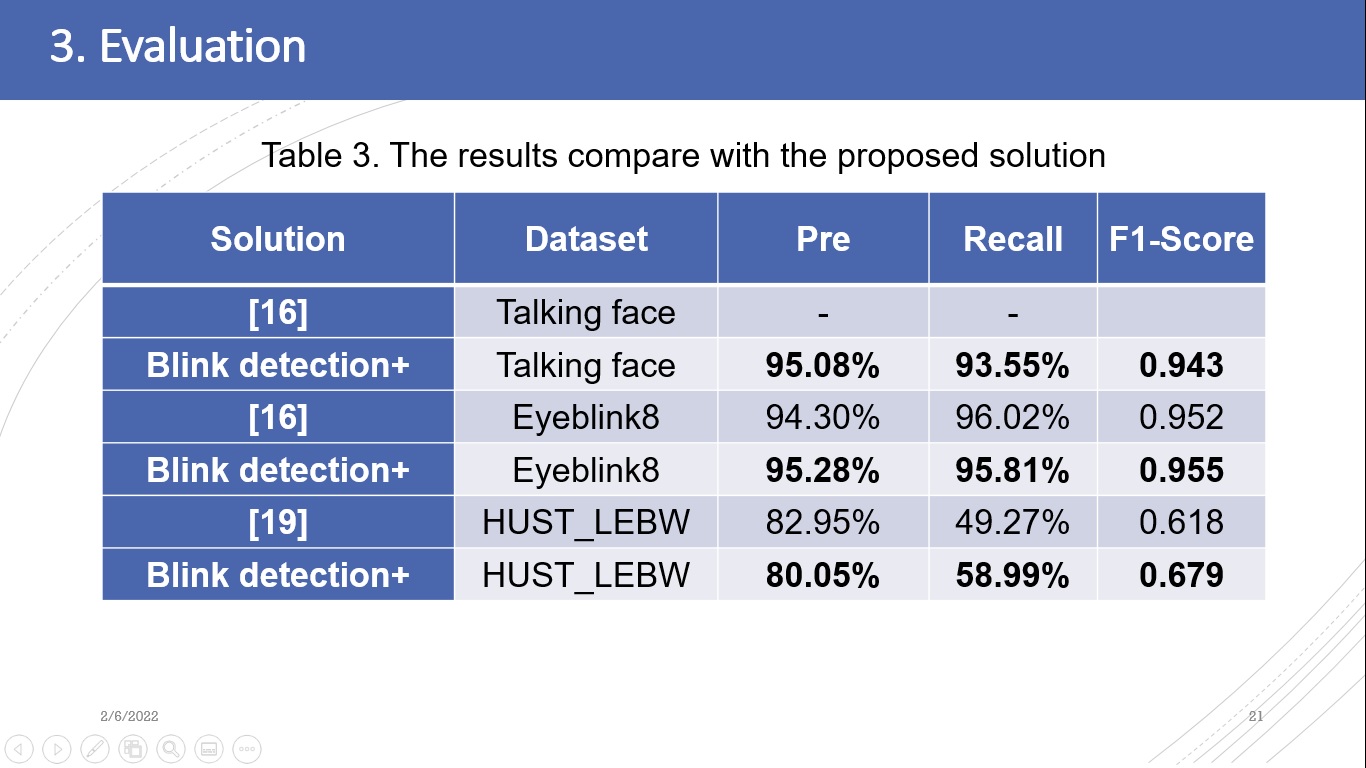 |
The results compare with the proposed solution
|
|
ICACT20220026 Slide.20
[Big slide for presentation]
|
Chrome Text-to-Speach Click!! |
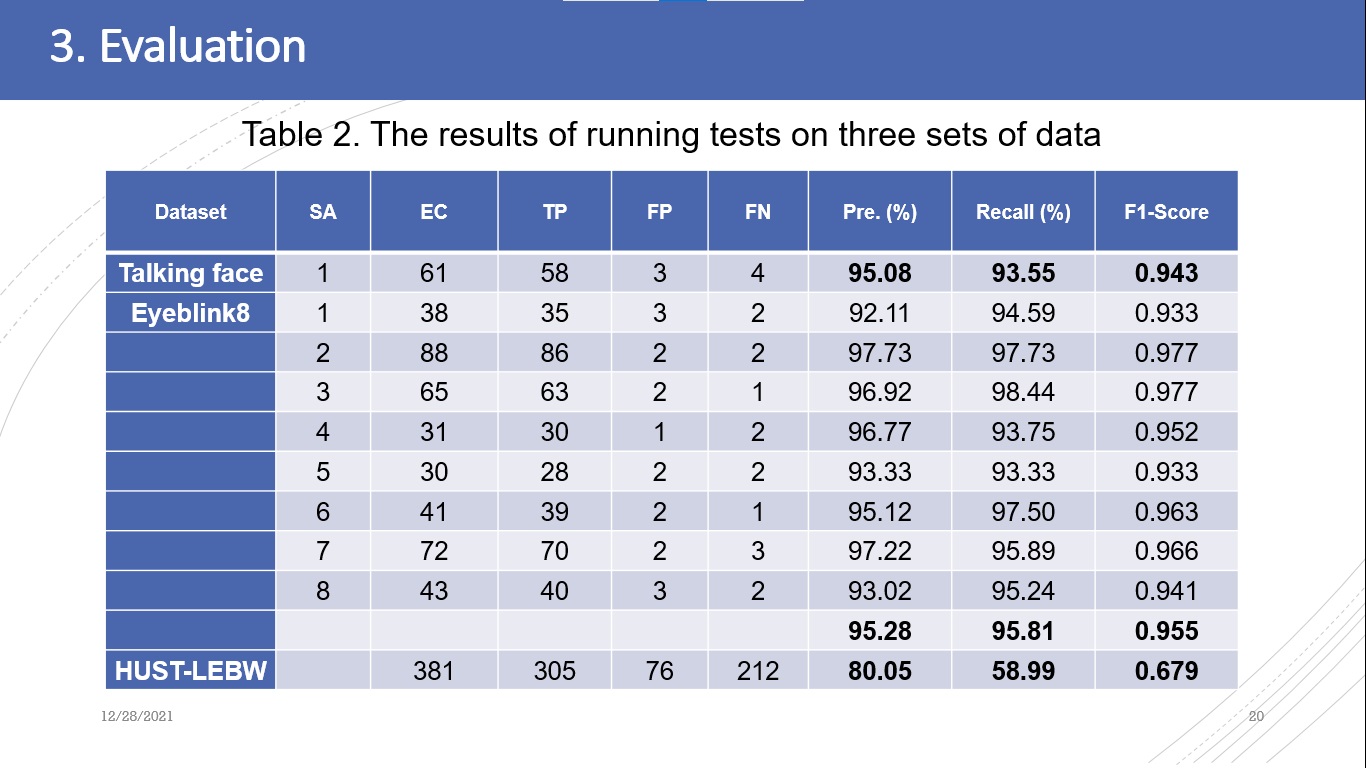 |
The results of running tests on three sets of data
|
|
ICACT20220026 Slide.19
[Big slide for presentation]
|
Chrome Text-to-Speach Click!! |
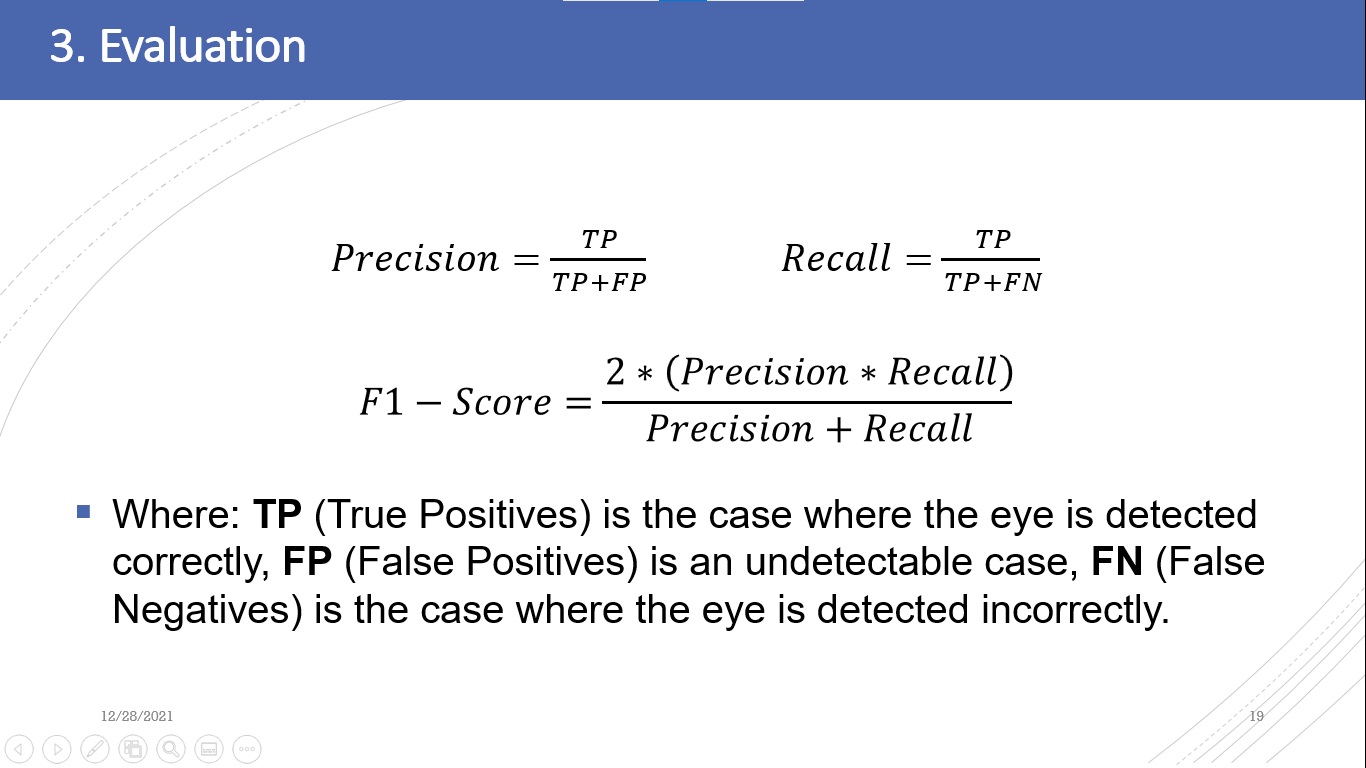 |
Performance metrics
|
|
ICACT20220026 Slide.18
[Big slide for presentation]
|
Chrome Text-to-Speach Click!! |
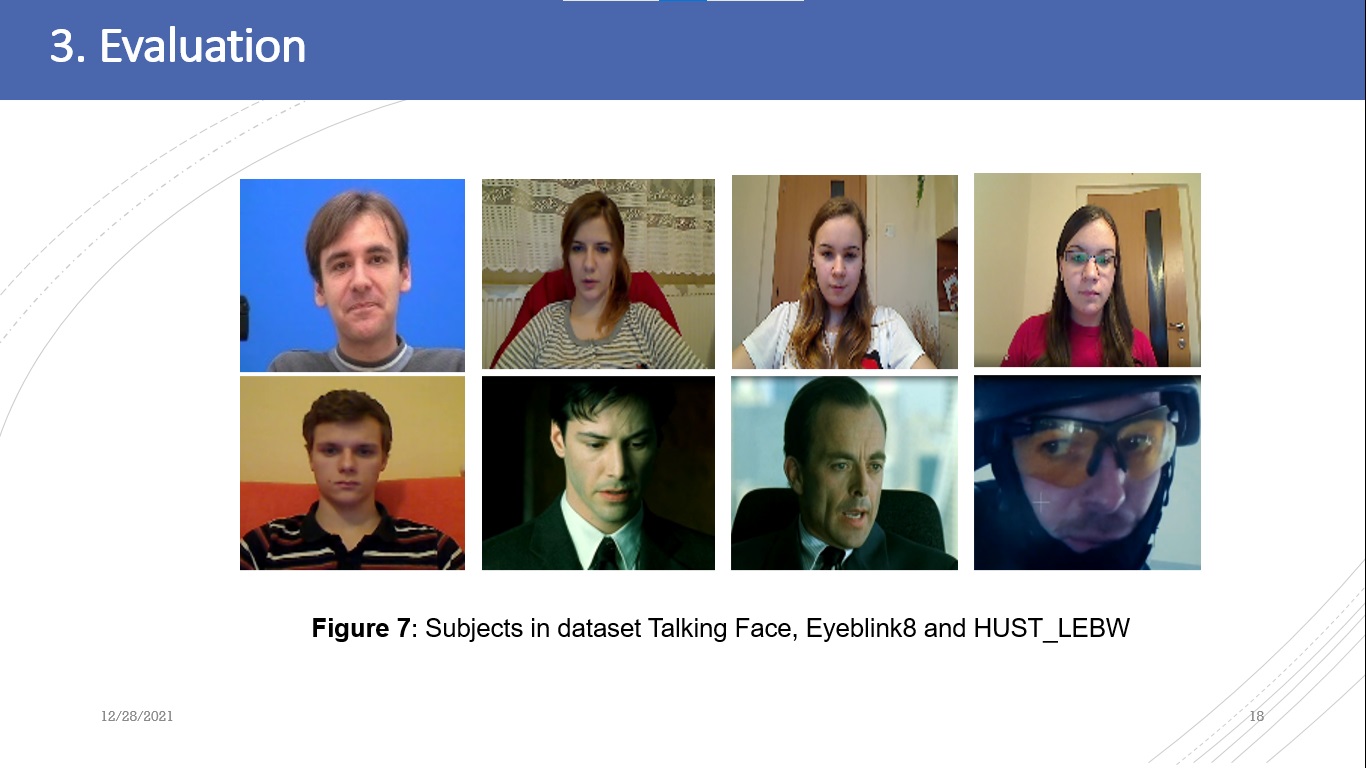 |
The image is cut from the clip in the experimental data
|
|
ICACT20220026 Slide.17
[Big slide for presentation]
|
Chrome Text-to-Speach Click!! |
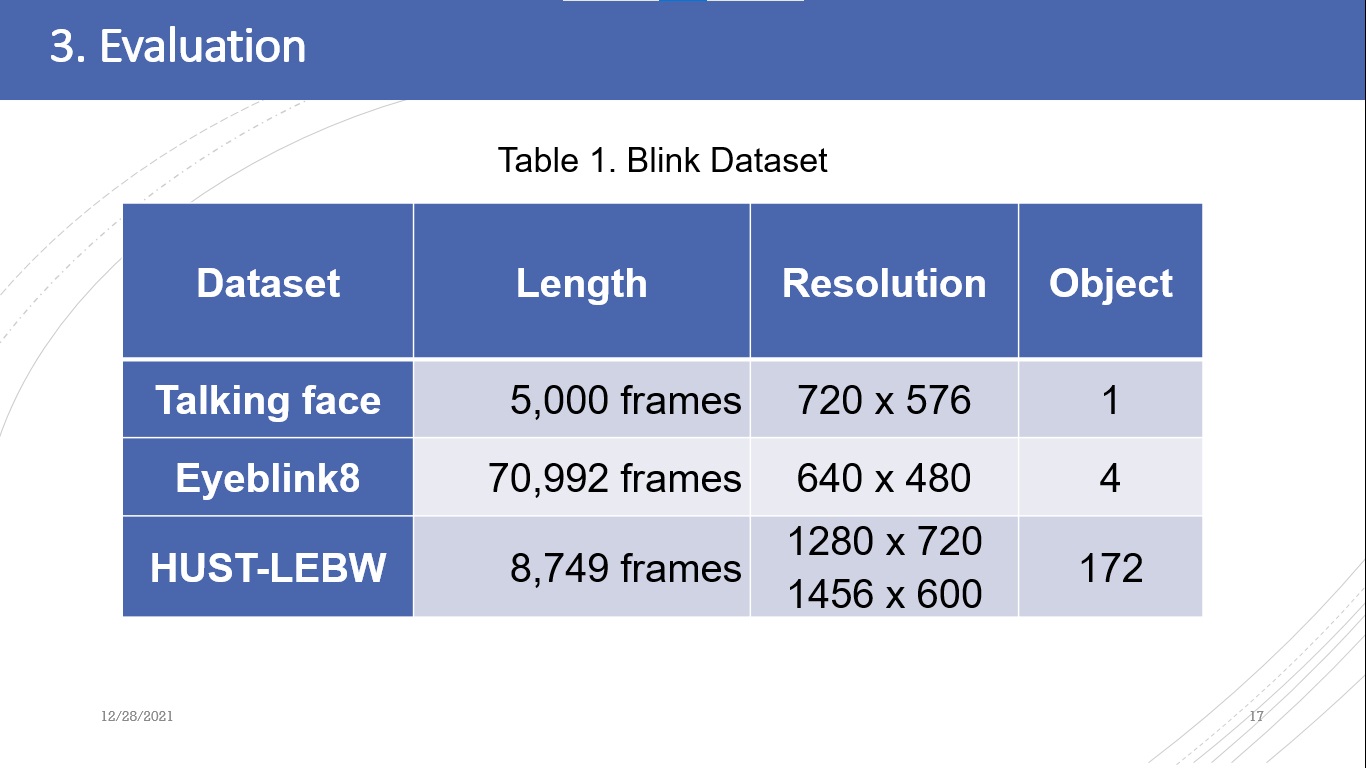 |
Three sets of experimental data for the solution
|
|
ICACT20220026 Slide.16
[Big slide for presentation]
|
Chrome Text-to-Speach Click!! |
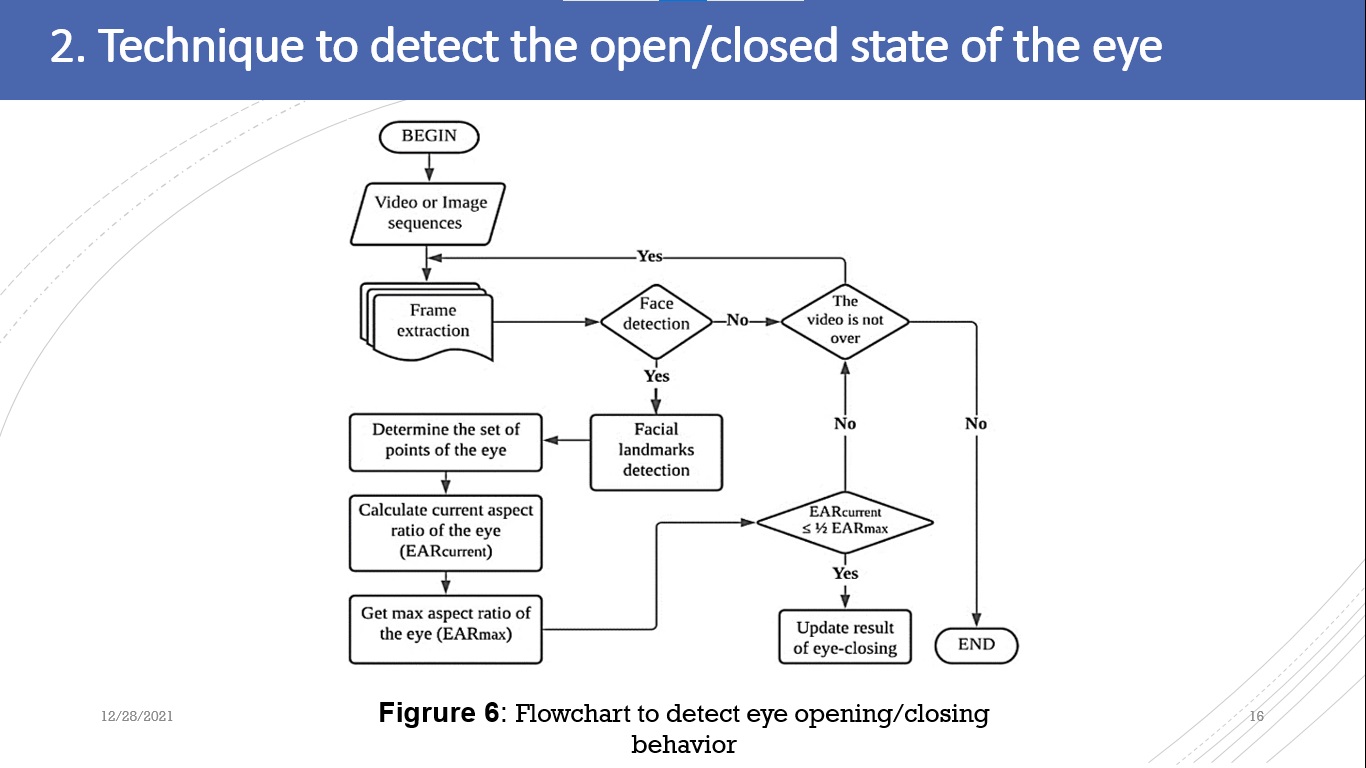 |
Flowchart of the algorithm. The input is video, the output is the state of the eyes open or closed of each object in each frame.
|
|
ICACT20220026 Slide.15
[Big slide for presentation]
|
Chrome Text-to-Speach Click!! |
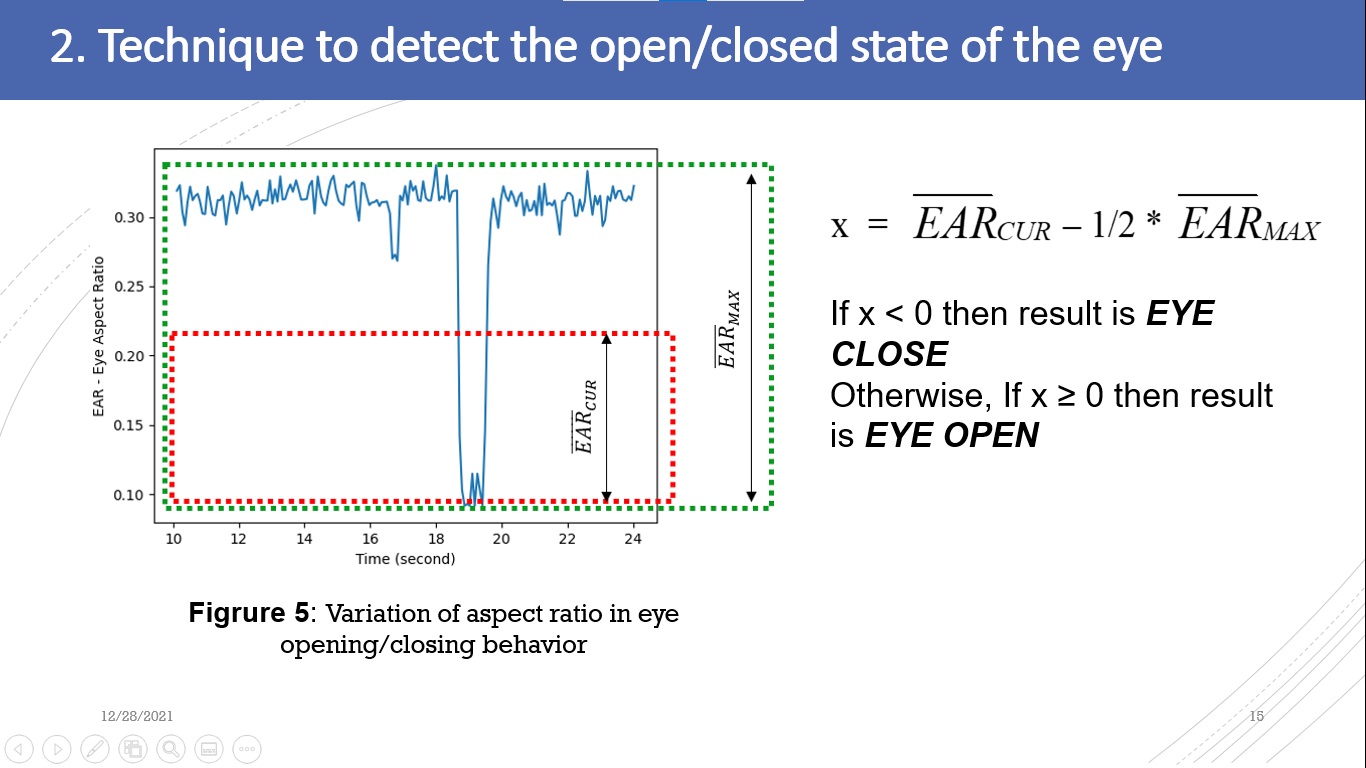 |
This slide illustrates the maximum aspect ratio and the current aspect ratio of the eye. Where, red simulates peak aspect ratio and blue simulates current aspect ratio. When the current aspect ratio is less than 1/2 of the maximum aspect ratio, the eyes are closed and vice versa, the eyes are open
|
|
ICACT20220026 Slide.14
[Big slide for presentation]
|
Chrome Text-to-Speach Click!! |
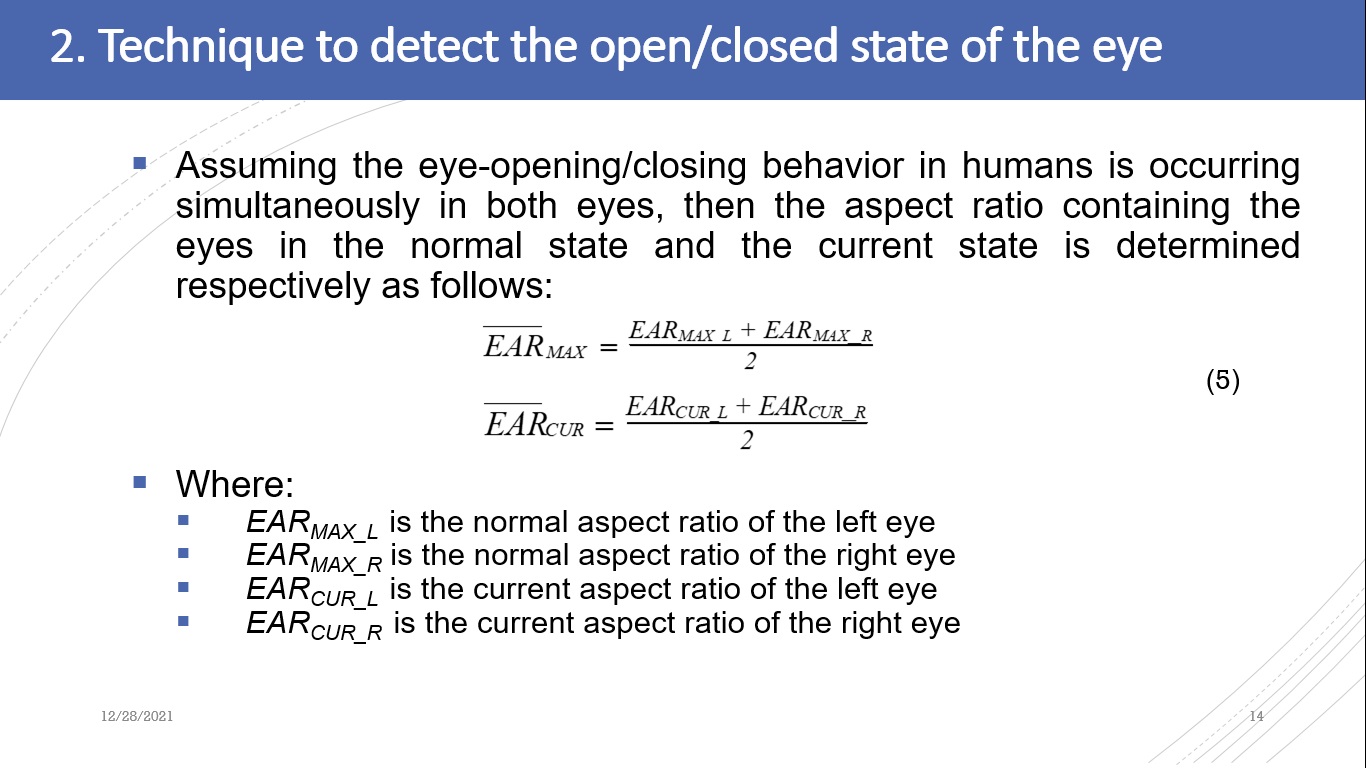 |
Determines the maximum eye-container aspect ratio and the current eye-container aspect ratio of both eyes
|
|
ICACT20220026 Slide.13
[Big slide for presentation]
|
Chrome Text-to-Speach Click!! |
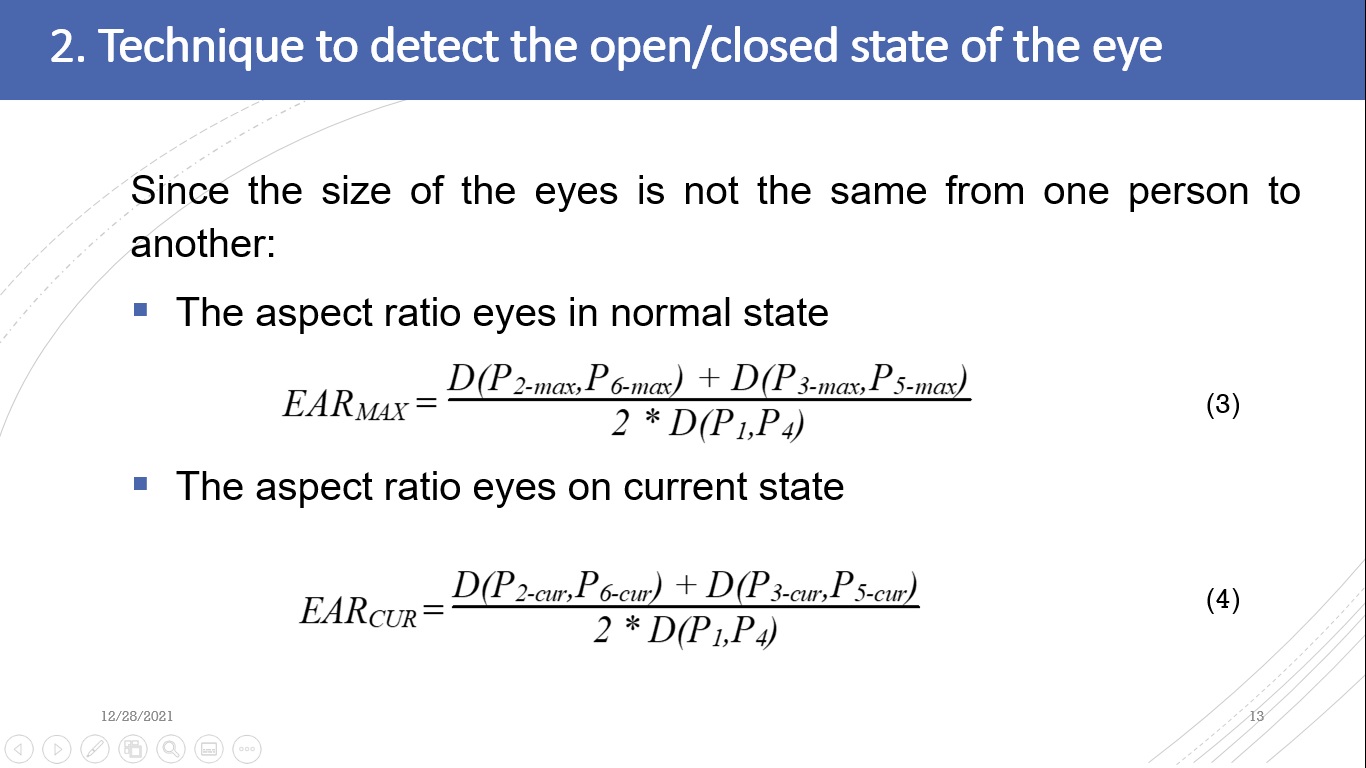 |
Since the size of the eyes is not the same from one person to another, so a person with large eyes and a person with small eyes will not have the same height and coordinate values. This leads to inaccuracies in determining eye opening/closing behavior when comparing the EAR value with a fixed threshold. To improve this, we offer a solution to determine the dynamic eye opening/closing behavior based on the variation of the frame containing the eyes of each individual as follows
|
|
ICACT20220026 Slide.12
[Big slide for presentation]
|
Chrome Text-to-Speach Click!! |
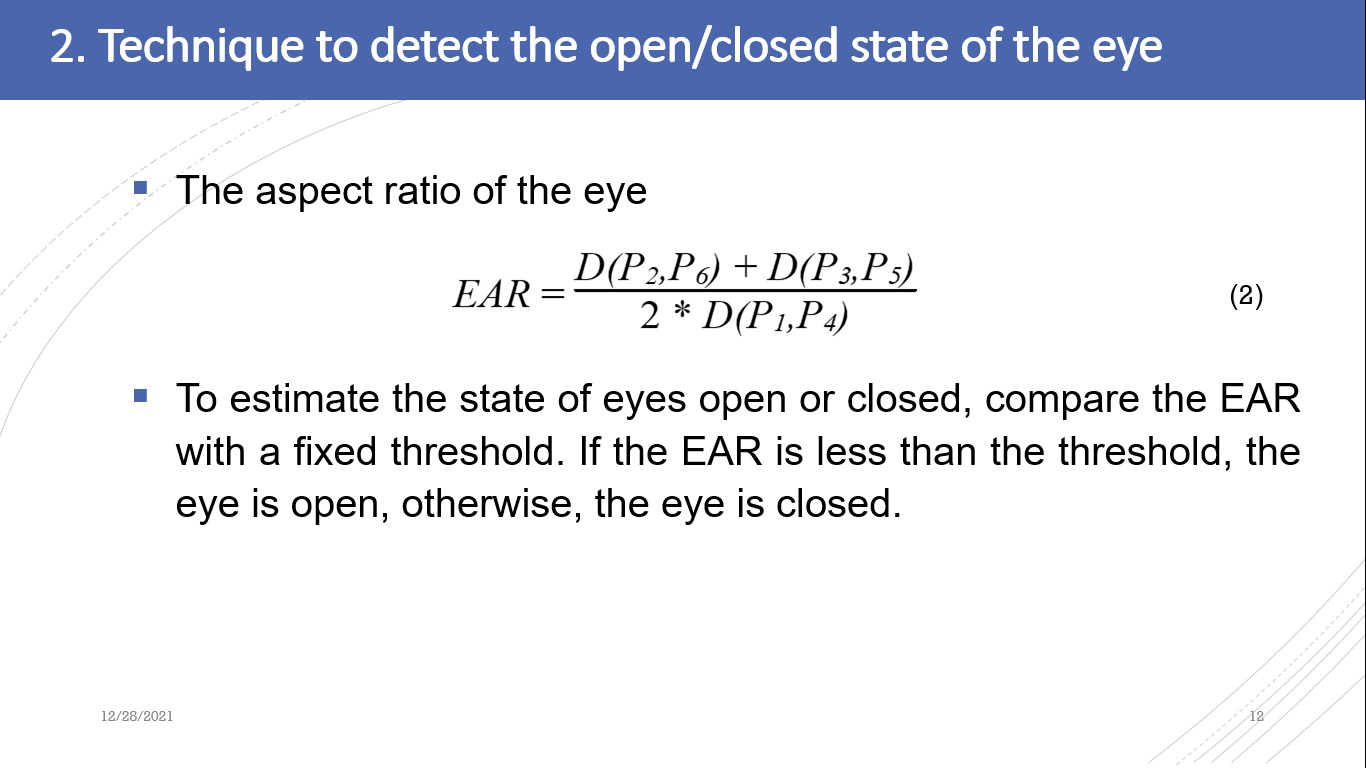 |
The aspect ratio containing the eye is the ratio between the height and the width and determined as formula (2). To estimate the state of eyes open or closed, compare the EAR with a fixed threshold. If the EAR is less than the threshold, the eye is open, otherwise, the eye is closed.
|
|
ICACT20220026 Slide.11
[Big slide for presentation]
|
Chrome Text-to-Speach Click!! |
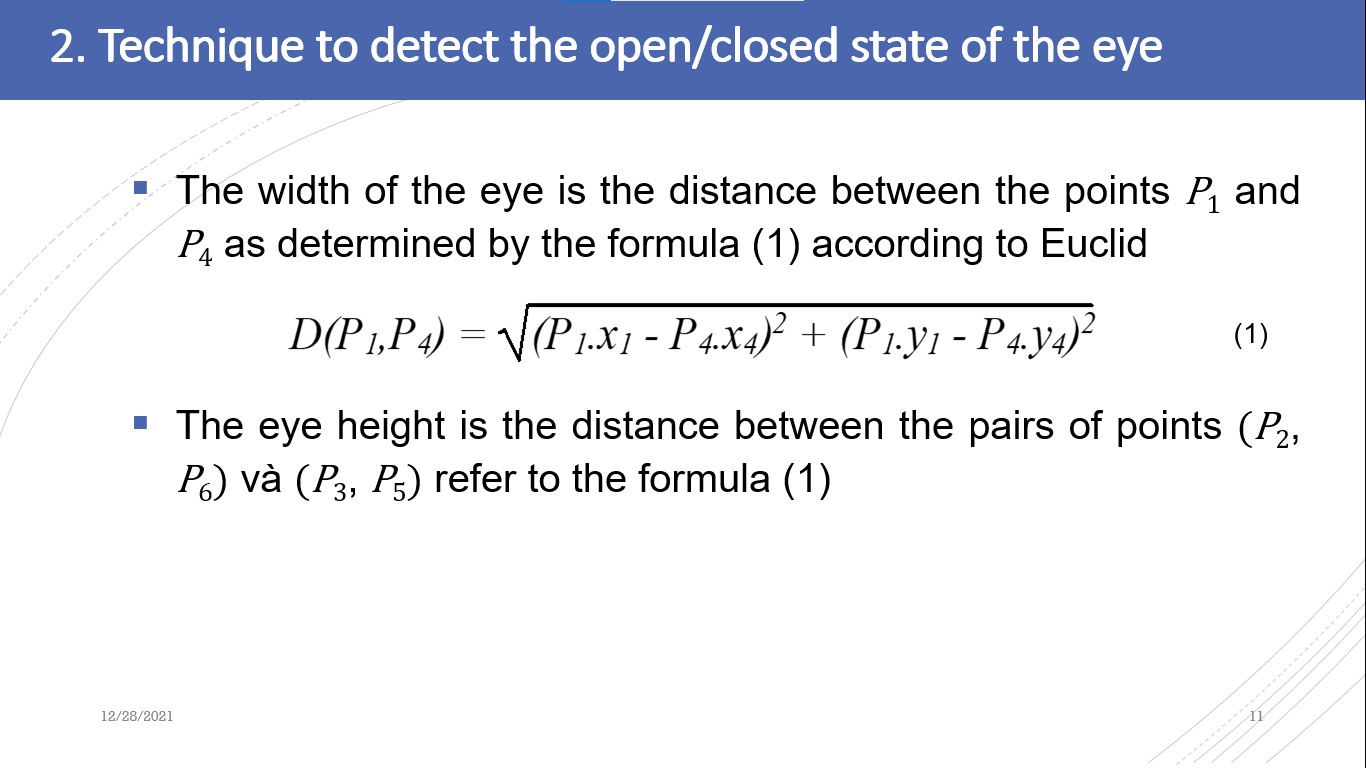 |
The aspect ratio containing the eye is the ratio between the height and the width. Where, The width of the eye is the distance between the points P1 and P4 as determined by the formula (1) according to Euclid.
The eye height is the distance between the pairs of points (P2, P6) và (P3, P5) refer to the formula (1)
|
|
ICACT20220026 Slide.10
[Big slide for presentation]
|
Chrome Text-to-Speach Click!! |
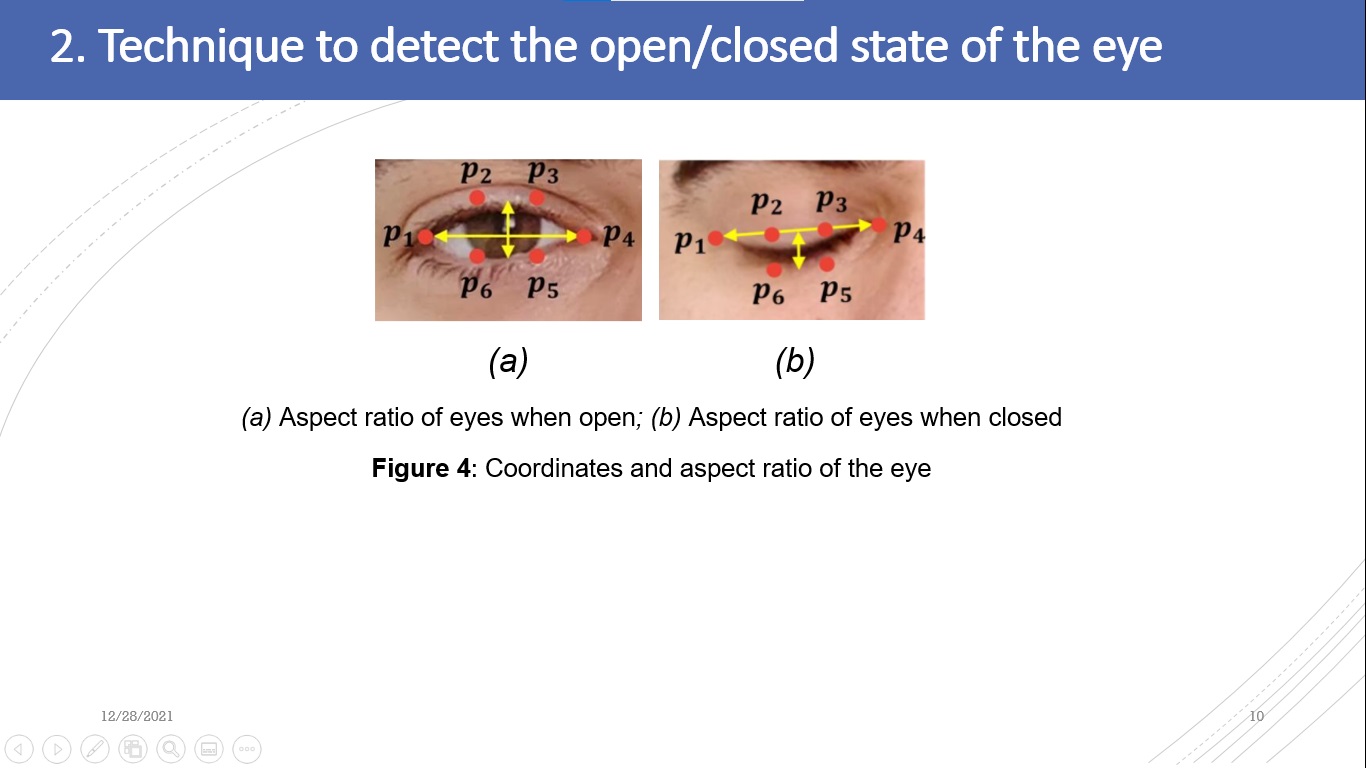 |
This slide illustrates the coordinates and aspect ratio of the eye. Where figure a simulates the aspect ratio of open eyes and figure b simulates the aspect ratio of closed eyes
|
|
ICACT20220026 Slide.09
[Big slide for presentation]
|
Chrome Text-to-Speach Click!! |
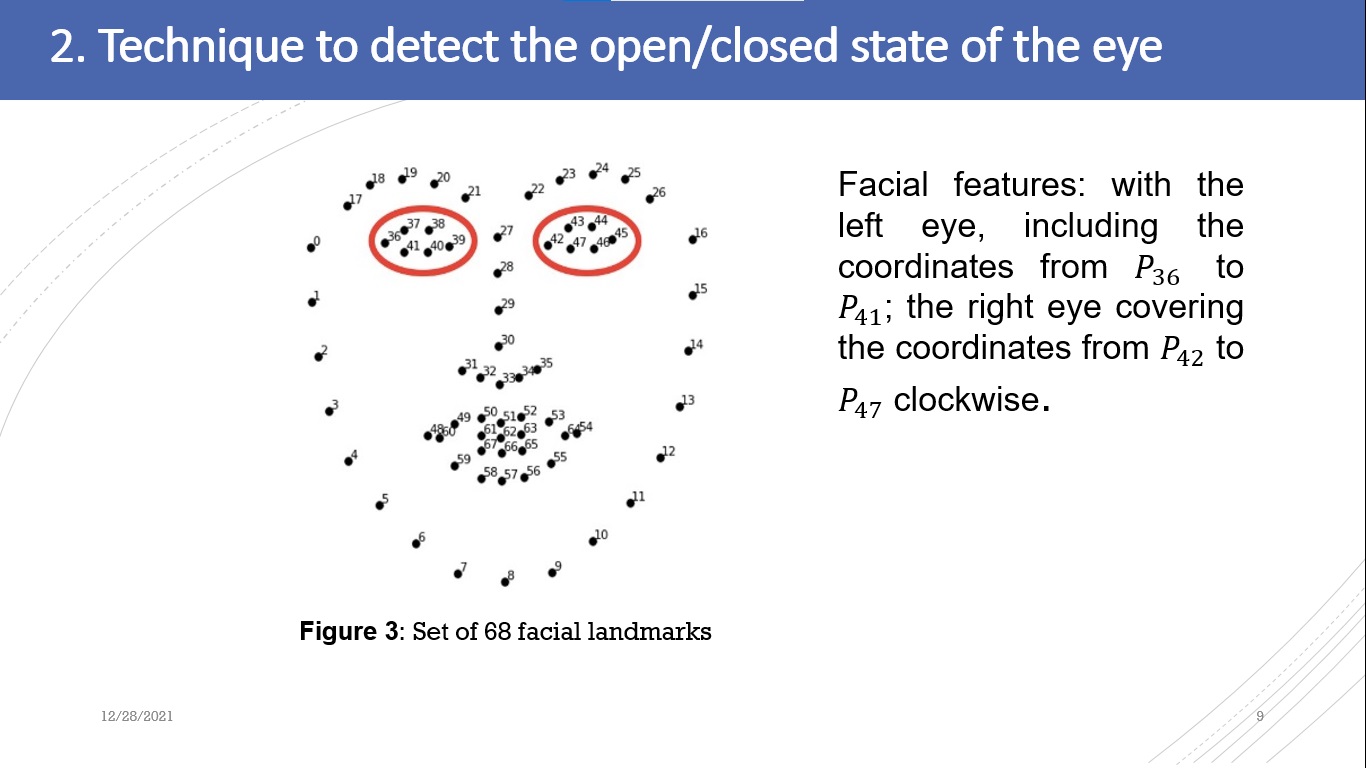 |
This slide shows us 68 features on the human face. Where the left eye is defined by the coordinates from P36 to P41 and the right eye from P42 to P47 clockwise
|
|
ICACT20220026 Slide.08
[Big slide for presentation]
|
Chrome Text-to-Speach Click!! |
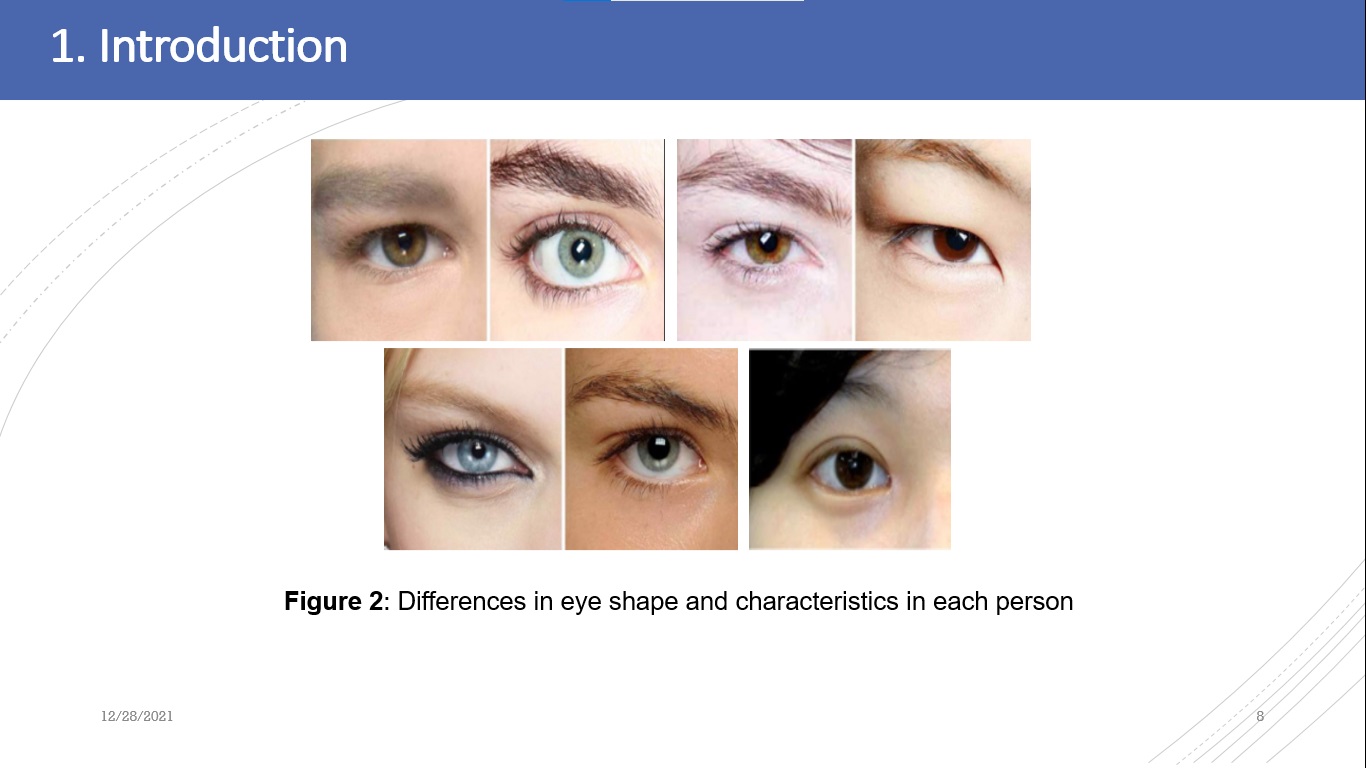 |
Differences in eye height and width in each person
|
|
ICACT20220026 Slide.07
[Big slide for presentation]
|
Chrome Text-to-Speach Click!! |
 |
For the feature-based method, according to [16], the eye's open/closed state is estimated based on the ratio of height and width.
- Optimized for speed.
- Limitation because the decision of the state of the eye must be based on a fixed threshold, this will not be generalizable to all subjects because the shape and characteristics of the eyes will be different in each person, leading to the ratio is also a difference between the height and width of the eyes in each person (see Figure 2).
|
|
ICACT20220026 Slide.06
[Big slide for presentation]
|
Chrome Text-to-Speach Click!! |
 |
For the indirect method, the system does not require any additional hardware and physical contact with people, but only analyzes based on images or video captured during monitoring. Approaches for the method include: pattern-based, appearance-based and feature-based.
|
|
ICACT20220026 Slide.05
[Big slide for presentation]
|
Chrome Text-to-Speach Click!! |
 |
Although there have been many applications related to estimating the state of the eye, this is an issue that is still of interest to researchers because of the variety of data and applications. Various methods have been proposed and are divided into two main groups: direct and indirect.
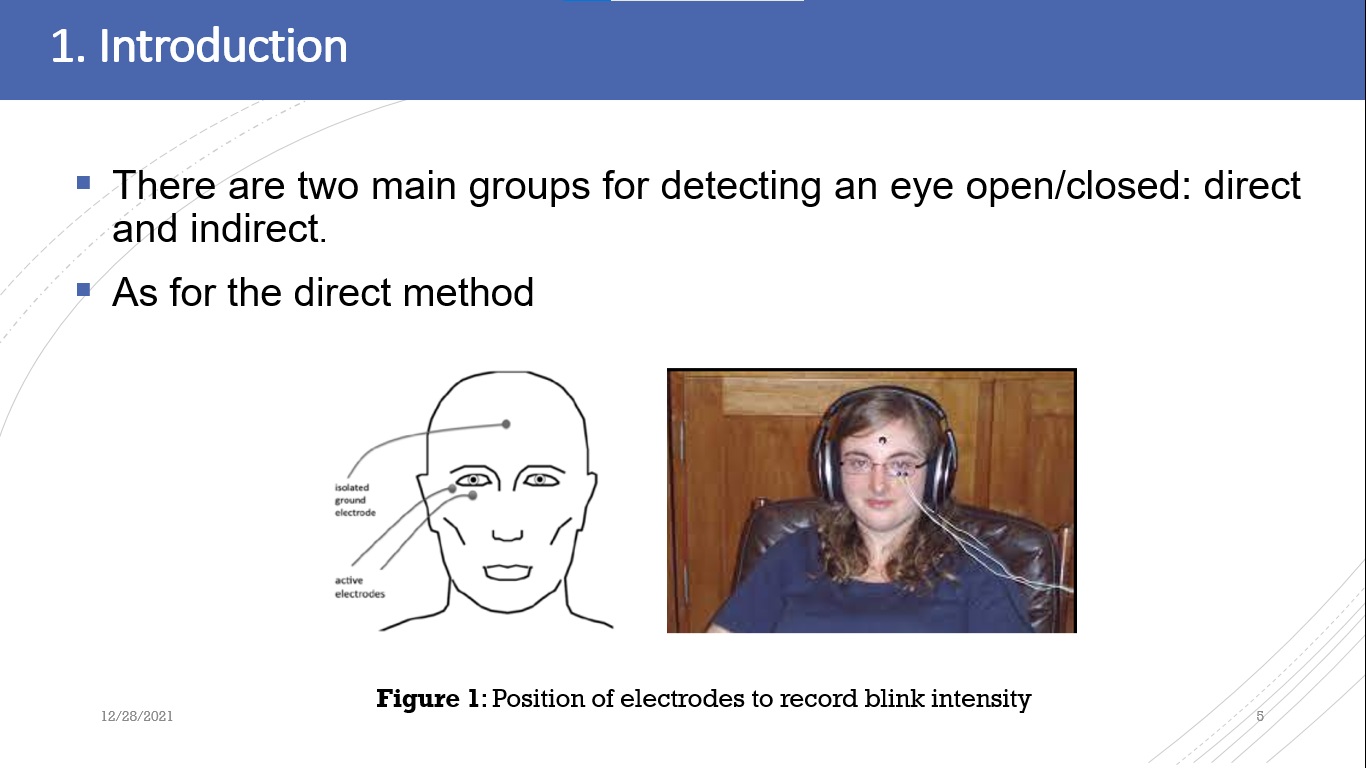
As for the direct method, which is performed by attaching a device around the eye to record the changes in eye movements, this method has high accuracy, but is difficult to implement in practice because of the inconvenient when having to attach additional sensors around the eyes
|
|
ICACT20220026 Slide.04
[Big slide for presentation]
|
Chrome Text-to-Speach Click!! |
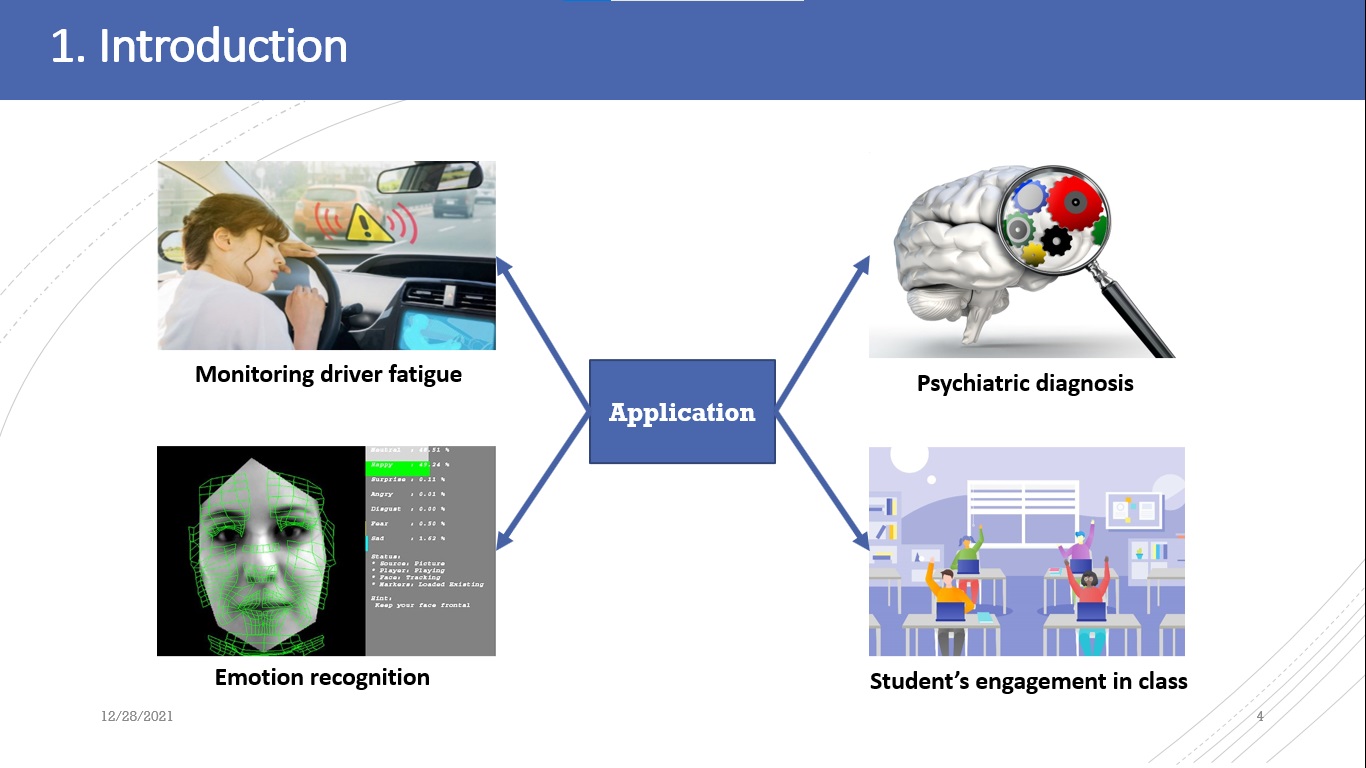 |
The open/closed state of the eyes is considered a powerful feature of the human face and has been studied over the years for a large number of applications, such as: monitoring driver fatigue and sleepiness for automobile accident prevention, psychiatric diagnosis, emotion recognition. In addition, detecting the open/closed state of the eyes is also applied in the system to estimate the student¡¯s concentration during class time
|
|
ICACT20220026 Slide.03
[Big slide for presentation]
|
Chrome Text-to-Speach Click!! |
 |
As we all know, Eyes are the most prominent features of the human face, and play an important role in analyzing and estimating the changing state and emotions of a person
|
|
ICACT20220026 Slide.02
[Big slide for presentation]
|
Chrome Text-to-Speach Click!! |
 |
The main content of the presentation, I would like to introduce to you includes 3 contents:
1. Introduction
2. Technique to detect the open/closed state of the eye
3. Evaluation
|
|
ICACT20220026 Slide.01
[Big slide for presentation]
|
Chrome Text-to-Speach Click!! |
 |
Hi everybody, my full name is Tran Thanh Phuong. I am from Lac Hong University, Vietnam. I would like to thank the ICACT organizers for giving our the opportunity to present our research work. Our presentation today is about an eye blink detection technique in surveillance video based on Eye Aspect Ratio.
|
















