 ICACT20220037 Slide.22
[Big slide for presentation] |
Chrome Text-to-Speach Click!! |
 |
Q and A
|
|
ICACT20220037 Slide.21
[Big slide for presentation]
|
Chrome Text-to-Speach Click!! |
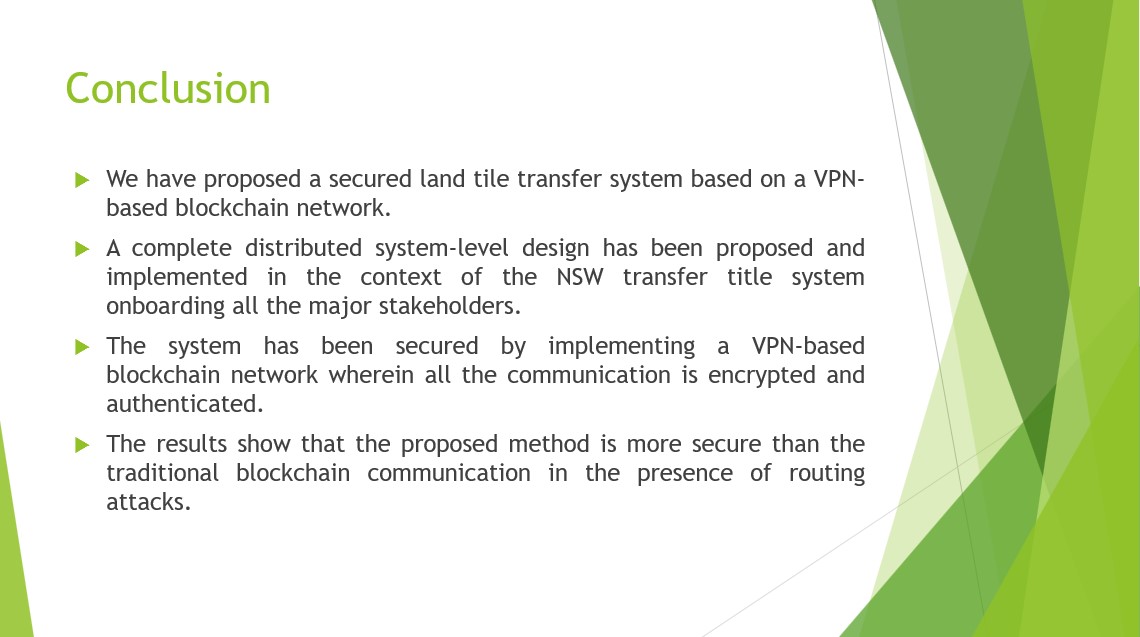 |
We have proposed a secured land tile transfer system based on a VPN-based blockchain network.
A complete distributed system-level design has been proposed and implemented in the context of the NSW transfer title system onboarding all the major stakeholders.
The system has been secured by implementing a VPN-based blockchain network wherein all the communication is encrypted and authenticated.
The results show that the proposed method is more secure than the traditional blockchain communication in the presence of routing attacks.
|
|
ICACT20220037 Slide.20
[Big slide for presentation]
|
Chrome Text-to-Speach Click!! |
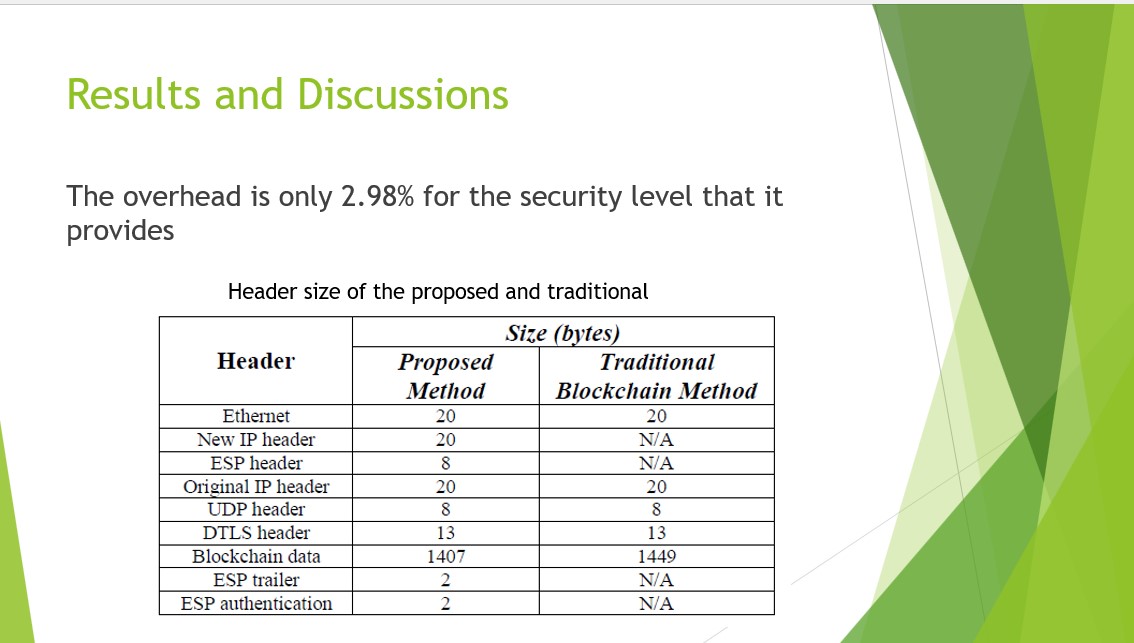 |
We have also calculated the overhead of the proposed
packet size as compared to traditional blockchain traffic.
Table II lists the different headers with their size both for the
proposed and the conventional blockchain network. The
overhead is only 2.98% for the security level that it provides.
|
|
ICACT20220037 Slide.19
[Big slide for presentation]
|
Chrome Text-to-Speach Click!! |
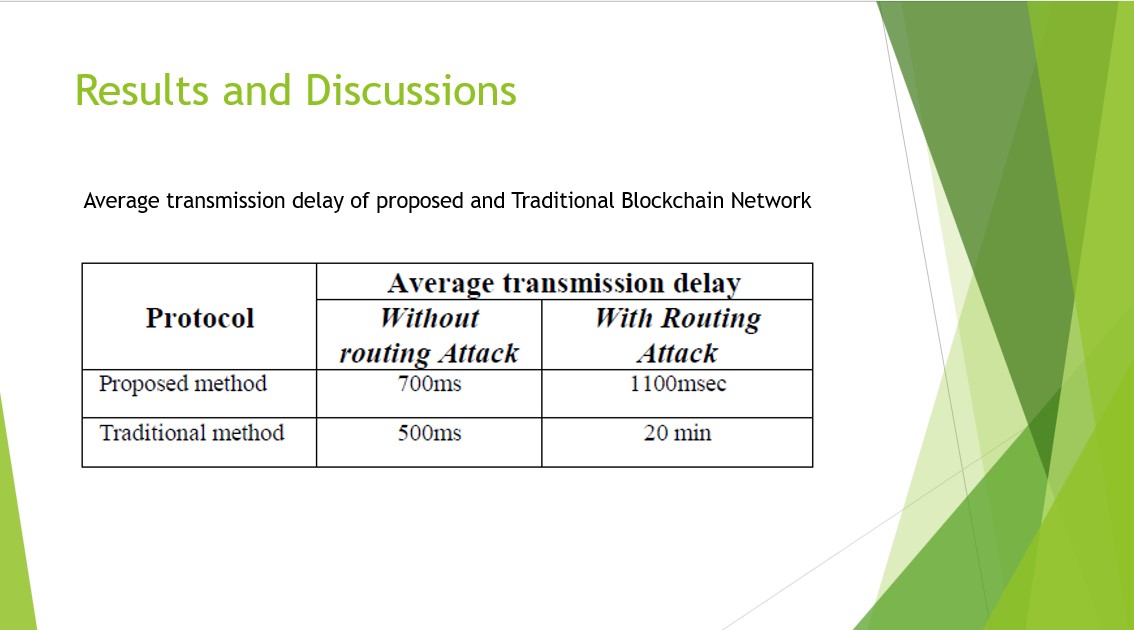 |
The table lists the average transmission delay of the
proposed VPN-based blockchain network as compared to the traditional Hyperledger fabric messages. The results
calculated from the network topology show that the average
transmission delay of a packet is 500ms in a traditional
blockchain network, whereas 700ms (200ms increased) in
the case of the proposed VPN-based blockchain network due
to the extra overhead. However, when we modeled the
routing attack, the packets were
delayed up to 20 minutes in traditional blockchain, which
leads to several problems. On the other hand, the VPN-based
traffic is secured in two layers. As a result,
the attacker can not find the source or destination of the
targeted traffic, thereby unable to predict its ASes. We
observed that there could be an additional delay of up to
1100ms if an attacker filters traffic based on an Access list
or AS filtering as listed in the Table.
|
|
ICACT20220037 Slide.18
[Big slide for presentation]
|
Chrome Text-to-Speach Click!! |
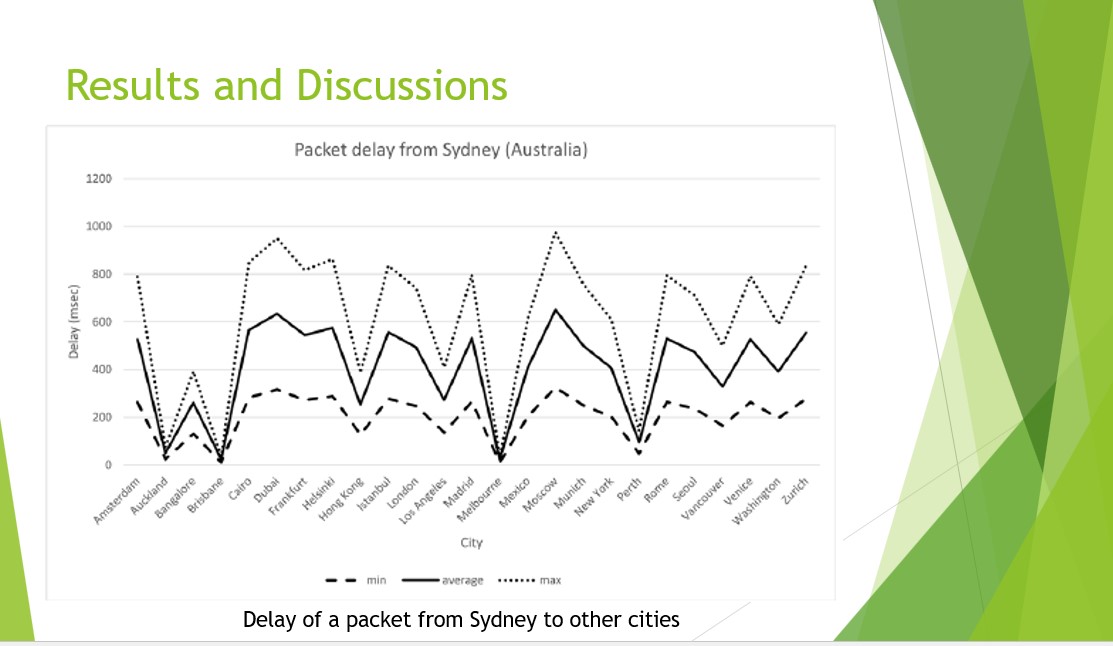 |
We have analyzed the delay which could be taken by a
packet over public Internet using an online tool [16]. This was
measured from Sydney Australia to 25 different cities across
the different parts of the world to get a practical packet delay
over the Internet as shown in Fig 6. We repeated the delay test
over 30 runs and then calculated the average to measure more
realistic values. The minimum delay was recorded 11.5 -
12.35ms to Melbourne whereas the maximum delay 325.42 -
325.62ms was recorded for Moscow. These delays were
randomly added to our service provider network/Internet to
emulate a practical view of the blockchain network.
|
|
ICACT20220037 Slide.17
[Big slide for presentation]
|
Chrome Text-to-Speach Click!! |
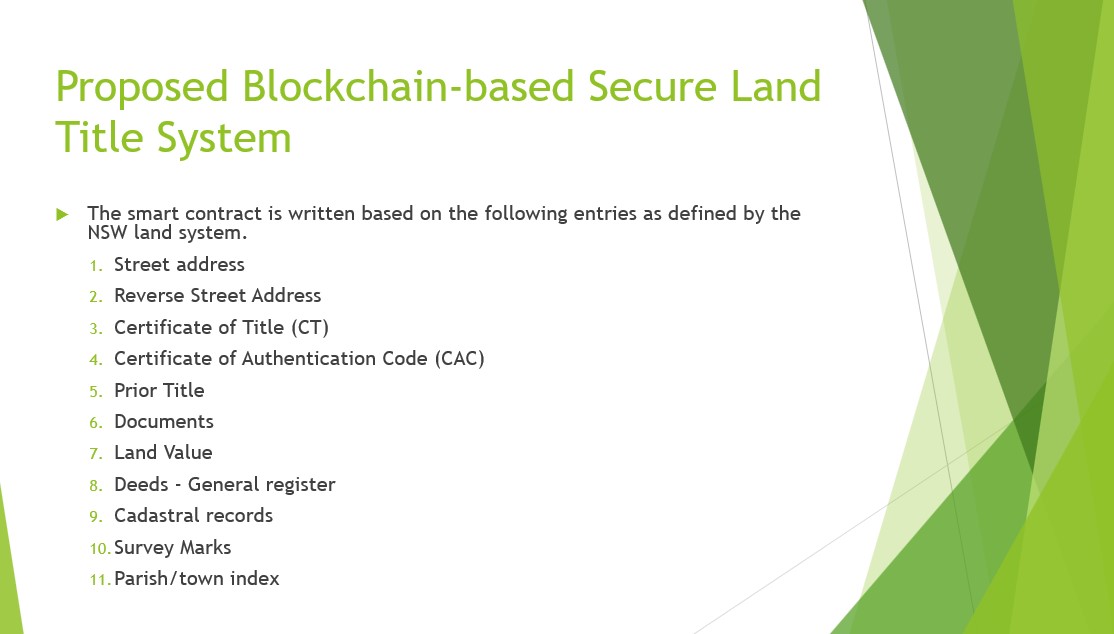 |
The smart contract is written based on the following entries as defined by the NSW land system.
Street address
Reverse Street Address
Certificate of Title (CT)
Certificate of Authentication Code (CAC)
Prior Title
Documents
Land Value
Deeds - General register
Cadastral records
Survey Marks
Parish/town index
|
|
ICACT20220037 Slide.16
[Big slide for presentation]
|
Chrome Text-to-Speach Click!! |
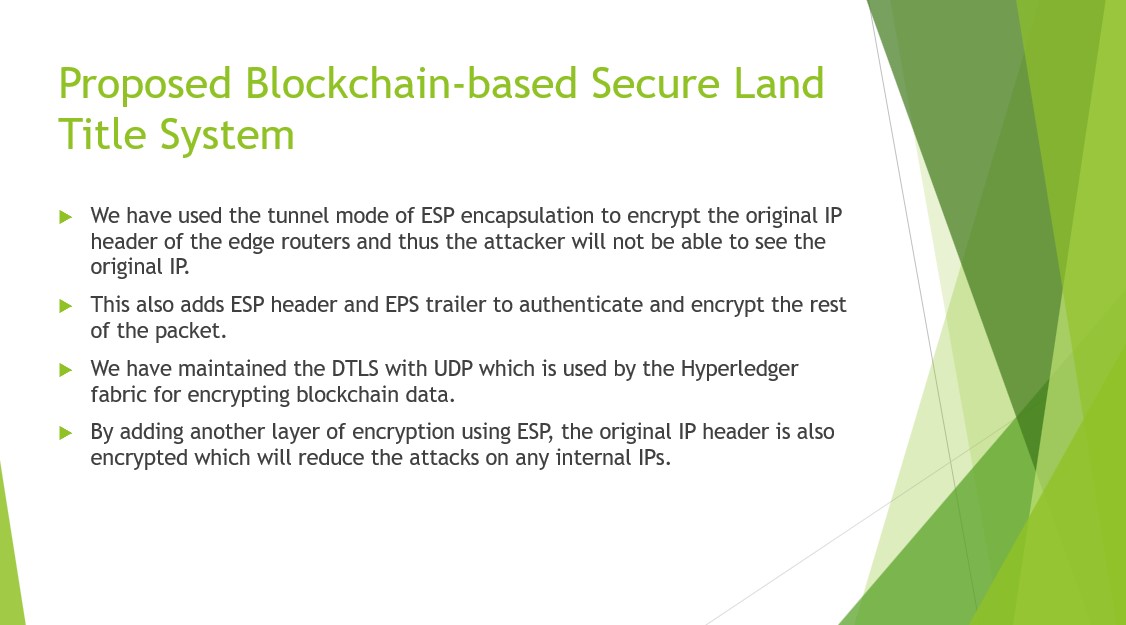 |
We have used the tunnel mode of ESP encapsulation to encrypt the original IP header of the edge routers and thus the attacker will not be able to see the original IP.
This also adds ESP header and EPS trailer to authenticate and encrypt the rest of the packet.
We have maintained the DTLS with UDP which is used by the Hyperledger fabric for encrypting blockchain data.
By adding another layer of encryption using ESP, the original IP header is also encrypted which will reduce the attacks on any internal IPs.
|
|
ICACT20220037 Slide.15
[Big slide for presentation]
|
Chrome Text-to-Speach Click!! |
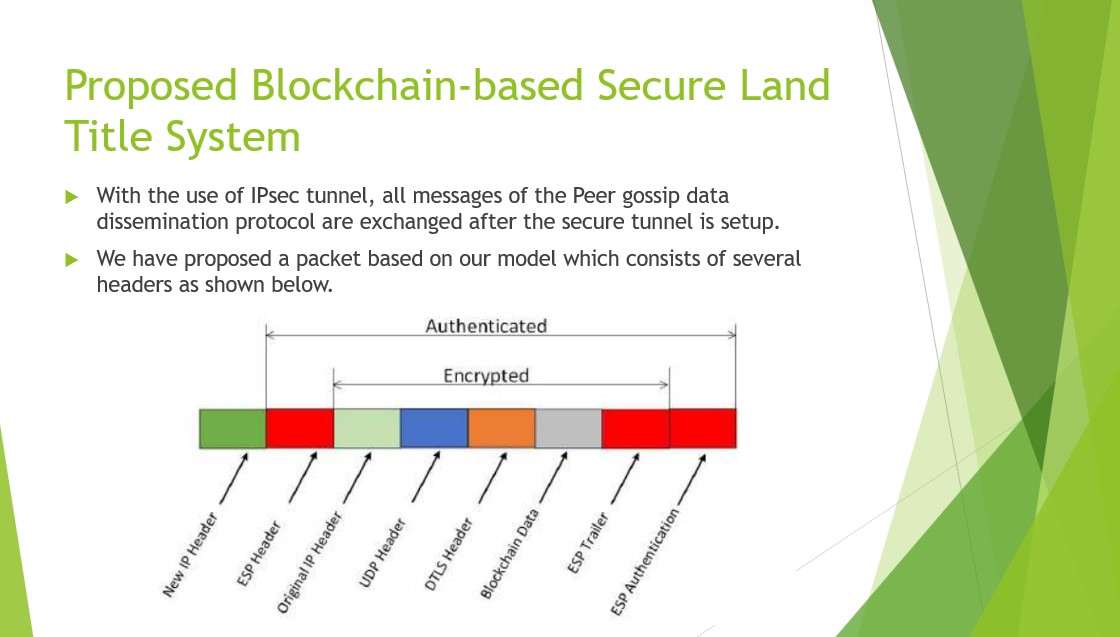 |
With the use of IPsec tunnel, all messages of the Peer gossip data dissemination protocol are exchanged after the secure tunnel is setup.
We have proposed a packet based on our model which consists of several headers as shown below.
|
|
ICACT20220037 Slide.14
[Big slide for presentation]
|
Chrome Text-to-Speach Click!! |
 |
As the blockchain messages are sent in a secure tunnel using the IPSec tunnel, they are less prone to routing attacks than the case when they are sent using the IP network.
The primary known attacks on the blockchain transactions that are focussed in this paper are delay and partition attacks.
These attacks result from intercepting the ASes path attribute and then changing or prepending AS number to the AS-Path attribute of the BGP protocol to change the traffic flow path.
As a result, the blockchain network is split into two parts, or the transactions are delayed, leading to double spending and other problems in the blockchain network.
For an attacker to attack the BGP routes, the information of the data part of the Blockchain transaction packet or the information of the source/destination IP addresses is crucial.
The other compromised parameter is the AS information of the nodes participating in the blockchain network,
|
|
ICACT20220037 Slide.13
[Big slide for presentation]
|
Chrome Text-to-Speach Click!! |
 |
We have implemented the proposed VPN-based blockchain network in a nested Virtual Machine (VM) environment based on EVE-NG, a clientless multivendor network emulation software.
The EVE-NG server has been setup on VMware Workstation 15 Player.
Each Peer of the proposed system behind the edge routers (LOC, REA, OS, DB, DI, and CA routers) is implemented in separate docker containers running on Ubuntu 18.04 VMs.
We have also emulated the client applications on a Windows 2007 VM. Thus, there are six Ubuntu 18.04 VMs and one Windows 2007 VM in our topology.
Each SP and all edge routers are running in separate Autonomous Systems (ASes). There are 12 AS which are connected to each other with eBGP neighbours. We have used full mech iBGP neighborship to connect routers inside an AS. This could be based on Route Reflector.
|
|
ICACT20220037 Slide.12
[Big slide for presentation]
|
Chrome Text-to-Speach Click!! |
 |
The proposed system consists of edge routers, namely: Local Estate Office (LOC) router, Real Estate Agent (REA) router, Financial Institution (FI) router, Developer/Builder (DB) router, Ordering Service (OS) router, and the Certificate Authority (CA) router.
All these edge routers are connected to the public Internet. We discussed the details of the Internet as a network of different service providers.
All these edge routers form full mesh IPSec links based on the channels (1,2,3).
The client applications could run on a mobile phone or a laptop peering with the rest of blockchain networks via SSL or DTLS link.
To implement the land title transfer system in Hyperledger Fabric, we have used NodeJS as a backend programming language
|
|
ICACT20220037 Slide.11
[Big slide for presentation]
|
Chrome Text-to-Speach Click!! |
 |
The third major component is the client-side applications which could be used by the seller, buyer, or any third-party solicitor (if any).
In addition to the blockchain elements, we have defined several channels which are used for communication.
The idea behind choosing several channels is to provide segregation and privacy.
For example, channel-1 connects seller, buyer, financial service, builder, and ordering service. This could be used for fund transfer in the case of a deal between the seller and buyer.
Channel-2 is used to connect the seller, buyer, solicitor, local state office, and ordering service. This may be used for signing the different forms which the state government provides
Channel-3 is used by the local state office, builder, real estate agent, and financial institute. This is used for the official coordination to comply with the rules.
|
|
ICACT20220037 Slide.10
[Big slide for presentation]
|
Chrome Text-to-Speach Click!! |
 |
The local state office is responsible for providing all the necessary documentation and forms.
The real estate agent or the broker coordinates all the deals and is usually the main point of contact for a seller/buyer.
The financial institution could be a bank or public/private financial entity that has provided a loan to the buyer.
There is also another entity involved in the case of a new home/property construction, which is the construction company known as a builder.
All these entities need to communicate with a certain entity which is called the Ordering Service. This could be anyone, but usually, it needs to be the state government.
The second component is the Certificate Authority (CA) who is responsible to authenticate all the other entities using a digital signature.
|
|
ICACT20220037 Slide.09
[Big slide for presentation]
|
Chrome Text-to-Speach Click!! |
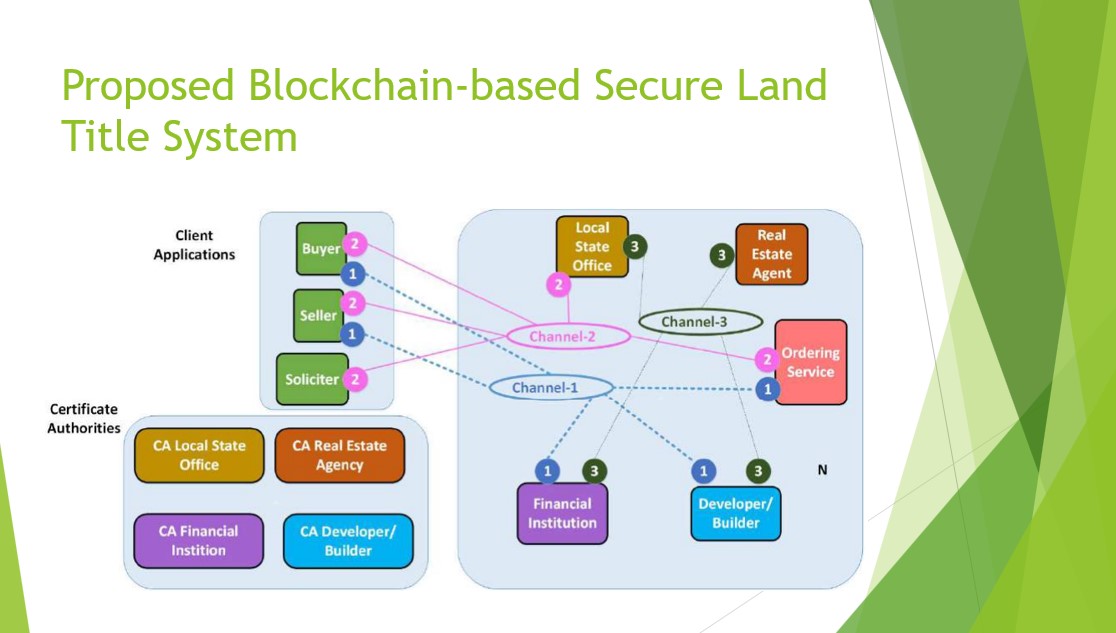 |
Architecture is explain in this diagram
|
|
ICACT20220037 Slide.08
[Big slide for presentation]
|
Chrome Text-to-Speach Click!! |
 |
We propose a distributed blockchain network system consisting of three major components: blockchain network, certificate authorities, and client applications
The major components of the proposed blockchain network N further consist of the participating stakeholders in land title transfer in the context of NSW.
These stakeholders are local state offices, real estate agents, financial institutions, developers/builders, and one or more ordering services.
These stakeholders can change from state to state or from one country to another depending on the process flow of the land title transfer system.
|
|
ICACT20220037 Slide.07
[Big slide for presentation]
|
Chrome Text-to-Speach Click!! |
 |
Virtual Private Networks (VPN) offer a secure data exchange over public network infrastructure.
There are several kinds of VPN available today to enable logical connections over the Internet.
The logical connection can be made at Layer 2, Layer 3, or Layer 4 of the OSI model
We focus on analysing the performance of a blockchain-based network over Layer 3 and Layer 4.
IPsec is a framework of open standards for ensuring private communications over public networks. It is fundamentally a collection of several protocols that assist in protecting communications over IP networks.
The basic components of the IPSec protocol suite are Encapsulating Security Payload (ESP), Authentication Header (AH), and Internet Key Exchange (IKE) protocols.
|
|
ICACT20220037 Slide.06
[Big slide for presentation]
|
Chrome Text-to-Speach Click!! |
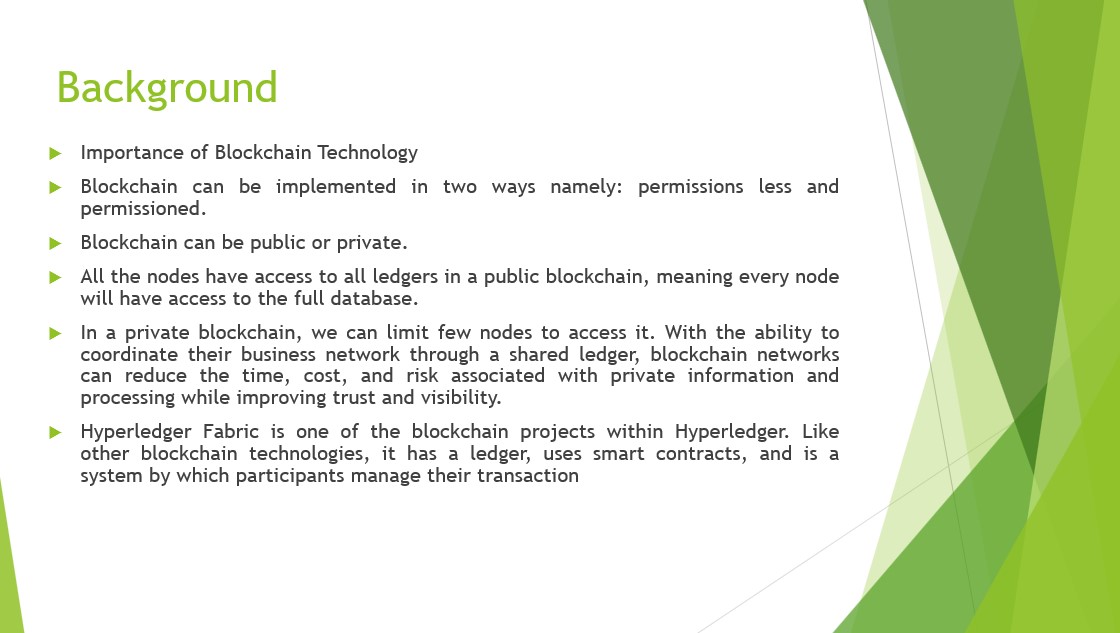 |
Importance of Blockchain Technology
Blockchain can be implemented in two ways namely: permissions less and permissioned.
Blockchain can be public or private.
All the nodes have access to all ledgers in a public blockchain, meaning every node will have access to the full database.
In a private blockchain, we can limit few nodes to access it. With the ability to coordinate their business network through a shared ledger, blockchain networks can reduce the time, cost, and risk associated with private information and processing while improving trust and visibility.
Hyperledger Fabric is one of the blockchain projects within Hyperledger. Like other blockchain technologies, it has a ledger, uses smart contracts, and is a system by which participants manage their transaction
|
|
ICACT20220037 Slide.05
[Big slide for presentation]
|
Chrome Text-to-Speach Click!! |
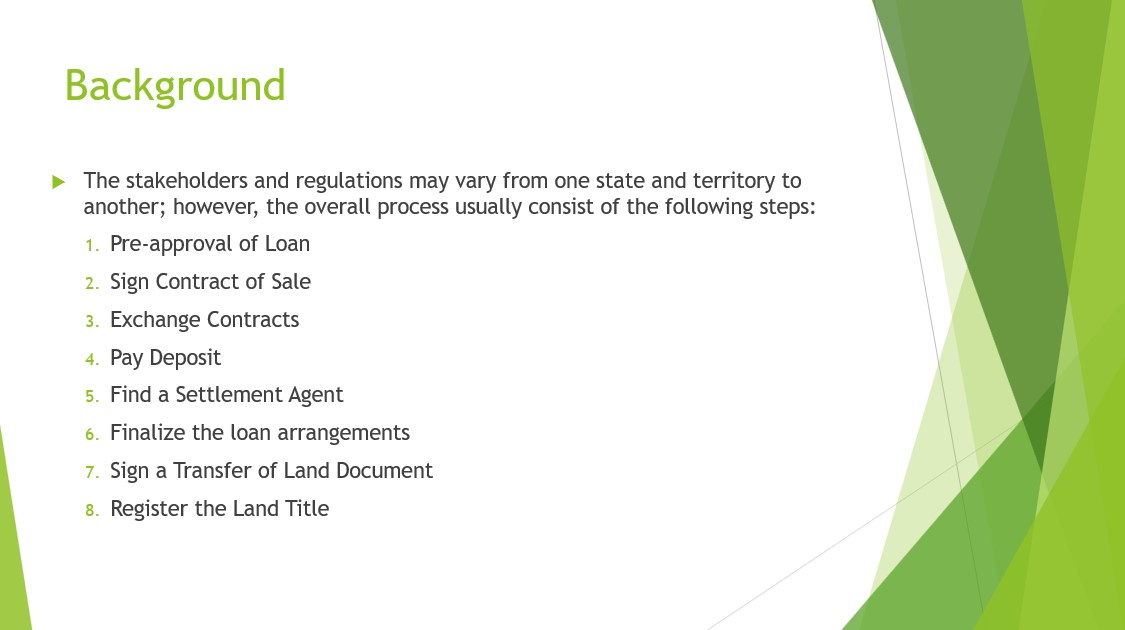 |
The stakeholders and regulations may vary from one state and territory to another; however, the overall process usually consist of the following steps:
Pre-approval of Loan
Sign Contract of Sale
Exchange Contracts
Pay Deposit
Find a Settlement Agent
Finalize the loan arrangements
Sign a Transfer of Land Document
Register the Land Title
|
|
ICACT20220037 Slide.04
[Big slide for presentation]
|
Chrome Text-to-Speach Click!! |
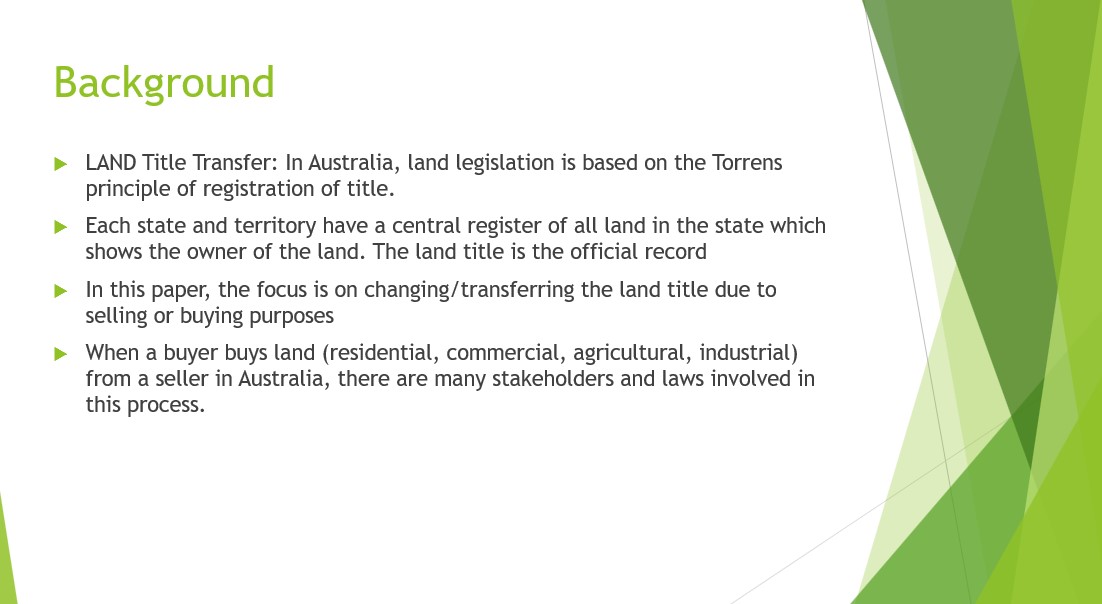 |
LAND Title Transfer: In Australia, land legislation is based on the Torrens principle of registration of title.
Each state and territory have a central register of all land in the state which shows the owner of the land. The land title is the official record
In this paper, the focus is on changing/transferring the land title due to selling or buying purposes
When a buyer buys land (residential, commercial, agricultural, industrial) from a seller in Australia, there are many stakeholders and laws involved in this process.
|
|
ICACT20220037 Slide.03
[Big slide for presentation]
|
Chrome Text-to-Speach Click!! |
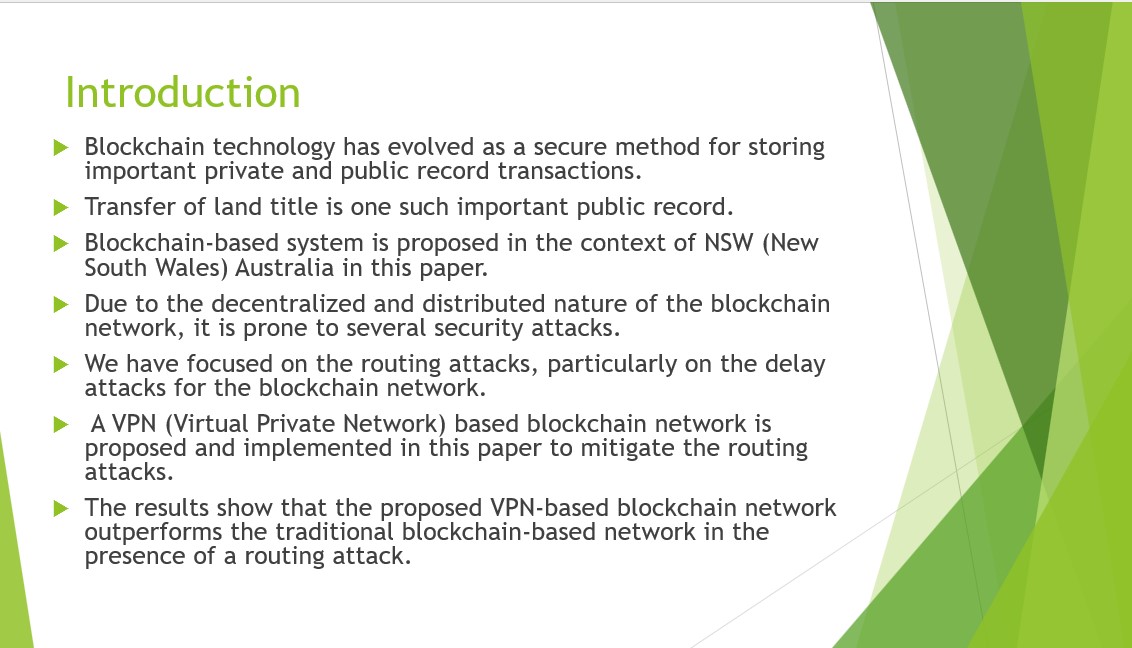 |
Blockchain technology has evolved as a secure method for storing important private and public record transactions.
Transfer of land title is one such important public record.
Blockchain-based system is proposed in the context of NSW (New South Wales) Australia in this paper.
Due to the decentralized and distributed nature of the blockchain network, it is prone to several security attacks.
We have focused on the routing attacks, particularly on the delay attacks for the blockchain network.
A VPN (Virtual Private Network) based blockchain network is proposed and implemented in this paper to mitigate the routing attacks.
The results show that the proposed VPN-based blockchain network outperforms the traditional blockchain-based network in the presence of a routing attack.
|
|
ICACT20220037 Slide.02
[Big slide for presentation]
|
Chrome Text-to-Speach Click!! |
 |
Introduction
Background
Proposed Blockchain-based Secure Land Title System
Results and Discussions
Conclusion
Q and A
|
|
ICACT20220037 Slide.01
[Big slide for presentation]
|
Chrome Text-to-Speach Click!! |
 |
We propose a distributed blockchain network system consisting of three major components: blockchain network, certificate authorities, and client applications
The major components of the proposed blockchain network N further consist of the participating stakeholders in land title transfer in the context of NSW.
These stakeholders are local state offices, real estate agents, financial institutions, developers/builders, and one or more ordering services.
These stakeholders can change from state to state or from one country to another depending on the process flow of the land title transfer system.
|
















