 ICACT20220402 Slide.22
[Big slide for presentation]
[YouTube] |
Chrome Text-to-Speach Click!! |
 |
Thank you, and stay safe.
|
|
ICACT20220402 Slide.21
[Big slide for presentation]
[YouTube] |
Chrome Text-to-Speach Click!! |
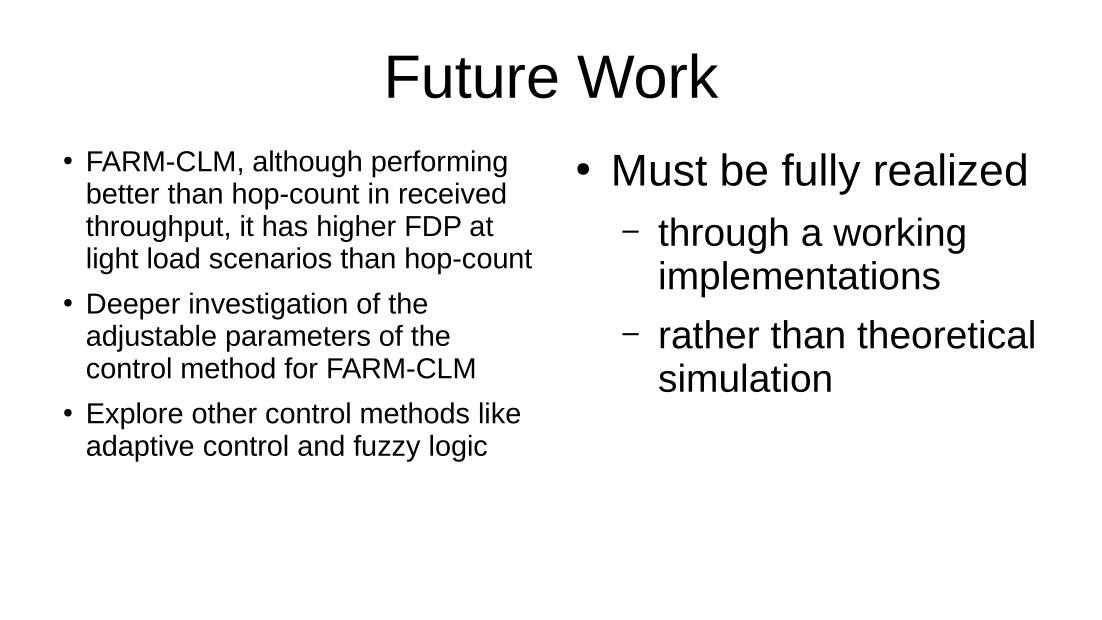 |
Despite having better overall network throughput than hop-count, it has significantly higher FDP at light load scenarios. That is, despite the achieved level of stability, FARM-CLM routes still oscillates in the absence of interfering traffic and there is enough space to maneuver across the network. For this reason, part of an interesting future work includes a deeper investigation of the adjustable parameters of the control method for FARM-CLM and an exploration of other control methods like adaptive control and fuzzy logic.
Ultimately our system must be fully realized through a working implementation rather than theoretical simulation.
|
|
ICACT20220402 Slide.20
[Big slide for presentation]
[YouTube] |
Chrome Text-to-Speach Click!! |
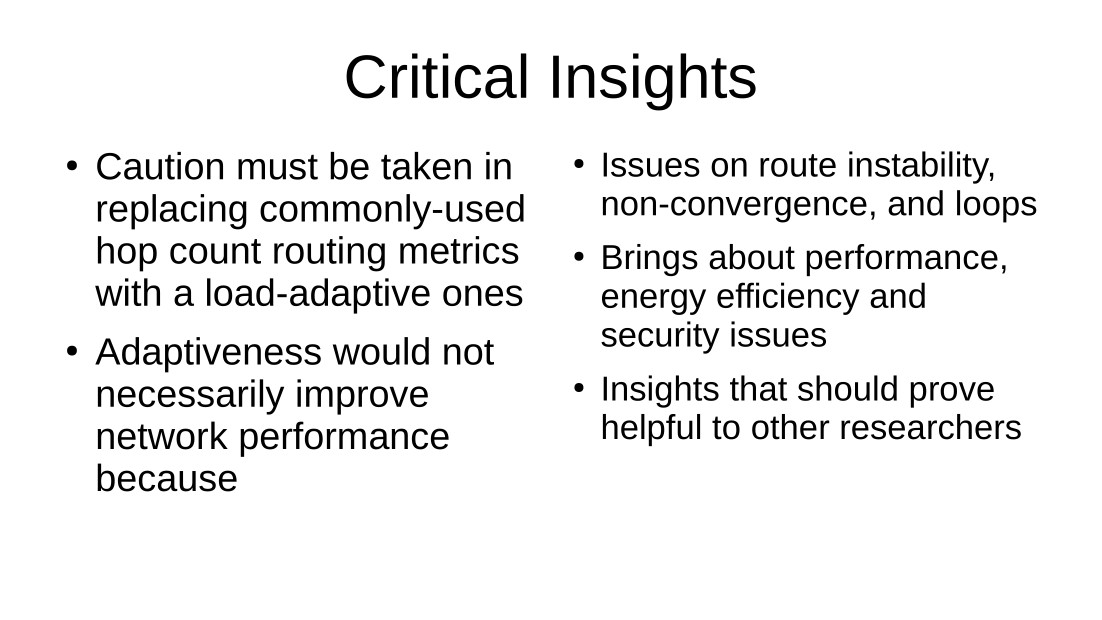 |
Caution must be taken in replacing the commonly-used hop count routing metrics with load-adaptive ones; adaptiveness would not necessarily improve network performance because of issues on route instability, non-convergence, and loops. These issues bring down network performance significantly in terms of throughput, packet delay, energy efficiency and security.
To the best of our knowledge these insights have not been reported in the literature and should prove helpful to other researchers
|
|
ICACT20220402 Slide.19
[Big slide for presentation]
[YouTube] |
Chrome Text-to-Speach Click!! |
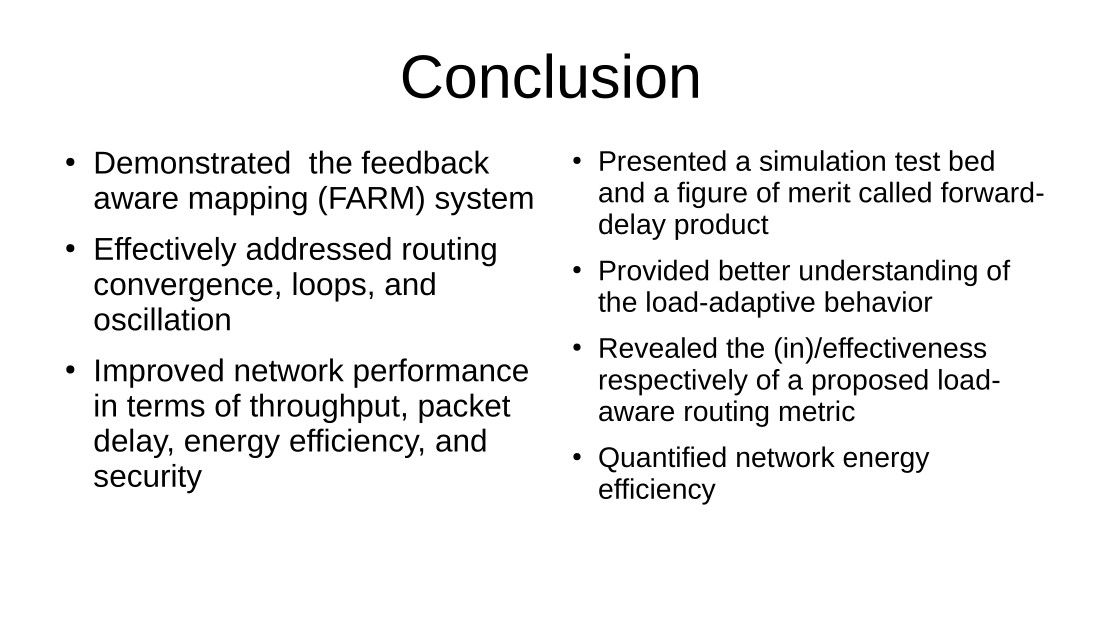 |
In conclusion, we presented our contributions. The feedback aware mapping (FARM) system effectively addresses routing convergence, loops, and oscillation.
Accordingly, it improves network performance in terms of throughput, packet delay, energy efficiency, and security
We also presented a simulation test bed to better understand load-adaptive routing (in)stabilities. It can reveal the ineffectiveness or effectiveness of a proposed load-aware routing metric.
To quantify better the stability and energy efficiency of a proposed load-aware routing metric we presented the forward-delay product (FDP).
|
|
ICACT20220402 Slide.18
[Big slide for presentation]
[YouTube] |
Chrome Text-to-Speach Click!! |
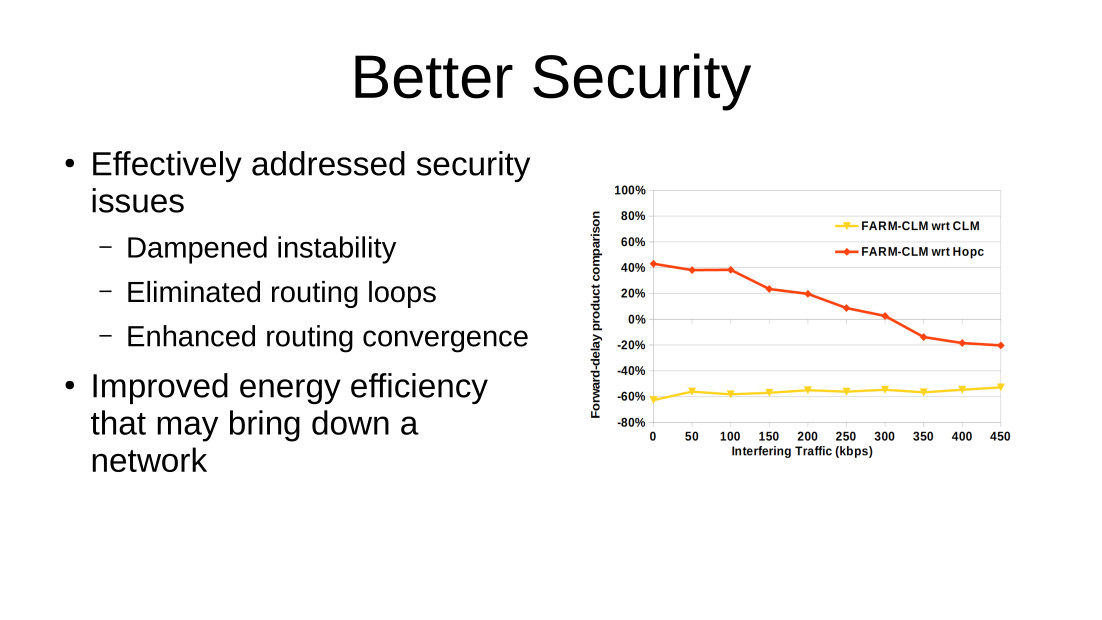 |
With routing loops eliminated and routing convergence improved, both energy efficiency and better security are addressed enough.
FARM effectively eliminated wild route flapping and tremendous energy use in forwarding packets. Consequently, the tendency of the network to drain itself more than usual has been solved.
|
|
ICACT20220402 Slide.17
[Big slide for presentation]
[YouTube] |
Chrome Text-to-Speach Click!! |
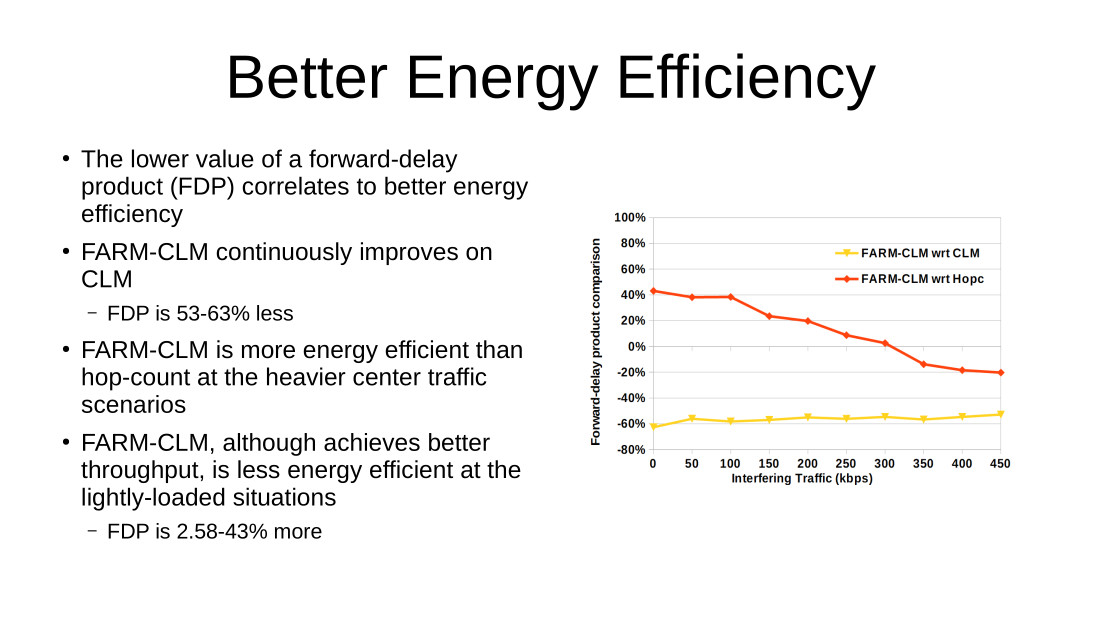 |
In terms of energy efficiency, the figure shows that FARM-CLM continuously improves on CLM, 53-63% less FDP. Recall that the lower value of a forward-delay product correlates to better energy efficiency.
However, with respect to hop-count based routing, FARM-CLM advantages appear only at the heavier center traffic scenarios and has longer packet delay at the lightly-loaded center traffic situations.
This behavior is due to the reason as mentioned previously. That is, first, it forwarded more packets in longer paths.
|
|
ICACT20220402 Slide.16
[Big slide for presentation]
[YouTube] |
Chrome Text-to-Speach Click!! |
 |
With the feedback-aware routing mechanism (FARM), the routing algorithm achieved better network performance.
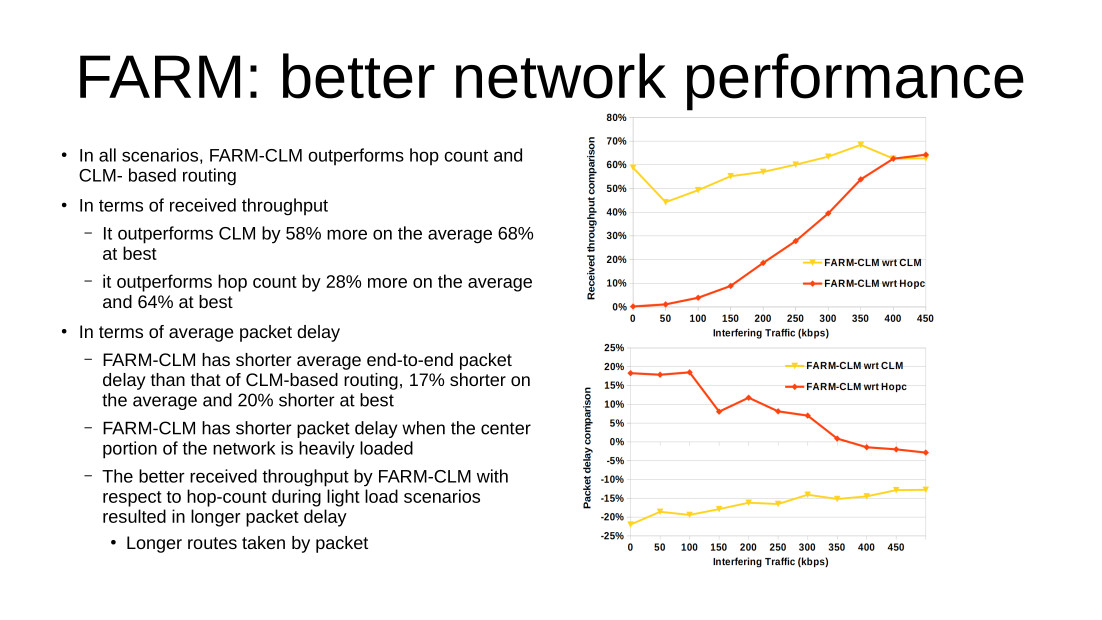
In all scenarios, FARM enhanced CLM (FARM-CLM) outperforms hop count and CLM- based routing.
In terms of received throughput, it outperforms hop count by 28% more on the average and 64% at best. It outperforms CLM by 58% more on the average 68% at best.
In terms of average packet delay FARM-CLM has shorter average end-to-end packet delay than that of CLM-based routing, 22% at best and 13% shorter at the least
However, in terms of average end-to-end packet delay, FARM-CLM outperforms hop count only in the presence of enough interfering traffic in the network. This situation is due to the fact that the interfering traffic is not heavy enough to bother the main traffic and the network is wide enough for routes to maneuver around taking longer path.
FARM-CLM-based routing achieves better throughput at the expense of more delay and less energy efficiency. The reasons for this behavior are, first, it has higher throughput taking longer paths. Second, the busy region does not generate enough collisions and retransmissions for hop-count based routing to cause packet delay longer than the packet delay incurred using FARM-CLM.
|
|
ICACT20220402 Slide.15
[Big slide for presentation]
[YouTube] |
Chrome Text-to-Speach Click!! |
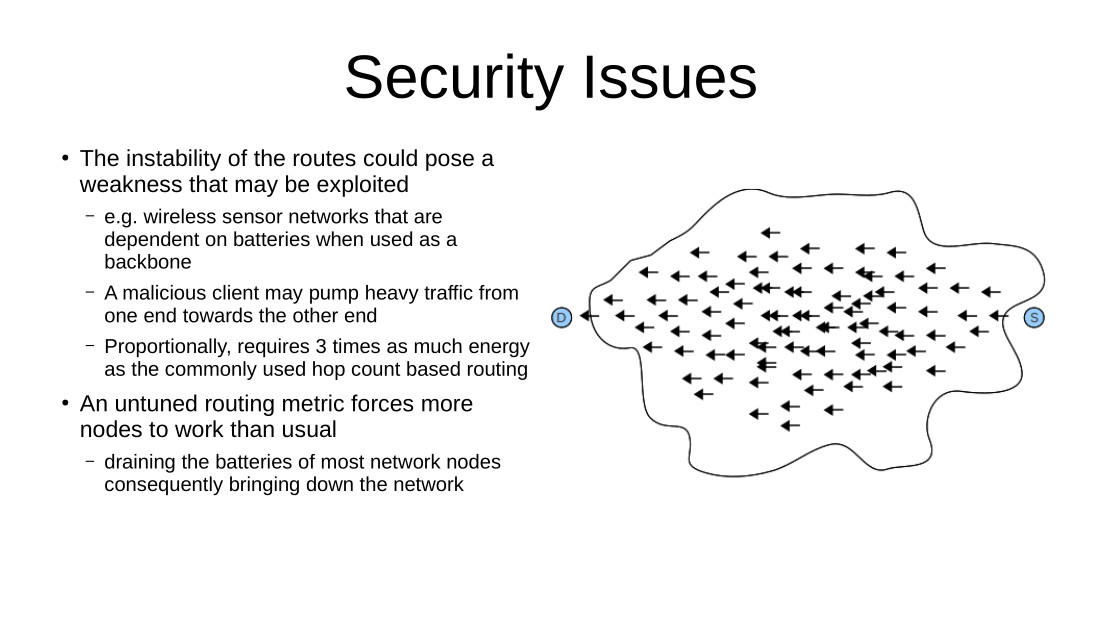 |
In a wireless mesh network that are composed of nodes with limited supply of power, like in wireless sensor networks, the instability of the routes could pose a weakness that may be exploited by rouge nodes. In case the wireless network is used as a backbone network where the clients are only connected at the edge nodes (see illustration), a malicious client may pump heavy traffic from one end of the network towards the other end. Considering the 0-kbps interfering traffic scenario where an untuned load-aware routing metric CLM spread 283% times traffic across the network. Proportionally, this amount of traffic requires 3 times as much energy as hop count based routing. This tendency forces more nodes to work than usual, eventually draining the batteries of most network nodes, potentially bringing down the network.
|
|
ICACT20220402 Slide.14
[Big slide for presentation]
[YouTube] |
Chrome Text-to-Speach Click!! |
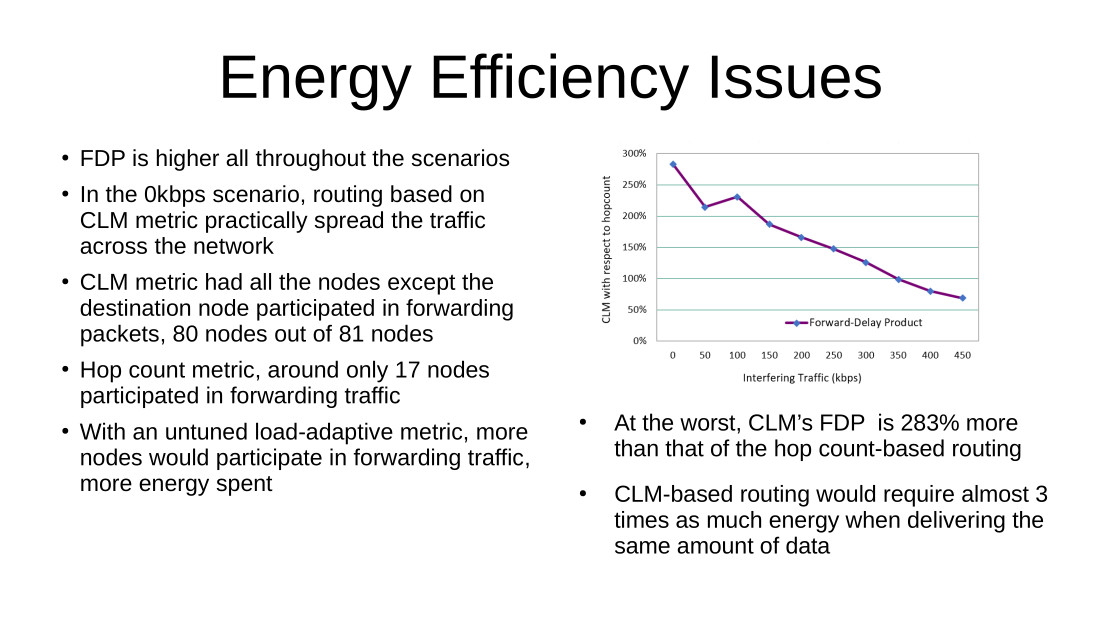 |
To better quantify the energy efficiency and stability of a proposed routing metric or scheme, we use FDP. FDP gives the amount of data that will be in transit in the network to move the same amount of input across the network. On the average, the forward-delay product of CLM is 283 percent more than that of the hop count-based routing. This means, to get across the same input traffic, proportionally CLM-based routing would require almost 3 times as much work or energy.
|
|
ICACT20220402 Slide.13
[Big slide for presentation]
[YouTube] |
Chrome Text-to-Speach Click!! |
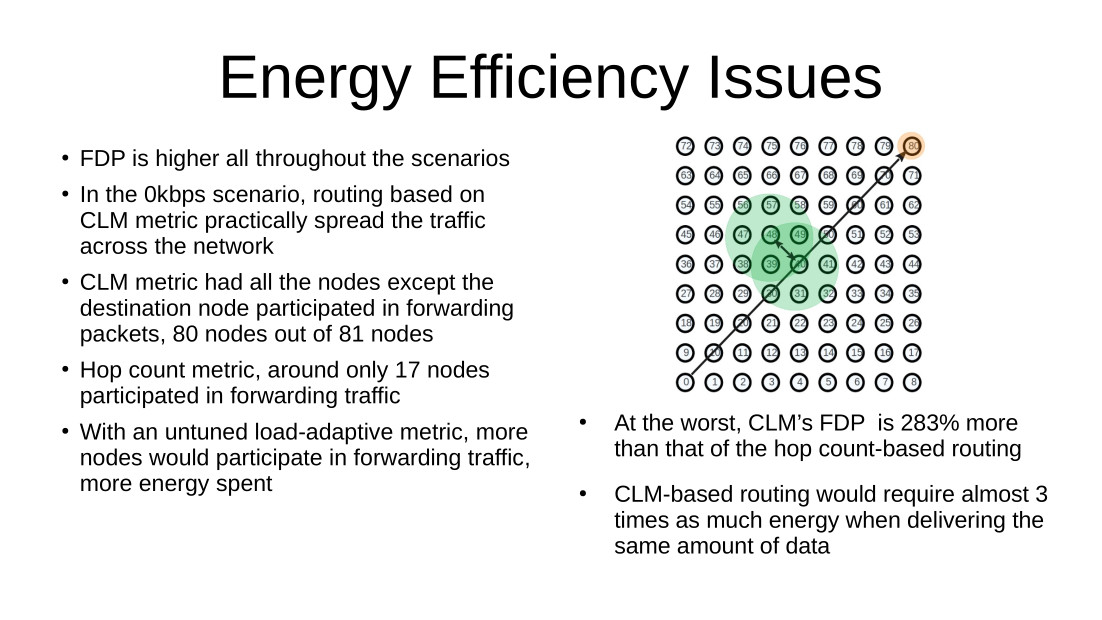 |
Although our target mesh network have nodes with stable source of power, the results of the experiment can be used to show how an untuned load-aware and adaptive routing metric could pose serious problems to wireless networks that are power limited like wireless sensor networks. When the routing instability and oscillation is severe enough, more mesh nodes will participate in forwarding packets than what is necessary.
As an illustration, in the 0kbps scenario, where the interfering traffic was non-existent, simulations results show that routing based on CLM metric practically spread the traffic across the network. On the average, the scenario that used CLM metric had all the nodes except the destination node participated in forwarding packets, 80 nodes out of 81 nodes. While the scenario that used hop count metric, around only 17 nodes participated in forwarding traffic, i.e., the nodes along the diagonal path from node 0 to node 80.
|
|
ICACT20220402 Slide.12
[Big slide for presentation]
[YouTube] |
Chrome Text-to-Speach Click!! |
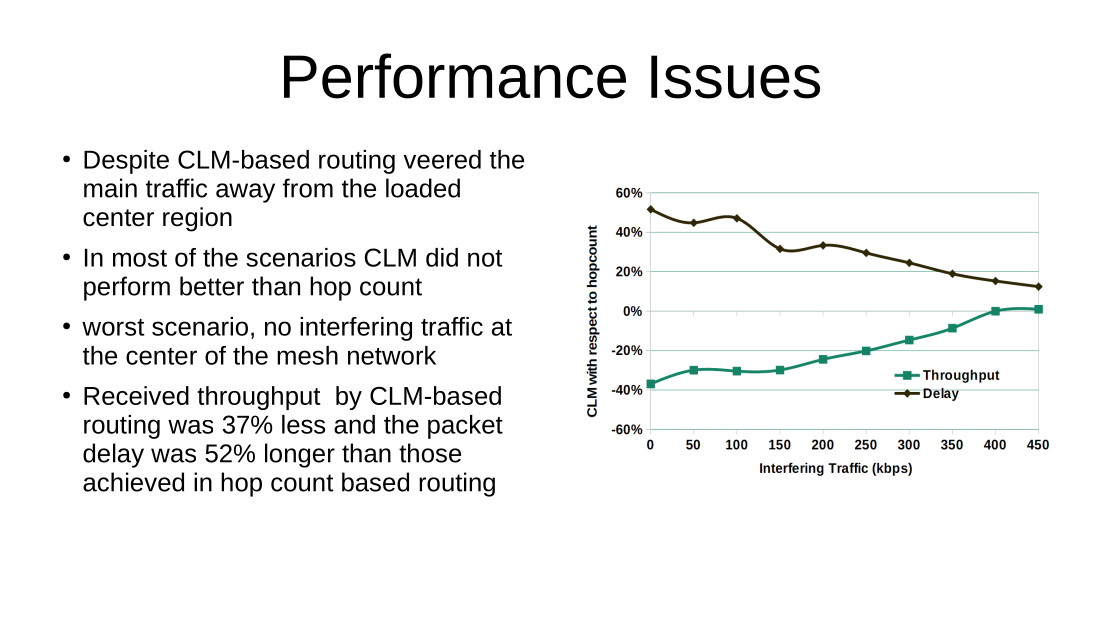 |
The worst scenario was when there was no interfering traffic at the center of the mesh network.
Received throughput by CLM-based routing was 37% less and the packet delay was 52% longer than those achieved in hop count based routing.
|
|
ICACT20220402 Slide.11
[Big slide for presentation]
[YouTube] |
Chrome Text-to-Speach Click!! |
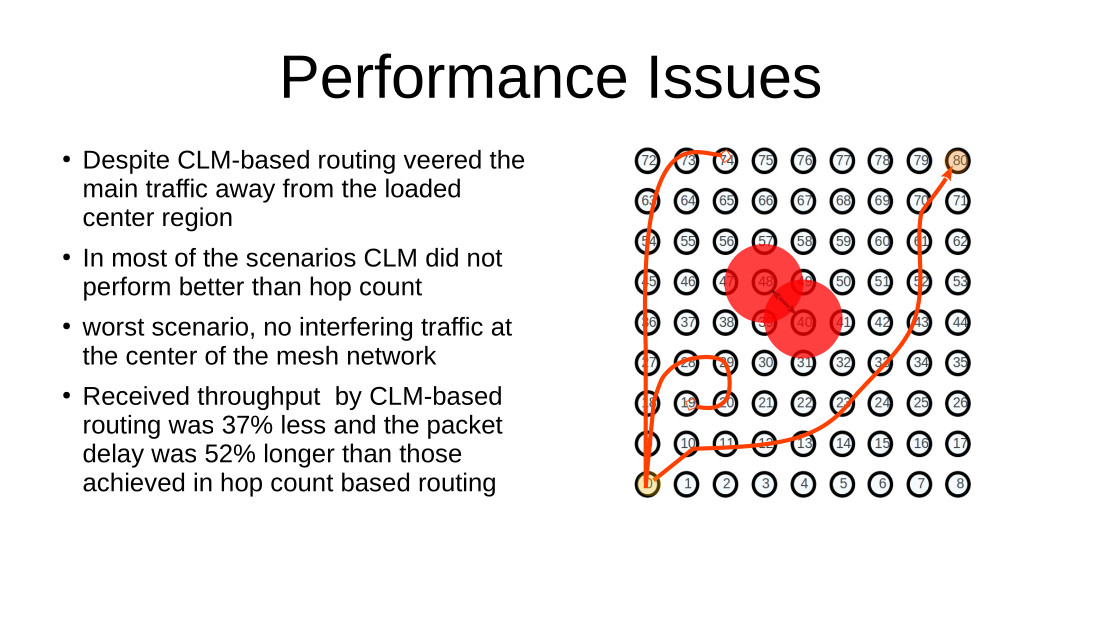 |
Despite veering the main traffic away from the loaded center region, in most of the scenarios CLM did not perform better than hop count. The worst scenario was when there was no interfering traffic at the center of the mesh network. CLM-based routing violently oscillated, created a lot of routing loops, and had difficulty converging in its route computations.
The routes behaved this way because of the zero or near-zero load weights for idle regions. In this case, when a node sent traffic towards a particular destination, the channel load weights of the regions along the path was relatively much greater than the zero or near-zero load weights of the idle regions. Consequently, the idle regions became better paths. The cost of the paths through the idle regions remained better, even if the route went back and forth in a loop within a set of nodes, than the cost of the path where the current traffic was traversing. Had the cost of each hop not been negligible in comparison with the path being traversed by the traffic flow, each cycle of the loop would have been more expensive in the computation of the path cost and another less cost path with less or no loop would have been found.
|
|
ICACT20220402 Slide.10
[Big slide for presentation]
[YouTube] |
Chrome Text-to-Speach Click!! |
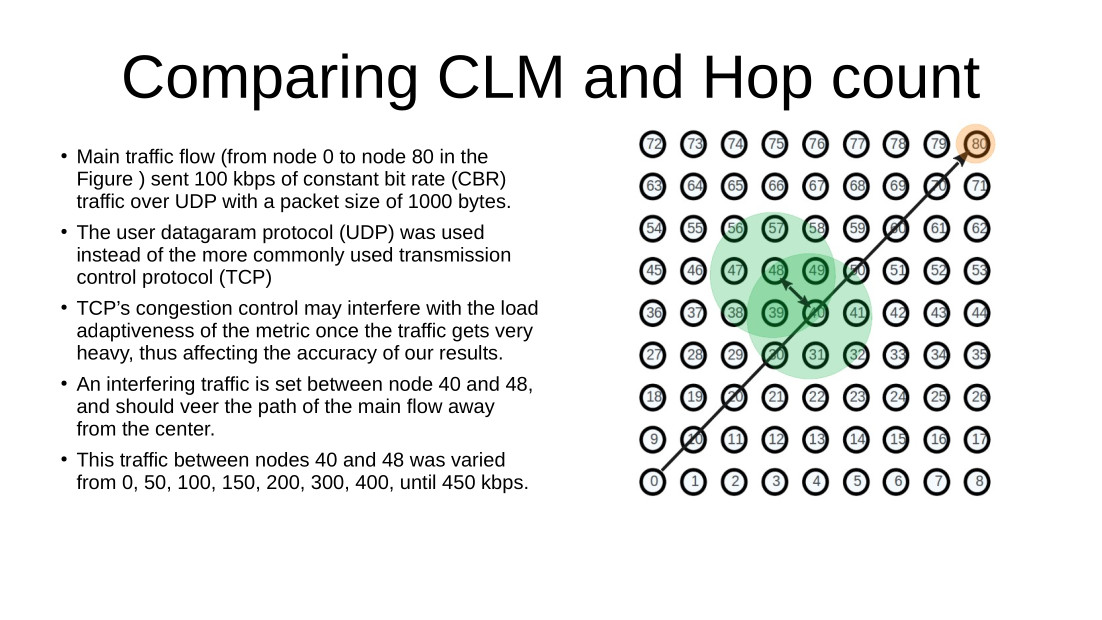 |
Our experiment specifically tested how a load-aware metric, called channel load metric or CLM, directed traffic across the network in the presence and absence of congested regions compared to the commonly used hop count based routing metrics.
To avoid the effects of performance anomalies exhibited by IEEE 802.11 devices in the presence of other wireless devices operating at different nominal bit rates all wireless nodes were set to operate at the basic rate of 1Mbps where routing and topology control packets are also transmitted. We also set the distance between devices such that the transmission range is within single hop.
The main traffic flow (from node 0 to node 80 in the Figure) sent 100 kbps of constant bit rate (CBR) traffic over UDP with a packet size of 1000 bytes. The user datagaram protocol (UDP) was used instead of the transmission control protocol (TCP). TCP’s congestion control may interfere with the load adaptiveness of the metric once the traffic gets very heavy, thus affecting the accuracy of our results.
Finally, an interfering traffic is set between node 40 and 48, and should veer the path of the main flow away from the center. This traffic between nodes 40 and 48 in the Figure varied from 0, 50, 100, 150, 200, 300, 400, until 450 kbps.
|
|
ICACT20220402 Slide.09
[Big slide for presentation]
[YouTube] |
Chrome Text-to-Speach Click!! |
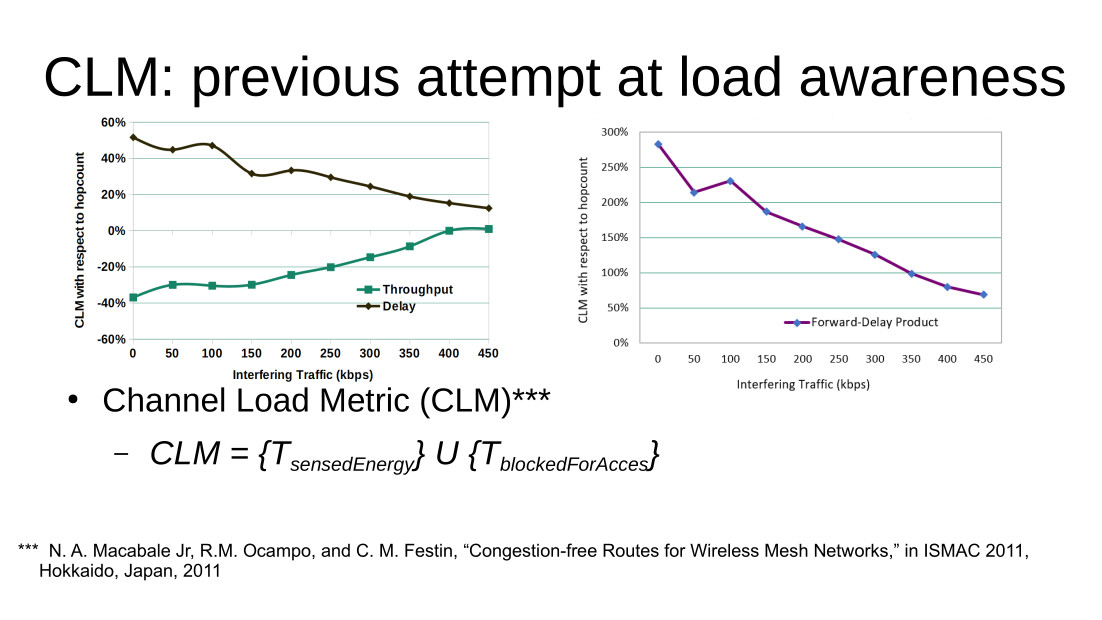 |
In a previous work, the channel load was well defined as any of those contributing event that hinders transmission.
Like when an energy is present in the channel that prevents a wireless node from transmitting packet,
or when the node concerned is blocked to access the channel like due to back-off algorithms similar to those in the distributed communication function of the 802.11 technology.
|
|
ICACT20220402 Slide.08
[Big slide for presentation]
[YouTube] |
Chrome Text-to-Speach Click!! |
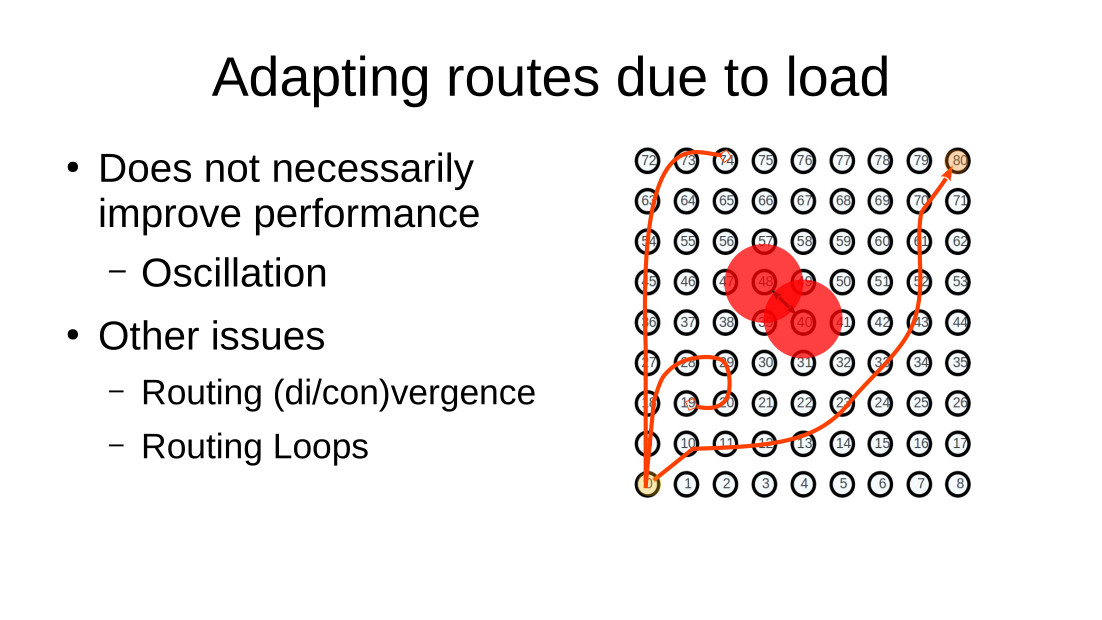 |
However, load adaptation approaches do not necessarily improve network performance because the load estimates used to choose routes are themselves affected by the resulting routing changes resulting to oscillation.
Although this is not a new phenomenon and has been studied in wired networks, it has not been investigated extensively in wireless mesh and sensor networks.
Our investigations show other instabilities in wireless mesh networks such as security and energy issues that are not present in wired networks.
To the best of our knowledge, these issues have not been reported in the literature and should prove useful n the research community.
|
|
ICACT20220402 Slide.07
[Big slide for presentation]
[YouTube] |
Chrome Text-to-Speach Click!! |
 |
Despite advances in the field, current routing metrics, such as hop counts, used for routing in wireless mesh networks unfortunately will not be able to scale up to the projected sizes of large community mesh networks and sensor networks.
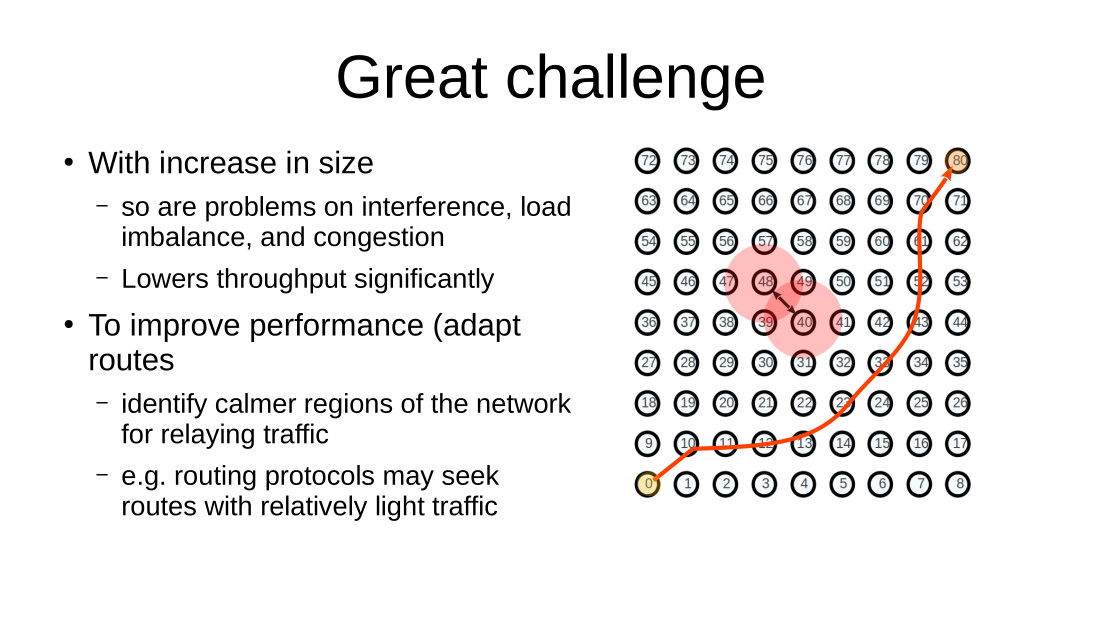
With increase in size, so are challenges such as interference, contention, load imbalance, and congestion. As load increases and congestion builds up, network throughput decreases significantly.
To address these issues, previous work employed load adaptive routing based on load sensitive and adpative routing metrics.
Packets are routed along the calmer regions of the network to improve network performance.
|
|
ICACT20220402 Slide.06
[Big slide for presentation]
[YouTube] |
Chrome Text-to-Speach Click!! |
 |
Wireless mesh networks are increasingly deployed as a flexible and low-cost alternative for providing wireless services for a variety of applications including community mesh networking, medical applications, and disaster ad hoc communications, transportation, sensor and IoT applications.
|
|
ICACT20220402 Slide.05
[Big slide for presentation]
[YouTube] |
Chrome Text-to-Speach Click!! |
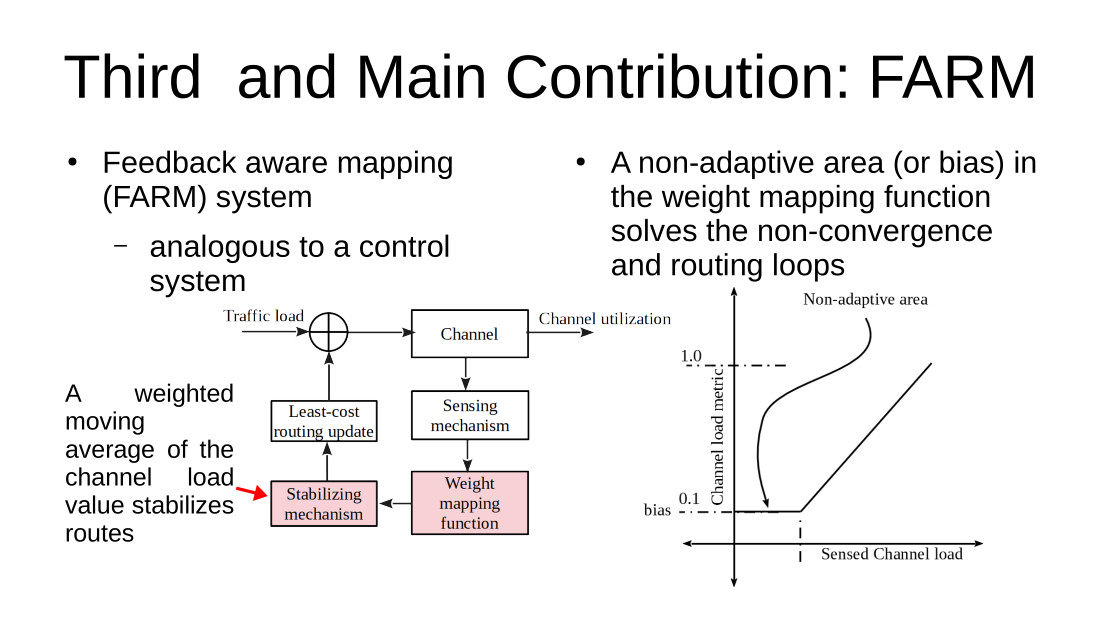 |
Our third and main contribution, the feedback aware mapping (FARM) system. It handles the routing instabilities in a manner analogous to a control system with feedback control.
First, A non-adaptive area (or bias) in the weight mapping function solves the non-convergence and routing loops.
Second, a weighted moving average of the channel load value stabilizes crippling route oscillation, flapping, and sudden changes in channel load.
|
|
ICACT20220402 Slide.04
[Big slide for presentation]
[YouTube] |
Chrome Text-to-Speach Click!! |
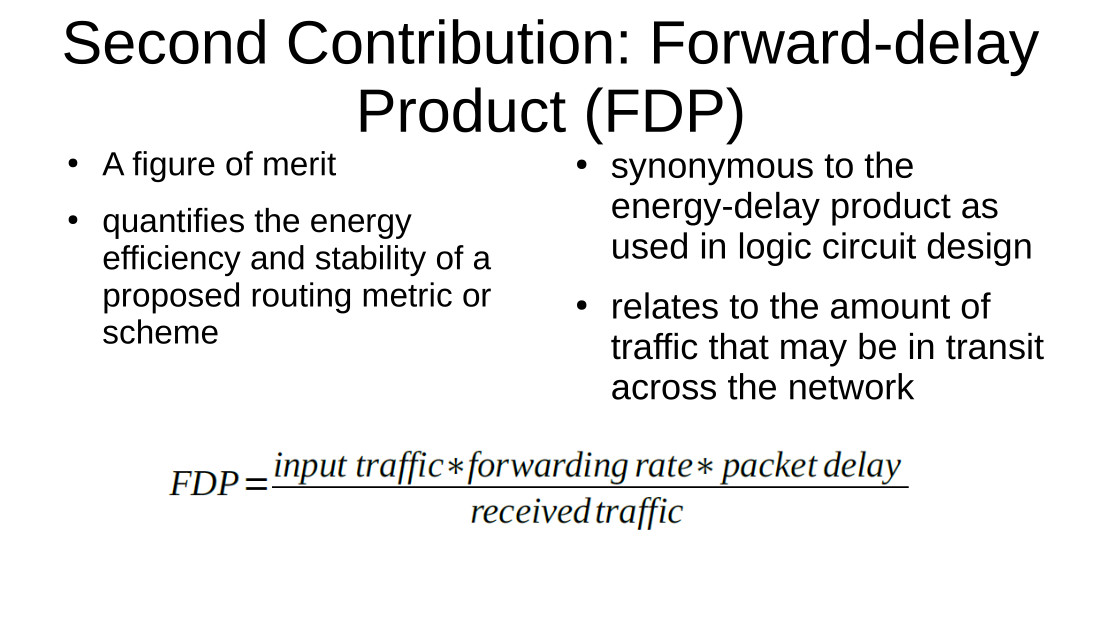 |
Our second contribution, the forward-delay product (FDP) relates to the amount of traffic that may be in transit across the network, and whose value could be huge should routes oscillates badly. This metric should come handy when comparing energy efficiency and stability of different load-adaptive routing schemes in wireless mesh networks.
Although it sounds like the bandwidth-delay product in computer networks, it’s more synonymous to the energy-delay product as used in logic circuit design
|
|
ICACT20220402 Slide.03
[Big slide for presentation]
[YouTube] |
Chrome Text-to-Speach Click!! |
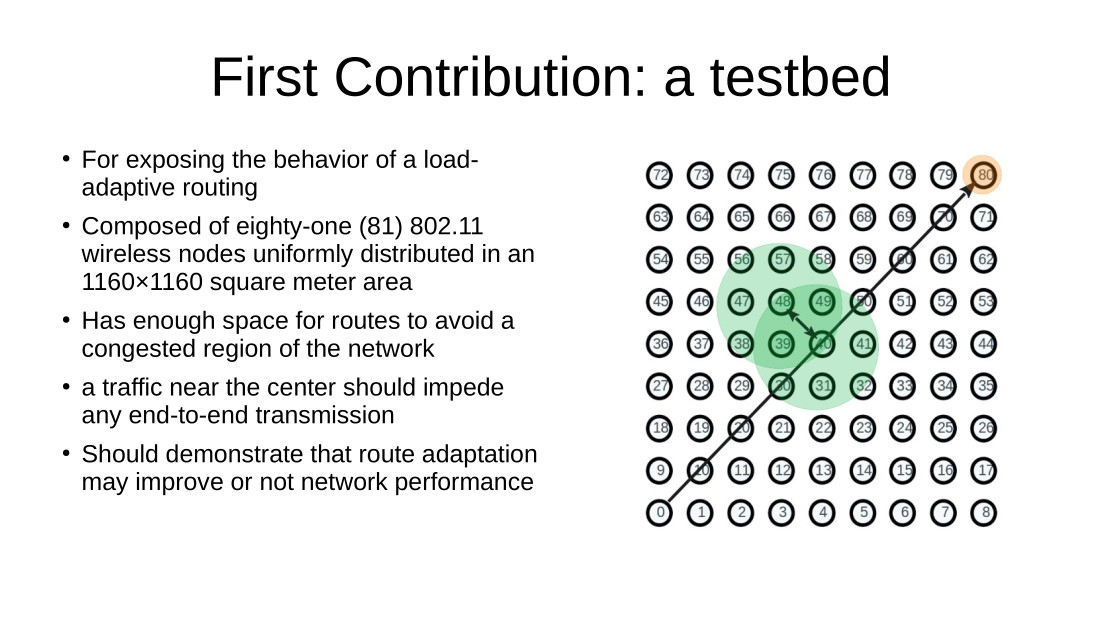 |
Our first contribution is the simulation testbed to expose the behavior of a load-adaptive routing based on a proposed routing metric. we designed a simulation test bed, composed of eighty-one (81) 802.11 wireless nodes uniformly distributed in a 1160×1160 square meter area.
Although in reality, wireless nodes are randomly placed, the uniform distribution covered all regions of the topology. If random distribution is used, some regions may not be available as routes, and routing may just default to the commonly used hop-count, and no adaptation can be demonstrated.
The size of the mesh network, on the same hand, provides enough space for routes to avoid a congested or loaded region of the network, thus demonstrating route adaptation.
|
|
ICACT20220402 Slide.02
[Big slide for presentation]
[YouTube] |
Chrome Text-to-Speach Click!! |
 |
I’ll start with our work’s contribution.
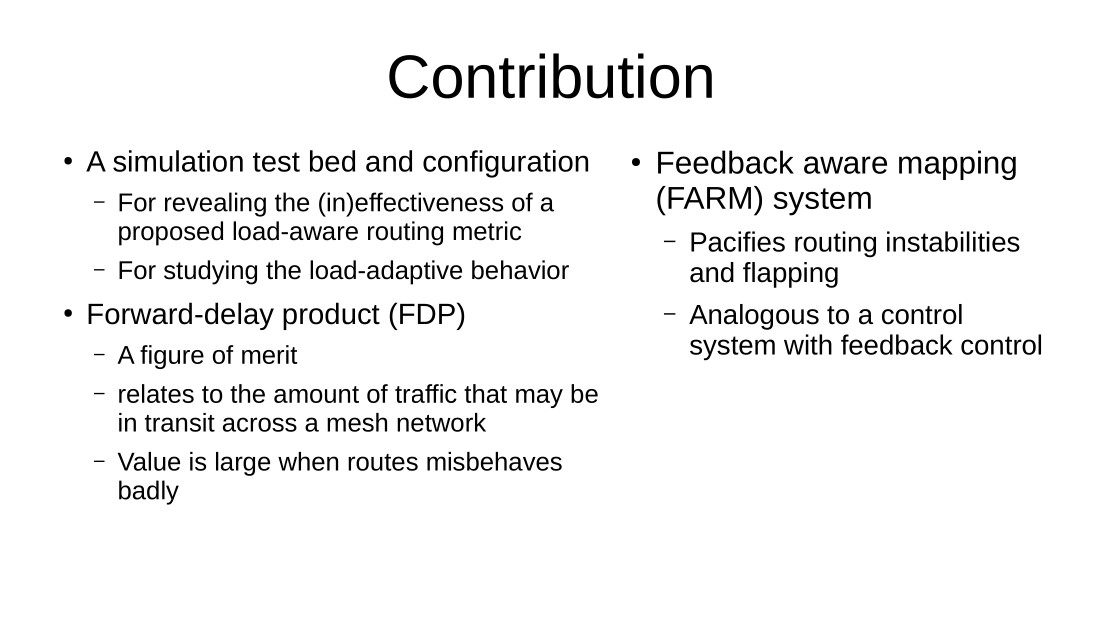
First is the simulation set-up and configuration where we could look closely at the load-adaptive behavior of a proposed load-aware routing metric. This set-up is designed to reveal the effectiveness or ineffectiveness of a proposed metric.
Second is the forward-delay product (FDP). Load-aware and adaptive routing metrics have been proposed; we need a figure of merit that we can use to measure and compare the degree of instability of load-adaptive routing. FDP is handy for these kind of cases. It relates to the amount of traffic that may be generated across a mesh network. Its value increases as routes misbehaves badly.
Finally, the third is the feedback aware mapping (FARM) system that pacifies the routing instabilities and flapping. It is analogous to a control system with feedback control.
|
|
ICACT20220402 Slide.01
[Big slide for presentation]
[YouTube] |
Chrome Text-to-Speach Click!! |
 |
Hello everybody, I am Nemesio A. Macabale Jr. They call me Jojo for short. I am pleased to present our work here in ICACT 2022.
This presentation is about the stability issues of load adaptive routing over wireless mesh and sensor networks.
|
















