 ICACT20230047 Slide.17
[Big slide for presentation]
[YouTube] |
Chrome Text-to-Speach Click!! |
 |
That's all for my presentation. If you have any questions please feel free to contact me, thank you!
|
|
ICACT20230047 Slide.16
[Big slide for presentation]
[YouTube] |
Chrome Text-to-Speach Click!! |
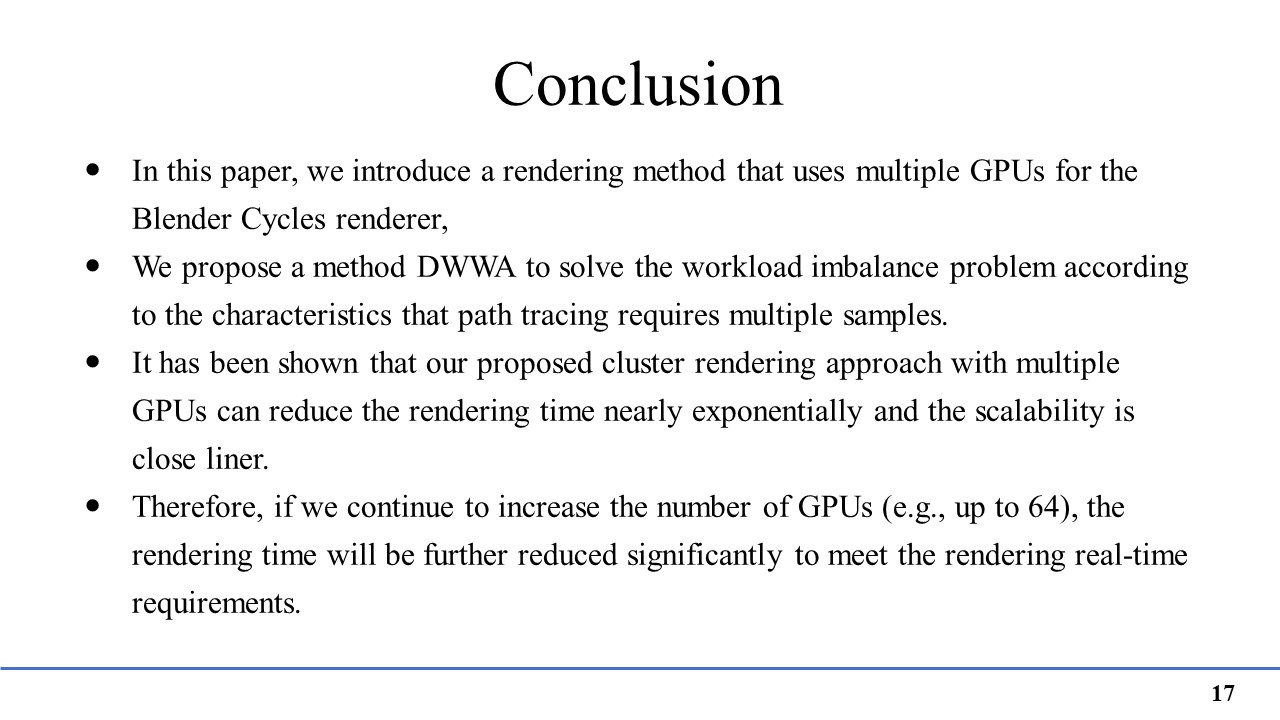 |
In this paper, we introduce a rendering method that uses multiple GPUs for the Blender Cycles renderer, and propose a method DWWA to solve the workload imbalance problem according to the characteristics that path tracing requires multiple samples. It has been shown that our proposed cluster rendering approach with multiple GPUs can reduce the rendering time nearly exponentially and the scalability is close liner. Therefore, if we continue to increase the number of GPUs (e.g., up to 64), the rendering time will be further reduced significantly to meet the rendering real-time requirements.
|
|
ICACT20230047 Slide.15
[Big slide for presentation]
[YouTube] |
Chrome Text-to-Speach Click!! |
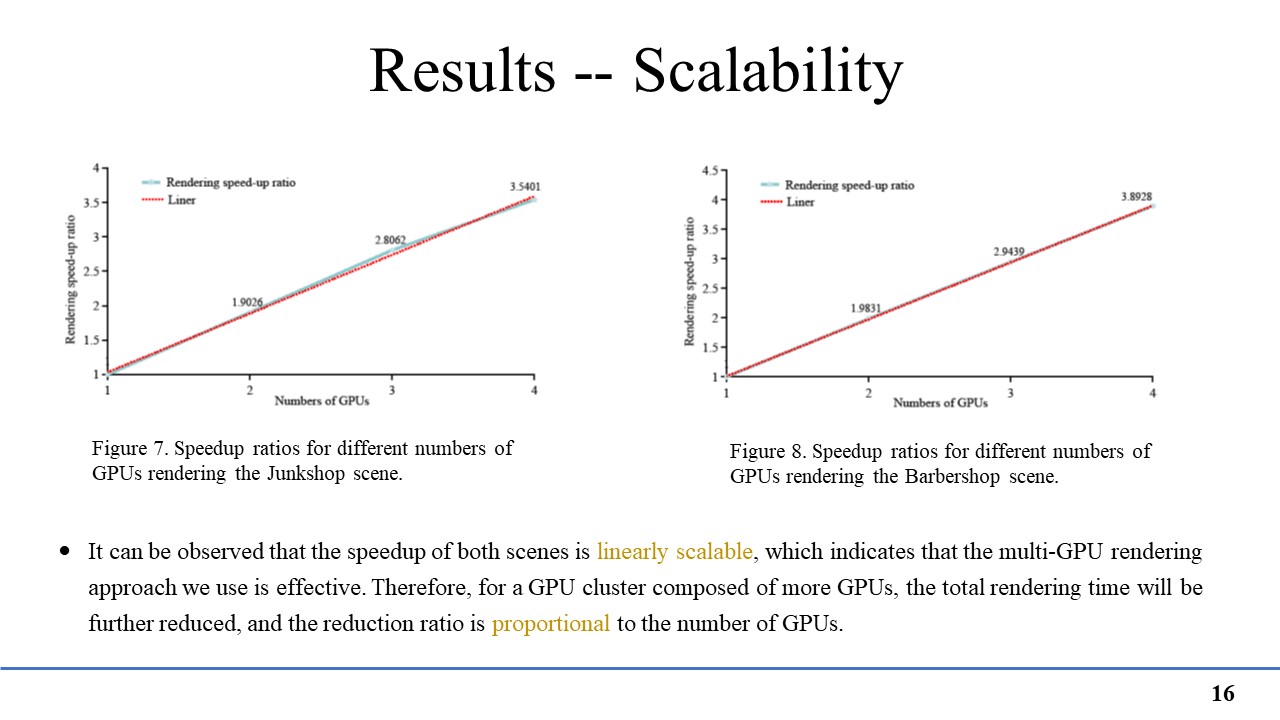 |
It can be observed that the speedup of both scenes is linearly scalable, which indicates that the multi-GPU rendering approach we use is effective. Therefore, for a GPU cluster composed of more GPUs, the total rendering time will be further reduced, and the reduction ratio is proportional to the number of GPUs.
|
|
ICACT20230047 Slide.14
[Big slide for presentation]
[YouTube] |
Chrome Text-to-Speach Click!! |
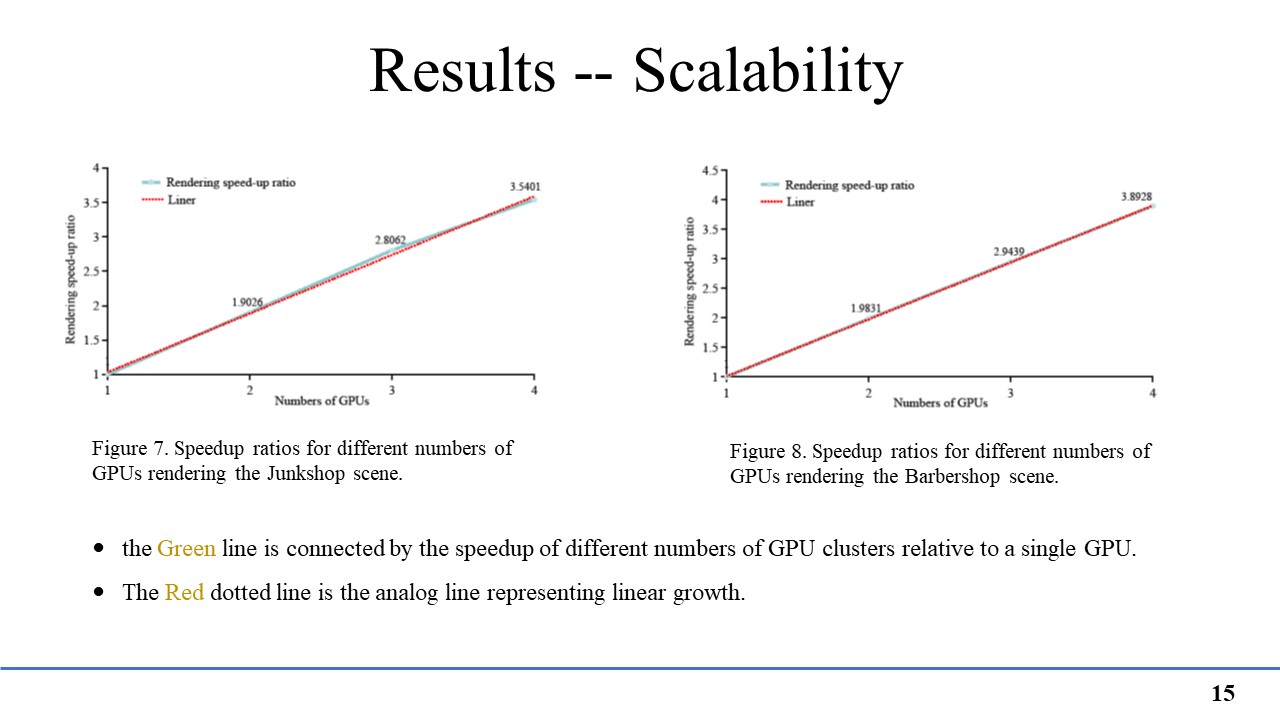 |
Figure 7,8 shows the speedup ratios for different numbers of GPUs rendering the Junkshop and Barbershop scenes respectively.
In both figures, the Green line is connected by the speedup of different numbers of GPU clusters relative to a single GPU.
The Red dotted line is the analog line representing linear growth.
|
|
ICACT20230047 Slide.13
[Big slide for presentation]
[YouTube] |
Chrome Text-to-Speach Click!! |
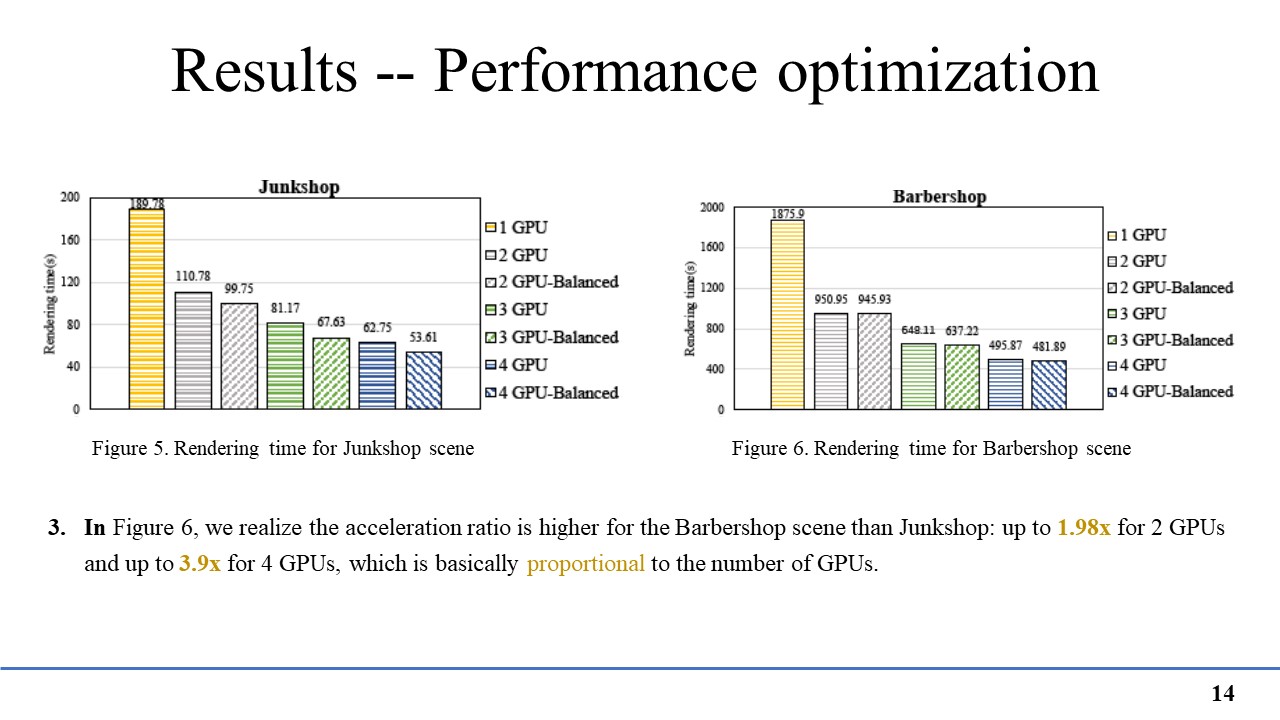 |
In Figure 6, we realize the acceleration ratio is higher for the Barbershop scene than Junkshop: up to 1.98 times for 2 GPUs and up to 3.9 times for 4 GPUs, which is basically proportional to the number of GPUs.
|
|
ICACT20230047 Slide.12
[Big slide for presentation]
[YouTube] |
Chrome Text-to-Speach Click!! |
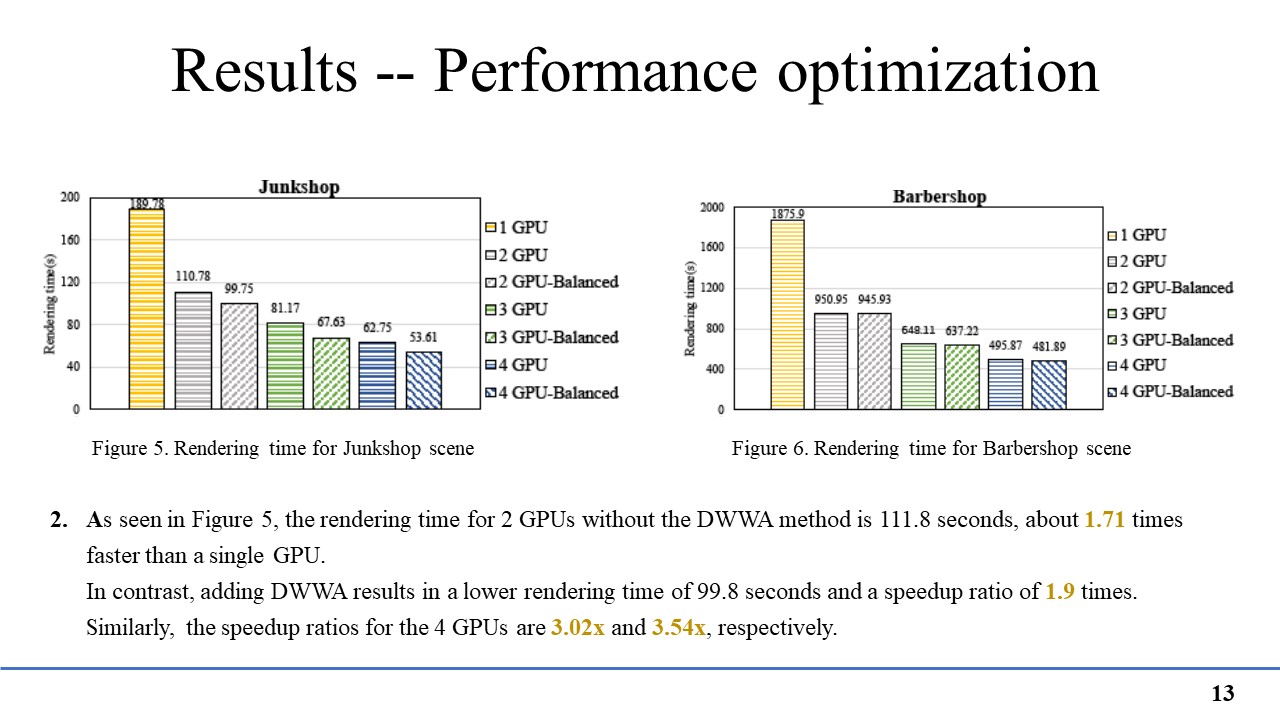 |
As seen in Figure 5, the rendering time for 2 GPUs without the DWWA method is 111.8 seconds, about 1.71 times that of a single GPU.
In contrast, adding DWWA results in a lower rendering time of 99.8 seconds and a speedup ratio of 1.9 times.
Similarly, the speedup ratios for the 4 GPUs are 3.02 times and 3.54 times, respectively, indicating that using DWWA can effectively improves rendering performance and that the speedup ratio is closer to the number of GPUs.
|
|
ICACT20230047 Slide.11
[Big slide for presentation]
[YouTube] |
Chrome Text-to-Speach Click!! |
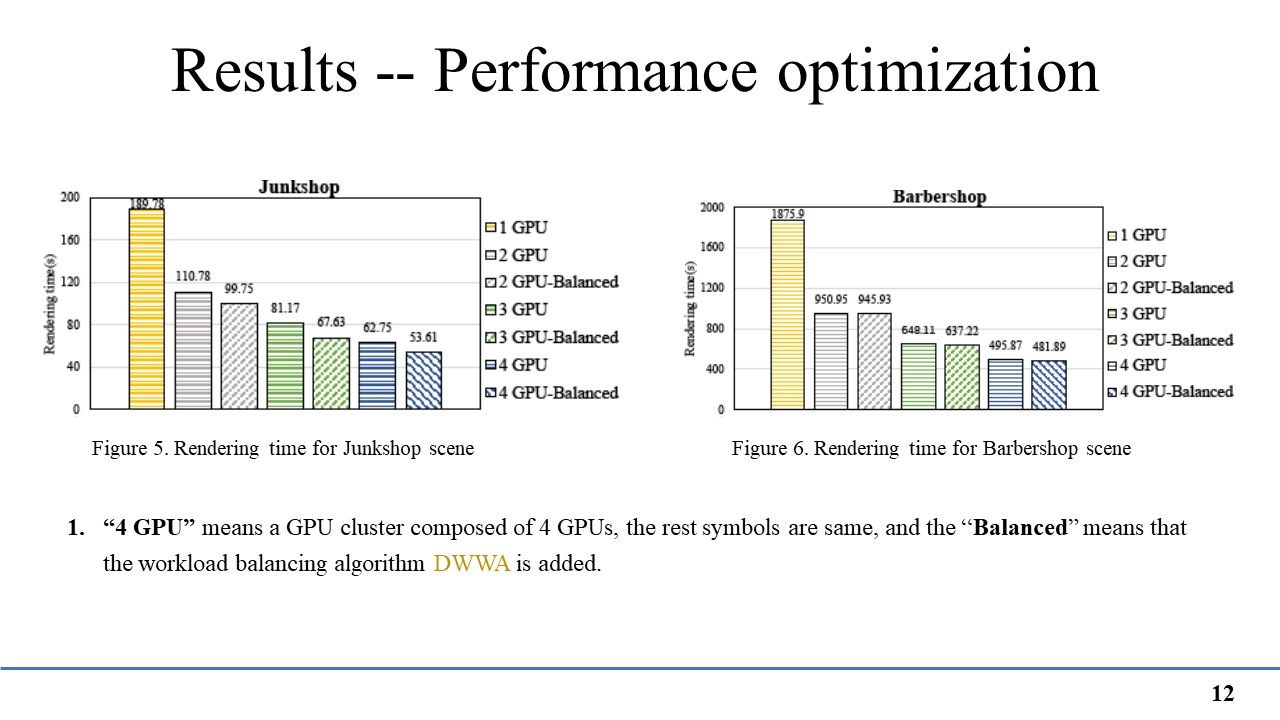 |
Figure 5 and Figure 6 below are the results of our rendering times for two different scenes.
Among them, “4 GPU” means a GPU cluster composed of 4 GPUs, the rest symbols are same, and the “Balanced” means that the workload balancing algorithm DWWA is added.
|
|
ICACT20230047 Slide.10
[Big slide for presentation]
[YouTube] |
Chrome Text-to-Speach Click!! |
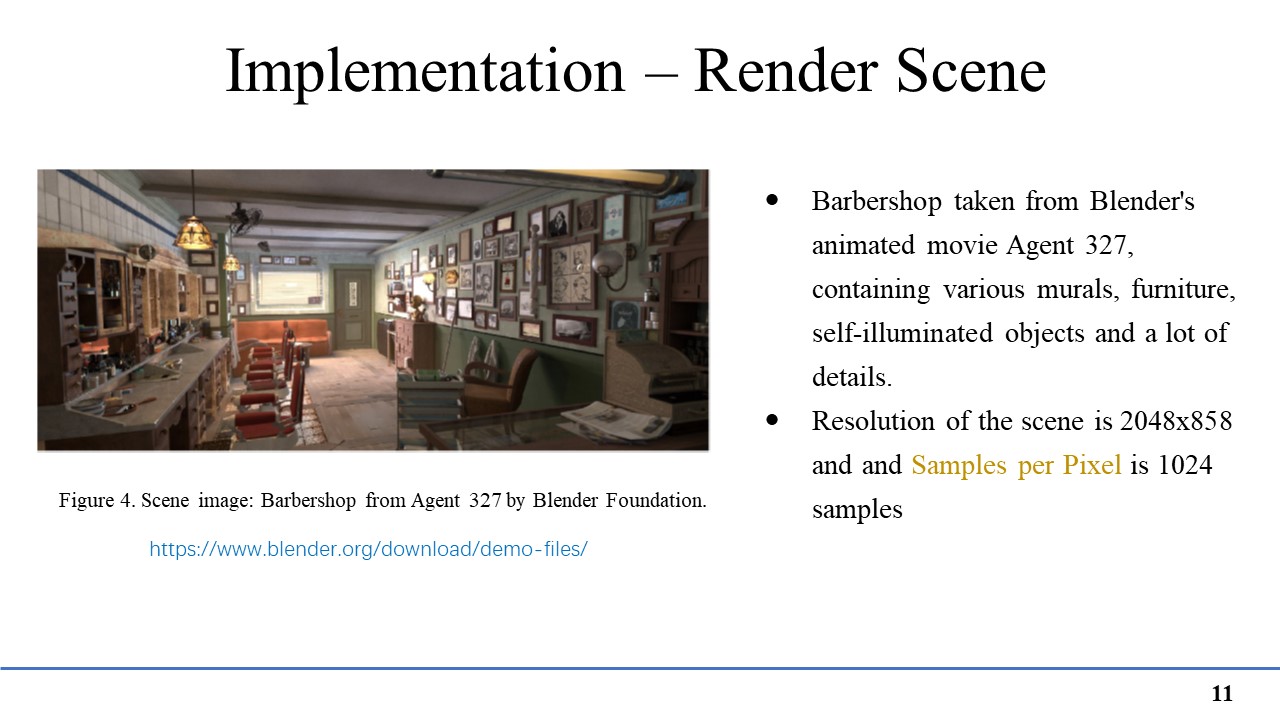 |
The other is a barbershop taken from Blender's animated movie Agent 327, containing various murals, furniture, self-illuminated objects and a lot of details, thus increasing the rendering time. The scene has a resolution of 2048 times 858. We set the sample value for both scenes to 1024, which ensures that the rendering image has no noise and is realistic.
|
|
ICACT20230047 Slide.09
[Big slide for presentation]
[YouTube] |
Chrome Text-to-Speach Click!! |
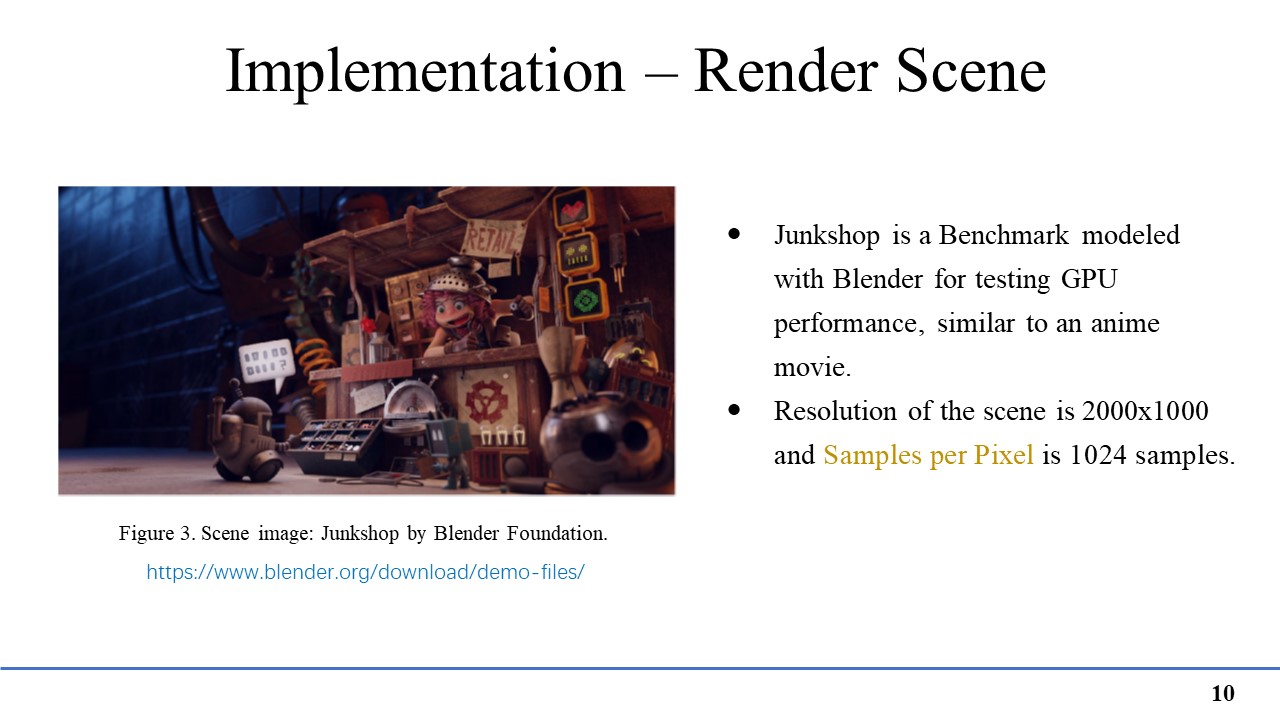 |
We do experiments in two different Scenes, as shown in Figure 3,4.
The first one called Junkshop is a Benchmark modeled with Blender for testing GPU performance, similar to an anime movie. The scene has a resolution of 2000 times 1000, or 2 million pixels,and rendering it is very computational.
|
|
ICACT20230047 Slide.08
[Big slide for presentation]
[YouTube] |
Chrome Text-to-Speach Click!! |
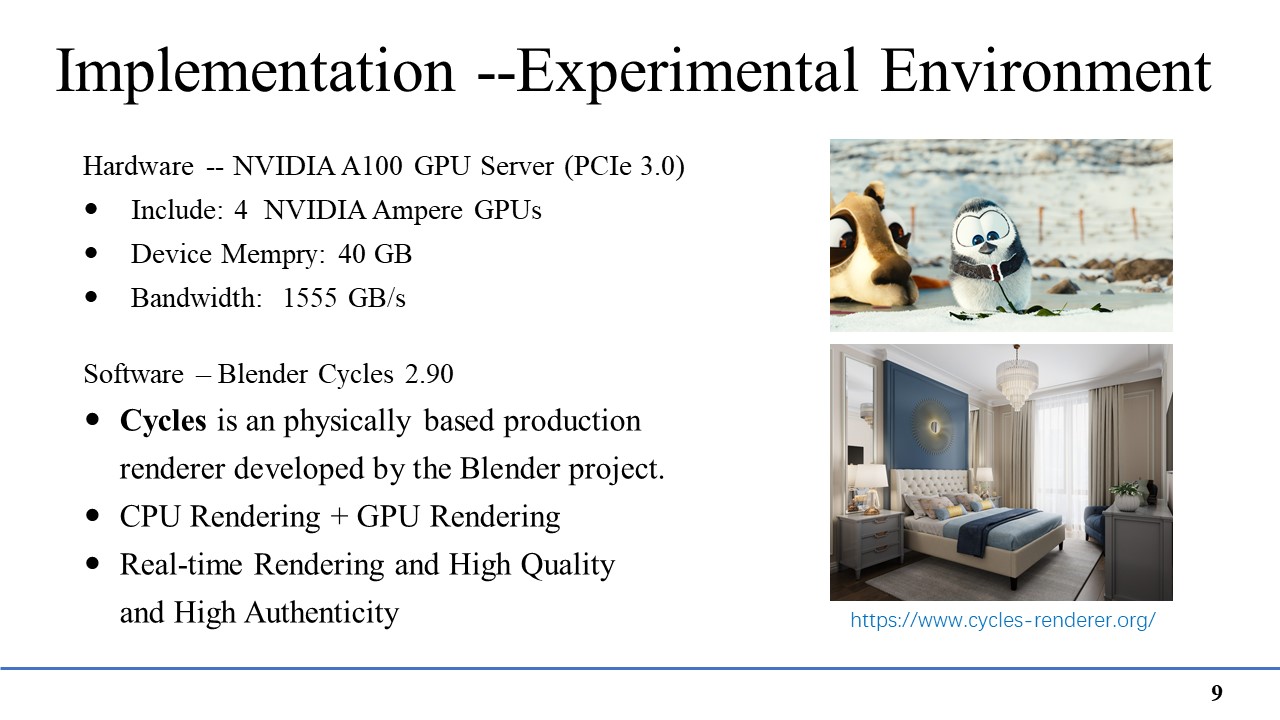 |
Experiments on rendering performance for both scenes and on scalability for multi-GPU performance acceleration conduct on a single-node server. This server contains 2 Intel Xeon Gold 6230R CPUs together equipped with 104 cores and 4 identical NVIDIA A100 Tensor Core GPUs. Of these, each GPU has a memory size of 40GB and memory bandwidth of 1555GB per second, and the bus standard is PCIe 3.0 (Peripheral Component Interconnect Express).
We use Blender Cycles to render the scene. Cycles is a physically based production renderer developed by the Blender project. It can be cross-platform and can use GPU rendering or CPU plus GPU hybrid rendering to increase rendering efficiency. And its advantages are fast rendering, rendering quality has authenticity.
It also supports distributed rendering for high performance computing, which is necessary to utilize the computational resources of multiple GPUs to improve rendering performance.
So the Multi-GPU rendering experiments in this paper are conducted in Blender Cycles engine.
|
|
ICACT20230047 Slide.07
[Big slide for presentation]
[YouTube] |
Chrome Text-to-Speach Click!! |
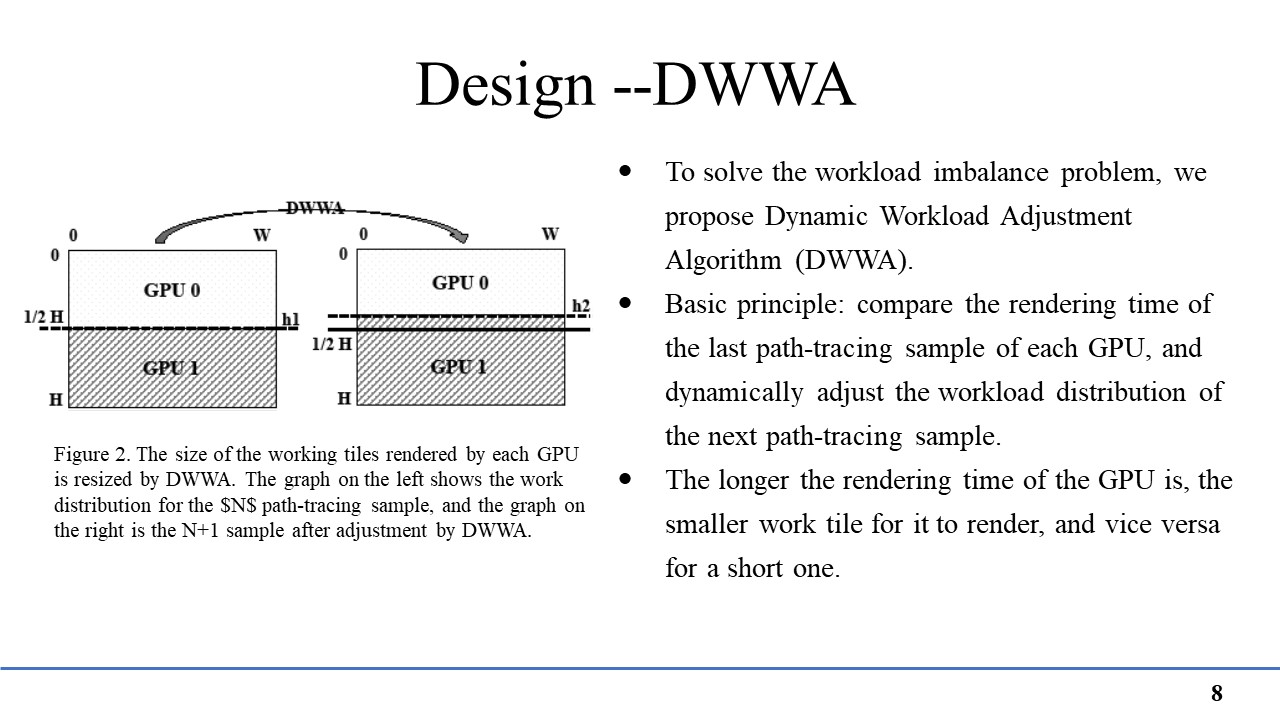 |
To solve this problem, we realize that because path-tracing requires multiple samples to reduce noise (we set the total number of samples to 1024), we can dynamically adjust the workload distribution for the next path-tracing sample based on a comparison of the rendering time of the previous sample, so that each GPU is always working, reducing the idle time of each GPU and thus improving the overall rendering performance.
Its basic principle is to compare the rendering time of the last path-tracing sample of each GPU, and dynamically adjust the workload distribution of the next path-tracing sample. The longer the rendering time of the GPU is, the smaller work tile for it to render, and vice versa for a short one.
As shown in Figure 2, for two GPUs cluster, GPU0 renders the pixel tile from 0-h1 and GPU1 renders the pixel tile from h1-height. At the Nth sample, if the rendering time of GPU0 is greater than GPU1, then the size of the tile to be rendered by GPU0 at the N+1th sample is reduced, that is GPU0 is responsible for rendering the pixel tile from 0-h2 and GPU1 renders the remaining area. At the next path-tracing sample, the rendering times of the two GPUs are compared again to adjust the workload at each path-tracing sample, so that the rendering times of the two GPUs are always very close to each other.
|
|
ICACT20230047 Slide.06
[Big slide for presentation]
[YouTube] |
Chrome Text-to-Speach Click!! |
 |
However, the number of rays emitted for tracing (numbers of ray bounce) and the amount of computation for each pixel in each tile are different, resulting in different rendering times for each GPU. Taking the cluster of 4 GPUs as an example, if GPU0 finishes rendering, it is possible that GPU3 only completes two-thirds of the rendering task, leading to a large amount of idle time for GPU0, so we have to use a workload balancing algorithm to reduce this situation.
That is even though each GPU is responsible for an equal image area size, the amount of rendering tasks for each rendering area is not determinable, which can easily cause load imbalance problems.
To solve this problem, we propose Dynamic Workload Adjustment Algorithm (DWWA).
|
|
ICACT20230047 Slide.05
[Big slide for presentation]
[YouTube] |
Chrome Text-to-Speach Click!! |
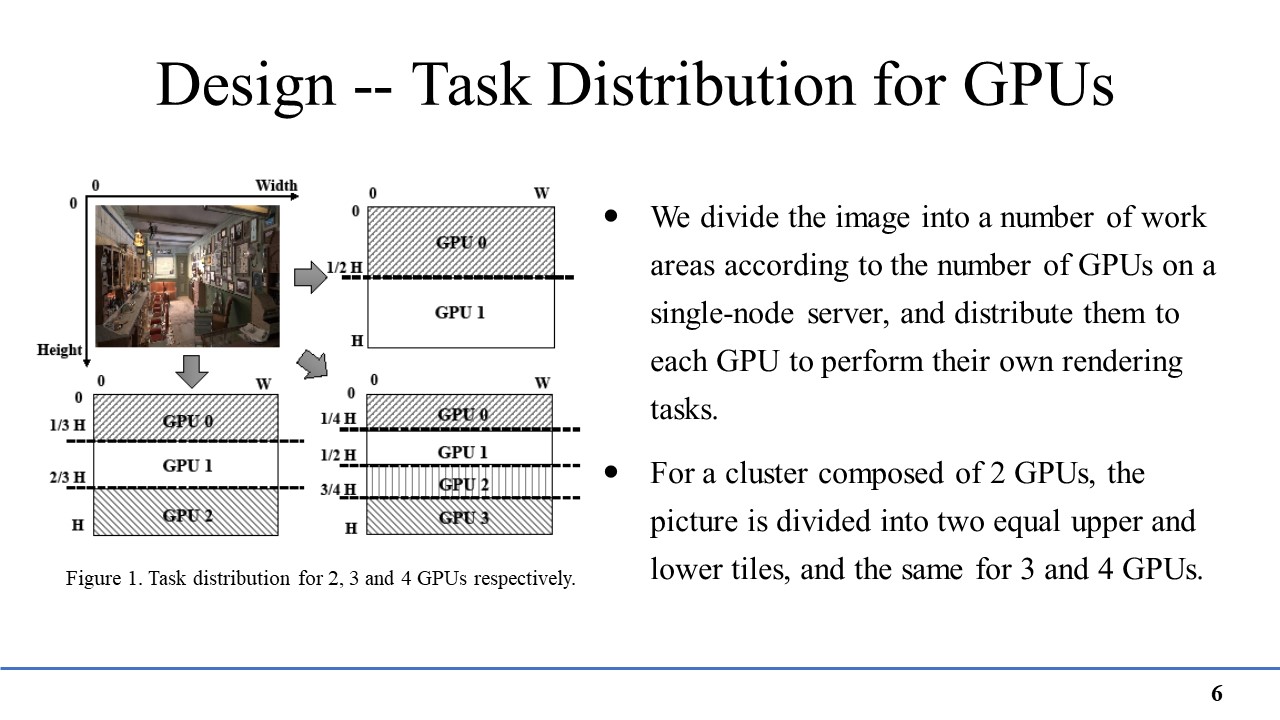 |
To use multiple GPUs for parallel rendering of path tracing, it is necessary to reasonably divide the rendering tasks to each GPU. Thus we divide the image into a number of work areas according to the number of GPUs on a single-node server, and distribute them to each GPU to perform their own rendering tasks.
Since the rendering tasks of the tiles cannot be known in advance, at the beginning of path-tracing, each GPU is responsible for the tiles of equal size for simplicity.
The workload division mode is shown in Figure 1. For a cluster composed of 2 GPUs, the picture is divided into two equal upper and lower tiles, and the same for 3 and 4 GPUs.
|
|
ICACT20230047 Slide.04
[Big slide for presentation]
[YouTube] |
Chrome Text-to-Speach Click!! |
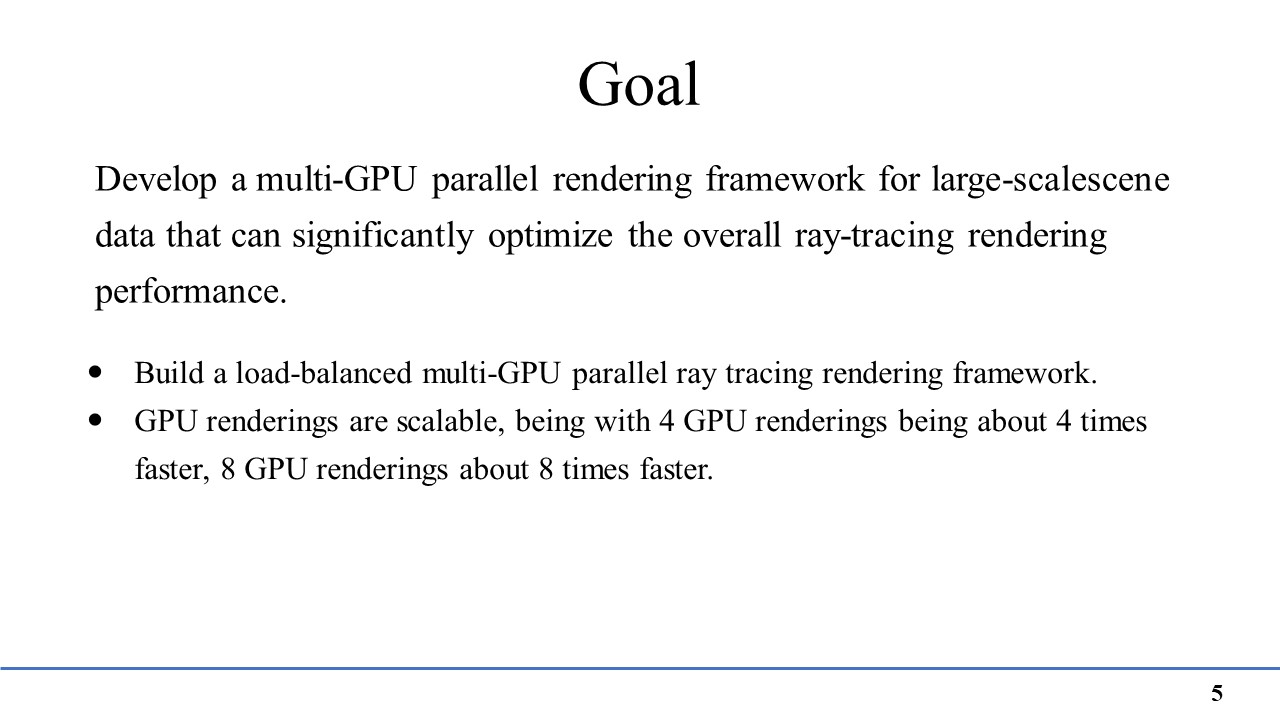 |
In order to solve the difficulties mentioned above, we target to develop a multi-GPU parallel rendering framework for large-scale scene data that can significantly optimize overall ray-tracing rendering performance.
In other words, we aim to build a load-balanced multi-GPU parallel ray tracing rendering framework that is scalable for rendering performance -- with 4 GPU renderings being about 4 times faster, 8 GPU renderings about 8 times faster.
In this paper, we use several GPUs to speed up the ray tracing rendering process, which has played a good acceleration effect with high scalability.
|
|
ICACT20230047 Slide.03
[Big slide for presentation]
[YouTube] |
Chrome Text-to-Speach Click!! |
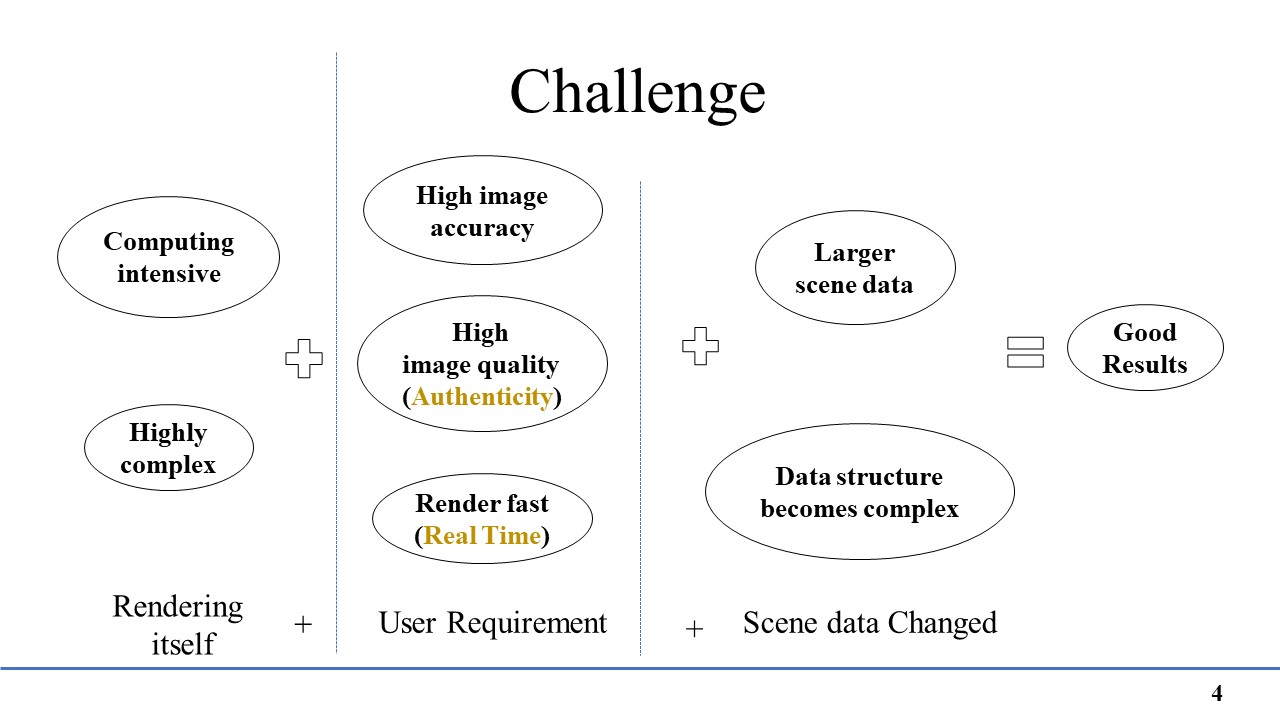 |
However,the development of rendering technology is full of challenges. I will describe them from three levels.
Firstly, rendering itself is a kind of highly complex and intensive computation that requires a lot of computing resources and preprocessing.
Secondly, With the rise of new fields and people's higher pursuit of visual sense, now users require more and more high-precision rendering images, image quality is more and more strong, and rendering speed is faster and faster.
In addition, with the advent of big data, the scene to render more and more complex, scene data is also getting larger and larger, 100 GB or even later up to 1 TB, a single GPU memory is difficult to store all the scene data.
Therefore, it is very difficult to get good results to meet the needs, and they are difficult points in the current research field of rendering.
|
|
ICACT20230047 Slide.02
[Big slide for presentation]
[YouTube] |
Chrome Text-to-Speach Click!! |
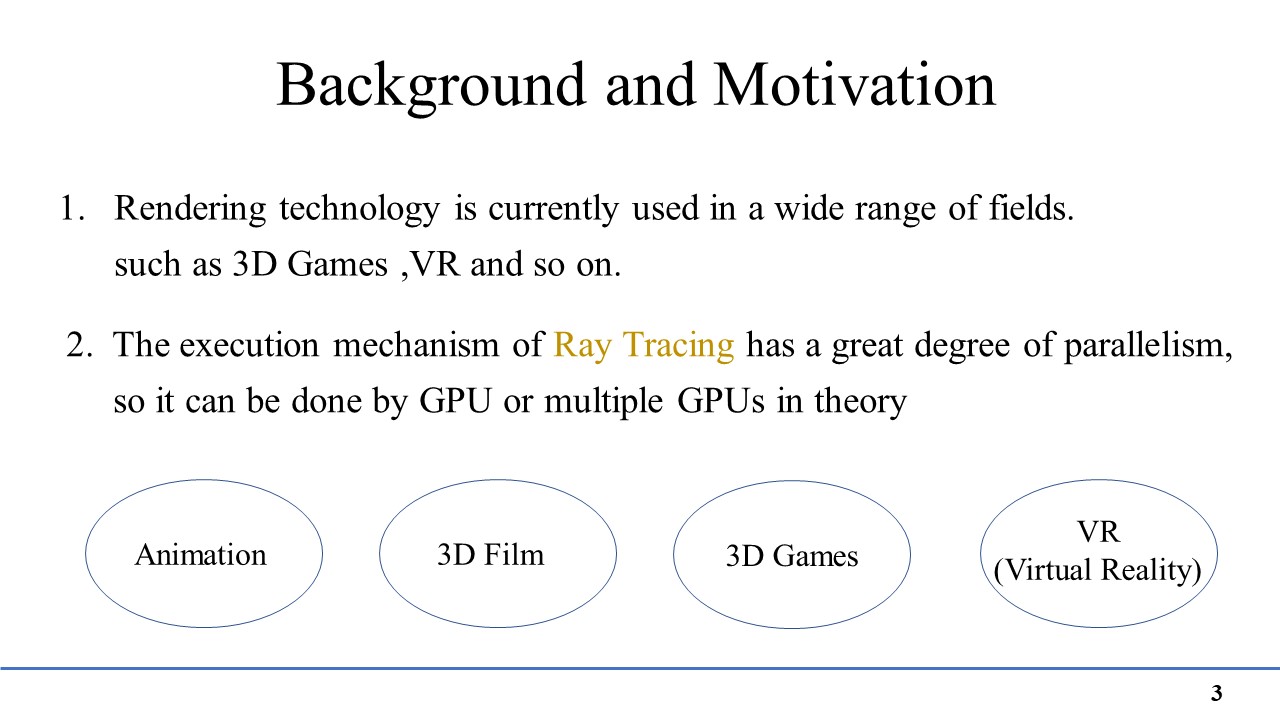 |
Rendering technology is currently used in a wide range of fields. It can be used not only in animation, 3D movies, 3D games, and virtual reality, but also in architectural visualization, medical imaging, aerospace, and other engineering fields.
Moreover, the execution mechanism of ray tracing has a great degree of parallelism, so it can be done by GPU or multiple gpus in theory, thus speeding up the rendering process.
|
|
ICACT20230047 Slide.01
[Big slide for presentation]
[YouTube] |
Chrome Text-to-Speach Click!! |
 |
My presentation will mainly include these parts.
Background and Motivation, Design, Experimental Implementation and Results and Conclusion.
|
|
ICACT20230047 Slide.00
[Big slide for presentation]
[YouTube] |
Chrome Text-to-Speach Click!! |
 |
Hello everyone. I am very glad to have this opportunity to attend the conference. My name is Chen Jiuyi. Currently, I am a Graduate Student at the Shenzhen Institute of Advanced Technology. My research focus on GPU rendering optimization techniques and parallel computing with my lab members Chen Ling and my professor Yu Zhibin. The topic of my presentation is about using multiple GPUs to linearly accelerate path tracing rendering.
|
















