 ICACT20210165 Slide.18
[Big slide for presentation] |
Chrome Text-to-Speach Click!! |
 |
Thanks for your attention! If you have any questions, please feel free to tell us.
|
|
ICACT20210165 Slide.17
[Big slide for presentation]
|
Chrome Text-to-Speach Click!! |
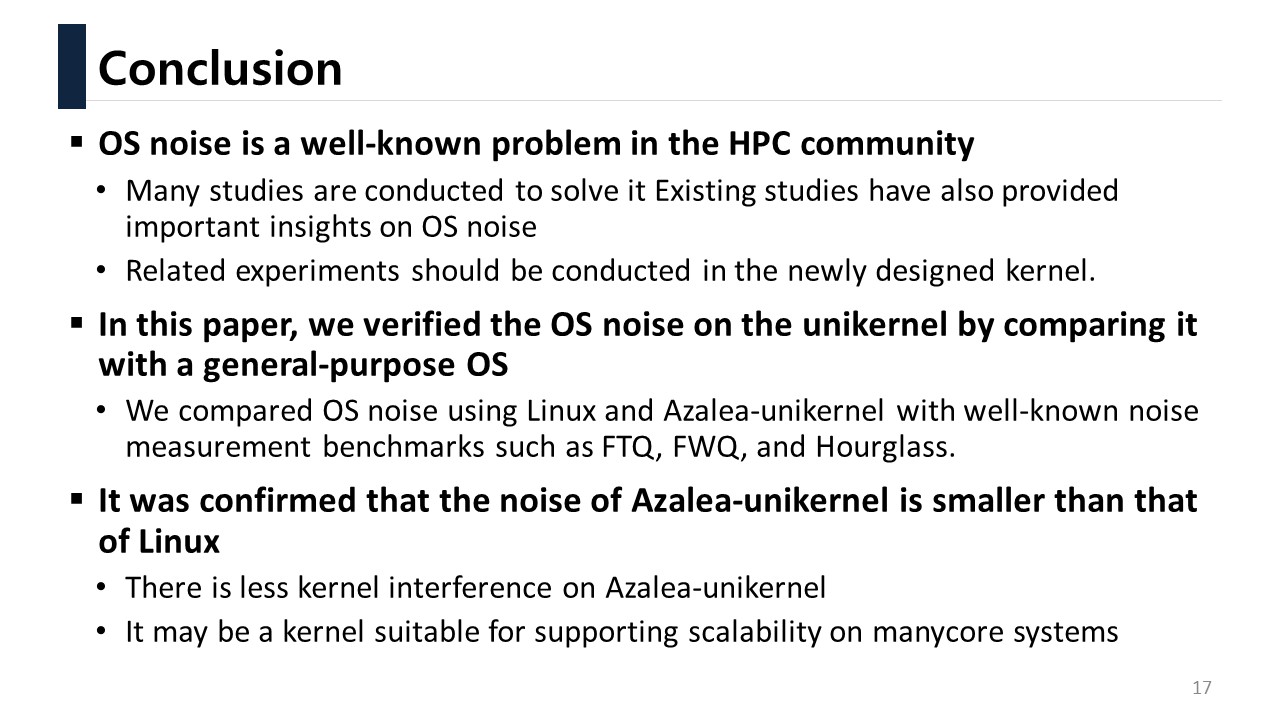 |
OS noise is a well-known problem in the HPC community, and many studies are conducted to solve it Existing studies have also provided important insights on OS noise, and accordingly, related experiments should be conducted in the newly designed kernel.
In this paper, we verified the OS noise on the unikernel by comparing it with a general-purpose OS. We compared OS noise using Linux and Azalea-unikernel with well-known noise measurement benchmarks such as FTQ, FWQ, and Hourglass.
Through experimental results using benchmarks, it was confirmed that the noise of Azalea-unikernel is smaller than that of Linux. This means that there is less kernel interference on Azalea-unikernel, and it also means it is a kernel suitable for supporting scalability on manycore systems.
|
|
ICACT20210165 Slide.16
[Big slide for presentation]
|
Chrome Text-to-Speach Click!! |
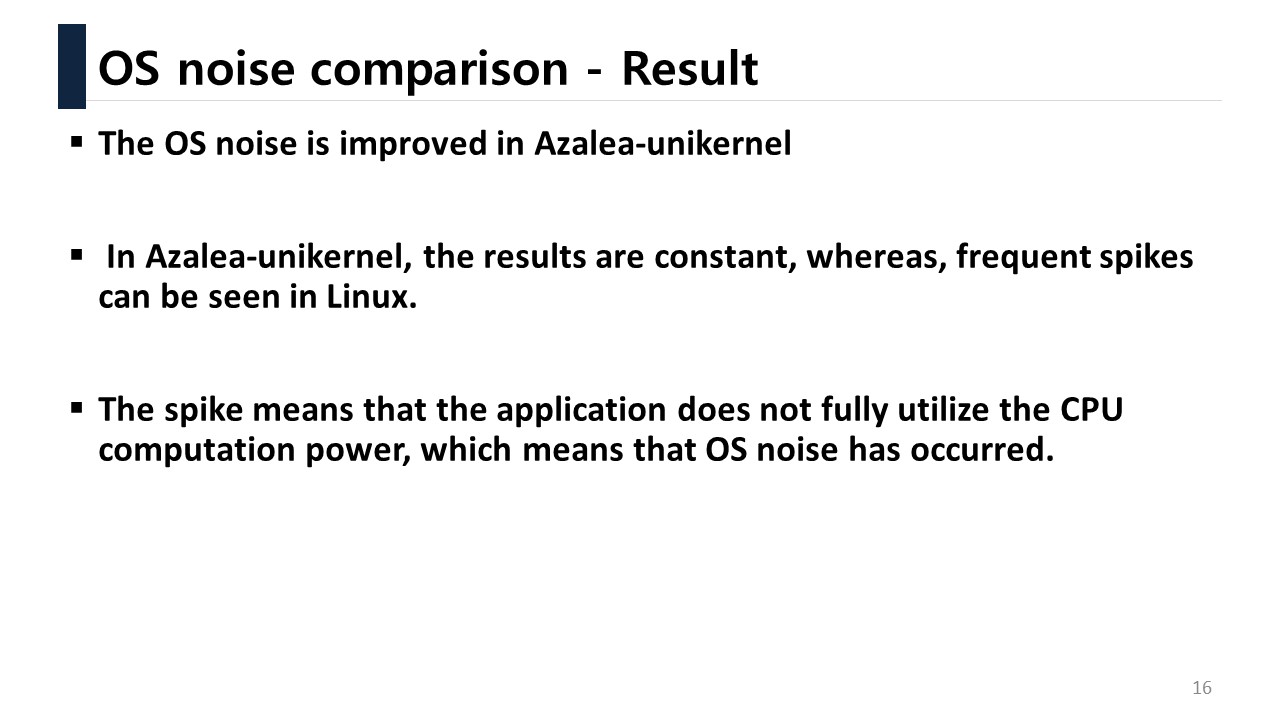 |
As a result of FTQ, FWQ, and Hourglass benchmark experiments, we found that the OS noise is improved in Azalea-unikernel. In Azalea-unikernel, the results are constant, whereas, frequent spikes can be seen in Linux. The spike means that the application does not fully utilize the CPU computation power, which means that OS noise has occurred.
|
|
ICACT20210165 Slide.15
[Big slide for presentation]
|
Chrome Text-to-Speach Click!! |
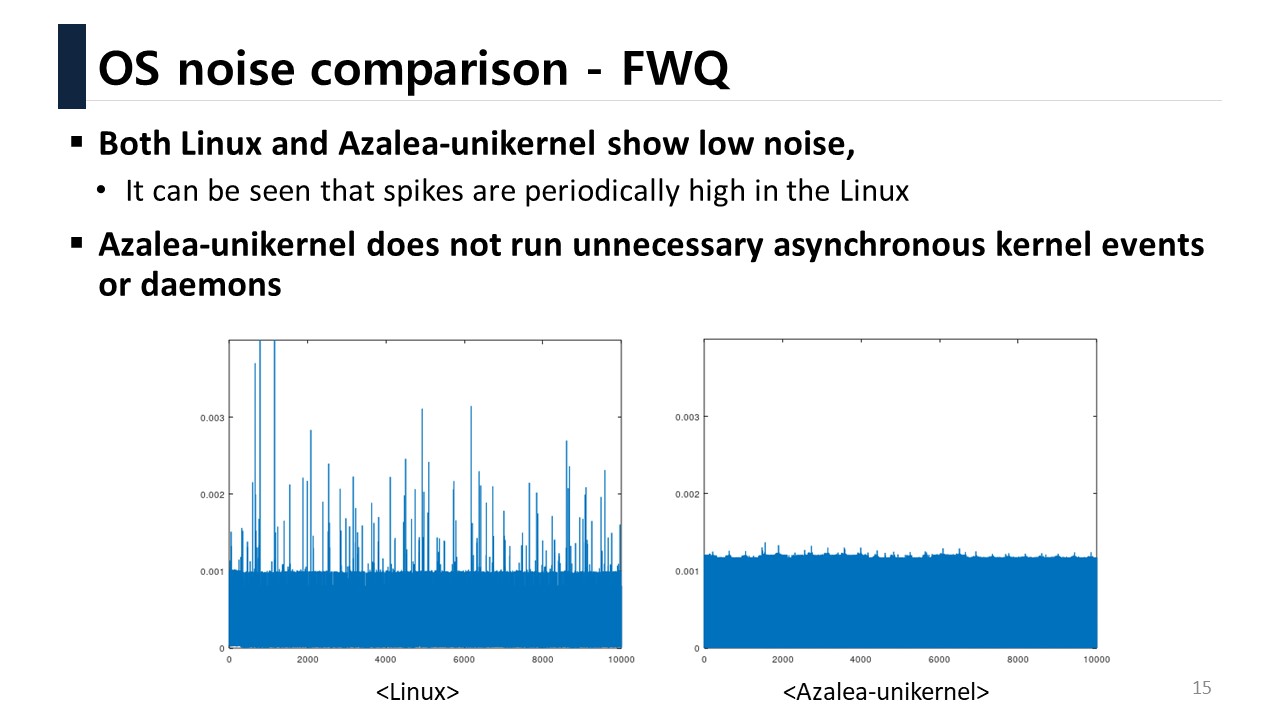 |
This figure shows the result of running FWQ on Linux and Azalea-unikernel. X-axis represents the sample number, Y-axis represents the time taken for each sample in milliseconds. Both Linux and Azalea-unikernel show low noise, however, in the case of Linux it can be seen that spikes are periodically high. This is because Azalea-unikernel does not run unnecessary asynchronous kernel events or daemons.
|
|
ICACT20210165 Slide.14
[Big slide for presentation]
|
Chrome Text-to-Speach Click!! |
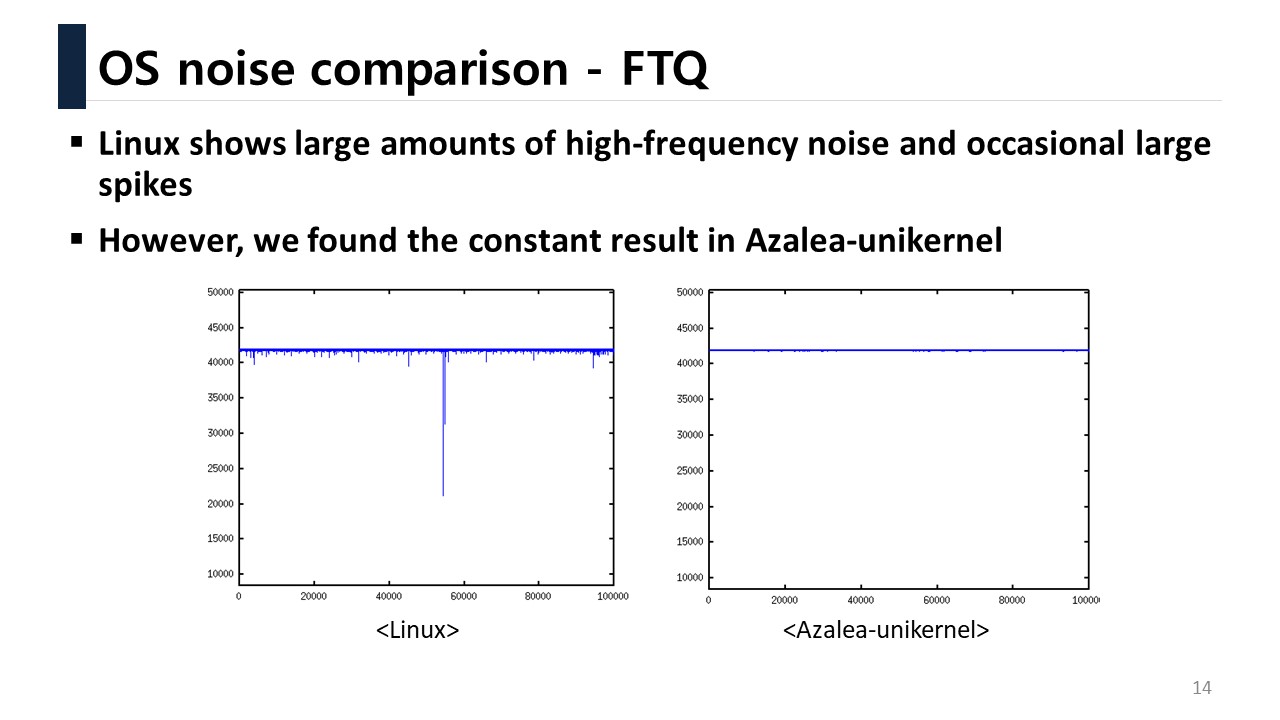 |
This figure is the result of executing FTQ on Linux and Azalea-unikernel. The X-axis represents the sample number, and the Y-axis represents the number of iterations performed during the time quantum. Linux shows large amounts of high-frequency noise and occasional large spikes. However, we found the constant result in Azalea-unikernel.
|
|
ICACT20210165 Slide.13
[Big slide for presentation]
|
Chrome Text-to-Speach Click!! |
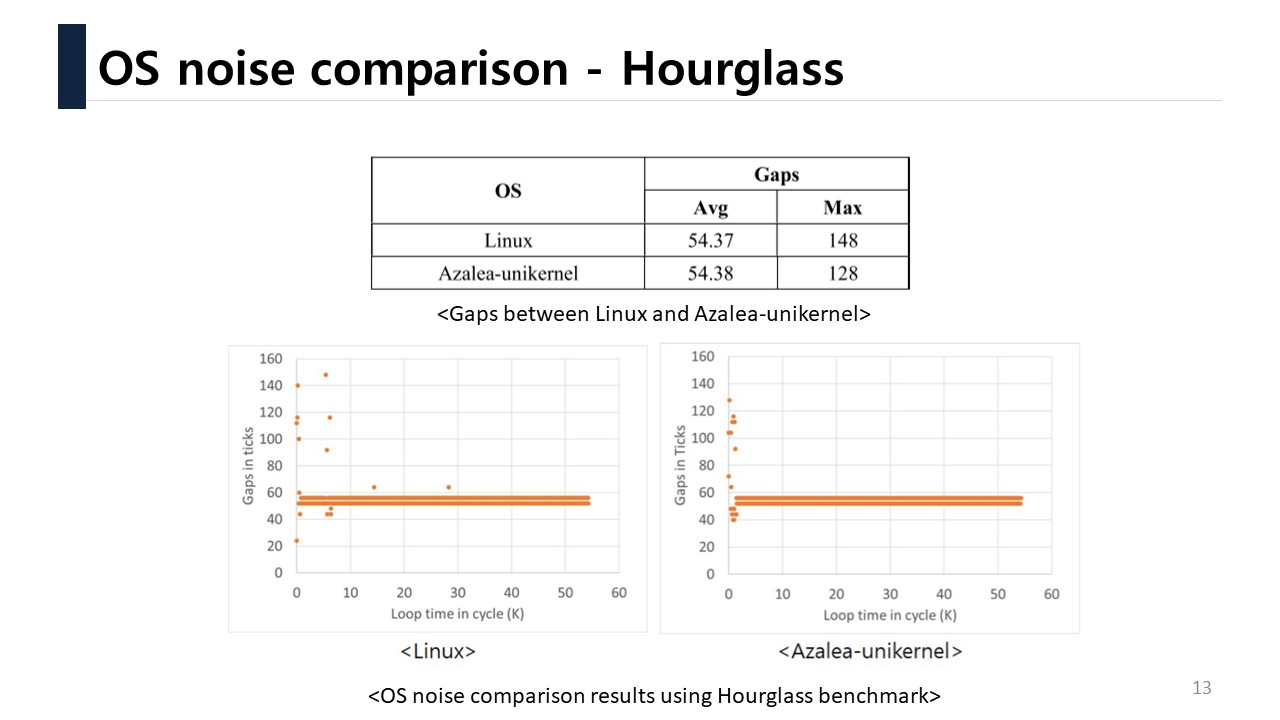 |
Upper table shows the maximum and average gaps of the CPU cycle in Linux and Azalea-unikernel, and below figure shows a histogram for intervals over 1000 cycles.
The average number of the cycle for the timestamp count is constant at about 54. The maximum value is more than 20 for Azalea-unikernel than Linux. Also, in Linux, the performance is more distributed and thus the latency is high. This is due to noise from the operating system such as interrupts or other tasks running at the same time.
|
|
ICACT20210165 Slide.12
[Big slide for presentation]
|
Chrome Text-to-Speach Click!! |
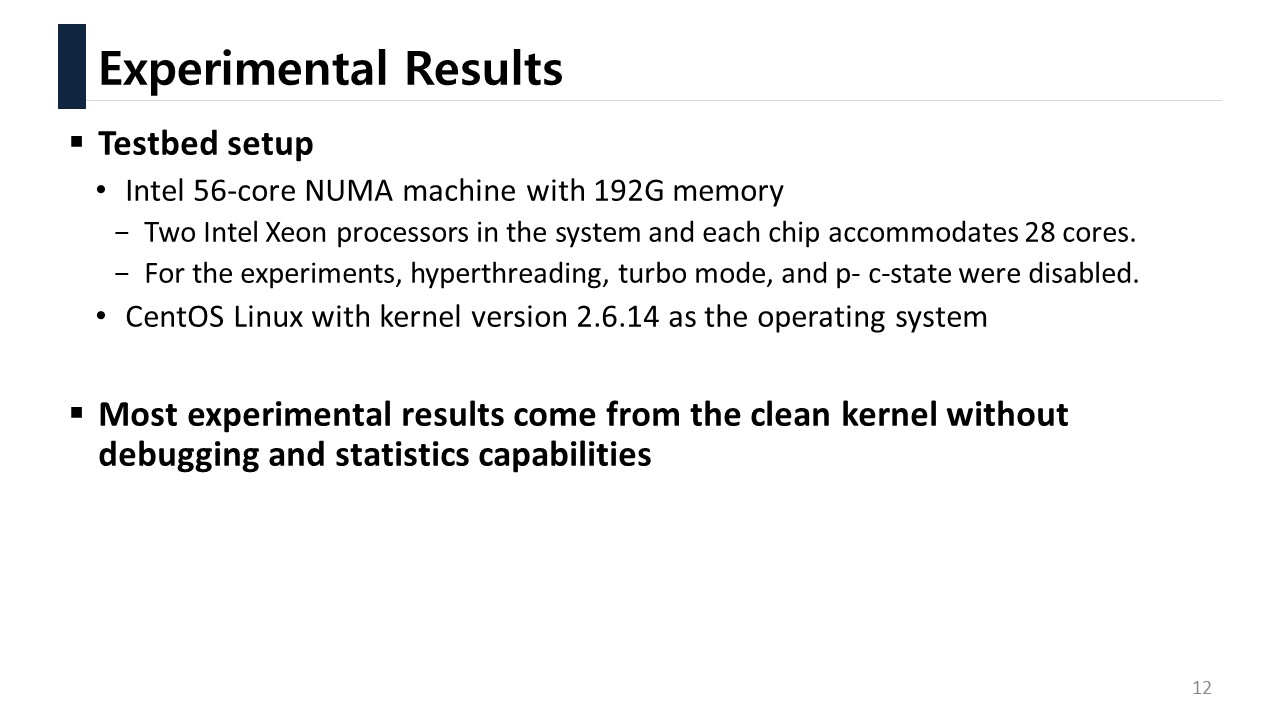 |
All experiments are carried out on an Intel 56-core NUMA machine with 192G memory. There are two Intel Xeon processors in the system and each chip accommodates 28 cores. For the experiments, hyperthreading, turbo mode, and p- c-state were disabled. We use CentOS Linux with kernel version 2.6.14 as the operating system.
Most experimental results come from the clean kernel without debugging and statistics capabilities.
|
|
ICACT20210165 Slide.11
[Big slide for presentation]
|
Chrome Text-to-Speach Click!! |
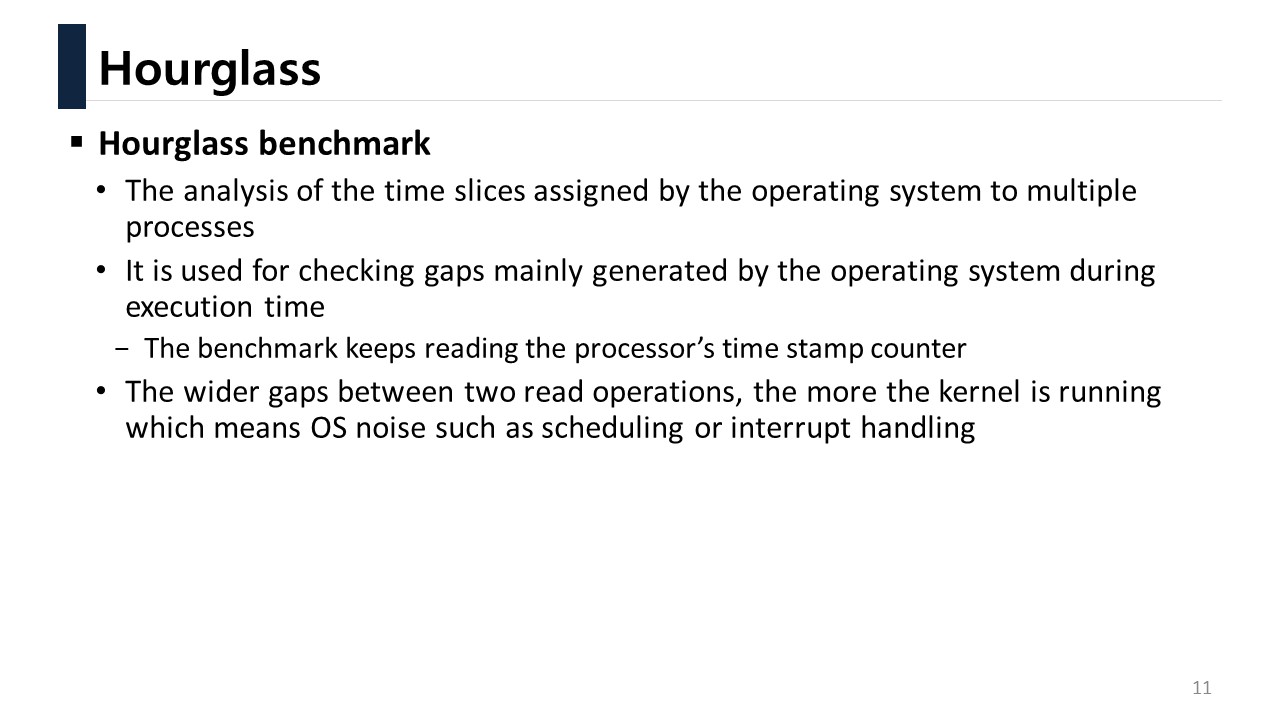 |
Hourglass benchmark was introduced for the analysis of the time slices assigned by the operating system to multiple processes. In this work, it is used for checking gaps mainly generated by the operating system during execution time. The benchmark keeps reading the processor’s time stamp counter. Except for some blocked system services, it is bound to a specific core and operates in the system. In other words, the wider gaps between two read operations, the more the kernel is running which means OS noise such as scheduling or interrupt handling.
|
|
ICACT20210165 Slide.10
[Big slide for presentation]
|
Chrome Text-to-Speach Click!! |
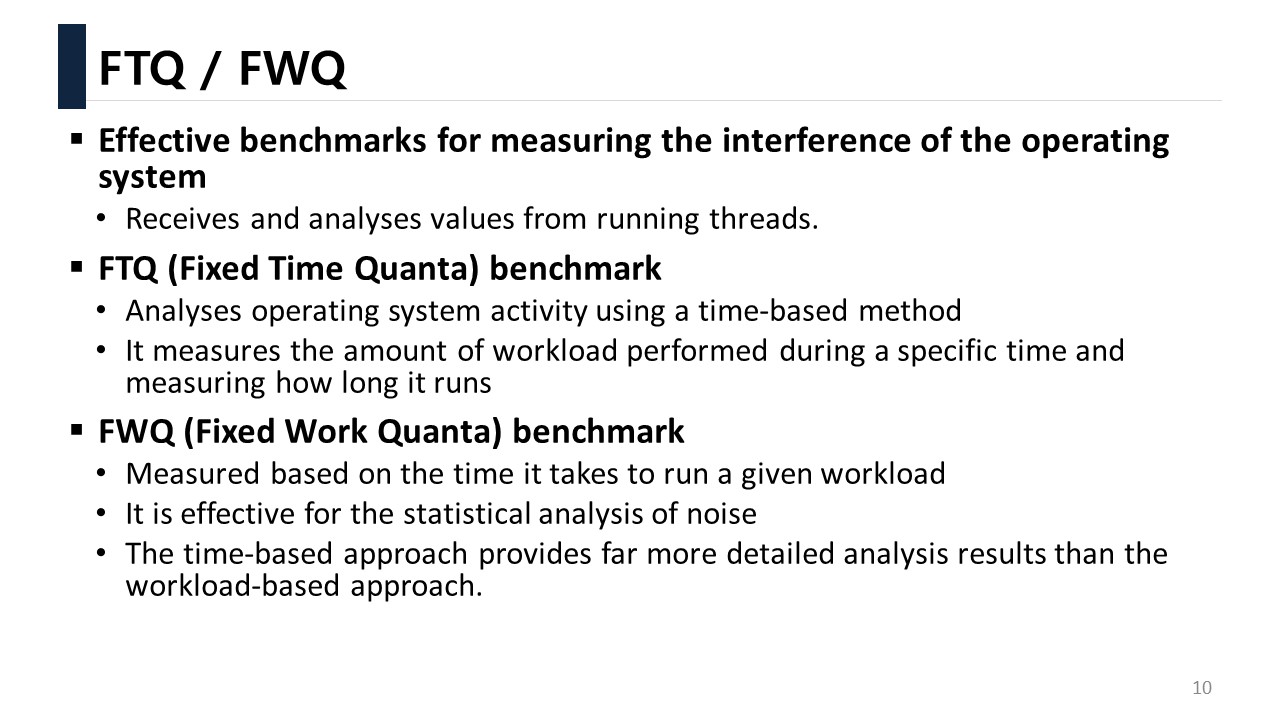 |
FTQ and FWQ are effective benchmarks for measuring the interference of the operating system that receives and analyses values from running threads.
FTQ benchmark analyses operating system activity using a time-based method rather than a workload-based method. In other words, it measures the amount of workload performed during a specific time rather than fixing the workload and measuring how long it runs. It is designed to strictly adhere to the interval, in very short units, around 1ms in time.
FWQ benchmark is measured based on the time it takes to run a given workload. Since the amount of data in workload is fixed, it is effective for the statistical analysis of noise. These analysis results are divided into the amount of noise in hardware and software environments. The time-based approach provides far more detailed analysis results than the workload-based approach.
|
|
ICACT20210165 Slide.09
[Big slide for presentation]
|
Chrome Text-to-Speach Click!! |
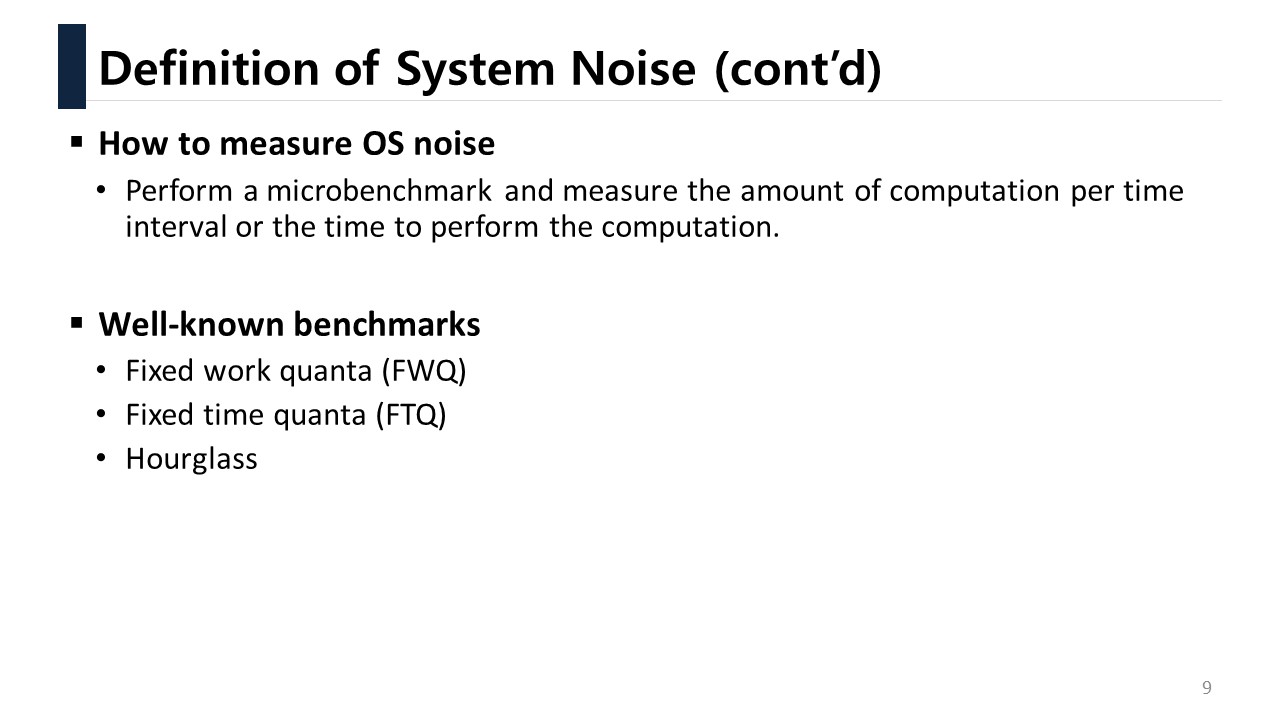 |
A common way to measure OS noise is to perform a microbenchmark and measure the amount of computation per time interval or the time to perform the computation.
Well-known benchmarks include the Fixed work quanta (FTQ), fixed time quanta (FWQ), and Hourglass benchmarks.
|
|
ICACT20210165 Slide.08
[Big slide for presentation]
|
Chrome Text-to-Speach Click!! |
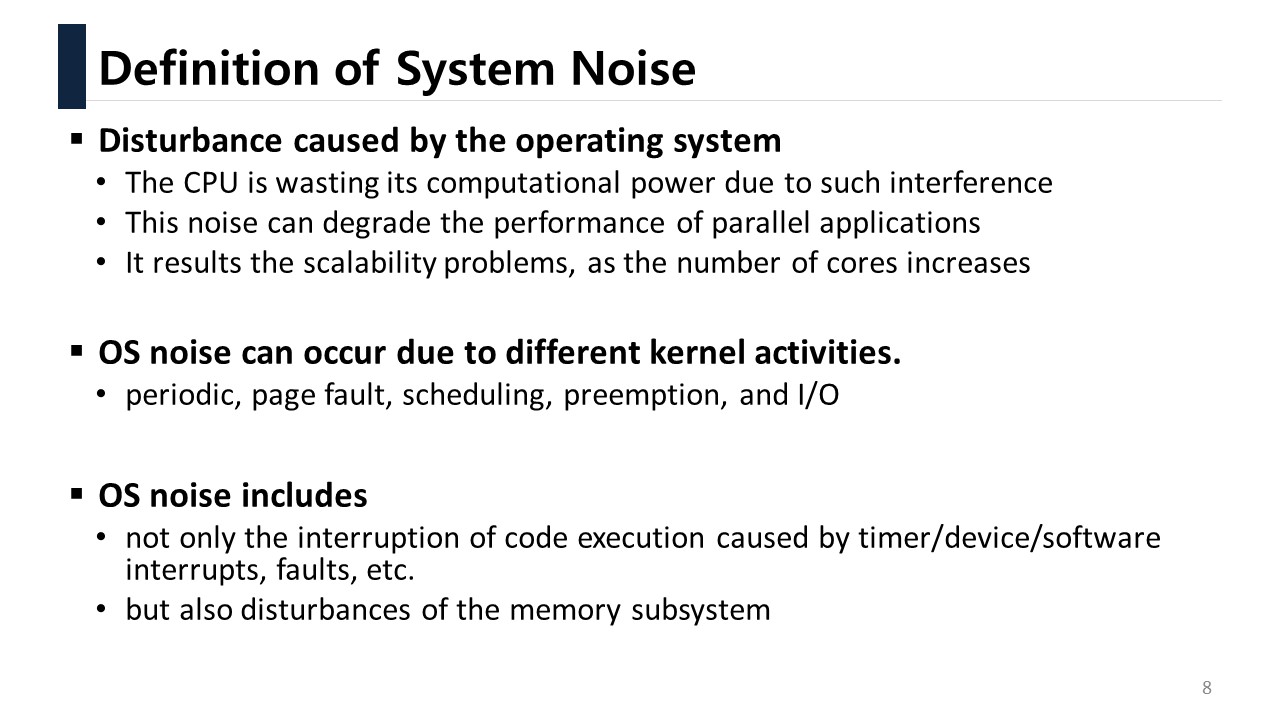 |
The general definition of OS noise is the disturbance caused by the operating system when an application is running on a processor. The CPU is wasting its computational power due to such interference, and this noise can degrade the performance of parallel applications. As the number of cores increases, it affects the performance more, resulting in scalability problems.
OS noise can occur due to different kernel activities. In the previous research, kernel activities that cause OS noise are classified into 5 categories: periodic, page fault, scheduling, pre-emption, and I/O.
OS noise includes not only the interruption of code execution caused by timer/device/software interrupts, faults, etc. but also disturbances of the memory subsystem that occur when the operating system makes requests to the processor’s cache subsystem.
|
|
ICACT20210165 Slide.07
[Big slide for presentation]
|
Chrome Text-to-Speach Click!! |
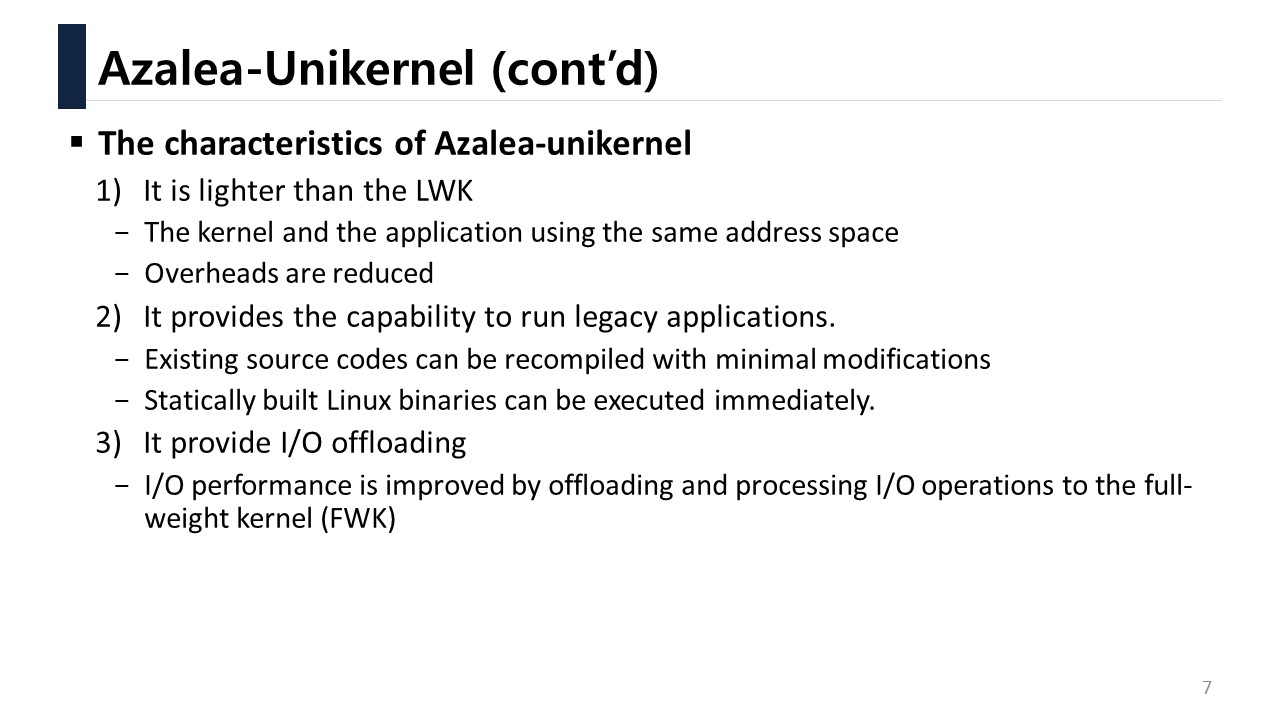 |
The characteristics of Azalea-unikernel are as follows:
1) Since the kernel and the application using the same address space, the overhead such as having to replace privileges is reduced, making it lighter than the LWK.
2) It provides the capability to run legacy applications. Existing source codes can be recompiled with minimal modifications or statically built Linux binaries can be executed immediately.
3) I/O performance is improved by offloading and processing I/O operations to the full-weight kernel (FWK).
|
|
ICACT20210165 Slide.06
[Big slide for presentation]
|
Chrome Text-to-Speach Click!! |
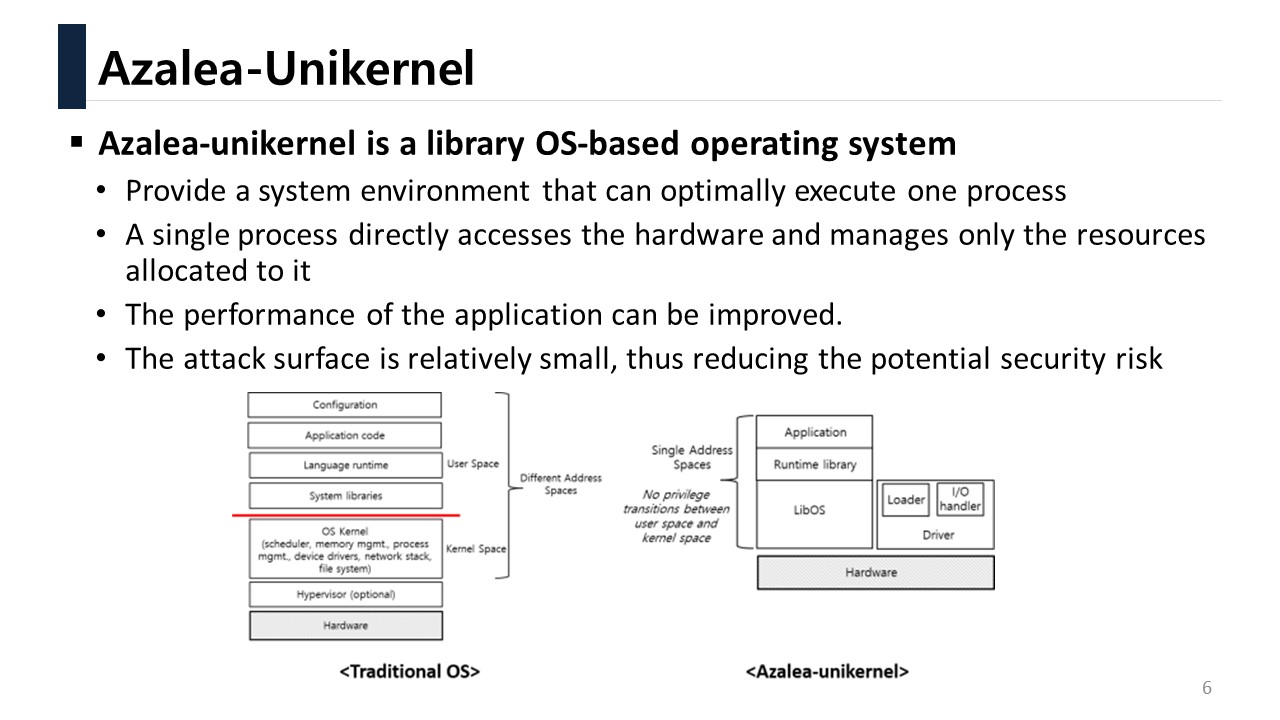 |
Azalea-unikernel is a library OS-based operating system and provides a system environment that can optimally execute one process. Through this, a single process directly accesses the hardware and manages only the resources allocated to it.
It does not cause resource competition between other processes, so the performance of the application can be improved. In addition, since only the hardware resources and kernel functions required by a specific application program are included, the attack surface is relatively small, thus reducing the potential security risk.
Figure 1 shows the difference between the existing OS and Azalea-unikernel structure.
|
|
ICACT20210165 Slide.05
[Big slide for presentation]
|
Chrome Text-to-Speach Click!! |
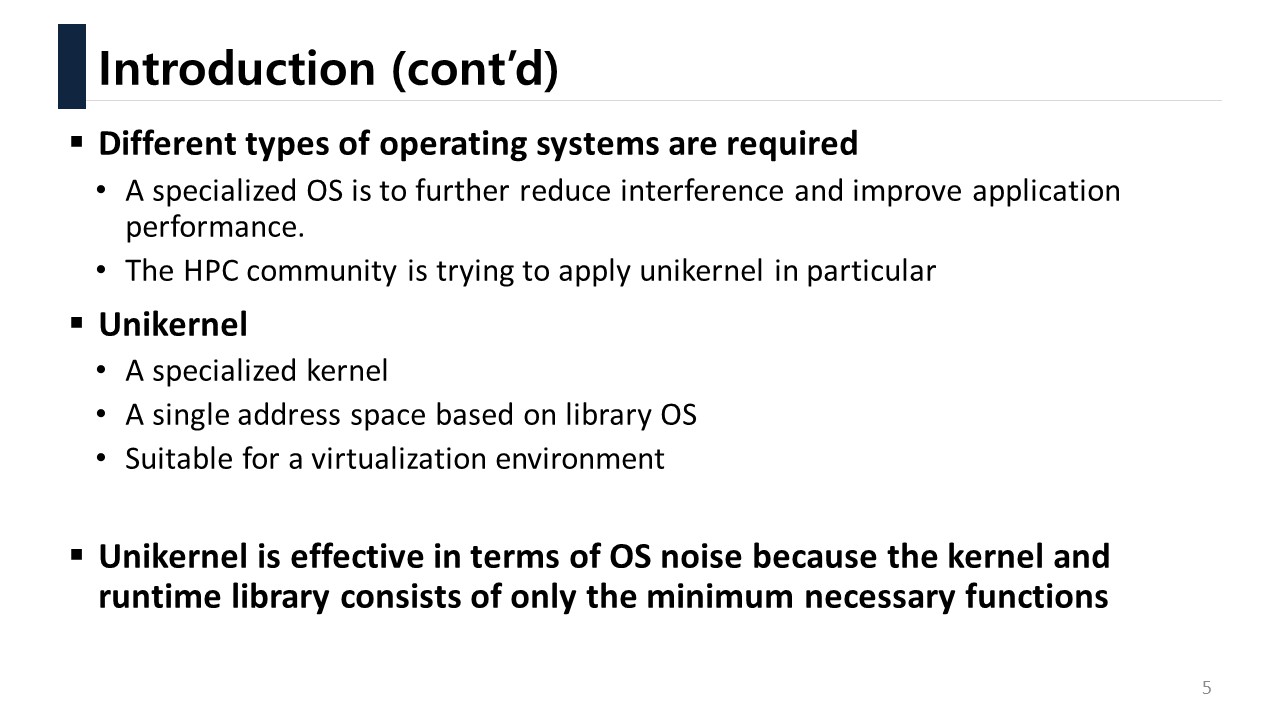 |
The OS research is gradually evolving from the existing general-purpose OS to a specialized OS to further reduce interference and improve application performance. The HPC community is trying to apply unikernel in particular.
Unikernel is a specialized kernel that uses a single address space based on library OS. This has strengths in small size, performance, predictability, and security. Also, it is suitable for a virtualization environment because the execution environment works well on the hypervisor.
Unikernel is effective in terms of OS noise because the kernel and runtime library consists of only the minimum necessary functions.
|
|
ICACT20210165 Slide.04
[Big slide for presentation]
|
Chrome Text-to-Speach Click!! |
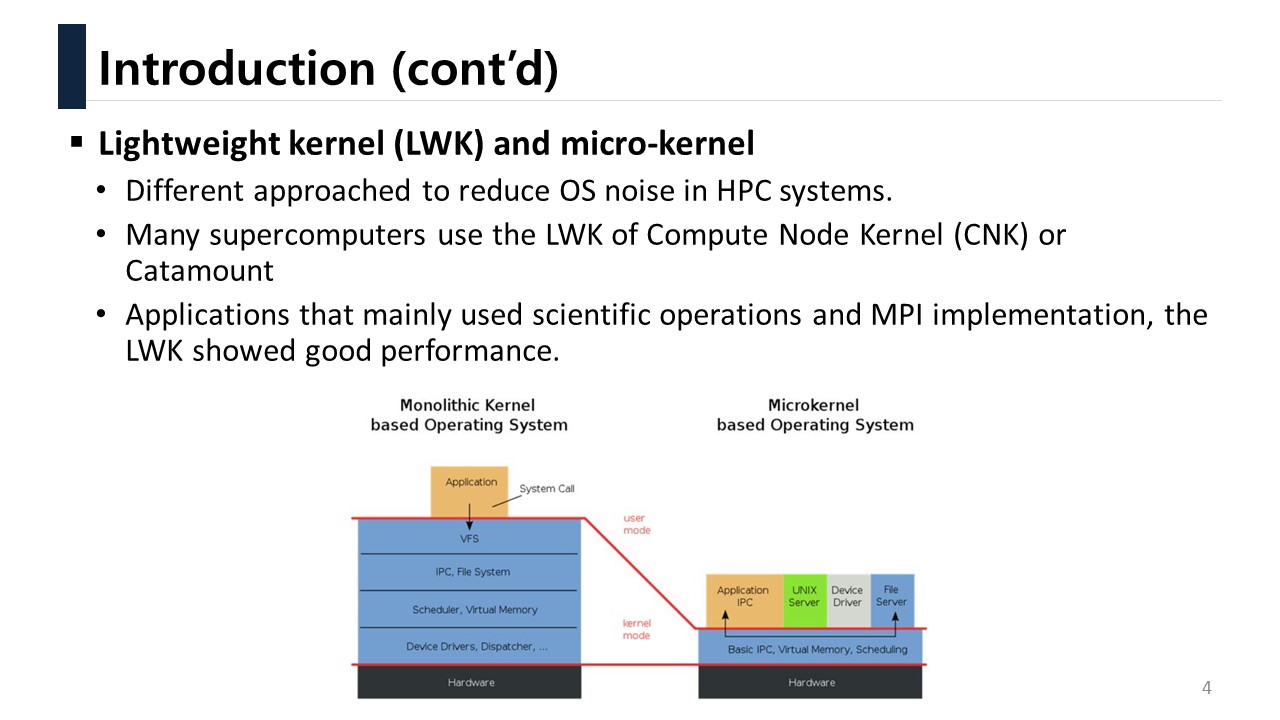 |
Many studies have been conducted to solve this problem.
For example, lightweight kernel (LWK) and micro-kernel are different approached to reduce OS noise in HPC systems. Many supercomputers use the LWK of Compute Node Kernel (CNK) or Catamount.
In the past, in applications that mainly used scientific operations and MPI implementation, the LWK showed good performance.
|
|
ICACT20210165 Slide.03
[Big slide for presentation]
|
Chrome Text-to-Speach Click!! |
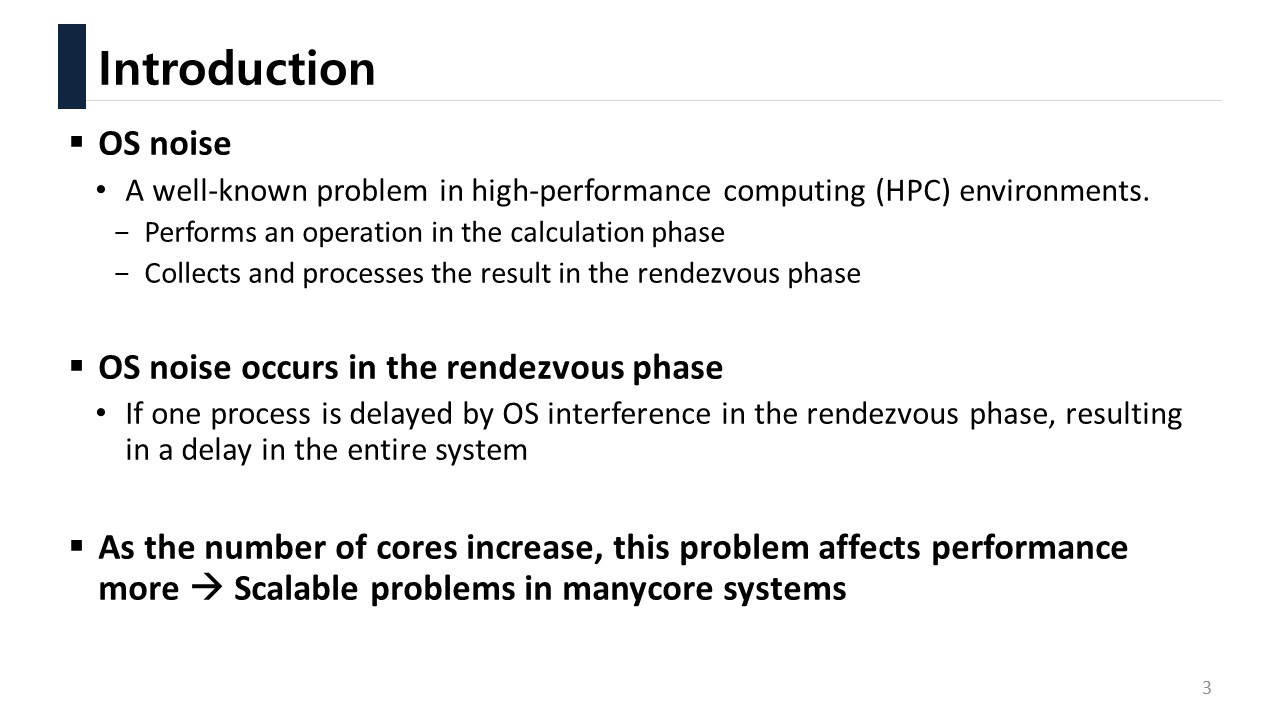 |
OS noise is a well-known problem in high-performance computing (HPC) environments. The HPC application performs an operation in the calculation phase and collects and processes the result in the rendezvous phase.
The problem of performance degradation occurs in the rendezvous phase. The investigation found that if one process is delayed by OS interference such as timer interrupt, the other processes wait while wasting their computational power in the rendezvous phase, resulting in a delay in the entire system.
This problem affects performance even more as the number of cores increases, which leads scalability problems.
|
|
ICACT20210165 Slide.02
[Big slide for presentation]
|
Chrome Text-to-Speach Click!! |
 |
This is the contents of this presentation.
|
|
ICACT20210165 Slide.01
[Big slide for presentation]
|
Chrome Text-to-Speach Click!! |
 |
Hi everybody, my name is Seung-Jun Cha. Our presentation today is about OS noise Analysis on Azalea-unikernel.
|
















