 ICACT20250133 Slide.20
[Big slide for presentation] |
Chrome Text-to-Speach Click!! |
 |
Thank you for your attention !!
|
|
ICACT20250133 Slide.19
[Big slide for presentation]
|
Chrome Text-to-Speach Click!! |
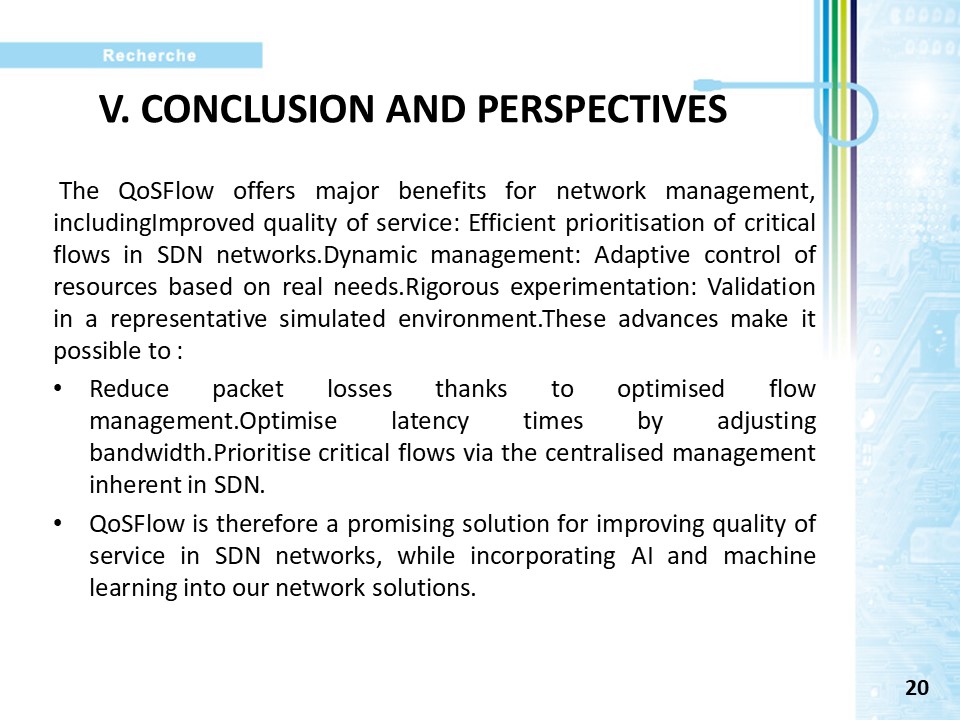 |
we can say and conclude that:
QoSFlow offers major advantages for network management, including improving Quality of Service:
• Effective flow prioritization of critical flows in SDN networks.
• Dynamic management: Adaptive resource control based on actual needs.
• Rigorous experimentation: Validation in a representative simulated environment.
These advancements enable us to:
• Reduce packet loss through optimized flow management.
• Optimize latency times by adjusting bandwidth.
• Prioritize critical flows via centralized management inherent in SDN.
QoSFlow is thus a promising solution for improving Quality of Service in SDN networks, while integrating AI and machine learning into our network solutions.
|
|
ICACT20250133 Slide.18
[Big slide for presentation]
|
Chrome Text-to-Speach Click!! |
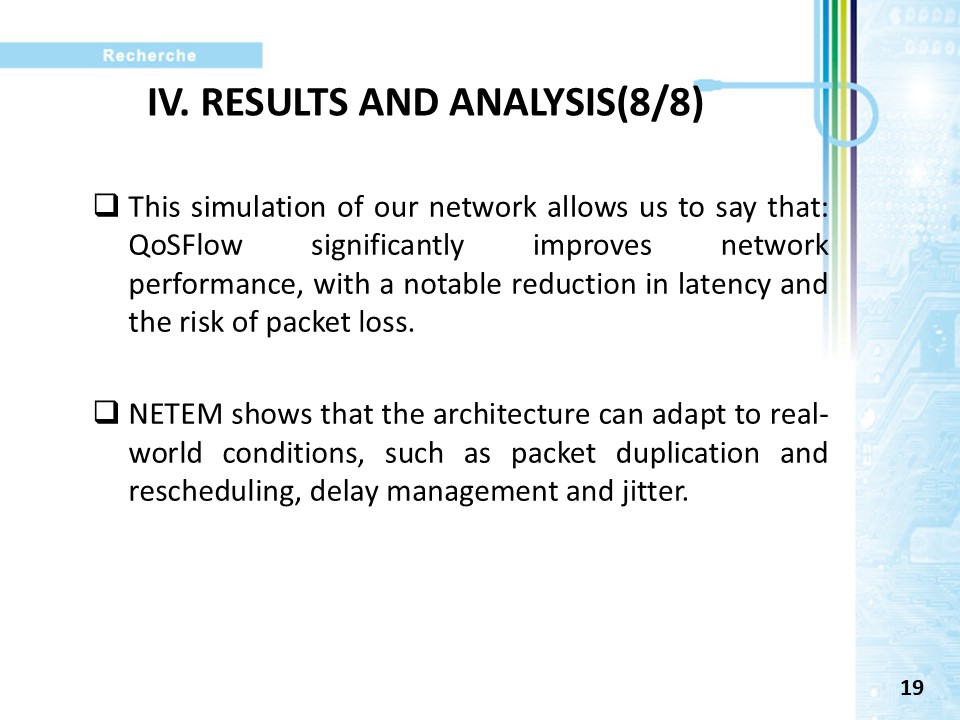 |
ladies and gentlemen of the jury, after emulating our network with NETEM, we conclude that:
This simulation of our network allows us to assert that QoSFlow significantly improves network performance, with a notable reduction in latency and packet loss risk.
NETEM shows that the architecture can adapt to real-world conditions, such as packet duplication, reordering, delay management, and jitter.
|
|
ICACT20250133 Slide.17
[Big slide for presentation]
|
Chrome Text-to-Speach Click!! |
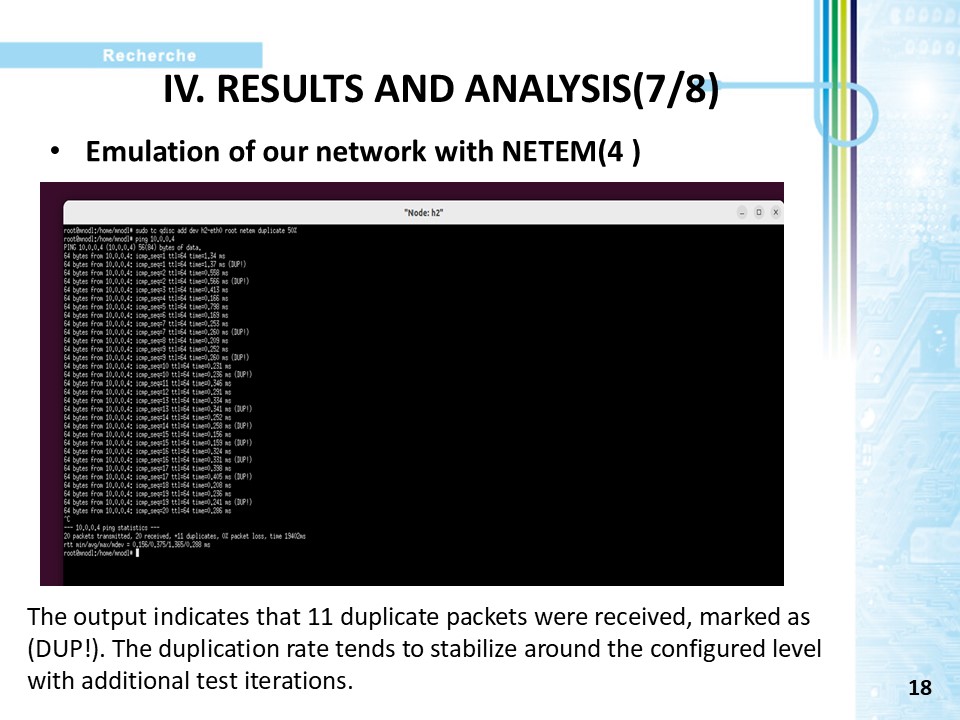 |
In this slide, ladies and gentlemen of the jury, we emulate our network with NETEM (4) by duplicating 50% of the packets in our network. The output indicates that 11 duplicated packets were received, marked as (DUP!). The duplication rate tends to stabilize around the configured level with additional test iterations.
|
|
ICACT20250133 Slide.16
[Big slide for presentation]
|
Chrome Text-to-Speach Click!! |
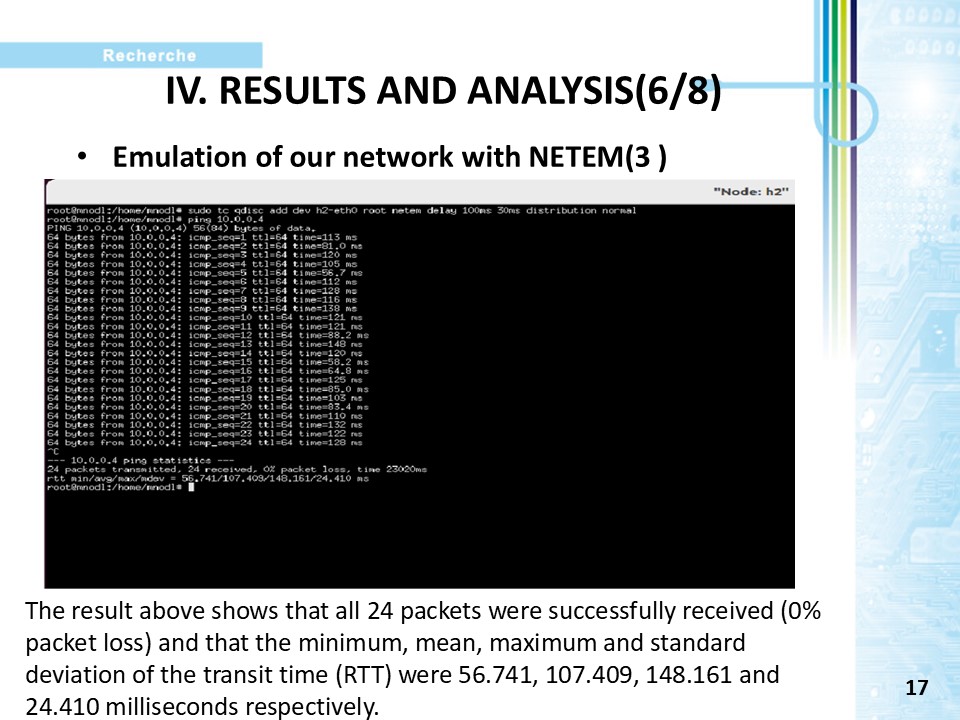 |
here, we have emulated our network with NETEM (3) by adding a normal delay distribution of 100 ms with a standard deviation of 30 ms. The result above shows that 24 packets were successfully received (0% packet loss) and the minimum, average, maximum, and standard deviation of the round-trip time (RTT) were 56.741, 107.409, 148.161, and 24.410 milliseconds, respectively.
|
|
ICACT20250133 Slide.15
[Big slide for presentation]
|
Chrome Text-to-Speach Click!! |
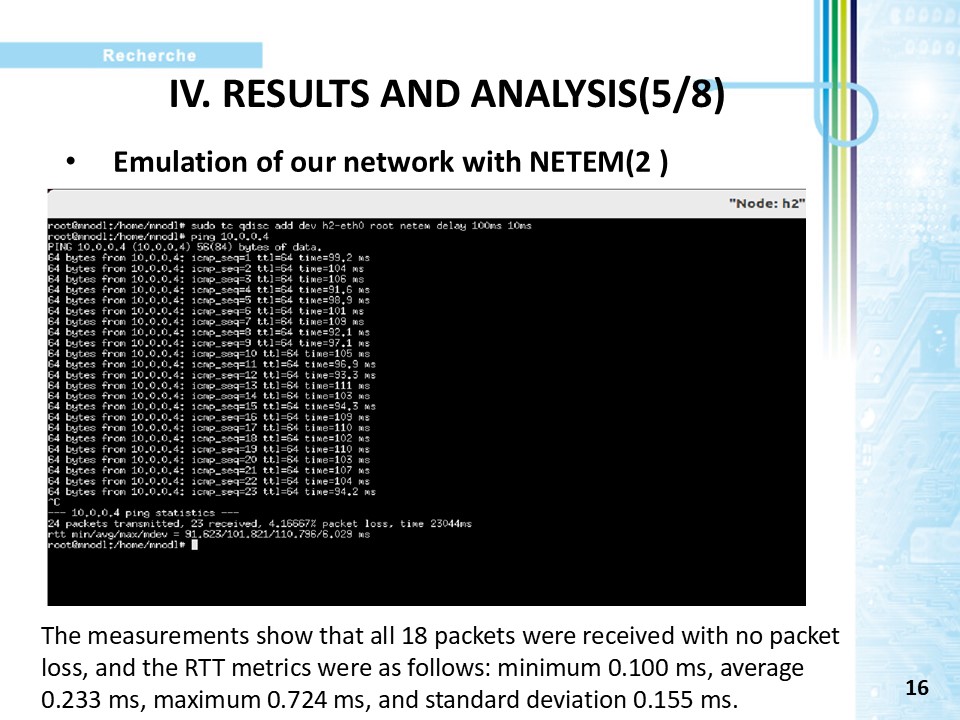 |
In this slide, ladies and gentlemen of the jury, we emulate our network with NETEM (2) by adding a delay of 100 ms and a standard deviation of 10 ms. The measurements show that the 18 packets were received without packet loss, with RTT parameters as follows: minimum 0.100 ms, average 0.233 ms, maximum 0.724 ms, and standard deviation 0.155 ms.
|
|
ICACT20250133 Slide.14
[Big slide for presentation]
|
Chrome Text-to-Speach Click!! |
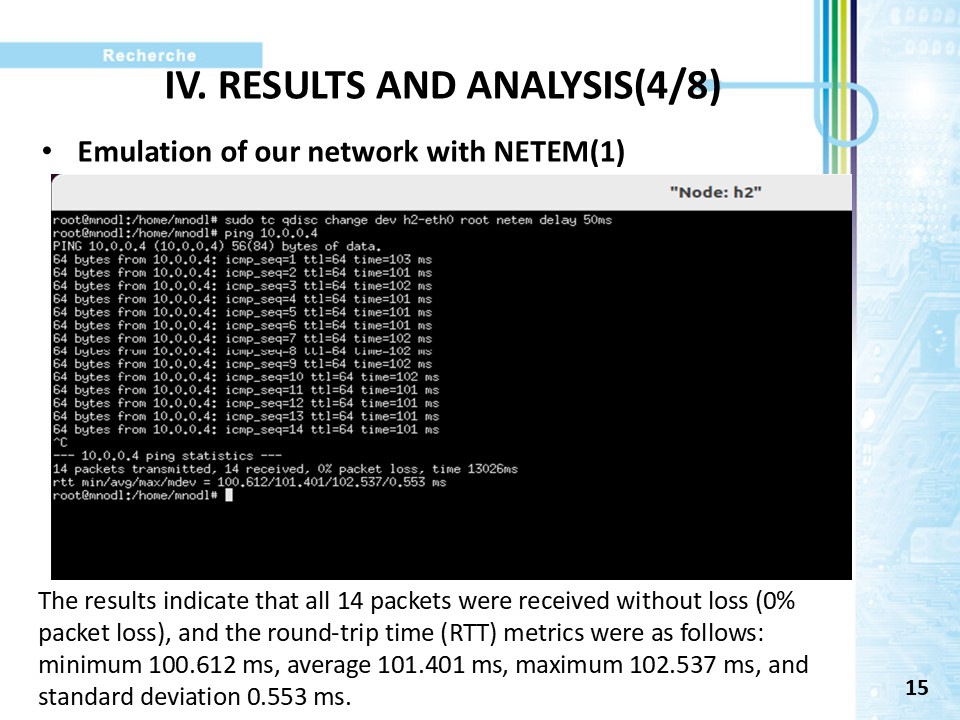 |
In this slide, ladies and gentlemen of the jury, we emulate our network with NETEM (1), and the results indicate that the 14 packets were received without loss (0% packet loss), with round-trip times (RTT) as follows: minimum 100.612 ms, average 101.401 ms, maximum 102.537 ms, and standard deviation 0.553 ms.
|
|
ICACT20250133 Slide.13
[Big slide for presentation]
|
Chrome Text-to-Speach Click!! |
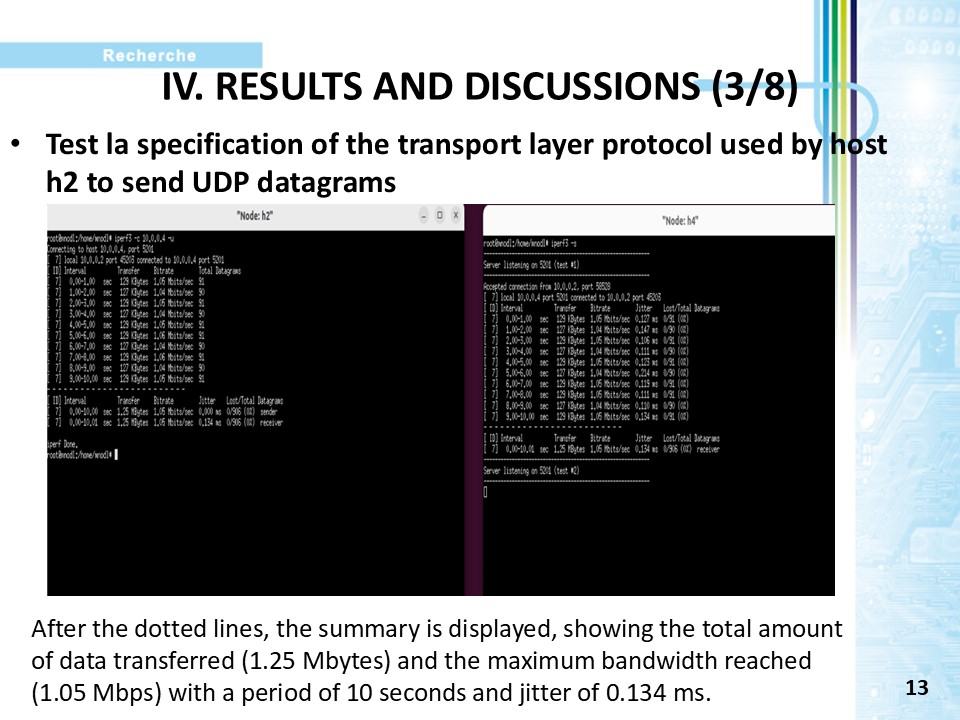 |
In this slide, we have changed the transport protocol from TCP to UDP, which also gives, after the dotted lines, the summary indicating the total data transferred (1.25 Mbytes) and the maximum bandwidth achieved (1.05 Mbps) with a period of 10 seconds and jitter of 0.134 ms.
|
|
ICACT20250133 Slide.12
[Big slide for presentation]
|
Chrome Text-to-Speach Click!! |
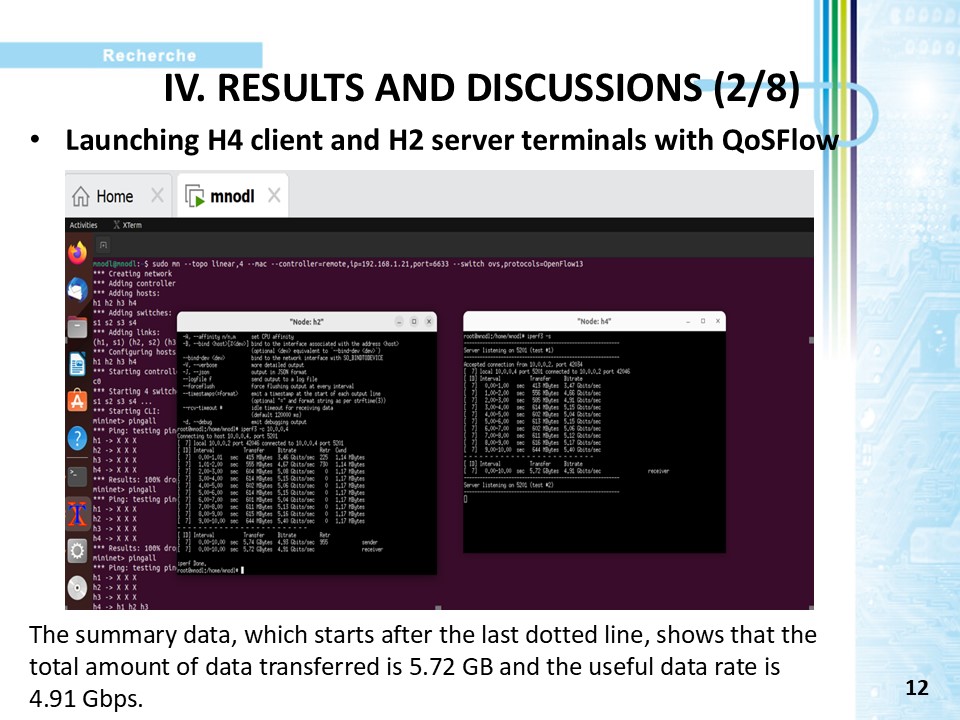 |
Here, we have launched the virtual client terminals H4 and server H2 with QoSFlow.
The summary data, starting after the last dotted line, shows that the total data transferred is 5.72 GB and the throughput is 4.91 Gbps.
|
|
ICACT20250133 Slide.11
[Big slide for presentation]
|
Chrome Text-to-Speach Click!! |
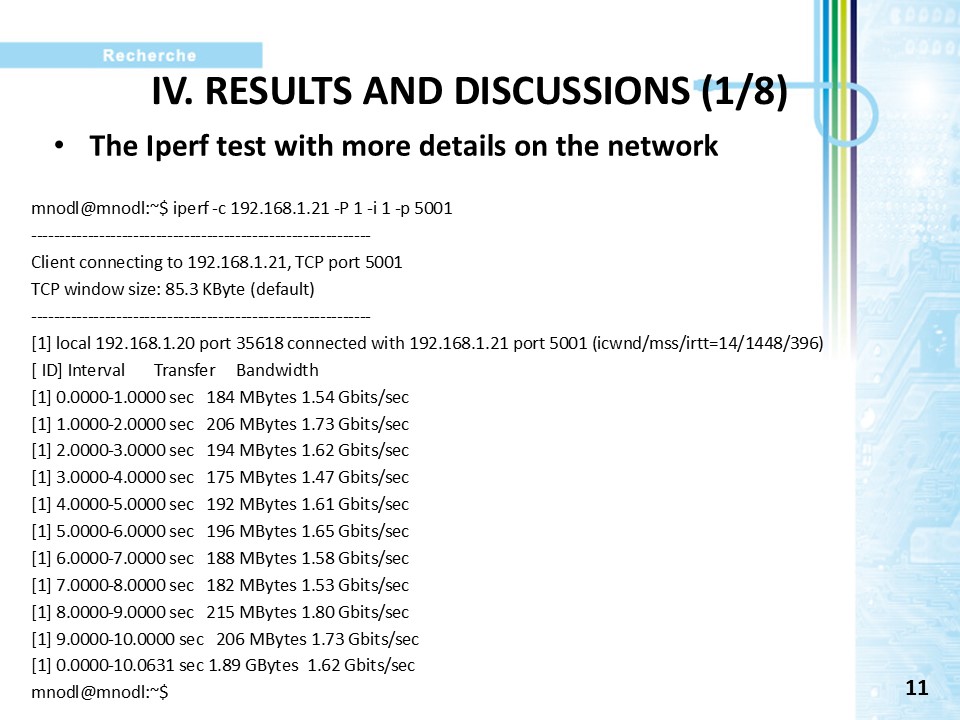 |
In this slide, we present the connection between our physical machine and the virtual one using Iperf before testing the parameters of our virtual network.
|
|
ICACT20250133 Slide.10
[Big slide for presentation]
|
Chrome Text-to-Speach Click!! |
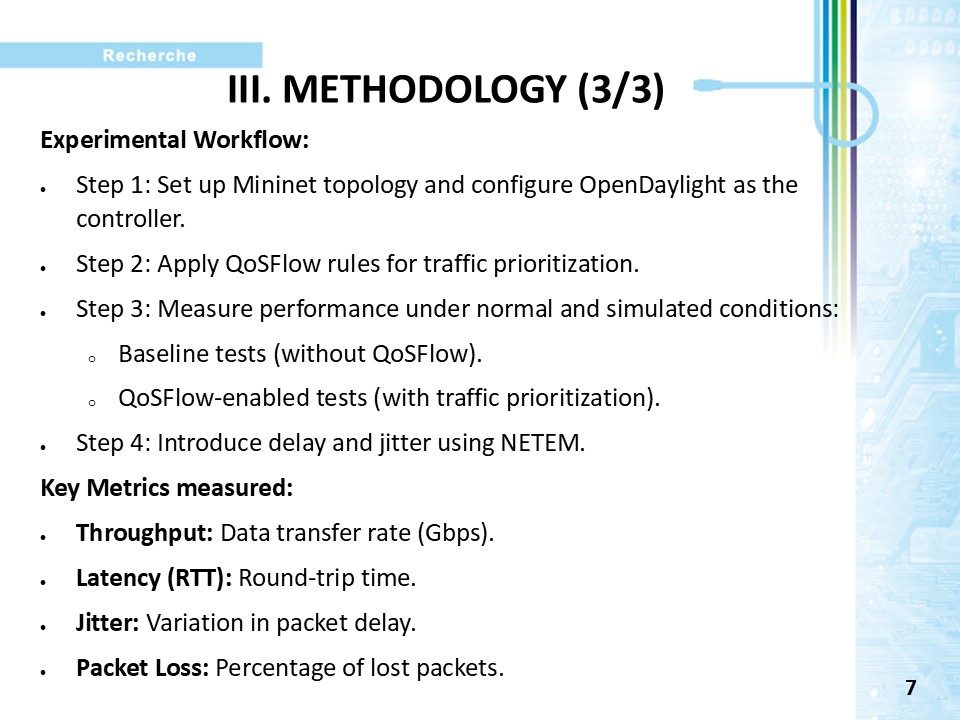 |
In this slide, ladies and gentlemen of the jury, we present the steps and main parameters measured, as follows:
Experimental Workflow:
• Step 1: Set up the Mininet topology and configure OpenDaylight as the controller.
• Step 2: Apply the QoSFlow rules for traffic prioritization.
• Step 3: Measure performance under normal and simulated conditions:
o Baseline tests (without QoSFlow).
o Tests with QoSFlow (with traffic prioritization).
• Step 4: Introduce delay and jitter using NETEM.
Main Parameters Measured:
• Throughput: Data transfer rate (Gbps).
• Latency (RTT): Round-trip time.
• Jitter: Variation in packet delay.
• Packet Loss: Percentage of lost packets.
|
|
ICACT20250133 Slide.09
[Big slide for presentation]
|
Chrome Text-to-Speach Click!! |
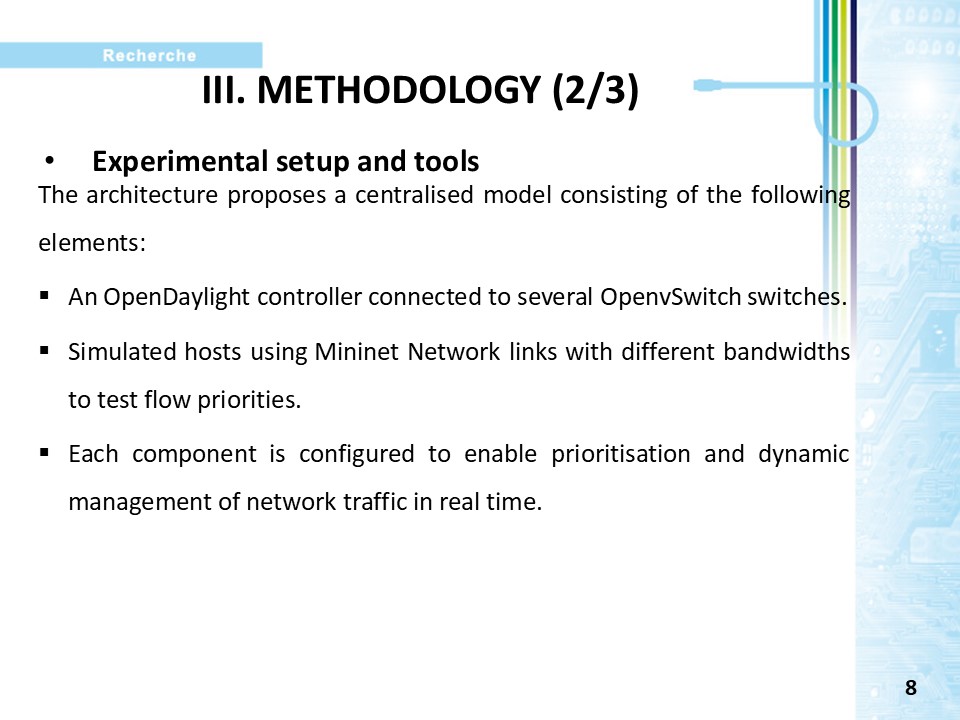 |
Our architecture in Slide 7 consists of:
The architecture proposes a centralized model composed of the following elements:
• An OpenDaylight controller connected to multiple OpenvSwitch switches.
• Simulated hosts using Mininet Network links with varying bandwidths to test flow priorities.
• Each component is configured to allow the prioritization and dynamic management of network traffic in real time.
|
|
ICACT20250133 Slide.08
[Big slide for presentation]
|
Chrome Text-to-Speach Click!! |
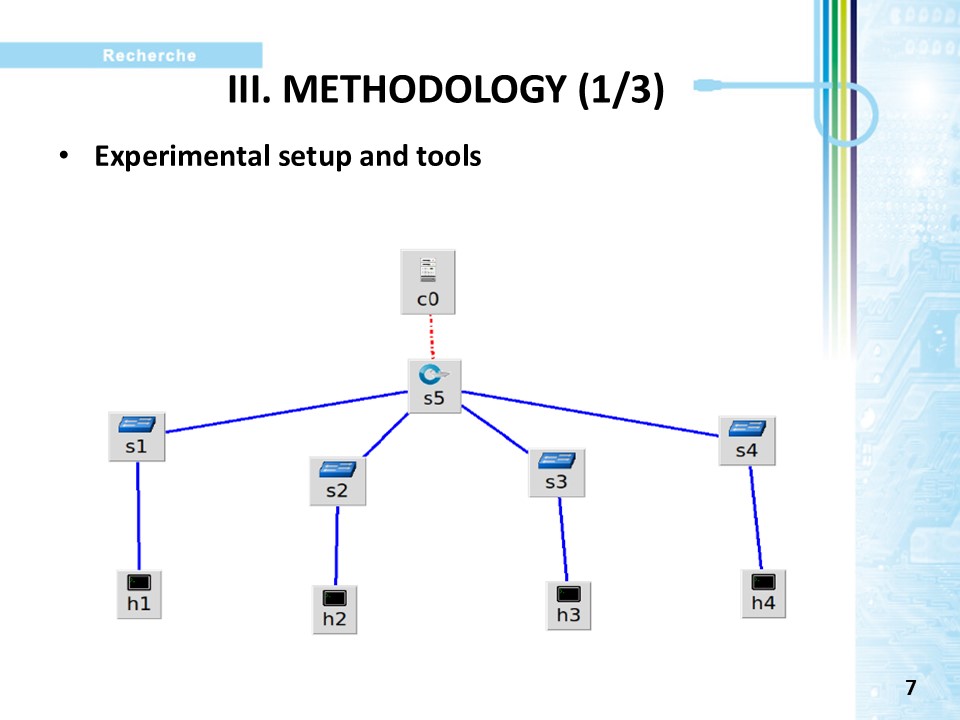 |
To effectively carry out our research project, we used the following architecture.
|
|
ICACT20250133 Slide.07
[Big slide for presentation]
|
Chrome Text-to-Speach Click!! |
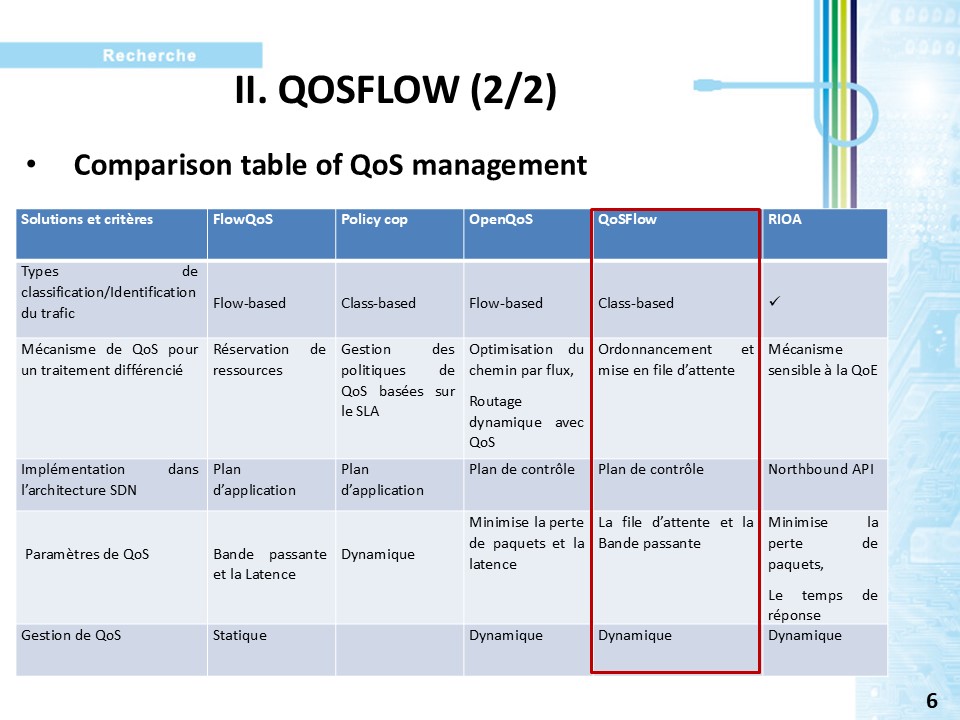 |
This comparative table of QoS solutions in SDN helped emphasize our choice of QoSFlow.
|
|
ICACT20250133 Slide.06
[Big slide for presentation]
|
Chrome Text-to-Speach Click!! |
 |
Why QoSFlow?
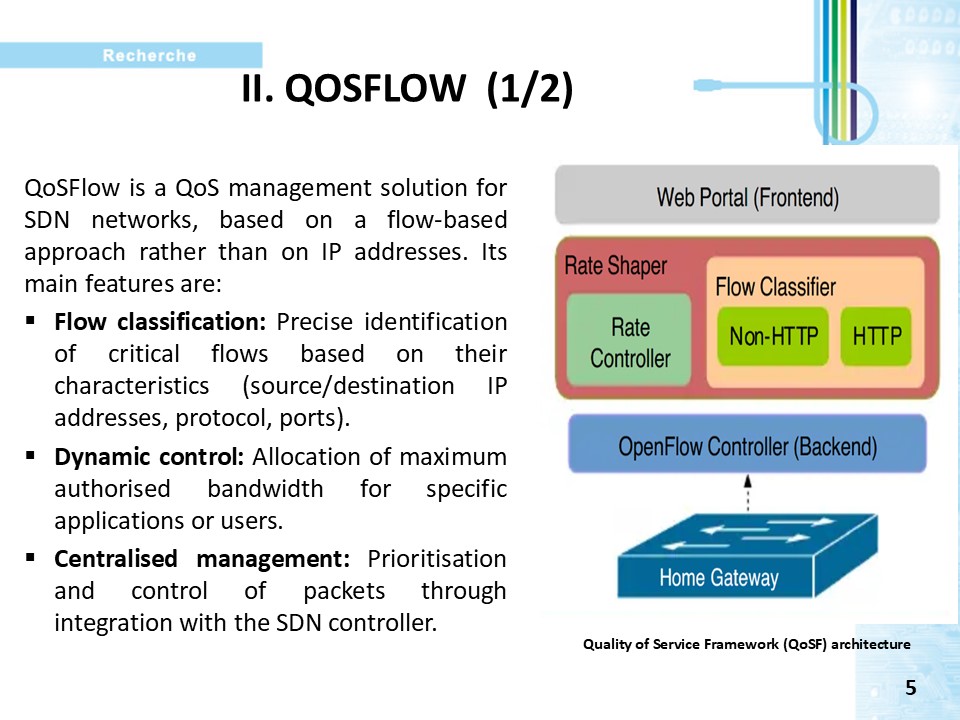
We selected QoSFlow as our solution because it redefines Quality of Service (QoS) management in Software-Defined Networking (SDN) through its innovative flow-based approach, moving beyond traditional IP address-based methods.
Key Features of QoSFlow:
Flow Classification: Enables precise identification of critical network flows by analyzing their characteristics, such as source and destination IP addresses, protocols, and port numbers.
Dynamic Control: Ensures optimal performance by dynamically allocating bandwidth based on the specific requirements of applications or users, prioritizing those with stringent QoS needs.
Centralized Management: Leverages integration with the SDN controller to streamline traffic prioritization and packet control, ensuring a more efficient and adaptable network management process.
QoSFlow’s flow-based methodology, coupled with its advanced features, positions it as a robust and forward-thinking solution for addressing the evolving challenges of QoS in SDN networks.
|
|
ICACT20250133 Slide.05
[Big slide for presentation]
|
Chrome Text-to-Speach Click!! |
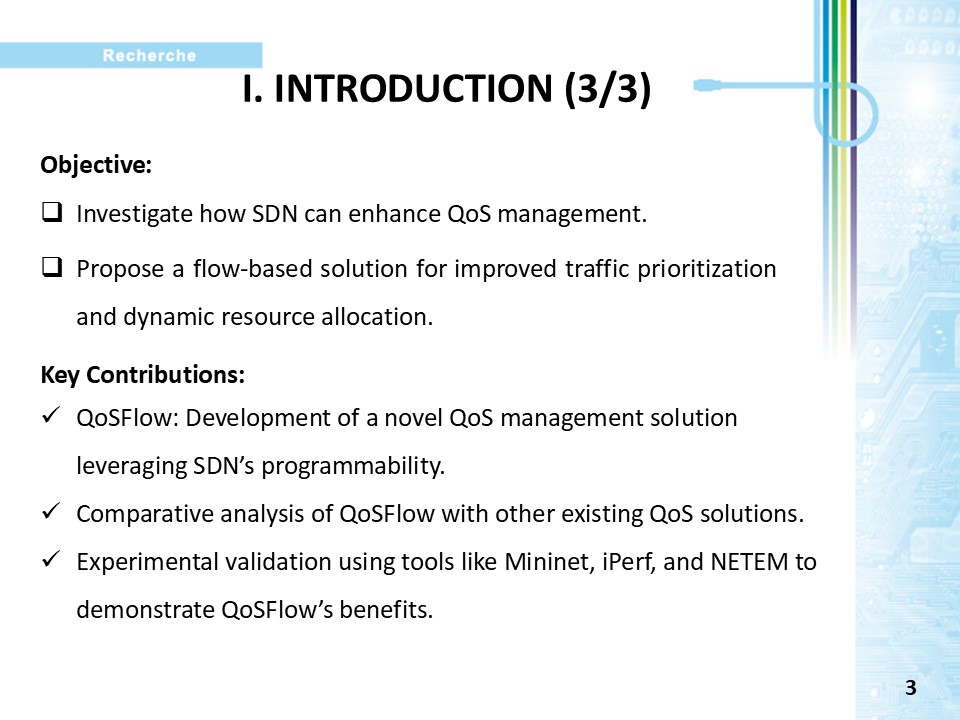 |
This quest for QoS in SDN led us to set the following objectives:
• To explore how SDN can improve QoS management,
• To propose a flow-based solution to prioritize traffic and dynamically allocate resources.
For this proposal, we made the following contributions:
• Using QoSFlow: Developing an innovative QoS management solution that leverages SDN programmability;
• Conducting a comparative analysis of QoSFlow with other existing solutions;
• Providing experimental validation using tools such as Mininet, iPerf, and NETEM to demonstrate the advantages of QoSFlow.
|
|
ICACT20250133 Slide.04
[Big slide for presentation]
|
Chrome Text-to-Speach Click!! |
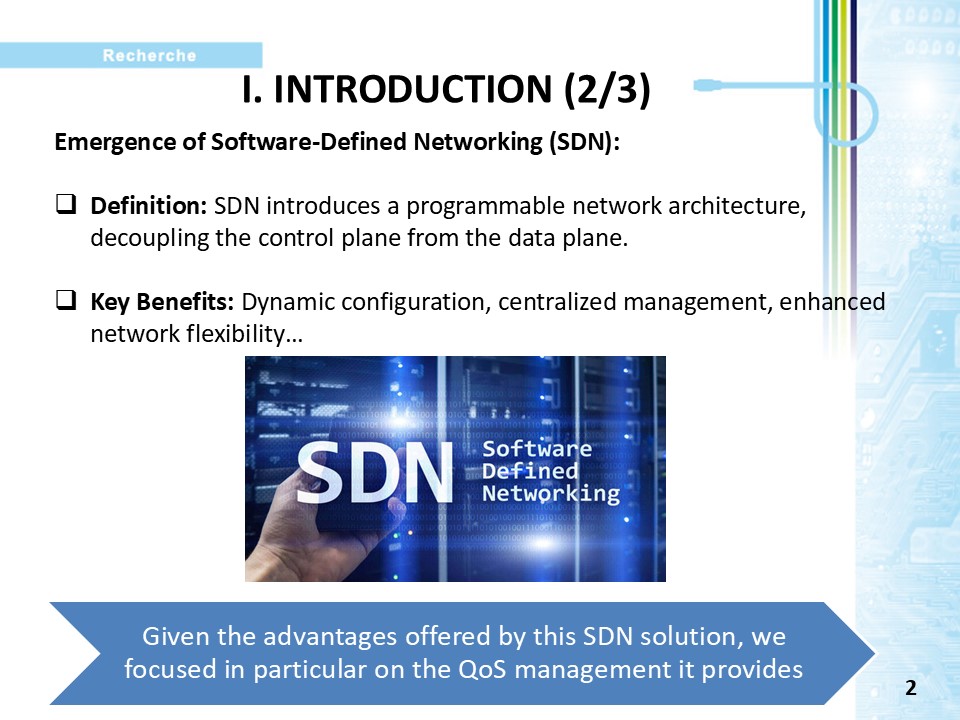 |
Ladies and gentlemen of the jury, one of the key pillars of our project is the emergence of Software-Defined Networking (SDN). SDN represents a significant shift in network architecture by introducing the separation of the control plane from the data plane and enabling network programmability.
This architectural innovation offers three major advantages:
Dynamic configuration: SDN provides the ability to adapt and reconfigure networks in real-time to meet changing traffic demands or operational needs. This level of flexibility is especially critical in today’s rapidly evolving network environments.
Centralized management: By centralizing control, SDN enables network operators to manage resources more effectively, optimize traffic flows, and implement consistent policies across the network.
Increased network flexibility: SDN allows for rapid deployment of new services and better adaptation to the diverse needs of modern applications, including those with stringent QoS requirements like IoT, VoIP, and real-time streaming.
Considering these advantages, our research has placed a particular emphasis on Quality of Service (QoS) management within SDN. We believe that leveraging SDN's programmability and centralized control can significantly enhance the prioritization of traffic flows and the dynamic allocation of resources, addressing some of the key challenges faced by traditional networks.
|
|
ICACT20250133 Slide.03
[Big slide for presentation]
|
Chrome Text-to-Speach Click!! |
 |
We live in an era where traditional networks are often overwhelmed by the rapid growth of traffic, and the lack of flexibility and adaptability to the evolving demands of traffic.
This rapid increase in network traffic makes ensuring Quality of Service (QoS) more and more difficult.
The impact of these limitations includes:
• Increased packet loss and delays in data transmission.
• Difficulty in supporting applications with strict QoS requirements, such as streaming, online gaming, IoT, and VOIP.
These limitations in traditional networks led us to explore new solutions, one of which is SDN.
|
|
ICACT20250133 Slide.02
[Big slide for presentation]
|
Chrome Text-to-Speach Click!! |
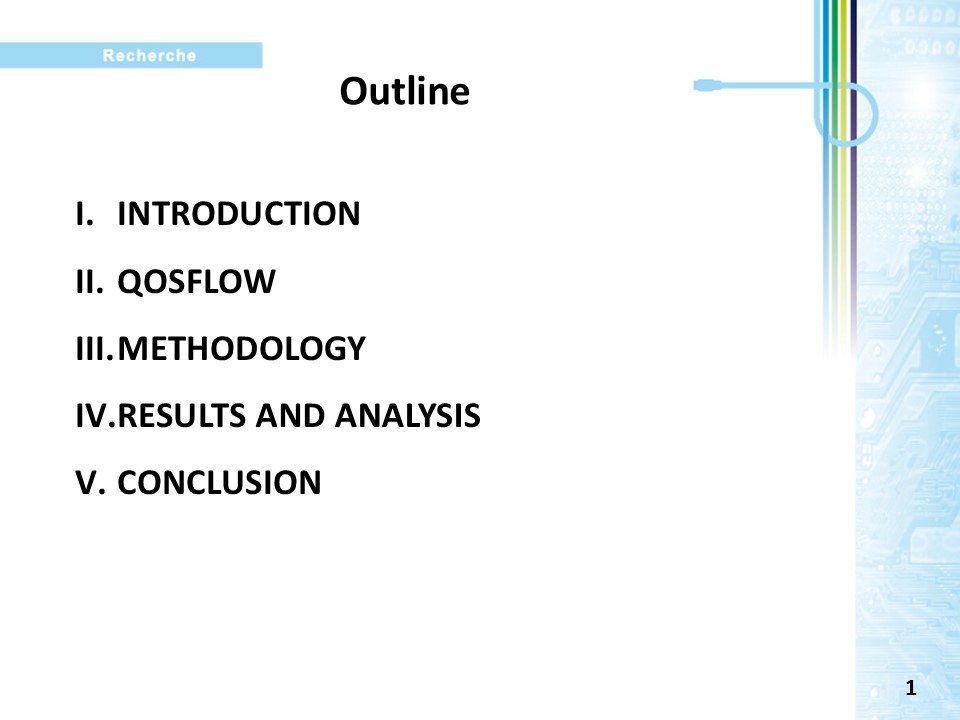 |
Ladies and gentlemen of the jury, our research presentation will be structured around five main points, namely:
Introduction
QoSFlow
Methodology
Results and Analysis
Conclusion
This structure will guide us through the key aspects of our study, highlighting the challenges, our innovative solution, and the findings we achieved through experimentation.
|
|
ICACT20250133 Slide.01
[Big slide for presentation]
|
Chrome Text-to-Speach Click!! |
 |
Hello everyone,
Good morning, ladies and gentlemen of the jury, and thank you for the opportunity to present the results of our research on the project entitled "QoSFlow: Prioritizing Flows in Software-Defined Networks for Enhanced Quality of Service."
My name is Jean Pierre Leno, and I am a telecommunications engineer. I am presenting this work along with the following authors:
• Mr. Dourahamane IDE BARKIRE
• Dr. Benjamin KONÉ
• Mr. Jean Pierre LENO (myself)
• Prof. Ahmed Dooguy KORA
This research has been conducted under the E-INOV LAB at ESMT, Dakar, Senegal.
The goal of our project is to address the growing challenges in Quality of Service (QoS) management in traditional networks by proposing an innovative solution based on Software-Defined Networking (SDN).
|
















