 ICACT20240369 Slide.21
[Big slide for presentation]
[YouTube] |
Chrome Text-to-Speach Click!! |
 |
The above is the entire content of my current display, criticism and correction are welcome.
|
|
ICACT20240369 Slide.20
[Big slide for presentation]
[YouTube] |
Chrome Text-to-Speach Click!! |
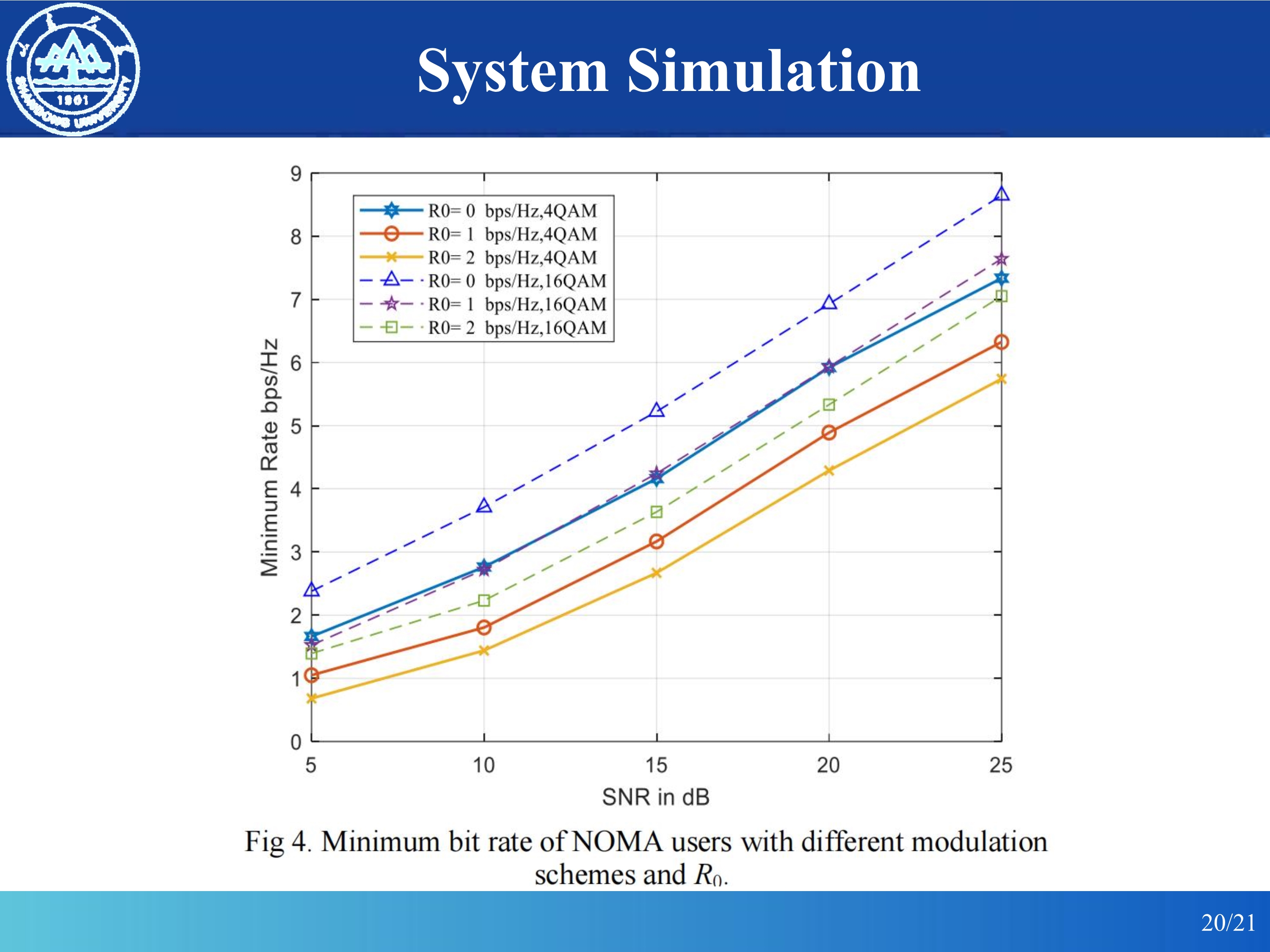 |
Fig. 4 depicts the minimum bit rates of NOMA users for OPA policy with different modulation modes and QoS constraints of V0 considering three NOMA users, we use the appropriate channel coding scheme respectively. It is seen that the case of 16QAM outperforms the case of 4QAM since it transmits more bits per symbol. As the QoS constraints of V0 intensify (continuously increasing with R0), the minimum rate for NOMA users diminishes due to increased power allocation for QoS of V0. In the low SNR regions, this depletes the power of the NOMA users, which further impacts the accuracy and performance of SIC. When without rate constraints for V0, the high-speed user will not influence power allocation, the NOMA users’ rates peaked.
|
|
ICACT20240369 Slide.19
[Big slide for presentation]
[YouTube] |
Chrome Text-to-Speach Click!! |
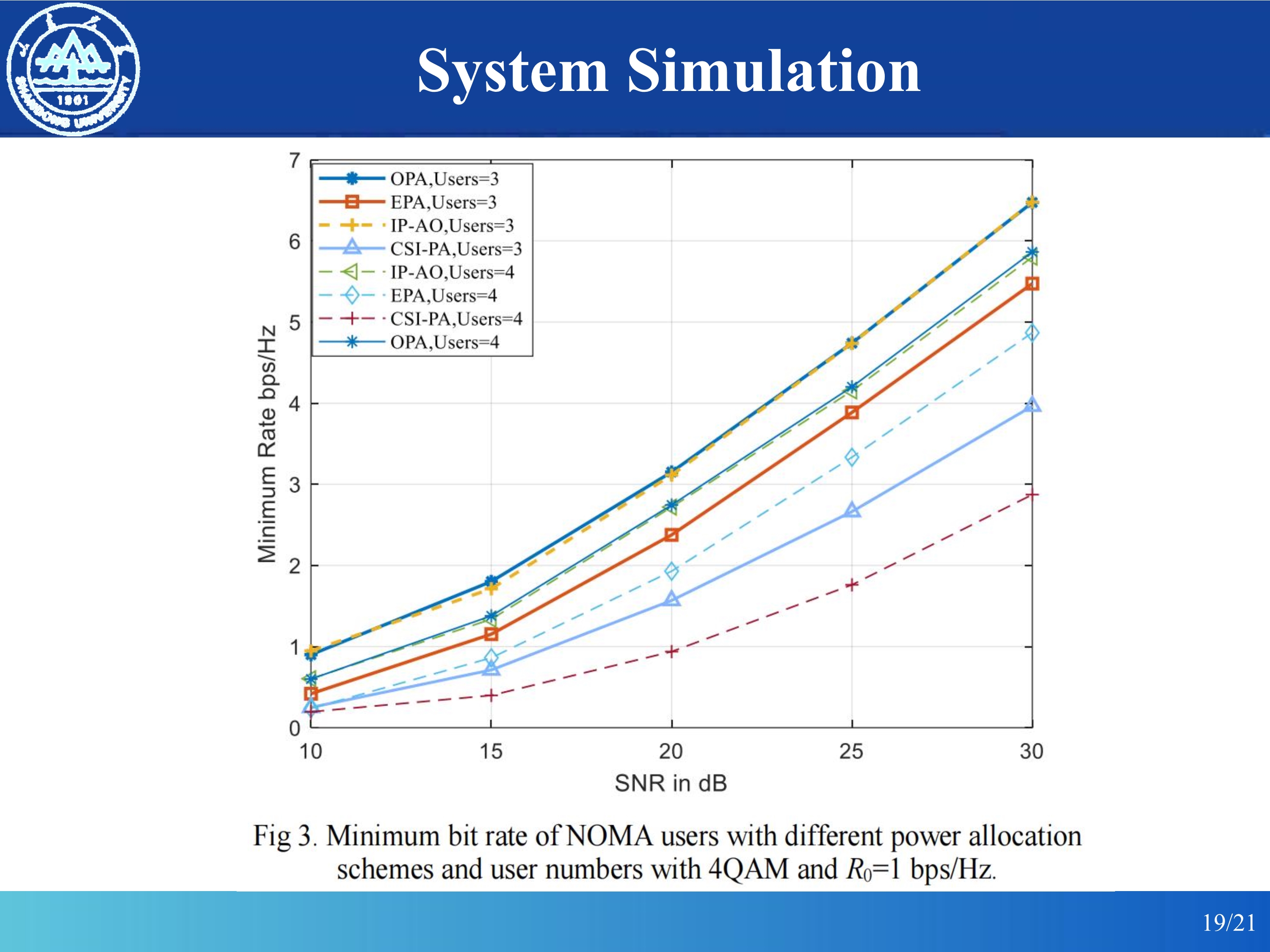 |
We compare the NOMA users’minimum bit rates under different power allocation policies and NOMA user numbers in Fig. 3, the proposed IP-AO and OPA outperform both EPA and channel state information-based power allocation (CSI-PA) strategy [9] (the allocated power of each user is proportional to the channel gain). The OPA scheme achieves the maximum system bit rate with minimum complexity. Meanwhile, CSI-PA method exacerbates user unfairness and results in suboptimal performance. Specially, the fixed power allocation yields decreased minimum rates with more users, which is due to the total power constraints
|
|
ICACT20240369 Slide.18
[Big slide for presentation]
[YouTube] |
Chrome Text-to-Speach Click!! |
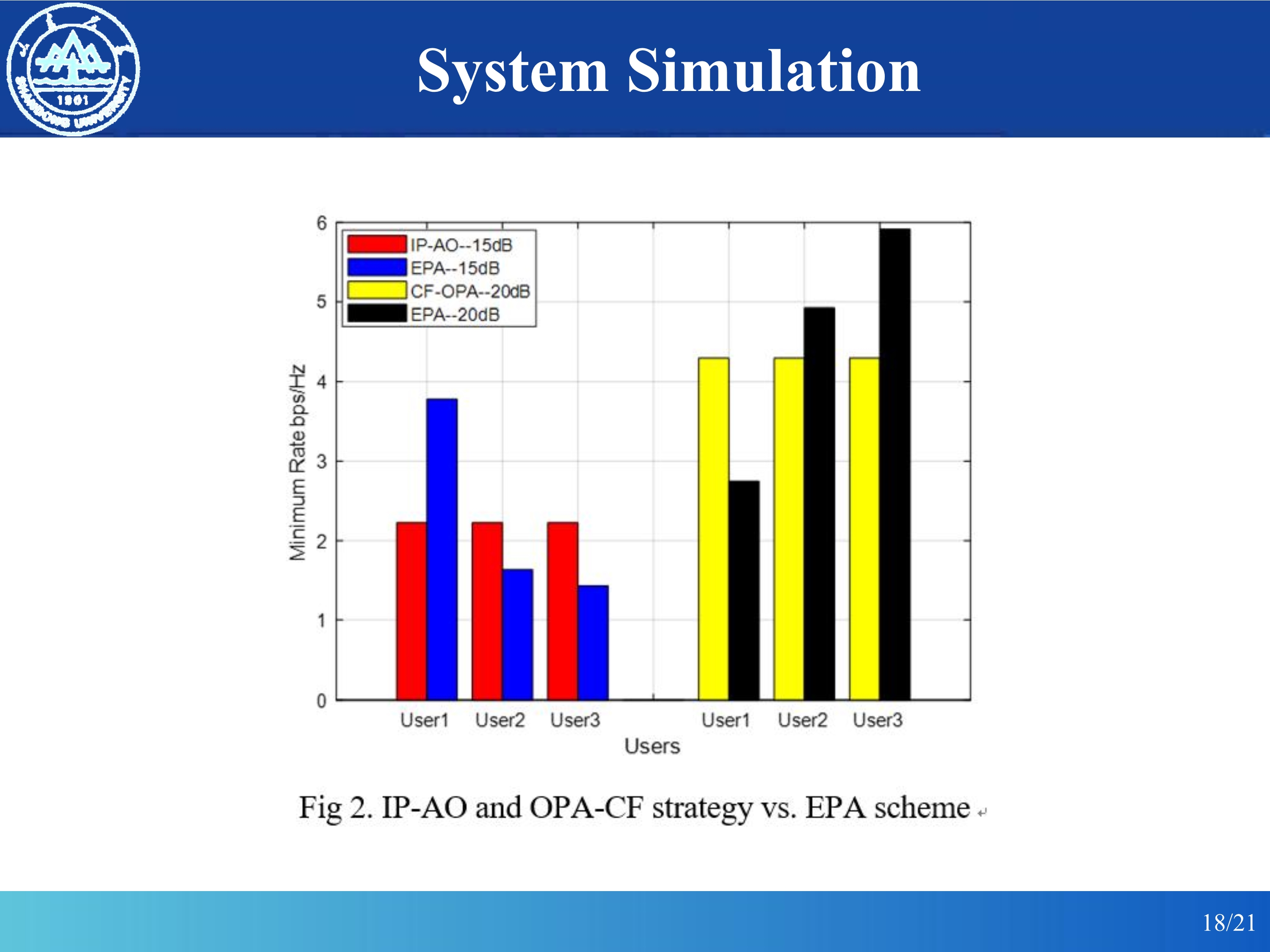 |
In the display on this page, you will see the picture that the IP-AO and OPA strategy vs traditional EPA scheme.As shown in Fig. 2, both of the proposed power allocation schemes show significant advantages in rate distribution compared with the equal power allocation (EPA) strategy. Both schemes can ensure the rate fairness among NOMA users under different transmit SNRs, while the EPA method leads to obvious rate difference. However, power allocation schemes based on user fairness are realized at the expense of system throughput or efficiency.
|
|
ICACT20240369 Slide.17
[Big slide for presentation]
[YouTube] |
Chrome Text-to-Speach Click!! |
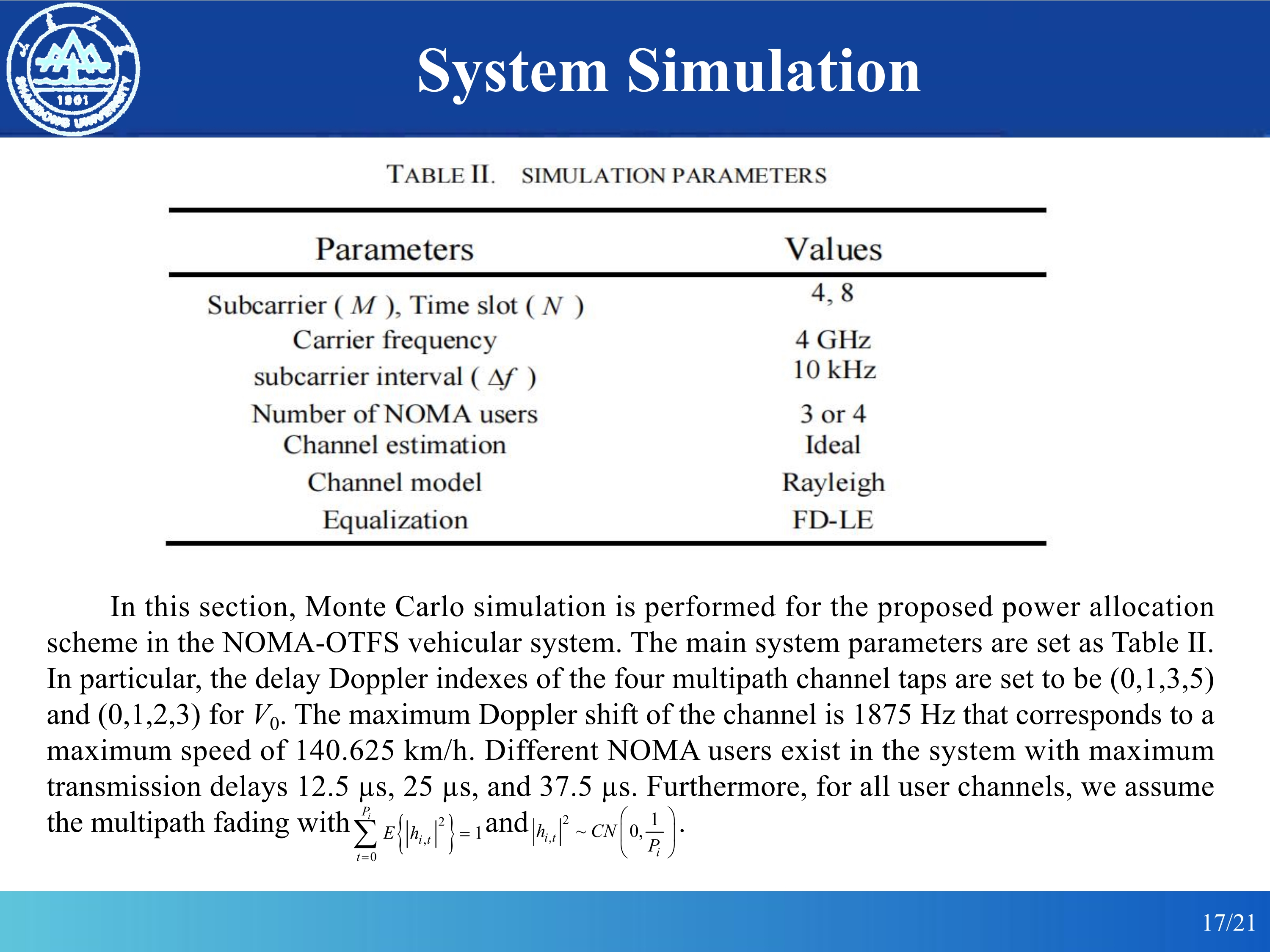 |
In this section, Monte Carlo simulation is performed for the proposed power allocation scheme in the NOMA-OTFS vehicular system. The main system parameters are set as Table Ⅱ. In particular, the delay Doppler indexes of the four multipath channel taps are set to be (0,1,3,5) and (0,1,2,3) for V0. The maximum Doppler shift of the channel is 1875 Hz that corresponds to a maximum speed of 140.625 km/h. Different NOMA users exist in the system with maximum transmission delays 12.5 µs, 25 µs, and 37.5 µs. Furthermore, for all user channels, we assume the multipath fading with this and that.
|
|
ICACT20240369 Slide.16
[Big slide for presentation]
[YouTube] |
Chrome Text-to-Speach Click!! |
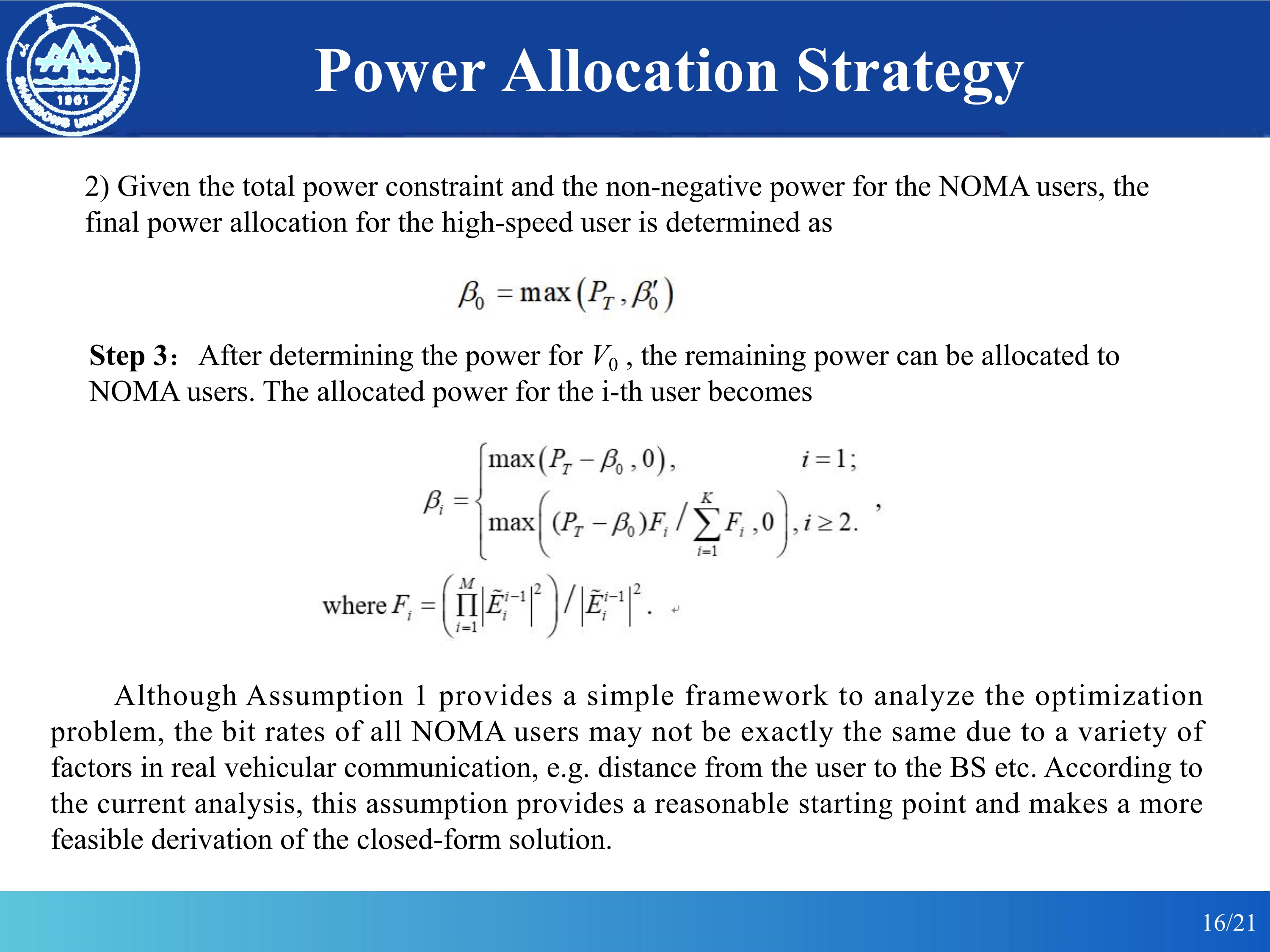 |
Given the total power constraint and the non-negative power for the NOMA users, the final power allocation for the high-speed user is determined as the first formula. After determining the power for V0 , the remaining power can be allocated to NOMA users. The allocated power for the i-th user becomes the second formula.Although Assumption 1 provides a simple framework to analyze the optimization problem, the bit rates of all NOMA users may not be exactly the same due to a variety of factors in real vehicular communication, e.g. distance from the user to the BS etc. According to the current analysis, this assumption provides a reasonable starting point and makes a more feasible derivation of the closed-form solution.
|
|
ICACT20240369 Slide.15
[Big slide for presentation]
[YouTube] |
Chrome Text-to-Speach Click!! |
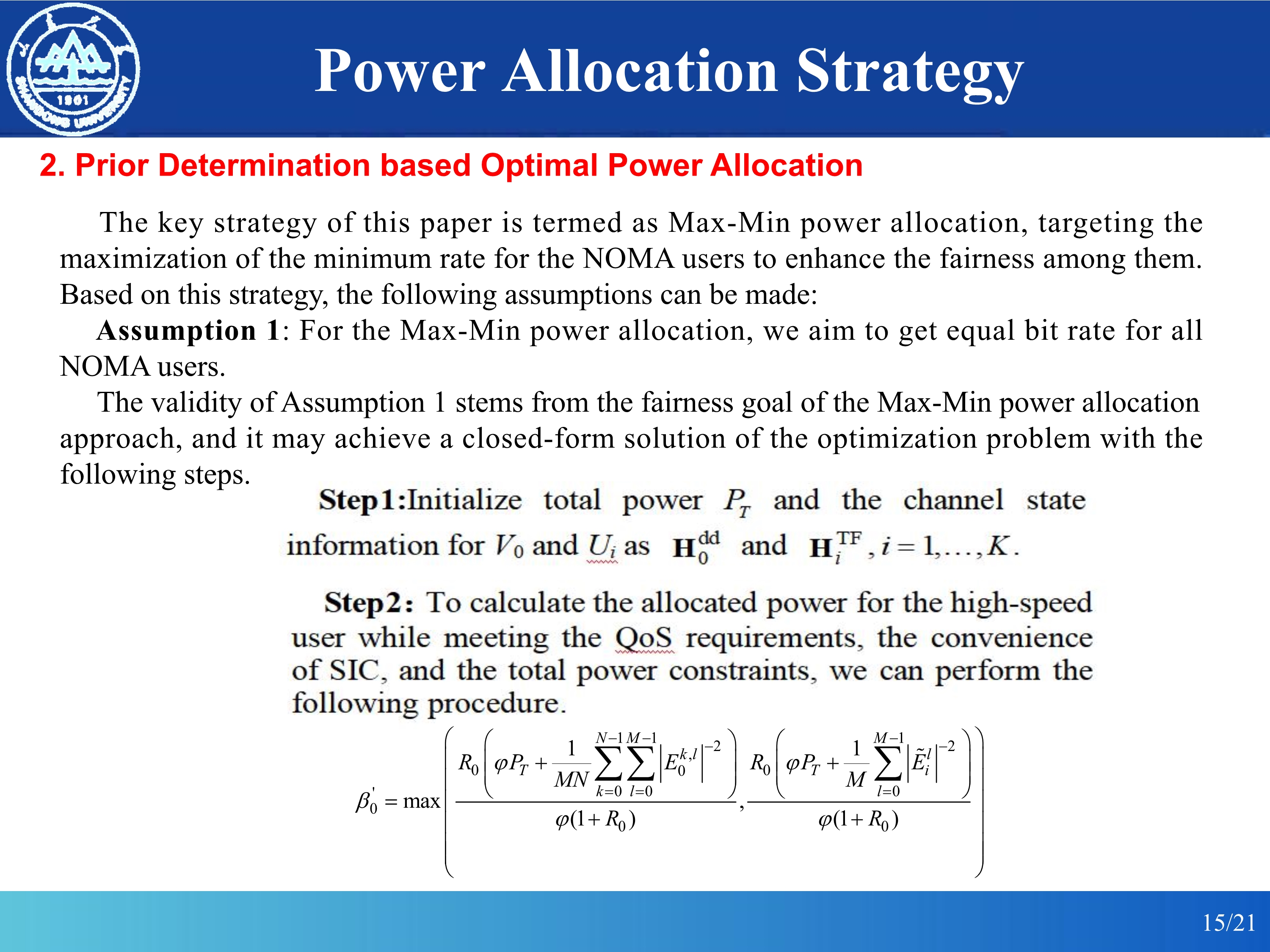 |
The key strategy of this paper is termed as Max-Min power allocation, targeting the maximization of the minimum rate for the NOMA users to enhance the fairness among them. Based on this strategy, the following assumptions can be made:
Assumption 1: For the Max-Min power allocation, we aim to get equal bit rate for all NOMA users.
The validity of Assumption 1 stems from the fairness goal of the Max-Min power allocation approach, and it may achieve a closed-form solution of the optimization problem with the following steps.Please browse by yourself
|
|
ICACT20240369 Slide.14
[Big slide for presentation]
[YouTube] |
Chrome Text-to-Speach Click!! |
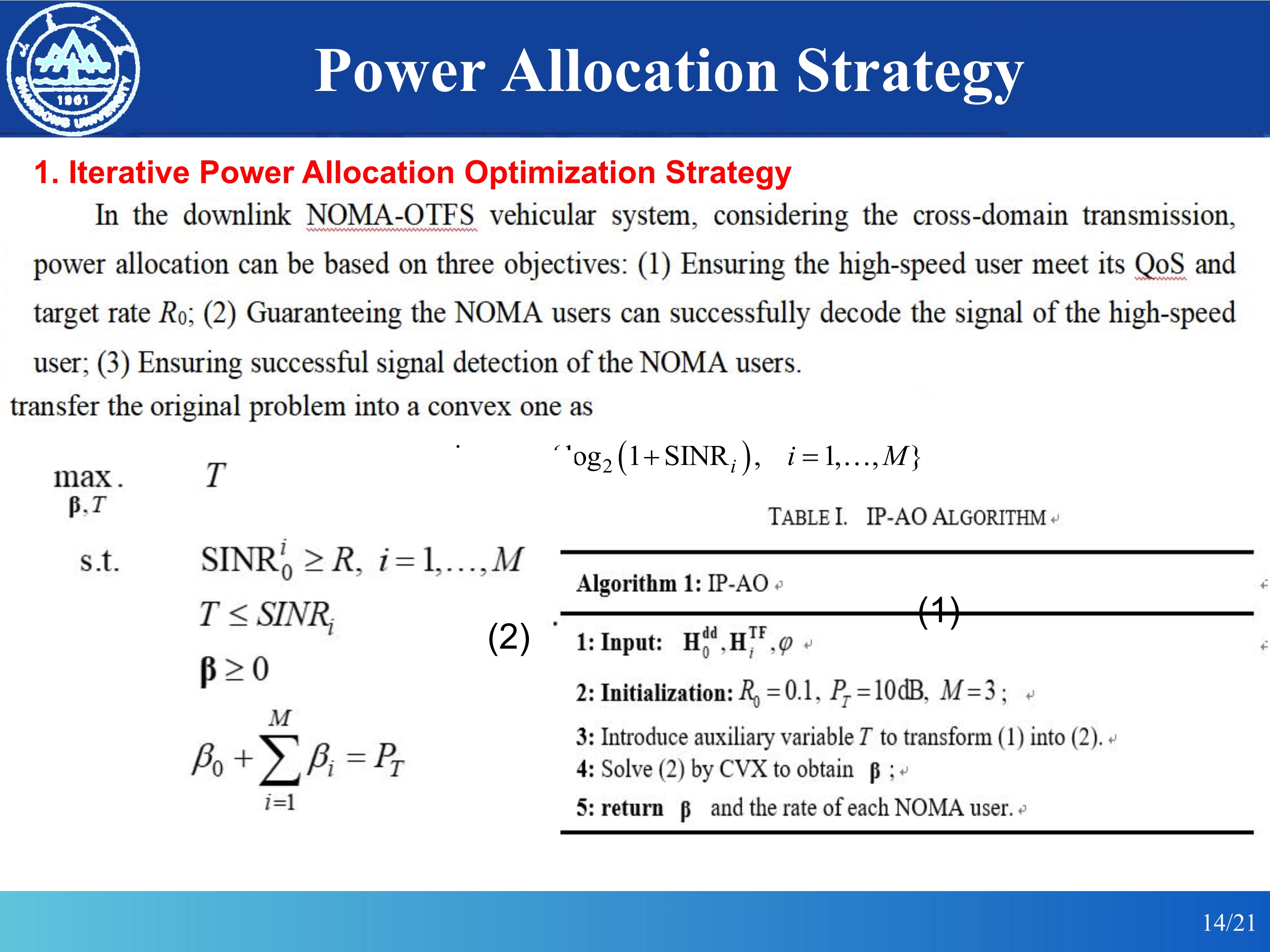 |
In the downlink NOMA-OTFS vehicular system, considering the cross-domain transmissionpower allocation can be based on three objectives: (l) Ensuring the high-speed user meet its QoS andtarget rate R0, (2) Guaranteeing the NOMA users can successfully decode the signal of the high-speeduser: (3) Ensuring successful signal detection of the NOMA users.The objective function aims to maximize the minimum data rates of Ui,i =l,...,K . The constraint guarantees the target data rate of while ensuring that the NOMA users can successfully decode the signal of with a given total system power limit.Since the optimization problem is non-convex. auxiliary variable is introduced totransfer the original problem into a convex one as the formula,the IP-AO algorithm as follows.
|
|
ICACT20240369 Slide.13
[Big slide for presentation]
[YouTube] |
Chrome Text-to-Speach Click!! |
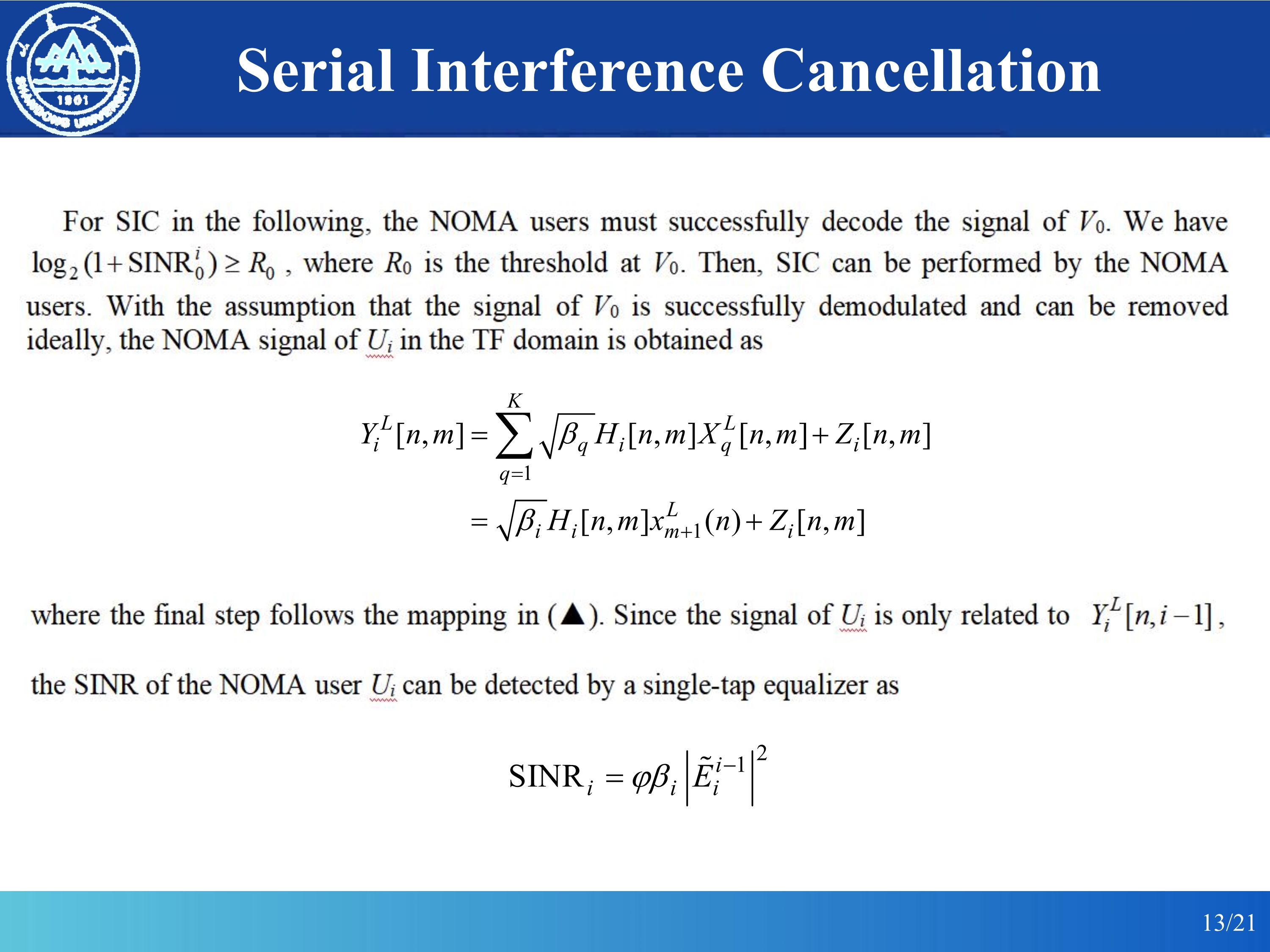 |
For SIC in the following, the NOMA users must successfully decode the signal of V0. We havelog,(l+SINR0)> R0 , where R0 is the threshold at V0. Then, SIC can be performed by the NOMA users. With the assumption that the signal of V is successfully demodulated and can be removed ideally, the NOMA signal of Ui in the TF domain is obtained as the first formula.The SINR of the NOMA user Ui can be detected by a single-tap equalizer as the second formula.
|
|
ICACT20240369 Slide.12
[Big slide for presentation]
[YouTube] |
Chrome Text-to-Speach Click!! |
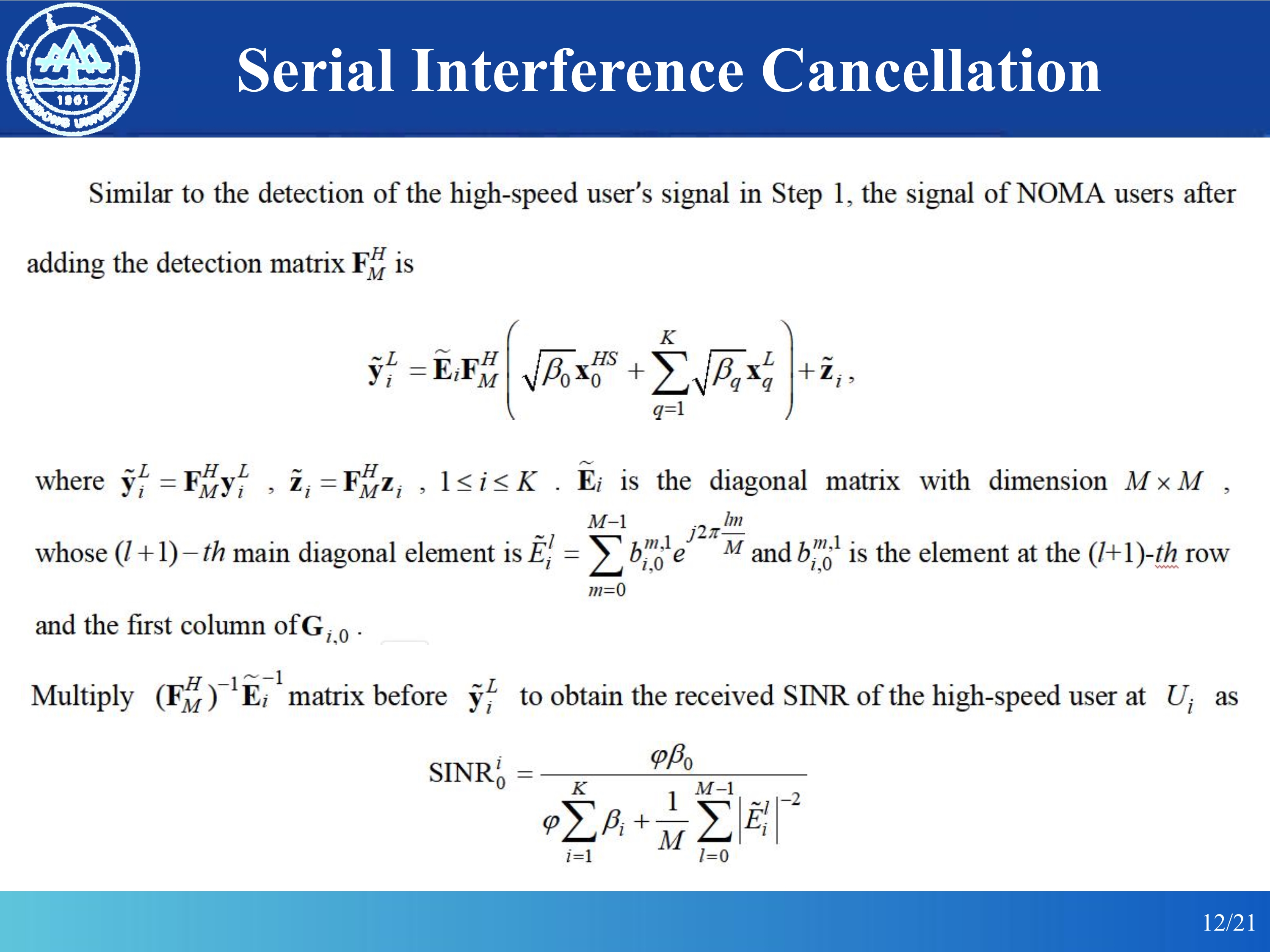 |
Similar to the detection of the high-speed user's signal in Step l, the signal of NOMA users after adding the detection matrix is the first formula.Multiply the matrix before yil to obtain the received SINR of the high-speed user at Ui as the second formula.
|
|
ICACT20240369 Slide.11
[Big slide for presentation]
[YouTube] |
Chrome Text-to-Speach Click!! |
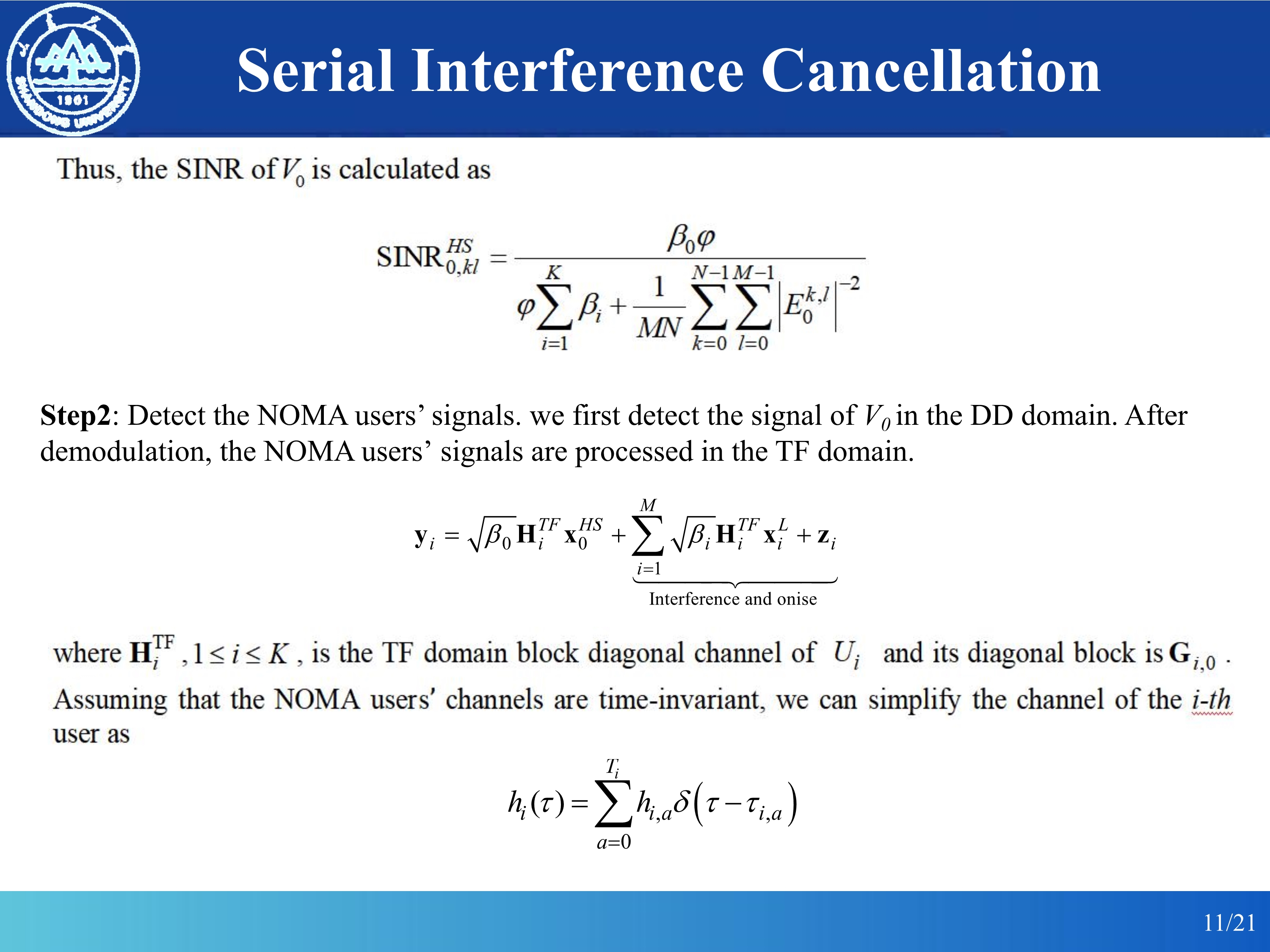 |
Thus,the SINR of V0 is calculated as the first formula.Step2: Detect the NOMA users’ signals. we first detect the signal of V0 in the DD domain. After demodulation, the NOMA users’ signals are processed in the TF domain.Assuming that the NOMA users' channels are time-invariant, we can simplify the channel of the i-th user as follows.
|
|
ICACT20240369 Slide.10
[Big slide for presentation]
[YouTube] |
Chrome Text-to-Speach Click!! |
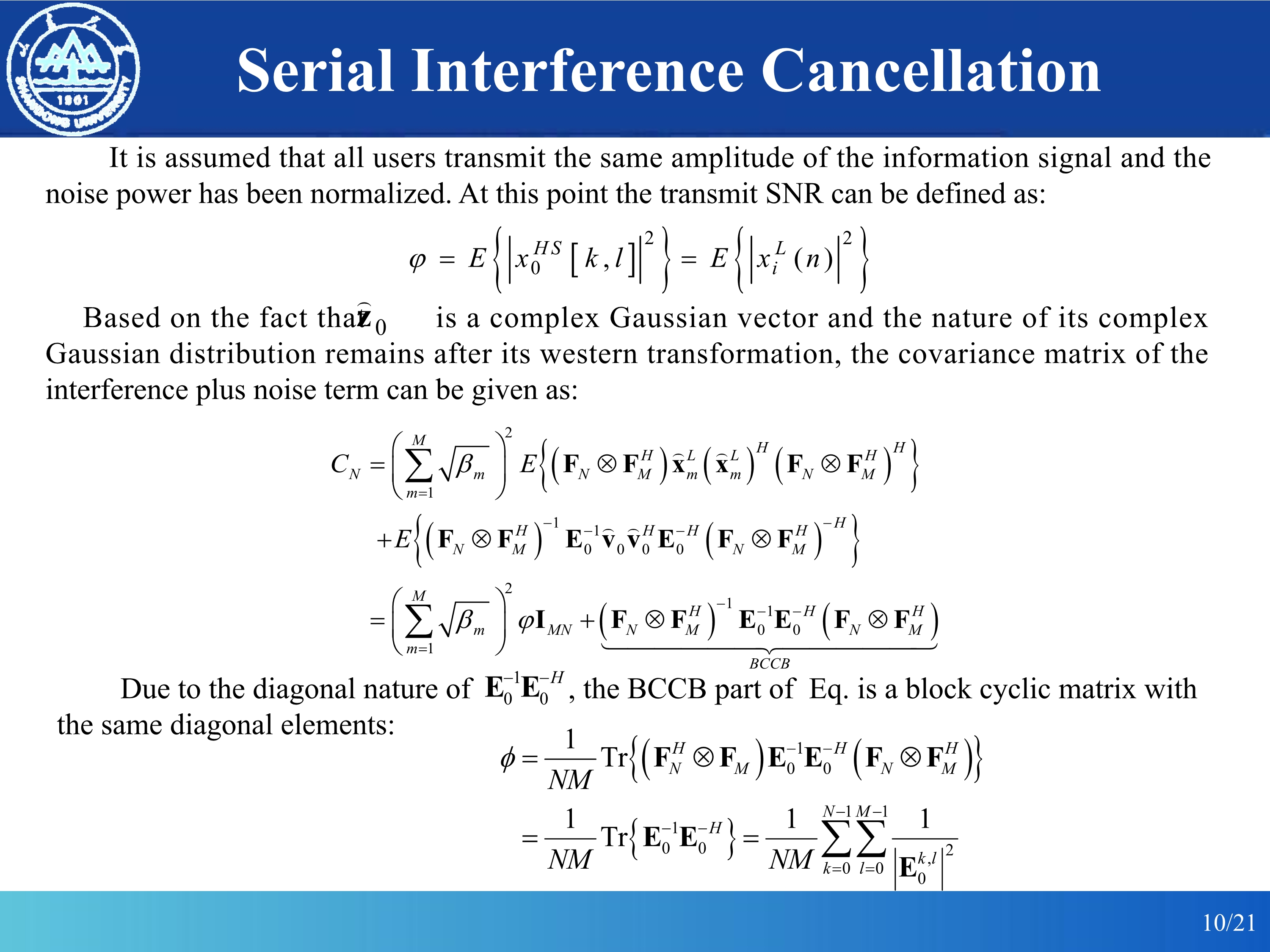 |
It is assumed that all users transmit the same amplitude of the information signal and the noise power has been normalized. At this point the transmit SNR can be defined as the first formula,Based on the fact that z0 is a complex Gaussian vector and the nature of its complex Gaussian distribution remains after its western transformation, the covariance matrix of the interference plus noise term can be given as the second formula,then the BCCB part of Eq. is a block cyclic matrix with the same diagonal elements as the third formula.
|
|
ICACT20240369 Slide.09
[Big slide for presentation]
[YouTube] |
Chrome Text-to-Speach Click!! |
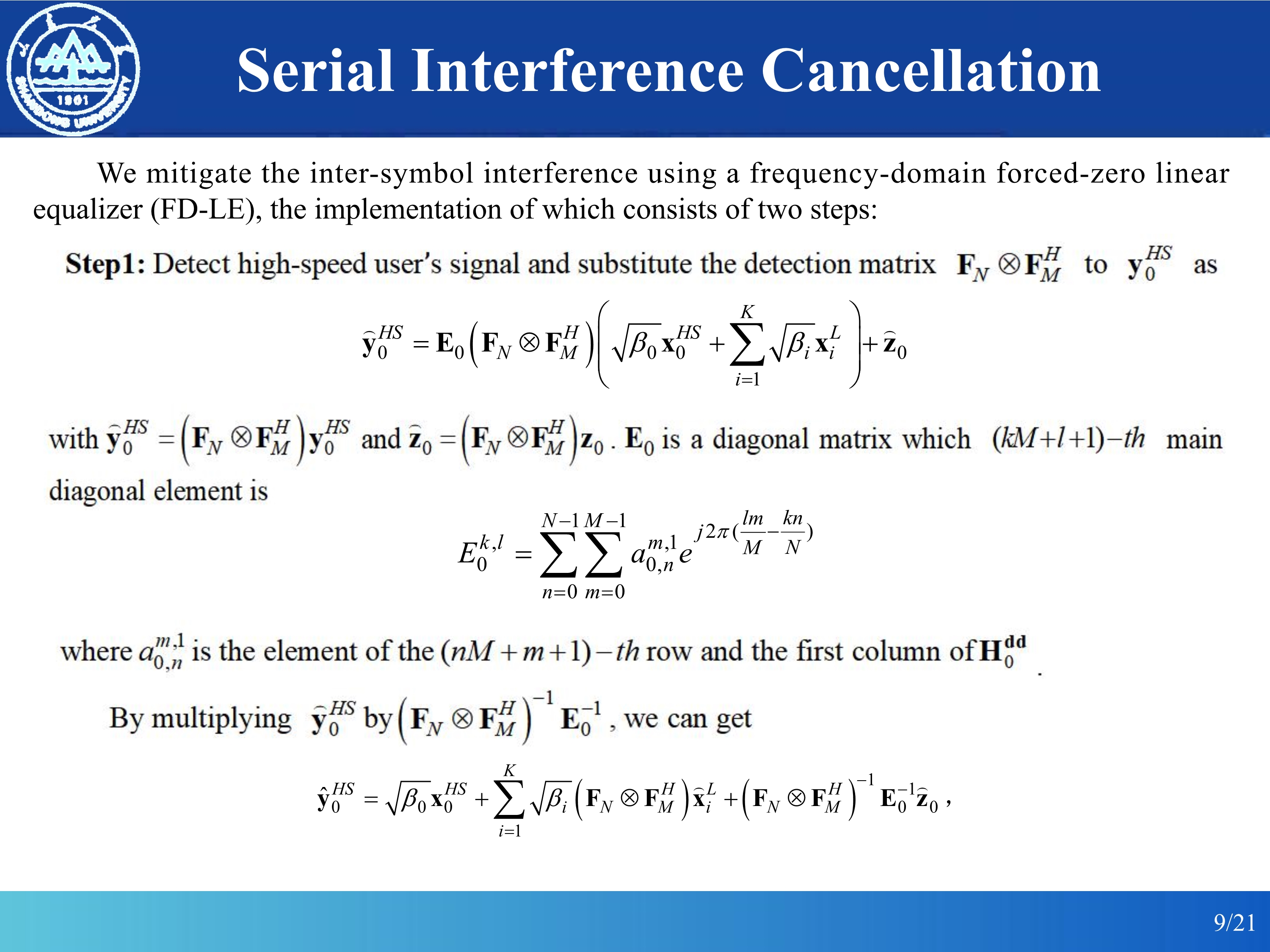 |
We mitigate the inter-symbol interference using a frequency-domain forced-zero linear equalizer (FD-LE), the implementation of which consists of two steps:
step1:Detect high-speed user's signal and substitute the detection matrix to y0
|
|
ICACT20240369 Slide.08
[Big slide for presentation]
[YouTube] |
Chrome Text-to-Speach Click!! |
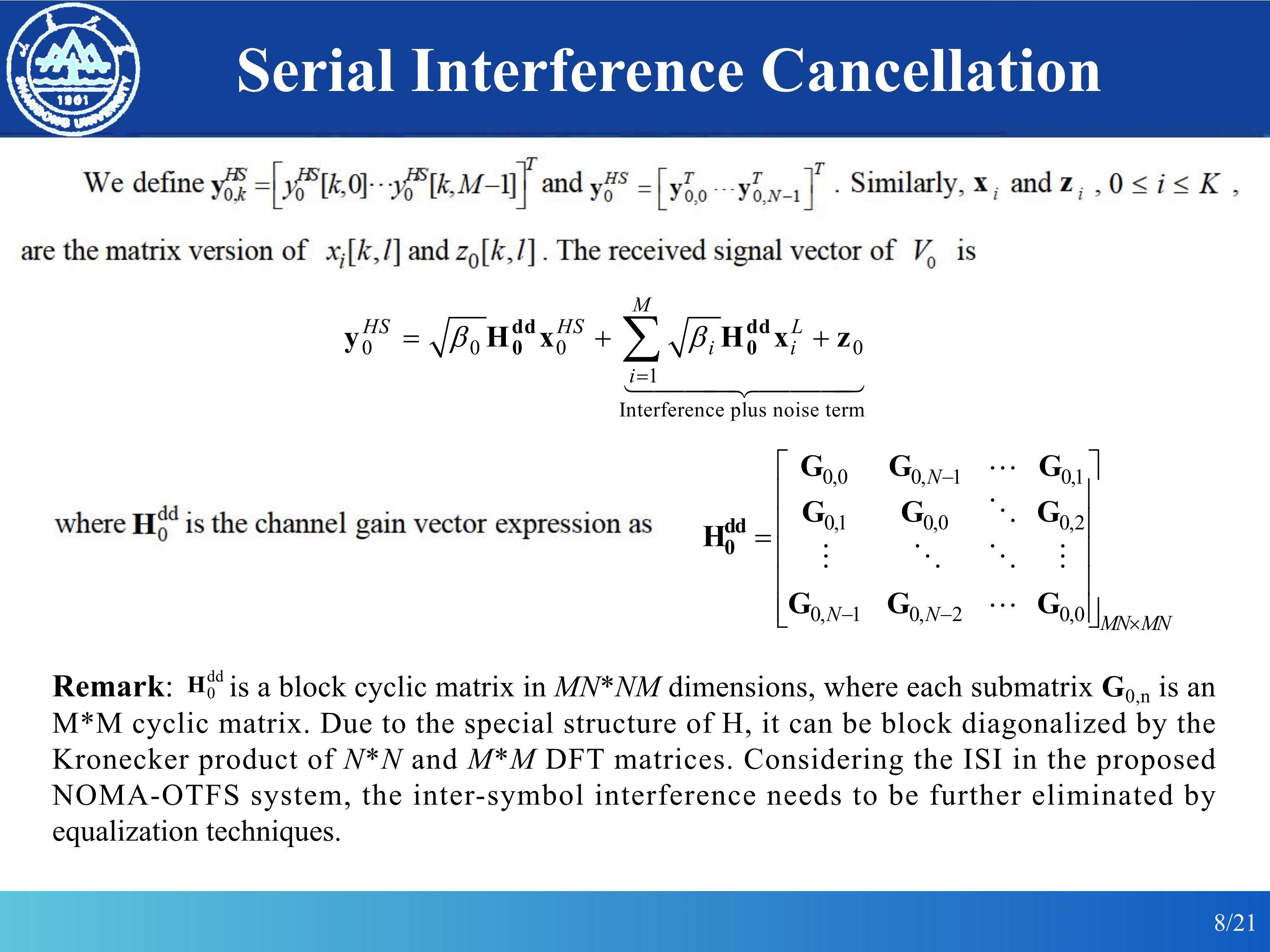 |
We define y0,k and y0Hs as follows respectively,the received signal vector of V0 as the first formula, where Hdd is the channal gain vector expression as follows. Hdd is a block cyclic matrix in MN*NM dimensions, where each submatrix G0 is a M*M cyclic matrix. Due to the special structure of H, it can be block diagonalized by theKronecker product of N*N and M*M DFT matrices. Considering the ISI in the proposed NOMA-OTFS system, the inter-symbol interference needs to be further eliminated byequalization techniques.
|
|
ICACT20240369 Slide.07
[Big slide for presentation]
[YouTube] |
Chrome Text-to-Speach Click!! |
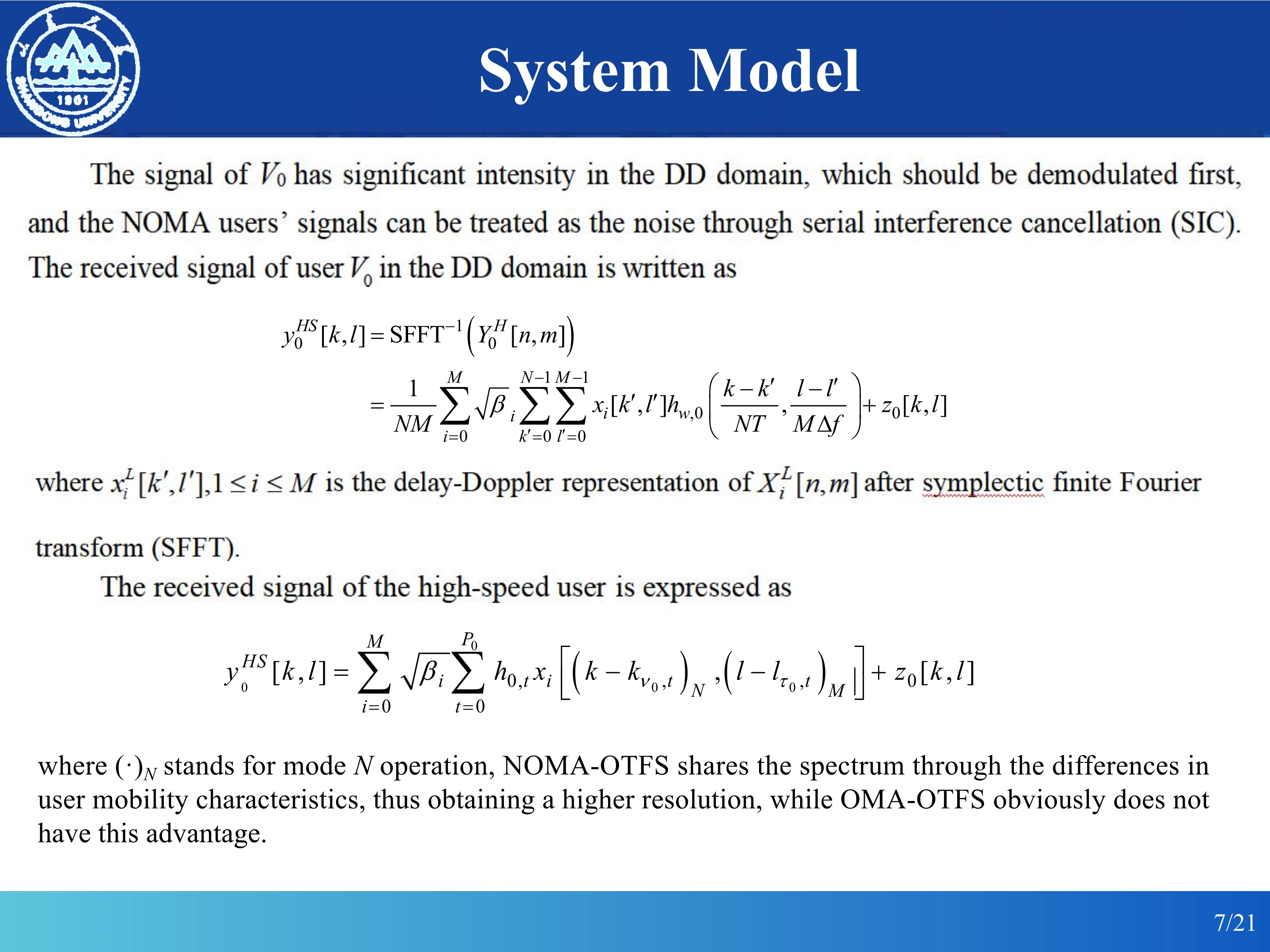 |
The signal of V0 has significant intensity in the DD domain, which should be demodulated first.and the NOMA users’signals can be treated as the noise through serial interference cancellation (SIC).The received signal of user V0 in the DD domain is written as the first formula,the received signal of the high-speed user is expressed as the second formula.NOMA-OTFS shares the spectrum through the differences inuser mobility characteristics, thus obtaining a higher resolution, while OMA-OTFS obviously does nothave this advantage.
|
|
ICACT20240369 Slide.06
[Big slide for presentation]
[YouTube] |
Chrome Text-to-Speach Click!! |
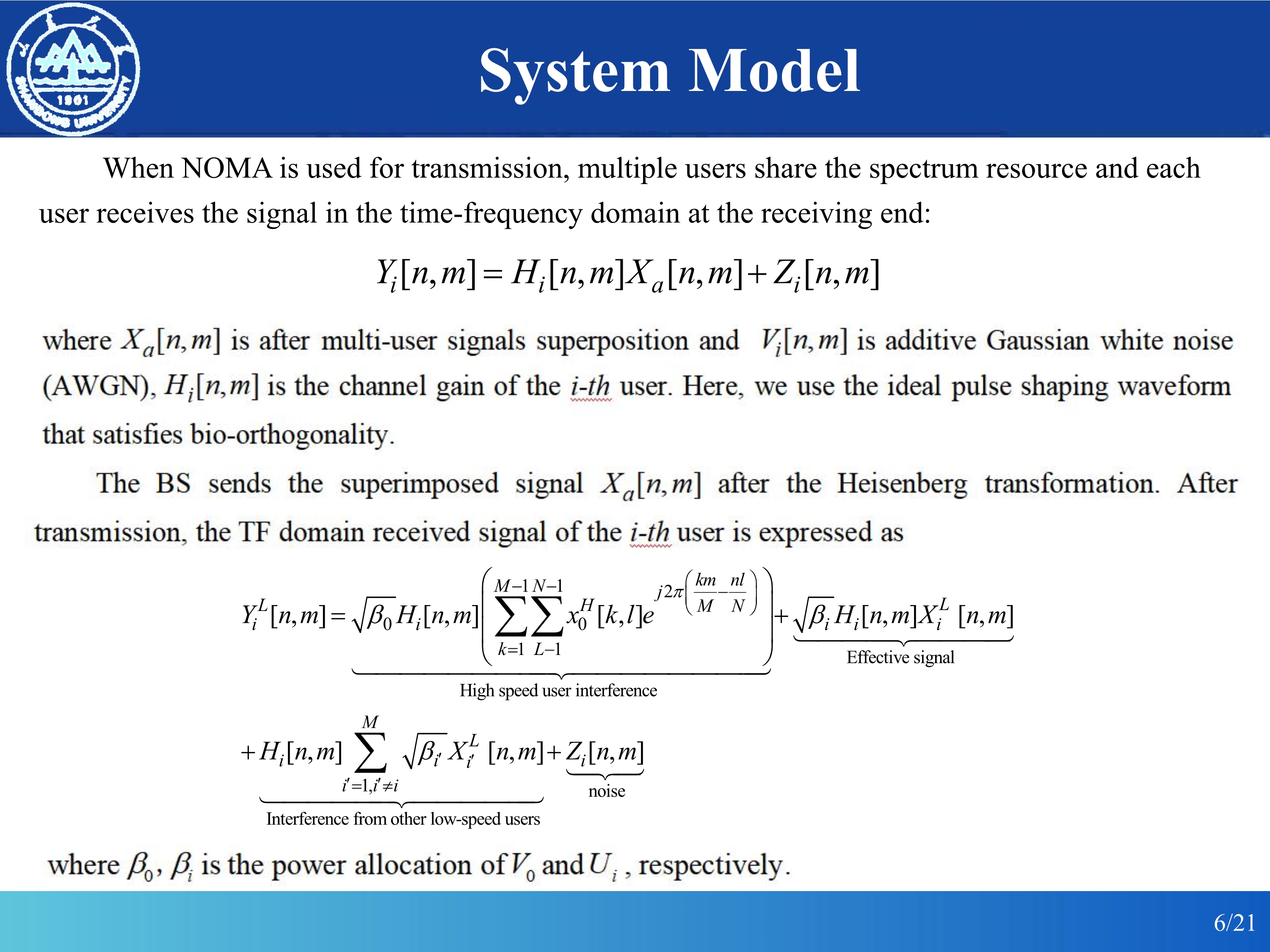 |
When NOMA is used for transmission, multiple users share the spectrum resource and each user receives the signal in the time-frequency domain at the receiving end as the first formula,the BS sends the superimposed signal Xa[n,m] after the Heisenberg transformation. After transmission, the TF domain received signal of the i-th user is expressed as the second formula.
|
|
ICACT20240369 Slide.05
[Big slide for presentation]
[YouTube] |
Chrome Text-to-Speach Click!! |
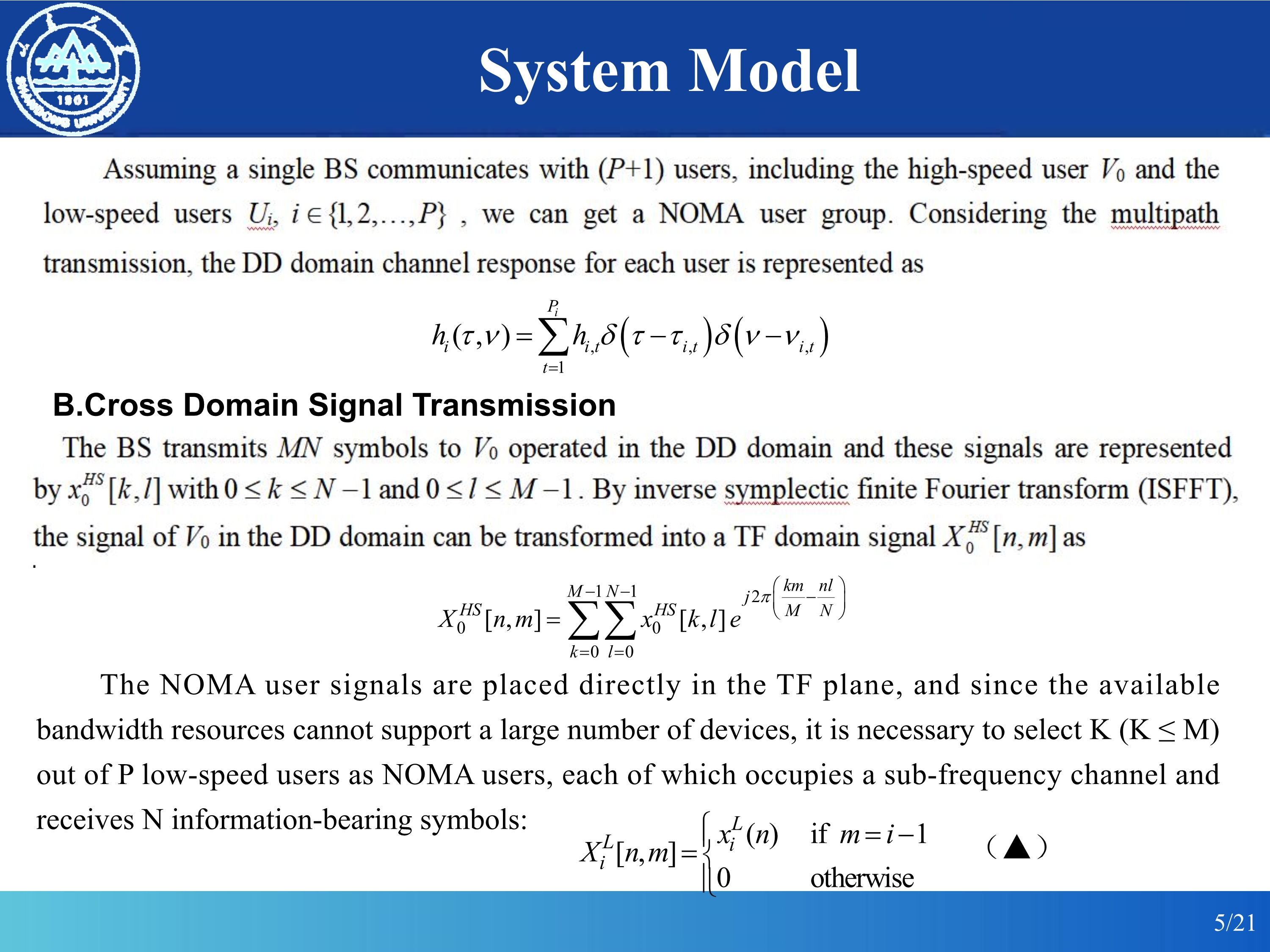 |
Assuming a single BS communicates with (P+l) users, including the high-speed user V0 and thelow-speed users Ui, we can get a NOMA user group. Considering the multipathCtransmission, the DD domain channel response for each user is represented as the formula.The BS transmits MN symbols to Vo operated in the DD domain and these signals are represented by X0[k,1] with 0
|
|
ICACT20240369 Slide.04
[Big slide for presentation]
[YouTube] |
Chrome Text-to-Speach Click!! |
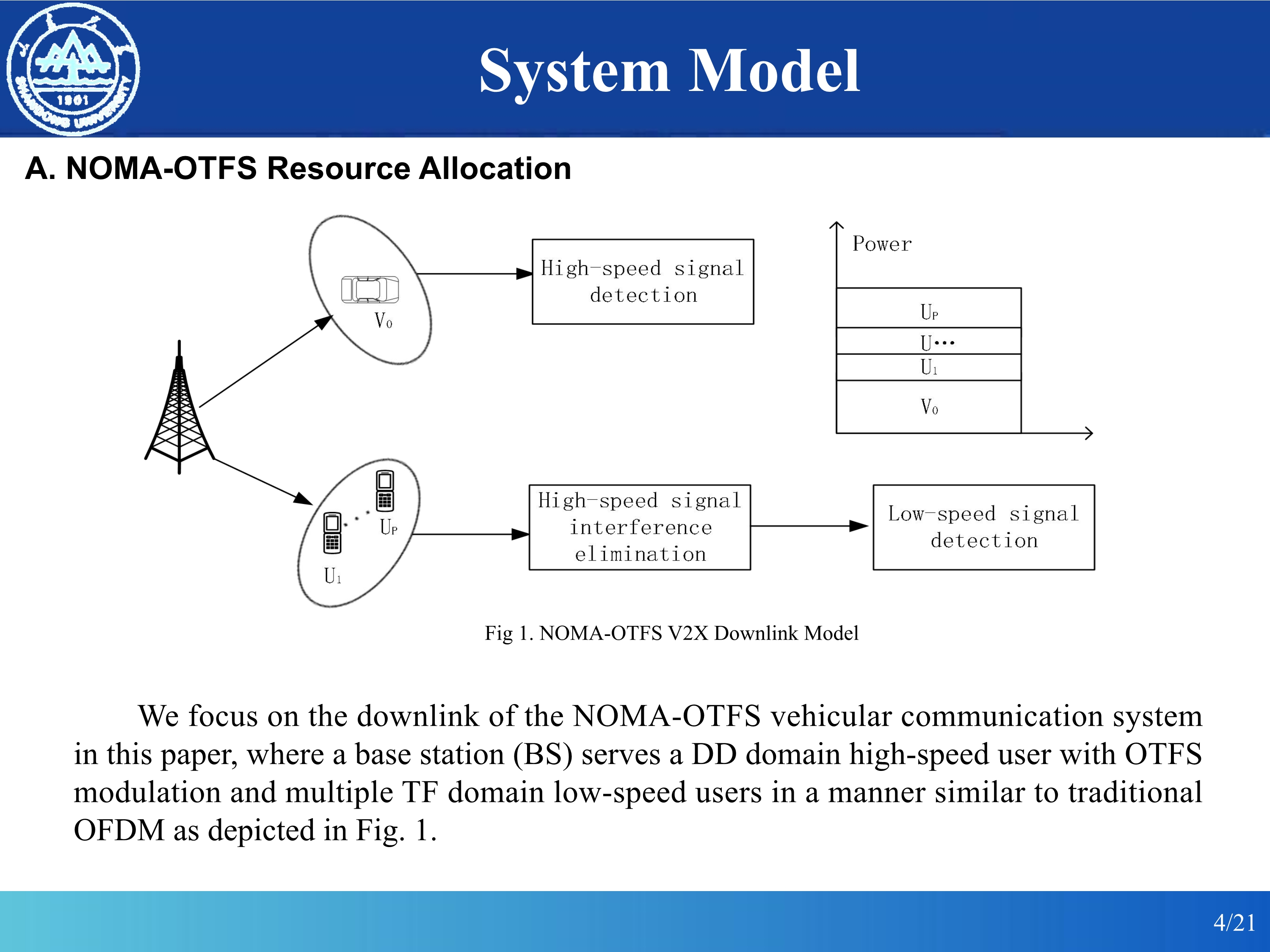 |
The system model is shown in Figure I.We focus on the downlink of the NOMA-OTFS vehicular communication system in this paper, where a base station (BS) serves a DD domain high-speed user with OTFS modulation and multiple TF domain low-speed users in a manner similar to traditional OFDM.
|
|
ICACT20240369 Slide.03
[Big slide for presentation]
[YouTube] |
Chrome Text-to-Speach Click!! |
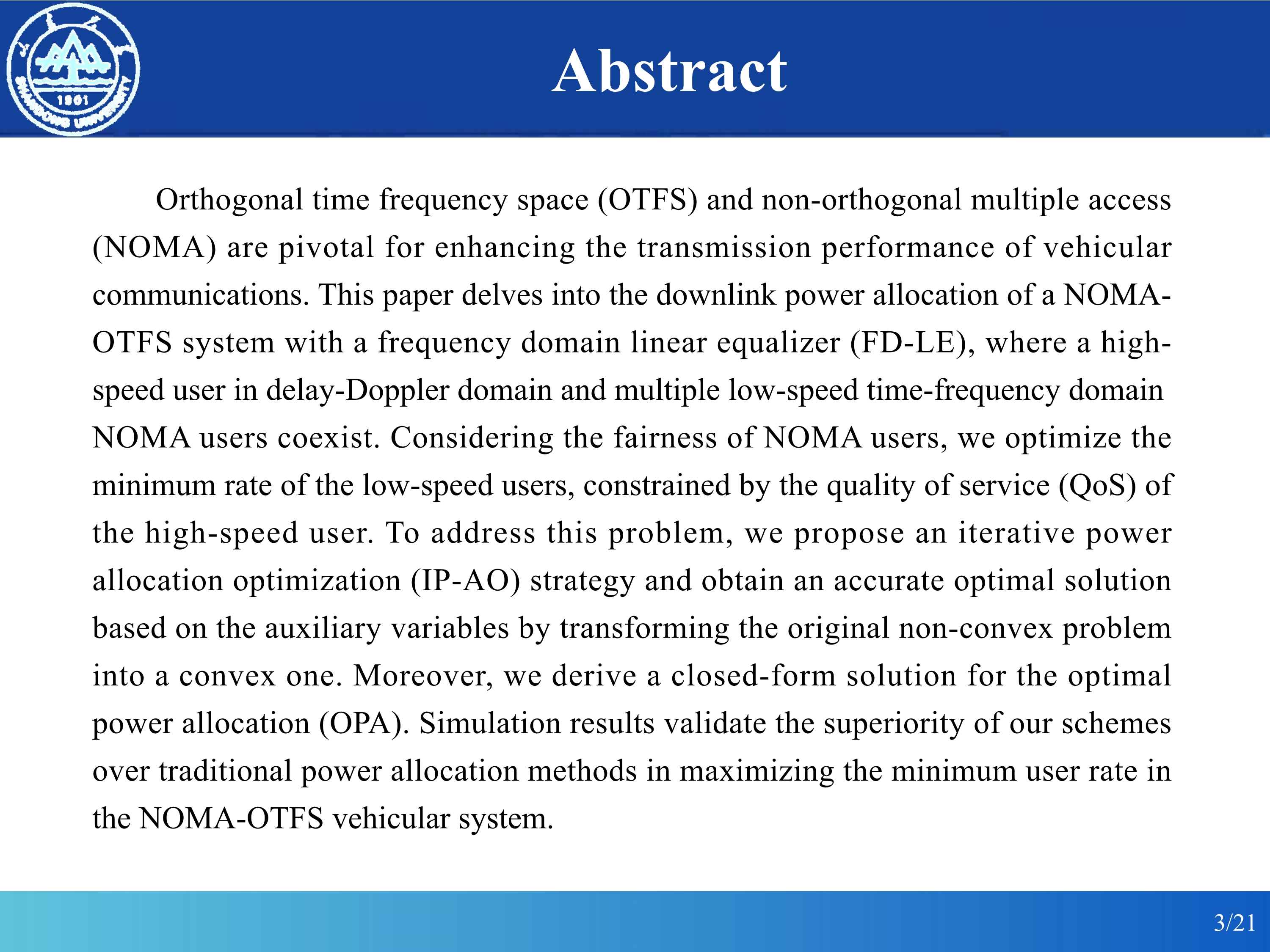 |
The following is the summary section:Orthogonal time frequency space (OTFS) and non-orthogonal multiple access (NOMA) are pivotal for enhancing the transmission performance of vehicular communications. This paper delves into the downlink power allocation of a NOMA-OTFS system with a frequency domain linear equalizer (FD-LE), where a high-speed user in delay-Doppler domain and multiple low-speed time-frequency domain NOMA users coexist. Considering the fairness of NOMA users, we optimize the minimum rate of the low-speed users, constrained by the quality of service (QoS) of the high-speed user. To address this problem, we propose an iterative power allocation optimization (IP-AO) strategy and obtain an accurate optimal solution based on the auxiliary variables by transforming the original non-convex problem into a convex one. Moreover, we derive a closed-form solution for the optimal power allocation (OPA). Simulation results validate the superiority of our schemes over traditional power allocation methods in maximizing the minimum user rate in the NOMA-OTFS vehicular system.
|
|
ICACT20240369 Slide.02
[Big slide for presentation]
[YouTube] |
Chrome Text-to-Speach Click!! |
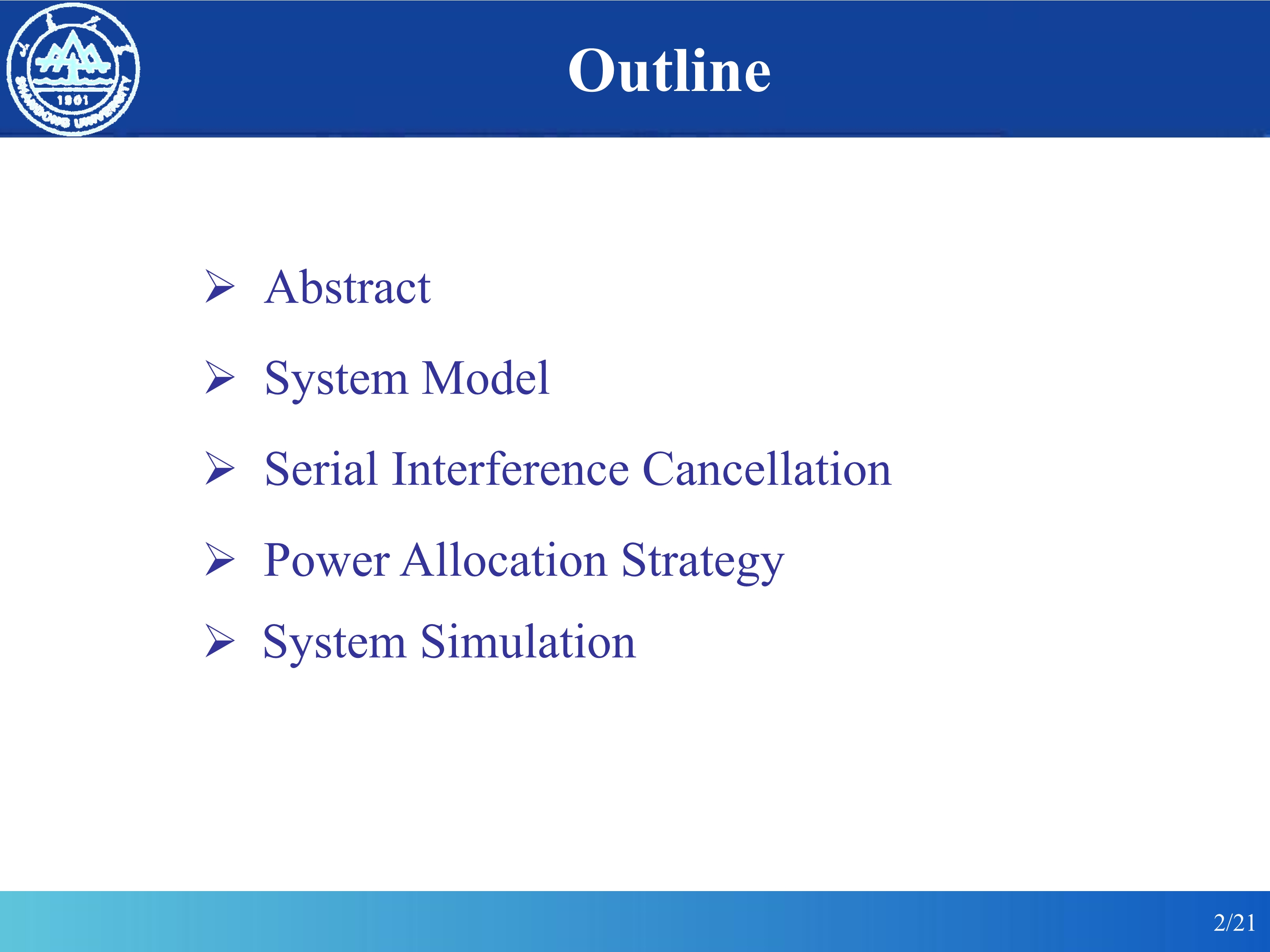 |
I will present my thesis in the following five areas, which are Abstract, System Model, Serial Interference Cancellation, Power Allocation Strategy and System Simulation.
|
|
ICACT20240369 Slide.01
[Big slide for presentation]
[YouTube] |
Chrome Text-to-Speach Click!! |
 |
Hello everyone,the title of my report is Optimization of Downlink Power Allocation in NOMA-OTFS based Cross-Domain Vehicular Networks,my name is Hao Xu.
|
















