 ICACT20220114 Slide.18
[Big slide for presentation]
[YouTube] |
Chrome Text-to-Speach Click!! |
 |
This is my talk. Thanks for listening.
|
|
ICACT20220114 Slide.17
[Big slide for presentation]
[YouTube] |
Chrome Text-to-Speach Click!! |
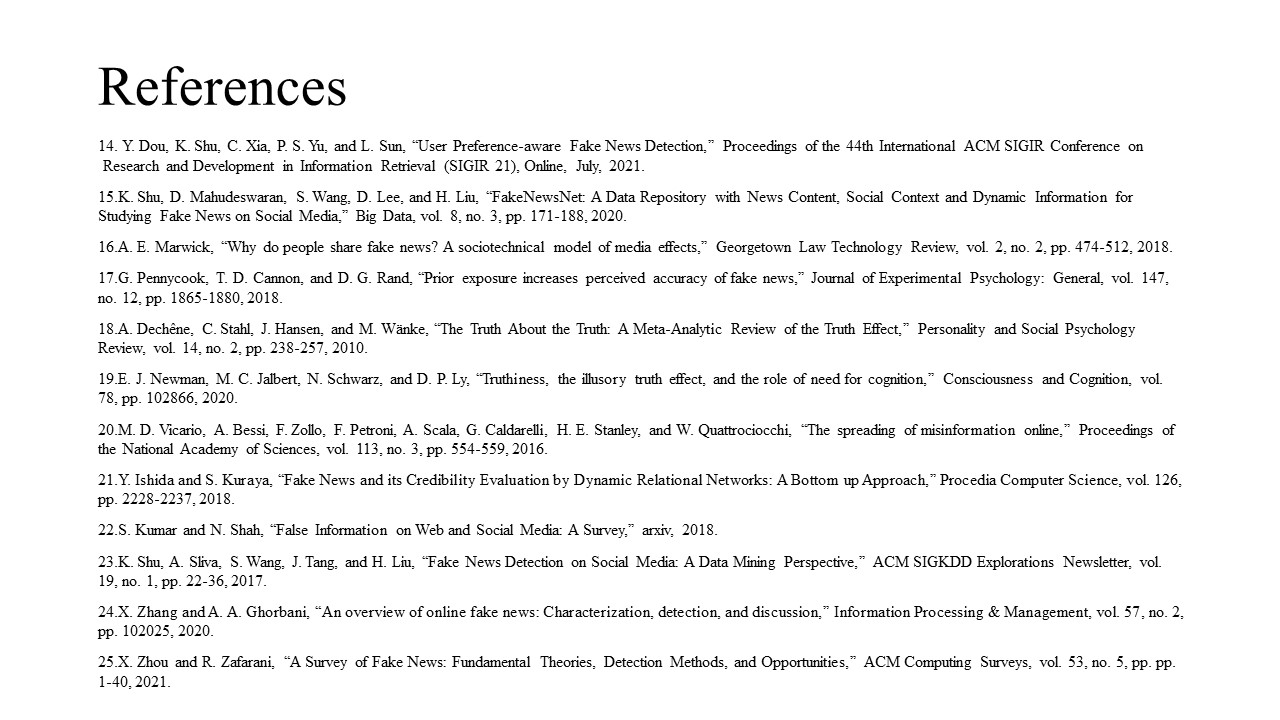 |
Here is the list of references of this work.
|
|
ICACT20220114 Slide.16
[Big slide for presentation]
[YouTube] |
Chrome Text-to-Speach Click!! |
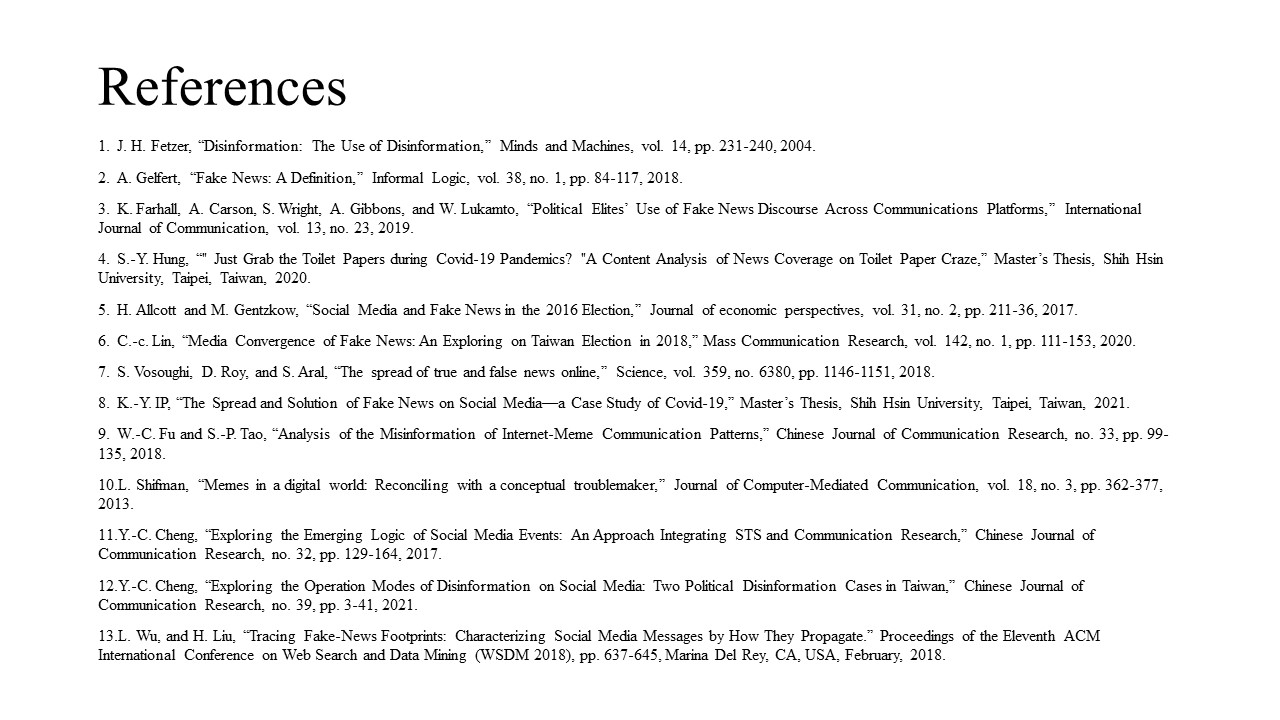 |
Here is the list of references of this work.
|
|
ICACT20220114 Slide.15
[Big slide for presentation]
[YouTube] |
Chrome Text-to-Speach Click!! |
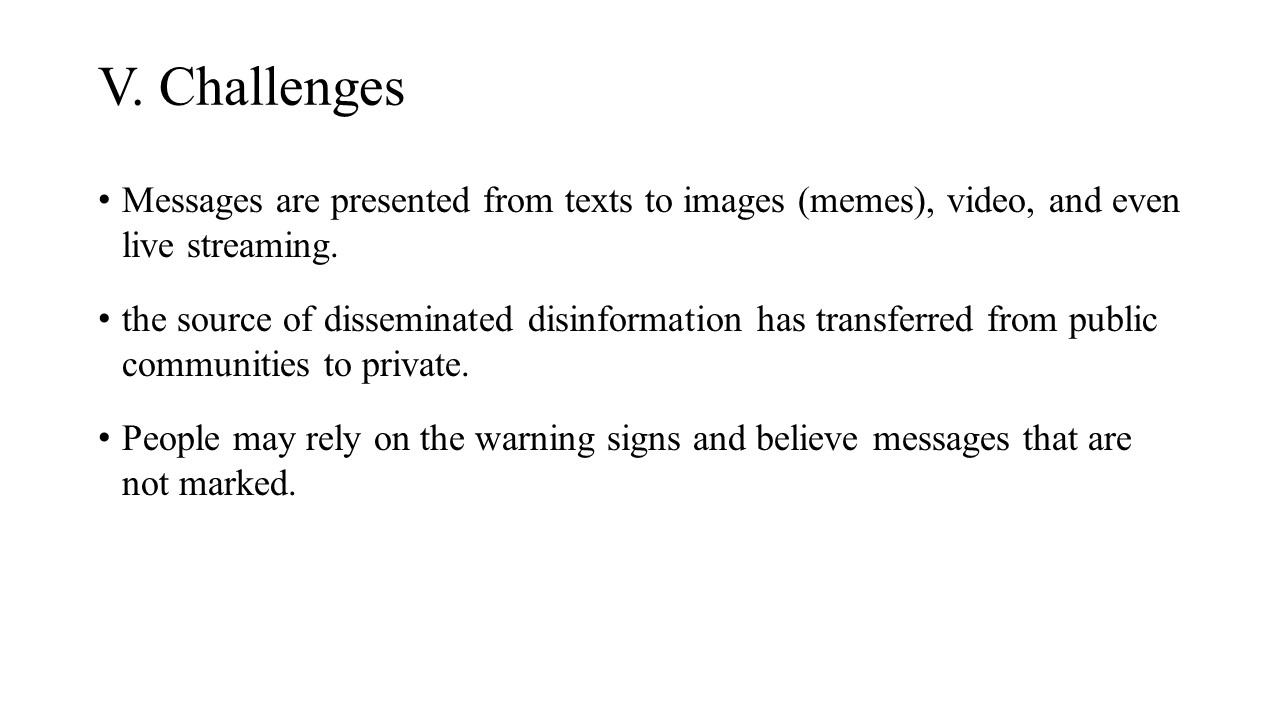 |
Because the content detection technology has achieved a great performance, the presentation of disinformation has also been reinforced. Messages are presented from texts to images (memes), video, and even live streaming. It makes disinformation detection become more and more difficult.
It is becoming more and more difficult to track the source of disseminated disinformation. Because the battlefield has transferred from public communities to private.
Due to the efforts to combat the dissemination of disinformation, if a message is reported as false on social platforms, it will be warned by signs. People may rely on the warning signs over time and believe those messages that are not marked as wrong.
|
|
ICACT20220114 Slide.14
[Big slide for presentation]
[YouTube] |
Chrome Text-to-Speach Click!! |
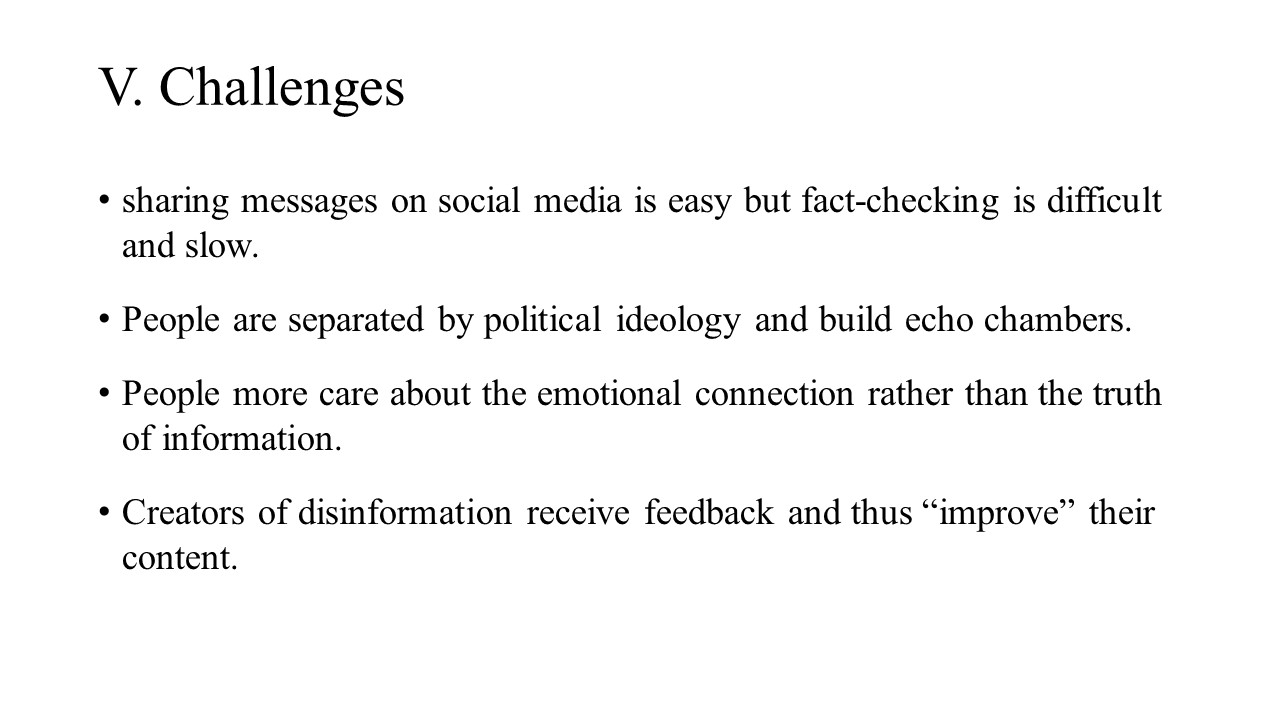 |
Unfortunately, disinformation will always exist if it is very lucrative to generate and use. The survey also highlights some challenges in current research and opportunities that go with these challenges. The challenges around disinformation are including the following.
Social media are a hotbed for rapid propagation of disinformation because the sharing mechanism allows messages to be spread easily and fact-checking is difficult and slow.
People are separated by political ideology and build echo chambers. They then tend to seek out information that reinforces their beliefs without exposure to opposing opinions. Ultimately, people develop cognitive biases that can polarize nations.
People more care about the emotional connection on social media rather than the truth of information. Therefore, disinformation creators often stimulate readers’ emotions - especially anger and fear - to motivate them to spread the disinformation further.
Creators of disinformation receive feedback from fact-checking mechanisms and thus “improve” their content by mixing false and real information, adjusting their writing styles, and revising their semantics, making fact-checking increasingly difficult over time.
|
|
ICACT20220114 Slide.13
[Big slide for presentation]
[YouTube] |
Chrome Text-to-Speach Click!! |
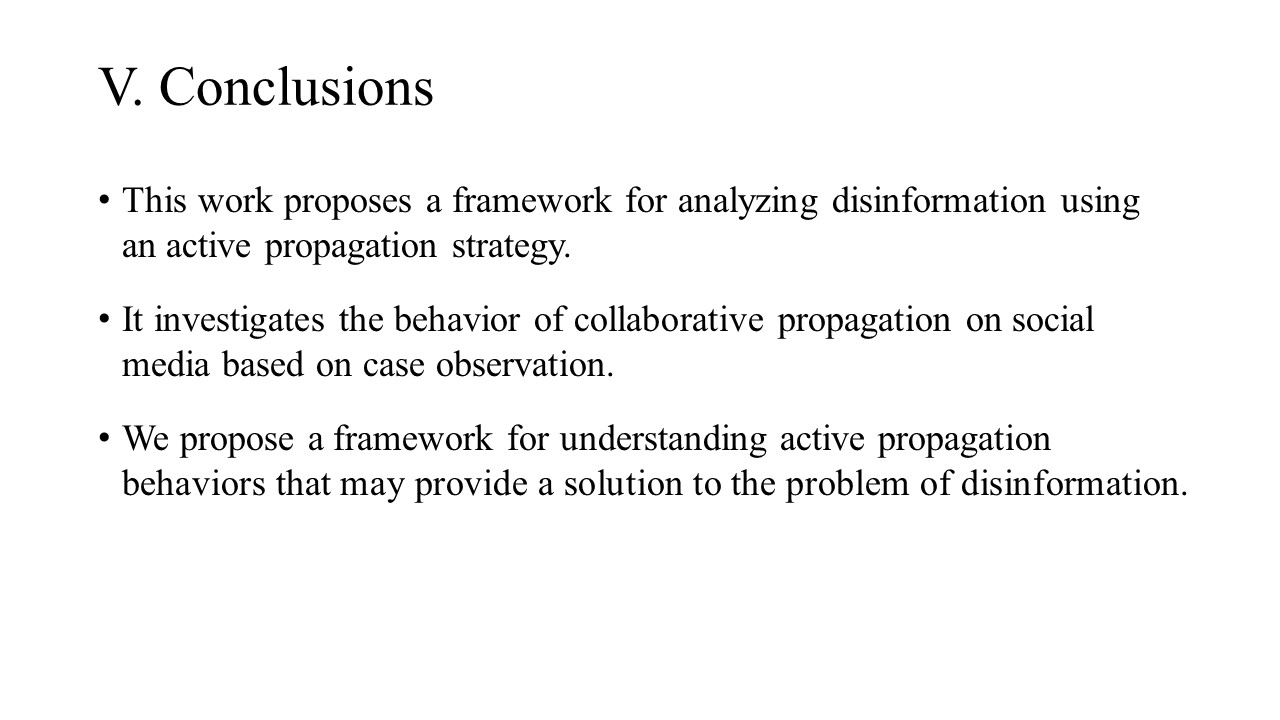 |
In conclusion.
This work proposes a framework for analyzing disinformation using an active propagation strategy.
It investigates the behavior of collaborative propagation on social media based on case observation.
We propose a framework for understanding active propagation behaviors that may provide a solution to the problem of disinformation.
|
|
ICACT20220114 Slide.12
[Big slide for presentation]
[YouTube] |
Chrome Text-to-Speach Click!! |
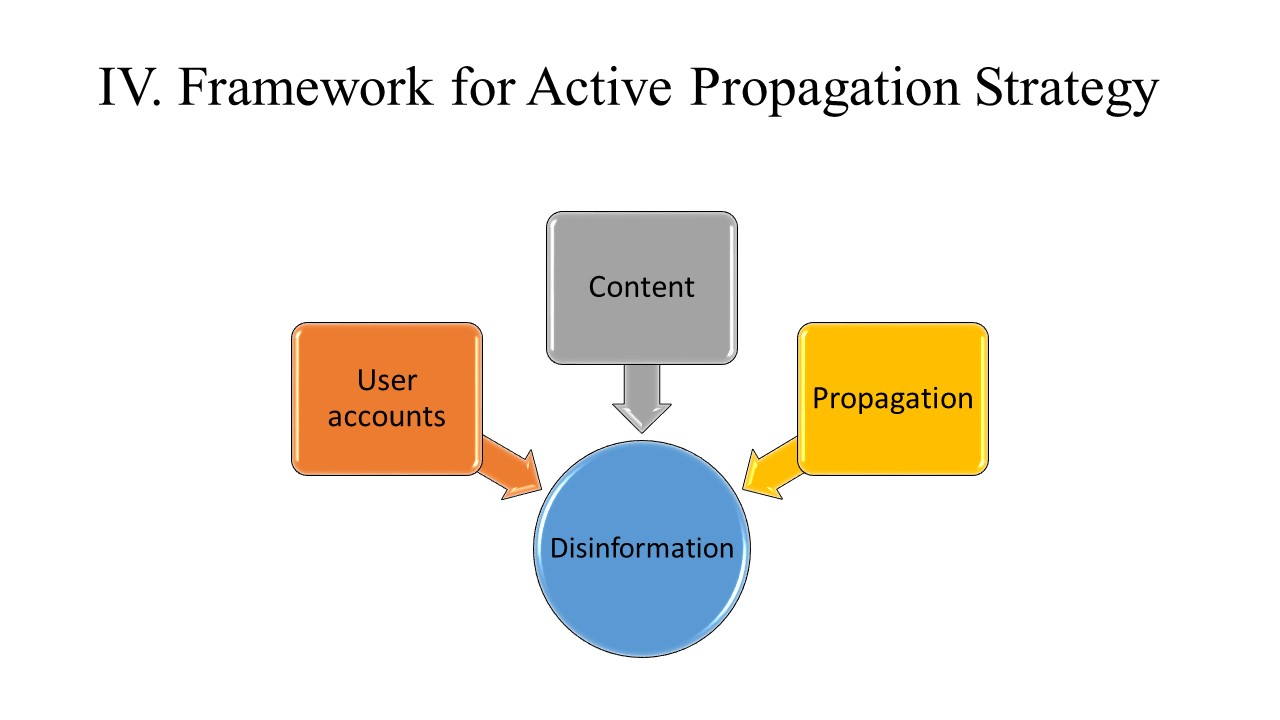 |
This work proposes a framework that combines features from the user accounts of spreaders, the content of messages, and the propagation on social media. Features are utilized to try to track the source of disseminated disinformation. Finally, the track of the coordinated dissemination is evaluated for early detection and early warning of active propagation strategy in disinformation.
|
|
ICACT20220114 Slide.11
[Big slide for presentation]
[YouTube] |
Chrome Text-to-Speach Click!! |
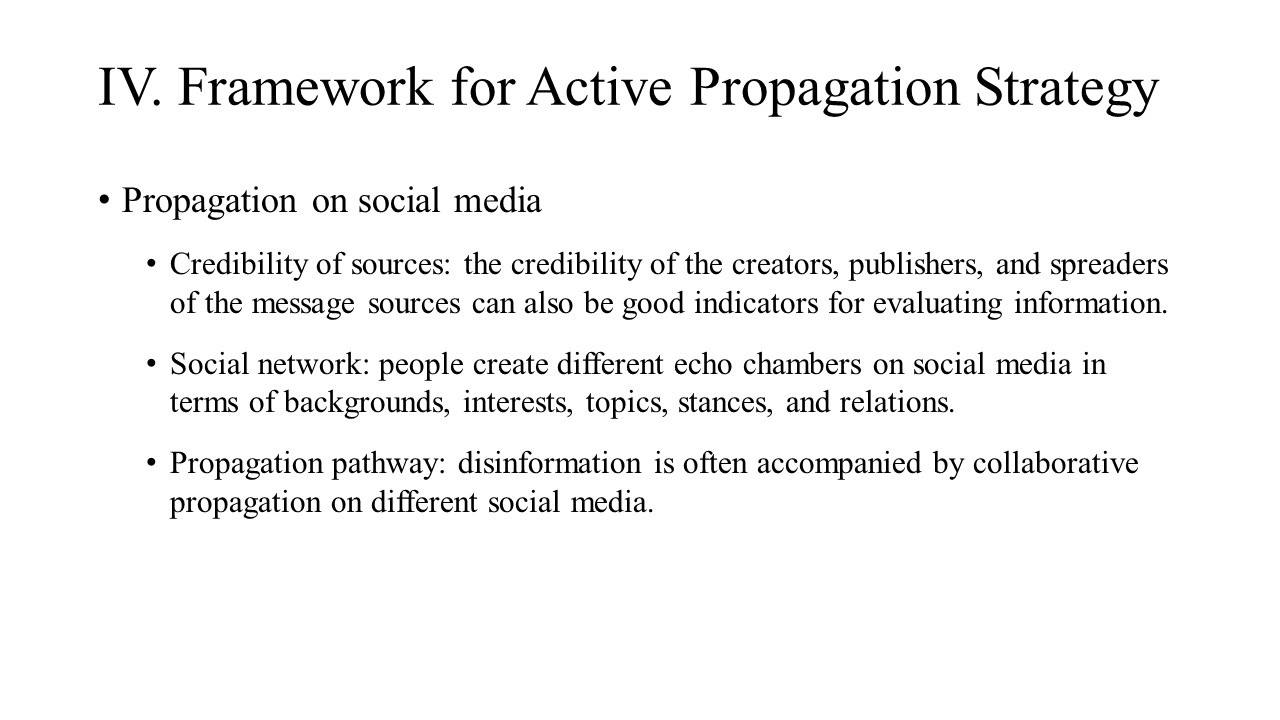 |
The identification of disinformation can not only depend on the user accounts of spreaders and the content of messages, but the propagation patterns on social media are also influential factors [22]-[25]. Follows are some propagation characteristics that can be used to capture patterns of disinformation.
Credibility of Sources: The credibility of the creators, publishers, and spreaders of the message sources can also be good indicators for evaluating information. A credible source makes people likely believe that the story is true and will prompt people to share the messages, especially when there are not enough resources available to check the authenticity of the messages.
Social Network: People create different echo chambers on social media in terms of backgrounds, interests, topics, stances, and relations. As mentioned before, the creator of disinformation tends to form an echo chamber that makes people keep on sharing the same information.
Propagation Pathway: The propagation of disinformation is often accompanied by collaborative propagation on different social media. After disinformation is generated, the creator of disinformation actively releases the message on various social media. The goal is to let people bring the message into their own echo chamber.
|
|
ICACT20220114 Slide.10
[Big slide for presentation]
[YouTube] |
Chrome Text-to-Speach Click!! |
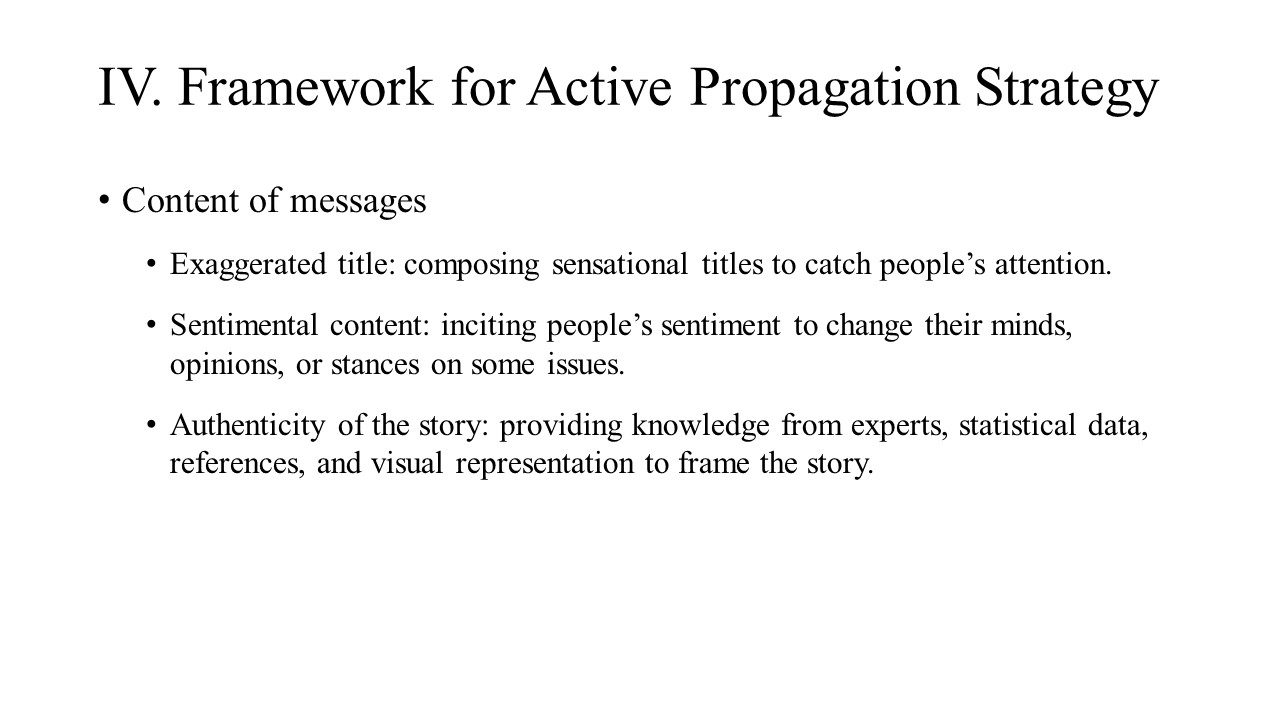 |
The most common method for disinformation detection is based on content analysis [22]-[25]. There are many algorithms that are used for detecting online disinformation. Follows are some content characteristics that can help us to detect potential disinformation.
Exaggerated Title: The creators of disinformation usually compose sensational titles to catch people’s attention. They aim to attract people to read the disinformation and share it with others.
Sentimental Content: The creators of disinformation often incite people’s sentiment to change their minds, opinions, or stances on some issues.
Authenticity of the Story: To persuade people, the creators of disinformation usually provide knowledge from experts, statistical data, references, and visual representation to frame the story.
|
|
ICACT20220114 Slide.09
[Big slide for presentation]
[YouTube] |
Chrome Text-to-Speach Click!! |
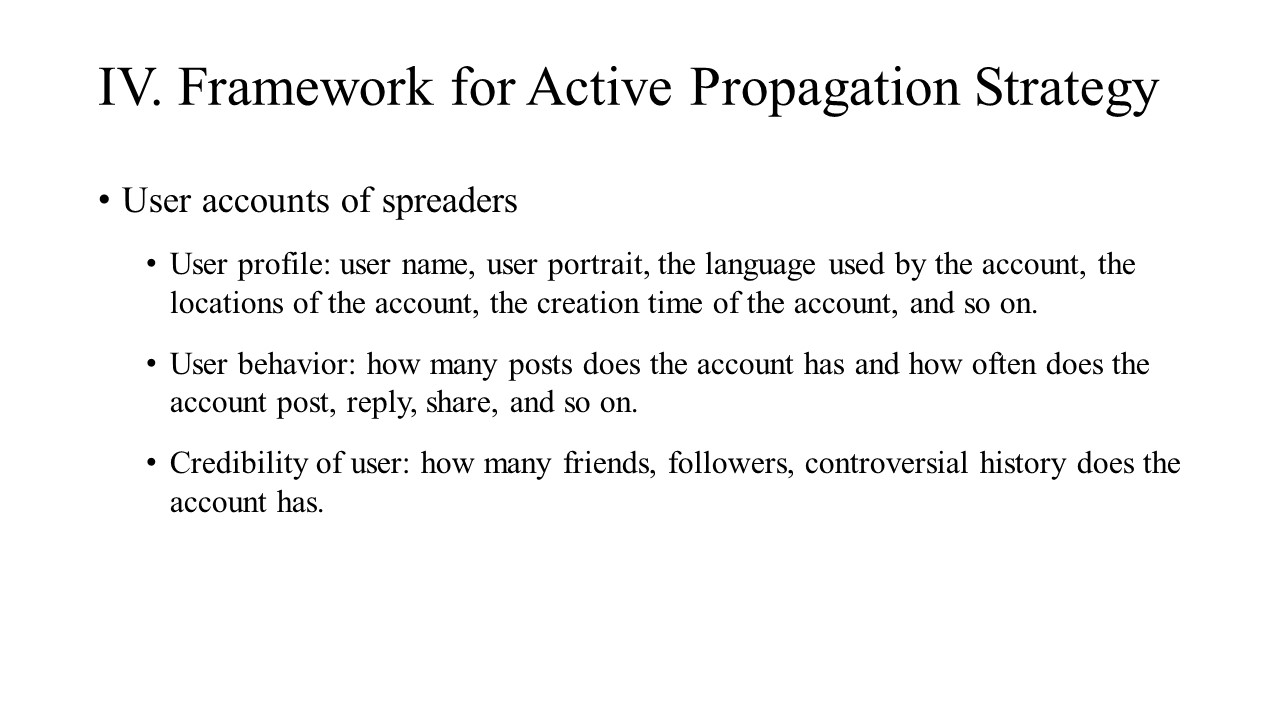 |
Many studies [22]-[25] have shown that a good way for detecting disinformation is focusing on the user accounts of spreaders. People can detect disinformation by evaluating the credibility of user accounts. Follows are some account characteristics that can provide important clues for assessing suspicious sources of information.
User Profile: A user profile is a collection of information associated with a user. It contains the user name, user portrait, the language used by the account, the locations of the account, the creation time of the account, and so on.
User Behavior: The behavior is an important feature of how spreaders interact within groups on social media. It contains how many posts does the account has and how often does the account post, reply, share, and so on.
Credibility of User: The credibility is also a good feature for evaluating malicious accounts on social media. It contains how many friends, followers, controversial history does the account has.
|
|
ICACT20220114 Slide.08
[Big slide for presentation]
[YouTube] |
Chrome Text-to-Speach Click!! |
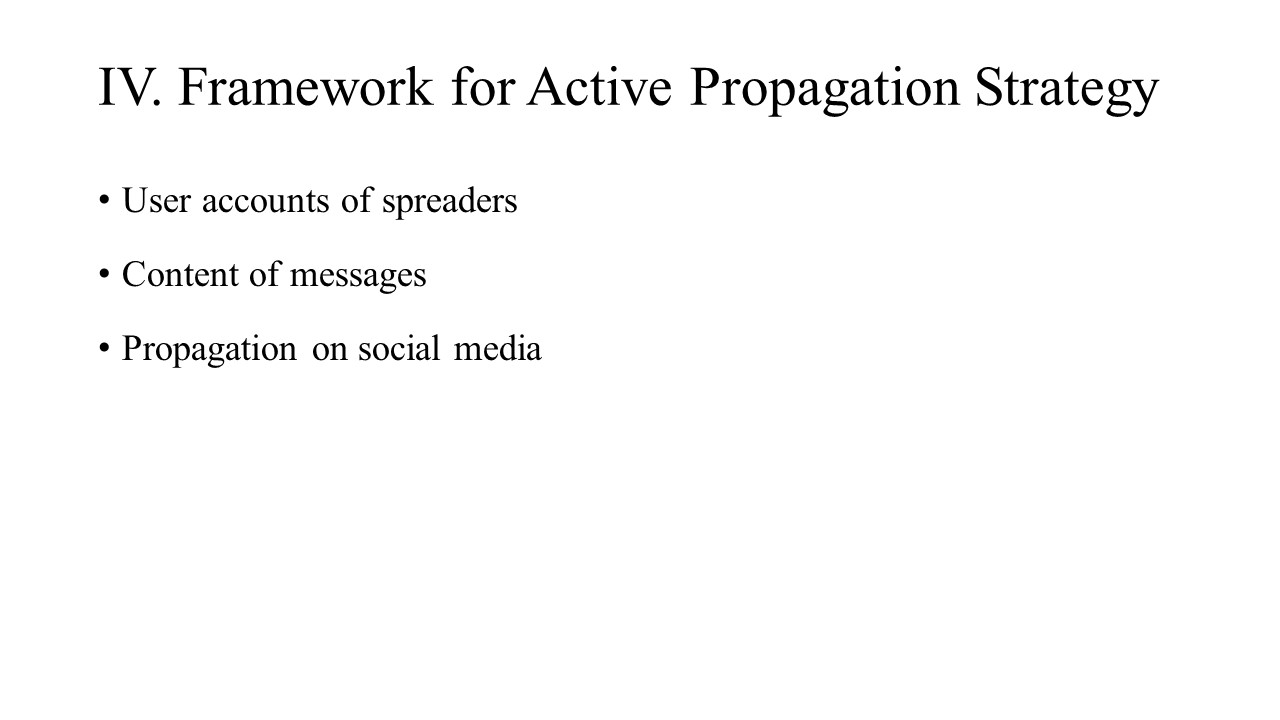 |
Disinformation can be observed from three aspects: the user accounts of spreaders, the content of messages, and the propagation on social media. And each aspect is discussed as follows.
|
|
ICACT20220114 Slide.07
[Big slide for presentation]
[YouTube] |
Chrome Text-to-Speach Click!! |
 |
Now, I will introduce the framework for Active Propagation Strategy.
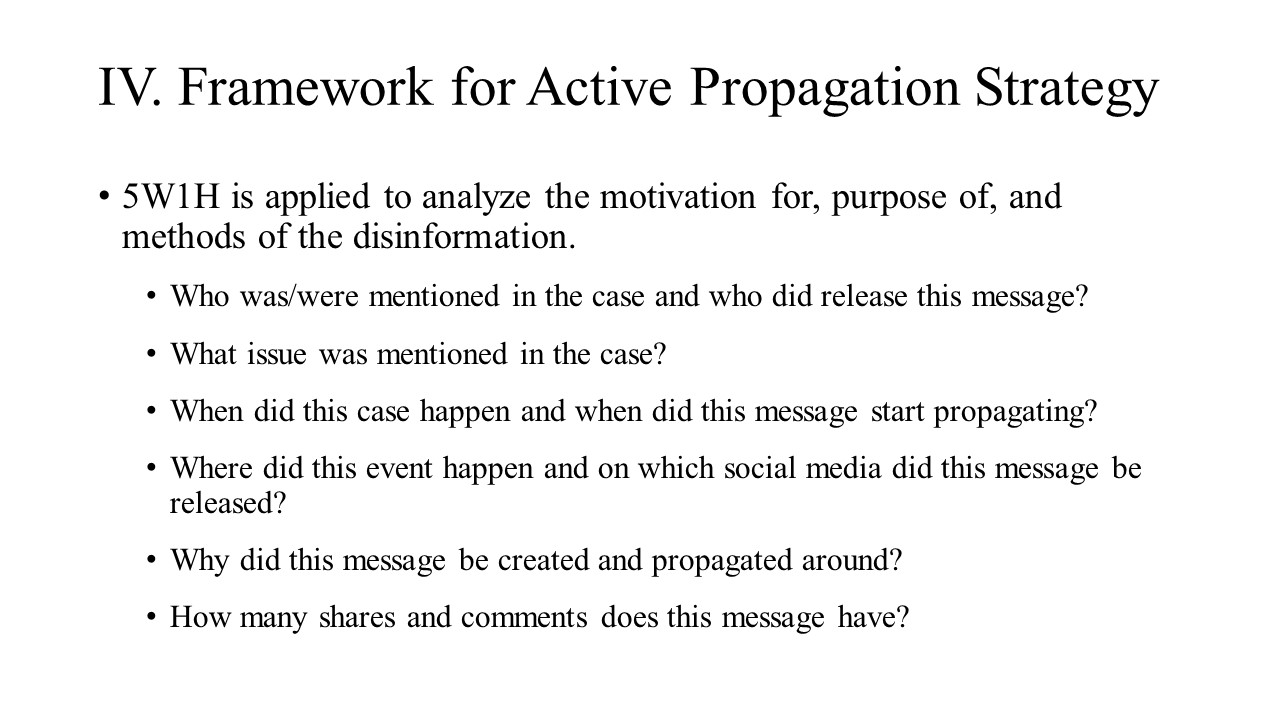
This work uses the case study method to observe behaviors associated with collaborative propagation. Then, fact-checking tools, such as the Taiwan FactCheck Center, Cofacts, MyGoPen, and others, are used to identify the authenticity of the information. If an incident is judged to involve the dissemination of disinformation, we analyze the motivation for, purpose of, and methods of the disinformation. In order to observe fully the modes of dissemination of disinformation, the 5W1H (who, what, when, where, why, and how) method [21] is applied to analyze the responses of other users to the event and subsequent information-disseminating behaviors. The goals are to understand the process of information propagation on social media. The 5W1H are described as follows.
Who was/were mentioned in the case and who did release this message?
What issue was mentioned in the case?
When did this case happen and when did this message start propagating?
Where did this event happen and on which social media did this message be released?
Why did this message be created and propagated around?
How many shares and comments does this message have?
|
|
ICACT20220114 Slide.06
[Big slide for presentation]
[YouTube] |
Chrome Text-to-Speach Click!! |
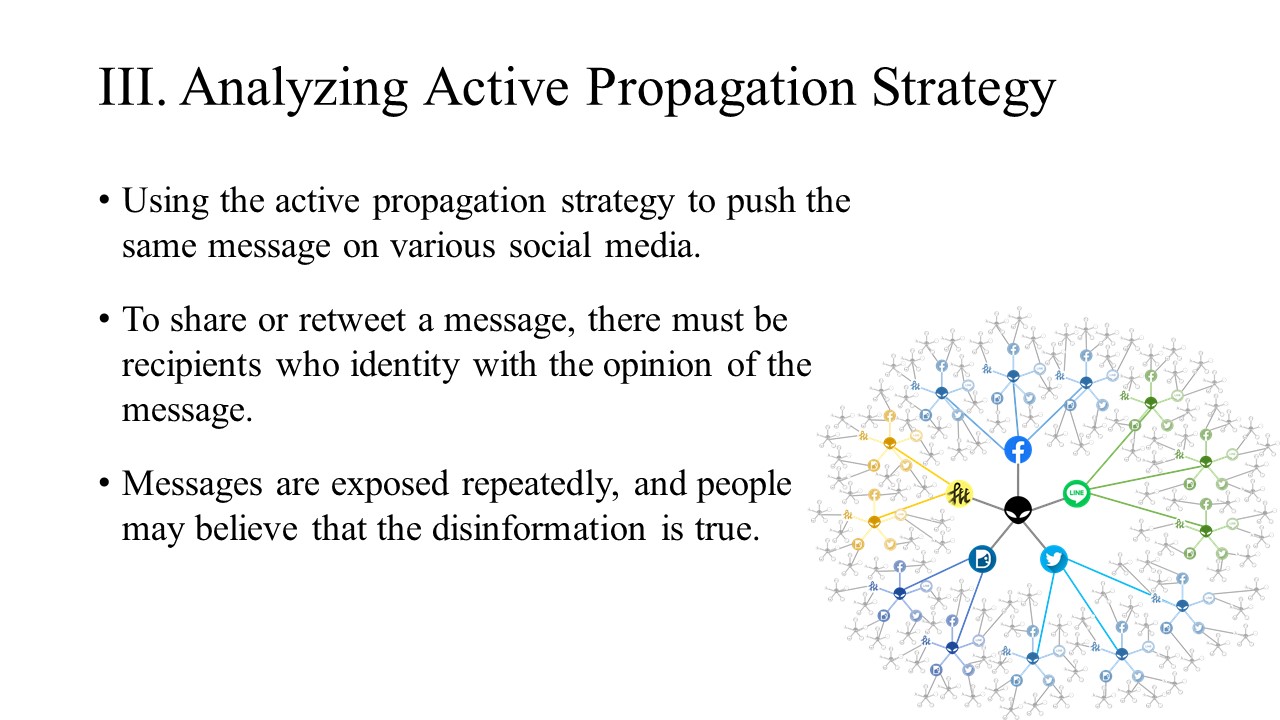 |
Creators of disinformation often use the active propagation strategy to push the same message on various social media, such as Facebook, Line, PTT, Dcard, and others, as shown in Fig.
The recipients of this message then share the disinformation on various social media. To share or retweet a message, there must be recipients who identity with the opinion of the message. In general, people who are in the same echo chamber have a stronger sense of identity. The higher the sense of identity, the greater the power of dissemination [20].
Spreaders share these messages to their own echo chamber, and then the messages are pushed on various social media by members in their echo chamber. In this way, messages are exposed repeatedly, and people may believe that the disinformation is true.
|
|
ICACT20220114 Slide.05
[Big slide for presentation]
[YouTube] |
Chrome Text-to-Speach Click!! |
 |
Now, let me explain our analysis of Active Propagation Strategy.
The dissemination of disinformation on social media has harmed people. Nowadays, as a result of domestic efforts to combat the dissemination of disinformation, domestic governments, third-party groups and even social media companies are committed to the verification and clarification of information. But they still cannot effectively prevent the dissemination of disinformation. Studies have found that most disinformation is quickly generated and disseminated through social media.
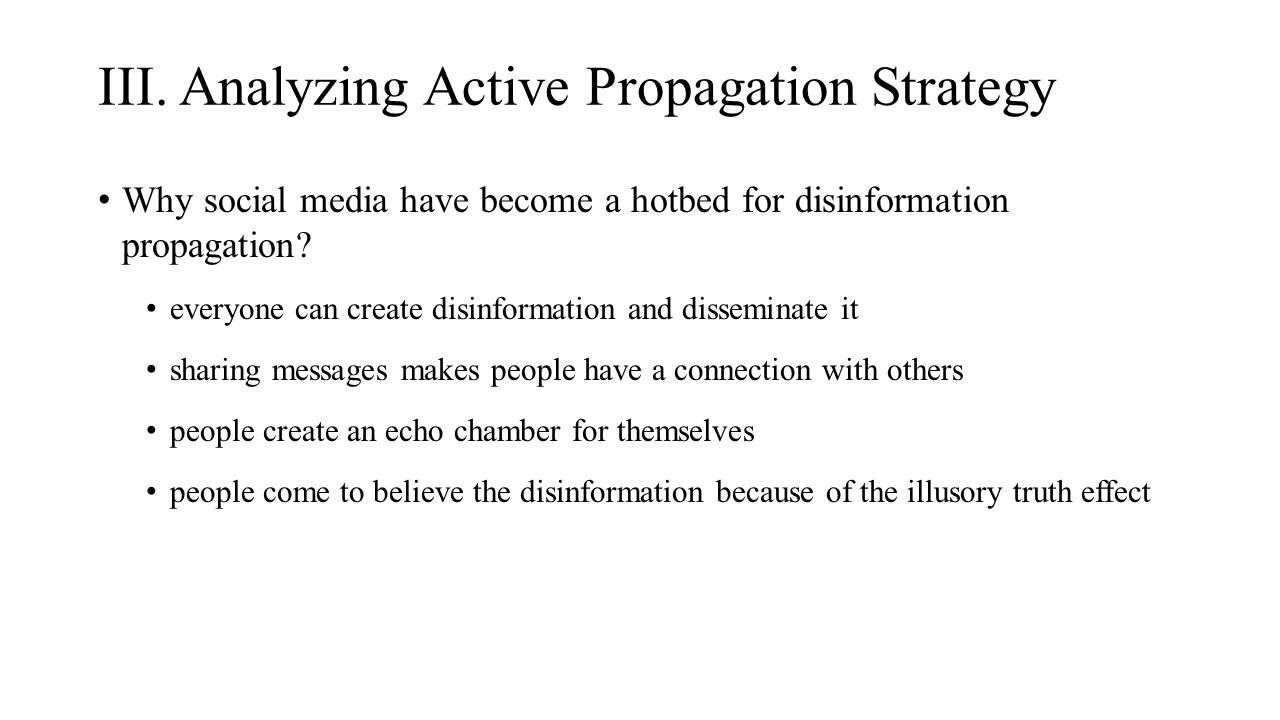
Why social media have become a hotbed for disinformation propagation?
-Because everyone can create disinformation and disseminate it easily, but fact-checking is difficult and takes a long time.
-Additionally, sharing messages makes people have a connection with others, so more people care about the emotional connection on social media rather than the authenticity of the message. This is why many people habitually share news without verification.
-Moreover, when people give a like, upvote, or thumbs-up on social media, they unintentionally create an echo chamber [16] for themselves.
Once disinformation is present in someone’s echo chamber, he/she will hear it again and again. Subsequently, he/she will only be more likely to encounter disinformation that reflects and reinforces that previously shared. Ultimately, many people come to believe that the disinformation they have encountered is true [17]. This effect is known as the illusory truth effect [18]. And, the echo chamber and the illusory truth effect are tricks that are commonly used in the active propagation strategy for disinformation.
|
|
ICACT20220114 Slide.04
[Big slide for presentation]
[YouTube] |
Chrome Text-to-Speach Click!! |
 |
Now, I will go through the related works.
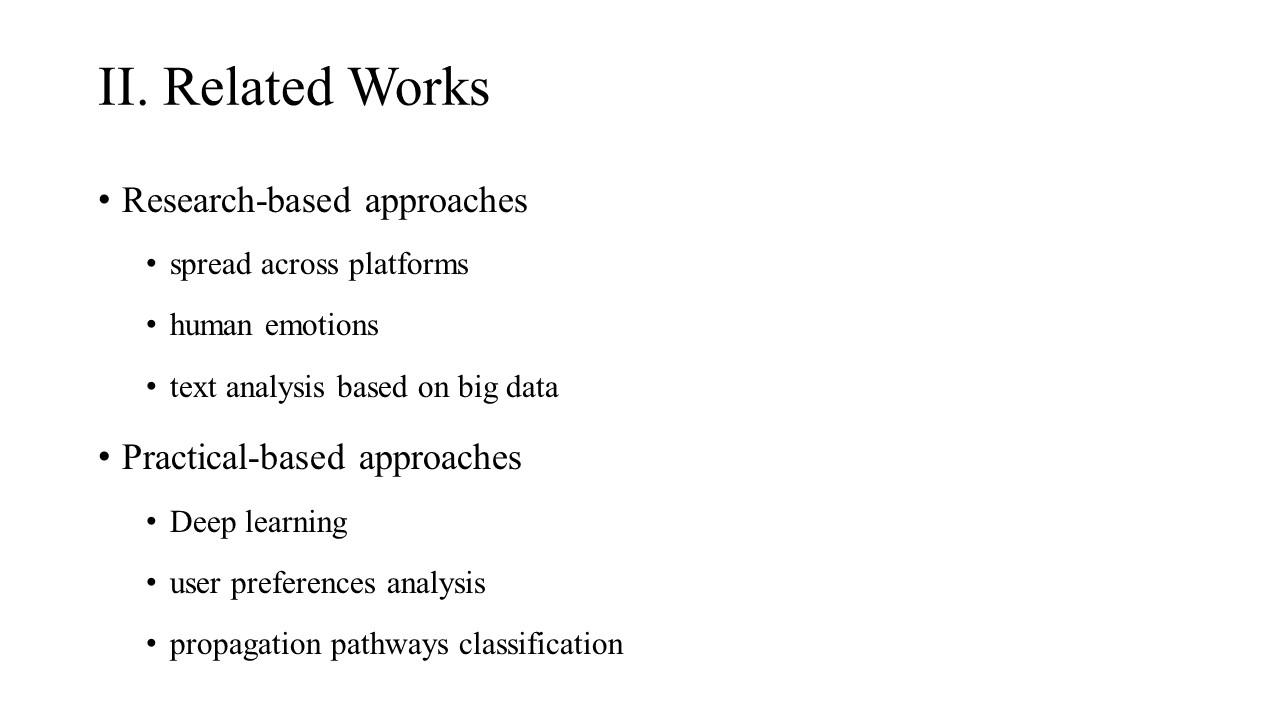
Lin [6] explores the spread of fake news on different social platforms from the viewpoint of media convergence. Vosoughi et al. [7] focus on human emotions to analyze the factors that affect dissemination of disinformation. Ip [8] analyzes the factors that drive the spreading of fake news across platforms and proposes some possible solutions. Fu and Tao [9] explore the dissemination of disinformation on social media by using text analysis based on big data on Internet memes [10], Cheng [11] integrates STS (science and technology studies) with methods in communication research to explore how disinformation is spread on social platforms quickly. Cheng [12] proposes a framework involving multiple approaches to analyze the circulation and dissemination patterns of disinformation on social media. Wu and Liu [13] combine an LSTM-RNN (the Long Short-Term Memory cells into the RNN model) with an embedding method to classify propagation pathways of a message. Dou et al. [14] analyze user preferences for the purposes of detection of disinformation. Shu et al. [15] established a fake news database FakeNewsNet to promote research into fake news and this database facilitates potential applications on fake news study on social media.
|
|
ICACT20220114 Slide.03
[Big slide for presentation]
[YouTube] |
Chrome Text-to-Speach Click!! |
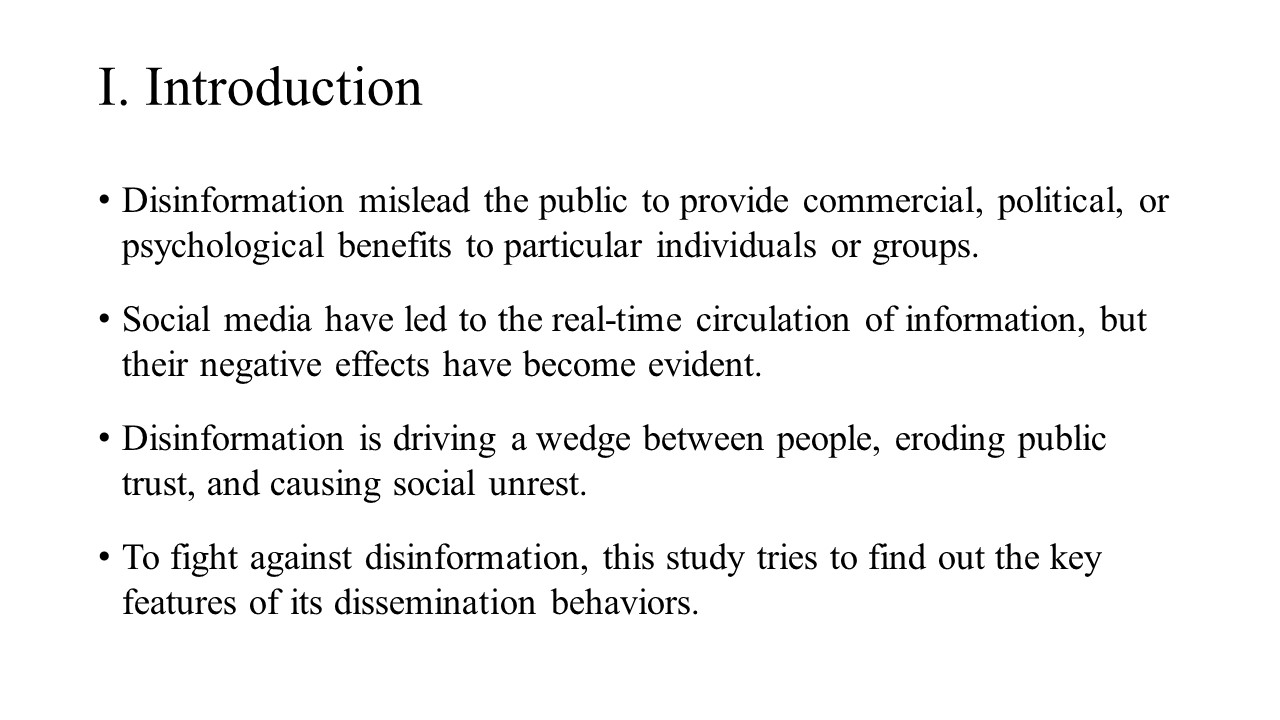 |
A creator of disinformation aims to mislead the public to provide commercial, political, or psychological benefits to particular individuals or groups. It differs from “fake news” [2] in that it is not endorsed by third-party media, and so might be expected to have no credibility and only a weak influence on people.
Although social platforms have led to the real-time circulation of information, their negative effects have become evident. Disinformation is emerging in an endless stream whose impact on human beings has been increasing continuously, as when the coronavirus caused the panic-buying of toilet paper [4] and fake news was reported during the 2016 Election [5]. Sometimes, the effect causes actual harm [6].
Over time, it is driving a wedge between people, eroding public trust, and causing social unrest.
To fight against malicious propaganda and the dissemination of disinformation on various social platforms, relevant research must be performed. Therefore, this research study events and their communication behaviors on different social platforms to analyze relevant motives, purposes and intentions, and try to find out the key features of dissemination of disinformation.
|
|
ICACT20220114 Slide.02
[Big slide for presentation]
[YouTube] |
Chrome Text-to-Speach Click!! |
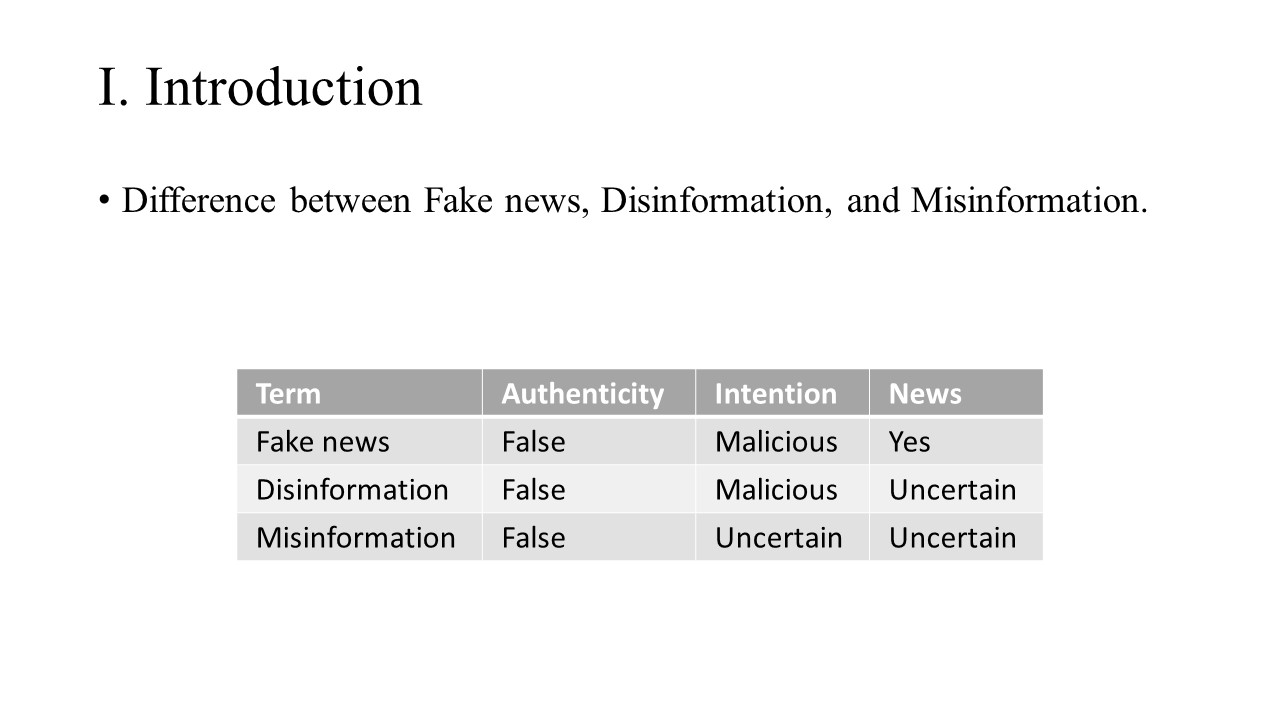 |
Disinformation [1] has been a very difficult issue to resolve since ancient times.
With the rise of social media, the sources of information we got have shifted from traditional TV news, newspapers and magazines to various social media, such as Facebook, Dcard, or PTT in Taiwan. Nowadays, the false information is disseminated less by word of mouth, newspapers, and magazines, and more by such simple means as reposting and sharing on social media. With the help of social networks, mobile devices, and unlimited data phone plans, the spread of false information has become faster and the scope of its influence has increased [3].
Now, let’s show what’s the difference between Fake news, Disinformation, and Misinformation.
Fake news is purposefully crafted, sensational, emotionally charged, misleading or totally fabricated information that mimics the form of mainstream news.
Disinformation is false content that is intentionally disseminated with intent to harm.
Misinformation is false content that is unintentionally or unknowingly disseminated.
|
|
ICACT20220114 Slide.01
[Big slide for presentation]
[YouTube] |
Chrome Text-to-Speach Click!! |
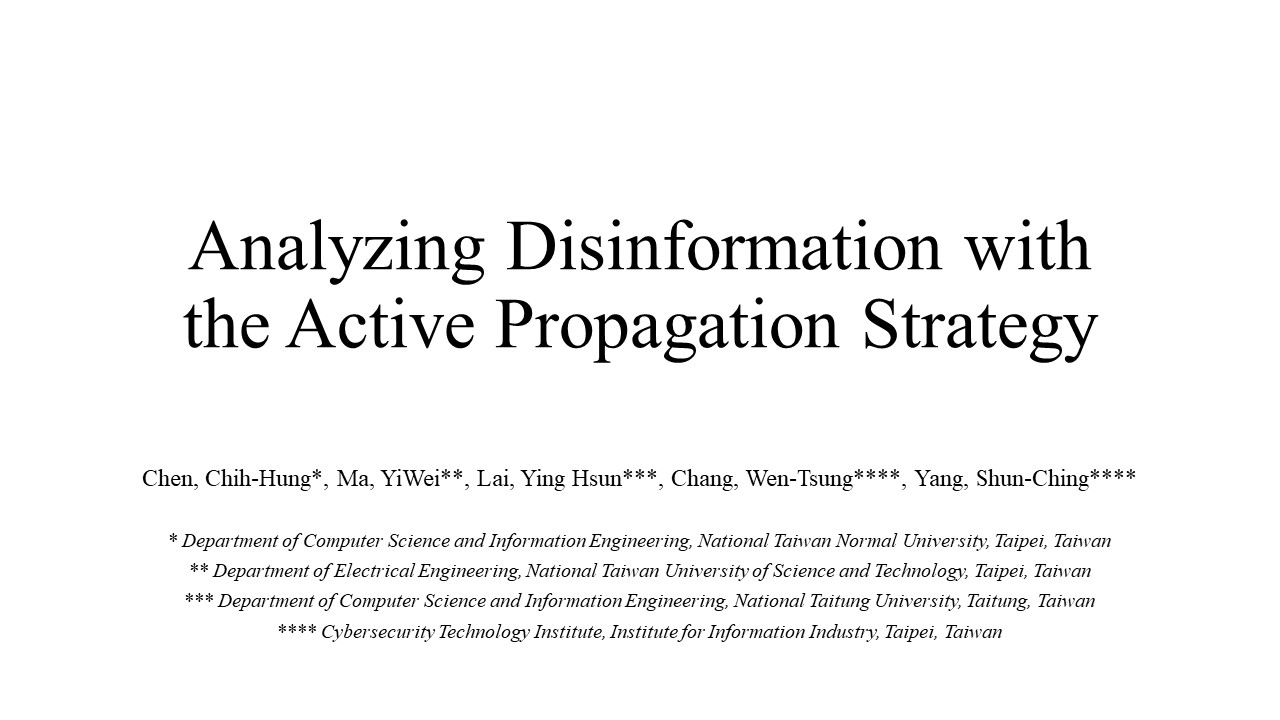 |
Good morning, ladies and gentlemen. I am Chen, Chih-Hung from National Taiwan Normal University.
Today I want to talk about one of our research. The title is “Analyzing Disinformation with the Active Propagation Strategy”
|
















