Now 6837 visitors
Today:0 Yesterday:0
Total: 155503
216S 51P 5R
2026-10-22, Week 43 |
| Member Login |
| TACT Journal Homepage |
| Call for Paper |
| Committee |
| Find My Paper |
| Author Homepage |
| Statistics & History |
| Welcome Message |
| Paper Procedure |
| FAQ |
| Paper Archives |
| Outstanding Papers |
| Author Homepage |
| - Paper Procedure |
| - Journal Procedure |
| - Presentation Tips |
|
| Program & Proceedings |
| Program with Papers |
| Plenary Session |
| Tutorial Session |
|
| Presentation Platform |
| Hotel & Travel Info |
| About Korea |
| Accommodation |
| Transportation |
| VISA |
| Other Infomation |
|
| Photo Gallery |
| Scheduler Login |
| Seminar |
| Archives Login |
|
| Sponsors |

|

|

|

|

|

|

|

|

|

|
|
|
|
|
main_email:mrana15@lamar.edu
| Save the slide and description |

|
*** You can edit any slide by selecting the Slide number below***
|
 ICACT20250208 Slide.20
[Big slide for presentation] |
Chrome Text-to-Speach Click!! |
 |
Appreciate Your Time: Any Questions?
|
|
ICACT20250208 Slide.19
[Big slide for presentation]
[YouTube] |
Chrome Text-to-Speach Click!! |
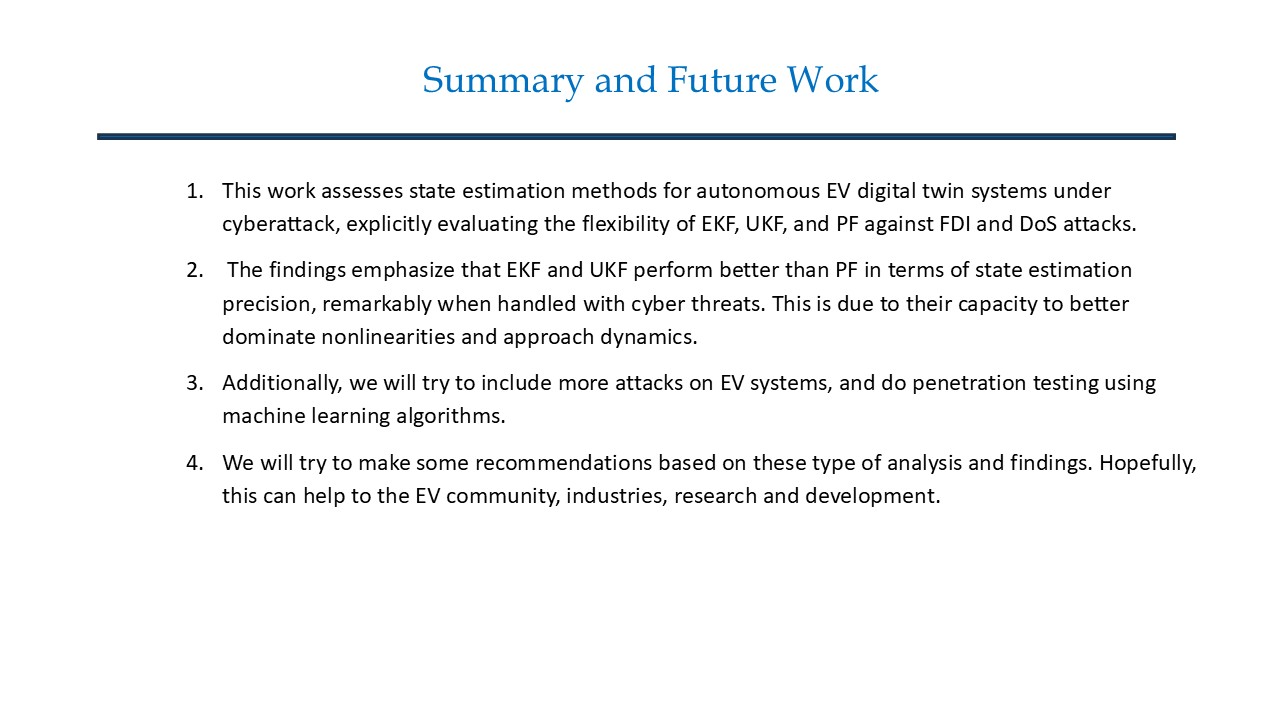 |
This work assesses state estimation methods for autonomous EV digital twin systems under cyberattack, explicitly evaluating the flexibility of EKF, UKF, and PF against FDI and DoS attacks.
The findings emphasize that EKF and UKF perform better than PF in terms of state estimation precision, remarkably when handled with cyber threats. This is due to their capacity to better dominate nonlinearities and approach dynamics.
Additionally, we will try to include more attacks on EV systems, and do penetration testing using machine learning algorithms.
We will try to make some recommendations based on these type of analysis and findings. Hopefully, this can help to the EV community, industries, research and development.
|
|
ICACT20250208 Slide.18
[Big slide for presentation]
[YouTube] |
Chrome Text-to-Speach Click!! |
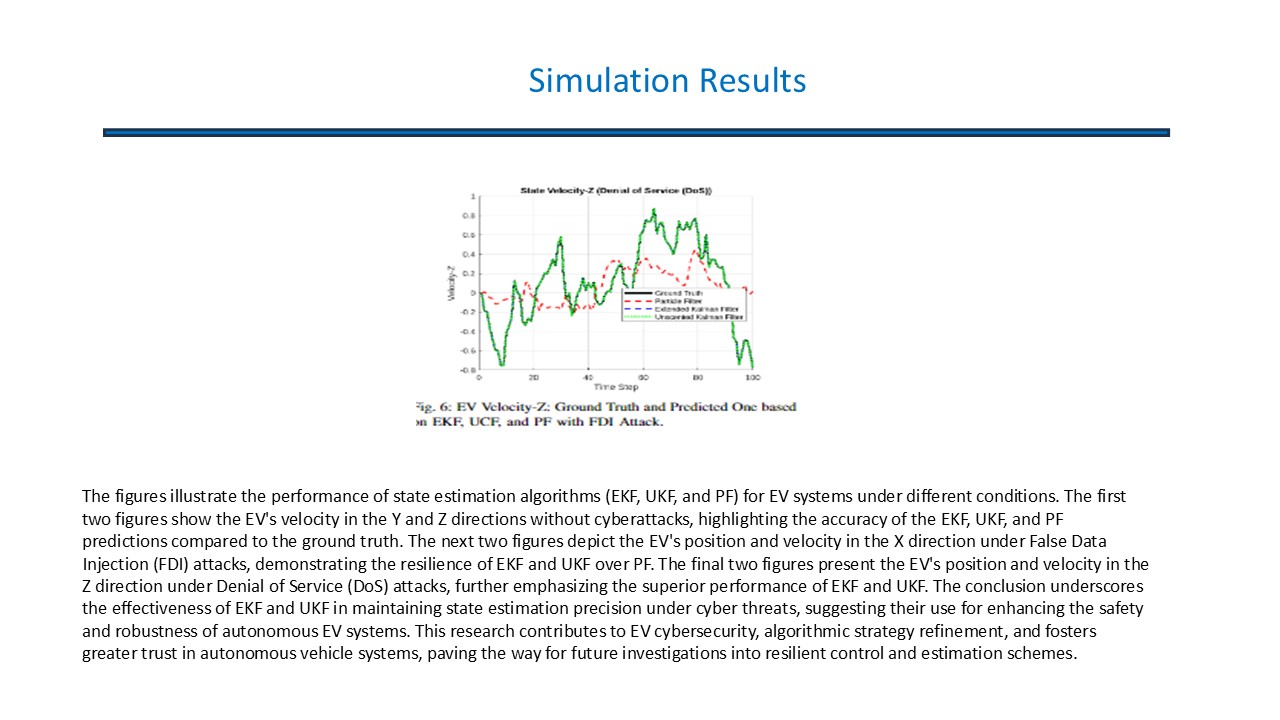 |
The figures illustrate the performance of state estimation algorithms (EKF, UKF, and PF) for EV systems under different conditions. The first two figures show the EV's velocity in the Y and Z directions without cyberattacks, highlighting the accuracy of the EKF, UKF, and PF predictions compared to the ground truth. The next two figures depict the EV's position and velocity in the X direction under False Data Injection (FDI) attacks, demonstrating the resilience of EKF and UKF over PF. The final two figures present the EV's position and velocity in the Z direction under Denial of Service (DoS) attacks, further emphasizing the superior performance of EKF and UKF. The conclusion underscores the effectiveness of EKF and UKF in maintaining state estimation precision under cyber threats, suggesting their use for enhancing the safety and robustness of autonomous EV systems. This research contributes to EV cybersecurity, algorithmic strategy refinement, and fosters greater trust in autonomous vehicle systems, paving the way for future investigations into resilient control and estimation schemes.
|
|
ICACT20250208 Slide.17
[Big slide for presentation]
|
Chrome Text-to-Speach Click!! |
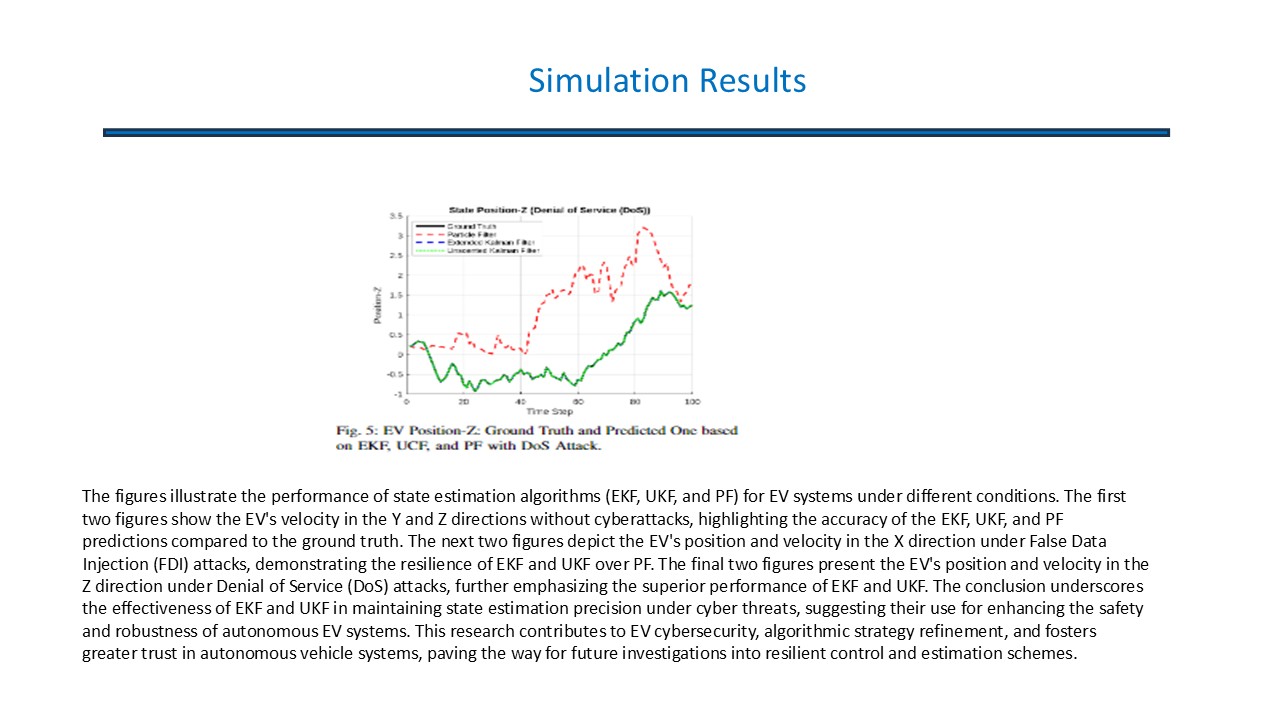 |
The figures illustrate the performance of state estimation algorithms (EKF, UKF, and PF) for EV systems under different conditions. The first two figures show the EV's velocity in the Y and Z directions without cyberattacks, highlighting the accuracy of the EKF, UKF, and PF predictions compared to the ground truth. The next two figures depict the EV's position and velocity in the X direction under False Data Injection (FDI) attacks, demonstrating the resilience of EKF and UKF over PF. The final two figures present the EV's position and velocity in the Z direction under Denial of Service (DoS) attacks, further emphasizing the superior performance of EKF and UKF. The conclusion underscores the effectiveness of EKF and UKF in maintaining state estimation precision under cyber threats, suggesting their use for enhancing the safety and robustness of autonomous EV systems. This research contributes to EV cybersecurity, algorithmic strategy refinement, and fosters greater trust in autonomous vehicle systems, paving the way for future investigations into resilient control and estimation schemes.
|
|
ICACT20250208 Slide.16
[Big slide for presentation]
|
Chrome Text-to-Speach Click!! |
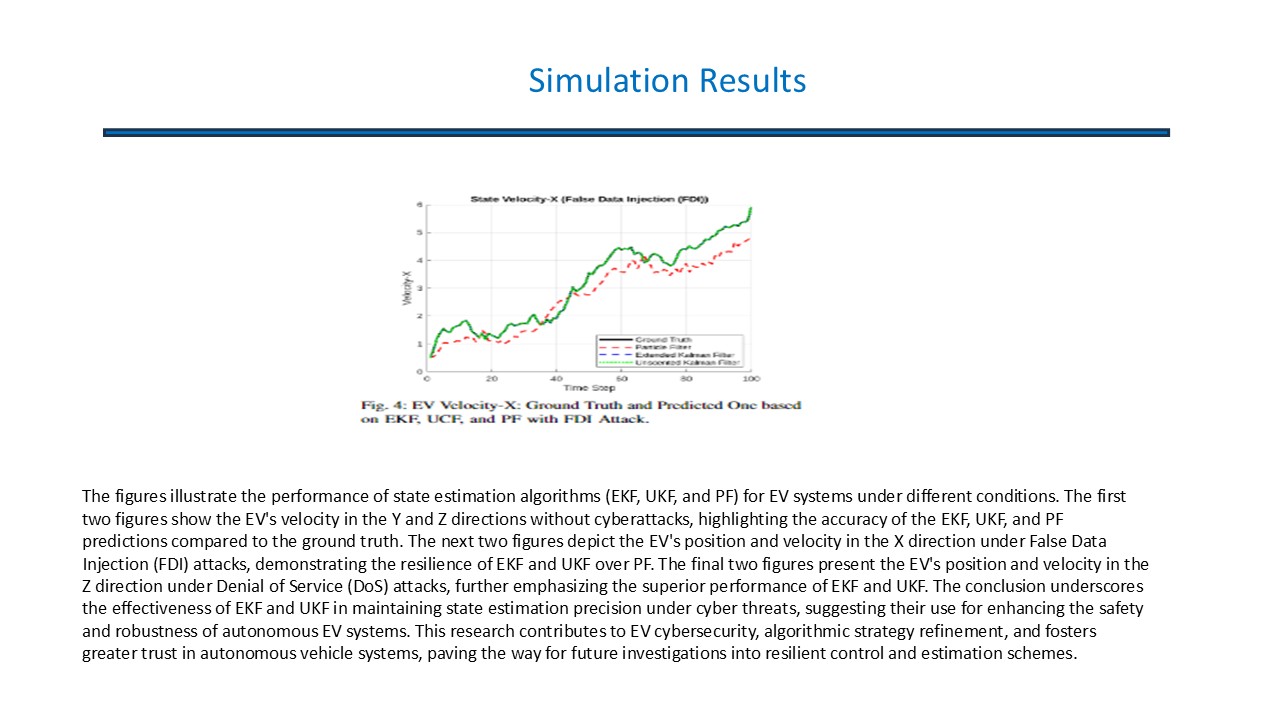 |
The figures illustrate the performance of state estimation algorithms (EKF, UKF, and PF) for EV systems under different conditions. The first two figures show the EV's velocity in the Y and Z directions without cyberattacks, highlighting the accuracy of the EKF, UKF, and PF predictions compared to the ground truth. The next two figures depict the EV's position and velocity in the X direction under False Data Injection (FDI) attacks, demonstrating the resilience of EKF and UKF over PF. The final two figures present the EV's position and velocity in the Z direction under Denial of Service (DoS) attacks, further emphasizing the superior performance of EKF and UKF. The conclusion underscores the effectiveness of EKF and UKF in maintaining state estimation precision under cyber threats, suggesting their use for enhancing the safety and robustness of autonomous EV systems. This research contributes to EV cybersecurity, algorithmic strategy refinement, and fosters greater trust in autonomous vehicle systems, paving the way for future investigations into resilient control and estimation schemes.
|
|
ICACT20250208 Slide.15
[Big slide for presentation]
[YouTube] |
Chrome Text-to-Speach Click!! |
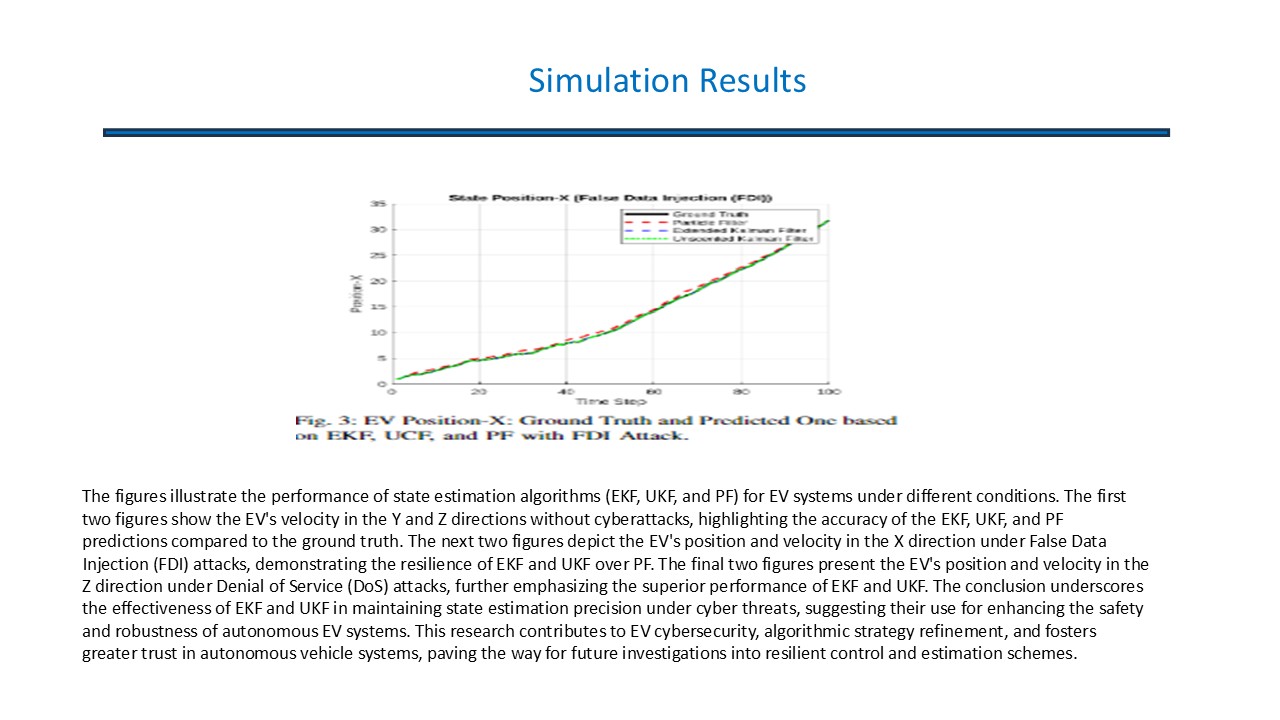 |
The figures illustrate the performance of state estimation algorithms (EKF, UKF, and PF) for EV systems under different conditions. The first two figures show the EV's velocity in the Y and Z directions without cyberattacks, highlighting the accuracy of the EKF, UKF, and PF predictions compared to the ground truth. The next two figures depict the EV's position and velocity in the X direction under False Data Injection (FDI) attacks, demonstrating the resilience of EKF and UKF over PF. The final two figures present the EV's position and velocity in the Z direction under Denial of Service (DoS) attacks, further emphasizing the superior performance of EKF and UKF. The conclusion underscores the effectiveness of EKF and UKF in maintaining state estimation precision under cyber threats, suggesting their use for enhancing the safety and robustness of autonomous EV systems. This research contributes to EV cybersecurity, algorithmic strategy refinement, and fosters greater trust in autonomous vehicle systems, paving the way for future investigations into resilient control and estimation schemes.
|
|
ICACT20250208 Slide.14
[Big slide for presentation]
|
Chrome Text-to-Speach Click!! |
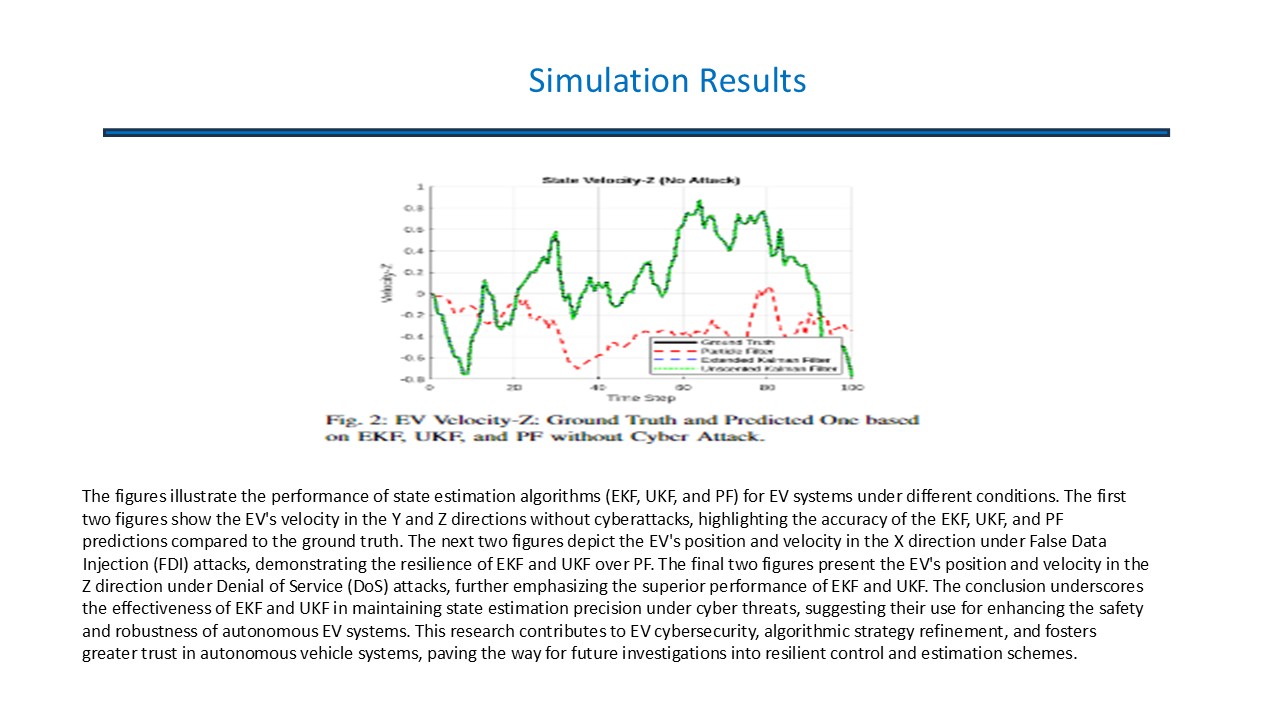 |
The figures illustrate the performance of state estimation algorithms (EKF, UKF, and PF) for EV systems under different conditions. The first two figures show the EV's velocity in the Y and Z directions without cyberattacks, highlighting the accuracy of the EKF, UKF, and PF predictions compared to the ground truth. The next two figures depict the EV's position and velocity in the X direction under False Data Injection (FDI) attacks, demonstrating the resilience of EKF and UKF over PF. The final two figures present the EV's position and velocity in the Z direction under Denial of Service (DoS) attacks, further emphasizing the superior performance of EKF and UKF. The conclusion underscores the effectiveness of EKF and UKF in maintaining state estimation precision under cyber threats, suggesting their use for enhancing the safety and robustness of autonomous EV systems. This research contributes to EV cybersecurity, algorithmic strategy refinement, and fosters greater trust in autonomous vehicle systems, paving the way for future investigations into resilient control and estimation schemes.
|
|
ICACT20250208 Slide.13
[Big slide for presentation]
[YouTube] |
Chrome Text-to-Speach Click!! |
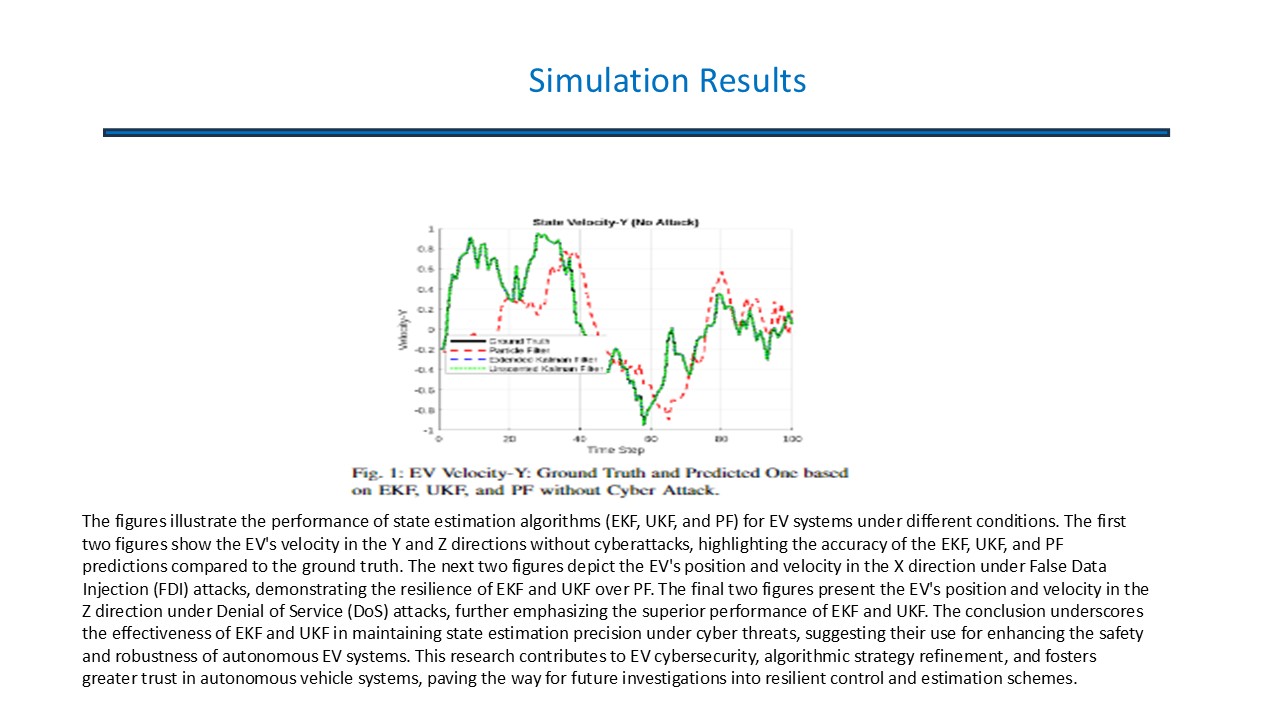 |
The figures illustrate the performance of state estimation algorithms (EKF, UKF, and PF) for EV systems under different conditions. The first two figures show the EV's velocity in the Y and Z directions without cyberattacks, highlighting the accuracy of the EKF, UKF, and PF predictions compared to the ground truth. The next two figures depict the EV's position and velocity in the X direction under False Data Injection (FDI) attacks, demonstrating the resilience of EKF and UKF over PF. The final two figures present the EV's position and velocity in the Z direction under Denial of Service (DoS) attacks, further emphasizing the superior performance of EKF and UKF. The conclusion underscores the effectiveness of EKF and UKF in maintaining state estimation precision under cyber threats, suggesting their use for enhancing the safety and robustness of autonomous EV systems. This research contributes to EV cybersecurity, algorithmic strategy refinement, and fosters greater trust in autonomous vehicle systems, paving the way for future investigations into resilient control and estimation schemes.
|
|
ICACT20250208 Slide.12
[Big slide for presentation]
[YouTube] |
Chrome Text-to-Speach Click!! |
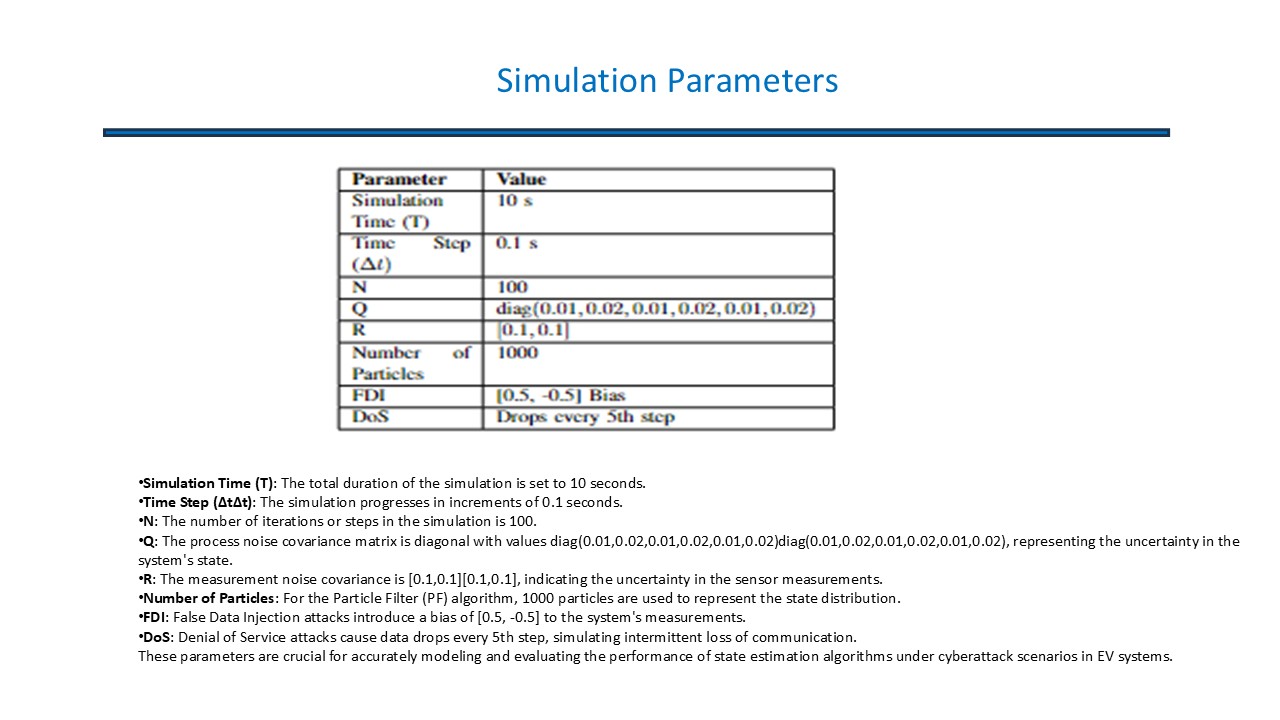 |
Simulation Time (T): The total duration of the simulation is set to 10 seconds.
Time Step (ΔtΔt): The simulation progresses in increments of 0.1 seconds.
N: The number of iterations or steps in the simulation is 100.
Q: The process noise covariance matrix is diagonal with values diag(0.01,0.02,0.01,0.02,0.01,0.02)diag(0.01,0.02,0.01,0.02,0.01,0.02), representing the uncertainty in the system's state.
R: The measurement noise covariance is [0.1,0.1][0.1,0.1], indicating the uncertainty in the sensor measurements.
Number of Particles: For the Particle Filter (PF) algorithm, 1000 particles are used to represent the state distribution.
FDI: False Data Injection attacks introduce a bias of [0.5, -0.5] to the system's measurements.
DoS: Denial of Service attacks cause data drops every 5th step, simulating intermittent loss of communication.
These parameters are crucial for accurately modeling and evaluating the performance of state estimation algorithms under cyberattack scenarios in EV systems.
|
|
ICACT20250208 Slide.11
[Big slide for presentation]
[YouTube] |
Chrome Text-to-Speach Click!! |
 |
Please see slides
|
|
ICACT20250208 Slide.10
[Big slide for presentation]
[YouTube] |
Chrome Text-to-Speach Click!! |
 |
Please see slide
|
|
ICACT20250208 Slide.09
[Big slide for presentation]
|
Chrome Text-to-Speach Click!! |
 |
Please see slide
|
|
ICACT20250208 Slide.08
[Big slide for presentation]
|
Chrome Text-to-Speach Click!! |
 |
Please see slide
|
|
ICACT20250208 Slide.07
[Big slide for presentation]
|
Chrome Text-to-Speach Click!! |
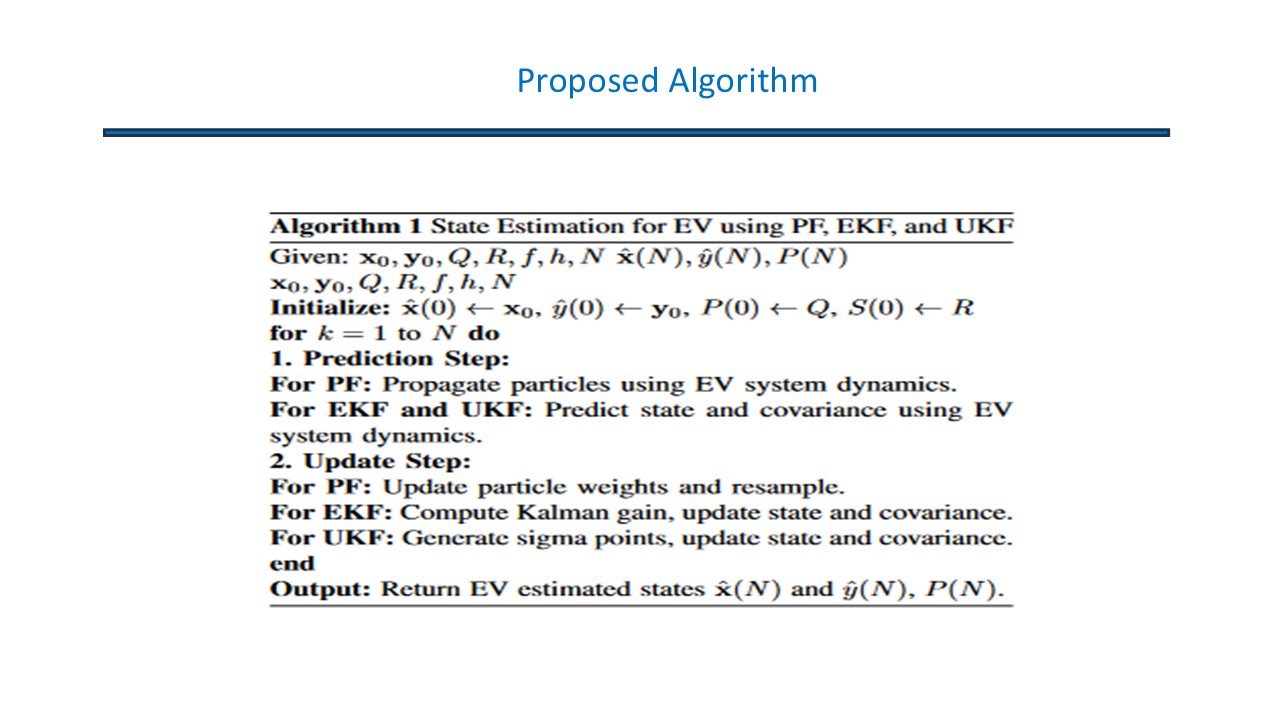 |
Please see slide
|
|
ICACT20250208 Slide.06
[Big slide for presentation]
[YouTube] |
Chrome Text-to-Speach Click!! |
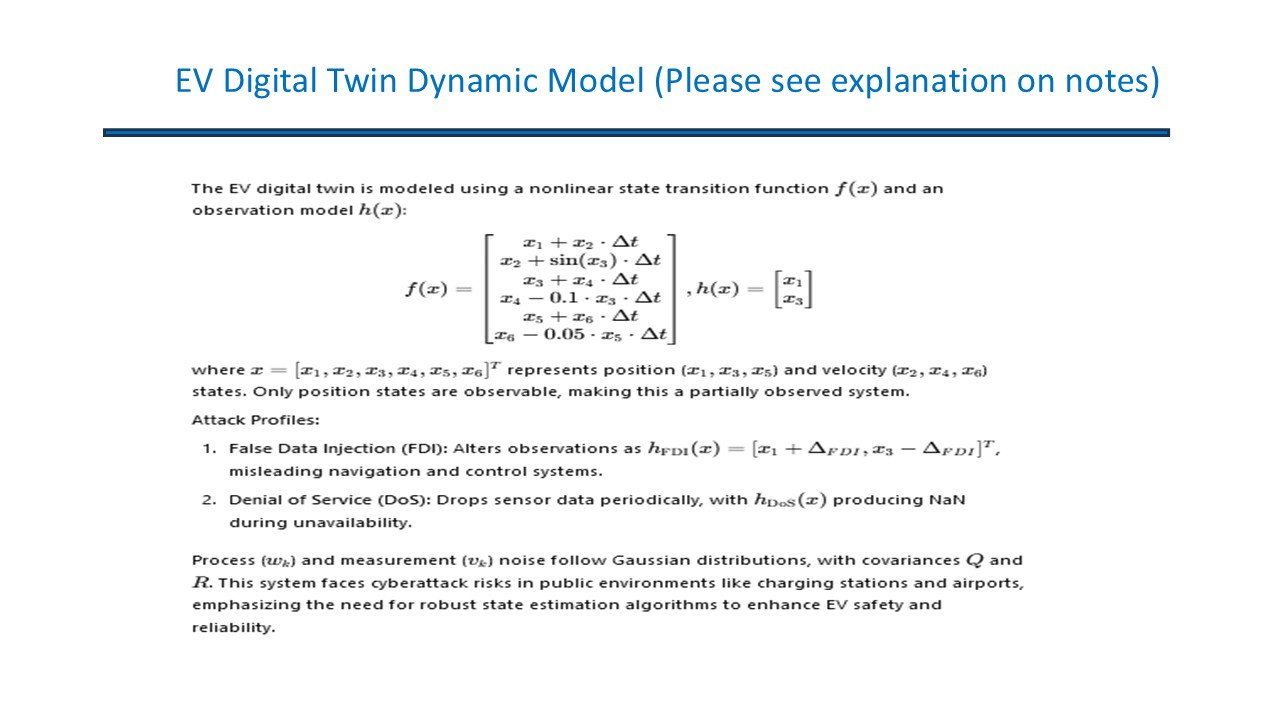 |
The EV Digital Twin Dynamic Model is a virtual representation of an electric vehicle that mirrors its physical counterpart in real-time. This model integrates data from various sensors and IoT devices embedded in the EV, capturing parameters such as temperature, speed, battery status, and motor performance1
. The digital twin allows for continuous monitoring and optimization by simulating the vehicle's behavior under different conditions, including stress tests and performance scenarios1
2
. Advanced algorithms, such as those used in AI-enhanced digital twins, enable predictive maintenance and improve the design and performance of EV components like motors and batteries2
. This comprehensive approach helps in identifying potential issues before they occur, enhancing the reliability, efficiency, and safety of electric vehicles
|
|
ICACT20250208 Slide.05
[Big slide for presentation]
|
Chrome Text-to-Speach Click!! |
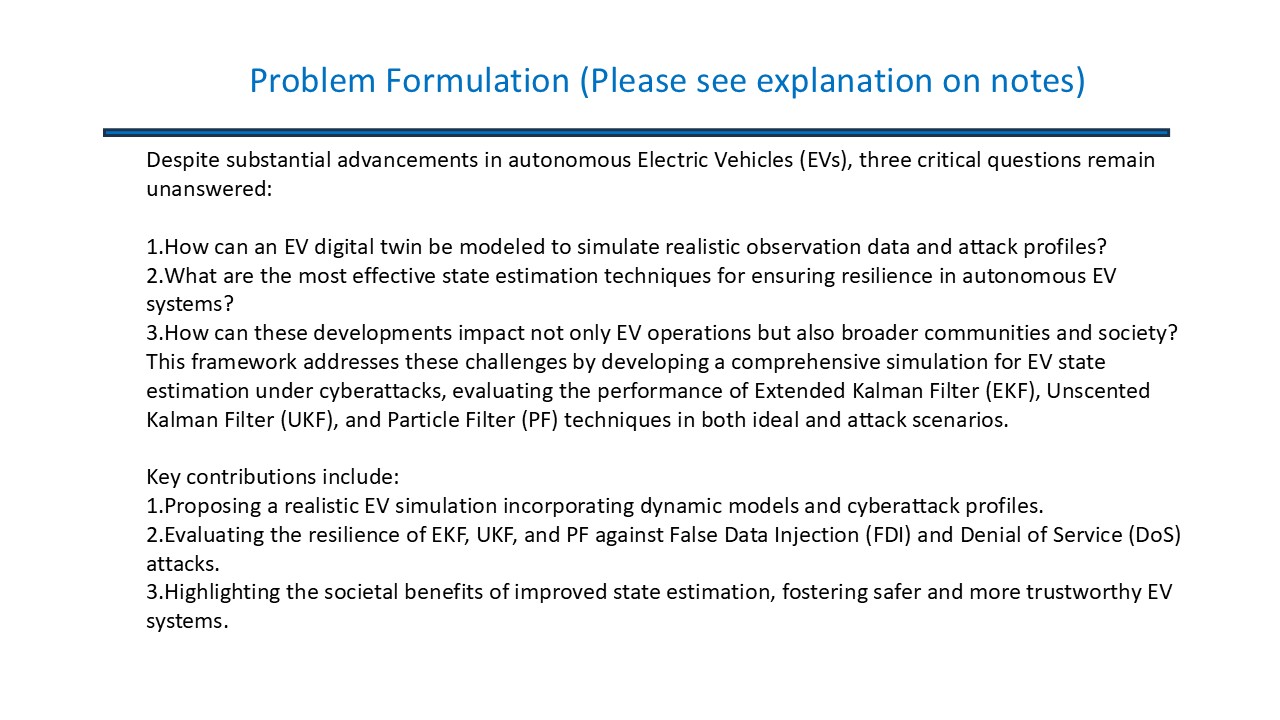 |
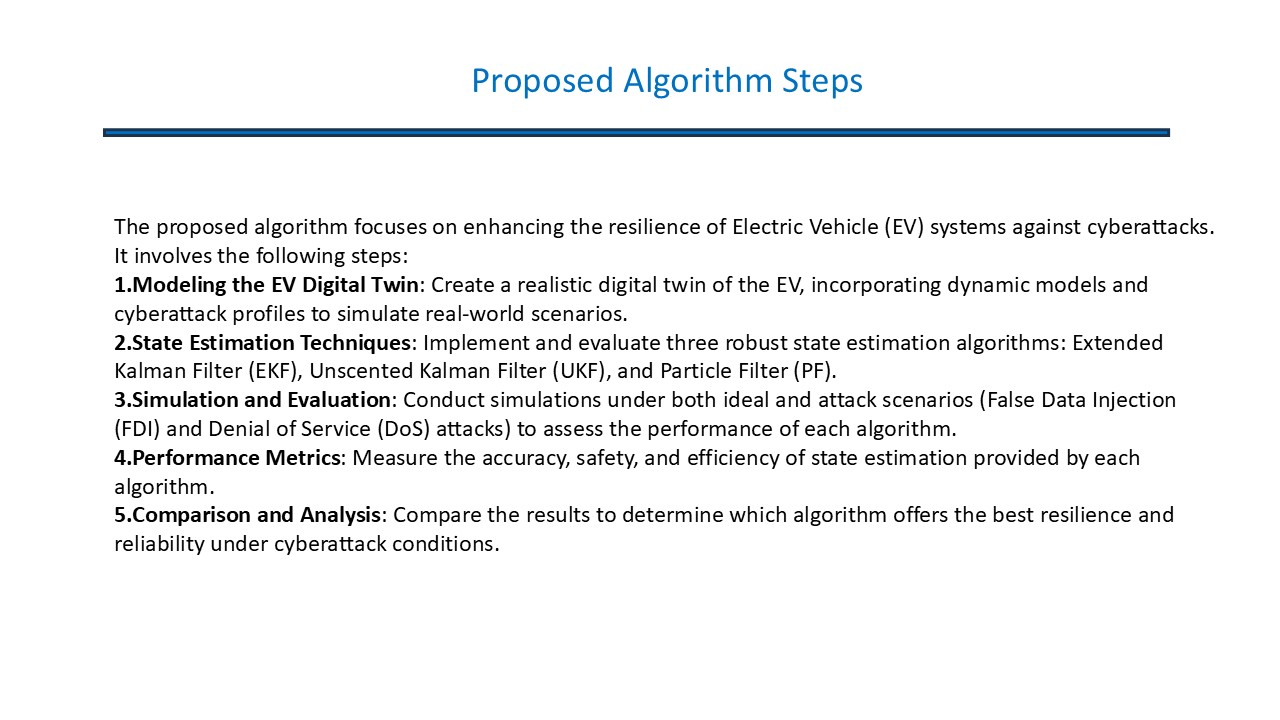
Despite substantial advancements in autonomous Electric Vehicles (EVs), three critical questions remain unanswered: How can an EV digital twin be modeled to simulate realistic observation data and attack profiles? What are the most effective state estimation techniques for ensuring resilience in autonomous EV systems? How can these developments impact not only EV operations but also broader communities and society? This framework addresses these challenges by developing a comprehensive simulation for EV state estimation under cyberattacks, evaluating the performance of Extended Kalman Filter (EKF), Unscented Kalman Filter (UKF), and Particle Filter (PF) techniques in both ideal and attack scenarios.
Key contributions include proposing a realistic EV simulation incorporating dynamic models and cyberattack profiles, evaluating the resilience of EKF, UKF, and PF against False Data Injection (FDI) and Denial of Service (DoS) attacks, and highlighting the societal benefits of improved state estimation, fostering safer and more trustworthy EV systems.
AI-generated content may be incorrect
|
|
ICACT20250208 Slide.04
[Big slide for presentation]
|
Chrome Text-to-Speach Click!! |
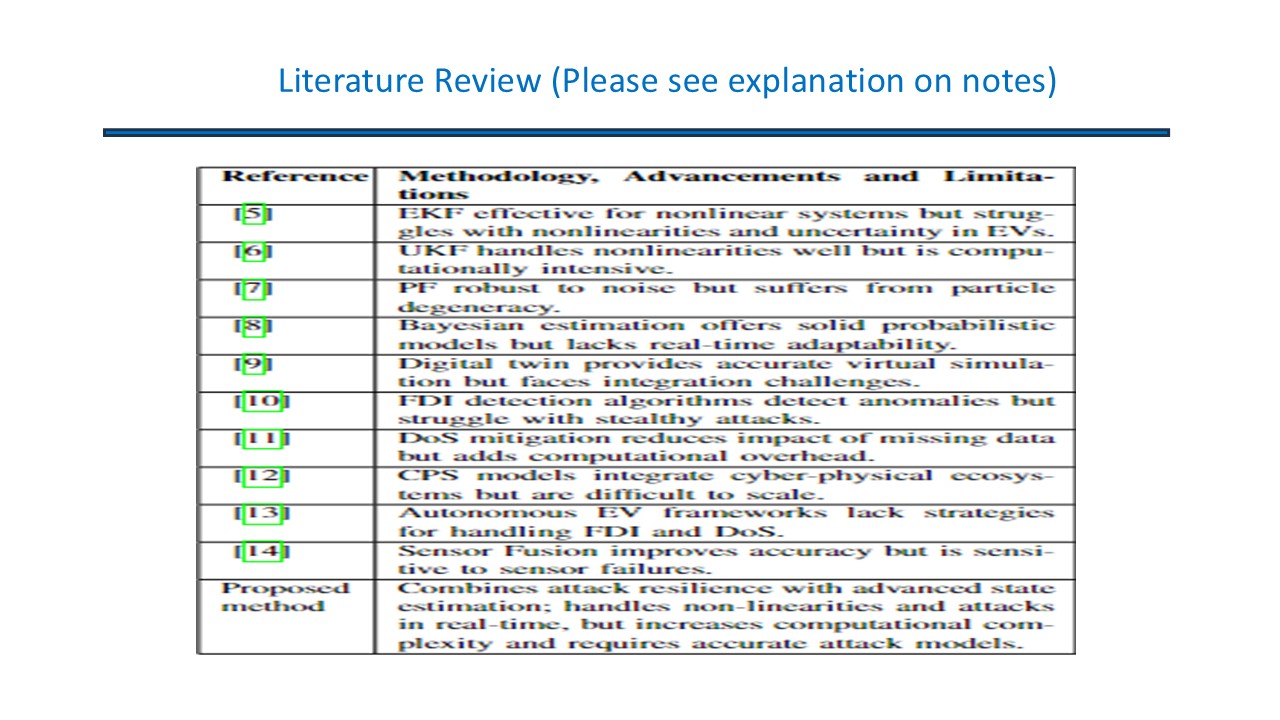 |
The literature on Electric Vehicle (EV) systems cybersecurity highlights the increasing integration of advanced algorithms for navigation, sensors, actuators, and energy management, which are vulnerable to cyberattacks. Key studies focus on the susceptibility of EV systems to threats like False Data Injection (FDA) and Denial of Service (DoS) attacks, which can disrupt navigation and control, leading to accidents and reduced efficiency1
2
. Research also explores various robust algorithms, such as the Extended Kalman Filter (EKF), Unscented Kalman Filter (UKF), and Particle Filter (PF), to enhance the resilience of EV systems against these attacks
. These studies provide valuable insights into the impact of cyberattacks on EV systems and the effectiveness of different algorithms in improving accuracy, safety, and efficiency.
|
|
ICACT20250208 Slide.03
[Big slide for presentation]
[YouTube] |
Chrome Text-to-Speach Click!! |
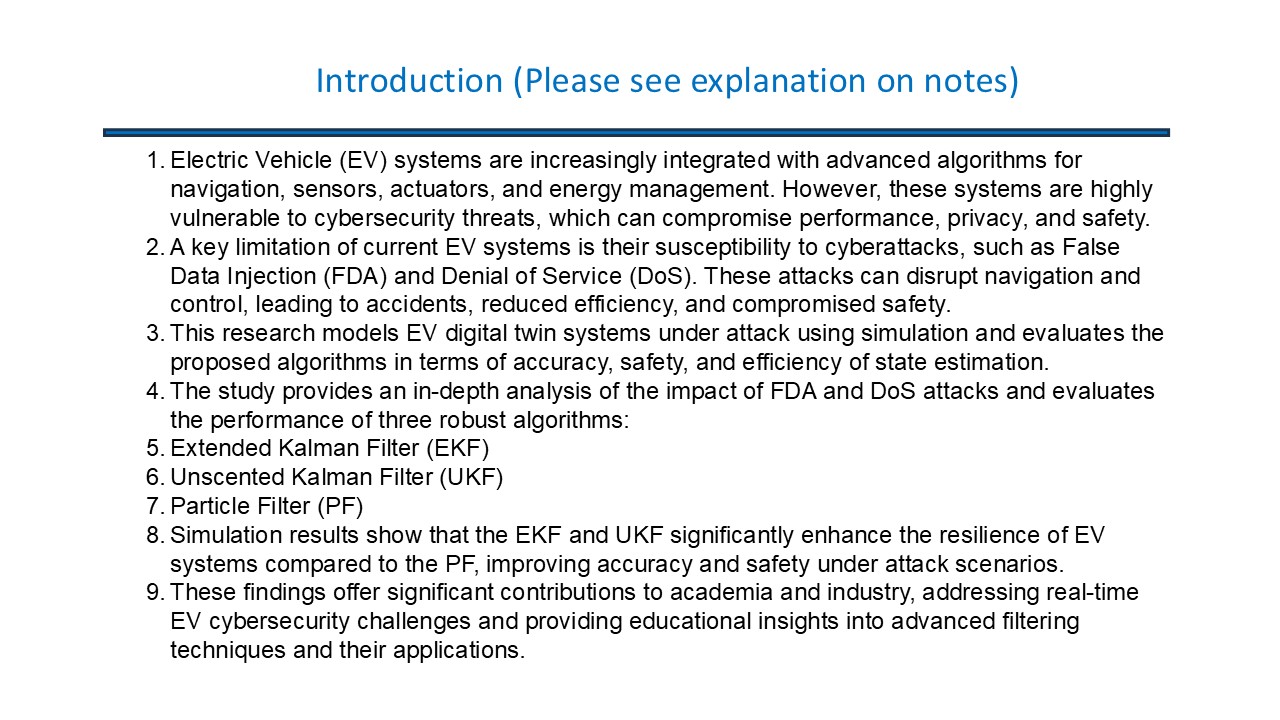 |
This presentation discusses the integration of advanced algorithms in Electric Vehicle (EV) systems for navigation, sensors, actuators, and energy management, highlighting their vulnerability to cybersecurity threats that can affect performance, privacy, and safety. A major issue is the susceptibility to cyberattacks like False Data Injection (FDA) and Denial of Service (DoS), which can disrupt navigation and control, leading to accidents and reduced efficiency. The research models EV digital twin systems under attack using simulations and evaluates the proposed algorithms for accuracy, safety, and efficiency in state estimation. It provides an in-depth analysis of FDA and DoS attacks and assesses the performance of three robust algorithms: Extended Kalman Filter (EKF), Unscented Kalman Filter (UKF), and Particle Filter (PF). Simulation results indicate that EKF and UKF significantly enhance the resilience of EV systems compared to PF, improving accuracy and safety under attack scenarios. These findings contribute to academia and industry by addressing real-time EV cybersecurity challenges and offering insights into advanced filtering techniques and their applications.
|
|
ICACT20250208 Slide.02
[Big slide for presentation]
[YouTube] |
Chrome Text-to-Speach Click!! |
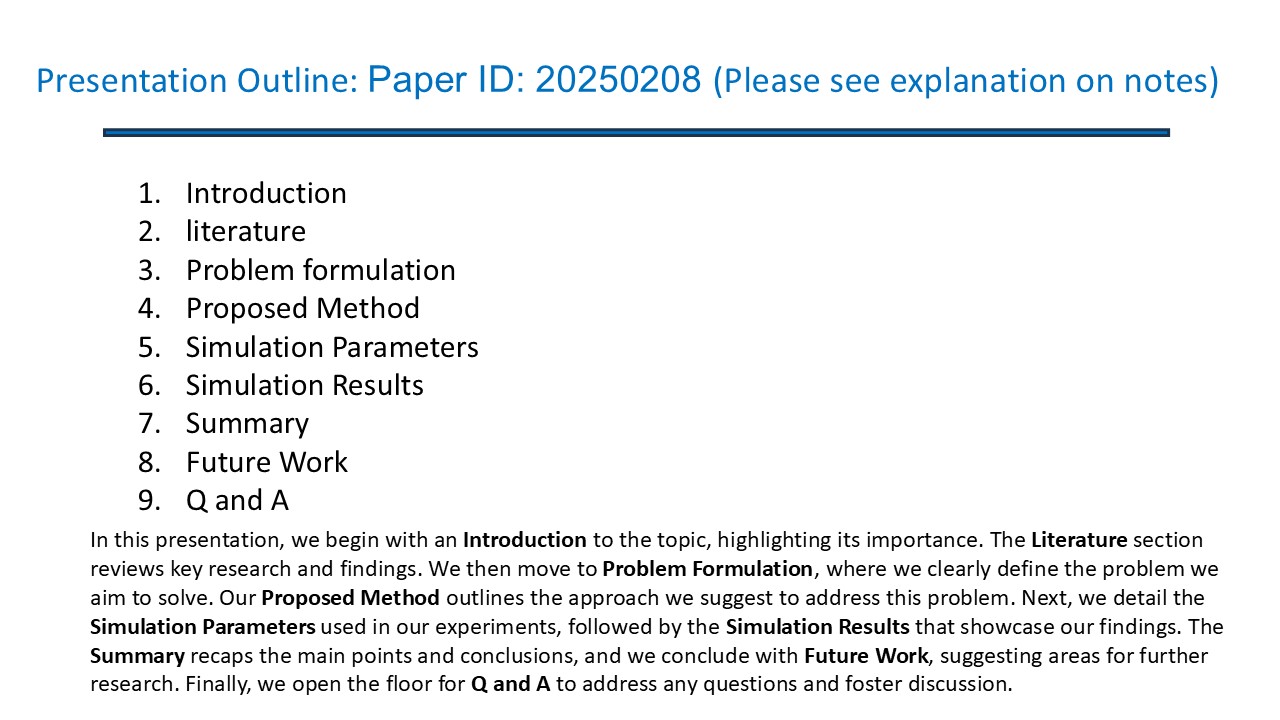 |
In this presentation, we begin with an Introduction to the topic, highlighting its importance. The Literature section reviews key research and findings. We then move to Problem Formulation, where we clearly define the problem we aim to solve. Our Proposed Method outlines the approach we suggest to address this problem. Next, we detail the Simulation Parameters used in our experiments, followed by the Simulation Results that showcase our findings. The Summary recaps the main points and conclusions, and we conclude with Future Work, suggesting areas for further research. Finally, we open the floor for Q and A to address any questions and foster discussion.
|
|
ICACT20250208 Slide.01
[Big slide for presentation]
[YouTube] |
Chrome Text-to-Speach Click!! |
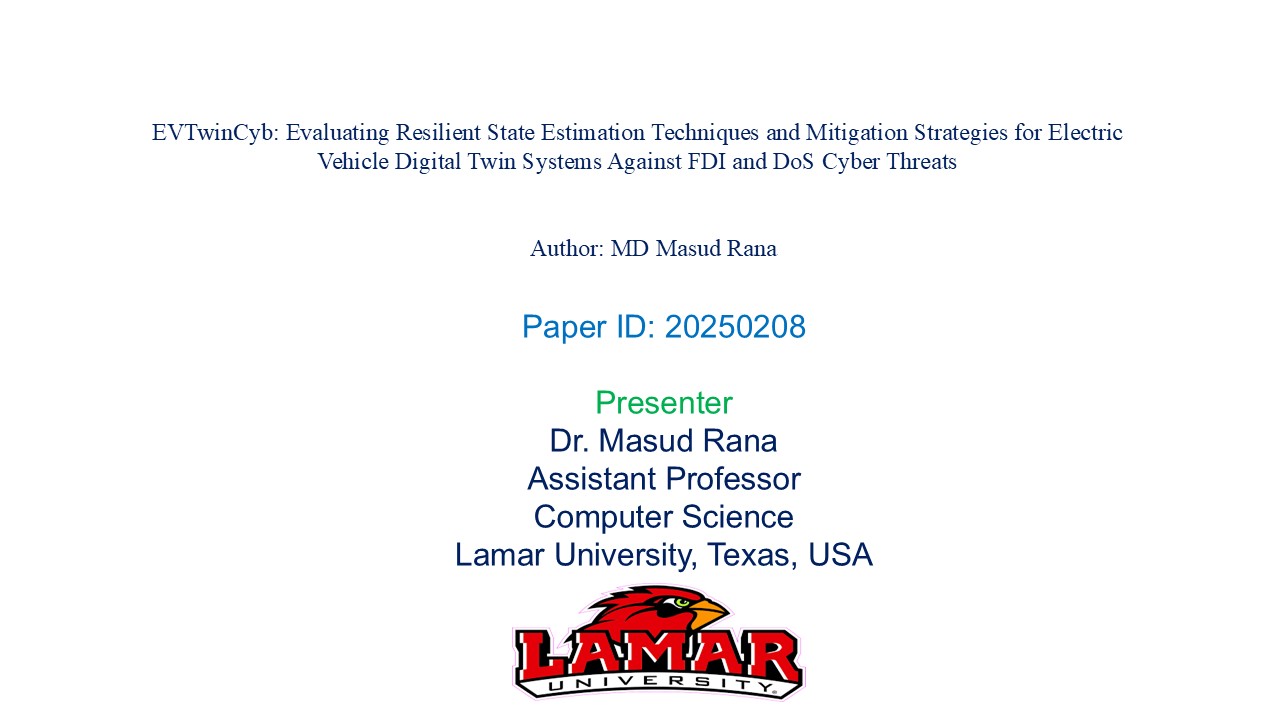 |
Welcome to EVTwinCyb
Evaluating Resilient State Estimation Techniques and Mitigation Strategies for Electric Vehicle Digital Twin Systems Against FDI and DoS Cyber Threats
Introduction: Introduce the topic of Electric Vehicle (EV) digital twin systems and their importance in modern transportation. Highlight the growing integration of advanced algorithms for navigation, sensors, actuators, and energy management in EVs.
Cybersecurity Challenges: Discuss the susceptibility of EV systems to cyberattacks, specifically False Data Injection (FDI) and Denial of Service (DoS) attacks. Explain how these attacks can compromise performance, privacy, and safety, leading to accidents and reduced efficiency.
Research Objectives: Describe the goal of modeling EV digital twin systems to simulate realistic observation data and attack profiles. Outline the aim to identify the most effective state estimation techniques for ensuring resilience in autonomous EV systems. Emphasize the potential impact of these developments on EV operations, communities, and society.
Proposed Framework: Introduce the comprehensive simulation framework for EV state estimation under cyberattacks. Mention the evaluation of Extended Kalman Filter (EKF), Unscented Kalman Filter (UKF), and Particle Filter (PF) techniques in both ideal and attack scenarios.
Key Contributions: Propose a realistic EV simulation incorporating dynamic models and cyberattack profiles. Evaluate the resilience of EKF, UKF, and PF against FDI and DoS attacks. Highlight the societal benefits of improved state estimation, fostering safer and more trustworthy EV systems.
|
| |





