 ICACT20240293 Slide.20
[Big slide for presentation] |
Chrome Text-to-Speach Click!! |
 |
Thank you all.
For any question or query, you can send us an email to the following email. It will help us to improve our work.
abdulmateencs@gmail.com
|
|
ICACT20240293 Slide.19
[Big slide for presentation]
|
Chrome Text-to-Speach Click!! |
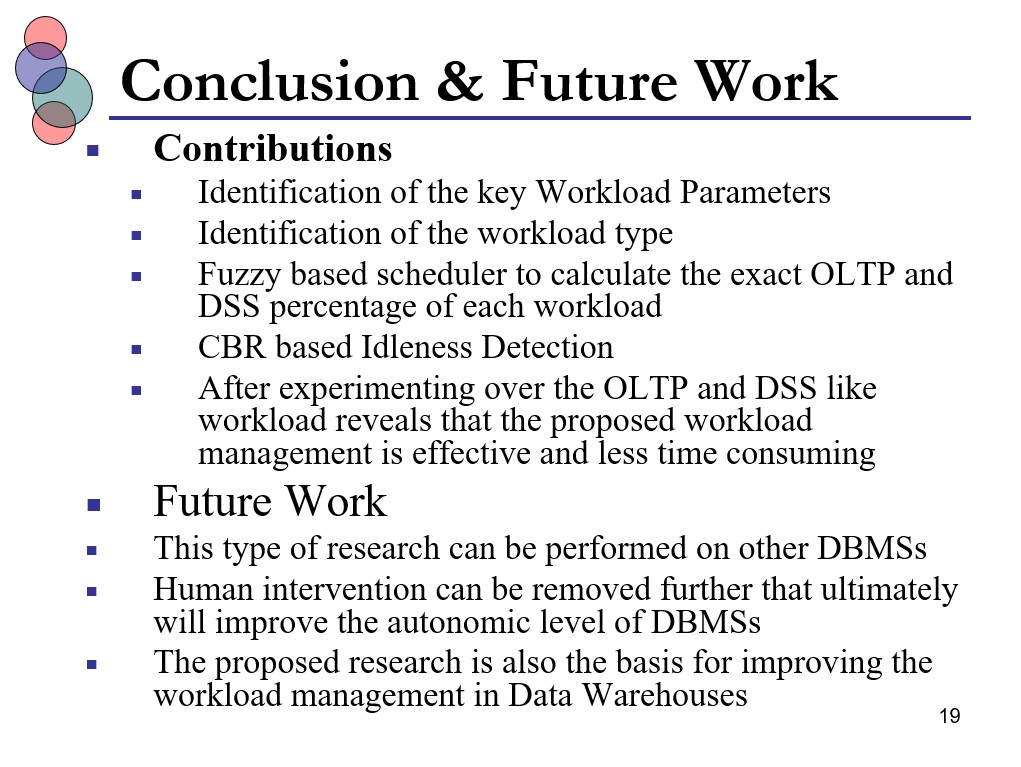 |
Main contributions of this research are:
1. Identification of the key Workload Parameters
2. Identification of the workload type
3. Fuzzy based scheduler to calculate the exact OLTP and DSS percentage of each workload.
4. CBR based Idleness Detection
Results achieved after experimenting over the OLTP and DSS like workload reveals that the proposed workload management is effective and less time consuming as compared to other techniques. In future, this type of research can be performed on other DBMSs, more human intervention can be lessened that ultimately improve the autonomic level of DBMSs. The proposed research is also providing the basis for improving the workload management in Data Warehouses.
|
|
ICACT20240293 Slide.18
[Big slide for presentation]
|
Chrome Text-to-Speach Click!! |
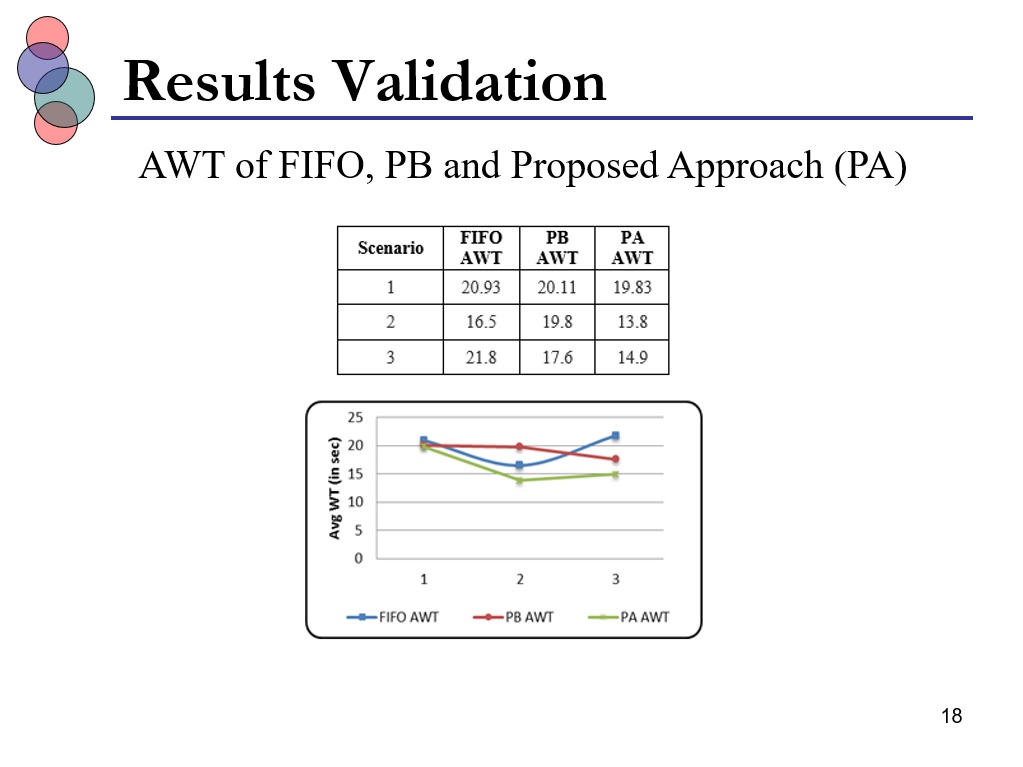 |
The results of the proposed, FIFO and Priority based workload management technique are presented for three different scenarios. After the execution of each scenario, performance behavior is evaluated by observing the workload execution time as well as average waiting time. Final results in the table shows that our proposed approach is better than the FIFO as well as PB with respect to average waiting time.
|
|
ICACT20240293 Slide.17
[Big slide for presentation]
|
Chrome Text-to-Speach Click!! |
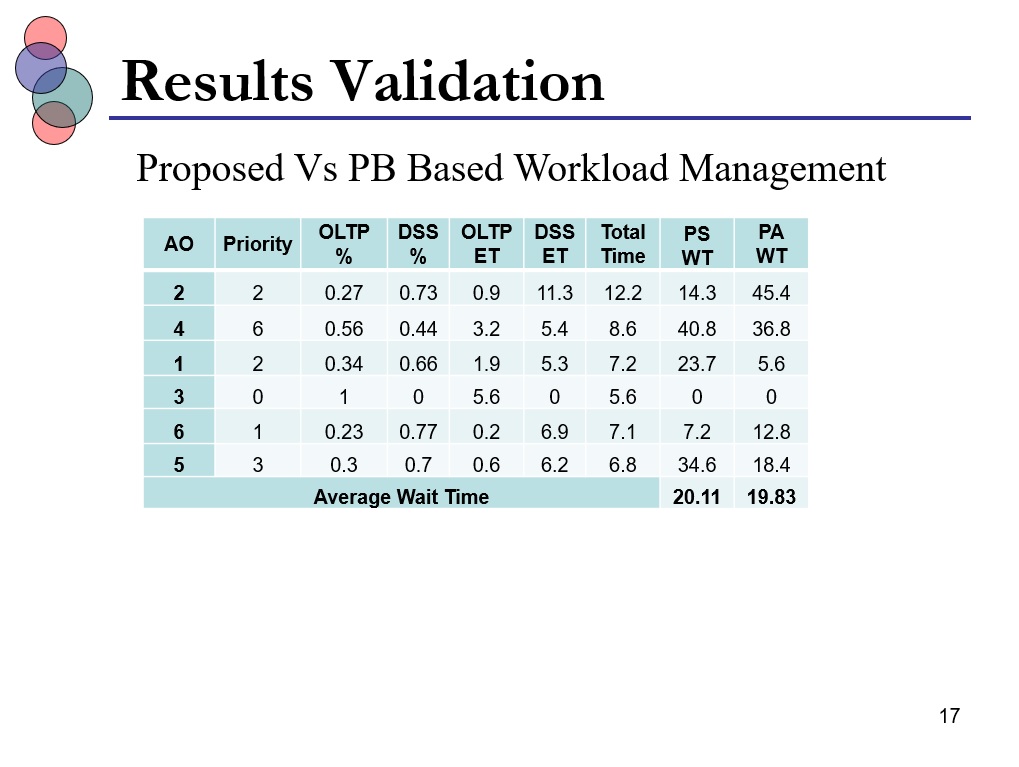 |
We are presenting the results of the proposed and Priority based workload management technique. In this scenario, again we have taken six (6) workloads which are generated by different users. After the execution of each workload, performance behavior is evaluated by observing the workload execution time as well as waiting time. Final result in the table shows that our proposed approach is better than the PB with respect to waiting time.
|
|
ICACT20240293 Slide.16
[Big slide for presentation]
|
Chrome Text-to-Speach Click!! |
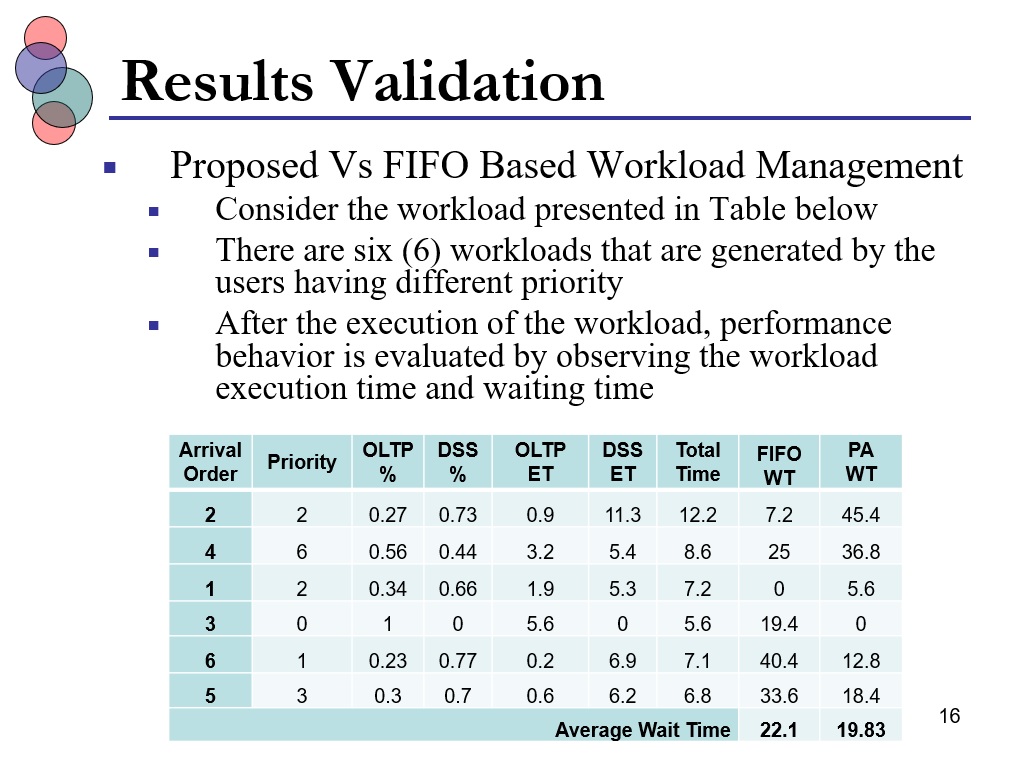 |
In this slide, we are presenting the results of the Proposed and FIFO based workload management technique. In this scenario, six (6) workloads are generated by the users having different priority. After the execution of each workload, performance behavior is evaluated by observing the workload execution time as well as waiting time. Final result in the table shows that our proposed approach is better than the FIFI with respect to waiting time.
|
|
ICACT20240293 Slide.15
[Big slide for presentation]
|
Chrome Text-to-Speach Click!! |
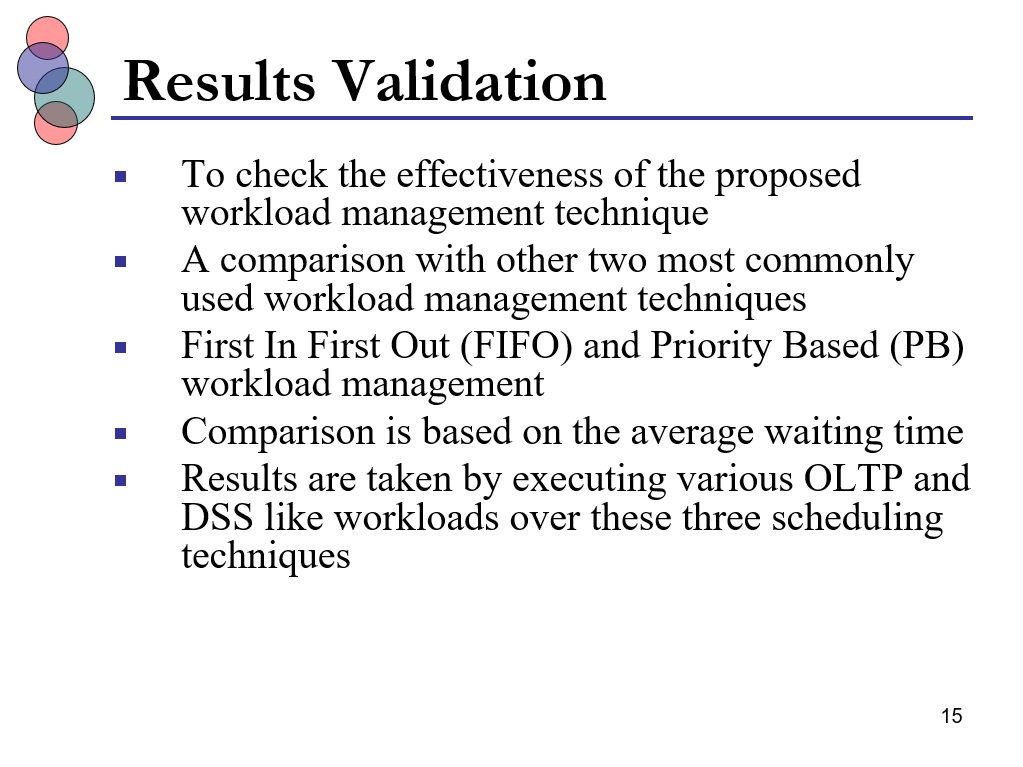 |
In order to check the effectiveness of the proposed workload management technique, a comparison with other two most commonly used workload management techniques (First n First Out (FIFO) and Priority Based (PB)) is performed. The comparison is based on the average waiting time of each workload. Various OLTP and DSS like workloads are executed over these two and the proposed workload techniques.
|
|
ICACT20240293 Slide.14
[Big slide for presentation]
|
Chrome Text-to-Speach Click!! |
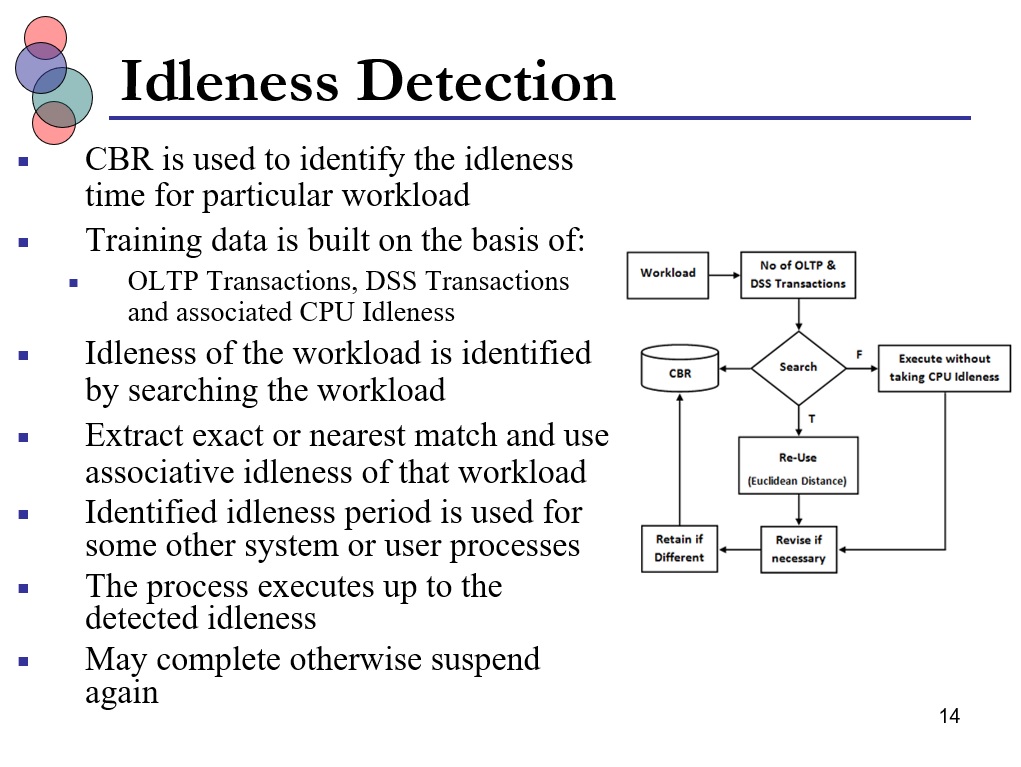 |
The Case based Reasoning approach is applied to identify the idleness time for the given workload. The training data is built on the basis of OLTP Transactions, DSS Transactions and associated CPU Idleness. The idleness period during the execution of each workload is identified by searching the workload. After the extraction of exact or nearest match, the associative idleness of that workload is used for some other system or user processes. The process executes up to the detected idleness where it may either complete or suspend again.
|
|
ICACT20240293 Slide.13
[Big slide for presentation]
|
Chrome Text-to-Speach Click!! |
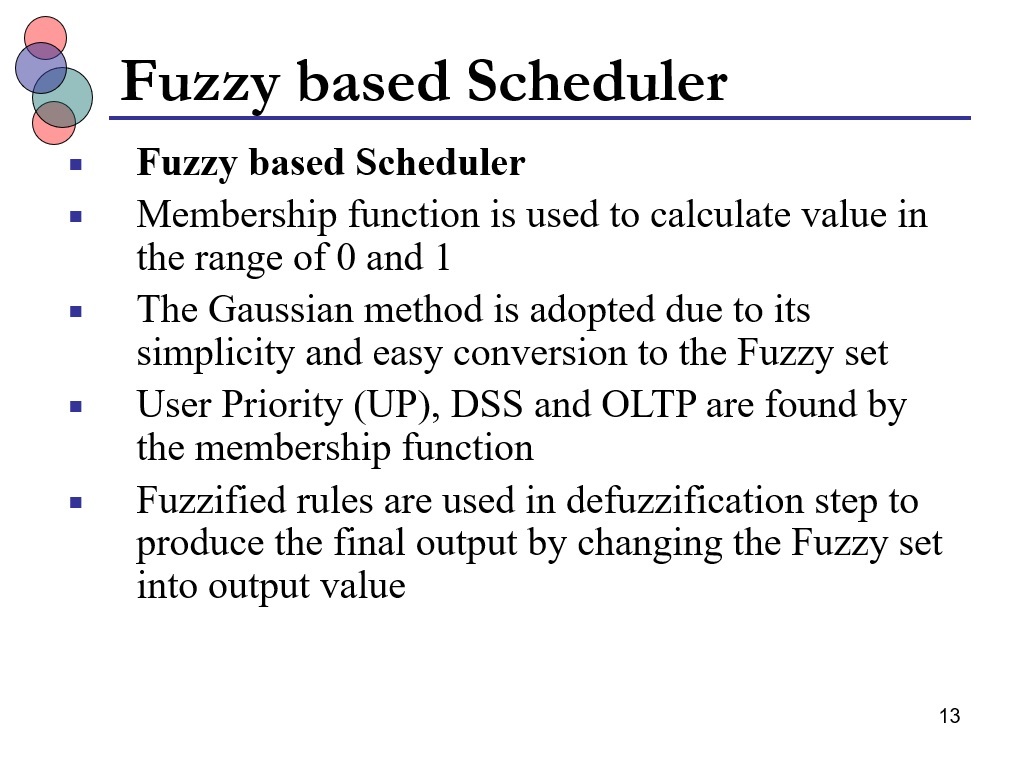 |
Membership function is used to calculate value in the range of 0 and 1. The Gaussian method is adopted in this research due to its simplicity and easy conversion to the Fuzzy set. User Priority (UP), DSS and OLTP are found by the membership function. Finally, the Fuzzified rules are used in defuzzification step to produce the final output by changing the Fuzzy set into output value.
|
|
ICACT20240293 Slide.11
[Big slide for presentation]
|
Chrome Text-to-Speach Click!! |
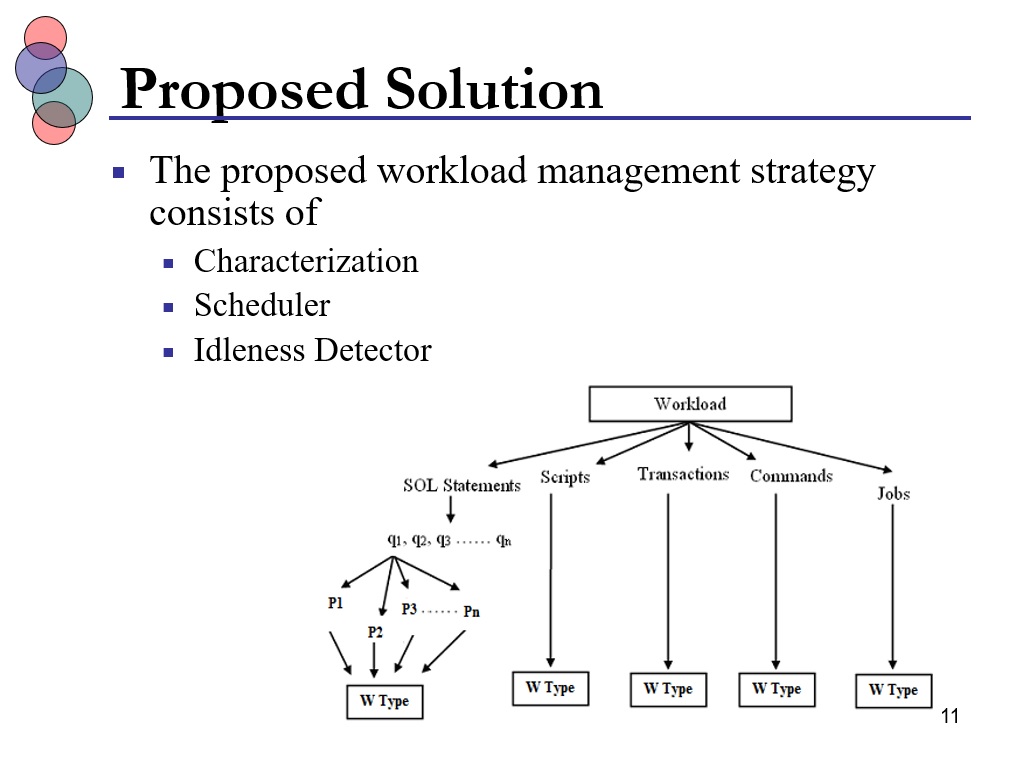 |
The proposed DB workload management strategy consists of three main components which are Characterization, Scheduler and Idleness Detector. The characterization diagram represents that the workload that consists of queries, command, scripts is divided into OLTP and DSS on the basis of workload parameters.
|
|
ICACT20240293 Slide.10
[Big slide for presentation]
|
Chrome Text-to-Speach Click!! |
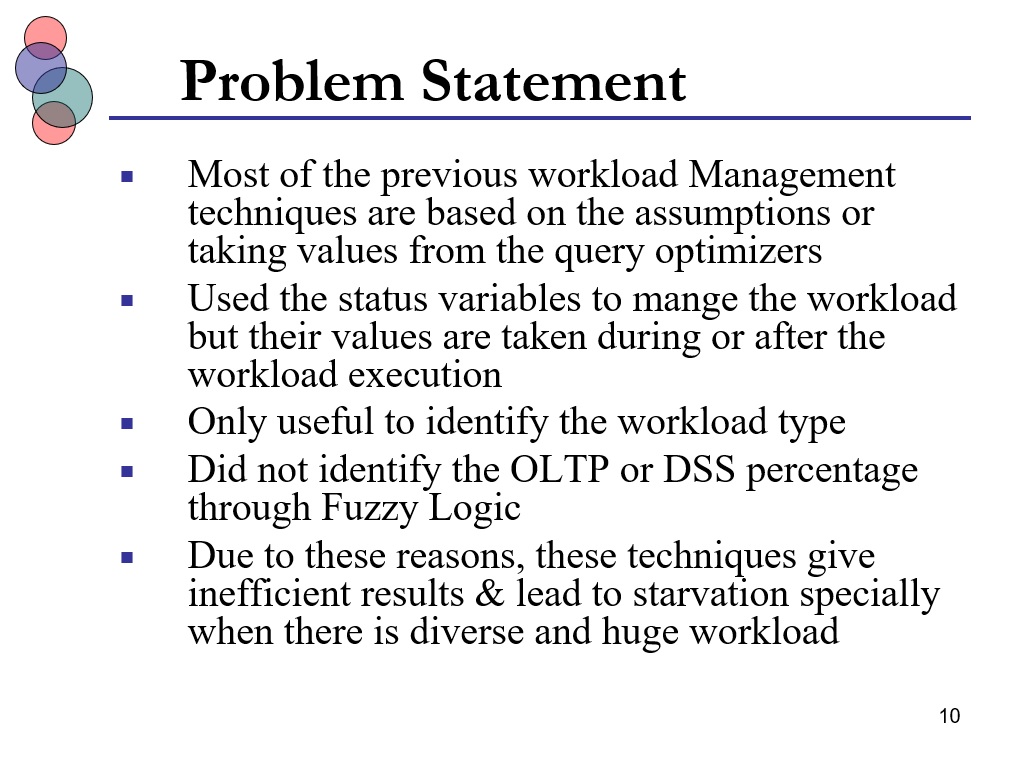 |
We have identified following main problems after an extensive review related with the workload management approaches and techniques.
1. Most of the previous work are based on the assumptions or they are taking values from the query optimizers.
2. The status variables are used to manage the workload, but their values are taken after the workload execution. These are only useful to identify the workload type.
3. None of the previous work identify the OLTP or DSS percentage through Fuzzy Logic.
Due to these reasons, these techniques give inefficient results and lead to starvation specially when there is diverse and huge workload.
|
|
ICACT20240293 Slide.09
[Big slide for presentation]
|
Chrome Text-to-Speach Click!! |
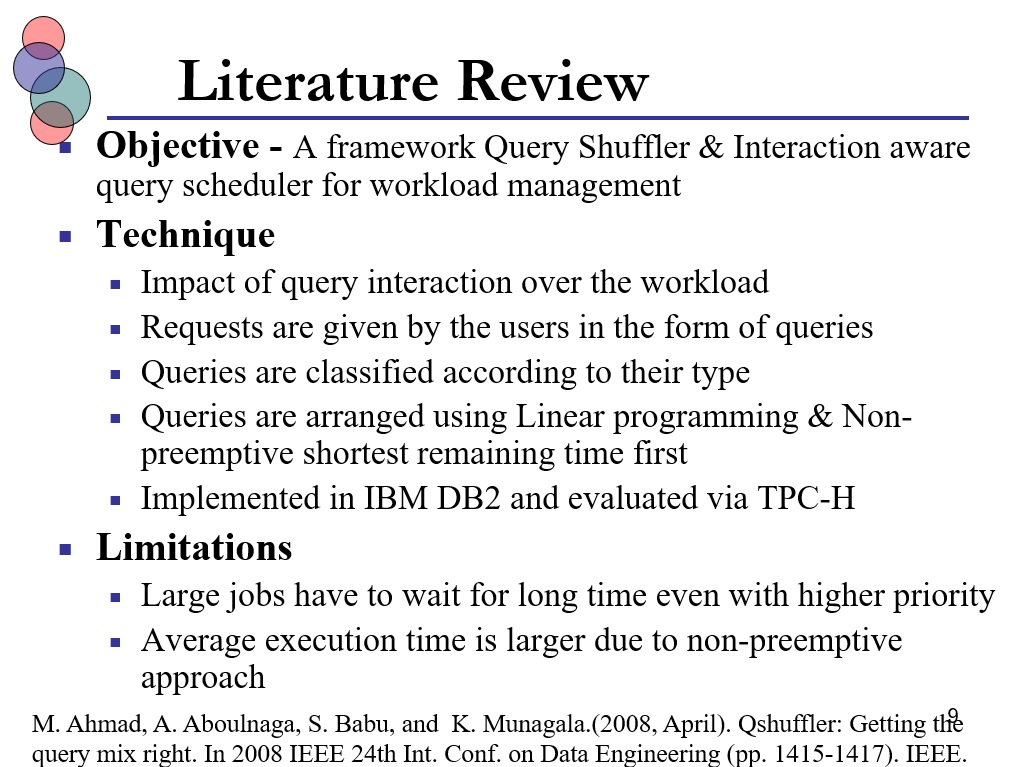 |
A framework Query Shuffler and Interaction aware query scheduler for workload management is introduced by Mumtaz Ahmad et al. Requests are given by the users in the form of queries and classified according to their type. All the queries are arranged using the Linear Programming and Non-preemptive shortest remaining time first. The work is implemented in IBM DB2 and evaluated via TPC-H benchmark. In Query Shuffler large jobs have to wait for long time even they have higher priority. Moreover, the average execution time is larger due to use of non-preemptive approach.
|
|
ICACT20240293 Slide.08
[Big slide for presentation]
|
Chrome Text-to-Speach Click!! |
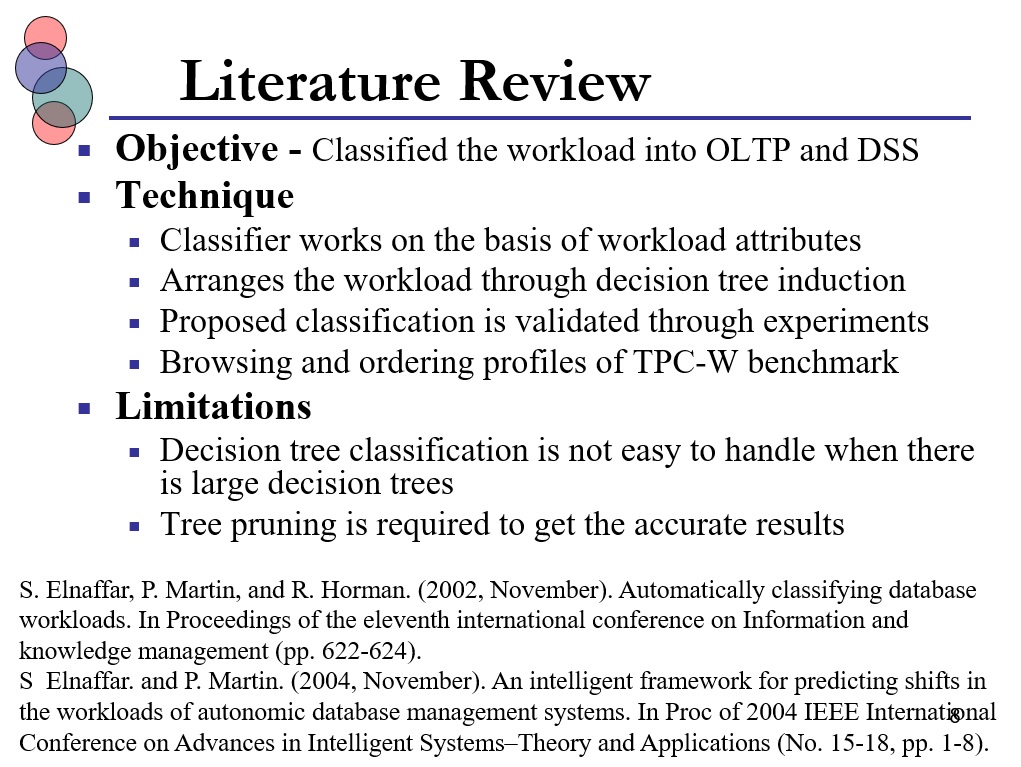 |
Next research is performed by Elnaffer et al. who classified the database workload into the OLTP and DSS. Their classifier works by using the decision tree induction that uses workload attributes. The research is validated through number of experiments. They used browsing and ordering profiles of TPC-W benchmark during experiments. Main problem in this research is that the Decision Tree classification tends to complex when size of the decision tree becomes large. In that case, Tree pruning is required to get the accurate results.
|
|
ICACT20240293 Slide.07
[Big slide for presentation]
|
Chrome Text-to-Speach Click!! |
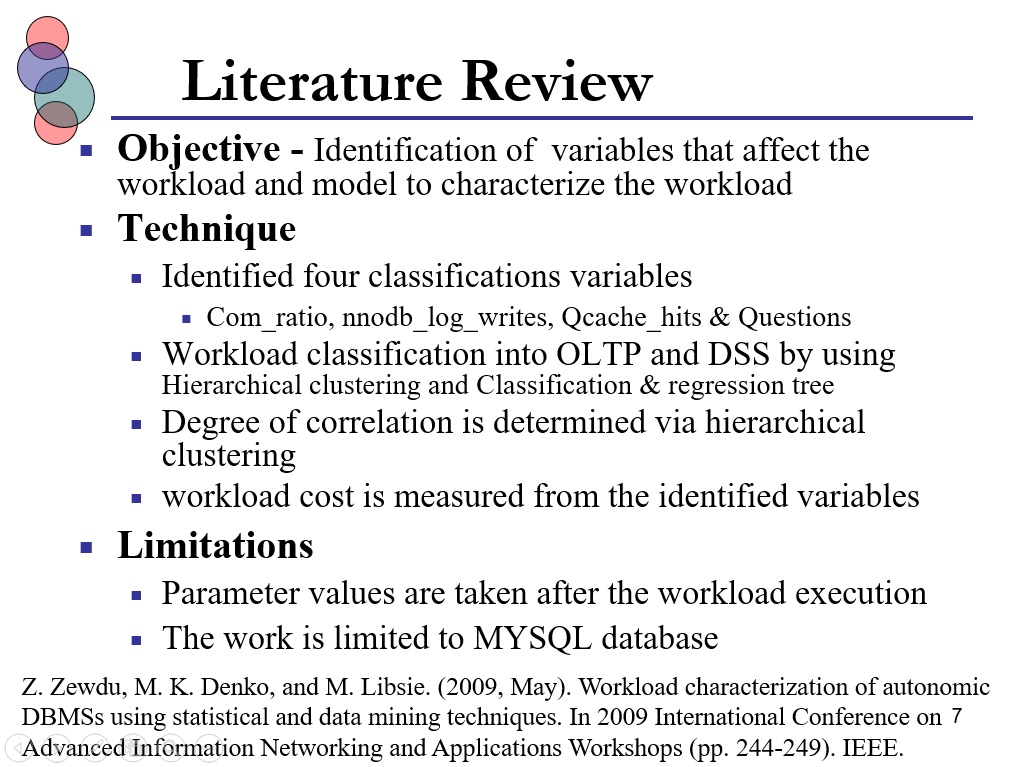 |
Another research is performed by Zewdu et al, who identified the variables that affect the workload and model to characterize the workload. They identified four classifications variables (Com_ratio, nnodb_log_writes, Qcache_hits & Questions). The workload classification is performed into OLTP and DSS by using Hierarchical clustering and Classification & Regression tree approach. The degree of correlation is determined via hierarchical clustering while workload cost is measured from the identified variables. The research is limited to MYSQL database, and the other problem is that the parameter’s values are taken after the execution of workload.
|
|
ICACT20240293 Slide.06
[Big slide for presentation]
|
Chrome Text-to-Speach Click!! |
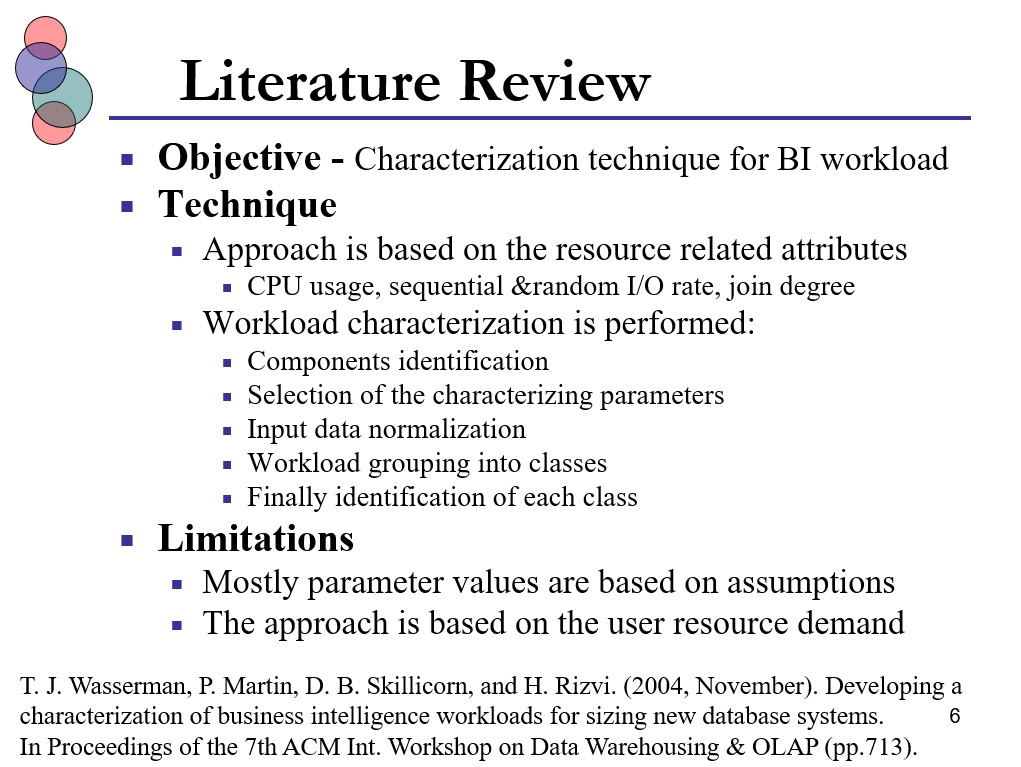 |
The first research in the literature review is carried out by Wasserman et al who characterizes the technique to manage the BI workload. The technique is based on the resource related attributes such as CPU usage, sequential & random I/O rate, join degree. The workload characterization is performed by following the following steps.
1. Components identification
2. Selection of the characterizing parameters
3. Input data normalization
4. Workload grouping into classes
5. Finally, identification of each class
However, the technique works by taking the mostly parameter’s value on the basis of assumptions.
|
|
ICACT20240293 Slide.05
[Big slide for presentation]
|
Chrome Text-to-Speach Click!! |
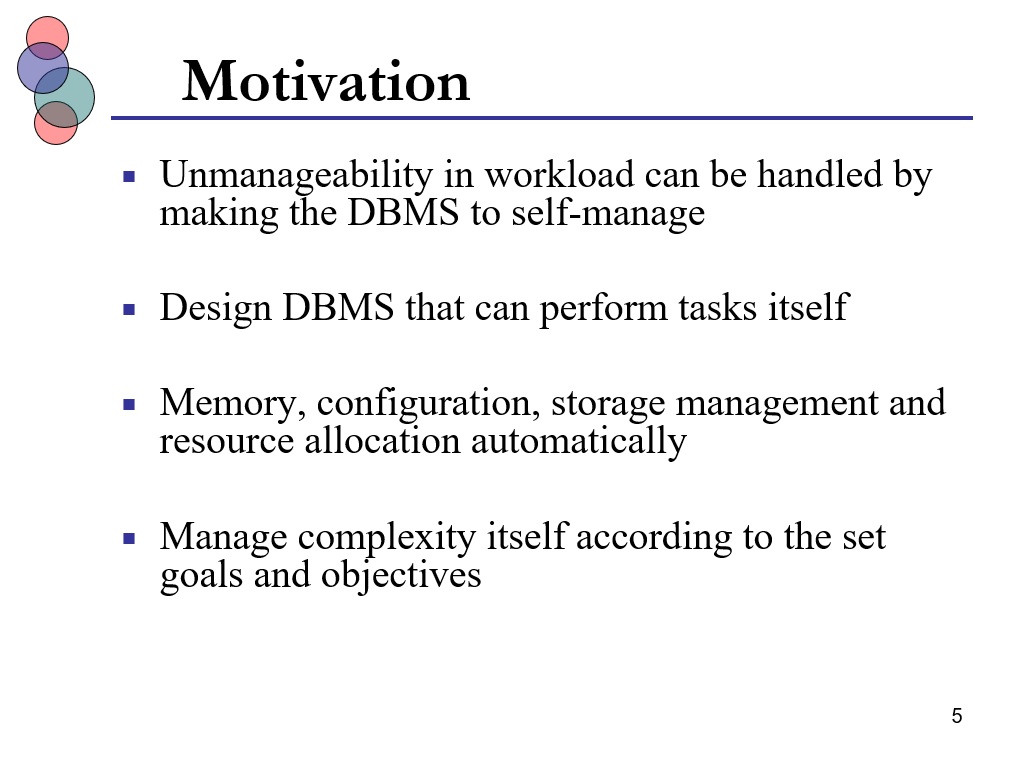 |
The motivations behind this research are as following:
1. Unmanageability in the DB workload can be handled by making the DBMS to self-manage.
2. Design the DBMS that can perform all of its tasks without any human intervention.
3. Memory, configuration, storage management and resource allocation automatically, i.e. managing the complexity itself according to the set goals and objectives.
|
|
ICACT20240293 Slide.04
[Big slide for presentation]
|
Chrome Text-to-Speach Click!! |
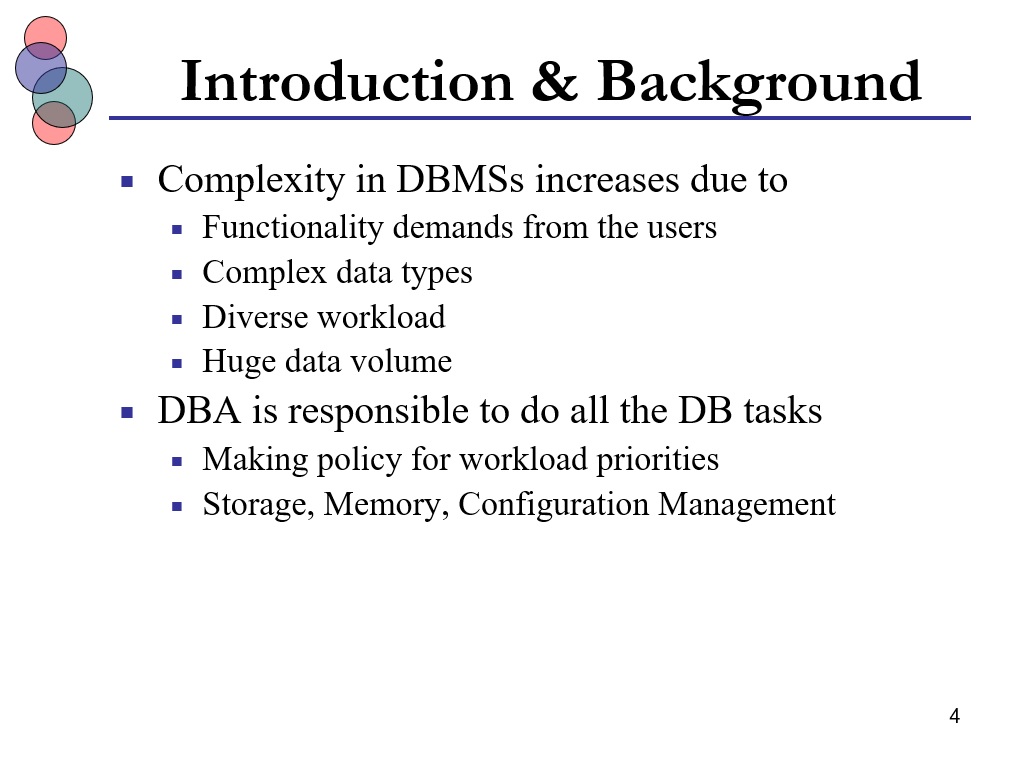 |
Complexity in DBMSs has been increased due to demands from the users, Complex data types, Diverse workload, huge data volume. Usually, DBAs are responsible to do all the DB tasks in an organization. They are also responsible for making the policy for workload priorities, storage, memory, and configuration management.
|
|
ICACT20240293 Slide.03
[Big slide for presentation]
|
Chrome Text-to-Speach Click!! |
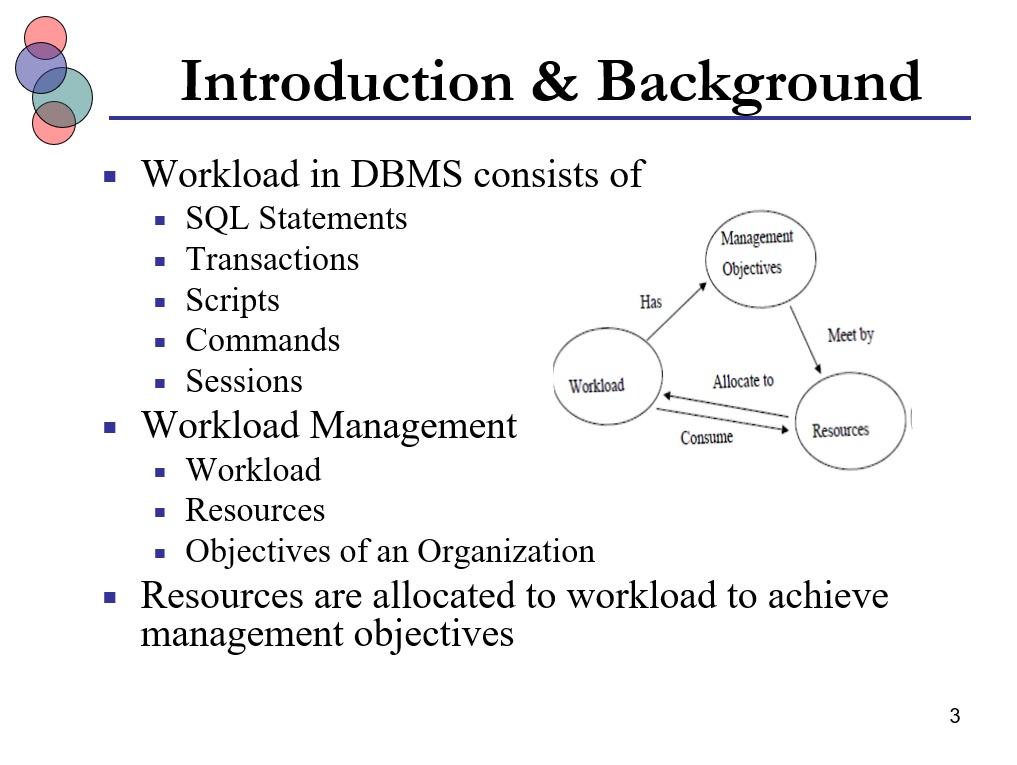 |
When we talk about the DB workload then it means SQL Statements, Transactions, Scripts, Commands and Sessions that are generated by the users. Generally, the workload consists of three parts i.e. workload, resources and objectives. The workload consumes resources to achieve the management objectives.
|
|
ICACT20240293 Slide.02
[Big slide for presentation]
|
Chrome Text-to-Speach Click!! |
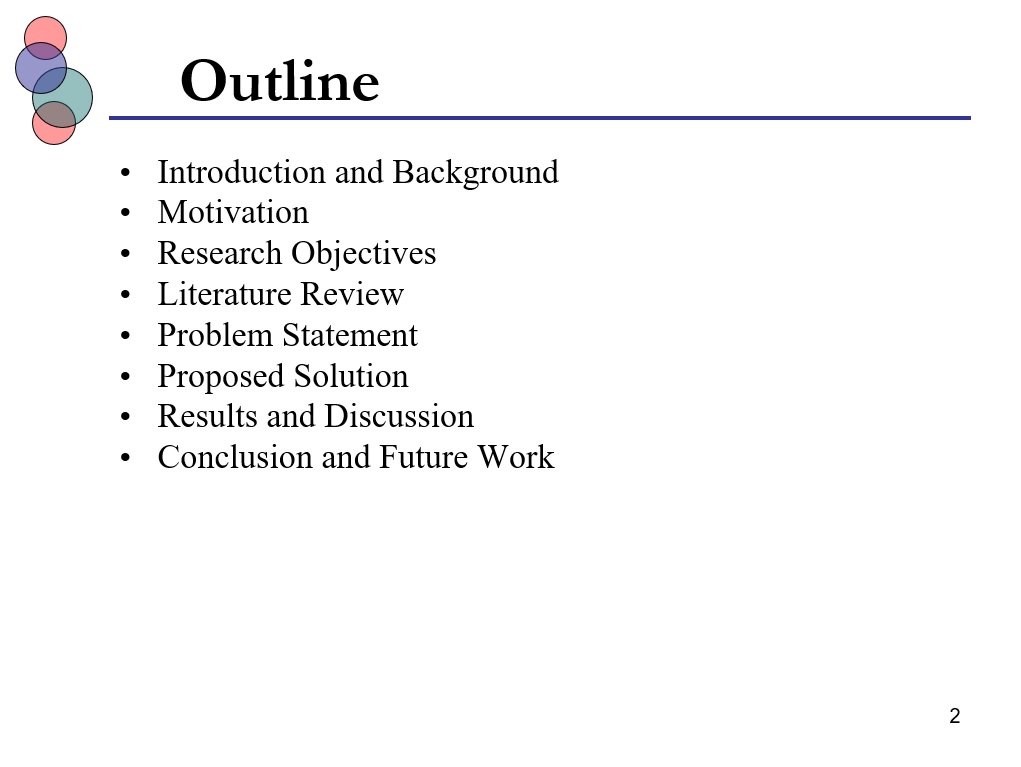 |
The agenda of the presentation is:
First of all, the introduction and background of the research is presented. After that Motivation and research objectives are outlined. The literature review includes some of the related papers followed by the problem statement. After then the proposed solution, validation of the results and discussion is explained. Finally, the proposed research is concluded along with future directions.
|
|
ICACT20240293 Slide.01
[Big slide for presentation]
|
Chrome Text-to-Speach Click!! |
 |
In this research paper, we are presenting a DB workload management approach that uses the CBR and Fuzzy logic. Along with me the other authors are Khawaja Tahir and Professor Seung Yeaob Nam.
|
|
ICACT20240293 Slide.00
[Big slide for presentation]
|
Chrome Text-to-Speach Click!! |

















