 ICACT20230132 Slide.16
[Big slide for presentation]
[YouTube] |
Chrome Text-to-Speach Click!! |
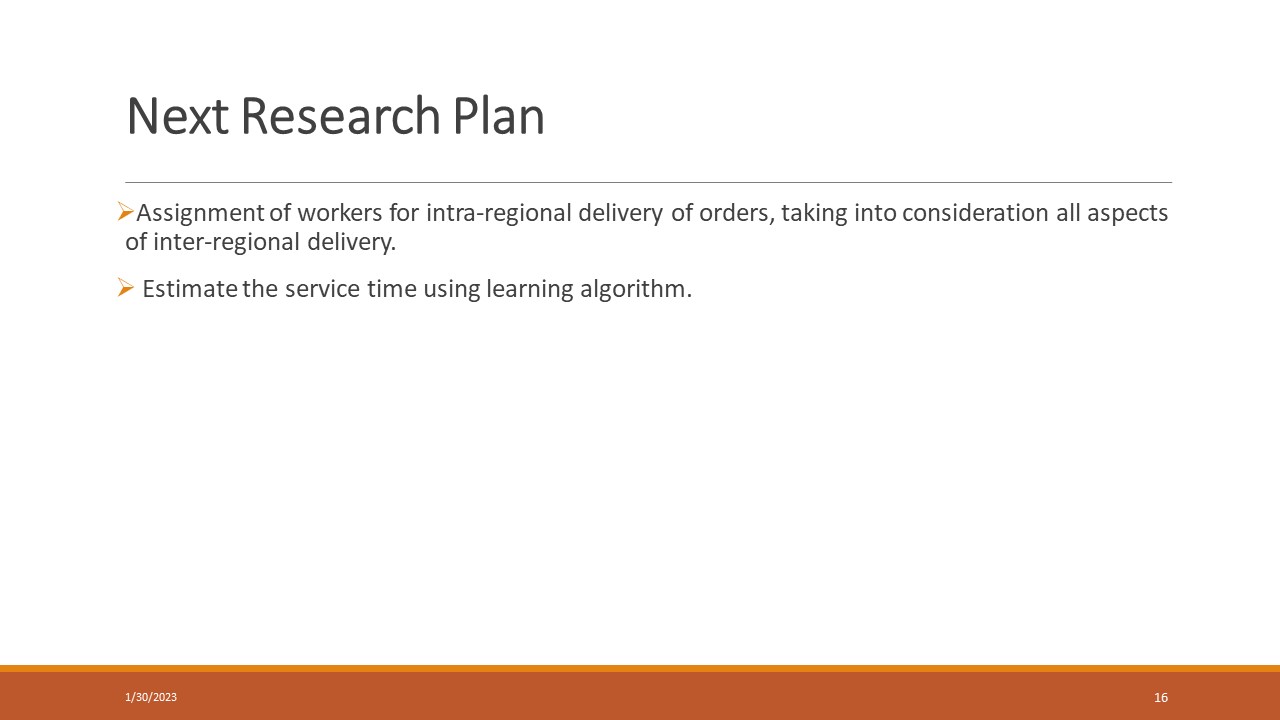 |
The assignment of workers for intra-regional delivery of orders, taking into consideration all aspects of inter-regional delivery, could be an interesting problem to solve in the future. Alsowe will apply learning algorithm to estimate the total service time to achieve more accurate result.
|
|
ICACT20230132 Slide.15
[Big slide for presentation]
[YouTube] |
Chrome Text-to-Speach Click!! |
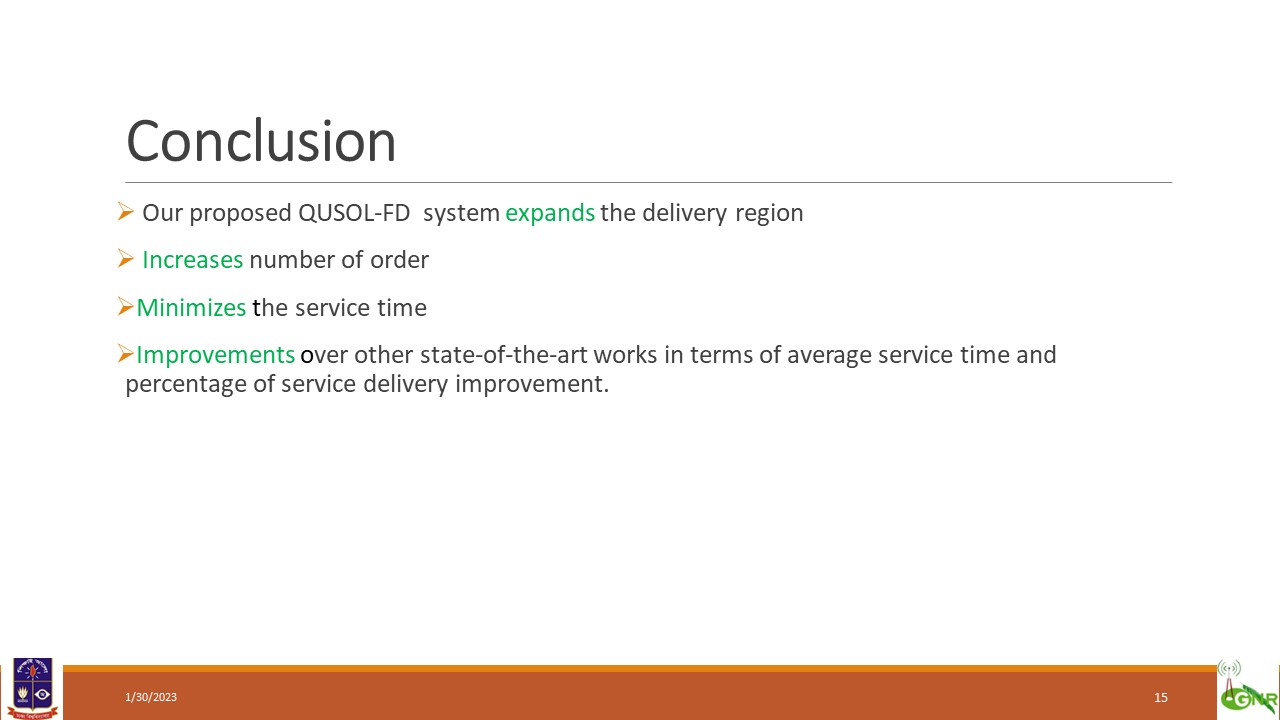 |
In this work, we developed an order allocation strategy based on transfer vehicle for the inter-regional online food delivery (QUSOL-FD) that enhances the Quality of Service of the system by increasing number of order while minimizing the service time and expanding the delivery region. The evaluation results of performance of the proposed QUSOL-FD indicated the improvements over other state-of-the-art works in terms of average service time and percentage of service delivery improvement.
|
|
ICACT20230132 Slide.14
[Big slide for presentation]
[YouTube] |
Chrome Text-to-Speach Click!! |
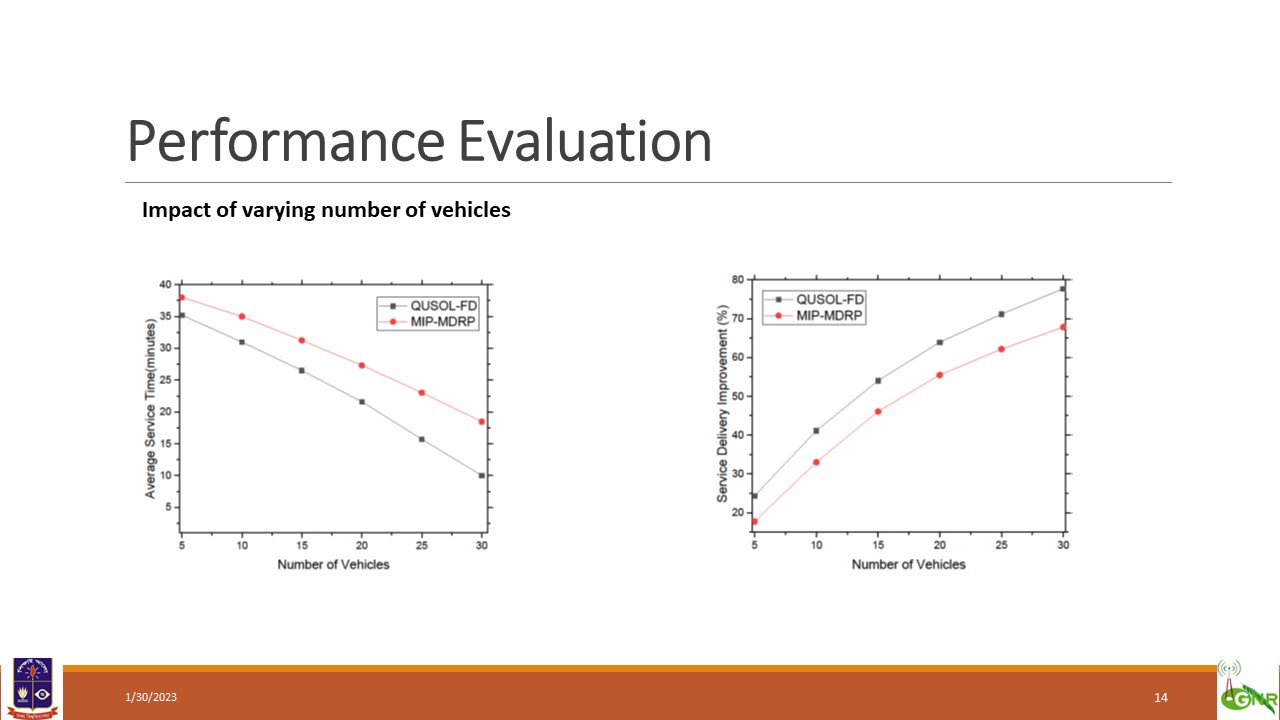 |
QUSOL-FD experiences lower service time compared to the MIPMDRP as QUSOL-FD assigns multiple orders to a transfer vehicle not only based on its carrying capacity but also considering the location of pickup points of the orders which minimizes the service time. In Fig. 4(b), the proposed QUSOL-FD obtains a higher proportion of increased inter-regional orders as the number of transfer vehicles increases, because with designated transfer vehicles and multiple meeting sites, it can serve a larger area with more customers.
|
|
ICACT20230132 Slide.13
[Big slide for presentation]
[YouTube] |
Chrome Text-to-Speach Click!! |
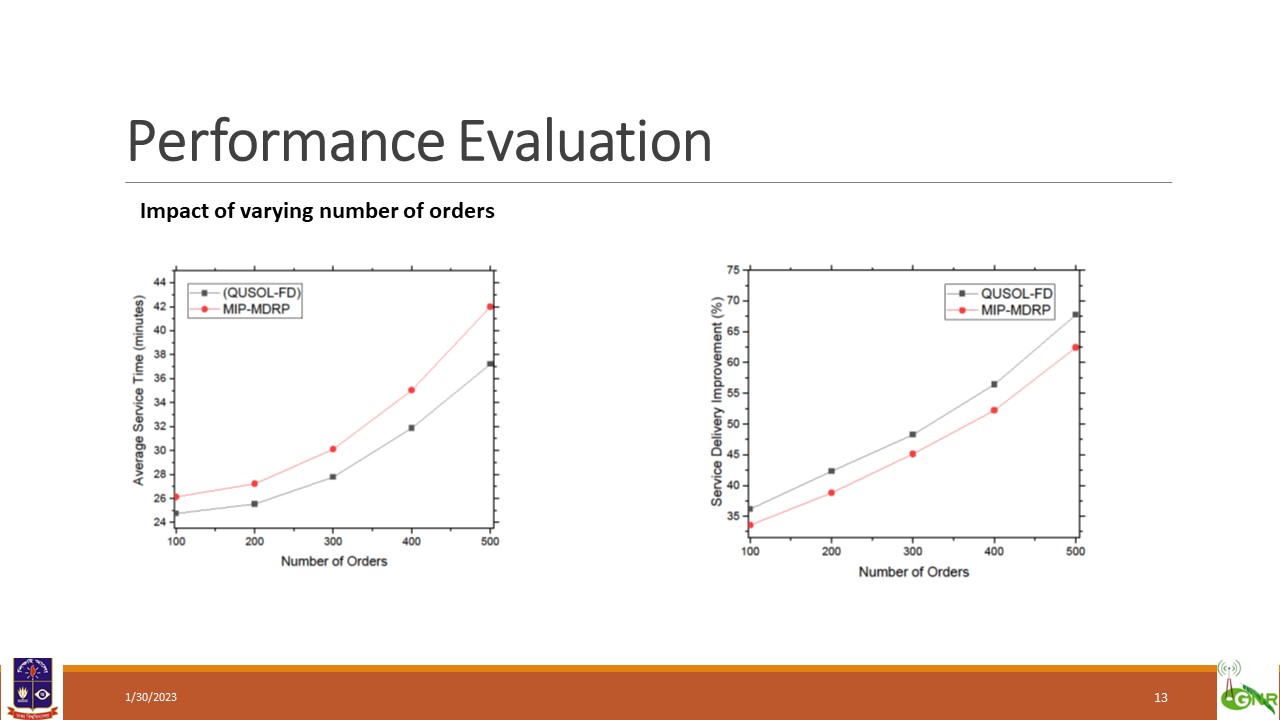 |
In contrast to MIP-MDRP, the proposed QUSOL-FD system requires less average service time. The correlation between the two factors can be explained by the fact that the number of orders placed in close proximity to one another increases as the average order volume per restaurant increases. This allows the QUSOL-FD system to allocate many orders that are co-located with a transfer vehicle to reduce travel time to the pickup points. In Fig. 3(b), the percentage of inter-region orders increases with increasing number of total orders as the extended delivery region provide customers additional options for ordering food. However, the QUSOL-FD system achieves more percentage of increased orders as the distribution of order and multiple meeting-points.
|
|
ICACT20230132 Slide.12
[Big slide for presentation]
[YouTube] |
Chrome Text-to-Speach Click!! |
 |
The Average service time metric is average interval between the reception of an order and its delivery to the meeting-point by transfer vehicles. The lower value represents better performances.
Service delivery improvement metric is the percentage of number of orders that are increased due to the inter-regional orders that are placed on the platform. The higher value indicates the better performances.
|
|
ICACT20230132 Slide.11
[Big slide for presentation]
[YouTube] |
Chrome Text-to-Speach Click!! |
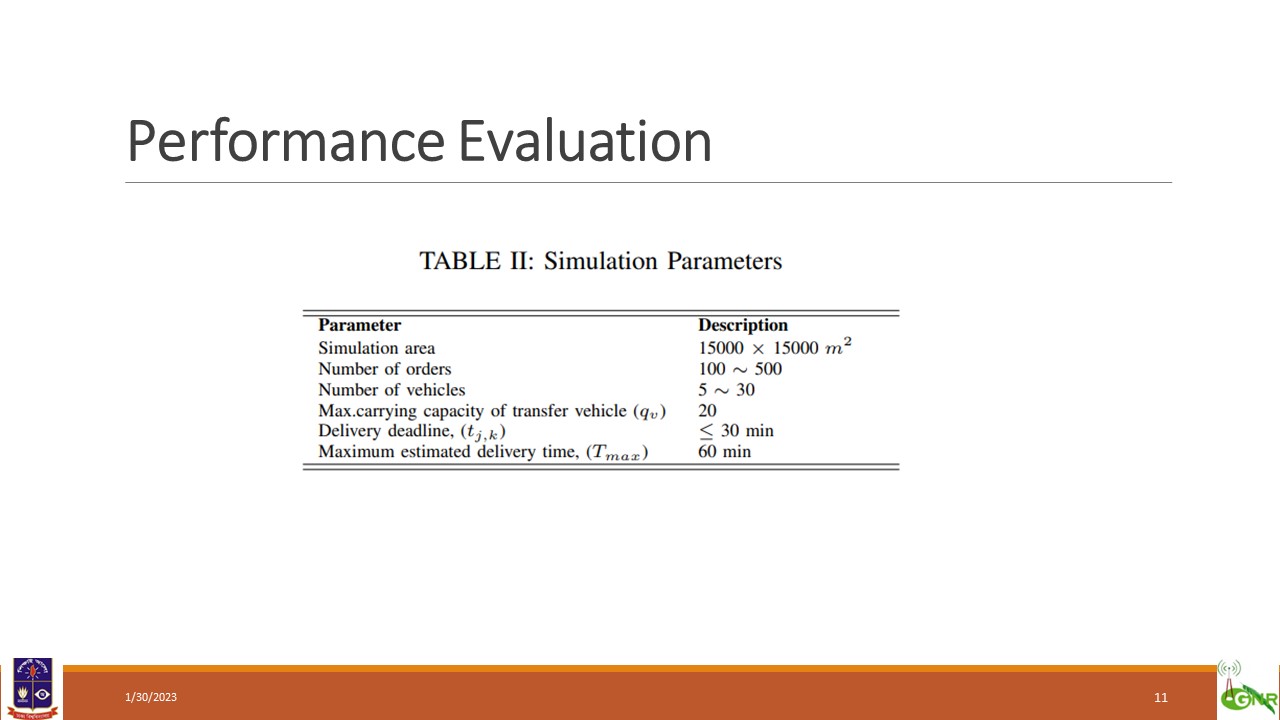 |
In this section, the performances of the proposed QUSOL-FD is evaluated and compared with one of state-of-the-art works, MIP-MDRP [7]. The simulation and experimental evaluations are carried out in Python on a real world data set [5]. The data set contains real world historic experiences of food delivery services and are used in recent works on online food delivery system design including [6]. We consider an area of 15000 x 15000 m2 where the location of restaurants, orders and workers are randomly distributed. The orders, vehicles and restaurants information are extracted from each instance of the dataset. The number of restaurants are kept in 50 and the number of orders, vehicles are varied in 100 500, and 5 30, respectively. Then, 20% of the total orders are selected based on the fact that the distance between the restaurant node and the customer node is between 3 to 10 km. All simulation experiments were conducted on a PC with an Intel Core i7 Processor and 16 GB memory running Ubuntu 20.04.
|
|
ICACT20230132 Slide.10
[Big slide for presentation]
[YouTube] |
Chrome Text-to-Speach Click!! |
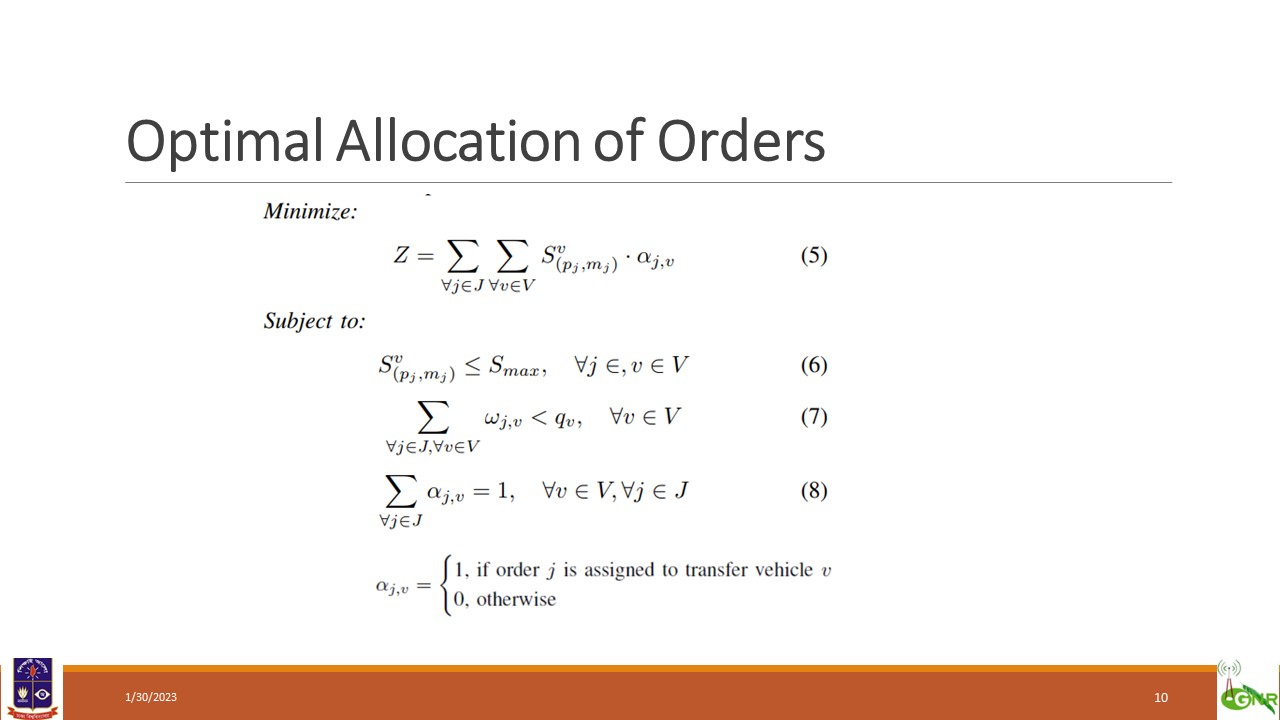 |
This system aims to assign a transfer vehicle a set of interregional orders in a way that reduces the total service time for transferring those from one region to other, accelerating the delivery time of an order. So our objective function is to minimize the service time of assigned transfer vehicles of each order. The constraint (6) is the order deadline constraint that ensures that the estimated service time of a vehicle to arrive at meeting-point for an inter-region order must not exceed the maximum delay tolerance time. The constraint (7) is vehicle capacity constraint that guarantees the total assigned orders to a vehicle must not exceed the carrying capacity of the transfer vehicle. The constraint (8) confirms that order allocation will be unique to a vehicle. It implicates that that a single order will be allocated to a single transfer vehicle.
|
|
ICACT20230132 Slide.09
[Big slide for presentation]
[YouTube] |
Chrome Text-to-Speach Click!! |
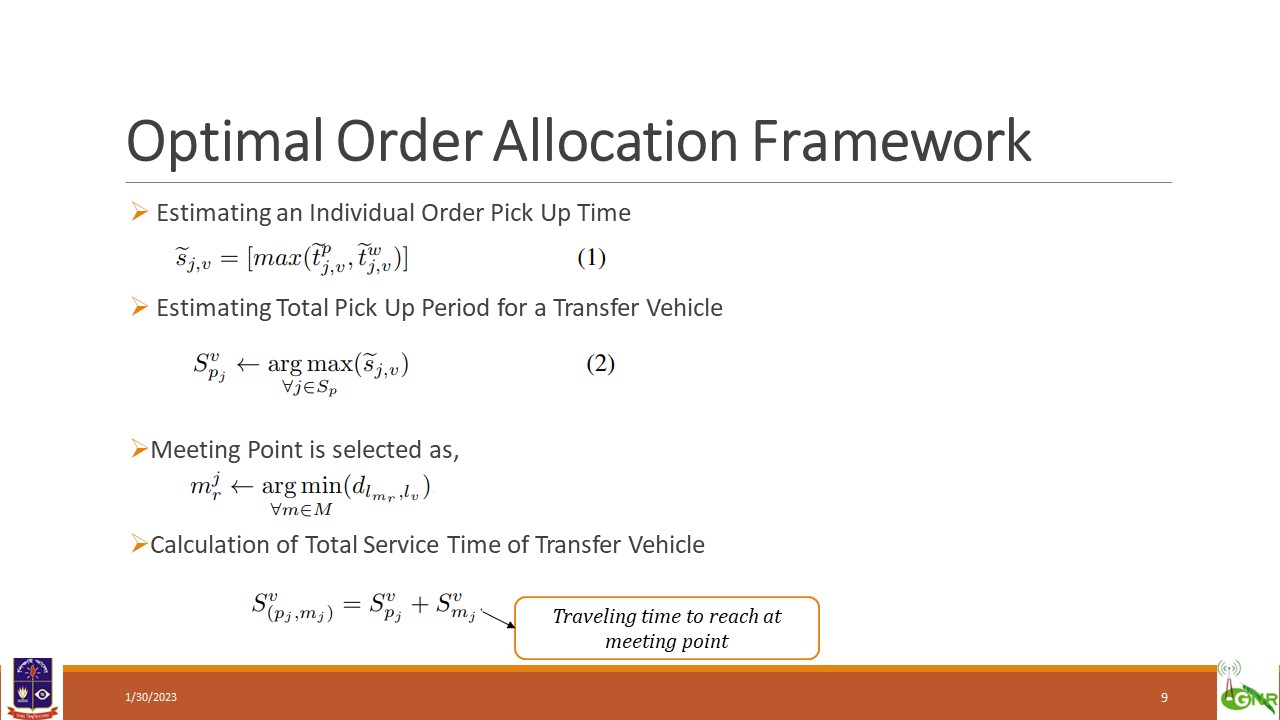 |
Service time of delivering an order is a critical point because it has significant impact on the performance of the system. To address this issue, we calculated the total service time of a transfer vehicle to deliver an order from one region to another. In Eq.(1) we calculate an estimated individual order pick up time by considering the travelling time that is required to travel from
the location of a transfer vehicle to the pick up point location of an order and the time that is required to prepare an online food order. The platform forecasts the duration of travel time
using Google Maps API (Application Programming Interface) which depends heavily on the distance covered by the road network. The system can also estimate the order processing time of a certain order from the past historical data.
A set of orders, Sp is generated to pick up the orders from the respective restaurants accordingly. Following the sequence in Sp, the designated transfer vehicle collects the orders from the restaurants for delivering to the workers at meeting-point. So, the total pick up time of a transfer vehicle for inter-regional orders is calculated as in Eq.(2). We select the location of meeting point for a specific regional set of orders based on the shortest distance between the locations of meeting-point and current locations of transfer vehicle. Finally thhe total service time of a transfer vehicle to arrive at meeting point of an inter-regional order is calculated as in last Eq. .
|
|
ICACT20230132 Slide.08
[Big slide for presentation]
[YouTube] |
Chrome Text-to-Speach Click!! |
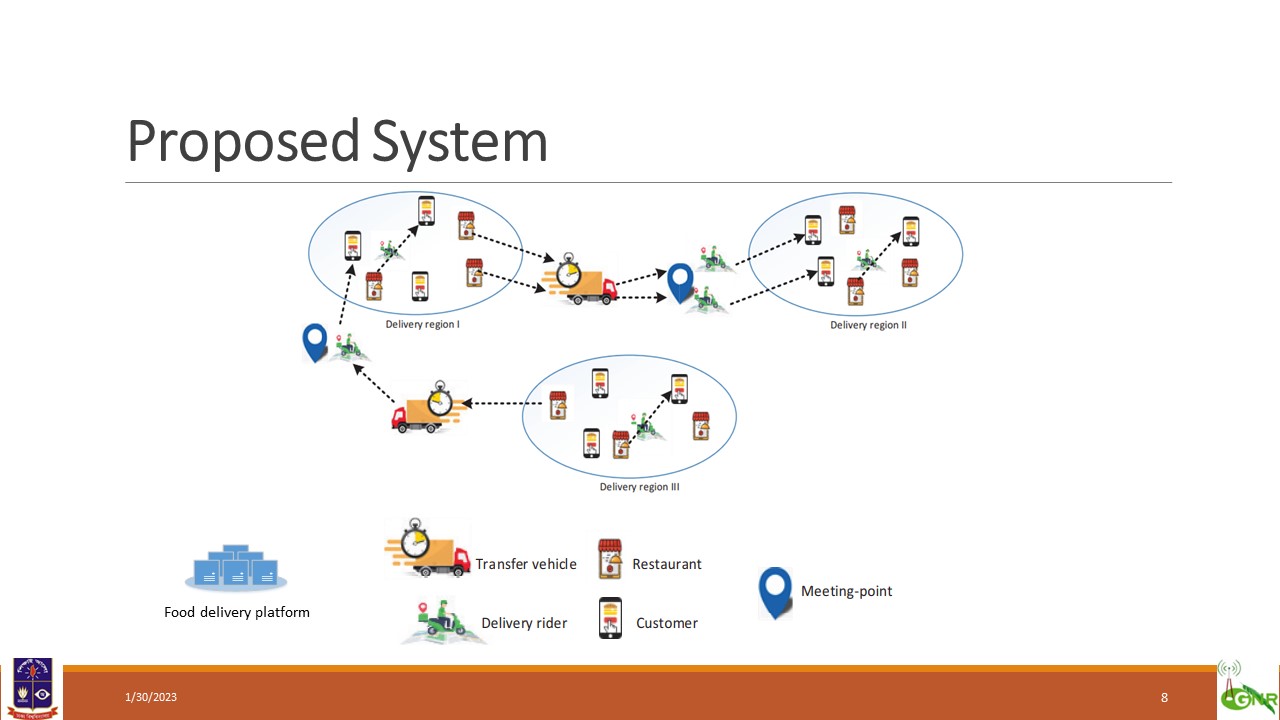 |
We consider an online food delivery system consists of platform, customer, restaurant , transfer vehicle and worker. Platform centrally coordinates the interaction among the entities and they are connected to the platform through registration. A customer can place food order from a local restaurant which is considered as intra-region order or place order from a distant restaurant beyond
his/her region which is considered as inter-region order. In case of inter-region delivery, dedicated vehicles are used for transferring orders to the workers of delivery regions at a mutual meeting-point for delivering the orders to the respective customers. We assume a transfer vehicle is always available in the pool; if not, customers whose orders are associated with this vehicle should be notified. This transfer vehicle based inter-region and intra-region strategy is illustrated in this figure. Platform, restaurants and workers get their appropriate portion of revenue when an order is completed successfully. For inter-region orders, the platform generates an initial set of orders based on the region of delivery. Then, after being allocated by platform, the transfer vehicle collects orders from restaurants and delivers them to the corresponding workers at the meeting-point within the estimated delivery time. Manhattan distance is calculated to estimate the position (x; y) of meeting-point of transfer vehicles and workers considering the characteristics of the complicated urban road network traffic state as in [7]. In the proposed system is assumed to have several meeting points to ensure faster delivery based on the distance between surrounding intra-regions. In this work we emphasis on the allocation of inter-region orders, thus we consider the spatial information of only inter-region orders and transfer vehicles.
|
|
ICACT20230132 Slide.07
[Big slide for presentation]
[YouTube] |
Chrome Text-to-Speach Click!! |
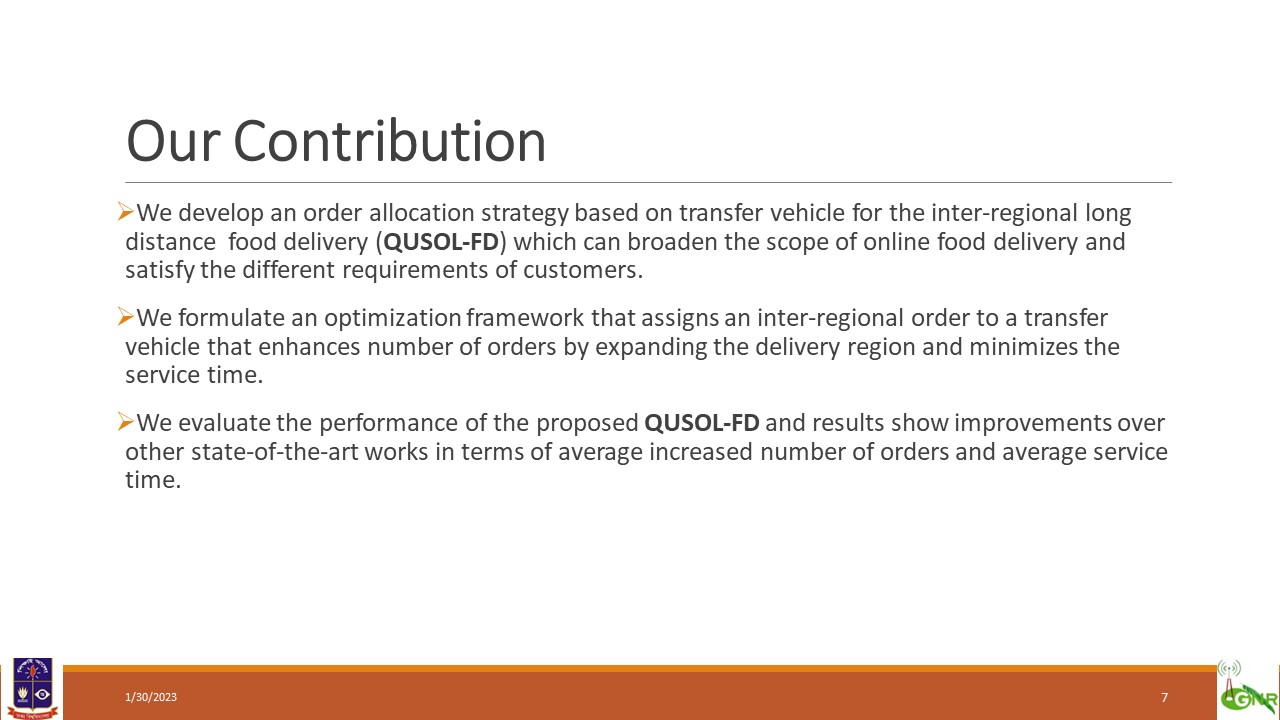 |
Our research work aims to develop an order allocation strategy based on transfer vehicle for the inter-regional long distance food delivery which can broaden the scope of online food delivery and satisfy the different requirements of customers. To achieve this we formulate an optimization framework that assigns an inter-regional order to a transfer vehicle that enhances number of orders by expanding the delivery region and minimizes the service time. evaluate the performance of the proposed QUSOL-FD and results show improvements over other state-of-the-art works in terms of average increased number of orders and average service time.
|
|
ICACT20230132 Slide.06
[Big slide for presentation]
[YouTube] |
Chrome Text-to-Speach Click!! |
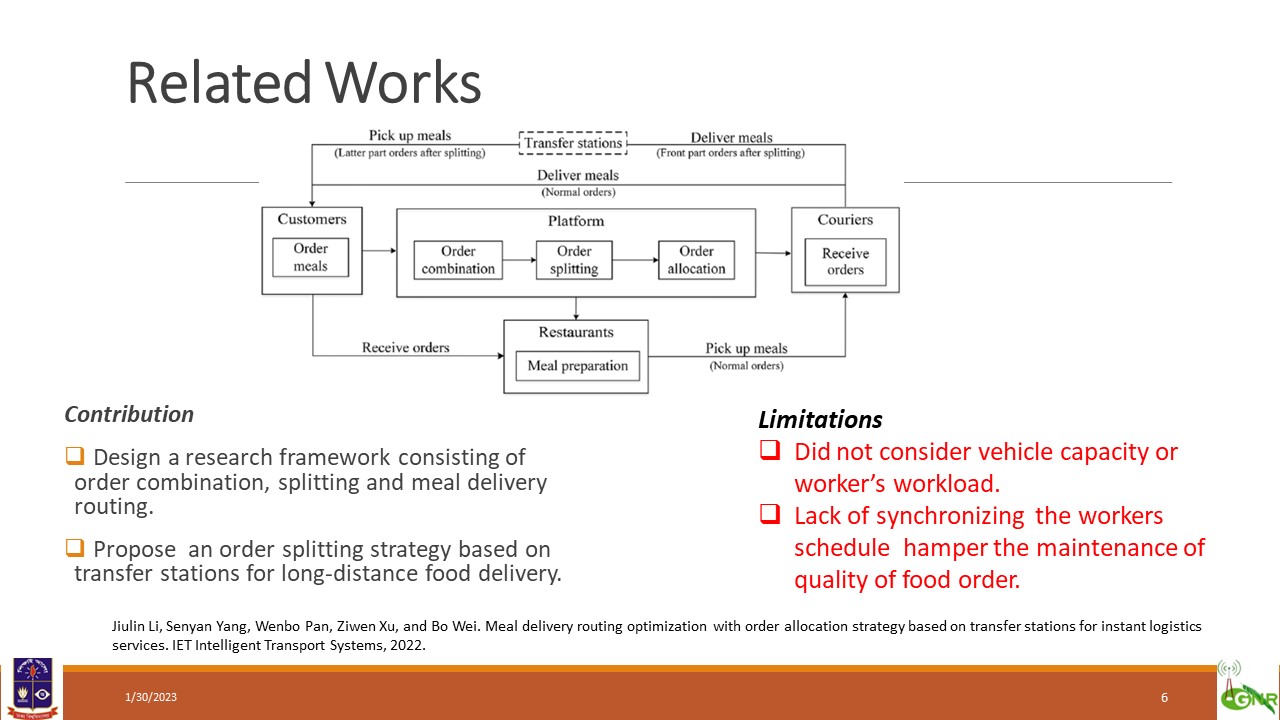 |
Li et.al proposed an order splitting strategy based on transfer stations for long distance food delivery in their work titled Meal delivery routing optimization with order allocation strategy based on transfer stations for instant logistics services in 2022 they design a research framework consisting of order combination, splitting and meal delivery routing. But lack of synchronizing the workers schedule that hampers the maintenance of quality of food order.
|
|
ICACT20230132 Slide.05
[Big slide for presentation]
[YouTube] |
Chrome Text-to-Speach Click!! |
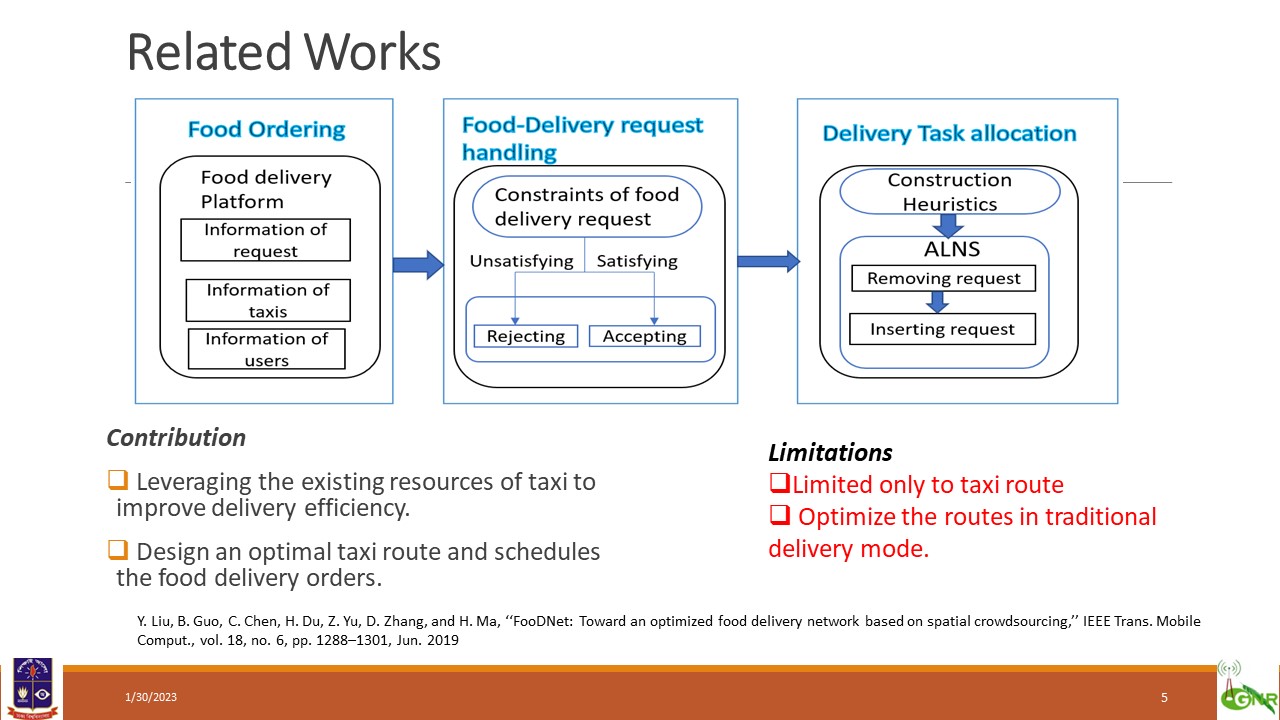 |
FooDNet published in IEEE transaction in 2019 utilized the taxi resources to deliver the long distance order. They design an optimal taxi route and schedules the food orders. Their work is limited only to taxi route and moreover they consider only the traditional delivery mode.
|
|
ICACT20230132 Slide.04
[Big slide for presentation]
[YouTube] |
Chrome Text-to-Speach Click!! |
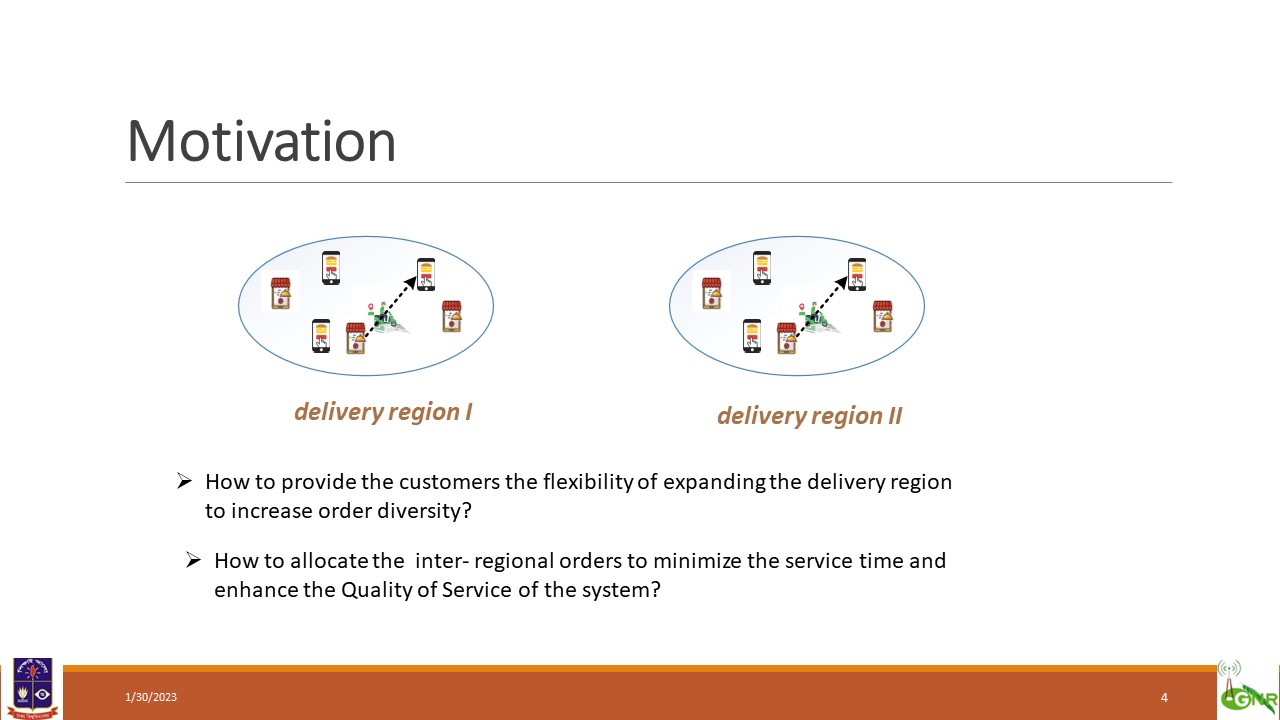 |
The traditional platforms restrict to serve the orders within a specified delivery region. So, it is a great concept to provide customers more choices for placing their orders with expanding delivery region because a larger delivery range means more choices for customers which can increase the no. of colors and make the platform and restaurants get more profits. In reality, some times customers may prefer to place orders from restaurants located outside of their local region, which requires the restaurants own delivery service rather than Online food delivery platforms to transport the food. So, it is important for OFD platforms to do research on inter-regional food delivery facility to enhance the Quality of Experience of customers.
|
|
ICACT20230132 Slide.03
[Big slide for presentation]
[YouTube] |
Chrome Text-to-Speach Click!! |
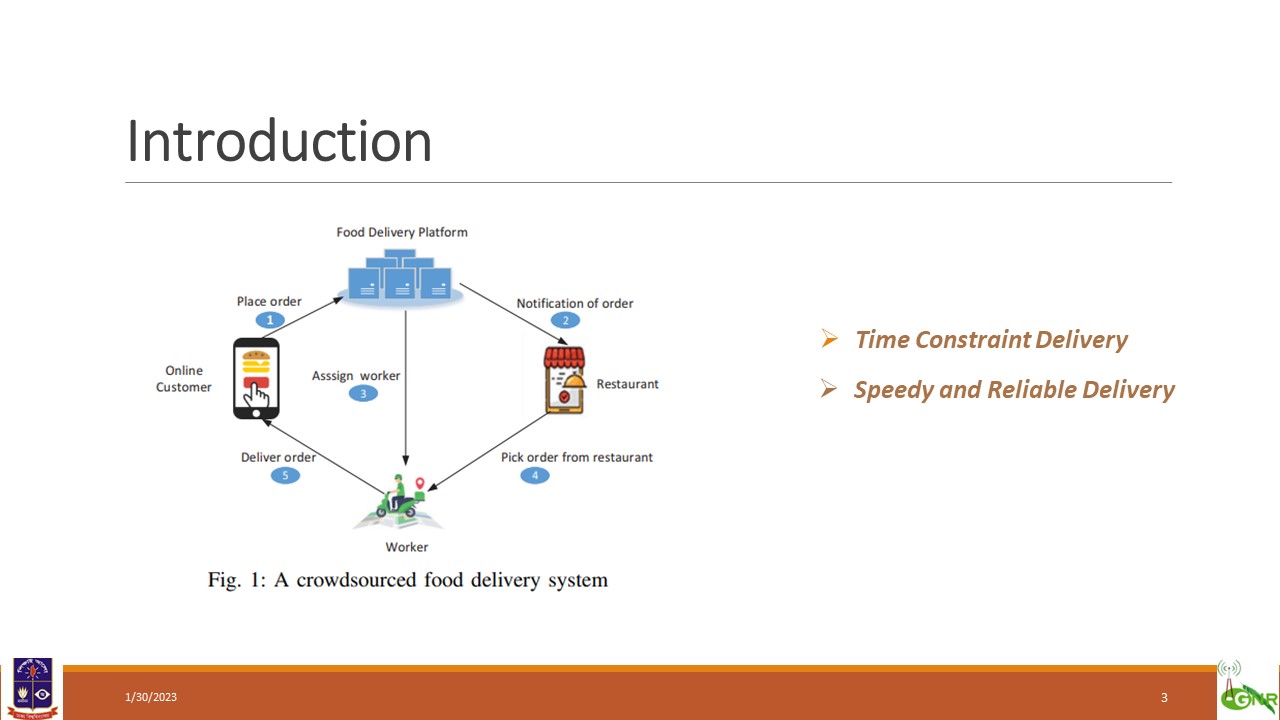 |
Online food delivery system is a specialized application of mobile crowdsourcing where online customers can place food orders to their desired restaurants through a food delivery platform. Then the platform assigns workers to pick the order from restaurant and deliver to customer’s location. In recent time the services become popular because of the hectic pace of modern life, mamy people prefer to have their food delivered to their doorsteps. As compared to other on demand services, food delivery is one that receives a massive volume of orders and as the products are highly perishable, the system needs to maintain a short delivery deadline. To cope with today’s highly cognizant customers expectation, this system needs a speedy and reliable service. As the competitive market of online food delivery sector escalates, the platform have to develop numerous approaches to address the various requirements of customers and improve the delivery efficiency.
|
|
ICACT20230132 Slide.02
[Big slide for presentation]
[YouTube] |
Chrome Text-to-Speach Click!! |
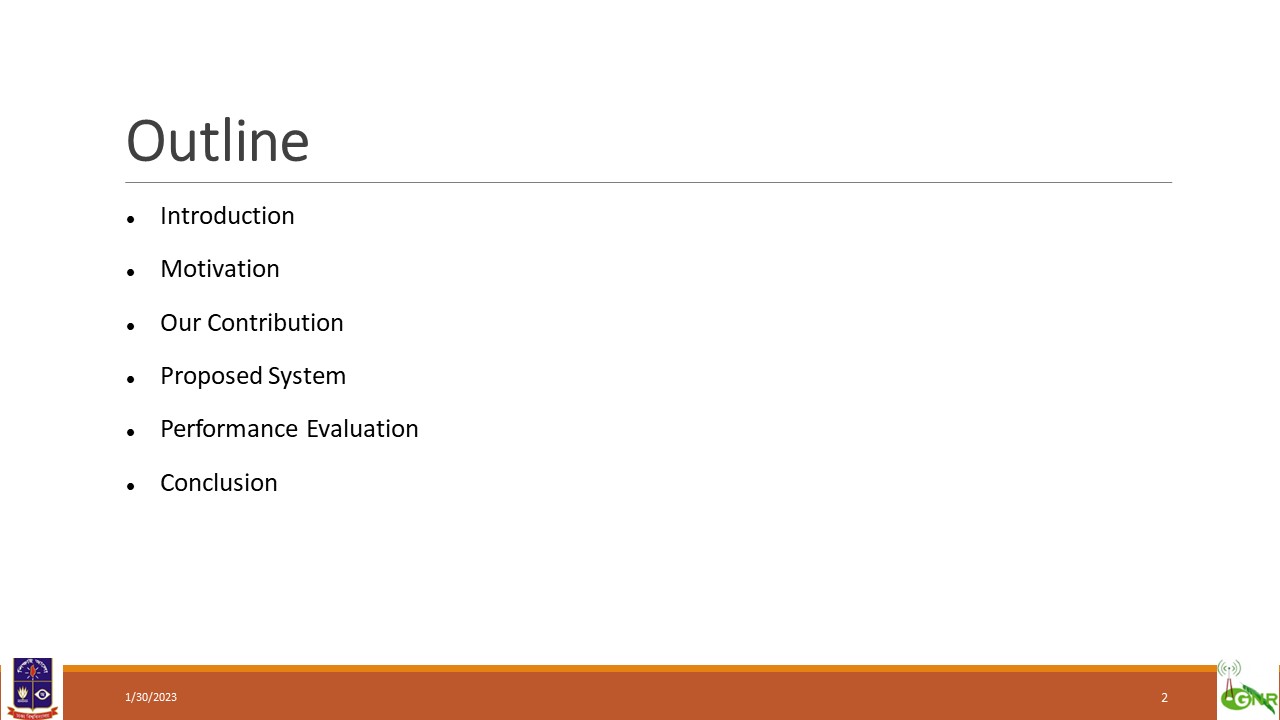 |
Here is the outline of my presentation.
|
|
ICACT20230132 Slide.01
[Big slide for presentation]
[YouTube] |
Chrome Text-to-Speach Click!! |
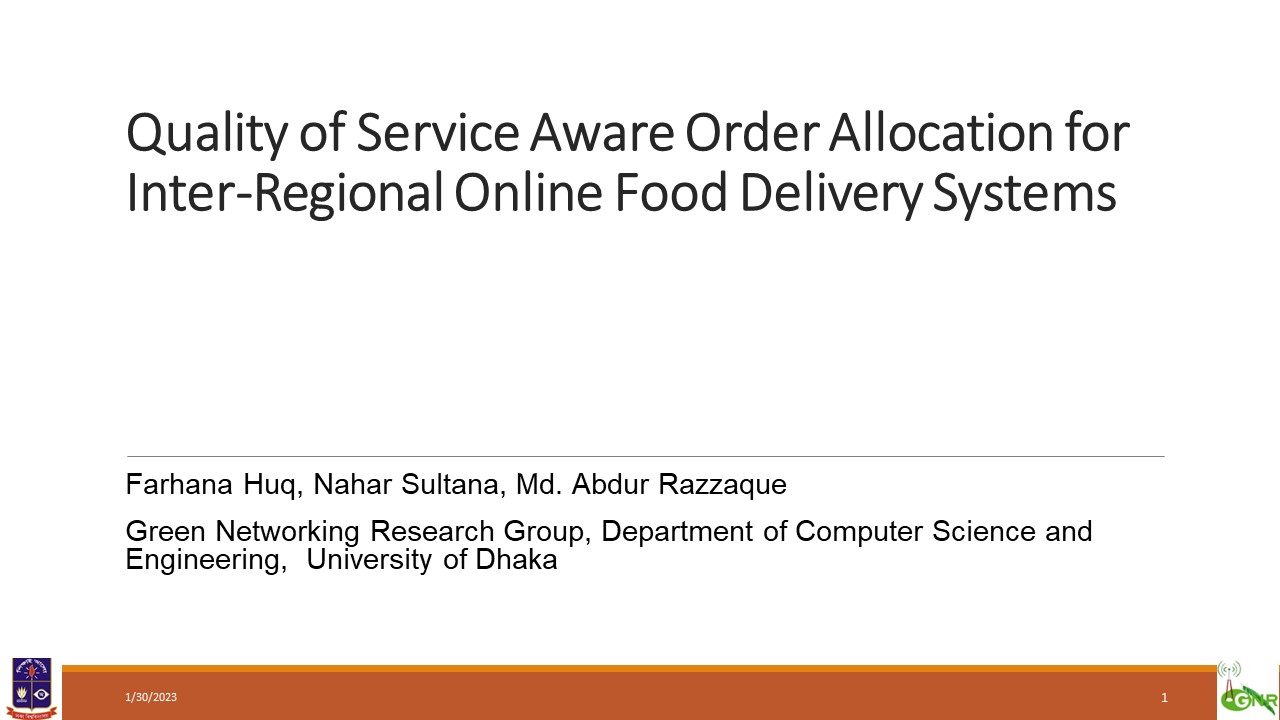 |
Hello Everyone, I am Farhana Huq Ph.D student of Dept. of computer science and engineering of University of Dhaka, Bangladesh. Today I present our paper titled Quality of Service Aware Order Allocation for Inter-Regional Online Food Delivery Systems accepted in ICACAT2023. We design an order allocation strategy for Online Food Delivery System considering the regions of delivery.
|
|
ICACT20230132 Slide.00
[Big slide for presentation]
|
Chrome Text-to-Speach Click!! |
 |
Here is the outline of my presentation.
|
















