 ICACT20220317 Slide.15
[Big slide for presentation]
[YouTube] |
Chrome Text-to-Speach Click!! |
 |
Thank you for watching the presentation!
If you have any questions, don't hesitate to contact me at: phamdinhlam(at)kgu.ac.kr
Thank you!
|
|
ICACT20220317 Slide.14
[Big slide for presentation]
[YouTube] |
Chrome Text-to-Speach Click!! |
 |
Our architecture combines the capability of algorithms in one system to efficiently recognize objects in videos thereby helping us to manage videos more effectively.
In future works, we will implement the system with this architecture, analyze the annotated videos, and apply the textual retrieval techniques to search the content inside videos.
For more detail of slide 14 content, please watch the recorded clip on youtube at https://www.youtube.com/watch?v=oY1q12rwbfc
|
|
ICACT20220317 Slide.13
[Big slide for presentation]
[YouTube] |
Chrome Text-to-Speach Click!! |
 |
In this paper, we propose an architecture for managing CCTV videos based on deep learning technologies. We have introduced the solution for generating contextualization video data by using the YOLO algorithm and JSON format.
Using this approach architecture, we can build the video retrieval system for helping the agents who are tasked with analyzing video content.
For more detail of slide 13 content, please watch the recorded clip on youtube at https://www.youtube.com/watch?v=oY1q12rwbfc
|
|
ICACT20220317 Slide.12
[Big slide for presentation]
[YouTube] |
Chrome Text-to-Speach Click!! |
 |
You can watch some case studies on Youtube at the address shown on the slide.
For more detail of slide 12 content, please watch the recorded clip on youtube at https://www.youtube.com/watch?v=oY1q12rwbfc
|
|
ICACT20220317 Slide.11
[Big slide for presentation]
[YouTube] |
Chrome Text-to-Speach Click!! |
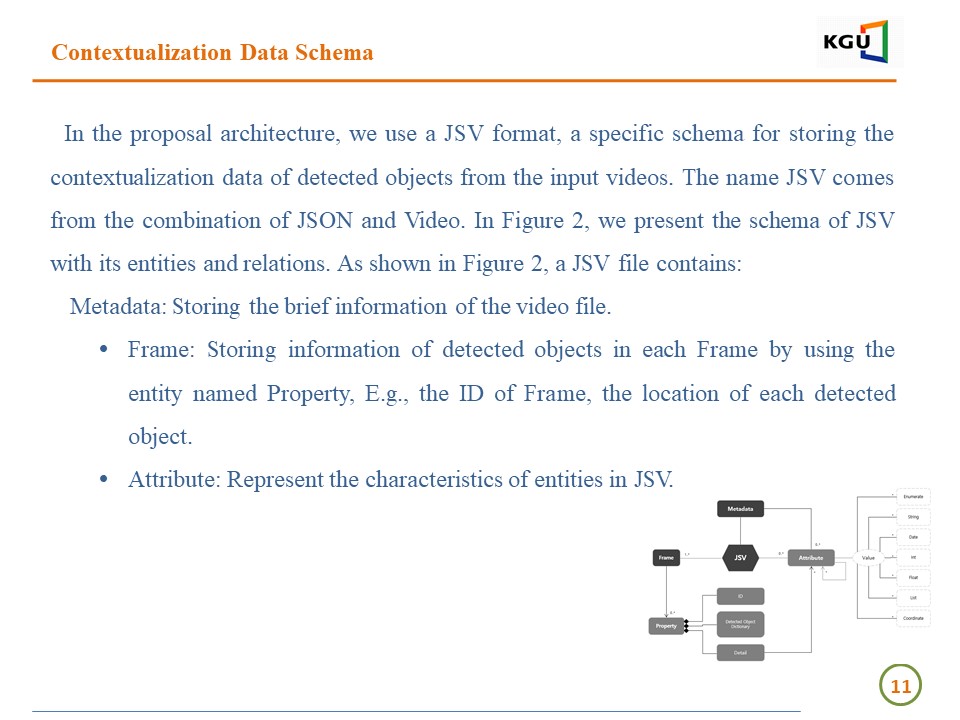 |
In the proposal architecture, we use a JSV format, a specific schema for storing the contextualization data of detected objects from the input videos. The name JSV comes from the combination of JSON and Video. In Figure 2, we present the schema of JSV with its entities and relations. As shown in Figure 2, a JSV file contains:
Metadata: Storing the brief information of the video file.
Frame: Storing information of detected objects in each Frame by using the entity named Property, E.g., the ID of Frame, the location of each detected object.
Attribute: Represent the characteristics of entities in JSV.
For more detail of slide 11 content, please watch the recorded clip on youtube at https://www.youtube.com/watch?v=oY1q12rwbfc
|
|
ICACT20220317 Slide.10
[Big slide for presentation]
[YouTube] |
Chrome Text-to-Speach Click!! |
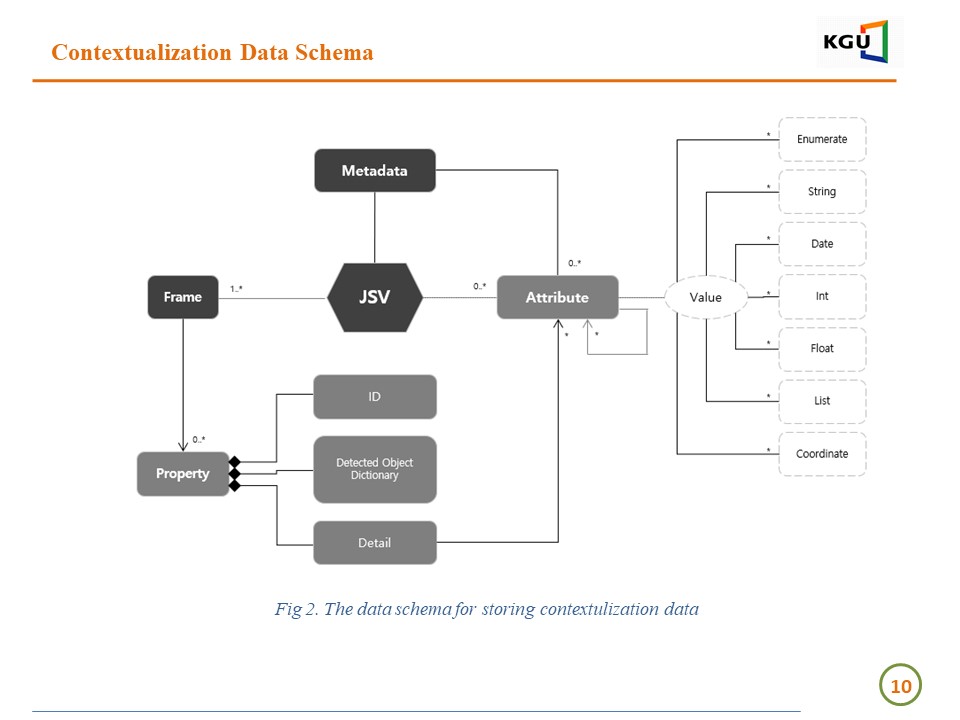 |
This figure describes the data schema for storing contextualization data in JSV format. As you can see in the figure, it contains the information of Metadata, Frame, Property, Detected objects, and other related information.
For more detail of slide 10 content, please watch the recorded clip on youtube at https://www.youtube.com/watch?v=oY1q12rwbfc
|
|
ICACT20220317 Slide.09
[Big slide for presentation]
[YouTube] |
Chrome Text-to-Speach Click!! |
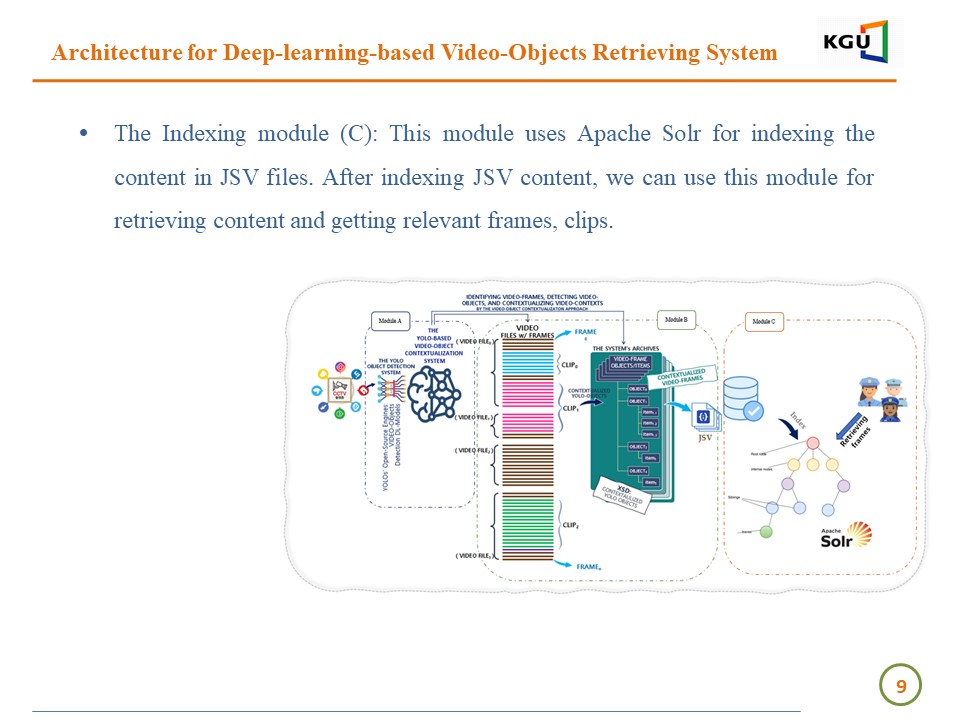 |
The Indexing module (C): This module uses Apache Solr for indexing the content in JSV files. After indexing JSV content, we can use this module for retrieving content and getting relevant frames, clips.
For more detail of slide 9 content, please watch the recorded clip
on youtube at https://www.youtube.com/watch?v=oY1q12rwbfc
|
|
ICACT20220317 Slide.08
[Big slide for presentation]
[YouTube] |
Chrome Text-to-Speach Click!! |
 |
The architecture contains three main Modules:
The YOLO object detection module (A): This module uses the YOLO algorithm for detecting objects in videos. Video types can come from different sources, e.g., CCTV, Social media video, etc.
The Video object contextualization module (B): This module stores detected objects in the JSV (Json video) format following a specific schema. The concept in the schema is divided by video files, clips, objects in clips, and their properties.
For more detail of slide 8 content, please watch the recorded clip on youtube at https://www.youtube.com/watch?v=oY1q12rwbfc
|
|
ICACT20220317 Slide.07
[Big slide for presentation]
[YouTube] |
Chrome Text-to-Speach Click!! |
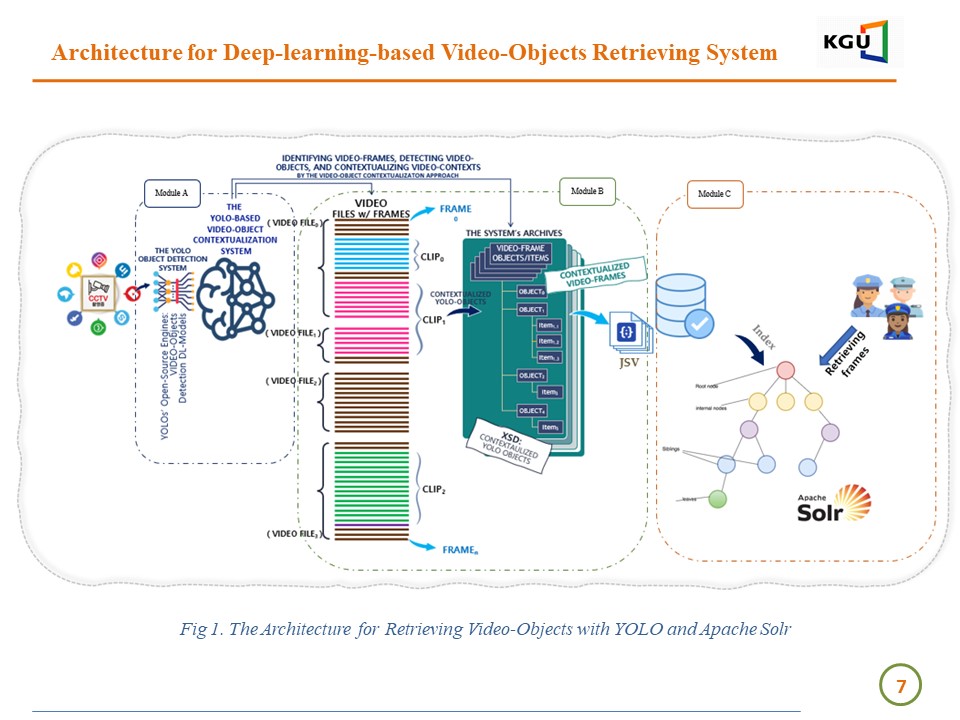 |
This figure describes the Architecture for Retrieving Video-Objects with YOLO and Apache Solr.
For more detail of slide 7 content, please watch the recorded clip on youtube at https://www.youtube.com/watch?v=oY1q12rwbfc
|
|
ICACT20220317 Slide.06
[Big slide for presentation]
[YouTube] |
Chrome Text-to-Speach Click!! |
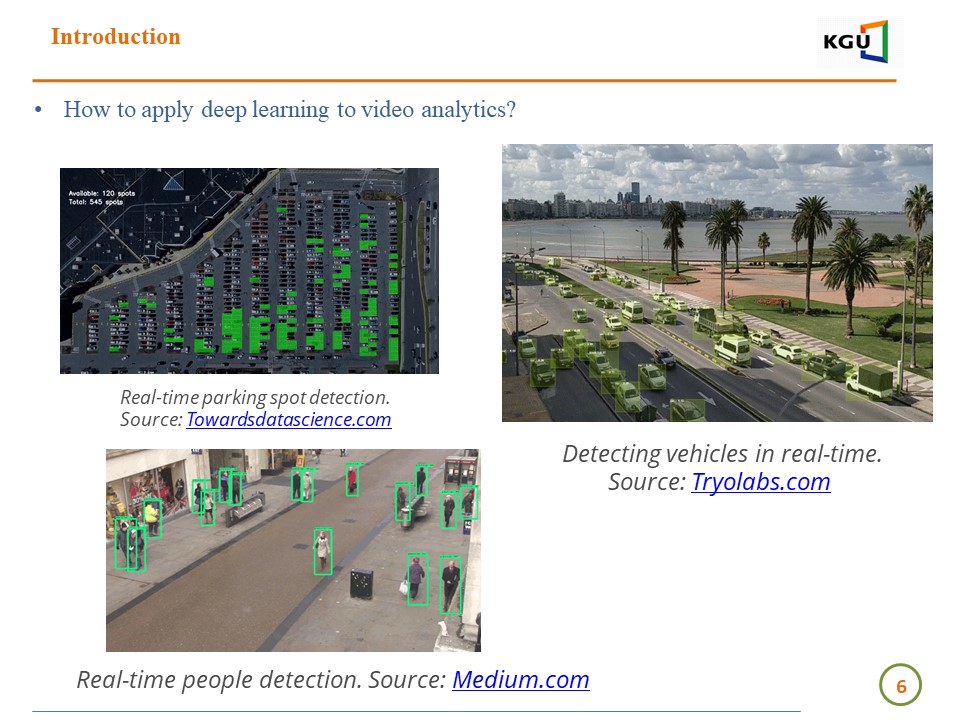 |
As you can see on the images on this slide, scientists applied deep learning into video analytics with different solutions, e.g., Real-time parking spot detection, Real-time vehicles detection, real-time people detection.
For more detail of slide 6 content, please watch the recorded clip on youtube at https://www.youtube.com/watch?v=oY1q12rwbfc
|
|
ICACT20220317 Slide.05
[Big slide for presentation]
[YouTube] |
Chrome Text-to-Speach Click!! |
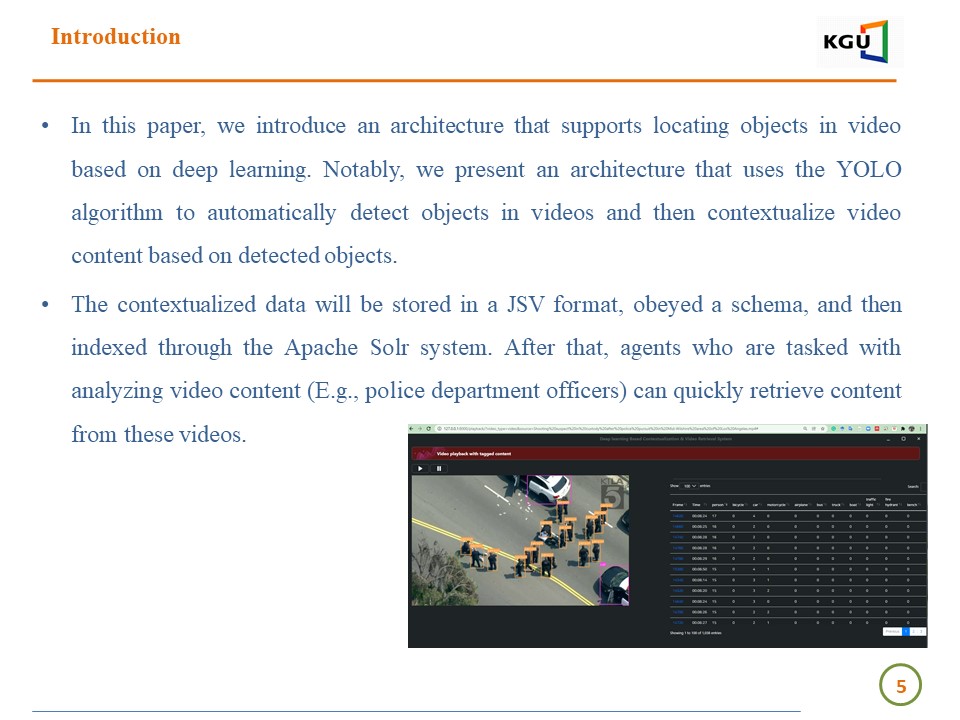 |
In this paper, we introduce an architecture that supports locating objects in video based on deep learning. Notably, we present an architecture that uses the YOLO algorithm to automatically detect objects in videos and then contextualize video content based on detected objects.
The contextualized data will be stored in a JSV format, obeyed a schema, and then indexed through the Apache Solr system. After that, agents who are tasked with analyzing video content (E.g., police department officers) can quickly retrieve content from these videos.
For more detail of slide 5 content, please watch the recorded clip on youtube at https://www.youtube.com/watch?v=oY1q12rwbfc
|
|
ICACT20220317 Slide.04
[Big slide for presentation]
[YouTube] |
Chrome Text-to-Speach Click!! |
 |
In today's modern social life, using CCTV cameras to support the local government to monitor urban security has become popular in most countries.
We can see CCTV cameras appearing everywhere on the streets, public areas, bus stations, etc.
The formation and development of CCTV cameras started in the 1950s of the last century. At that time, with the limited technology and expensive cost of CCTV systems, only a few large cities in rich countries could afford to install CCTV surveillance systems.
For more detail of slide 4 content, please watch the recorded clip on youtube at https://www.youtube.com/watch?v=oY1q12rwbfc
|
|
ICACT20220317 Slide.03
[Big slide for presentation]
[YouTube] |
Chrome Text-to-Speach Click!! |
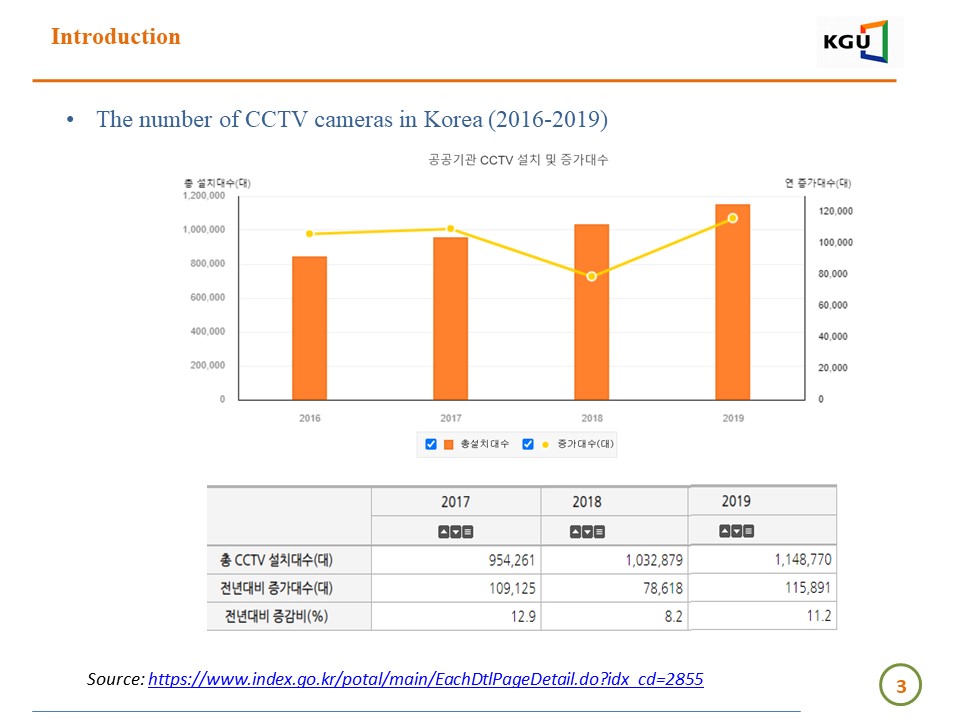 |
The chart and table on the slide describe the growth of CCTV devices in Korea from 2016 to 2019.
For more detail of slide 3 content, please watch the recorded clip on youtube at https://www.youtube.com/watch?v=oY1q12rwbfc
|
|
ICACT20220317 Slide.02
[Big slide for presentation]
[YouTube] |
Chrome Text-to-Speach Click!! |
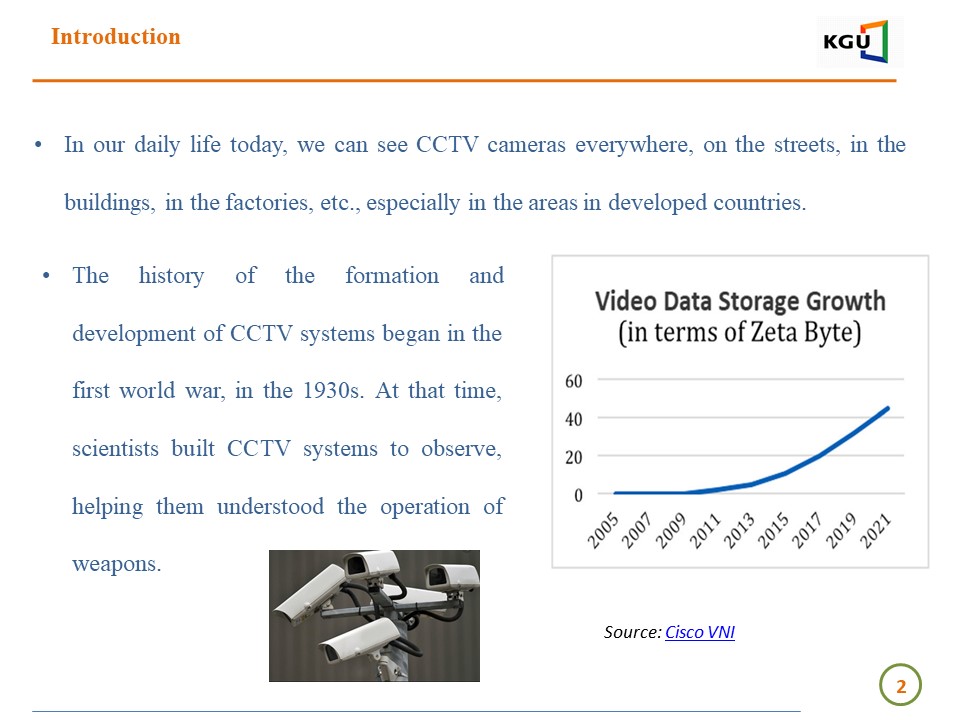 |
In our daily life today, we can see CCTV cameras everywhere, on the streets, in the buildings, in the factories, etc., especially in the areas in developed countries
The history of the formation and development of CCTV systems began in the first world war, in the 1930s. At that time, scientists built CCTV systems to observe, helping them understand the operation of weapons.
For more detail of slide 2 content, please watch the recorded clip on youtube at https://www.youtube.com/watch?v=oY1q12rwbfc
|
|
ICACT20220317 Slide.01
[Big slide for presentation]
[YouTube] |
Chrome Text-to-Speach Click!! |
 |
Hello everyone, My name is Lam, from Kyonggi University, Korea. In this presentation at ICACT 2022 conference, I would like to present our study about using deep learning-based techniques for creating a Video-objects retrieving system. The study was summarized in the paper entitled "A Conceptual Architecture for Deep-learning-based Video-Objects Retrieving System"
|
















