 ICACT20240312 Slide.20
[Big slide for presentation] |
Chrome Text-to-Speach Click!! |
 |
Thank you for your great attention to the presentation. Please ask me if there are any questions regarding my presentation.
|
|
ICACT20240312 Slide.19
[Big slide for presentation]
|
Chrome Text-to-Speach Click!! |
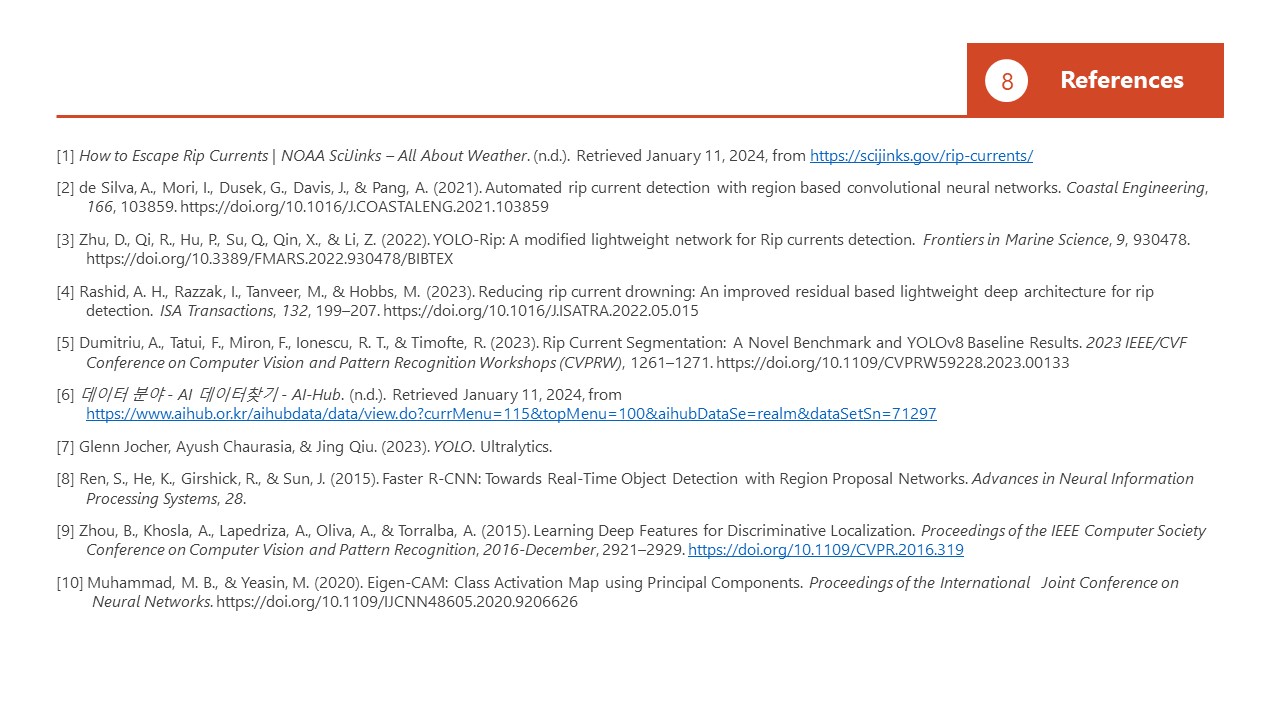 |
These are the references used in the presentation.
|
|
ICACT20240312 Slide.18
[Big slide for presentation]
|
Chrome Text-to-Speach Click!! |
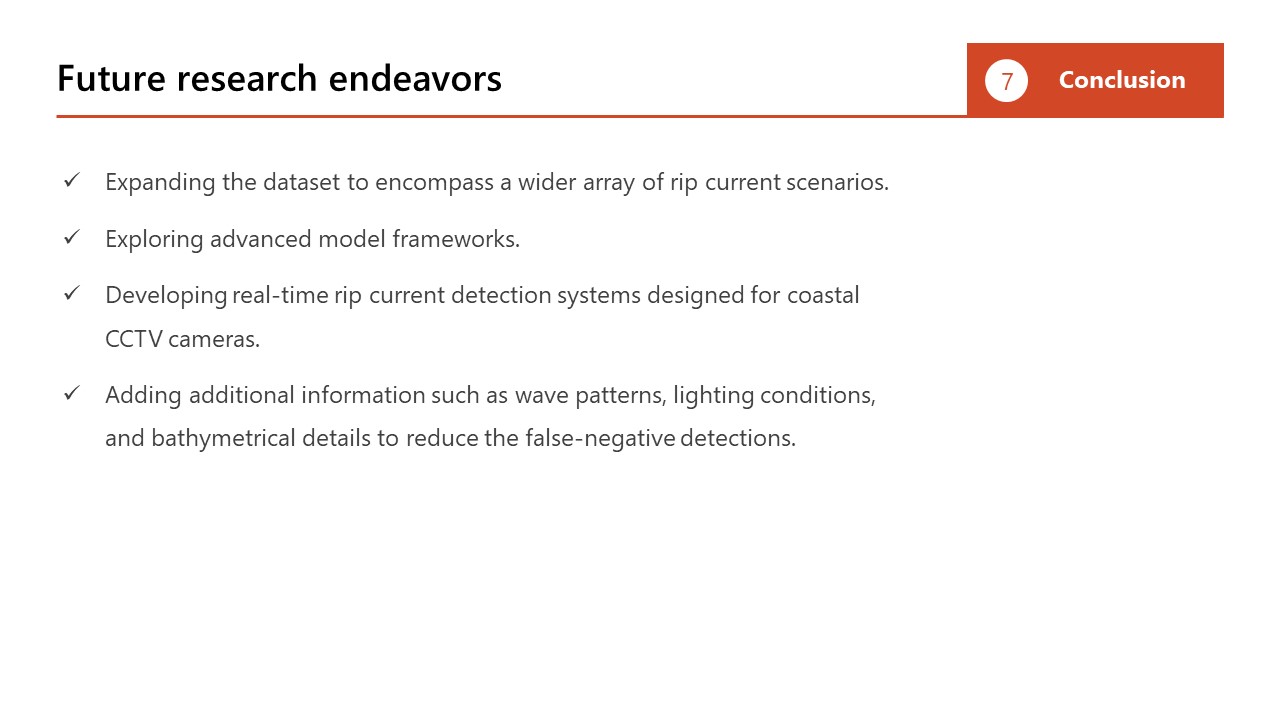 |
For future research endeavors, we plan to do the following tasks. Those are expanding the dataset to encompass a wider array of rip current scenarios, Exploring advanced model frameworks, Developing real-time rip current detection systems designed for coastal CCTV cameras, Adding additional information such as wave patterns, lighting conditions, and bathymetrical details to reduce the false-negative detections.
|
|
ICACT20240312 Slide.17
[Big slide for presentation]
|
Chrome Text-to-Speach Click!! |
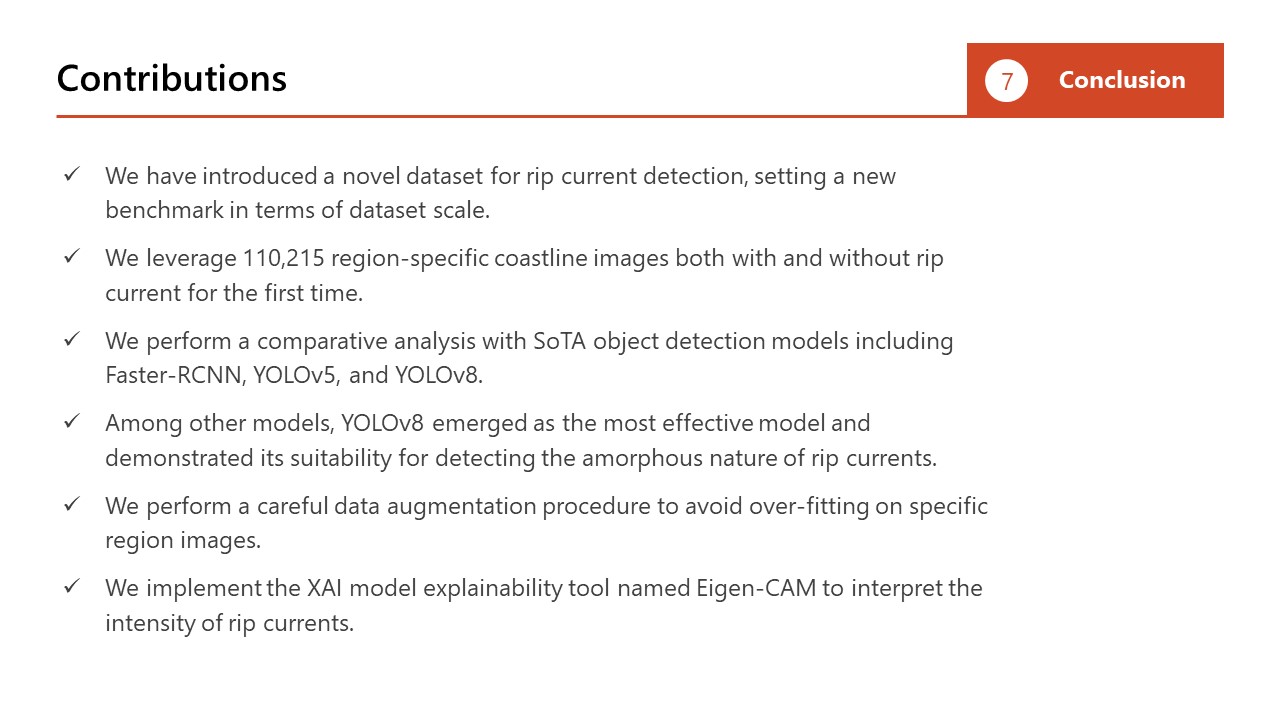 |
These are our major contributions from this research work. We have introduced a novel dataset for rip current detection, setting a new benchmark in terms of dataset scale. We leverage 110,215 region-specific coastline images both with and without rip current for the first time. We perform a comparative analysis with SoTA object detection models including Faster-RCNN, YOLOv5, and YOLOv8.
Among other models, YOLOv8 emerged as the most effective model and demonstrated its suitability for detecting the amorphous nature of rip currents. We perform a careful data augmentation procedure to avoid over-fitting on specific region images. We implement the XAI model explainability tool named Eigen-CAM to interpret the intensity of rip currents.
|
|
ICACT20240312 Slide.16
[Big slide for presentation]
|
Chrome Text-to-Speach Click!! |
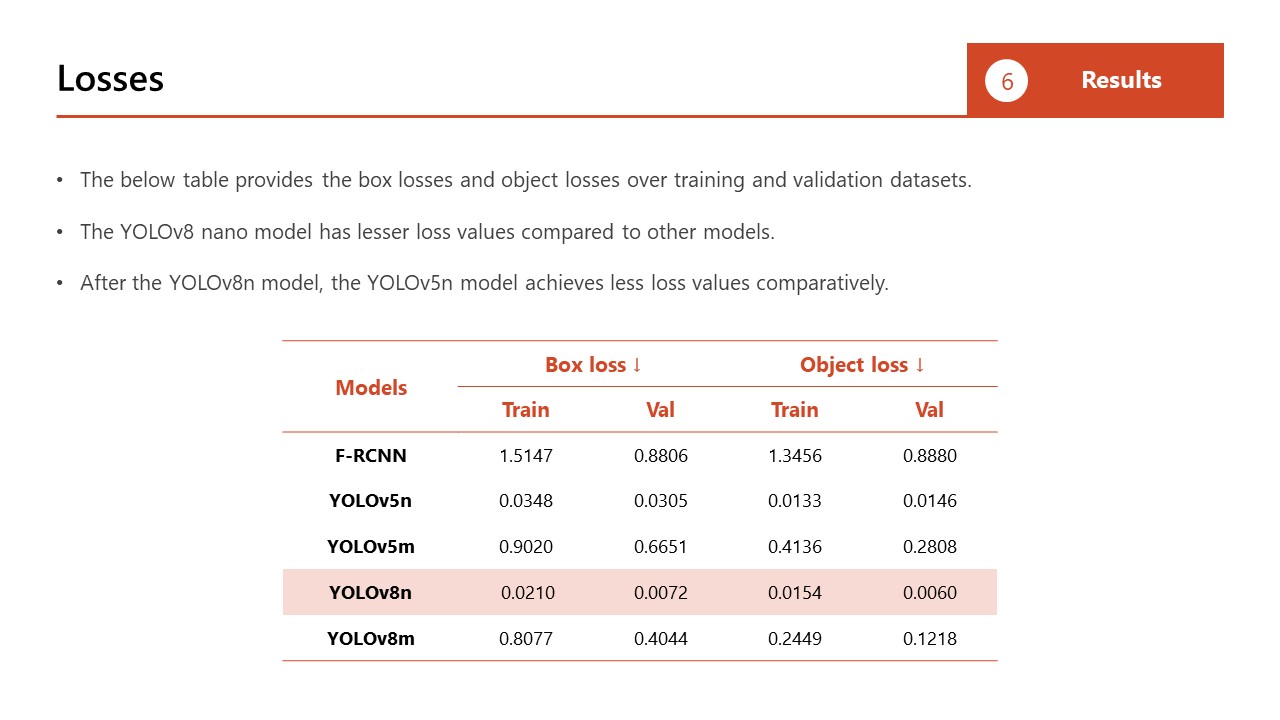 |
This table provides the box losses and object losses over training and validation datasets. The YOLOv8 nano model has lesser loss values compared to other models. After the YOLOv8n model, the YOLOv5n model achieves less loss values comparatively.
|
|
ICACT20240312 Slide.15
[Big slide for presentation]
|
Chrome Text-to-Speach Click!! |
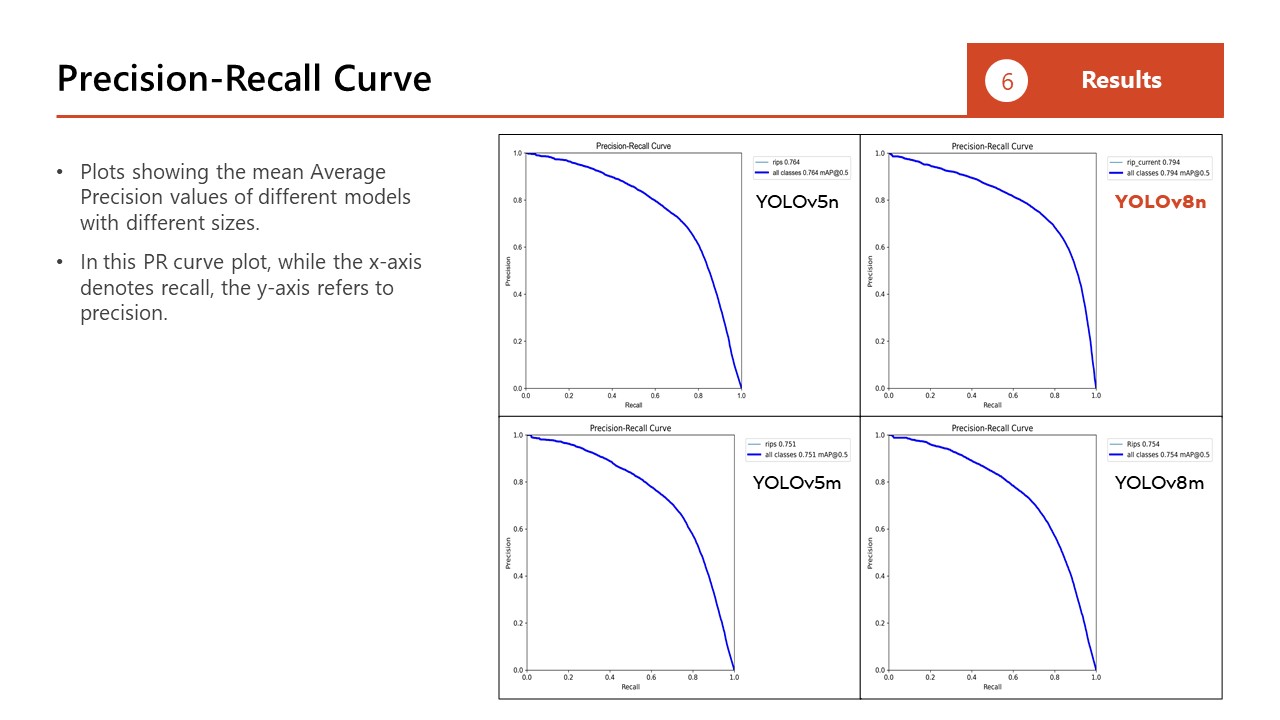 |
Plots showing the mean Average Precision values of different models with different sizes. In this Precision-Recall curve plot, while the x-axis denotes recall, the y-axis refers to precision.
|
|
ICACT20240312 Slide.14
[Big slide for presentation]
|
Chrome Text-to-Speach Click!! |
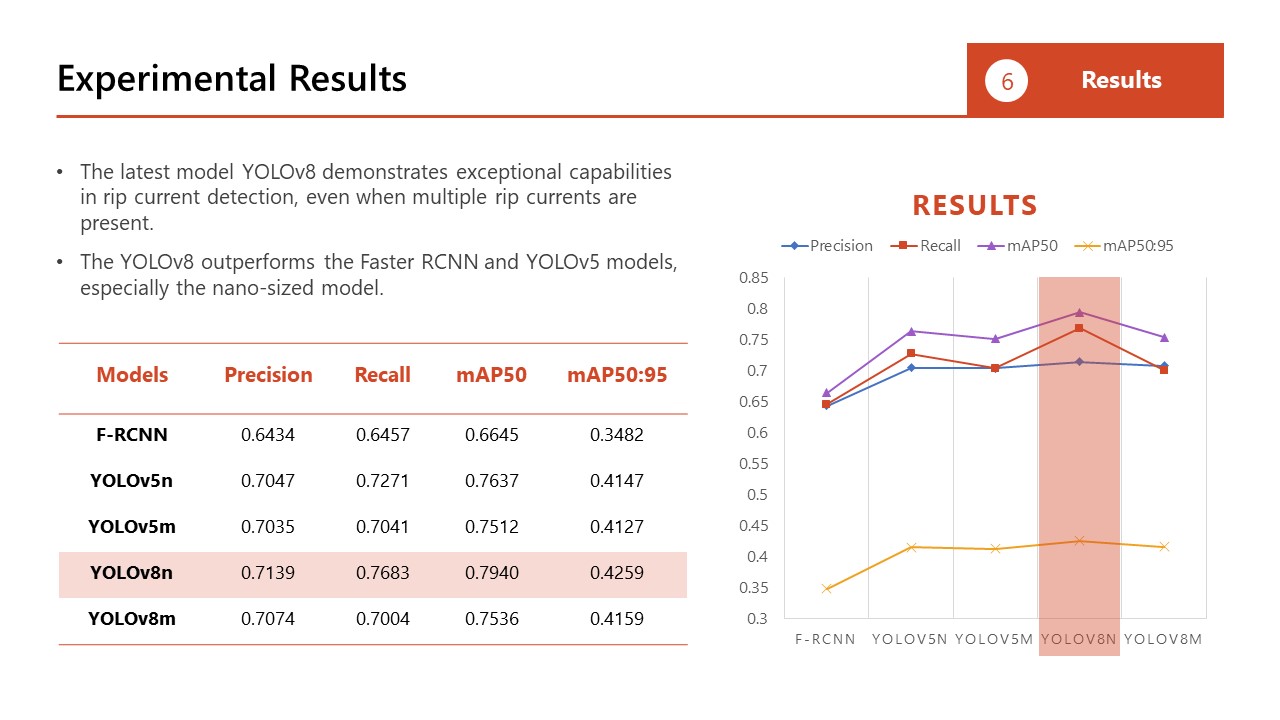 |
The latest model YOLOv8 demonstrates exceptional capabilities in rip current detection, even when multiple rip currents are present. The YOLOv8 outperforms the Faster RCNN and YOLOv5 models, especially the nano-sized model YOLOv8n.
|
|
ICACT20240312 Slide.13
[Big slide for presentation]
|
Chrome Text-to-Speach Click!! |
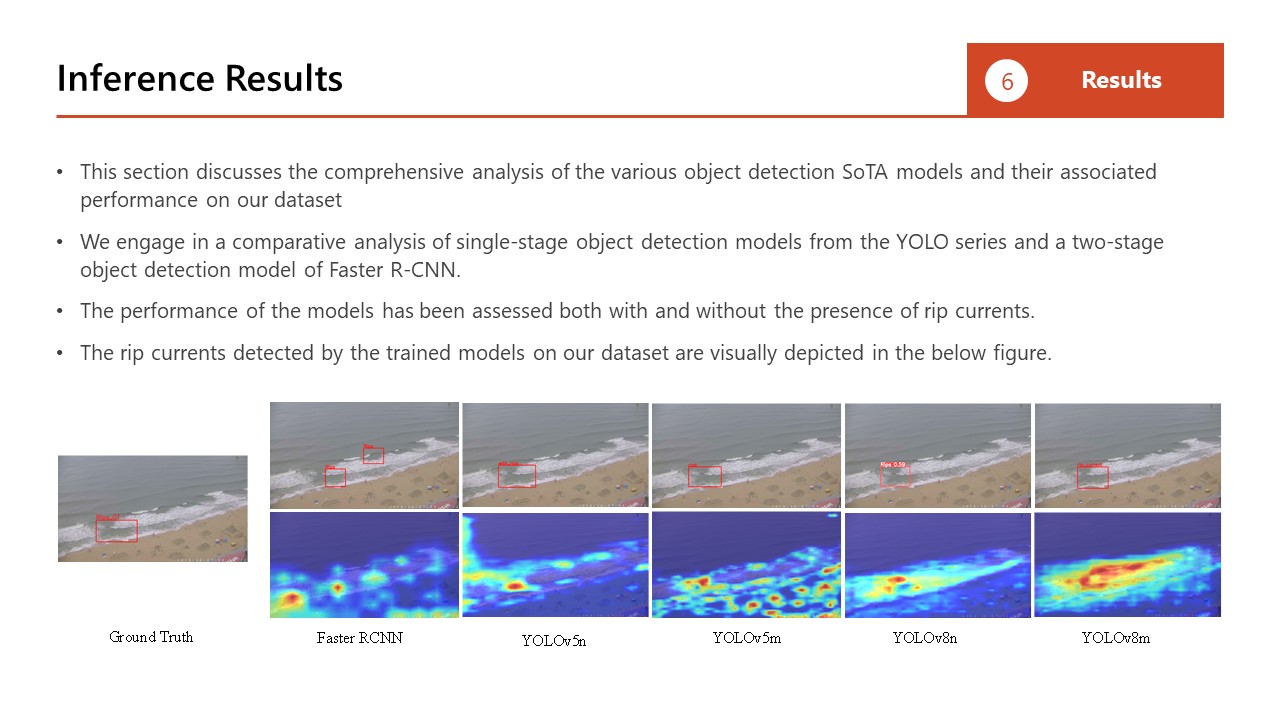 |
This section discusses the comprehensive analysis of the various object detection SoTA models and their associated performance on our dataset. We engage in a comparative analysis of single-stage object detection models from the YOLO series and a two-stage object detection model of Faster R-CNN. The performance of the models has been assessed both with and without the presence of rip currents. The rip currents detected by the trained models on our dataset are visually depicted in the below figure.
|
|
ICACT20240312 Slide.12
[Big slide for presentation]
|
Chrome Text-to-Speach Click!! |
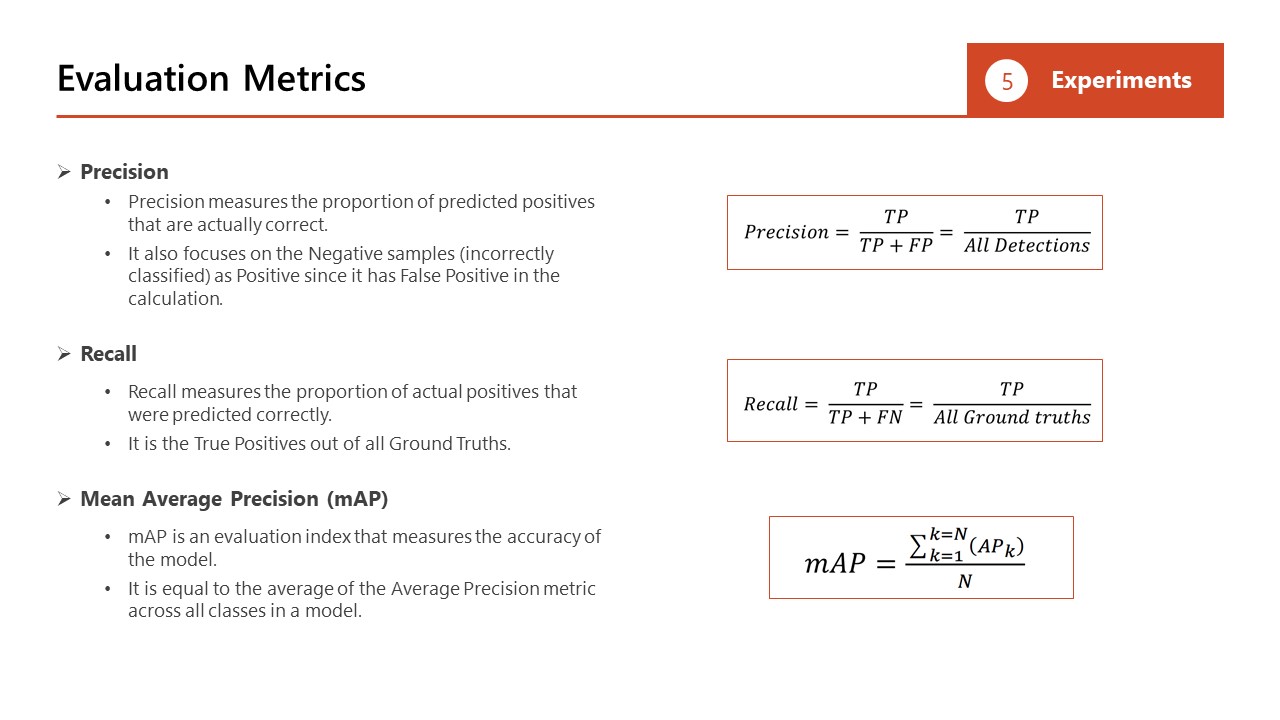 |
For Evaluation Metrics, we used, Precision, Recall, and mAP. Precision measures the proportion of predicted positives that are actually correct. Recall measures the proportion of actual positives that were predicted correctly. mAP is an evaluation index that measures the accuracy of the model.
|
|
ICACT20240312 Slide.11
[Big slide for presentation]
|
Chrome Text-to-Speach Click!! |
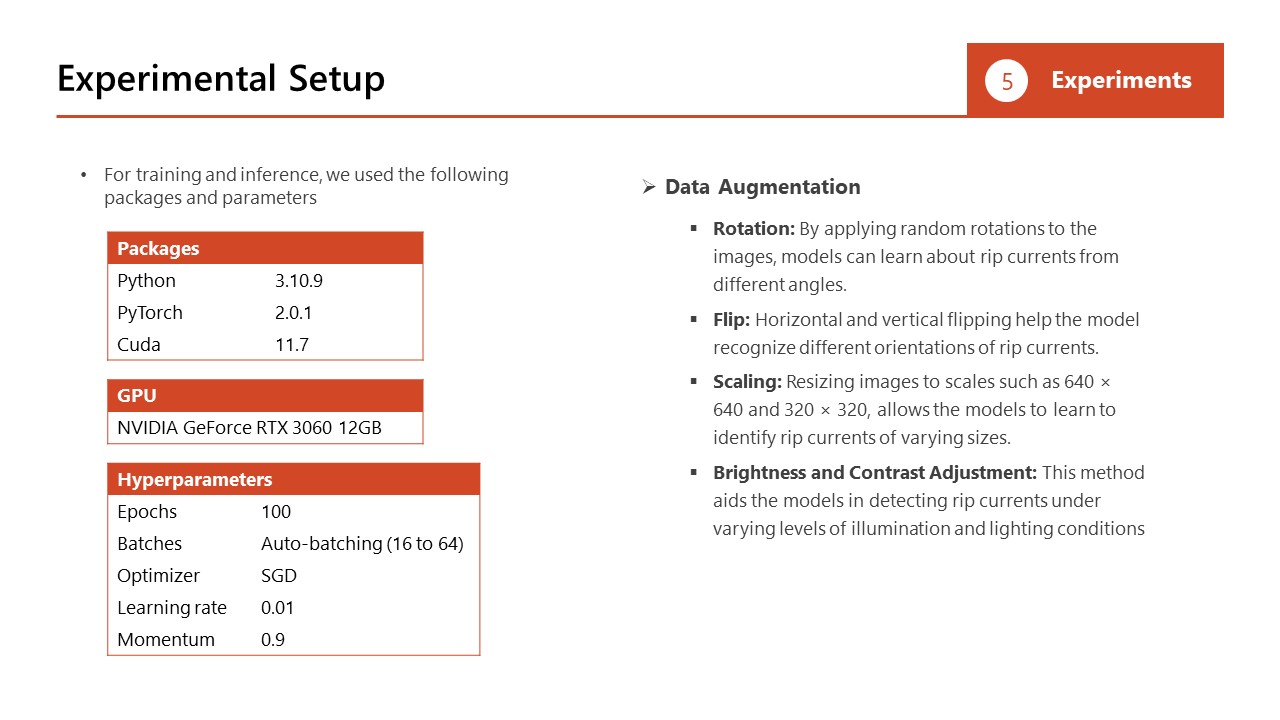 |
For training and inference, we used Python 3.10, PyTorch 2.0, and cuda 11.7 with NVIDIA GeForce RTX 3060 12GB. The hyperparameters are epochs of 100, auto-batching ranging from 16 to 64, SGD Optimizer, 0.01 learning rate, and 0.9 momentum. Also, we augmented the dataset with rotation, flipping, scaling, brightness and contrast adjustments.
|
|
ICACT20240312 Slide.10
[Big slide for presentation]
|
Chrome Text-to-Speach Click!! |
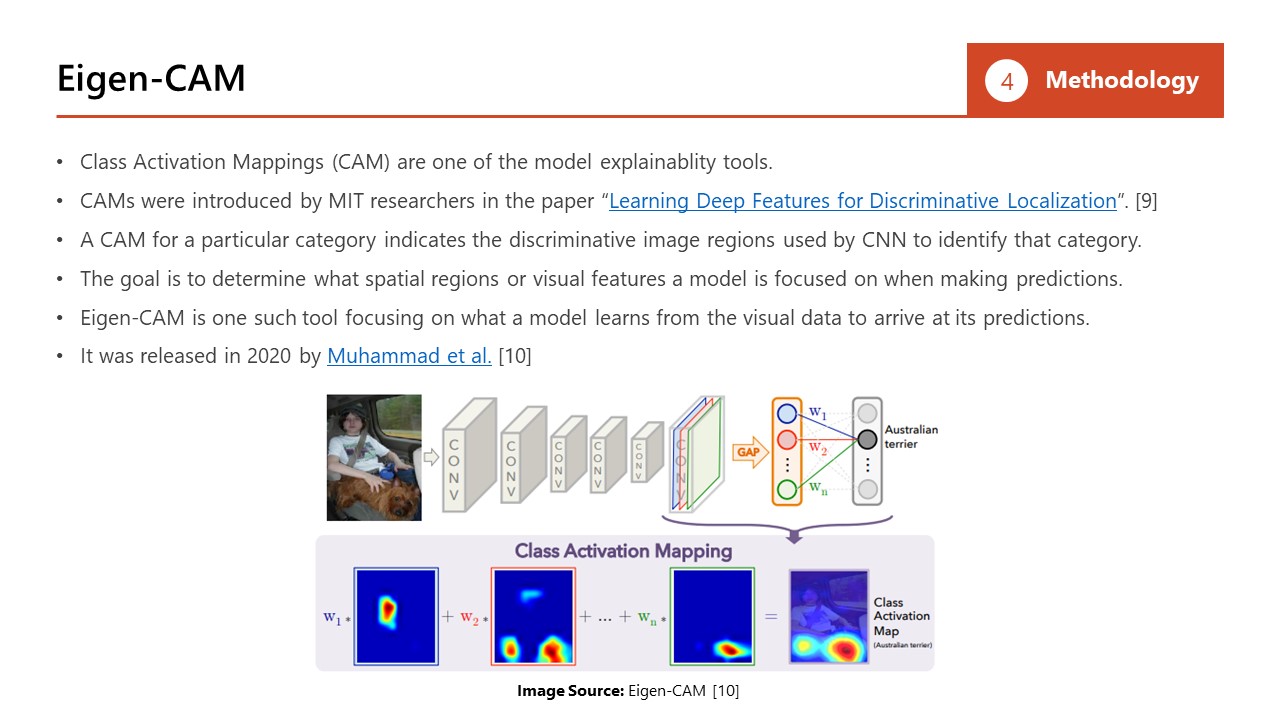 |
Class Activation Mappings are one of the model explainablity tools. CAMs were introduced by MIT researchers in the paper 'Learning Deep Features for Discriminative Localization'. A CAM for a particular category indicates the discriminative image regions used by CNN to identify that category. The goal is to determine what spatial regions or visual features a model is focused on when making predictions. Eigen-CAM is one such tool focusing on what a model learns from the visual data to arrive at its predictions. It was released in 2020 by Muhammad et al.
|
|
ICACT20240312 Slide.09
[Big slide for presentation]
|
Chrome Text-to-Speach Click!! |
 |
Explainable artificial intelligence can be defined as a set of processes and methods that allow human users to comprehend and trust the results and output created by machine learning algorithms. It is a powerful tool for answering critical How? and Why? questions about AI systems. The primary goal of explainable AI tools is to create transparency around AI decision-making processes.
|
|
ICACT20240312 Slide.08
[Big slide for presentation]
|
Chrome Text-to-Speach Click!! |
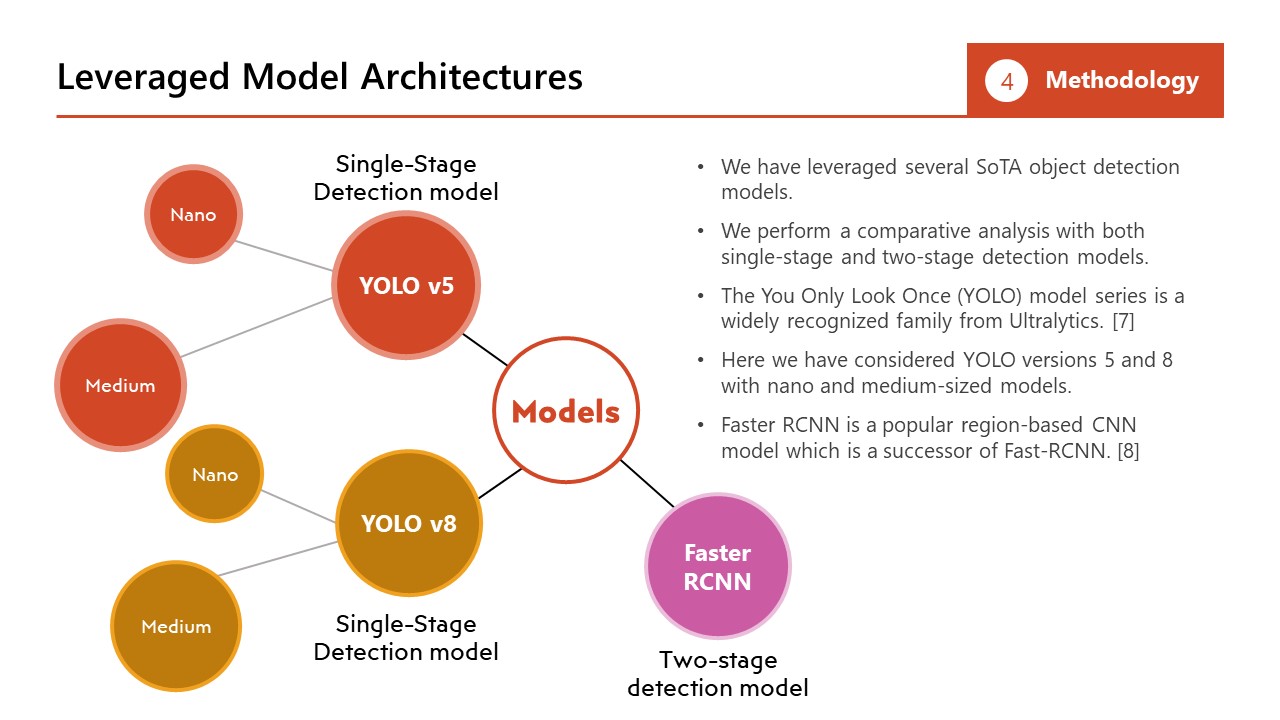 |
We have leveraged several SoTA object detection models. We perform a comparative analysis with both single-stage and two-stage detection models. The You Only Look Once (YOLO) model series is a widely recognized family from Ultralytics. Here we have considered YOLO versions 5 and 8 with nano and medium-sized models. Faster RCNN is a popular region-based CNN model which is a successor of Fast-RCNN.
|
|
ICACT20240312 Slide.07
[Big slide for presentation]
|
Chrome Text-to-Speach Click!! |
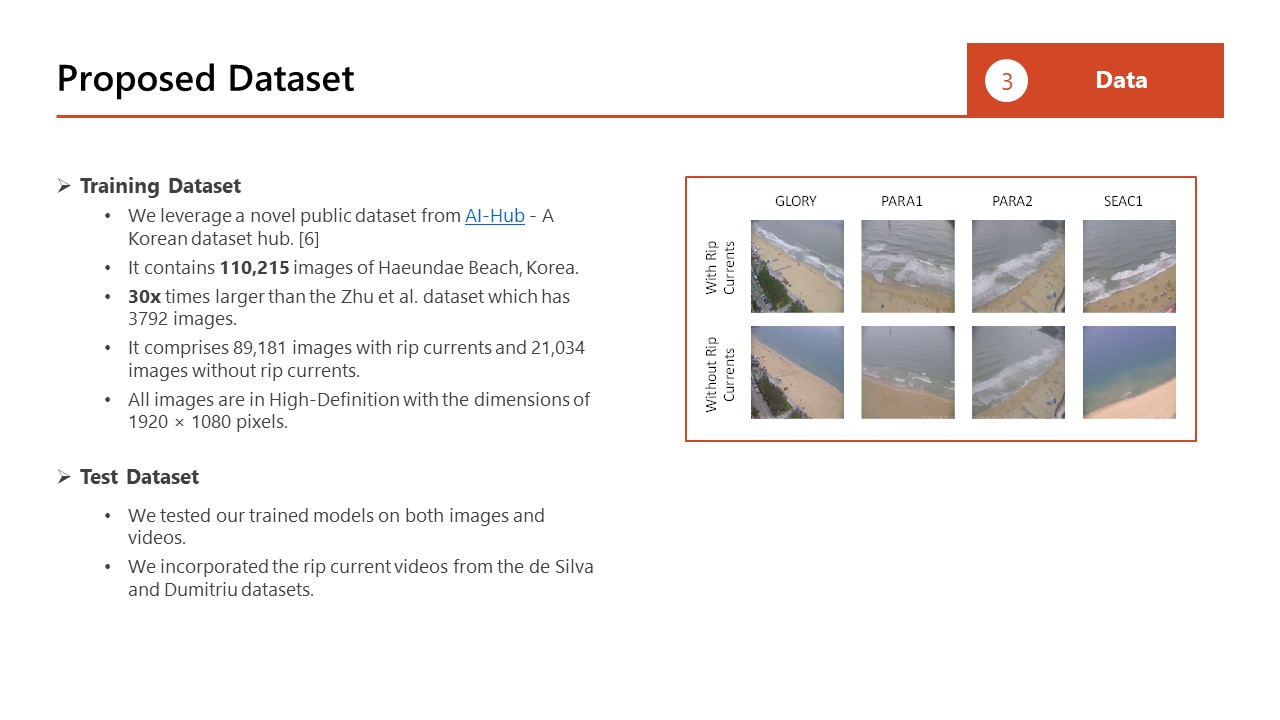 |
Our proposed training dataset has been leveraged from a public dataset from AI-Hub - A Korean dataset hub. It contains 110,215 images of Haeundae Beach, Korea. It is 30x times larger than the Zhu et al. dataset which has 3792 images. It comprises 89,181 images with rip currents and 21,034 images without rip currents. All these images are in High-Definition with 1920 ¡¿ 1080 pixels. And we tested our trained models on both images and videos.
We incorporated the rip current videos from the de Silva and Dumitriu datasets.
|
|
ICACT20240312 Slide.06
[Big slide for presentation]
|
Chrome Text-to-Speach Click!! |
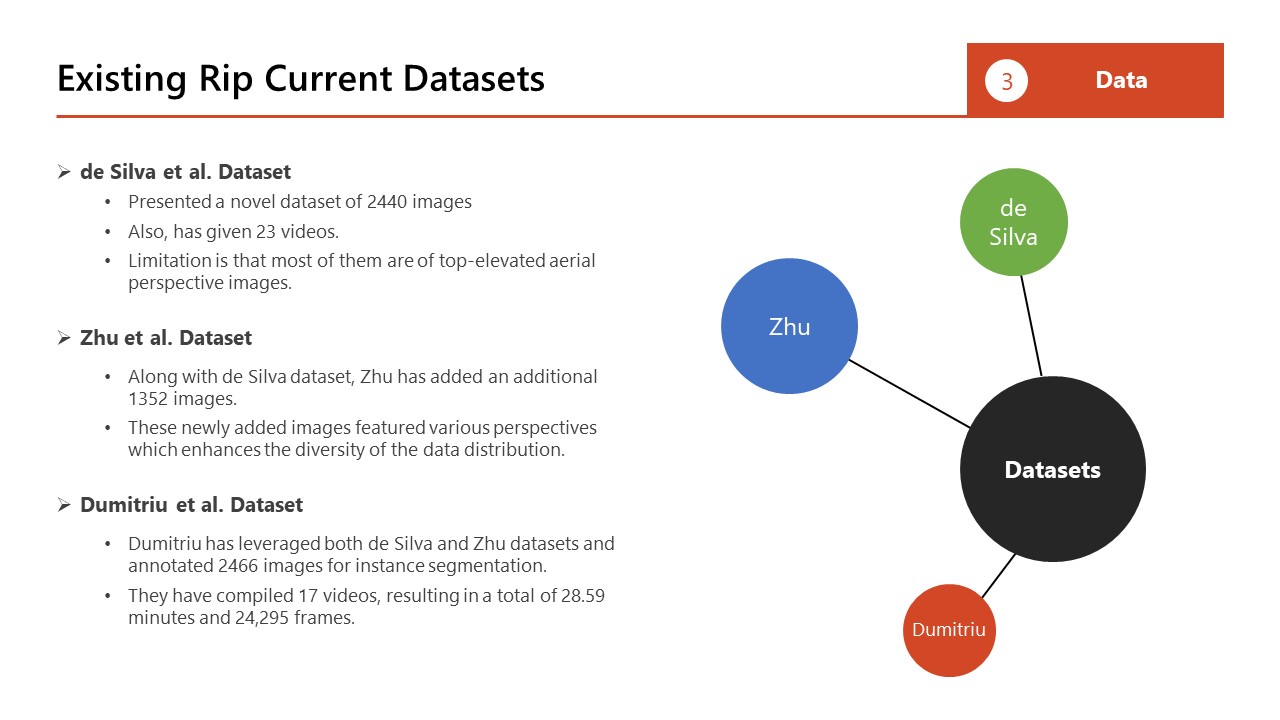 |
Currently, there are three major rip current datasets available in the literature. First de Silva et al. presented a novel dataset of 2440 images. Also, has given 23 videos. The limitation is that most of them are of top-elevated aerial perspective images. Along with the de Silva dataset, Zhu has added an additional 1352 images. These newly added images featured various perspectives which enhances the diversity of the data distribution. Then Dumitriu leveraged both de Silva and Zhu datasets and annotated 2466 images for instance segmentation. They have compiled 17 videos, resulting in a total of 28.59 minutes and 24,295 frames.
|
|
ICACT20240312 Slide.05
[Big slide for presentation]
|
Chrome Text-to-Speach Click!! |
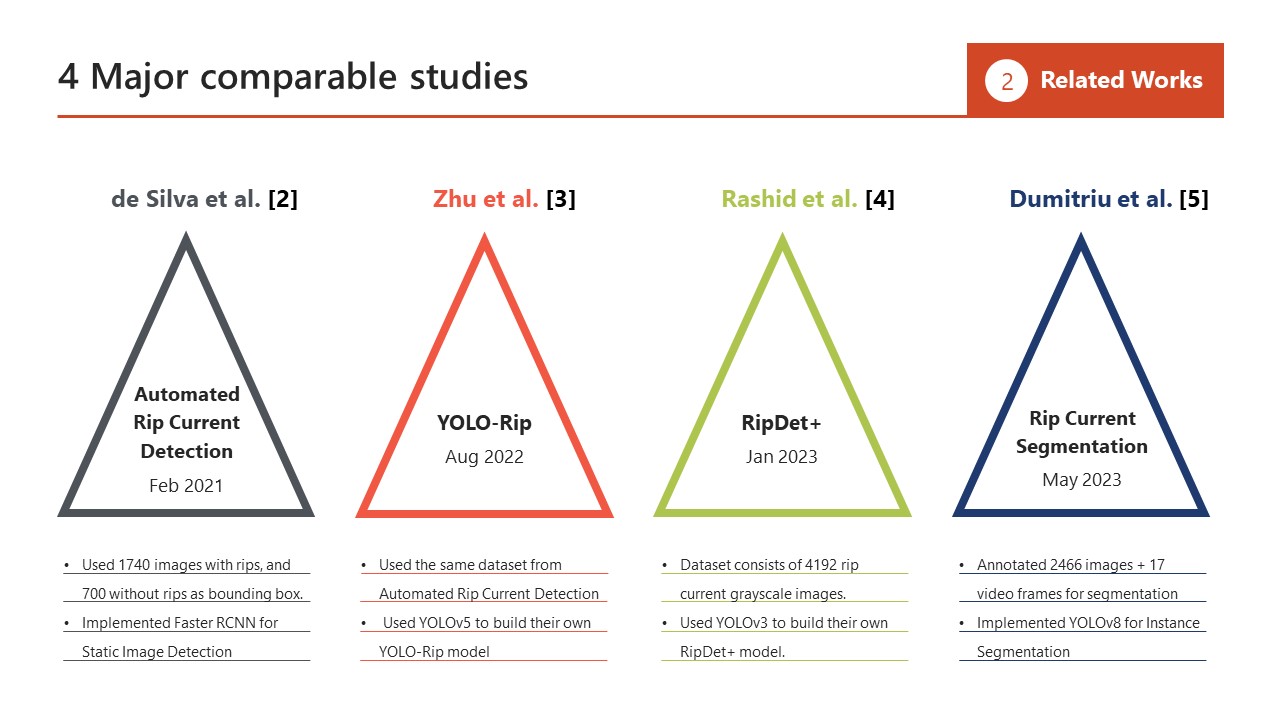 |
Though there are a number of rip current detection methods available, we consider these studies as the most related and comparable studies for our research work. First Automated Rip Current Detection by de Silva et al. It Used 1740 images with rips, and 700 without rips as bounding boxes. And implemented Faster RCNN for Static Image Detection. Second is YOLO-Rip by Zhu et al. It used the same dataset from Automated Rip Current Detection and used YOLOv5 to build its own YOLO-Rip model. Third RipDet+ model by Rashid et al. and finally Rip current segmentation method by Dumitriu.
|
|
ICACT20240312 Slide.04
[Big slide for presentation]
|
Chrome Text-to-Speach Click!! |
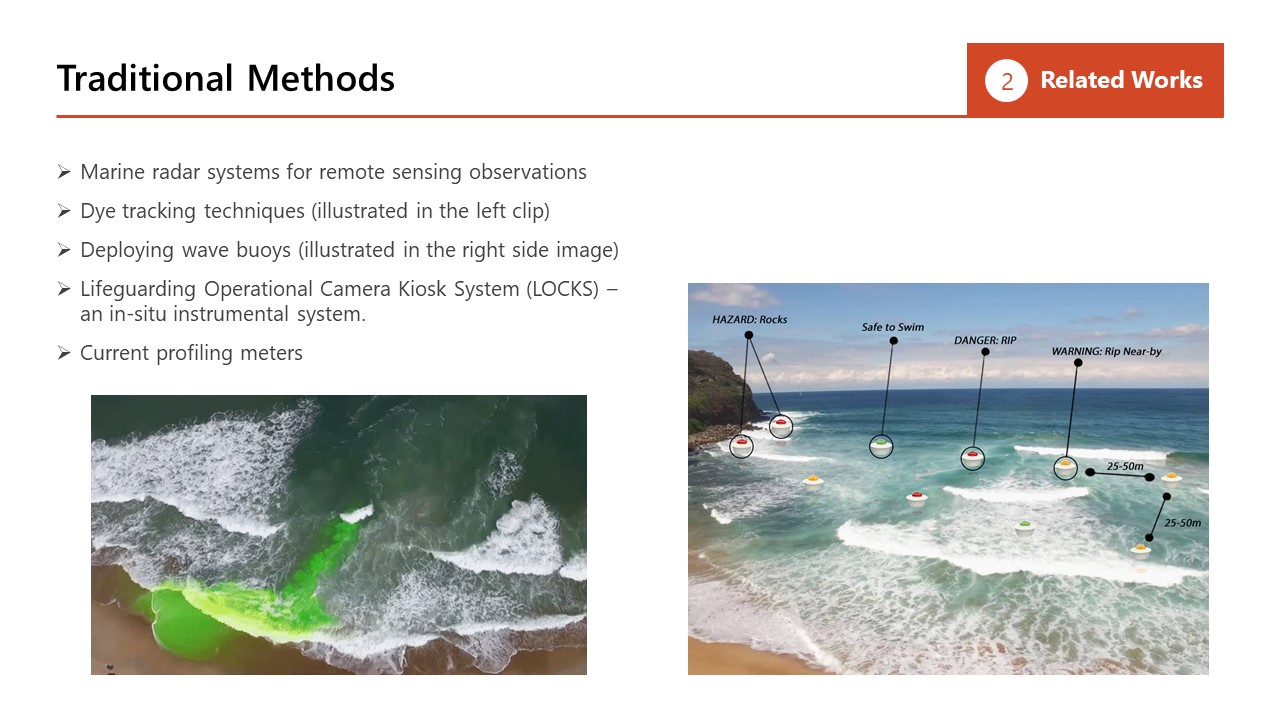 |
Next, we discuss about traditional methods of rip current detection. following are the several methods: Marine radar systems for remote sensing observations, Dye tracking techniques (illustrated in the left clip), Deploying wave buoys (illustrated in the right side image), Lifeguarding Operational Camera Kiosk System (LOCKS) – an in-situ instrumental system, Current profiling meters.
|
|
ICACT20240312 Slide.03
[Big slide for presentation]
|
Chrome Text-to-Speach Click!! |
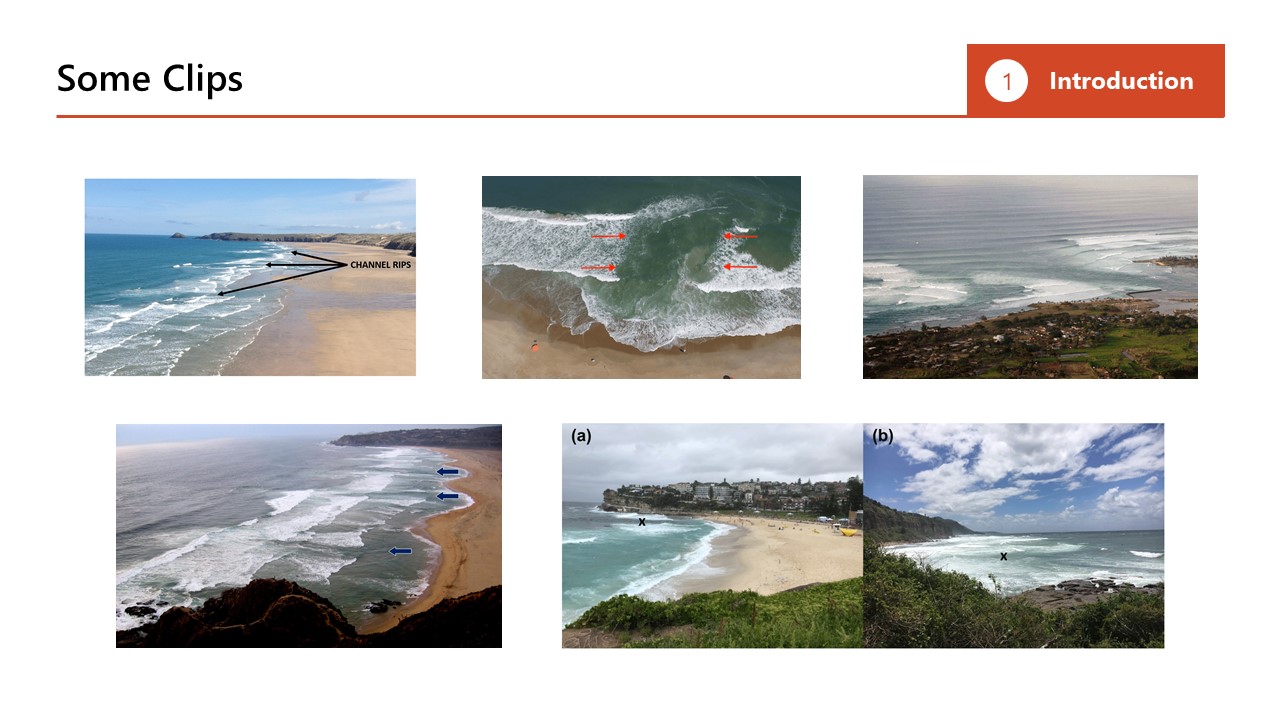 |
These are the few photo clips of rip currents captured on various beaches and coastlines.
|
|
ICACT20240312 Slide.02
[Big slide for presentation]
|
Chrome Text-to-Speach Click!! |
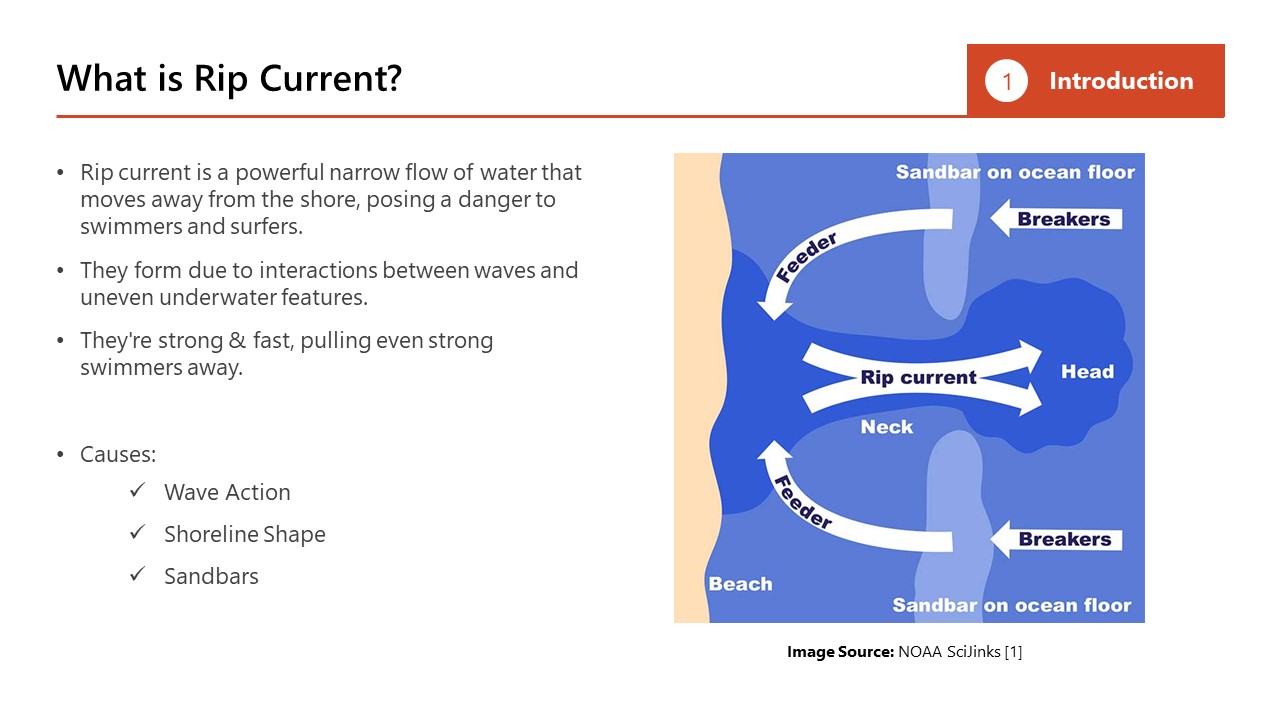 |
This slide will describe what is Rip Current. The rip current is a powerful narrow flow of water that moves away from the shore, posing a danger to swimmers and surfers. They form due to interactions between waves and uneven underwater features. They're strong & fast, pulling even strong swimmers away. The general causes of the rip currents are Wave Action, Shoreline Shape, and Sandbars.
|
|
ICACT20240312 Slide.01
[Big slide for presentation]
|
Chrome Text-to-Speach Click!! |
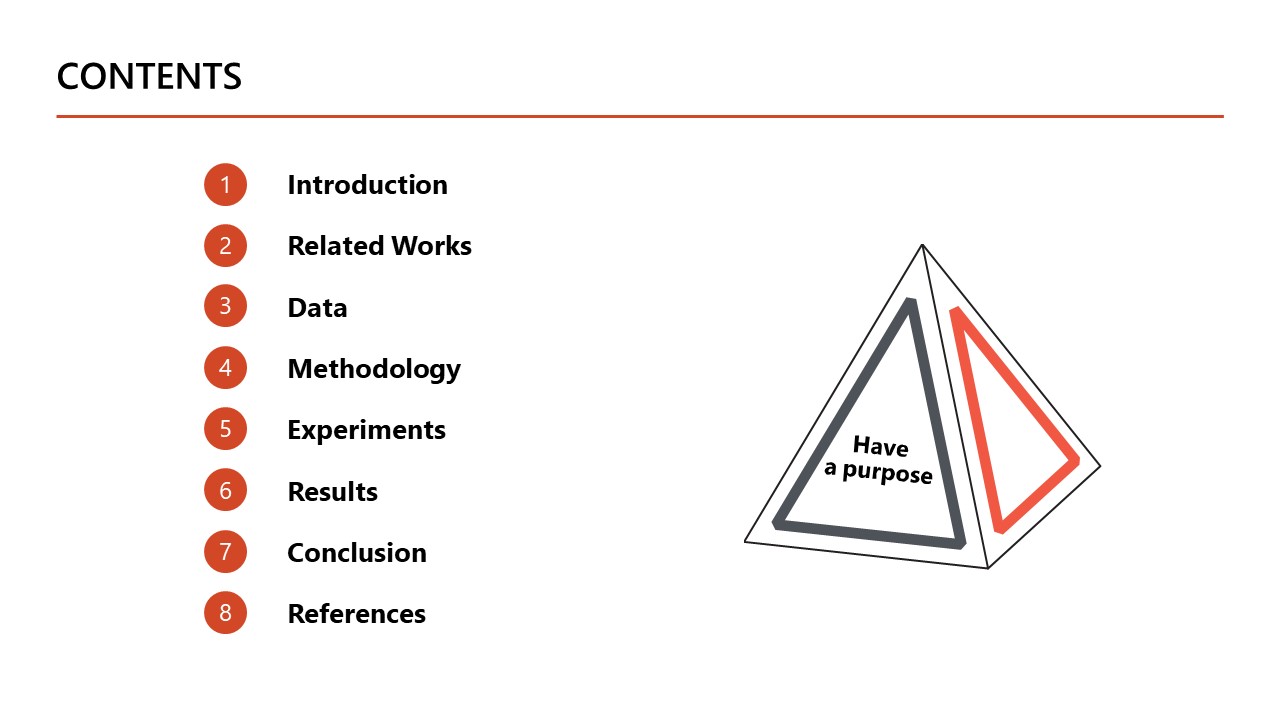 |
These are the contents of the presentation. Our presentation has 8 chapters beginning with the introduction and ending with the conclusion and references.
|
|
ICACT20240312 Slide.00
[Big slide for presentation]
|
Chrome Text-to-Speach Click!! |
 |
Hello Everyone! I am Muralidharan Rejendran, working as a Research and Development Engineer at GreenBlue Inc., which is a software development company, situated in Busan, Korea. I am excited to present the topic of Explainable Rip Current Detection and Visualization with XAI EigenCAM.
|
















